
Incorporation of the Bill of Rights
OpenStax and Lumen Learning; Collected works; and Tom Rozinski
3.1 Introduction to Civil Liberties

Recent Black Lives Matter demonstrations across the nation provide an example of the freedom of assembly protected by the Bill of Rights. This right may now be in jeopardy as bills in several state legislatures threaten peaceful gatherings and even shield citizens who attack such protesters. Fights like this—in the streets, courts, legislatures, and public opinion—are hardly unique in U.S. history. In fact, they are the main driver of political change. The COVID-19 pandemic offers new examples that involve real and perceived infringement on the rights of individuals: to mingle unmasked, to gather in close proximity, or even to assemble at all.[1]
The framers of the Constitution wanted a government that would not repeat the abuses of individual liberties and rights that caused them to declare independence from Britain. However, laws and other “parchment barriers” (or written documents) alone have not protected freedoms over the years; instead, citizens have learned the truth of the old saying (often attributed to Thomas Jefferson but actually said by Irish politician John Philpot Curran), “Eternal vigilance is the price of liberty.” The actions of ordinary citizens, lawyers, and politicians have been at the core of a vigilant effort to protect constitutional liberties.
But what are those freedoms? And how should we balance them against the interests of society and other individuals? These are the key questions we will tackle in this chapter.
3.2 What Are Civil Liberties?
LEARNING OUTCOMES
By the end of this section, you will be able to:
- Define civil liberties and civil rights
- Describe the origin of civil liberties in the U.S. context
- Identify the key positions on civil liberties taken at the Constitutional Convention
- Explain the Civil War origin of concern that the states should respect civil liberties
The U.S. Constitution—in particular, the first ten amendments that form the Bill of Rights—protects the freedoms and rights of individuals. It does not limit this protection just to citizens or adults; instead, in most cases, the Constitution simply refers to “persons,” which over time has grown to mean that even children, visitors from other countries, and immigrants—permanent or temporary, legal or undocumented—enjoy the same freedoms when they are in the United States or its territories as adult citizens do. So, whether you are a Japanese tourist visiting Disney World or someone who has stayed beyond the limit of days allowed on your visa, you do not sacrifice your liberties. In everyday conversation, we tend to treat freedoms, liberties, and rights as interchangeable—similar to how separation of powers and checks and balances are often used synonymously, when, in fact, these are distinct concepts.
LINK TO LEARNING
*Watch this video to learn more about civil rights and liberties in the United States.
Defining Civil Liberties
To be more precise in their language, political scientists and legal experts make a distinction between civil liberties and civil rights, even though the Constitution has been interpreted to protect both. We typically envision civil liberties as limitations on government power, intended to protect freedoms upon which governments may not legally intrude. For example, the First Amendment denies the government the power to prohibit “the free exercise” of religion. This means that neither states nor the national government can forbid people to follow a religion of their choice, even if politicians and judges think the religion is misguided, blasphemous, or otherwise inappropriate. Unlike most of the rest of world at the time, U.S. citizens could even create their own faiths recruit followers to it (subject to the U.S. Supreme Court deeming it a religion), even if both society and government disapprove of its tenets. That said, the way you practice your religion, like any other practice, may be regulated if it impinges on the rights of others. To return to the previous example, religious communities may believe their faith will protect them and loved ones from disease, but they may not have the right to both not vaccinate their children and have those children publicly educated, where they would pose a risk to others. The Eighth Amendment says the government cannot impose “cruel and unusual punishments” on individuals for their criminal acts. Although the definitions of cruel and unusual have expanded over the years, the courts have generally and consistently interpreted this provision as making it unconstitutional for government officials to torture suspects. As we will see later in this chapter, courts are currently debating the degree to which extended solitary confinement and certain forms of capital punishment might count as cruel and unusual.
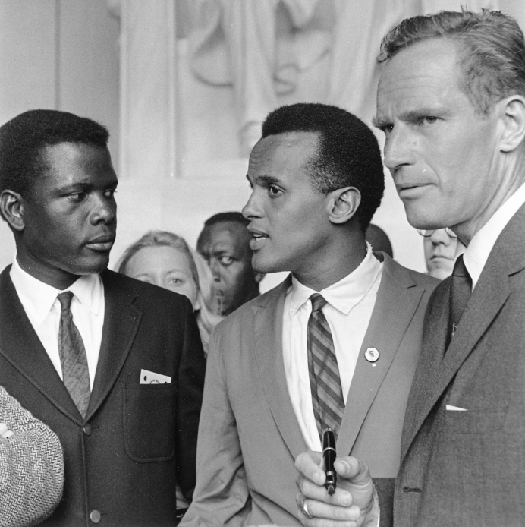
Civil rights, on the other hand, are guarantees that government officials will treat people equally and that decisions will be made on the basis of merit rather than race, gender, or other personal characteristics. Because of the Constitution’s civil rights guarantee, it is unlawful for any publicly-funded entity, such as a school or state university, or even a landlord or potential landlord to treat people differently based on their race, ethnicity, age, sex, or national origin. In the 1960s and 1970s, many states had separate schools where only students of a certain race or gender were able to study. However, the courts decided that these policies violated the civil rights of students who could not be admitted because of those rules.[2] In 2017, the Trump administration began enacting a policy at border entries in El Paso that entailed separating undocumented parents and children as they entered the United States. They expanded that policy in 2018. Today, the government continues to try to reunite families who were separated during that time.[3]
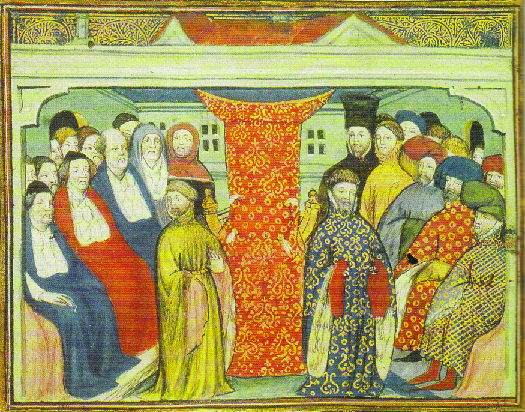
The idea that Americans—indeed, people in general—have fundamental rights and liberties was at the core of the arguments in favor of their independence. In writing the Declaration of Independence in 1776, Thomas Jefferson drew on the ideas of English philosopher John Locke to express the colonists’ belief that they had certain inalienable or natural rights that no ruler had the power or authority to deny to their subjects. It was a scathing legal indictment of King George III for violating the colonists’ liberties. Although the Declaration of Independence does not guarantee specific freedoms, its language was instrumental in inspiring many of the states to adopt protections for civil liberties and rights in their own constitutions, and in expressing principles of the founding era that have resonated in the United States since its independence. In particular, Jefferson’s words “all men are created equal” became the centerpiece of struggles for the rights of women and minorities (Figure 3.2).
LINKS TO LEARNING
Founded in 1920, the American Civil Liberties Union (ACLU) is one of the oldest interest groups in the United States. The mission of this non-partisan, not-for-profit organization is “to defend and preserve the individual rights and liberties guaranteed to every person in this country by the Constitution and laws of the United States.” Many of the Supreme Court cases in this chapter were litigated by, or with the support of, the ACLU. The ACLU offers a listing of state and local chapters on their website.
Civil Liberties and The Constitution
The Constitution as drafted in 1787 did not include a Bill of Rights, although the idea of including one was proposed and, after brief discussion, dismissed in the final week of the Constitutional Convention. The framers of the Constitution believed they faced much more pressing concerns than the protection of civil rights and liberties—most notably keeping the fragile union together in the light of internal unrest and external threats.
Moreover, the framers thought that they had adequately covered rights issues in the main body of the document. Indeed, the Federalists did include in the Constitution some protections against legislative acts that might restrict the liberties of citizens, based on the history of real and perceived abuses by both British kings and parliaments as well as royal governors. In Article I, Section 9, the Constitution limits the power of Congress in three ways: prohibiting the passage of bills of attainder, prohibiting ex post facto laws, and limiting the ability of Congress to suspend the writ of habeas corpus.
A bill of attainder is a law that convicts or punishes someone for a crime without a trial, a tactic used fairly frequently in England against the king’s enemies. Prohibition of such laws means that the U.S. Congress cannot simply punish people who are unpopular or who seem to be guilty of crimes. An ex post facto law has a retroactive effect: it can be used to punish crimes that were not crimes at the time they were committed, or it can be used to increase the severity of punishment after the fact.
Finally, the writ of habeas corpus is used in our common-law legal system to demand that a neutral judge decide whether someone has been lawfully detained. Particularly in times of war, or even in response to threats against national security, the government has held suspected enemy agents without access to civilian courts, often without access to lawyers or a defense, seeking instead to try them before military tribunals or detain them indefinitely without trial. For example, during the Civil War, President Abraham Lincoln detained suspected Confederate saboteurs and sympathizers in Union-controlled states and attempted to have them tried in military courts, leading the Supreme Court to rule in Ex parte Milligan that the government could not bypass the civilian court system in states where it was operating.[4] In 1919, Justice Oliver Wendell Holmes was the lone dissenter in the Abrams v. United States decision that convicted four, young, antiwar activists for pamphleteering against U.S. involvement in the Russian Civil War, which now would be exercised as a clear case of freedom of speech.
During World War II, the Roosevelt administration interned Japanese Americans and had other suspected enemy agents—including U.S. citizens—tried by military courts rather than by the civilian justice system, a choice the Supreme Court upheld in Ex parte Quirin (Figure 3.3).[5] More recently, in the wake of the 9/11 attacks on the World Trade Center and the Pentagon, the Bush and Obama administrations detained suspected terrorists captured both within and outside the United States and sought to avoid trials in civilian courts, and surveilled U.S. citizens to detect threats. Hence, there have been times in our history when national security issues trumped individual liberties.
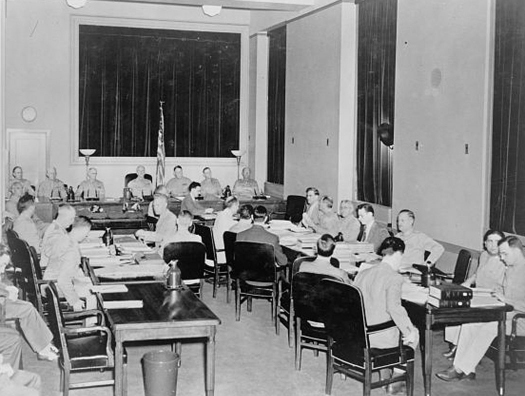
Debate has always swirled over these issues. The Federalists reasoned that the limited set of named or enumerated powers of Congress, along with the limitations on those powers in Article I, Section 9 of the Constitution, would suffice, and that no separate bill of rights was needed. Writing as Publius in Federalist No. 84, Alexander Hamilton argued that the Constitution was “merely intended to regulate the general political interests of the nation” rather than contend with “the regulation of every species of personal and private concerns.” Hamilton went on to argue that listing some rights might actually be dangerous, because it would provide a pretext for people to claim that rights not included in such a list were not protected. Later, James Madison, in his speech introducing the proposed amendments that would become the Bill of Rights, acknowledged another Federalist argument: “It has been said, that a bill of rights is not necessary, because the establishment of this government has not repealed those declarations of rights which are added to the several state constitutions.”[6] Neither had the Articles of Confederation included a specific listing of rights, even if it was predictable that state governments would differ in what they would tolerate, grant, and prohibit among their citizens.
Anti-Federalists argued that the Federalists’ position was incorrect and perhaps even insincere. The Anti-Federalists believed provisions such as the so-called elastic clause in Article I, Section 8 of the Constitution would allow Congress to legislate on matters well beyond those foreseen by the Constitution’s authors. Thus, they held that a bill of rights was necessary. One of the Anti-Federalists, Brutus, whom most scholars believe to be Robert Yates, wrote: “The powers, rights, and authority, granted to the general government by this Constitution, are as complete, with respect to every object to which they extend, as that of any state government—It reaches to every thing which concerns human happiness—Life, liberty, and property, are under its controul [sic]. There is the same reason, therefore, that the exercise of power, in this case, should be restrained within proper limits, as in that of the state governments.”[7] The experience of the past two centuries has suggested that the Anti-Federalists may have been correct in this regard. While the states retain a great deal of importance, the scope and powers of the national government are much broader today than in 1787—likely beyond even the imaginings of the Federalists themselves.
The struggle to have rights clearly delineated and the decision of the framers to omit a bill of rights from the Constitution nearly derailed the ratification process. While some of the states were willing to ratify without any further guarantees, in some of the larger states—New York and Virginia in particular—the Constitution’s lack of specified rights became a serious point of contention. The Constitution could go into effect with the support of only nine states, but the Federalists knew it could not be effective without the participation of the largest states. To secure majorities in favor of ratification in New York and Virginia, as well as Massachusetts, they agreed to consider incorporating provisions suggested by the ratifying states as amendments to the Constitution.
Ultimately, James Madison delivered on this promise by proposing a package of amendments in the First Congress, drawing from the Declaration of Rights in the Virginia state constitution, suggestions from the ratification conventions, and other sources. Each of these were extensively debated in both houses of Congress and, ultimately, proposed as twelve separate amendments for ratification by the states. Ten of the amendments were successfully ratified by the requisite 75 percent of the states and became known as the Bill of Rights (Table 3.1).
FINDING A MIDDLE GROUND
Debating the Need for a Bill of Rights
One of the most serious debates between the Federalists and the Anti-Federalists was over the necessity of limiting the power of the new federal government with a Bill of Rights. As we saw in this section, the Federalists believed a Bill of Rights was unnecessary—and perhaps even dangerous to liberty, because it might invite violations of rights that weren’t included in it—while the Anti-Federalists thought the national government would prove adept at expanding its powers and influence and that citizens couldn’t depend on the good judgment of Congress alone to protect their rights.
As George Washington’s call for a bill of rights in his first inaugural address suggested, while the Federalists ultimately had to add the Bill of Rights to the Constitution in order to win ratification, the Anti-Federalists’ fear that the national government might intrude on civil liberties proved to be prescient. In 1798, at the behest of President John Adams during the Quasi-War with France, Congress passed a series of four laws collectively known as the Alien and Sedition Acts. These laws were drafted to allow the president to imprison or deport foreign citizens that he believed were “dangerous to the peace and safety of the United States” and to restrict speech and newspaper articles critical of the federal government or its officials. The laws were primarily used against members and supporters of the opposition, the Democratic-Republican Party.
State laws and constitutions protecting free speech and freedom of the press proved ineffective in limiting this new federal power. Although the courts did not decide on the constitutionality of these laws at the time, most scholars believe the Sedition Act, in particular, would be ruled unconstitutional if it had remained in effect. Three of the four laws were repealed in the Jefferson administration, but one—the Alien Enemies Act—remains on the books today. Two centuries later, the issue of free speech and freedom of the press during times of international conflict remains a subject of intense public debate.
Should the government be able to restrict or censor unpatriotic, disloyal, or critical speech in times of international conflict? What about from government whistle-blowers or employees who leak sensitive information? How much freedom should journalists have to report on stories from the perspective of enemies or to repeat propaganda from opposing forces?
Extending The Bill of Rights to The States
In the decades following the Constitution’s ratification, the Supreme Court declined to expand the Bill of Rights to curb the power of the states, most notably in the 1833 case of Barron v. Baltimore.[8] In this case, which dealt with property rights under the Fifth Amendment, the Supreme Court unanimously decided that the Bill of Rights applied only to actions by the federal government, not state or local governments. Explaining the court’s ruling, Chief Justice John Marshall wrote that it was incorrect to argue that “the Constitution was intended to secure the people of the several states against the undue exercise of power by their respective state governments; as well as against that which might be attempted by their [Federal] government.”
The festering issue of the rights of enslaved persons and the convulsions of the Civil War and its aftermath forced a reexamination of the prevailing thinking about the application of the Bill of Rights to the states. Soon after slavery was abolished by the Thirteenth Amendment, state governments—particularly those in the former Confederacy—began to pass “Black codes” that restricted the rights of formerly enslaved people, including the right to hold office, own land, or vote, relegating them to second-class citizenship. Angered by these actions, members of the Radical Republican faction in Congress demanded that the Black codes be overturned. In the short term, they advocated suspending civilian government in most of the southern states and replacing politicians who had enacted these discriminatory laws. Their long-term solution was to propose and enforce two amendments to the Constitution to guarantee the rights of freed men and women. These became the Fourteenth Amendment, which dealt with civil liberties and rights in general, and the Fifteenth Amendment, which protected the right to vote in particular (Figure 3.4). though still not for women or Native Americans.
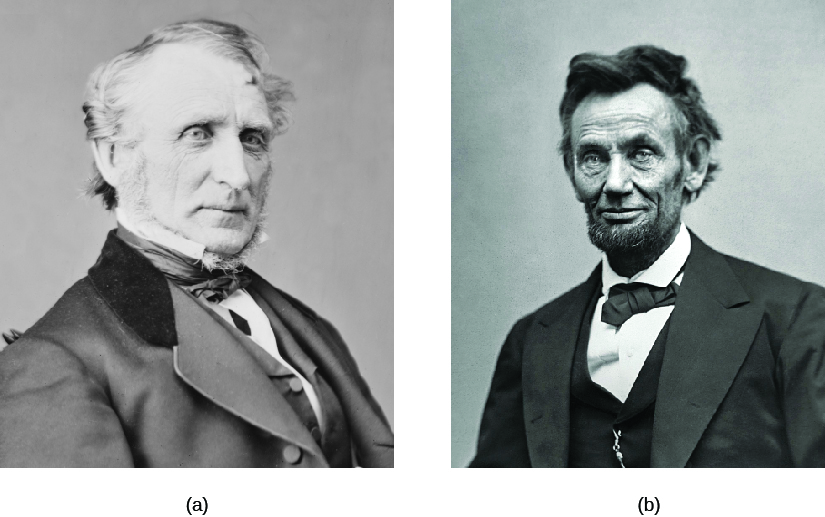
With the ratification of the Fourteenth Amendment in 1868, the scope and limits of civil liberties became clearer. First, the amendment says, “no State shall make or enforce any law which shall abridge the privileges or immunities of citizens of the United States,” which is a provision that echoes the privileges and immunities clause in Article IV, Section 2 of the original Constitution ensuring that states treat citizens of other states the same as their own citizens. (To use an example from today, the punishment for speeding by an out-of-state driver cannot be more severe than the punishment for an in-state driver). Legal scholars and the courts have extensively debated the meaning of this privileges or immunities clause over the years, with some arguing that it was supposed to extend the entire Bill of Rights (or at least the first eight amendments) to the states, and others arguing that only some rights are extended. In 1999, Justice John Paul Stevens, writing for a majority of the Supreme Court, argued in Saenz v. Roe that the clause protects the right to travel from one state to another.[9] More recently, Justice Clarence Thomas argued in the 2010 McDonald v. Chicago ruling that the individual right to bear arms applied to the states because of this clause.[10]
The second provision of the Fourteenth Amendment pertaining to the application of the Bill of Rights to the states is the due process clause, which famously reads, “nor shall any State deprive any person of life, liberty, or property, without due process of law.” Like the Fifth Amendment, this clause refers to “due process,” a term that is interpreted to require both access to procedural justice (such as the right to a trial) as well as the more substantive implication that people be treated fairly and impartially by government officials. Although the text of the provision does not mention rights specifically, the courts have held in a series of cases that due process also implies that there are certain fundamental liberties that cannot be denied by the states. For example, in Sherbert v. Verner (1963), the Supreme Court ruled that states could not deny unemployment benefits to an individual who turned down a job because it required working on the Sabbath.[11]
Beginning in 1897, the Supreme Court has found that various provisions of the Bill of Rights protecting these fundamental liberties must be upheld by the states, even if their state constitutions and laws (and the Tenth Amendment itself) do not protect them as fully as the Bill of Rights does—or at all. This means there has been a process of selective incorporation of the Bill of Rights into the practices of the states: the Constitution effectively inserts parts of the Bill of Rights into state laws and constitutions, even though it doesn’t do so explicitly. When cases arise to clarify particular issues and procedures, the Supreme Court decides whether state laws violate the Bill of Rights and are therefore unconstitutional.
For example, under the Fifth Amendment, a person can be tried in federal court for a felony—a serious crime—only after a grand jury issues an indictment indicating that it is reasonable to try them. (A grand jury is a group of citizens charged with deciding whether there is enough evidence of a crime to prosecute someone.) The Supreme Court has ruled that states don’t have to use grand juries as long as they ensure people accused of crimes are indicted using an equally fair process.
Selective incorporation is an ongoing process. When the Supreme Court initially decided in 2008 that the Second Amendment protects an individual’s right to keep and bear arms, it did not decide then that it was a fundamental liberty the states must uphold as well. It was only in the McDonald v. Chicago case two years later that the Supreme Court incorporated the Second Amendment into state law. Another area in which the Supreme Court gradually moved to incorporate the Bill of Rights regards censorship and the Fourteenth Amendment. In Near v. Minnesota (1931), the Court disagreed with state courts regarding censorship and ruled it unconstitutional except in rare cases.[12]
3.3 Securing Basic Freedoms
LEARNING OUTCOMES
By the end of this section, you will be able to:
- Identify the liberties and rights guaranteed by the first four amendments to the Constitution
- Explain why in practice these rights and liberties are limited
- Explain why interpreting some amendments has been controversial
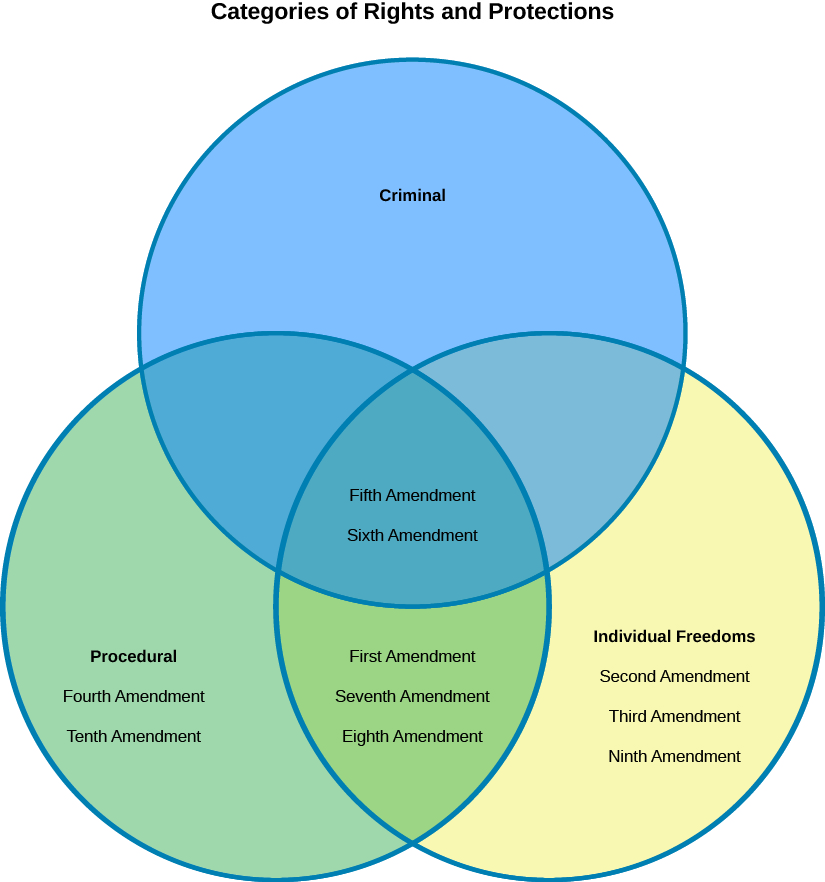
We can broadly divide the provisions of the Bill of Rights into three categories. The First, Second, Third, and Fourth Amendments protect basic individual freedoms; the Fourth (partly), Fifth, Sixth, Seventh, and Eighth protect people suspected or accused of criminal activity or facing civil litigation; and the Ninth and Tenth, are consistent with the framers’ view that the Bill of Rights is not necessarily an exhaustive list of all the rights people have and guarantees a role for state as well as federal government (Figure 3.5).
The First Amendment
The First Amendment is perhaps the most famous provision of the Bill of Rights. It is arguably also the most extensive, because it guarantees both religious freedoms and the right to express your views in public. Specifically, the First Amendment says:
“Congress shall make no law respecting an establishment of religion, or prohibiting the free exercise thereof; or abridging the freedom of speech, or of the press; or the right of the people peaceably to assemble, and to petition the Government for a redress of grievances.”
Given the broad scope of this amendment, it is helpful to break it into its two major parts. The first portion deals with religious freedom. However, it actually protects two related sorts of freedom: first, it protects people from having a set of religious beliefs imposed on them by the government, and second, it protects people from having their own religious beliefs restricted by government authorities.
LINK TO LEARNING
*Watch this video to learn more about freedom of speech.
The first of these two freedoms is known as the establishment clause. Congress is prohibited from creating or promoting a state-sponsored religion (this now includes the states). When the United States was founded, most countries around the world had an established church or religion—an officially sponsored set of religious beliefs and values. In Europe, bitter wars were fought between and within states, often because the established church of one territory was in conflict with that of another. Wars and civil strife were common, particularly between states with Protestant and Catholic churches that had differing interpretations of Christianity. Even today, the legacy of these wars remains, most notably in Ireland, where complications from Brexit have rekindled tensions between a mostly Catholic south and a largely Protestant north that have been simmering for nearly a century.
Many settlers in the United States came to this continent as refugees from such wars; others came to find a place where they could follow their own religion with like-minded people in relative peace. Even if the early United States had wanted to establish a single national religion, the diversity of religious beliefs within and between the colonies would have made this quite impossible. Nonetheless the differences were small; most people were of European origin and professed some form of Christianity (although in private some of the founders, most notably Thomas Jefferson, Thomas Paine, and Benjamin Franklin, held what today would be seen as more pluralistic Unitarian or deistic views). So for much of U.S. history, the establishment clause was not particularly important—the vast majority of citizens were Protestant Christians of some form, and since the federal government was relatively uninvolved in the day-to-day lives of the people, there was little opportunity for conflict. That said, there were some citizenship and office-holding restrictions on Jews within some of the states.
Worry about state sponsorship of religion in the United States began to reemerge in the latter part of the nineteenth century. An influx of immigrants from Ireland and eastern and southern Europe brought large numbers of Catholics. Fearing the new immigrants and their children would not assimilate, states passed laws forbidding government aid to religious schools. New religious organizations, such as The Church of Jesus Christ of Latter-day Saints, Seventh-day Adventists, Jehovah’s Witnesses, and many others, also emerged, blending aspects of Protestant beliefs with other ideas and teachings at odds with the more traditional Protestant churches of the era. At the same time, public schooling was beginning to take root on a wide scale. Since most states had traditional Protestant majorities and most state officials were Protestants themselves, the public school curriculum incorporated many Protestant features; at times, these features would come into conflict with the beliefs of children from other Christian sects or from other religious traditions.
The establishment clause today tends to be interpreted a bit more broadly than in the past; it not only forbids the creation of a “Church of the United States” or “Church of Ohio” it also forbids the government from favoring one set of religious beliefs over others or favoring religion (of any variety) over non-religion. Thus, the government cannot promote, say, Islamic beliefs over Sikh beliefs or belief in God over atheism or agnosticism (Figure 3.6).
The key question that faces the courts is whether the establishment clause should be understood as imposing, in Thomas Jefferson’s words, “a wall of separation between church and state.” In a 1971 case known as Lemon v. Kurtzman, the Supreme Court established the Lemon test for deciding whether a law or other government action that might promote a particular religious practice should be allowed to stand.[13] The Lemon test has three criteria that must be satisfied for such a law or action to be found constitutional and remain in effect:
- The action or law must not lead to excessive government entanglement with religion; in other words, policing the boundary between government and religion should be relatively straightforward and not require extensive effort by the government.
- The action or law cannot either inhibit or advance religious practice; it should be neutral in its effects on religion.
- The action or law must have some secular purpose; there must be some non-religious justification for the law.
For example, imagine your state decides to fund a school voucher program that allows children to attend private and parochial schools at public expense; the vouchers can be used to pay for school books and transportation to and from school. Would this voucher program be constitutional?
Let’s start with the secular-purpose prong of the test. Educating children is a clear, non-religious purpose, so the law has a secular purpose. The law would neither inhibit nor advance religious practice, so that prong would be satisfied. The remaining question—and usually the one on which court decisions turn—is whether the law leads to excessive government entanglement with religious practice. Given that transportation and school books generally have no religious purpose, there is little risk that paying for them would lead the state to much entanglement with religion. The decision would become more difficult if the funding were unrestricted in use or helped to pay for facilities or teacher salaries; if that were the case, it might indeed be used for a religious purpose, and it would be harder for the government to ensure that it wasn’t without audits or other investigations that could lead to too much government entanglement with religion.
The use of education as an example is not an accident; in fact, many of the court’s cases dealing with the establishment clause have involved education, particularly public education, because school-age children are considered a special and vulnerable population. Perhaps no subject affected by the First Amendment has been more controversial than the issue of prayer in public schools. Discussion about school prayer has been particularly fraught because in many ways it appears to bring the two religious liberty clauses into conflict with each other. The free exercise clause, discussed below, guarantees the right of individuals to practice their religion without government interference—and while the rights of children are not as extensive in all areas as those of adults, the courts have consistently ruled that the free exercise clause’s guarantee of religious freedom applies to children as well.
At the same time, however, government actions that require or encourage particular religious practices might infringe upon children’s rights to follow their own religious beliefs and thus, in effect, be unconstitutional establishments of religion. For example, a teacher, an athletic coach, or even a student reciting a prayer in front of a class or leading students in prayer as part of the organized school activities constitutes an illegal establishment of religion.[14] Yet a school cannot prohibit voluntary, non-disruptive prayer by its students, because that would impair the free exercise of religion. So although the blanket statement that “prayer in schools is illegal” or unconstitutional is incorrect, the establishment clause does limit official endorsement of religion, including prayers organized or otherwise facilitated by school authorities, even as part of off-campus or extracurricular activities.[15]
But some laws that may appear to establish certain religious practices are allowed. For example, the courts have permitted religiously inspired blue laws that limit working hours or even shutter businesses on Sunday, the Christian day of rest, because by allowing people to practice their (Christian) faith, such rules may help ensure the “health, safety, recreation, and general well-being” of citizens. They have allowed restrictions on the sale of alcohol and sometimes other goods on Sunday for similar reasons. Such laws in Bergen County, New Jersey, and especially its borough of Paramus, shutter many retail stores every Sunday, despite Bergen having one of the largest concentrations of retail space in the nation and five large enclosed shopping malls. While various political figures, including Chris Christie, have proposed repealing the laws, town and county officials have vowed to keep them in place as a “quality of life” element. Many citizens support them, while others cite the difficulty in doing their own shopping and the impact on smaller retailers in their rationale for eliminating the restrictions.
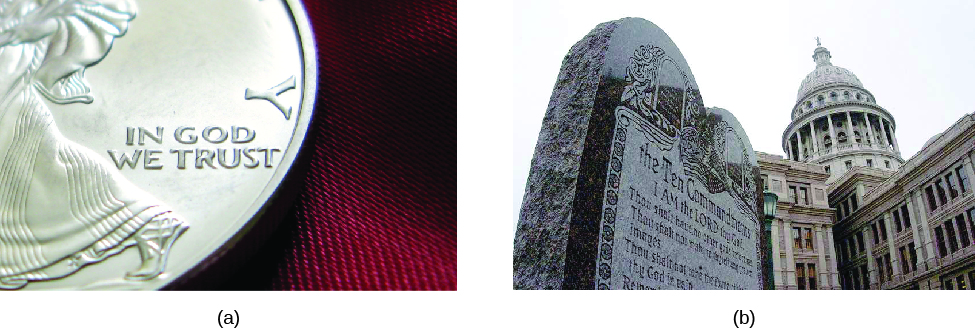
The meaning of the establishment clause has been controversial at times because, as a matter of course, government officials acknowledge that we live in a society with vigorous religious practice where most people believe in God—even if we disagree on what God is. Disputes often arise over how much the government can acknowledge this widespread religious belief. The courts have generally allowed for a certain tolerance of what is described as ceremonial deism, an acknowledgement of God or a creator that generally lacks any substantive religious content. For example, the national motto “In God We Trust,” which appears on our coins and paper money (Figure 3.7), is seen as more an acknowledgment that most citizens believe in God than any serious effort by government officials to promote religious belief and practice. This reasoning has also been used to permit the inclusion of the phrase “under God” in the Pledge of Allegiance—a change that came about during the early years of the Cold War as a means of contrasting the United States with the “godless” Soviet Union.
In addition, the courts have allowed some religiously motivated actions by government agencies, such as clergy delivering prayers to open city council meetings and legislative sessions, on the presumption that—unlike school children—adult participants can distinguish between the government’s allowing someone to speak and endorsing that person’s speech. Yet, while some displays of religious codes (e.g., Ten Commandments) are permitted in the context of showing the evolution of law over the centuries (Figure 3.7), in other cases, these displays have been removed after state supreme court rulings. In Oklahoma, the courts ordered the removal of a Ten Commandments sculpture at the state capitol when other groups, including Satanists and the Church of the Flying Spaghetti Monster, attempted to get their own sculptures allowed there.
LINK TO LEARNING
*Watch this video to learn about freedom of religion.
The Free Exercise Clause
The free exercise clause, on the other hand, limits the ability of the government to control or restrict religious practices. This portion of the First Amendment regulates not the government’s promotion of religion, but rather government suppression of religious beliefs and practices. Much of the controversy surrounding the free exercise clause reflects the way laws or rules that apply to everyone might apply to people with particular religious beliefs. For example, can a Jewish police officer whose religious belief, if followed strictly, requires them to observe Shabbat be compelled to work on a Friday night or during the day on Saturday? Or must the government accommodate this religious practice, even if it means the general law or rule in question is not applied equally to everyone?
In the 1930s and 1940s, cases involving Jehovah’s Witnesses demonstrated the difficulty of striking the right balance. In addition to following their church’s teaching that they should not participate in military combat, members refuse to participate in displays of patriotism, including saluting the flag and reciting the Pledge of Allegiance, and they regularly engage in door-to-door evangelism to recruit converts. These activities have led to frequent conflict with local authorities. Jehovah’s Witness children were punished in public schools for failing to salute the flag or recite the Pledge of Allegiance, and members attempting to evangelize were arrested for violating laws against door-to-door solicitation of customers. In early legal challenges brought by Jehovah’s Witnesses, the Supreme Court was reluctant to overturn state and local laws that burdened their religious beliefs.[16] However, in later cases, the court was willing to uphold the rights of Jehovah’s Witnesses to proselytize and refuse to salute the flag or recite the Pledge.[17]
The rights of conscientious objectors—individuals who claim the right to refuse to perform military service on the grounds of freedom of thought, conscience, or religion—have also been controversial, although many conscientious objectors have contributed service as non-combatant medics during wartime. To avoid serving in the Vietnam War, many people claimed to have a conscientious objection to military service on the basis that they believed this particular war was unwise or unjust. However, the Supreme Court ruled in Gillette v. United States that to claim to be a conscientious objector, a person must be opposed to serving in any war, not just some wars.[18]
Establishing a general framework for deciding whether a religious belief can trump general laws and policies has been a challenge for the Supreme Court. In the 1960s and 1970s, the court decided two cases in which it laid out a general test for deciding similar cases in the future. In both Sherbert v. Verner, a case dealing with unemployment compensation, and Wisconsin v. Yoder, which dealt with the right of Amish parents to homeschool their children, the court said that for a law to be allowed to limit or burden a religious practice, the government must meet two criteria.[19] It must demonstrate both that it had a “compelling governmental interest” in limiting that practice and that the restriction was “narrowly tailored.” In other words, it must show there was a very good reason for the law in question and that the law was the only feasible way of achieving that goal. This standard became known as the Sherbert test. Since the burden of proof in these cases was on the government, the Supreme Court made it very difficult for the federal and state governments to enforce laws against individuals that would infringe upon their religious beliefs.
In 1990, the Supreme Court made a controversial decision substantially narrowing the Sherbert test in Employment Division v. Smith, more popularly known as “the peyote case.”[20] This case involved two men who were members of the Native American Church, a religious organization that uses the hallucinogenic peyote plant as part of its sacraments. After being arrested for possession of peyote, the two men were fired from their jobs as counselors at a private drug rehabilitation clinic. When they applied for unemployment benefits, the state refused to pay on the basis that they had been dismissed for work-related reasons. The men appealed the denial of benefits and were initially successful, since the state courts applied the Sherbert test and found that the denial of unemployment benefits burdened their religious beliefs. However, the Supreme Court ruled in a 6–3 decision that the “compelling governmental interest” standard should not apply; instead, so long as the law was not designed to target a person’s religious beliefs in particular, it was not up to the courts to decide that those beliefs were more important than the law in question.
On the surface, a case involving the Native American Church seems unlikely to arouse much controversy. But because it replaced the Sherbert test with one that allowed more government regulation of religious practices, followers of other religious traditions grew concerned that state and local laws, even ones neutral on their face, might be used to curtail their religious practices. In 1993, in response to this decision, Congress passed a law known as the Religious Freedom Restoration Act (RFRA), which was followed in 2000 by the Religious Land Use and Institutionalized Persons Act after part of the RFRA was struck down by the Supreme Court. In addition, since 1990, twenty-one states have passed state RFRAs that include the Sherbert test in state law, and state court decisions in eleven states have enshrined the Sherbert test’s compelling governmental interest interpretation of the free exercise clause into state law.[21]
However, the RFRA itself has not been without its critics. While it has been relatively uncontroversial as applied to the rights of individuals, debate has emerged about whether businesses and other groups can be said to have religious liberty. In explicitly religious organizations, such as an Orthodox Union congregation or the Roman Catholic Church, it is fairly obvious members have a meaningful, shared religious belief. But the application of the RFRA has become more problematic in businesses and non-profit organizations whose owners or organizers may share a religious belief while the organization has some secular, non-religious purpose.
Such a conflict emerged in the 2014 Supreme Court case known as Burwell v. Hobby Lobby.[22] The Hobby Lobby chain of stores sells arts and crafts merchandise at hundreds of stores and its founder, David Green, is a fundamentalist Christian whose beliefs include opposition to abortion and contraception. Consistent with these beliefs, he used his business to object to a provision of the Patient Protection and Affordable Care Act (ACA or Obamacare) requiring employer-backed insurance plans to include no-charge access to the morning-after pill, a form of emergency contraception, arguing that this requirement infringed on his conscience. Based in part on the federal RFRA, the Supreme Court agreed 5–4 with Green and Hobby Lobby’s position and said that Hobby Lobby and other closely held businesses did not have to provide employees free access to emergency contraception or other birth control if doing so would violate the religious beliefs of the business’ owners, because there were other less restrictive ways the government could ensure access to these services for Hobby Lobby’s employees (e.g., paying for them directly).

In 2015, state RFRAs became controversial when individuals and businesses that provided wedding services (e.g., catering and photography) were compelled to provide these for same-sex weddings in states where the practice had been newly legalized (Figure 3.8).Proponents of state RFRA laws argued that people and businesses ought not be compelled to endorse practices that their religious beliefs hold to be immoral or indecent. They also indicated concerns that clergy might be compelled to officiate same-sex marriages against their religion’s teachings. Opponents of RFRA laws argued that individuals and businesses should be required, per Obergefell v. Hodges, to serve same-sex marriages on an equal basis as a matter of ensuring the civil rights of gays and lesbian people, just as they would be obliged to cater or photograph an interracial marriage.[23] It should be noted that religious organizations and clergy are not homogeneous in their view of marriage. For example, same-sex marriage is supported by Episcopalians, a sizable number of Methodists, and many leaders in the Jewish and Hindu faiths.[24]
Despite ongoing controversy, however, the courts have consistently found some public interests sufficiently compelling to override the free exercise clause. For example, since the late nineteenth century, the courts have consistently held that people’s religious beliefs do not exempt them from the general laws against polygamy, drug use, or human sacrifice. Yet, the public interest did not trump individual rights during the COVID-19 pandemic, when the Supreme Court overturned California’s ban on indoor gatherings.[25] Other potential acts in the name of religion that are also out of the question are drug use and human sacrifice.
Freedom of Expression
Although the remainder of the First Amendment protects four distinct rights—free speech, press, assembly, and petition—we generally think of these rights today as encompassing a right to freedom of expression, particularly since the world’s technological evolution has blurred the lines between oral and written communication (i.e., speech and press) in the centuries since the First Amendment was written and adopted.
Controversies over freedom of expression were rare until the 1900s, even though government censorship was quite common. For example, during the Civil War, the Union post office refused to deliver newspapers that opposed the war or sympathized with the Confederacy, while allowing pro-war newspapers to be mailed. The emergence of photography and movies, in particular, led to new public concerns about morality, causing both state and federal politicians to censor lewd and otherwise improper content. At the same time, writers became more ambitious in their subject matter by including explicit references to sex and using obscene language, leading to government censorship of books and magazines.
Censorship reached its height during World War I. The United States was swept up in two waves of hysteria. Anti-German feeling was provoked by the actions of Germany and its allies leading up to the war, including the sinking of the RMS Lusitania and the Zimmerman Telegram, an effort by the Germans to conclude an alliance with Mexico against the United States. This concern was compounded in 1917 by the Bolshevik revolution against the more moderate interim government of Russia; the leaders of the Bolsheviks, most notably Vladimir Lenin, Leon Trotsky, and Joseph Stalin, withdrew from the war against Germany and called for communist revolutionaries to overthrow the capitalist, democratic governments in western Europe and North America.
Americans who vocally supported the communist cause or opposed the war often found themselves in jail. In Schenck v. United States, the Supreme Court ruled that people encouraging young men to dodge the draft could be imprisoned for doing so, arguing that recommending that people disobey the law was tantamount to “falsely shouting fire in a theatre and causing a panic” and thus presented a “clear and present danger” to public order.[26] Similarly, communists and other revolutionary anarchists and socialists during the Red Scare after the war were prosecuted under various state and federal laws for supporting the forceful or violent overthrow of government. This general approach to political speech remained in place for the next fifty years.
In the 1960s, however, the Supreme Court’s rulings on free expression became more liberal, in response to the Vietnam War and the growing antiwar movement. In a 1969 case involving the Ku Klux Klan, Brandenburg v. Ohio, the Supreme Court found that only speech or writing that constituted a direct call or plan to imminent lawless action, an illegal act in the immediate future, could be suppressed; the mere advocacy of a hypothetical revolution was not enough.[27] The Supreme Court also found that various forms of symbolic speech—wearing clothing like an armband that carried a political symbol or raising a fist in the air, for example—were subject to the same protections as written and spoken communication. More recently, symbolic speech related to the U.S. flag has engendered intense debate. Whether one should kneel during the national anthem, or ought to be able to burn the U.S. flag, are key questions.
LINK TO LEARNING
*Watch this video to learn more about freedom of the press.
MILESTONE
Burning the U.S. Flag
Perhaps no act of symbolic speech has been as controversial in U.S. history as the burning of the flag (Figure 3.9). Citizens tend to revere the flag as a unifying symbol of the country in much the same way most people in Britain would treat the reigning queen (or king). States and the federal government have long had laws protecting the flag from being desecrated—defaced, damaged, or otherwise treated with disrespect. Perhaps in part because of these laws, people who have wanted to drive home a point in opposition to U.S. government policies have found desecrating the flag a useful way to gain public and press attention to their cause.

One such person was Gregory Lee Johnson, a member of various pro-communist and antiwar groups. In 1984, as part of a protest near the Republican National Convention in Dallas, Texas, Johnson set fire to a U.S. flag that another protestor had torn from a flagpole. He was arrested, charged with “desecration of a venerated object” (among other offenses), and eventually convicted of that offense. However, in 1989, the Supreme Court decided in Texas v. Johnson that burning the flag was a form of symbolic speech protected by the First Amendment and found the law, as applied to flag desecration, to be unconstitutional.[28]
This court decision was strongly criticized, and Congress responded by passing a federal law, the Flag Protection Act, intended to overrule it; the act, too, was struck down as unconstitutional in 1990.[29] Since then, Congress has tried and failed on several occasions to propose constitutional amendments allowing the states and federal government to re-criminalize flag desecration.
Should we amend the Constitution to allow Congress or the states to pass laws protecting the U.S. flag from desecration? Should we protect other national symbols as well, such as standing for the national anthem? Why or why not?
Freedom of the press is an important component of the right to free expression as well. In Near v. Minnesota, an early case regarding press freedoms, the Supreme Court ruled that the government generally could not engage in prior restraint; that is, states and the federal government could not in advance prohibit someone from publishing something without a very compelling reason.[30] This standard was reinforced in 1971 in the Pentagon Papers case, in which the Supreme Court found that the government could not prohibit the New York Times and Washington Post newspapers from publishing the Pentagon Papers.[31] These papers included materials from a secret history of the Vietnam War that had been compiled by the military. More specifically, the papers were compiled at the request of Secretary of Defense Robert McNamara and provided a study of U.S. political and military involvement in Vietnam from 1945 to 1967. Daniel Ellsberg famously released passages of the Papers to the press to show that the United States had secretly enlarged the scope of the war by bombing Cambodia and Laos among other deeds while lying to the American public about doing so.
Although people who leak secret information to the media can still be prosecuted and punished, this does not generally extend to reporters and news outlets that pass that information on to the public. The Edward Snowden case is another good case in point. Snowden himself, rather than those involved in promoting the information that he shared, is the object of criminal prosecution.
Furthermore, the courts have recognized that government officials and other public figures might try to silence press criticism and avoid unfavorable news coverage by threatening a lawsuit for defamation of character. In the 1964 New York Times v. Sullivan case, the Supreme Court decided that public figures needed to demonstrate not only that a negative press statement about them was untrue but also that the statement was published or made with either malicious intent or “reckless disregard” for the truth.[32] This ruling made it much harder for politicians to silence potential critics or to bankrupt their political opponents through the courts.
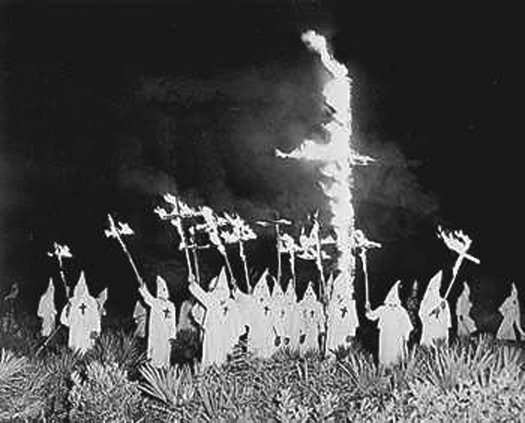
The right to freedom of expression is not absolute; several key restrictions limit our ability to speak or publish opinions under certain circumstances. We have seen that the Constitution protects most forms of offensive and unpopular expression, particularly political speech; however, incitement of a criminal act, “fighting words,” and genuine threats are not protected. So, for example, you can’t point at someone in front of an angry crowd and shout, “Let’s beat up that guy!” And the Supreme Court has allowed laws that ban threatening symbolic speech, such as burning a cross on the lawn of an African American family’s home (Figure 3.10).[33] Finally, as we’ve just seen, defamation of character—whether in written form (libel) or spoken form (slander)—is not protected by the First Amendment, so people who are subject to false accusations can sue to recover damages, although criminal prosecutions of libel and slander are uncommon.
Another key exception to the right to freedom of expression is obscenity, acts or statements that are extremely offensive under current societal standards. Defining obscenity has been something of a challenge for the courts; Supreme Court Justice Potter Stewart famously said of obscenity, having watched pornography in the Supreme Court building, “I know it when I see it.” Into the early twentieth century, written work was frequently banned as being obscene, including works by noted authors such as James Joyce and Henry Miller, although today it is rare for the courts to uphold obscenity charges for written material alone. In 1973, the Supreme Court established the Miller test for deciding whether something is obscene: “(a) whether the average person, applying contemporary community standards, would find that the work, taken as a whole, appeals to the prurient interest, (b) whether the work depicts or describes, in a patently offensive way, sexual conduct specifically defined by the applicable state law; and (c) whether the work, taken as a whole, lacks serious literary, artistic, political, or scientific value.”[34] However, the application of this standard has at times been problematic. In particular, the concept of “contemporary community standards” raises the possibility that obscenity varies from place to place; many people in New York or San Francisco might not bat an eye at something people in Memphis or Salt Lake City would consider offensive. The one form of obscenity that has been banned almost without challenge is child pornography, although even in this area the courts have found exceptions.
The courts have allowed censorship of less-than-obscene content when it is broadcast over the airwaves, particularly when it is available for anyone to receive. In general, these restrictions on indecency—a quality of acts or statements that offend societal norms or may be harmful to minors—apply only to radio and television programming broadcast when children might be in the audience, although most cable and satellite channels follow similar standards for commercial reasons. An infamous case of televised indecency occurred during the halftime show of the 2004 Super Bowl, during a performance by singer Janet Jackson in which a part of her clothing was removed by fellow performer Justin Timberlake, revealing her right breast. The network responsible for the broadcast, CBS, was ultimately presented with a fine of $550,000 by the Federal Communications Commission, the government agency that regulates television broadcasting. However, CBS was not ultimately required to pay.
On the other hand, in 1997, the NBC network showed a broadcast of Schindler’s List, a film depicting events during the Holocaust in Nazi Germany, without any editing, so it included graphic nudity and depictions of violence. NBC was not fined or otherwise punished, suggesting there is no uniform standard for indecency. Similarly, in the 1990s Congress compelled television broadcasters to implement a television ratings system, enforced by a “V-Chip” in televisions and cable boxes, so parents could better control the television programming their children might watch. However, similar efforts to regulate indecent content on the Internet to protect children from pornography have largely been struck down as unconstitutional. This outcome suggests that technology has created new avenues for obscene material to be disseminated. The Children’s Internet Protection Act, however, requires K–12 schools and public libraries receiving Internet access using special E-rate discounts to filter or block access to obscene material and other material deemed harmful to minors, with certain exceptions.
The courts have also allowed laws that forbid or compel certain forms of expression by businesses, such as laws that require the disclosure of nutritional information on food and beverage containers and warning labels on tobacco products (Figure 3.11). The federal government requires the prices advertised for airline tickets to include all taxes and fees. Many states regulate advertising by lawyers. And, in general, false or misleading statements made in connection with a commercial transaction can be illegal if they constitute fraud.

Furthermore, the courts have ruled that, although public school officials are government actors, the First Amendment freedom of expression rights of children attending public schools are somewhat limited. In particular, in Tinker v. Des Moines (1969) and Hazelwood v. Kuhlmeier (1988), the Supreme Court has upheld restrictions on speech that creates “substantial interference with school discipline or the rights of others”[35] or is “reasonably related to legitimate pedagogical concerns.”[36] For example, the content of school-sponsored activities like school newspapers and speeches delivered by students can be controlled, either for the purposes of instructing students in proper adult behavior or to deter conflict between students.
Free expression includes the right to assemble peaceably and the right to petition government officials. This right even extends to members of groups whose views most people find abhorrent, such as American Nazis and the vehemently anti-LGBTQ Westboro Baptist Church, whose members have become known for their protests at the funerals of U.S. soldiers who have died fighting in the war on terror.[37] Free expression—although a broad right—is subject to certain constraints to balance it against the interests of public order. In particular, the nature, place, and timing of protests—but not their substantive content—are subject to reasonable limits. The courts have ruled that while people may peaceably assemble in a place that is a public forum, not all public property is a public forum. For example, the inside of a government office building or a college classroom—particularly while someone is teaching—is not generally considered a public forum.
Rallies and protests on land that has other dedicated uses, such as roads and highways, can be limited to groups that have secured a permit in advance, and those organizing large gatherings may be required to give sufficient notice so government authorities can ensure there is enough security available. However, any such regulation must be viewpoint-neutral; the government may not treat one group differently than another because of its opinions or beliefs. For example, the government can’t permit a rally by a group that favors a government policy but forbid opponents from staging a similar rally. Finally, there have been controversial situations in which government agencies have established free-speech zones for protesters during political conventions, presidential visits, and international meetings in areas that are arguably selected to minimize their public audience or to ensure that the subjects of the protests do not have to encounter the protesters.
The Second Amendment
There has been increased conflict over the Second Amendment in recent years due to school shootings and gun violence. As a result, gun rights have become a highly charged political issue. The text of the Second Amendment is among the shortest of those included in the Constitution:
“A well regulated Militia, being necessary to the security of a free State, the right of the people to keep and bear Arms, shall not be infringed.”
But the relative simplicity of its text has not kept it from controversy; arguably, the Second Amendment has become controversial in large part because of its text. Is this amendment merely a protection of the right of the states to organize and arm a “well regulated militia” for civil defense, or is it a protection of a “right of the people” as a whole to individually bear arms?
Before the Civil War, this would have been a nearly meaningless distinction. In most states at that time, White males of military age were considered part of the militia, liable to be called for service to put down rebellions or invasions, and the right “to keep and bear Arms” was considered a common-law right inherited from English law that predated the federal and state constitutions. The Constitution was not seen as a limitation on state power, and since the states expected all free men to keep arms as a matter of course, what gun control there was mostly revolved around ensuring enslaved people (and their abolitionist allies) didn’t have guns.
With the beginning of selective incorporation after the Civil War, debates over the Second Amendment were reinvigorated. In the meantime, as part of their Black codes designed to reintroduce most of the trappings of slavery, several southern states adopted laws that restricted the carrying and ownership of weapons by formerly enslaved people. Despite acknowledging a common-law individual right to keep and bear arms, in 1876 the Supreme Court declined, in United States v. Cruickshank, to intervene to ensure the states would respect it.[38]
In the following decades, states gradually began to introduce laws to regulate gun ownership. Federal gun control laws began to be introduced in the 1930s in response to organized crime, with stricter laws that regulated most commerce and trade in guns coming into force in the wake of the street protests of the 1960s. In the early 1980s, following an assassination attempt on President Ronald Reagan, laws requiring background checks for prospective gun buyers were passed. During this period, the Supreme Court’s decisions regarding the meaning of the Second Amendment were ambiguous at best. In United States v. Miller, the Supreme Court upheld the 1934 National Firearms Act’s prohibition of sawed-off shotguns, largely on the basis that possession of such a gun was not related to the goal of promoting a “well regulated militia.”[39] This finding was generally interpreted as meaning that the Second Amendment protected the right of the states to organize a militia, rather than an individual right, and thus lower courts generally found most firearm regulations—including some city and state laws that virtually outlawed the private ownership of firearms—to be constitutional.
However, in 2008, in a narrow 5–4 decision on District of Columbia v. Heller, the Supreme Court found that at least some gun control laws did violate the Second Amendment and that this amendment does protect an individual’s right to keep and bear arms, at least in some circumstances—in particular, “for traditionally lawful purposes, such as self-defense within the home.”[40] Because the District of Columbia is not a state, this decision immediately applied the right only to the federal government and territorial governments. Two years later, in McDonald v. Chicago, the Supreme Court overturned the Cruickshank decision (5–4) and again found that the right to bear arms was a fundamental right incorporated against the states, meaning that state regulation of firearms might, in some circumstances, be unconstitutional. In 2015, however, the Supreme Court allowed several of San Francisco’s strict gun control laws to remain in place, suggesting that—as in the case of rights protected by the First Amendment—the courts will not treat gun rights as absolute (Figure 3.12).[41] Elsewhere in the political system, the gun issue remains similarly unsettled. However, in the wake of especially traumatic shootings at a Las Vegas outdoor concert and at a school in Parkland, Florida, there has been increased activism around gun control and community safety, especially among the young.[42]

The Third Amendment
The Third Amendment says in full:
“No Soldier shall, in time of peace be quartered in any house, without the consent of the Owner, nor in time of war, but in a manner to be prescribed by law.”
Most people consider this provision of the Constitution obsolete and unimportant. However, it is worthwhile to note its relevance in the context of the time: citizens remembered having their cities and towns occupied by British soldiers and mercenaries during the Revolutionary War, and they viewed the British laws that required the colonists to house soldiers particularly offensive, to the point that it had been among the grievances listed in the Declaration of Independence.
Today it seems unlikely the federal government would need to house military forces in civilian lodgings against the will of property owners or tenants; however, perhaps in the same way we consider the Second and Fourth amendments, we can think of the Third Amendment as reflecting a broader idea that our homes lie within a “zone of privacy” that government officials should not violate unless absolutely necessary.
LINK TO LEARNING
*Watch this video to learn more about search and seizure as it relates to the Fourth Amendment.
The Fourth Amendment
The Fourth Amendment sits at the boundary between general individual freedoms and the rights of those suspected of crimes. We saw earlier that perhaps it reflects James Madison’s broader concern about establishing an expectation of privacy from government intrusion at home. Another way to think of the Fourth Amendment is that it protects us from overzealous efforts by law enforcement to root out crime by ensuring that police have good reason before they intrude on people’s lives with criminal investigations.
The text of the Fourth Amendment is as follows:
“The right of the people to be secure in their persons, houses, papers, and effects, against unreasonable searches and seizures, shall not be violated, and no Warrants shall issue, but upon probable cause, supported by Oath or affirmation, and particularly describing the place to be searched, and the persons or things to be seized.”
The amendment places limits on both searches and seizures: Searches are efforts to locate documents and contraband. Seizures are the taking of these items by the government for use as evidence in a criminal prosecution (or, in the case of a person, the detention or taking of the person into custody).
In either case, the amendment indicates that government officials are required to apply for and receive a search warrant prior to a search or seizure; this warrant is a legal document, signed by a judge, allowing police to search and/or seize persons or property. Since the 1960s, however, the Supreme Court has issued a series of rulings limiting the warrant requirement in situations where a person can be said to lack a “reasonable expectation of privacy” outside the home. Police can also search and/or seize people or property without a warrant if the owner or renter consents to the search, if there is a reasonable expectation that evidence may be destroyed or tampered with before a warrant can be issued (i.e., exigent circumstances), or if the items in question are in plain view of government officials.
Furthermore, the courts have found that police do not generally need a warrant to search the passenger compartment of a car (Figure 3.13), or to search people entering the United States from another country.[43] When a warrant is needed, law enforcement officers do not need enough evidence to secure a conviction, but they must demonstrate to a judge that there is probable cause to believe a crime has been committed or evidence will be found. Probable cause is the legal standard for determining whether a search or seizure is constitutional or a crime has been committed; it is a lower threshold than the standard of proof at a criminal trial.
Critics have argued that this requirement is not very meaningful because law enforcement officers are almost always able to get a search warrant when they request one. On the other hand, since we wouldn’t expect the police to waste their time or a judge’s time trying to get search warrants that are unlikely to be granted, perhaps the high rate at which they get them should not be so surprising. The use of “no-knock” warrants based on the premise that a suspect would destroy drug evidence has recently been curtailed after the wrongful killing of Breonna Taylor by police serving such a warrant.[44], [45]

What happens if the police conduct an illegal search or seizure without a warrant and find evidence of a crime? In the 1961 Supreme Court case Mapp v. Ohio, the court decided that evidence obtained without a warrant that didn’t fall under one of the exceptions mentioned above could not be used as evidence in a state criminal trial, giving rise to the broad application of what is known as the exclusionary rule, which was first established in 1914 on a federal level in Weeks v. United States.[46] The exclusionary rule doesn’t just apply to evidence found or to items or people seized without a warrant (or falling under an exception noted above); it also applies to any evidence developed or discovered as a result of the illegal search or seizure.
For example, if police search your home without a warrant, find bank statements showing large cash deposits on a regular basis, and discover you are engaged in some other crime in which they were previously unaware (e.g., blackmail, drugs, or prostitution), they can neither use the bank statements as evidence of criminal activity, nor prosecute you for the crimes they discovered during the illegal search. This extension of the exclusionary rule is sometimes called the “fruit of the poisonous tree,” because just as the metaphorical tree (i.e., the original search or seizure) is poisoned, so is anything that grows out of it.[47]
However, like the requirement for a search warrant, the exclusionary rule does have exceptions. The courts have allowed evidence to be used that was obtained without the necessary legal procedures in circumstances where police executed warrants they believed were correctly granted but in fact were not (“good faith” exception), and when the evidence would have been found anyway had they followed the law (“inevitable discovery”).
The requirement of probable cause also applies to arrest warrants. A person cannot generally be detained by police or taken into custody without a warrant, although most states allow police to arrest someone suspected of a felony crime without a warrant so long as probable cause exists, and police can arrest people for minor crimes or misdemeanors they have witnessed themselves.
The Supreme Court’s 2012 and 2018 decisions in United States v. Jones and Carpenter v. United States extended the prohibition of illegal search and seizure to warrantless location tracking, either by installing a GPS device, as in the Jones case, or by accessing that information provided to cellular companies, as in Carpenter.
3.4 The Rights of Suspects
LEARNING OUTCOMES
By the end of this section, you will be able to:
- Identify the rights of those suspected or accused of criminal activity
- Explain how Supreme Court decisions transformed the rights of the accused
- Explain why the Eighth Amendment is controversial regarding capital punishment
In addition to protecting the personal freedoms of individuals, the Bill of Rights protects those suspected or accused of crimes from various forms of unfair or unjust treatment. The prominence of these protections in the Bill of Rights may seem surprising. Given the colonists’ experience of what they believed to be unjust rule by British authorities, however, and the use of the legal system to punish rebels and their sympathizers for political offenses, the impetus to ensure fair, just, and impartial treatment to everyone accused of a crime—no matter how unpopular—is perhaps more understandable. What is more, the revolutionaries, and the eventual framers of the Constitution, wanted to keep the best features of English law as well.
In addition to the protections outlined in the Fourth Amendment, which largely pertain to investigations conducted before someone has been charged with a crime, the next four amendments pertain to those suspected, accused, or convicted of crimes, as well as people engaged in other legal disputes. At every stage of the legal process, the Bill of Rights incorporates protections for these people.
LINK TO LEARNING
*Watch this video to learn more about due process law.
The Fifth Amendment
“No person shall be held to answer for a capital, or otherwise infamous crime, unless on a presentment or indictment of a Grand Jury, except in cases arising in the land or naval forces, or in the Militia, when in actual service in time of War or public danger; nor shall any person be subject for the same offence to be twice put in jeopardy of life or limb; nor shall be compelled in any criminal case to be a witness against himself, nor be deprived of life, liberty, or property, without due process of law; nor shall private property be taken for public use, without just compensation.”
The first clause requires that serious crimes be prosecuted only after an indictment has been issued by a grand jury. However, several exceptions are permitted as a result of the evolving interpretation and understanding of this amendment by the courts, given the Constitution is a living document. First, the courts have generally found this requirement to apply only to felonies; less serious crimes can be tried without a grand jury proceeding. Second, this provision of the Bill of Rights does not apply to the states because it has not been incorporated; many states instead require a judge to hold a preliminary hearing to decide whether there is enough evidence to hold a full trial. Finally, members of the armed forces who are accused of crimes are not entitled to a grand jury proceeding.
The Fifth Amendment also protects individuals against double jeopardy, a process that subjects a suspect to prosecution twice for the same criminal act. No one who has been acquitted (found not guilty) of a crime can be prosecuted again for that crime. But the prohibition against double jeopardy has its own exceptions. The most notable is that it prohibits a second prosecution only at the same level of government (federal or state) as the first; the federal government can try you for violating federal law, even if a state or local court finds you not guilty of the same action. For example, in the early 1990s, several Los Angeles police officers accused of brutally beating motorist Rodney King during his arrest were acquitted of various charges in a state court, but some were later convicted in a federal court of violating King’s civil rights.
The double jeopardy rule does not prevent someone from recovering damages in a civil case—a legal dispute between individuals over a contract or compensation for an injury—that results from a criminal act, even if the person accused of that act is found not guilty. One famous case from the 1990s involved former football star and television personality O. J. Simpson. Simpson, although acquitted of the murders of his ex-wife Nicole Brown and her friend Ron Goldman in a criminal court, was later found to be responsible for their deaths in a subsequent civil case and as a result was forced to forfeit most of his wealth to pay damages to their families.
Perhaps the most famous provision of the Fifth Amendment is its protection against self-incrimination, or the right to remain silent. This provision is so well known that we have a phrase for it: “taking the Fifth.” People have the right not to give evidence in court or to law enforcement officers that might constitute an admission of guilt or responsibility for a crime. Moreover, in a criminal trial, if someone does not testify in their own defense, the prosecution cannot use that failure to testify as evidence of guilt or imply that an innocent person would testify. This provision became embedded in the public consciousness following the Supreme Court’s 1966 ruling in Miranda v. Arizona, whereby suspects were required to be informed of their most important rights, including the right against self-incrimination, before being interrogated in police custody.[48] However, contrary to some media depictions of the Miranda warning, law enforcement officials do not necessarily have to inform suspects of their rights before they are questioned in situations where they are free to leave.
Like the Fourteenth Amendment’s due process clause, the Fifth Amendment prohibits the federal government from depriving people of their “life, liberty, or property, without due process of law.” Recall that due process is a guarantee that people will be treated fairly and impartially by government officials when the government seeks to fine or imprison them or take their personal property away from them. The courts have interpreted this provision to mean that government officials must establish consistent, fair procedures to decide when people’s freedoms are limited. In other words, citizens cannot be detained, their freedom limited, or their property taken arbitrarily or on a whim by police or other government officials. As a result, an entire body of procedural safeguards comes into play for the legal prosecution of crimes. However, the Patriot Act, passed into law after the 9/11 terrorist attacks, somewhat altered this notion.
The final provision of the Fifth Amendment has little to do with crime at all. The takings clause says that “private property [cannot] be taken for public use, without just compensation.” This provision, along with the due process clause’s provisions limiting the taking of property, can be viewed as a protection of individuals’ economic liberty: their right to obtain, use, and trade tangible and intangible property for their own benefit. For example, you have the right to trade your knowledge, skills, and labor for money through work or the use of your property, or trade money or goods for other things of value, such as clothing, housing, education, or food.
A significant recent controversy over economic liberty has been sparked by cities’ and states’ use of the power of eminent domain to take property for redevelopment. Traditionally, the main use of eminent domain was to obtain property for transportation corridors like railroads, highways, canals and reservoirs, and pipelines, which require fairly straight routes to be efficient. Because any single property owner could effectively block a particular route or extract an unfair price for land if it was the last piece needed to assemble a route, there are reasonable arguments for using eminent domain as a last resort in these circumstances, particularly for projects that convey substantial benefits to the public at large.
However, increasingly eminent domain has been used to allow economic development, with beneficiaries ranging from politically connected big businesses such as car manufacturers building new factories to highly profitable sports teams seeking ever-more-luxurious stadiums (Figure 3.14). And, while we traditionally think of property owners as relatively well-off people who can fend for themselves in the political system and whose rights don’t necessarily need protecting, these cases frequently pit lower- and middle-class homeowners against multinational corporations or multimillionaires with the ear of city and state officials. In a notorious 2005 case, Kelo v. City of New London, the Supreme Court sided with municipal officials taking homes in a middle-class neighborhood to obtain land for a large pharmaceutical company’s corporate campus.[49] Ultimately, the campus was not built on the seized land and the case led to a public backlash against the use of eminent domain and legal changes in many states, making it harder for cities to take property from one private party and give it to another for economic redevelopment purposes. Eminent domain has once again become a salient issue in the context of the Trump administration’s attempt to use the doctrine to seize several parcels of private property for the proposed border wall.[50]

Some disputes over economic liberty have gone beyond the idea of eminent domain. In the past few years, companies seeking to offer profitable services online such as direct sales by electric car manufacturer Tesla Motors, on-demand ride-sharing services like Lyft and Uber, and short-term property rentals through companies like Airbnb have led to conflict with states and cities trying to regulate these businesses, and with incumbent service providers such as hotels and taxi cabs. In the absence of new public policies to clarify rights, the path forward is often determined through norms established by governments or by court cases.
Sometimes, however, the legislative process seeks to clarify or improve the interpretation and application of amendments. The Fifth Amendment Integrity Restoration Act is aimed at reducing the practice of civil forfeiture, in which governments and law enforcement entities seize property of people suspected of crimes, prior to conviction and sometimes without bringing formal charges. The government can take financial assets, jewelry, vehicles, art, and other items of value. The bipartisan bill backed by organizations ranging from the conservative-leaning Heritage Foundation to the ACLU, would reduce what its Senate sponsor, Rand Paul, refers to as “policing for profit.” Civil forfeiture was a mainstay of the war on drugs and contributed to the mass incarceration of people of color. It can be economically damaging even for those who are never charged or convicted, because in many cases seized property is not returned to its owner. Various court cases have ruled on aspects of the practice, but have not eliminated it derisively, leaving the opportunity for a new law to address it.
The Sixth Amendment
Once someone has been charged with a crime and indicted, the next stage in a criminal case is typically the trial itself, unless a plea bargain is reached. The Sixth Amendment contains the provisions that govern criminal trials. In full, it states:
“In all criminal prosecutions, the accused shall enjoy the right to a speedy and public trial, by an impartial jury of the State and district wherein the crime shall have been committed, which district shall have been previously ascertained by law, and to be informed of the nature and cause of the accusation; to be confronted with the witnesses against him; to have compulsory process for obtaining witnesses in his favor, and to have the Assistance of Counsel for his defence [sic].”
The first of these guarantees is the right to have a speedy, public trial by an impartial jury. Although there is no absolute limit on the length of time that may pass between an indictment and a trial, the Supreme Court has said that excessively lengthy delays must be justified and balanced against the potential harm to the defendant.[51] In effect, the speedy trial requirement protects people from being detained indefinitely by the government. Yet the courts have ruled that there are exceptions to the public trial requirement; if a public trial would undermine the defendant’s right to a fair trial, it can be held behind closed doors, while prosecutors can request closed proceedings only in certain, narrow circumstances (generally, to protect witnesses from retaliation or to guard classified information). In general, a prosecution must also be made in the “state and district” where the crime was committed; however, people accused of crimes may ask for a change of venue for their trial if they believe pre-trial publicity or other factors make it difficult or impossible for them to receive a fair trial where the crime occurred.
LINK TO LEARNING
Although the Supreme Court’s proceedings are not televised and there is no video of the courtroom, audio recordings of the oral arguments and decisions announced in cases have been made since 1955. A complete collection of these recordings can be found at the Oyez Project website along with full information about each case.
Most people accused of crimes decline their right to a jury trial. This choice is typically the result of a plea bargain, an agreement between the defendant and the prosecutor in which the defendant pleads guilty to the charge(s) in question, or perhaps to less serious charges, in exchange for more lenient punishment than they might receive if convicted after a full trial. There are a number of reasons why this might happen. The evidence against the accused may be so overwhelming that conviction is a near-certainty, so the accused might decide that avoiding the more serious penalty (perhaps even the death penalty) is better than taking the small chance of being acquitted after a trial. Someone accused of being part of a larger crime or criminal organization might agree to testify against others in exchange for lighter punishment. At the same time, prosecutors might want to ensure a win in a case that might not hold up in court by securing convictions for offenses they know they can prove, while avoiding a lengthy trial on other charges they might lose.
The requirement that a jury be impartial is a critical requirement of the Sixth Amendment. Both the prosecution and the defense are permitted to reject potential jurors who they believe are unable to fairly decide the case without prejudice. However, the courts have also said that the composition of the jury as a whole may in itself be prejudicial, so potential jurors may not be rejected simply because of their race or sex, for example.[52]
The Sixth Amendment guarantees the right of those accused of crimes to present witnesses in their own defense (if necessary, compelling them to testify) and to confront and cross-examine witnesses presented by the prosecution. In general, the only testimony acceptable in a criminal trial must be given in a courtroom and be subject to cross-examination; hearsay, or testimony by one person about what another person has said, is generally inadmissible, although hearsay may be presented as evidence when it is an admission of guilt by the defendant or a “dying declaration” by a person who has passed away. Although both sides in a trial have the opportunity to examine and cross-examine witnesses, the judge may exclude testimony deemed irrelevant or prejudicial.
Finally, the Sixth Amendment guarantees the right of those accused of crimes to have the assistance of an attorney in their defense. Historically, many states did not provide attorneys to those accused of most crimes who could not afford one themselves, and even when an attorney was provided, their assistance was often inadequate, at best. This situation changed as a result of the Supreme Court’s decision in Gideon v. Wainwright (1963).[53] Clarence Gideon, a poor drifter, was accused of breaking into and stealing money and other items from a pool hall in Panama City, Florida. Denied a lawyer, Gideon was tried and convicted and sentenced to a five-year prison term. While in prison and still without assistance of a lawyer, he drafted a handwritten appeal and sent it to the Supreme Court, which agreed to hear his case (Figure 3.15). The justices unanimously ruled that Gideon, and anyone else accused of a serious crime, was entitled to the assistance of a lawyer, even if they could not afford one, as part of the general due process right to a fair trial.

The Supreme Court later extended the Gideon v. Wainwright ruling to apply to any case in which an accused person faced the possibility of “loss of liberty,” even for one day. The courts have also overturned convictions in which people had incompetent or ineffective lawyers through no fault of their own. The Gideon ruling has led to an increased need for professional public defenders, lawyers who are paid by the government to represent those who cannot afford an attorney themselves, although some states instead require practicing lawyers to represent poor defendants on a pro bono basis (essentially, donating their time and energy to the case).
LINK TO LEARNING
The National Association for Public Defense represents public defenders, lobbying for better funding for public defense and improvements in the justice system in general.
INSIDER PERSPECTIVE
Criminal Justice: Theory Meets Practice
Typically, a person charged with a serious crime will have a brief hearing before a judge to be informed of the charges against the person, to be made aware of the right to counsel, and to enter a plea. Other hearings may be held to decide on the admissibility of evidence seized or otherwise obtained by prosecutors.
If the two sides cannot agree on a plea bargain during this period, the next stage is the selection of a jury. A pool of potential jurors is summoned to the court and screened for impartiality, with the goal of seating twelve (in most states) and one or two alternates. All hear the evidence in the trial and unless an alternate must serve, the original twelve decide whether the evidence overwhelmingly points toward guilt, or innocence beyond a reasonable doubt.
In the trial itself, the lawyers for the prosecution and defense make opening arguments, followed by testimony by witnesses for the prosecution (and any cross-examination), and then testimony by witnesses for the defense, including the defendant if the defendant chooses. Additional prosecution witnesses may be called to rebut testimony by the defense. Finally, both sides make closing arguments. The judge then issues instructions to the jury, including an admonition not to discuss the case with anyone outside the jury room. The jury members leave the courtroom to enter the jury room and begin their deliberations (Figure 3.16).

The jurors pick a foreman or forewoman to coordinate their deliberations. They may ask to review evidence or to hear transcripts of testimony. They deliberate in secret and their decision must be unanimous. If they are unable to agree on a verdict after extensive deliberation, a mistrial may be declared, which in effect requires the prosecution to try the case all over again.
A defendant found not guilty of all charges will be immediately released unless other charges are pending (e.g., the defendant is wanted for a crime in another jurisdiction). If the defendant is found guilty of one or more offenses, the judge will choose an appropriate sentence based on the law and the circumstances. In the federal system, this sentence will typically be based on guidelines that assign point values to various offenses and facts in the case. If the prosecution is pursuing the death penalty, the jury will decide whether the defendant should be subject to capital punishment or life imprisonment.
The reality of court procedure is much less dramatic and exciting than what is typically portrayed in television shows and movies. Nonetheless, most Americans will participate in the legal system at least once in their lives as a witness, juror, or defendant.
Have you or any member of your family served on a jury? If so, was the experience a positive one? Did the trial proceed as expected? If you haven’t served on a jury, is it something you look forward to? Why or why not?
The Seventh Amendment
The Seventh Amendment deals with the rights of those engaged in civil disputes—disagreements between individuals or businesses in which people are typically seeking compensation for some harm caused. For example, in an automobile accident, the person responsible is compelled to compensate any others (either directly or through their insurance company). Much of the work of the legal system consists of efforts to resolve civil disputes. The Seventh Amendment, in full, reads:
“In Suits at common law, where the value in controversy shall exceed twenty dollars, the right of trial by jury shall be preserved, and no fact tried by a jury, shall be otherwise re-examined in any Court of the United States, than according to the rules of the common law.”
Because of this provision, all trials in civil cases must take place before a jury unless both sides waive their right to a jury trial. However, this right is not always incorporated. In many states, civil disputes—particularly those involving small sums of money, which may be heard by a dedicated small claims court—need not be tried in front of a jury and may instead be decided by a judge working alone.
The Seventh Amendment limits the ability of judges to reconsider questions of fact, rather than of law, that were originally decided by a jury. For example, if a jury decides a person was responsible for an action and the case is appealed, the appeals judge cannot decide someone else was responsible. This preserves the traditional common-law distinction that judges are responsible for deciding questions of law while jurors are responsible for determining the facts of a particular case.
The Eighth Amendment
The Eighth Amendment says, in full:
“Excessive bail shall not be required, nor excessive fines imposed, nor cruel and unusual punishments inflicted.”
Bail is a payment of money that allows a person accused of a crime to be freed pending trial. If you “make bail” in a case and do not show up for your trial, you will forfeit the money you paid. Since many people cannot afford to pay bail directly, they may instead get a bail bond, which allows them to pay a fraction of the money (typically 10 percent) to a person who sells bonds and who pays the full bail amount. (In most states, the bond seller makes money because the defendant does not get back the money for the bond, and most people show up for their trials.) However, people believed likely to flee or who represent a risk to the community while free may be denied bail and held in jail until their trial takes place.
It is rare for bail to be successfully challenged for being excessive. The Supreme Court has defined an excessive fine as one “so grossly excessive as to amount to deprivation of property without due process of law” or “grossly disproportional to the gravity of a defendant’s offense.”[54] Historically, the courts have rarely struck down fines as excessive, though California and other states have recently passed legislation seeking to reform the more discriminatory aspects of the bail system.
The most controversial provision of the Eighth Amendment is the ban on “cruel and unusual punishments.” Various torturous forms of execution common in the past—drawing and quartering, burning people alive, and the electric chair—are prohibited by this provision.[55] Recent controversies over lethal injections and firing squads demonstrate that the topic of whether and how to execute is still very much alive. The Dutch producer of one of the chemicals in the most common lethal injection cocktail recently refused to export it to the United States when it was shown to protract the dying process for some inmates, maintaining consciousness, prolonging suffering, and paralyzing response. In a 2021 case, one death row prisoner lost an appeal to request death by firing squad in lieu of lethal injection. While the Supreme Court has never established a definitive test for what constitutes a cruel and unusual punishment, it has generally allowed most penalties short of death for adults, even when the punishment appears disproportionate or excessive to outside observers.[56]
In recent years the Supreme Court has issued a series of rulings substantially narrowing the application of the death penalty. As a result, defendants who have intellectual disabilities may not be executed.[57] Defendants who were under eighteen when they committed an offense that would otherwise be subject to the death penalty may not be executed.[58] The court has generally rejected the application of the death penalty to crimes that did not result in the death of another human being, most notably in the case of rape.[59] And, while permitting the death penalty to be applied to murder in some cases, the Supreme Court has generally struck down laws that require the application of the death penalty in certain circumstances. Still, the United States is among ten countries with the most executions worldwide, with the Trump Justice Department pushing through a flurry of thirteen executions in the last four months of his administration, breaking with the 130-year-old precedent of pausing executions amid a presidential transition (Figure 3.17).
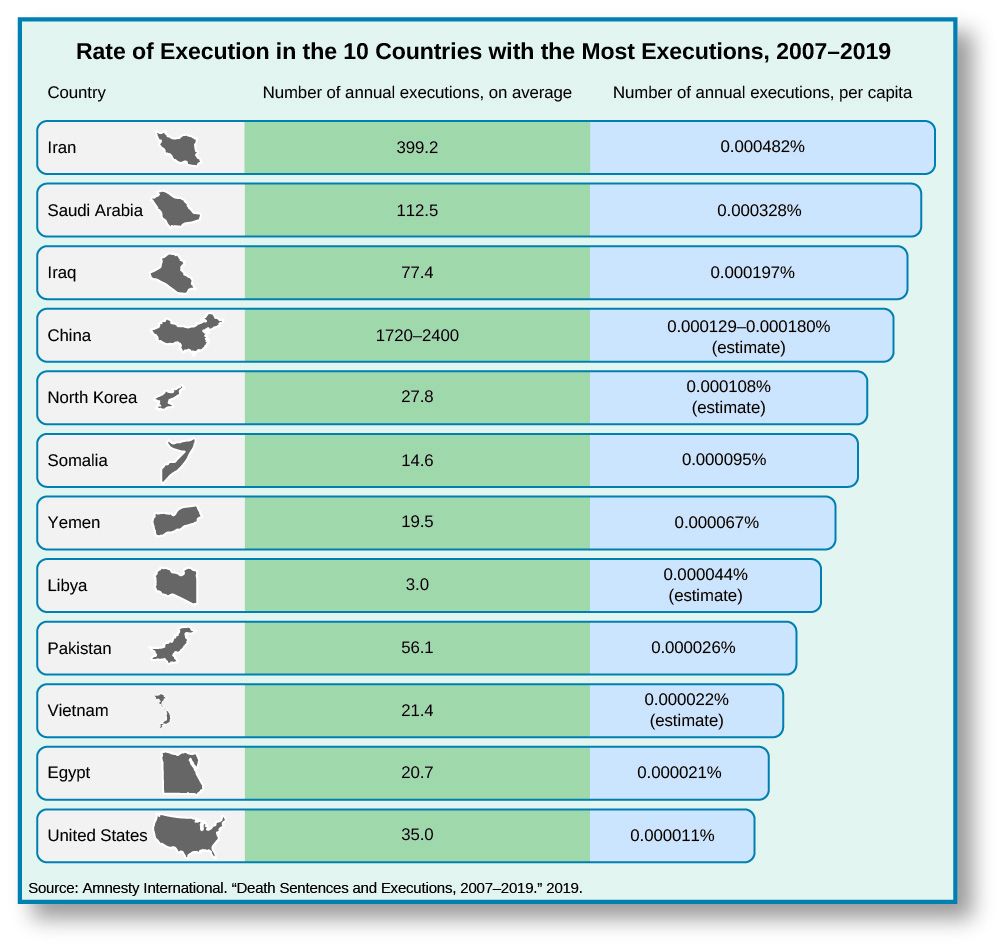
At the same time, however, it appears that the public mood may have shifted somewhat against the death penalty, perhaps due in part to an overall decline in violent crime. The reexamination of past cases through DNA evidence has revealed dozens in which people were wrongfully executed.[60] For example, Claude Jones was executed for murder based on 1990-era DNA testing of a single hair that was determined at that time to be his but that with better DNA testing technology was later found to be that of the victim.[61] Perhaps as a result of this and other cases, seven additional states have abolished capital punishment since 2007. As of 2015, nineteen states and the District of Columbia no longer apply the death penalty in new cases, and several other states do not carry out executions despite sentencing people to death.[62] It remains to be seen whether this gradual trend toward the elimination of the death penalty by the states will continue, or whether the Supreme Court will eventually decide to follow former Justice Harry Blackmun’s decision to “no longer… tinker with the machinery of death” and abolish it completely.
3.5 Interpreting the Bill of Rights
LEARNING OUTCOMES
By the end of this section, you will be able to:
- Describe how the Ninth and Tenth Amendments reflect on our other rights
- Identify the two senses of the “right to privacy” embodied in the Constitution
- Explain the controversy over privacy when applied to abortion and same-sex relationships
As this chapter has suggested, the provisions of the Bill of Rights have been interpreted and reinterpreted repeatedly over the past two centuries. However, the first eight amendments are largely silent on the status of traditional common law, which was the legal basis for many of the natural rights claimed by the framers in the Declaration of Independence. These amendments largely reflect the worldview of the time in which they were written. New technology, societal norms, and economic realities furnish challenges that fail to fit neatly into the framework established in the late eighteenth century.
In this section, we consider the final two amendments of the Bill of Rights and the way they affect our understanding of the Constitution as a whole. Rather than protecting specific rights and liberties, the Ninth and Tenth Amendments indicate how the Constitution and the Bill of Rights should be interpreted, and lay out the residual powers of the state governments. We will also examine privacy rights, an area the Bill of Rights does not address directly. Rather, the emergence of defined privacy rights demonstrates how the Ninth and Tenth Amendments have been applied to expand the scope of rights protected by the Constitution.
The Ninth Amendment
We saw above that James Madison and the other framers were aware they might endanger some rights if they listed a few in the Constitution and omitted others. To ensure that those interpreting the Constitution would recognize that the listing of freedoms and rights in the Bill of Rights was not exhaustive, the Ninth Amendment states:
“The enumeration in the Constitution, of certain rights, shall not be construed to deny or disparage others retained by the people.”
These rights “retained by the people” include the common-law and natural rights inherited from the laws, traditions, and past court decisions of England. To this day, we regularly exercise and take for granted rights that aren’t written down in the federal constitution, like the right to marry, the right to seek opportunities for employment and education, and the right to have children and raise a family. Supreme Court justices over the years have interpreted the Ninth Amendment in different ways, with some arguing that it was intended to extend the rights protected by the Constitution to those natural and common-law rights and others arguing that it does not prohibit states from changing their constitutions and laws to modify or limit those rights as they see fit.
Critics of a broad interpretation of the Ninth Amendment point out that the Constitution provides ways to protect newly formalized rights through the amendment process. For example, in the nineteenth and twentieth centuries, the right to vote was gradually expanded by a series of constitutional amendments (the Fifteenth and Nineteenth), even though at times this expansion was the subject of great public controversy. However, supporters of a broad interpretation of the Ninth Amendment point out that the rights of the people—particularly people belonging to political or demographic minorities—should not be subject to the whims of popular majorities. One right the courts have said may be at least partially based on the Ninth Amendment is a general right to privacy, discussed later in the chapter.
The Tenth Amendment
The Tenth Amendment is as follows:
“The powers not delegated to the United States by the Constitution, nor prohibited by it to the States, are reserved to the States respectively, or to the people.”
Unlike the other provisions of the Bill of Rights, this amendment focuses on power rather than rights. The courts have generally read the Tenth Amendment as merely stating, as Chief Justice Harlan Stone put it, a “truism that all is retained which has not been surrendered.”[63] In other words, rather than limiting the power of the federal government in any meaningful way, it simply restates what is made obvious elsewhere in the Constitution: the federal government has both enumerated and implied powers, but where the federal government does not (or chooses not to) exercise power, the states may do so. Others read this final “or” as capturing the essential question of U.S. political history: do the states who agreed to unite in a federal system remain sovereign, or once united, is it the federal government’s responsibility to protect the power of the people—including against states that might infringe upon them?
At times, politicians and state governments have argued that the Tenth Amendment means states can engage in interposition or nullification by blocking federal government laws and actions they deem to exceed the constitutional powers of the national government. But the courts have rarely been sympathetic to these arguments, except when the federal government appears to be directly requiring state and local officials to do something. For example, in 1997 the Supreme Court struck down part of a federal law that required state and local law enforcement to participate in conducting background checks for prospective gun purchasers, while in 2012 the court ruled that the government could not compel states to participate in expanding the joint state-federal Medicaid program by taking away all their existing Medicaid funding if they refused to do so.[64]
However, the Tenth Amendment also allows states to guarantee rights and liberties more fully or extensively than the federal government does, or to include additional rights. For example, many state constitutions guarantee the right to a free public education, several states give victims of crimes certain rights, and eighteen states include the right to hunt game and/or fish.[65] A number of state constitutions explicitly guarantee equal rights for men and women. Starting with Wyoming in 1869, some some states permitted women to vote before the Nineteenth Amendment secured the franchise for all women in 1920. Similarly, people aged 18–20 could vote in a few states before the Twenty-Sixth Amendment came into force in 1971. As we will see below, several states also explicitly recognize a right to privacy. State courts at times have interpreted state constitutional provisions to include broader protections for basic liberties than their federal counterparts. For example, though people do not generally have the right to free speech and assembly on private property owned by others without their permission, California’s constitutional protection of freedom of expression was extended to portions of some privately owned shopping centers by the state’s supreme court (Figure 3.18). [66]

These state protections do not extend the other way, however. If the federal government passes a law or adopts a constitutional amendment that restricts rights or liberties, or a Supreme Court decision interprets the Constitution in a way that narrows these rights, the state’s protection no longer applies. For example, if Congress decided to outlaw hunting and fishing and the Supreme Court decided this law was a valid exercise of federal power, the state constitutional provisions that protect the right to hunt and fish would effectively be meaningless. More concretely, federal laws that control weapons and drugs override state laws and constitutional provisions that otherwise permit them. While federal marijuana policies are not strictly enforced, state-level marijuana policies in Colorado and Washington provide a prominent exception to that clarity.
GET CONNECTED!
Student-Led Constitutional Change
Although the United States has not had a national constitutional convention since 1787, the states have generally been much more willing to revise their constitutions. In 1998, two politicians in Texas decided to do something a little bit different: they enlisted the help of college students at Angelo State University to draft a completely new constitution for the state of Texas, which was then formally proposed to the state legislature.[67] Although the proposal failed, it was certainly a valuable learning experience for the students who took part.
Each state has a different process for changing its constitution. In some, like California and Mississippi, voters can propose amendments to their state constitution directly, bypassing the state legislature. In others, such as Tennessee and Texas, the state legislature controls the process of initiation. The process can affect the sorts of amendments likely to be considered; it shouldn’t be surprising, for example, that amendments limiting the number of terms legislators can serve in office have been much more common in states where the legislators themselves have no say in whether such provisions are adopted.
What rights or liberties do you think ought to be protected by your state constitution that aren’t already? Or would you get rid of some of these protections instead? Find a copy of your current state constitution, read through it, and decide. Then find out what steps would be needed to amend your state’s constitution to make the changes you would like to see.
The Right to Privacy
Although the term privacy does not appear in the Constitution or Bill of Rights, scholars have interpreted several Bill of Rights provisions as an indication that James Madison and Congress sought to protect a common-law right to privacy as it would have been understood in the late eighteenth century: a right to be free of government intrusion into our personal life, particularly within the bounds of the home. For example, one could see the Second Amendment as standing for the common-law right to self-defense in the home; the Third Amendment as a statement that government soldiers should not be housed in anyone’s home; the Fourth Amendment as setting a high legal standard for allowing agents of the state to intrude on someone’s home; and the due process and takings clauses of the Fifth Amendment as applying an equally high legal standard to the government’s taking a home or property (reinforced after the Civil War by the Fourteenth Amendment). Alternatively, one could argue that the Ninth Amendment anticipated the existence of a common-law right to privacy, among other rights, when it acknowledged the existence of basic, natural rights not listed in the Bill of Rights or the body of the Constitution itself.[68] Lawyers Samuel D. Warren and Louis Brandeis (the latter a future Supreme Court justice) famously developed the concept of privacy rights in a law review article published in 1890.[69]
Although several state constitutions do list the right to privacy as a protected right, the explicit recognition by the Supreme Court of a right to privacy in the U.S. Constitution emerged only in the middle of the twentieth century. In 1965, the court spelled out the right to privacy for the first time in Griswold v. Connecticut, a case that struck down a state law forbidding even married individuals to use any form of contraception.[70] Although many subsequent cases before the Supreme Court also dealt with privacy in the course of intimate, sexual conduct, the issue of privacy matters as well in the context of surveillance and monitoring by government and private parties of our activities, movements, and communications. Both these senses of privacy are examined below.
Sexual Privacy
Although the Griswold case originally pertained only to married couples, in 1972 it was extended to apply the right to obtain contraception to unmarried people as well.[71] Although neither decision was entirely without controversy, the “sexual revolution” taking place at the time may well have contributed to a sense that anti-contraception laws were at the very least dated, if not in violation of people’s rights. The contraceptive coverage controversy surrounding the Hobby Lobby case shows that this topic remains relevant.
The Supreme Court’s application of the right to privacy doctrine to abortion rights proved far more problematic, legally and politically. In 1972, four states permitted abortions without restrictions, while thirteen allowed abortions “if the pregnant woman’s life or physical or mental health were endangered, if the fetus would be born with a severe physical or mental defect, or if the pregnancy had resulted from rape or incest”; abortions were completely illegal in Pennsylvania and heavily restricted in the remaining states.[72] On average, several hundred American women a year died as a result of “back alley abortions” in the 1960s.
The legal landscape changed dramatically as a result of the 1973 ruling in Roe v. Wade,[73] in which the Supreme Court decided the right to privacy encompassed a right for women to terminate a pregnancy, at least under certain scenarios. The justices ruled that while the government did have an interest in protecting the “potentiality of human life,” nonetheless this had to be balanced against the interests of both women’s health and women’s right to decide whether to have an abortion. Accordingly, the court established a framework for deciding whether abortions could be regulated based on the fetus’s viability (i.e., potential to survive outside the womb) and the stage of pregnancy, with no restrictions permissible during the first three months of pregnancy (i.e., the first trimester), during which abortions were deemed safer for women than childbirth itself.
Starting in the 1980s, Supreme Court justices appointed by Republican presidents began to roll back the Roe decision. A key turning point was the court’s ruling in Planned Parenthood v. Casey in 1992, in which a plurality of the court rejected Roe’s framework based on trimesters of pregnancy and replaced it with the undue burden test, which allows restrictions prior to viability that are not “substantial obstacle[s]” (undue burdens) to women seeking an abortion.[74] Thus, the court upheld some state restrictions, including a required waiting period between arranging and having an abortion, parental consent (or, if not possible for some reason such as incest, authorization of a judge) for minors, and the requirement that women be informed of the health consequences of having an abortion. Other restrictions such as a requirement that a married woman notify her spouse prior to an abortion were struck down as an undue burden. Since the Casey decision, many states have passed other restrictions on abortions, such as banning certain procedures, requiring women to have and view an ultrasound before having an abortion, and implementing more stringent licensing and inspection requirements for facilities where abortions are performed. Although no majority of Supreme Court justices has ever moved to overrule Roe, the restrictions on abortion the Court has upheld in the last few decades have made access to abortions more difficult in many areas of the country, particularly in rural states and communities along the U.S.–Mexico border (Figure 3.19). However, in Whole Woman’s Health v. Hellerstedt (2016), the Court reinforced Roe 5–3 by disallowing two Texas state regulations regarding the delivery of abortion services.[75] Yet, the issue is far from settled, as the Supreme Court decided in May 2021 to hear in their next term a Mississippi case that would roll back abortion rights considerably. The case would disallow abortions after fifteen weeks.[76]
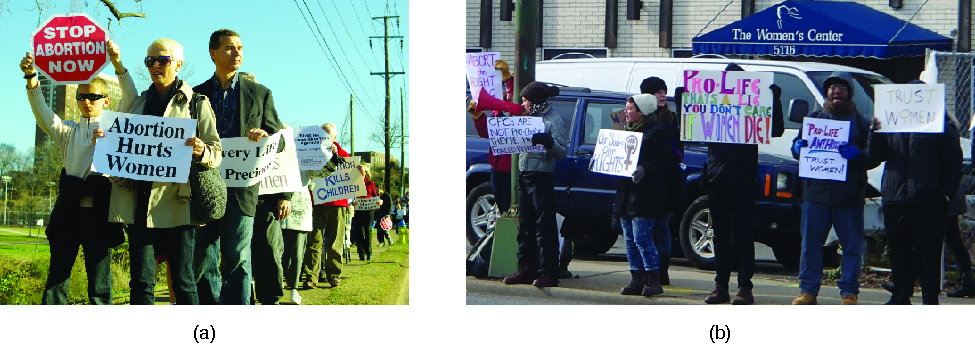
Beyond the issues of contraception and abortion, the right to privacy has been interpreted to encompass a more general right for adults to have noncommercial, consensual sexual relationships in private. However, this legal development is relatively new; as recently as 1986, the Supreme Court ruled that states could still criminalize sex acts between two people of the same sex.[77] That decision was overturned in 2003 in Lawrence v. Texas, which invalidated state laws that criminalized sodomy.[78]
The state and national governments still have leeway to regulate sexual morality to some degree; “anything goes” is not the law of the land, even for actions that are consensual. The Supreme Court has declined to strike down laws in a few states that outlaw the sale of vibrators and other sex toys. Prostitution remains illegal in every state except in certain rural counties in Nevada; both polygamy (marriage to more than one other person) and bestiality (sex with animals) are illegal everywhere. And, as we saw earlier, the states may regulate obscene materials and, in certain situations, material that may be harmful to minors or otherwise indecent; to this end, states and localities have sought to ban or regulate the production, distribution, and sale of pornography.
Privacy of Communications and Property
Another example of heightened concerns about privacy in the modern era is the reality that society is under pervasive surveillance. In the past, monitoring the public was difficult at best. During the Cold War, regimes in the Soviet bloc employed millions of people as domestic spies and informants in an effort to suppress internal dissent through constant monitoring of the general public. Not only was this effort extremely expensive in terms of the human and monetary capital it required, but it also proved remarkably ineffective. Groups like the East German Stasi and the Romanian Securitate were unable to suppress the popular uprisings that undermined communist one-party rule in most of those countries in the late 1980s.
Technology has now made it much easier to track and monitor people. Police cars and roadways are equipped with cameras that can photograph the license plate of every passing car or truck and record it in a database; while allowing police to recover stolen vehicles and catch fleeing suspects, this data can also be used to track the movements of law-abiding citizens. But law enforcement officials don’t even have to go to this much work; millions of car and truck drivers pay tolls electronically without stopping at toll booths thanks to transponders attached to their vehicles, which can be read by scanners well away from any toll road or bridge to monitor traffic flow or any other purpose (Figure 3.20). The pervasive use of GPS (Global Positioning System) raises similar issues.

Even pedestrians and cyclists are relatively easy to track today. Cameras pointed at sidewalks and roadways can employ facial recognition software to identify people as they walk or bike around a city. Many people carry smartphones that constantly report their location to the nearest cell phone tower and broadcast a beacon signal to nearby wireless hotspots and Bluetooth devices. Police can set up a small device called a Stingray that identifies and tracks all cell phones that attempt to connect to it within a radius of several thousand feet. With the right software, law enforcement and criminals can remotely activate a phone’s microphone and camera, effectively planting a bug in someone’s pocket without the person even knowing it.
These aren’t just gimmicks in a bad science fiction movie; businesses and governments have openly admitted they are using these methods. Research shows that even metadata—information about the messages we send and the calls we make and receive, such as time, location, sender, and recipient but excluding their content—can tell governments and businesses a lot about what someone is doing. Even when this information is collected in an anonymous way, it is often still possible to trace it back to specific individuals, since people travel and communicate in largely predictable patterns.
The next frontier of privacy issues may well be the increased use of drones, small preprogrammed or remotely piloted aircraft. Drones can fly virtually undetected and monitor events from overhead. They can peek into backyards surrounded by fences, and using infrared cameras they can monitor activity inside houses and other buildings. The Fourth Amendment was written in an era when finding out what was going on in someone’s home meant either going inside or peeking through a window; applying its protections today, when seeing into someone’s house can be as easy as looking at a computer screen miles away, is no longer simple.
In the United States, many advocates of civil liberties are concerned that laws such as the USA PATRIOT Act (i.e., Uniting and Strengthening America by Providing Appropriate Tools Required to Intercept and Obstruct Terrorism Act), passed weeks after the 9/11 attacks in 2001, have given the federal government too much power by making it easy for officials to seek and obtain search warrants or, in some cases, to bypass warrant requirements altogether. Critics have argued that the Patriot Act has largely been used to prosecute ordinary criminals, in particular drug dealers, rather than terrorists as intended. Most European countries, at least on paper, have opted for laws that protect against such government surveillance, perhaps mindful of past experience with communist and fascist regimes. European countries also tend to have stricter laws limiting the collection, retention, and use of private data by companies, which makes it harder for governments to obtain and use that data. Most recently, the battle between Apple Inc. and the National Security Agency (NSA) over whether Apple should allow the government access to key information that is encrypted has made the discussion of this tradeoff salient once again. A recent court outcome in the United States suggests that America may follow Europe’s lead. In Carpenter v. United States (2018), the first case of its kind, the U.S. Supreme Court ruled that, under the Fourth Amendment, police need a search warrant to gather phone location data as evidence to be used in trials.[79]
LINK TO LEARNING
Several groups lobby the government, such as The Electronic Frontier Foundation and The Electronic Privacy Information Center, on issues related to privacy in the information age, particularly on the Internet.
All this is not to say that technological surveillance tools do not have value or are inherently bad. They can be used for many purposes that would benefit society and, perhaps, even enhance our freedoms. Spending less time stuck in traffic because we know there’s been an accident—detected automatically because the cell phones that normally whiz by at the speed limit are now crawling along—gives us time to spend on more valuable activities. Capturing criminals and terrorists by recognizing them or their vehicles before they can continue their agendas will protect the life, liberty, and property of the public at large. At the same time, however, the emergence of these technologies means calls for vigilance and limits on what businesses and governments can do with the information they collect and the length of time they may retain it. We might also be concerned about how this technology could be used by more oppressive regimes. If the technological resources that are at the disposal of today’s governments had been available to the East Germany Stasi and the Romanian Securitate, would those repressive regimes have fallen? How much privacy and freedom should citizens sacrifice in order to feel safe?
3.6 First Attempt
Barron v. Baltimore (1833)
32 U.S. 243 (1833)
Vote: 6-0
Opinion: Marshall, joined by Johnson, Duvall, Story, Thompson, McLean and Baldwin
Mr. Chief Justice MARSHALL delivered the opinion of the Court.
… The plaintiff in error contends that it comes within that clause in the fifth amendment to the constitution, which inhibits the taking of private property for public use without just compensation. He insists that this amendment, being in favor of the liberty of the citizen, ought to be so construed as to restrain the legislative power of a state, as well as that of the United States. If this proposition be untrue, the court can take no jurisdiction of the cause.
The question thus presented is, we think, of great importance, but not of much difficulty. The Constitution was ordained and established by the people of the United States for themselves, for their own government, and not for the government of the individual States. Each State established a constitution for itself, and in that constitution provided such limitations and restrictions on the powers of its particular government as its judgment dictated. The people of the United States framed such a government for the United States as they supposed best adapted to their situation and best calculated to promote their interests. The powers they conferred on this government were to be exercised by itself, and the limitations on power, if expressed in general terms, are naturally, and we think necessarily, applicable to the government created by the instrument. They are limitations of power granted in the instrument itself, not of distinct governments framed by different persons and for different purposes.
If these propositions be correct, the fifth amendment must be understood as restraining the power of the General Government, not as applicable to the States.
The counsel for the plaintiff in error insists that the constitution was intended to secure the people of the several states against the undue exercise of power by their respective state governments; as well as against that which might be attempted by their general government …
…
If the original constitution, in the ninth and tenth sections of the first article, draws this plain and marked line of discrimination between the limitations it imposes on the powers of the general government, and on those of the states; if in every inhibition intended to act on state power, words are employed which directly express that intent; some strong, reason must be assigned for departing from this safe and judicious course in framing the amendments, before that departure can be assumed …
Had the people of the several states, or any of them, required changes in their constitutions; had they required additional safeguards to liberty from the apprehended encroachments of their particular governments the remedy was in their own hands, and would have been applied by themselves. A convention would have been assembled by the discontented state, and the required improvements would have been made by itself. The unwieldy and cumbrous machinery of procuring a recommendation from two-thirds of congress, and the assent of three-fourths of their sister states, could never have occurred to any human being as a mode of doing that which might be effected by the state itself. Had the framers of these amendments intended them to be limitations on the powers of the state governments, they would have initiated the framers of the original constitution, and have expressed that intention. Had congress engaged in the extraordinary occupation of improving the constitutions of the several states by affording the people additional protection from the exercise of power by their own governments in matters which concerned themselves alone, they would have declared this purpose in plain and intelligible language.
But it is universally understood, it is a part of the history of the day, that the great revolution which established the constitution of the United States, was not effected without immense opposition. Serious fears were extensively entertained that those powers which the patriot statesmen, who then watched over the interests of our country, deemed essential to union, and to the attainment of those invaluable objects for which union was sought, might be exercised in a manner dangerous to liberty. In almost every convention by which the constitution was adopted, amendments to-guard against the abuse of power were recommended. These amendments demanded security against the apprehended encroachments of the general government-not against those of the local governments.
In compliance with a sentiment thus generally expressed, to quiet fears thus extensively entertained, amendments were proposed by, the required majority in congress, and adopted by the states. These amendments contain no expression indicating an intention to apply them to the state governments. This court cannot so apply them.
We are of opinion that the provision in the fifth amendment to the constitution, declaring that private property shall not be taken for public use without just compensation, is intended solely as a limitation on the exercise of power by the government of the United States, and is not applicable to the legislation of the states. We are therefore of opinion that there is no repugnancy between the several acts of the general assembly of Maryland, given in evidence by the defendants at the trial of this cause, in the court of that state, and the constitution of the United States. This court, therefore, has no jurisdiction of the cause; and it is dismissed.
3.7 Second Attempt under the P&I Clause
Butchers’ Benevolent Association v. Crescent City Livestock Landing & Slaughterhouse Co. (1873)
111 U.S. 746 (1873)
Vote: 5-4
Decision: Reversed
Majority: J. Miller, joined by J. Clifford, J. Strong, J. Hunt, J. Davis
Dissent: J. Field, joined by J. Chase, J. Swayne, J. Bradley
Notes of Reporter before the Court:
See Butchers’ Benevolent Association v. Crescent City Livestock Landing & Slaughterhouse Co. (1873) for full disposition.
Mr. John A. Campbell, and also Mr. J. Q. A. Fellows, argued the case at much length and on the authorities, in behalf of the plaintiffs in error. The reporter cannot pretend to give more than such an abstract of the argument as may show to what the opinion of the court was meant to be responsive.
The learned counsel quoting Thiers, contended that ‘the right to one’s self, to one’s own faculties, physical and intellectual, one’s own brain, eyes, hands, feet, in a word to his soul and body, was an incontestable right; one of whose enjoyment and exercise by its owner no one could complain, and one which no one could take away. More than this, the obligation to labor was a duty, a thing ordained of God, and which if submitted to faithfully, secured a blessing to the human family.’
…
Now, the act of the Louisiana legislature was in the face of all these principles; it made it unlawful for men to use their own land for their own purposes; made it unlawful to any except the seventeen of this company to exercise a lawful and necessary business for which others were as competent as they, for which at least one thousand persons in the three parishes named had qualified themselves, had framed their arrangements in life, had invested their property, and had founded all their hopes of success on earth. The act was a pure MONOPOLY; as such against common right, and void at the common law of England. And it was equally void by our own law.
…
But if this monopoly were not thus void at common law, would be so under both the thirteenth and the fourteenth amendments.
…
Lest some competitor may present more tempting or convenient arrangements, the act directs that all of these shall be closed on a particular day, and prohibits any one from having, keeping, or establishing any other; and a peremptory command is given that all animals shall be sheltered, preserved, and protected by this corporation, and by none other, under heavy penalties.
Is not this ‘a servitude?’ Might it not be so considered in a strict sense? It is like the ‘thirlage’ of the old Scotch law and the banalites of seignioral France; which were servitudes undoubtedly. But, if not strictly a servitude, it is certainly a servitude in a more popular sense, and, being an enforced one, it is an involuntary servitude.
…
The act is even more plainly in the face of the fourteenth amendment. That amendment was a development of the thirteenth, and is a more comprehensive exposition of the principles which lie at the foundation of the thirteenth.
…
But the fourteenth amendment does define citizenship and the relations of citizens to the State and Federal government. It ordains that ‘all persons born or naturalized in the United States and subject to the jurisdiction thereof are citizens of the United States and of the State where they reside.’ Citizenship in a State is made by residence and without reference to the consent of the State. Yet, by the same amendment, when it exists, no State can abridge its privileges or immunities.
…
The States in their closest connection with the members of the State, have been placed under the oversight and restraining and enforcing hand of Congress. The purpose is manifest, to establish through the whole jurisdiction of the United States ONE PEOPLE, and that every member of the empire shall understand and appreciate the fact that his privileges and immunities cannot be abridged by State authority; that State laws must be so framed as to secure life, liberty, property from arbitrary violation and secure protection of law to all. Thus, as the great personal rights of each and every person were established and guarded, a reasonable confidence that there would be good government might seem to be justified. The amendment embodies all that the statesmanship of the country has conceived for accommodating the Constitution and the institutions of the country to the vast additions of territory, increase of the population, multiplication of States and Territorial governments, the annual influx of aliens, and the mighty changes produced by revolutionary events, and by social, industrial, commercial development. It is an act of Union, an act to determine the reciprocal relations of the millions of population within the bounds of the United States—the numerous State governments and the entire United States administered by a common government—that they might mutually sustain, support, and co-operate for the promotion of peace, security, and the assurance of property and liberty.
…
From whatever cause originating, or with whatever special and present or pressing purpose passed, the fourteenth amendment is not confined to the population that had been servile, or to that which had any of the disabilities or disqualifications arising from race or from contract …
The only question then is this: ‘When a State passes a law depriving a thousand people, who have acquired valuable property, and who, through its instrumentality, are engaged in an honest and necessary business, which they understand, of their right to use such their own property, and to labor in such their honest and necessary business, and gives a monopoly, embracing the whole subject, including the right to labor in such business, to seventeen other persons—whether the State has abridged any of the privileges or immunities of these thousand persons?’
…
MR. JUSTICE MILLER delivered the opinion of the court.
…
The appellee brought a suit in the Circuit Court to obtain an injunction against the appellant forbidding the latter from exercising the business of butchering, or receiving and landing livestock intended for butchering, within certain limits in the parishes of Orleans, Jefferson, and St. Bernard, and obtained such injunction by a final decree in that court …
The ground on which this suit was brought and sustained is that the plaintiffs had the exclusive right to have all such stock landed at their stock-landing place, and butchered at their slaughter-house, by virtue of an act of the General Assembly of Louisiana, approved March 8th, 1869, entitled, “An act to protect the health of the city of New Orleans, to locate the stock landing and slaughter-houses, and to incorporate the Crescent City Live-Stock Lauding and Slaughter-House Company.” …
The fact that it did so, and that this was conceded, was the basis of the contest in this court in the Slaughter-House Cases, 16 Wall. 36, in which the law was assailed as a monopoly forbidden by the thirteenth and fourteenth amendments to the Constitution of the United States, and these amendments as well as the fifteenth, came for the first time before this court for construction. The constitutional power of the State to enact the statute was upheld by this court. This power was placed by the court in that case expressly on the ground that it was the exercise of the police power which had remained with the States in the formation of the original Constitution of the United States, and had not been taken away by the amendments adopted since …
…
The appellant, however, insists that, so far as the act of 1869 partakes of the nature of an irrepealable contract, the legislature exceeded its authority, and it had no power to tie the hands of the legislature in the future from legislating on that subject without being bound by the terms of the statute then enacted. This proposition presents the real point in the case …
While we are not prepared to say that the legislature can make valid contracts on no subject embraced in the largest definition of the police power, we think that, in regard to two subjects so embraced, it cannot, by any contract, limited exercise of those powers to the prejudice of the general welfare. These are the public health and public morals. The preservation of these is so necessary to the best interests of social organization that a wise policy forbids the legislative body to divest itself of the power to enact laws for the preservation of health and the repression of crime.
It cannot be permitted that, when the Constitution of a State, the fundamental law of the land, has imposed upon its legislature the duty of guarding, by suitable laws, the health of its citizens, especially in crowded cities, and the protection of their person and property by suppressing and preventing crime, that the power which enables it to perform this duty can be sold, bargained away, under any circumstances, as if it were a mere privilege which the legislator could dispose of at his pleasure.
This principle has been asserted and repeated in this court in the last few years in no ambiguous terms …
But the case of the Fertilizing Company v. Hyde Park (1879), is, perhaps, more directly in point as regard the facts of the case, while asserting the same principle. … The opinion cites the language of the court in Beer Company v. Massachusetts, already copied here, and numerous other cases of the exercise of the police power in protecting health and property, and holds that the charter conferred no irrepealable right for the fifty years of its duration to continue a practice injurious to the public health.
These cases are all cited and their views adopted in the opinion of the Supreme Court of Louisiana in a suit between the same parties in regard to the same matter as the present case, and which was brought to this court by writ of error and dismissed before a hearing by the present appellee.
The result of these considerations is that the constitution of 1879 and the ordinances of the city of New Orleans, which are complained of, are not void as impairing the obligation of complainant’s contract, and that
The decree of the Circuit Court must be reversed, and the case remanded to that court with directions to dismiss the bill.
3.8 The Door Opens under the Due Process Clause
Chicago, Burlington & Quincy Railroad Co. v. City of Chicago (1897)
166 U.S. 226 (1897)
Vote: 7-1
Opinion: J. Harlan
Decision: Affirmed
Majority: J. Harlan, joined by J. Field, J. Gray, J. Brown, J. Shiras, J. White, J. Peckham
Dissent: J. Brewer
MR. JUSTICE HARLAN delivered the opinion of the court.
…
The constitution of Illinois provides that “no person shall be deprived of life, liberty or property, without due process of law.” Art. 2, § 2. It also provides: “Private property shall not be taken or damaged for public use without just compensation. Such compensation, when not made by the State, shall be ascertained by a jury, as shall be prescribed by law. The fee of land taken for railroad tracks, without consent of the owners thereof, shall remain in such owners, subject to the use for which it is taken.” …
By the fifth article of the general statute, of Illinois, approved April 10, 1872, and relating to the incorporation of cities and villages, it was provided that “the city council shall have power, by condemnation or otherwise, to extend any street, alley or highway over or across, or to construct any sewer under or through any railroad track, right of way or land of any railroad company (within the corporate limits); but where no compensation is made to such railroad company, the city shall restore such railroad track, right of way or land to its former state, or in a sufficient manner not to have impaired its usefulness.” …
The ninth article of the same statute declared that when the corporate authorities of a city or village provided by ordinance for the making of any local improvement authorized to be made, the making of which would require that private property be taken or damaged for public use, the city or village should file in its name a petition in some court of record of the county praying “that the just compensation to be made for private property to be taken or damaged” for the improvement or purpose specified in the ordinance be ascertained by a jury …
By an ordinance of the city council of Chicago approved October 9, 1880, it was ordained that Rockwell Street in that city be opened and widened from West 18th Street to West 19th Street by condemning therefor, in accordance with the above act of April 10, 1872, certain parcels of land owned by individuals, and also certain parts of the right of way in that city of the Chicago, Burlington and Quincy Railroad Company, a corporation of Illinois …
In execution of that ordinance a petition was filed by the city, November 12, 1890, in the Circuit Court of Cook County, Illinois, for the condemnation of the lots, pieces or parcels of land and property proposed to be taken or damaged for the proposed improvement, and praying that the just compensation required for private property taken or damaged be ascertained by a jury …
The parties interested in the property described in the petition, including the Chicago, Burlington and Quincy Railroad Company, were admitted as defendants in the proceeding. In their verdict the jury fixed the just compensation to be paid to the respective individual owners of the lots, pieces and parcels of land and property sought to be taken or damaged by the proposed improvements, and fixed one dollar as just compensation to the railroad company in respect of those parts of its right of way described in the city’s petition as necessary to be used for the purposes of the proposed street …
It is not contended, as it could not be, that the constitution of Illinois deprives the railroad company of any right secured by the Fourteenth Amendment. For the state constitution not only declares that no person shall be deprived of his property without due process of law, but that private property shall not be taken or damaged for public use without just compensation. But it must be observed that the prohibitions of the amendment refer to all the instrumentalities of the State, to its legislative, executive and judicial authorities, and, therefore, whoever by virtue of public position under a state government deprives another of any right protected by that amendment against deprivation by the State, “violates the constitutional inhibition; and as he acts in the name and for the State, and is clothed with the State’s power, his act is that of the State.” This must be so, or, as we have often said, the constitutional prohibition has no meaning, and “the State has clothed one of its agents with power to annul or evade it.” …
When the government, through its’ established agencies, interferes with the title to one’s property, or with his independent enjoyment of it, and its action is called in question as not in accordance with the law of the land, we are to test its validity by those principles of civil liberty and constitutional protection which have become established in our system of laws, and not generally by rules that pertain to forms of procedure merely. In judicial proceedings the law of the land requires a hearing before condemnation, and judgment before dispossession; but when property is appropriated by the government to public uses, or the legislature interferes to give direction to its title through remedial statutes, different considerations from those which regard the controversies between man and man must prevail, different proceedings are required, and we have only to see whether the interference can be justified by the established rules applicable to the special case. Due process of law in each particular case means such an exertion of the powers of government as the settled maxims of law permit and sanction, and under such safeguards for the protection of individual rights as those maxims prescribe for the class of cases to which the one in question belongs …
In every government there is inherent authority to appropriate the property of the citizen for the necessities of the State, and constitutional provisions do not confer the power, though they generally surround it with safeguards to prevent abuse. The restraints are, that when specific property is taken, a pecuniary compensation, agreed upon or determined by judicial inquiry, must be paid.” …
In our opinion, a judgment of a state court, even if it be authorized by statute, whereby private property is taken for the State or under its direction for public use, without compensation made or secured to the owner, is, upon principle and authority, wanting in the due process of law required by the Fourteenth Amendment of the Constitution of the United States, and the affirmance of such judgment by the highest court of the State is a denial by that State of a right secured to the owner by that instrument …
It is further contended that the railroad company was denied the equal protection of the laws in that by the final judgment individual property owners were awarded, as compensation for contiguous property appropriated to the public use by the same proceeding, the value of their land taken, while only nominal compensation was given to the company-the value of its land, simply as land, across which the street was opened, not being taken into account. This contention is without merit. Compensation was awarded to individual owners upon the basis of the value of the property actually taken, having regard to the uses for which it was best adapted and the purposes for which it was held and used and was likely always to be used. Compensation was awarded to the railroad company upon the basis of the value of the thing actually appropriated by the public … In the case of individual owners, they were deprived of the entire use and enjoyment of their property, while the railroad company was left in the possession and use of its property for the purposes for which it was being used and for which it was best adapted, subject only to the right of the public to have a street across it. In this there was no denial of the equal protection of the laws …
We have examined all the questions of law arising on the record of which this court may take cognizance, and which, in our opinion, are of sufficient importance to require notice at our hands, and finding no error, the judgment is Affirmed.
3.9 Two Track Incorporation
Hurtado v. California (1884)
110 U.S. 516 (1884)
Vote: 7-1
Opinion: J. Matthews
Decision: Affirmed
Majority: J. Matthews, joined by J. Waite, J. Miller, J. Bradley, J. Woods, J. Gray, J. Blatchford
Dissent: J. Harlan
MR. Justice Matthews delivered the opinion of the court.
…
It is claimed on behalf of the prisoner that the conviction and sentence are void, on the ground that they are repugnant to that clause of the Fourteenth Article of Amendment of the Constitution of the United States which is in these words: ‘Nor shall any state deprive any person of life, liberty, or property without due process of law.’
The proposition of law we are asked to affirm is that an indictment or presentment by a grand jury, as known to the common law of England, is essential to that “due process of law,” when applied to prosecutions for felonies, which is secured and guaranteed by this provision of the Constitution of the United States, and which accordingly it is forbidden to the States respectively to dispense with in the administration of criminal law.
The question is one of grave and serious import, affecting both private and public rights and interests of great magnitude, and involves a consideration of what additional restrictions upon the legislative policy of the States has been imposed by the Fourteenth Amendment to the Constitution of the United States …
…
On the other hand, it is maintained on behalf of the plaintiff in error that the phrase “due process of law” is equivalent to “law of the land,” as found in the 29th chapter of Magna Charta; that, by immemorial usage, it has acquired a fixed, definite, and technical meaning; that it refers to and includes not only the general principles of public liberty and private right which lie at the foundation of all free government, but the very institutions which, venerable by time and custom, have been tried by experience and found fit and necessary for the preservation of those principles, and which, having been the birthright and inheritance of every English subject, crossed the Atlantic with the colonists and were transplanted and established in the fundamental laws of the State; that, having been originally introduced into the Constitution of the United States as a limitation upon the powers of the government, brought into being by that instrument, it has now been added as an additional security to the individual against oppression by the States themselves; that one of these institutions is that of the grand jury, an indictment or presentment by which against the accused in cases of alleged felonies is an essential part of due process of law in order that he may not be harassed or destroyed by prosecutions founded only upon private malice or popular fury.
… it may be said that Lord Coke himself explains his own meaning by saying ‘the law of the land,’ as expressed in Magna Charta, was intended due process of law, that is, by indictment or presentment of good and lawful men.
It is quite apparent from these extracts that the interpretation usually put upon Lord Coke’s statement is too large, because if an indictment or presentment by a grand jury is essential to due process of law in all cases of imprisonment for crime, it applies not only to felonies but to misdemeanors and petty offences, and the conclusion would be inevitable that information as a substitute for indictments would be illegal in all cases …
…
When we add to this that the primitive grand jury heard no witnesses in support of the truth of the charges to be preferred, but presented upon their own knowledge, or indicted upon common fame and general suspicion, we shall be ready to acknowledge that it is better not to go too far back into antiquity for the best securities for our “ancient liberties.” It is more consonant to the true philosophy of our historical legal institutions to say that the spirit of personal liberty and individual right, which they embodied, was preserved and developed by a progressive growth and wise adaptation to new circumstances and situations of the forms and processes found fit to give, from time to time, new expression and greater effect to modern ideas of self-government …
The Constitution of the United States was ordained, it is true, by descendants of Englishmen, who inherited the traditions of English law and history; but it was made for an undefined and expanding future, and for a people gathered and to be gathered from many nations and of many tongues. And while we take just pride in the principles and institutions of the common law, we are not to forget that in lands where other systems of jurisprudence prevail, the ideas and processes of civil justice are also not unknown. Due process of law, in spite of the absolutism of continental governments, is not alien to that code which survived the Roman Empire as the foundation of modern civilization in Europe, and which has given us that fundamental maxim of distributive justice-suum cuique tribuere. There is nothing in Magna Charta, rightly construed a broad charter of public right and law, which ought to exclude the best ideas of all systems and of every age; and as it was the characteristic principle of the common law to draw its inspiration from every fountain of justice, we are not to assume that the sources of its supply have been exhausted. On the contrary, we should expect that the new and various experiences of our own situation and system will mould and shape it into new and not less useful forms …
In this country written constitutions were deemed essential to protect the rights and liberties of the people against the encroachments of power delegated to their governments, and the provisions of Magna Charta were incorporated into Bills of Rights. They were limitations upon all the powers of government, legislative as well as executive and judicial …
Tried by these principles, we are unable to say that the substitution for a presentment or indictment by a grand jury of the proceeding by information, after examination and commitment by a magistrate, certifying to the probable guilt of the defendant, with the right on his part to the aid of counsel, and to the cross-examination of the witnesses produced for the prosecution, is not due process of law. It is, as we have seen, an ancient proceeding at common law, which might include every case of an offence of less grade than a felony, except misprision of treason; and in every circumstance of its administration, as authorized by the statute of California, it carefully considers and guards the substantial interest of the prisoner. It is merely a preliminary proceeding, and can result in no final judgment, except as the consequence of a regular judicial trial, conducted precisely as in cases of indictment …
For these reasons, finding no error therein, the judgment of the Supreme Court of California is
Affirmed.
Maxwell v. Dow (1900)
176 U.S. 581 (1900)
Vote: 8-1
Opinion: J. Peckham
Decision: Affirmed
Majority: Peckham, joined by Fuller, Gray, Brewer, Brown, Shiras, White, McKenna
Dissent: J. Harlan
MR. JUSTICE PECKHAM delivered the opinion of the court.
…
On the 27th of June, 1898, an information was filed against the plaintiff in error by the prosecuting attorney of the county, in a state court of the State of Utah, charging him with the crime of robbery committed within the county in May, 1898. In September, 1898, he was tried before a jury composed of but eight jurors, and convicted and sentenced to imprisonment in the state prison for eighteen years, and since that time has been confined in prison, undergoing the sentence of the state court.
In May, 1899, he applied to the Supreme Court of the State for a writ of habeas corpus, and alleged in his sworn petition that he was a natural-born citizen of the United States, and that his imprisonment was unlawful, because he was prosecuted under an information instead of by indictment by a grand jury, and was tried by a jury composed of eight instead of twelve jurors. He specially set up and claimed (1) that to prosecute him by information abridged his privileges and immunities as a citizen of the United States, under article 5 of the amendments to the Constitution of the United States, and also violated section 1 of article 14 of those amendments; (2) that a trial by jury of only eight persons abridged his privileges and immunities as a citizen of the United States, under article 6, and also violated section 1 of article 14 of such amendments; (3) that a trial by such a jury and his subsequent imprisonment by reason of the verdict of that jury deprived him of his liberty without due process of law, -in violation of section 1 of article 14, which provides that no State shall deprive any person of life, liberty or, property, without due process of law …
The questions to be determined in this court are, (1) as to the validity, with reference to the Federal Constitution, of the proceeding against the plaintiff in error on an information instead of by an indictment by a grand jury; and (2) the validity of the trial of the plaintiff in error by a jury composed of eight instead of twelve jurors …
In a Federal court no person can be held to answer for a capital or otherwise infamous crime unless by indictment by a grand jury, with the exceptions stated in the Fifth Amendment. Yet this amendment was held in the Hurtado case not to apply to a prosecution for murder in a state court pursuant to a state law. The claim was made in the case (and referred to in the opinion) that the adoption of the Fourteenth Amendment provided an additional security to the individual against oppression by the States themselves, and limited their powers to the same extent as the amendments theretofore adopted had limited the powers of the Federal Government. By holding that the conviction ‘upon an information was valid, the court necessarily held that an indictment was not necessary … To the other objection, that a conviction upon an information deprives a person of his liberty without due process of law, the Hurtado case is, as we have said, a complete and conclusive answer.
…
It would seem to be quite plain that the provision in the Utah constitution for a jury of eight jurors in all state criminal trials, for other than capital offences, violates the Sixth Amendment, provided that amendment is now to be construed as applicable to criminal prosecutions of citizens of the- United States in state courts …
It is conceded that there are certain privileges or immunities possessed by a citizen of the United States, because of his citizenship, and that they cannot be abridged by any action of the States. In order to limit the powers which it was feared might be claimed or exercised by the Federal Government, under the’ provisions of the Constitution as it was when adopted, the first ten amendments to that instrument were proposed to the legislatures of the several States by the first Congress on the 25th of September, 1789. They were intended as restraints and limitations upon the powers of the General Government, and were not intended to and did not have any effect upon the powers of the respective States. This has been many times decided. The cases herewith cited are to that effect, and they cite many others which decide the same matter. Spies v. Illinois (1887) [other citations omitted].
It is claimed, however, that since the adoption of the Fourteenth Amendment the effect of the former amendments has been thereby changed and greatly enlarged. It is now urged in substance that all the provisions contained in the first ten amendments, so far as they secure and recognize the fundamental rights of the individual as against the exercise of Federal power, are by virtue of this amendment to be regarded as privileges or immunities of a citizen of the United States, and, therefore, the States cannot provide for any procedure in state courts which could not be followed in a Federal court because of the limitations contained in those amendments …
That the primary reason for that amendment was to secure the full enjoyment of liberty to the colored race is not denied, yet it is not restricted to that purpose, and it applies to every one, white or black, that comes within its provisions. But, as said in the Slaughter-house Cases, the protection of the citizen in his rights as a citizen of the State still remains with the State … But if all these rights are included in the phrase “privileges and immunities”‘ of citizens of the United States, which the States by reason of the Fourteenth Amendment cannot in any manner abridge, then the sovereignty of the State in regard to them has been entirely destroyed, and the Slaughter-house Cases, and United States v. Cruikshank are all wrong, and should be overruled …
In the case of a constitutional amendment it is of less materiality than in that of an ordinary bill or resolution. A constitutional amendment must be agreed to, not only by Senators and Representatives, but it must be ratified by the legislatures, or by conventions, in three fourths of the States before such amendment can take effect. The safe way is to read its language in connection with the known condition of affairs out of which the occasion for its adoption may have arisen, and then to construe it, if there be therein any doubtful expressions, in a way so far as is reasonably possible, to forward the known purpose or object for which the amendment was adopted. This rule could not, of course, be so used as to limit the force and effect of an amendment in a manner which the plain and unambiguous language used therein would not justify or permit.
For the reasons stated, we come to the conclusion that the clause under consideration does not affect the validity of the Utah constitution and legislation.
The remaining question is, whether in denying the right of an individual, in all criminal cases not capital, to have a jury composed of twelve jurors, the State deprives him of life, liberty or property, without due process of law.
This question is, as we believe, substantially answered by the reasoning of the opinion in the Hurtado case, supra. The distinct question was there presented whether it was due process of law to prosecute a person charged with murder by an information under the state constitution and law. It was held that it was, and that the Fourteenth Amendment did not prohibit such a procedure. In our opinion the right to be exempt from prosecution for an infamous crime, except upon a presentment by a grand jury, is of the same nature as the right to a petit jury of the number fixed by the common law. If the State have the power to abolish the grand jury and the consequent proceeding by indictment, the same course of reasoning which establishes that right will and does establish the right to alter the number of the petit jury from that provided by the common law. Hodgson v. Vermont (1897) [other citations omitted].
Trial by jury has never been affirmed to be a necessary requisite of due process of law. In pot one of the cases cited and commented upon in the Hurtado case is a trial by jury mentioned as a necessary part of such process …
Judged by the various cases in this court we think there is no error in this record, and the judgment of the Supreme Court of Utah must, therefore, be Affirmed.
MR. JUSTICE HARLAN, dissenting.
…
What are the privileges and immunities of “citizens of the United States”? Without attempting to enumerate them, it ought to be deemed safe to say that such privileges and immunities embrace at least those expressly recognized by the Constitution of the United States and placed beyond the power of Congress to take away or impair …
It seems to me that the privileges and immunities enumerated in these amendments belong to every citizen of the United States. They were universally so regarded prior to the adoption of the Fourteenth Amendment. In order to form a more perfect union, establish justice, insure domestic tranquility, provide for the common defense, promote the general welfare and secure the blessings of liberty to themselves and their posterity, the political community known as the People of the United States ordained and established the Constitution of the United States; and every member of that political community was a citizen of the United States. It was that community that adopted, in the mode prescribed by the Constitution, the first ten amendments; and what they had in view by so doing was to make it certain that the privileges and immunities therein specified -the enjoyment of which, the fathers believed, were necessary in order to secure the blessings of liberty could never be impaired or destroyed by the National Government …
I am also of opinion that the trial of the accused for the crime charged against him by a jury of eight persons was not consistent with the “due process of law” prescribed by the Fourteenth Amendment. Referring to the words in the Fifth Amendment, that “no person shall be deprived of life, liberty or property without due process of law,” this court said in Murray’s Lessee v. Hoboken: “The Constitution contains no description of those processes which it was intended to allow or forbid. It does not even declare what principles are to be applied to ascertain whether it be due process. It was manifest that it was not left to the legislative power to enact any process which might be devised. The article is a restraint on the legislative as well as on the executive and judicial powers of the Government, and cannot be so construed as to leave Congress free to make any process ‘due process of law’ by its mere will. To what principles are we to resort to ascertain whether this process enacted by Congress is due process? To this the answer must be twofold. We must examine the Constitution itself to see whether this process be in conflict with any of its provisions. If not found to be so, we must look to those settled usages and modes of proceeding existing in the common and statute law of England before the emigration of our ancestors, and which are shown not to have been unsuited to their civil and political condition by having been acted on by them after the settlement ‘of this country.” …
The right to be tried when charged with crime by a jury of twelve person is placed by the Constitution upon the same basis as the other rights specified in the first ten amendments. And while those amendments originally limited only the powers of the National Government in respect of the privileges and immunities specified therein, since the adoption of the Fourteenth Amendment those privileges and immunities are, in my opinion, also guarded against infringement by the States …
If some of the guarantees of life, liberty and property which at the time of the adoption of the National Constitution were regarded as fundamental and as absolutely essential to the enjoyment of freedom, have in the judgment of some ceased to be of practical value, it is for the people of the United States so to declare by an amendment of that instrument. But, if I do not wholly misapprehend the scope and legal effect of the present decision, the Constitution of the United States does not stand in the way of any State striking down guarantees of life and liberty that English speaking people have for centuries regarded as vital to personal security, and which the men of the Revolutionary period universally claimed as the birthright of freemen.
I dissent from the opinion and judgment of the court.
Gitlow v. NY (1925)
268 U.S. 652 (1925)
Vote: 7-2
Opinion: J. Sanford
Decision: Affirmed
Majority: J. Sanford, joined by J. Taft, J. Van Devanter, J. McReynolds, J. Sutherland, J. Butler, J. Stone
Dissent: J. Holmes, joined by J. Brandeis
MR. JUSTICE SANFORD delivered the opinion of the Court.
…
Benjamin Gitlow was indicted in the Supreme Court of New York, with three others, for the statutory crime of criminal anarchy. New York Penal Laws, §§ 160, 161. He was separately tried, convicted, and sentenced to imprisonment. The judgment was affirmed by the Appellate Division and by the Court of Appeals. 195 App. Div. 773; 234 N. Y. 132 and 539. The case is here on writ of error to the Supreme Court, to which the record was remitted …
The contention here is that the statute, by its terms and as applied in this case, is repugnant to the due process clause of the Fourteenth Amendment. Its material provisions are:
“§ 160. Criminal anarchy defined. Criminal anarchy is the doctrine that organized government should be overthrown by force or violence, or by assassination of the executive head or of any of the executive officials of government, or by any unlawful means. The advocacy of such doctrine either by word of mouth or writing is a felony …
The defendant is a member of the Left Wing Section of the Socialist Party, a dissenting branch or faction of that party formed in opposition to its dominant policy of” moderate Socialism.” Membership in both is open to aliens as well as citizens. The Left Wing Section was organized nationally at a conference in New York City in June, 1919, attended by ninety delegates from twenty different States. The conference elected a National Council, of which the defendant was a member, and left to it the adoption of a “Manifesto.” This was published in The Revolutionary Age, the official organ of the Left Wing. The defendant was on the board of managers of the paper and was its business manager. He arranged for the printing of the paper and took to the printer the manuscript of the first issue which contained the Left Wing Manifesto, and also a Communist Program and a Program of the Left Wing that had been adopted by the conference. Sixteen-thousand copies were printed, which were delivered at the premises in New York City used as the office of the Revolutionary Age and the headquarters of the Left Wing, and occupied by the defendant and other officials. These copies were paid for by the. defendant, as business manager of the paper. Employees at this office wrapped and mailed out copies of the paper under the defendant’s direction; and copies were sold from this office. It was admitted that the defendant signed a card subscribing to the Manifesto and Program of the Left Wing, which all applicants were required to sign before being admitted to membership; that he went to different parts of the State to speak to branches of the Socialist Party about the principles of the Left Wing and advocated their adoption; and that he was responsible for the Manifesto as it appeared, that “he knew of the publication, in a general way and he knew of its publication afterwards, and is responsible for its circulation.” …
The precise question presented, and the only question which we can consider under this writ of error, then is, whether the statute, as construed and applied in this case by the state courts, deprived the defendant of his liberty of expression in violation of the due process clause of the Fourteenth Amendment …
The statute does not penalize the utterance or publication of abstract “doctrine” or academic discussion having no quality of incitement to any concrete action. It is not aimed against mere historical or philosophical essays. It does not restrain the advocacy of changes in the form of government by constitutional and lawful means. What it prohibits is language advocating, advising or teaching the overthrow of organized government by unlawful means. These words imply urging to action …
The Manifesto, plainly, is neither the statement of abstract doctrine nor, as suggested by counsel, mere prediction that industrial disturbances and revolutionary mass strikes will result spontaneously in an inevitable process of evolution in the economic system. It advocates and urges in fervent language mass action which shall progressively foment industrial disturbances and through political mass strikes and revolutionary mass action overthrow and destroy organized parliamentary government. It concludes with a call to action in these words: “The proletariat revolution and the Communist reconstruction of society-the struggle for these-is now indispensable …
For present purposes we may and do assume that freedom of speech and of the press-which are protected by the First Amendment from abridgment by Congress are among the fundamental personal rights and “liberties” protected by the due process clause of the Fourteenth Amendment from impairment by the States …
It is a fundamental principle, long established, that the freedom of speech and of the press which is secured by the Constitution, does not confer an absolute right to speak or publish, without responsibility, whatever one may choose, or an unrestricted and unbridled license that gives immunity for every possible use of language and prevents the punishment of those who abuse this freedom …
That a State in the exercise of its police power may punish those who abuse this freedom by utterances inimical to the public welfare, tending to corrupt public morals, incite to crime, or disturb the public peace, is not open to question …
And, for yet more imperative reasons, a State may punish utterances endangering the foundations of organized government and threatening its overthrow by unlawful means. These imperil its own existence as a constitutional State. Freedom of speech and press, said Story (supra) does not protect disturbances to the public peace or the attempt to subvert the government. It does not protect publications or teachings which tend to subvert or imperil the government or to impede or hinder it in the performance of its governmental duties …
It does not protect publications prompting the overthrow of government by force; the punishment of those who publish articles which tend to destroy organized society being essential to the security of freedom and the stability of the State …
That utterances inciting to the overthrow of organized government by unlawful means, present a sufficient danger of substantive evil to bring their punishment within the range of legislative discretion, is clear. Such utterances, by their very nature, involve danger to the public peace and to the security of the State. They threaten breaches of the peace and ultimate revolution. And the immediate danger is none the less real and substantial, because the effect of a given utterance cannot be accurately foreseen. The State cannot reasonably be required to measure the danger from every such utterance in the nice balance of a jeweler’s scale. A single revolutionary spark may kindle a fire that, smouldering for a time, may burst into a sweeping and destructive conflagration. It cannot be said that the State is acting arbitrarily or unreasonably when in the exercise of its judgment as to the measures necessary to protect the public peace and safety, it seeks to extinguish the spark without waiting until it has enkindled the flame or blazed into the conflagration. It cannot reasonably be required to defer the adoption of measures for its own peace and safety until the revolutionary utterances lead to actual disturbances of the public peace or imminent and immediate danger of its own destruction; but it may, in the exercise of its judgment, suppress the threatened danger in its incipiency …
We cannot hold that the present statute is an arbitrary or unreasonable exercise of the police power of the State unwarrantably infringing the freedom of speech or press; and we must and do sustain its constitutionality.
This being so it may be applied to every utterance not too trivial to be beneath the notice of the law-which is of such a character and used with such intent and purpose as to bring it within the prohibition of the statute … In other words, when the legislative body has determined generally, in the constitutional exercise of its discretion, that utterances of a certain kind involve such danger of substantive evil that they may be punished, the question whether any specific utterance coming within the prohibited class is likely, in and of itself, to bring about the substantive evil, is not open to consideration. It is sufficient that the statute itself be constitutional and that the use of the language comes within its prohibition …
We need not enter upon a consideration of the English common law rule of seditious libel or the Federal Sedition Act of 1798, to which reference is made in the defendant’s brief. These are so unlike the present statute, that we think the decisions under them cast no helpful light upon the questions here.
And finding, for the reasons stated, that the statute is not in itself unconstitutional, and that it has not been applied in the present case in derogation of any constitutional right, the judgment of the Court of Appeals is
Affirmed.
Palko v. Connecticut (1947)
302 U.S. 319 (1947)
Vote: 7-1
Opinion: J. Cardozo
Decision: Affirmed
Majority: J. Cardozo, joined by J. McReynolds, J. Brandeis, J. Sutherland, J. Stone, J. Roberts, J. Black
Dissent: J. Butler
MR. JUSTICE CARDOZO delivered the opinion of the Court.
…
Appellant was indicted in Fairfield County, Connecticut, for the crime of murder in the first degree. A jury found him guilty of murder in the second degree, and he was sentenced to confinement in the state prison for life. Thereafter the State of Connecticut, with the permission of the judge presiding at the trial, gave notice of a plea to the Supreme Court of Errors …
Upon such appeal, the Supreme Court of Errors reversed the judgment and ordered a new trial. State v. Palko, 121 Conn. 669; 186 Atl. 657. It found that there had been error of law to the prejudice of the state (1) in excluding testimony as to a confession by defendant; (2) in excluding testimony upon cross-examination of defendant to impeach his credibility, and (3) in the instructions to the jury as to the difference between first and second degree murder …
Pursuant to the mandate of the Supreme Court of Errors, defendant was brought to trial again. Before a jury was impaneled and also at later stages of the case he made the objection that the effect of the new trial was to place him twice in jeopardy for the same offense, and in so doing to violate the Fourteenth Amendment of the Constitution of the United States …
The argument for appellant is that whatever is forbidden by the Fifth Amendment is forbidden by the Fourteenth also. The Fifth Amendment, which is not directed to the states, but Solely to the federal government, creates immunity from double jeopardy. No person shall be “subject for the same offense to be twice put in jeopardy of life or limb.” The Fourteenth Amendment ordains, “nor shall any State deprive any person of life, liberty, or property, without due process of law.” To retry a defendant, though under one indictment and only one, subjects him, it is said, to double jeopardy in violation of the Fifth Amendment, if the prosecution is one on behalf of the United States. From this the consequence is said to follow that there is a denial of life or liberty without due process of law, if the prosecution is one on behalf of the People of a State …
We have said that, in appellant’s view, the Fourteenth Amendment is to be taken as embodying the prohibitions of the Fifth. His thesis is even broader. Whatever would be a violation of the original bill of rights (Amendments I to VIII) if done by the federal government is now equally unlawful by force of the Fourteenth Amendment if done by a state. There is no such general rule.
The Fifth Amendment provides, among other things, that no person shall be held to answer for a capital or otherwise infamous crime unless on presentment or indictment of a grand jury. This court has held that, in prosecutions by a state, presentment or indictment by a grand jury may give way to informations at the instance of a public officer … On the other hand, the due process clause of the Fourteenth Amendment may make it unlawful for a state to abridge by its statutes the freedom of speech which the First Amendment safeguards against encroachment by the Congress, De Jonge v. Oregon (1937) [other citations omitted], or the like freedom of the press, Grosjean v. American Press Co. (1936) [other citations omitted], or the free exercise of religion, Hamilton v. Regents (1934) [other citations omitted] … In these and other situations immunities that are valid as against the federal government by force of the specific pledges of particular amendments have been found to be implicit in the concept of ordered liberty, and thus, through the Fourteenth Amendment, become valid as against the states …
The line of division may seem to be wavering and broken if there is a hasty catalogue of the cases on the one side and the other. Reflection and analysis will induce a different view. There emerges the perception of a rationalizing principle which gives to discrete instances a proper order and coherence. The right to trial by jury and the immunity from prosecution except as the result of an indictment may have value and importance. Even so, they are not of the very essence of a scheme of ordered liberty. To abolish them is not to violate a “principle of justice so rooted in the traditions and conscience of our people as to be ranked as fundamental.” Snyder v. Massachusetts (1934) [other citations omitted] … Few would be so narrow or provincial as to maintain that a fair and enlightened system of justice would be impossible without them. What is true of jury trials and indictments is true also, as the cases show, of the immunity from compulsory self-incrimination. Twining v. New Jersey (1908). This too might be lost, and justice still be done. Indeed, today as in the past there are students of our penal system who look upon the immunity as a mischief rather than a benefit, and who would limit its scope, or destroy it altogether! No doubt there would remain the need to give protection against torture, physical or mental. Justice, however, would not perish if the accused were subject to a duty to respond to orderly inquiry. The exclusion of these immunities and privileges from the privileges and immunities protected against the action of the states has not been arbitrary or casual. It has been dictated by -a study and appreciation of the meaning, the essential implications, of liberty itself …
We reach a different plane of social and moral values when we pass to the privileges and immunities that have been taken over from the earlier articles of the federal bill of rights and brought within the Fourteenth Amendment by a process of absorption. These in their origin were effective against the federal government alone. If the Fourteenth Amendment has absorbed them, the process of absorption has had its source in the belief that neither liberty nor justice would exist if they were sacrificed …
Our survey of the cases serves, we think, to justify the statement that the dividing line between them, if not unfaltering throughout its course, has been true for the most part to a unifying principle. On which side of the line the case made out by the appellant has appropriate location must be the next inquiry and the final one. Is that kind of double jeopardy to which the statute has subjected him a hardship so acute and shocking that our polity will not endure it? Does it violate those “fundamental principles of liberty and justice which lie at the base of all our civil and political institutions”? The answer surely must be “no.” What the answer would have to be if the state were permitted after a trial free from error to try the accused over again or to bring another case against him, we have no occasion to consider. We deal with the statute before us and no other. The state is not attempting to wear the accused out by a multitude of cases with accumulated trials. It asks no more than this, that the case against him shall go on until there shall be a trial free from the corrosion of substantial legal error. State v. Felch (1918). This is not cruelty at all, nor even vexation in any immoderate degree. If the trial had been infected with error adverse to the accused, there might have been review at his instance, and as often as necessary to purge the vicious taint. A reciprocal privilege, subject at all times to the discretion of the presiding judge, State v. Carabetta (1927), has now been granted to the state. There is here no seismic innovation. The edifice of justice stands, its symmetry, to many, greater than before …
The conviction of appellant is not in derogation of any privileges or immunities that belong to him as a citizen of the United States.
There is argument in his behalf that the privileges and immunities clause of the Fourteenth Amendment as well as the due process clause has been flouted by the judgment … gives all the answer that is necessary.
The judgment is
Affirmed.
Wolf v. Colorado (1949)
338 U.S. 25 (1949)
Vote: 6-3
Opinion: J. Frankfurter
Decision: Affirmed
Majority: J. Frankfurter, joined by J. Vinson, J. Reed, J. Jackson, J. Burton
Concurring: J. Black
Dissent: J. Murphy, joined by J. Rutledge, and J. Douglas
MR. JUSTICE FRANKFURTER delivered the opinion of the Court.
The precise question for consideration is this: Does a conviction by a State court for a State offense deny the “due process of law” required by the Fourteenth Amendment, solely because evidence that was admitted at the trial was obtained under circumstances which would have rendered it inadmissible in a prosecution for violation of a federal law in a court of the United States because there deemed to be an infraction of the Fourth Amendment as applied in Weeks v. United States (1914)?…
The notion that the “due process of law” guaranteed by the Fourteenth Amendment is shorthand for the first eight amendments of the Constitution and thereby incorporates them has been rejected by this Court again and again, after impressive consideration …
For purposes of ascertaining the restrictions which the Due Process Clause imposed upon the States in the enforcement of their criminal law, we adhere to the views expressed in Palko v. Connecticut, supra, 302 U. S. 319. That decision speaks to us with the great weight of the authority, particularly in matters of civil liberty, of a court that included Mr. Chief Justice Hughes, Mr. Justice Brandeis, Mr. Justice Stone and Mr. Justice Cardozo, to name only the dead in rejecting the suggestion that that the Due Process Clause incorporated the original Bill of Rights …
Due process of law thus conveys neither formal nor fixed nor narrow requirements. It is the compendious expression for all those rights which the courts must enforce because they are basic to our free society. But basic rights do not become petrified as of any one time, even though, as a matter of human experience, some may not too rhetorically be called eternal verities. It is of the very nature of a free society to advance in its standards of what is deemed reasonable and right. Representing as it does a living principle, due process is not confined within a permanent catalogue of what may at a given time be deemed the limits or the essentials of fundamental rights …
The security of one’s privacy against arbitrary intrusion by the police-which is at the core of the Fourth Amendment-is basic to a free society. It is therefore implicit in “the concept of ordered liberty” and as such enforceable against the States through the Due Process Clause. The knock at the door, whether by day or by night, as a prelude to a search, without authority of law but solely on the authority of the police, did not need the commentary of recent history to be condemned as inconsistent with the conception of human rights enshrined in the history and the basic constitutional documents of English-speaking peoples …
Granting that in practice the exclusion of evidence may be an effective way of deterring unreasonable searches, it is not for this Court to condemn as falling below the minimal standards assured by the Due Process Clause a State’s reliance upon other methods which, if consistently enforced, would be equally effective … We cannot brush aside the experience of States which deem the incidence of such conduct by the police too slight to call for a deterrent remedy not by way of disciplinary measures but by overriding the relevant rules of evidence. There are, moreover, reasons for excluding evidence unreasonably obtained by the federal police which are less compelling in the case of police under State or local authority. The public opinion of a community can far more effectively be exerted against oppressive conduct on the part of police directly responsible to the community itself than can local opinion, sporadically aroused, be brought to bear upon remote authority pervasively exerted throughout the country.
We hold, therefore, that in a prosecution in a State court for a State crime the Fourteenth Amendment does not forbid the admission of evidence obtained by an unreasonable search and seizure. And though we have interpreted the Fourth Amendment to forbid the admission of such evidence, a different question would be presented if Congress under its legislative powers were to pass a statute purporting to negate the Weeks doctrine. We would then be faced with the problem of the respect to be accorded the legislative judgment on an issue as to which, in default of that judgment, we have been forced to depend upon our own. Problems of a converse character, also not before us, would be presented should Congress under § 5 of the Fourteenth Amendment undertake to enforce the rights there guaranteed by attempting to make the Weeks doctrine binding upon the States.
Affirmed.
3.10 One Path Forward
Gideon v. Wainwright (1963)
372 U.S. 335 (1963)
Opinion: J. Black
Decision: unanimous reversed
Majority: J. Black, joined by J. Warren, J. Brennan, J. Stewart, J. White
Concurring: J. Clark, J. Harlan, J. Douglas
MR. JUSTICE BLACK delivered the opinion of the Court.
Petitioner was charged in a Florida state court with having broken and entered a poolroom with intent to commit a misdemeanor. This offense is a felony under Florida law. Appearing in court without funds and without a lawyer, petitioner asked the court to appoint counsel for him, whereupon the following colloquy took place:
“The COURT: Mr. Gideon, I am sorry, but I cannot appoint Counsel to represent you in this case. Under the laws of the State of Florida, the only time the Court can appoint Counsel to represent a Defendant is when that person is charged with a capital offense. I am sorry, but I will have to deny your request to appoint Counsel to defend you in this case.”
“The DEFENDANT: The United States Supreme Court says I am entitled to be represented by Counsel.”
Put to trial before a jury, Gideon conducted his defense about as well as could be expected from a layman. He made an opening statement to the jury, cross-examined the State’s witnesses, presented witnesses in his own defense, declined to testify himself, and. made a short argument “emphasizing his innocence to the charge contained in the Information filed in this case.” The jury returned a verdict of guilty, and petitioner was sentenced to serve five years in the state prison. Later, petitioner filed in the Florida Supreme Court this habeas corpus petition attacking his conviction and sentence on the ground that the trial court’s refusal to appoint counsel for him denied him rights “guaranteed by the Constitution and the Bill of Rights by the United States Government.” …
The facts upon which Betts claimed that he had been unconstitutionally denied the right to have counsel appointed to assist him are strikingly like the facts upon which Gideon here bases his federal constitutional claim. Betts was indicted for robbery in a Maryland state court. On arraignment, he told the trial judge of his lack of funds to hire a lawyer and asked the court to appoint one for him. Betts was advised that it was not the practice in that county to appoint counsel for indigent defendants except in murder and rape cases. He then pleaded not guilty, had witnesses summoned, cross-examined the State’s witnesses, examined his own, and chose not to testify himself. He was found guilty by the judge, sitting without a jury, and sentenced to eight years in prison …
Like Gideon, Betts sought release by habeas corpus, alleging that he had been denied the right to assistance of counsel in violation of the Fourteenth Amendment. Betts was denied any relief, and on review this Court affirmed. It was held that a refusal to appoint counsel for an indigent defendant charged with a felony did not necessarily violate the Due Process Clause of the Fourteenth Amendment, which for reasons given the Court deemed to be the only applicable federal constitutional provision …
The Sixth Amendment provides, “In all criminal prosecutions, the accused shall enjoy the right … to have the Assistance of Counsel for his defense.” We have construed this to mean that in federal courts counsel must be provided for defendants unable to employ counsel unless the right is competently and intelligently waived.’ Betts argued that this right is extended to indigent defendants in state courts by the Fourteenth Amendment. In response the Court stated that, while the Sixth Amendment laid down “no rule for the conduct of the States, the question recurs whether the constraint laid by the Amendment upon the national courts expresses a rule so fundamental and essential to a fair trial, and so, to due process of law, that it is made obligatory upon the States by the Fourteenth Amendment …
On the basis of this historical data the Court concluded that “appointment of counsel is not a fundamental right, essential to a fair trial.” … It was for this reason the Betts Court refused to accept the contention that the Sixth Amendment’s guarantee of counsel for indigent federal defendants was extended to or, in the words of that Court, “made obligatory upon the States by the Fourteenth Amendment.” Plainly, had the Court concluded that appointment of counsel for an indigent criminal defendant was “a fundamental right, essential to a fair trial,” it would have held that the Fourteenth Amendment requires appointment of counsel in’ a state court, just as the Sixth Amendment requires in a federal court …
In many cases other than Powell and Betts, this Court has looked to the fundamental nature of original Bill of Rights guarantees to decide whether the Fourteenth Amendment makes them obligatory on the States. Explicitly recognized to be of this “fundamental nature” and therefore made immune from state invasion by the Fourteenth, or some part of it, are the First Amendment’s freedoms of speech, press, religion, assembly, association, and petition for redress of grievances. For the same reason, though not always in precisely the same terminology, the Court had made obligatory on the States the Fifth Amendment’s command that private property shall not be taken for public use without just compensation, the Fourth Amendment’s prohibition of unreasonable searches and seizures,’ and the Eighth’s ban on cruel and unusual punishment …
We accept Betts v. Brady’s assumption, based as it was on our prior cases, that a provision of the Bill of Rights which is “fundamental and essential to a fait trial” is made obligatory upon the States by the Fourteenth Amendment. We think the Court in Betts was wrong, however, in concluding that the Sixth Amendment’s guarantee of counsel is not one of these fundamental rights. Ten years before Betts v. Brady, this Court, after full consideration of all the historical data examined in Betts, had unequivocally declared that “the right to the aid of counsel is of this fundamental character.” Powell v. Alabama (1932). While the Court at the close of its Powell opinion did by its language, as this Court frequently does, limit its holding to the particular facts and circumstances of that case, its conclusions about the fundamental nature of the right to counsel are unmistakable …
In returning, to these old precedents, sounder we believe than the new, we but restore constitutional principles established to achieve a fair system of justice. Not only these precedents but also reason and reflection require us to recognize that in our adversary system of criminal justice, any person haled into court, who is too poor to hire a lawyer, cannot be assured a fair trial unless counsel is provided for him. This seems to us to be an obvious truth. Governments, both state and federal, quite properly spend vast sums of money to establish machinery to try defendants accused of crime. Lawyers to prosecute are everywhere deemed essential to protect the public’s interest in an orderly society. Similarly, there are few defendants charged with crime, few indeed, who fail to hire the best lawyers they can get to prepare and present their defenses. That government hires lawyers to prosecute and defendants who have the money hire lawyers to defend are the strongest indications of the widespread belief that lawyers in criminal courts are necessities, not luxuries. The right of one charged with crime to counsel may not be deemed fundamental and essential to fair trials in some countries, but it is in ours. From the very beginning, our state and national constitutions and laws have laid great emphasis on procedural and substantive safeguards designed to assure fair trials before impartial tribunals in which every defendant stands equal before the law. This noble ideal cannot be realized if the poor man charged with crime has to face his accusers without a lawyer to assist him …
The Court in Betts v. Brady departed from the sound wisdom upon which the Court’s holding in Powell v. Alabama rested. Florida, supported by two other States, has asked that Betts v. Brady be left intact. Twenty-two States, as friends of the Court, argue that Betts was “an anachronism when handed down” and that it should now be overruled. We agree.
The judgment is reversed and the cause is remanded to the Supreme Court of Florida for further action not inconsistent with this opinion.
Reversed.
MR. JUSTICE DOUGLAS, concurring in judgement.
While I join the opinion of the Court, a brief historical resume of the relation between the Bill of Rights and the first section of the Fourteenth Amendment seems pertinent. Since the adoption of that Amendment, ten Justices have felt that it protects from infringement by the States the privileges, protections, and safeguards granted by the Bill of Rights. Justice Field, the first Justice Harlan, and probably Justice Brewer, took that position in O’Neil v. Vermont … as did Justices BLACK, DOUGLAS, Murphy and Rutledge in Adamson v. California … That view was also expressed by Justices Bradley and Swayne in the Slaughter-House Cases … and seemingly was accepted by Justice Clifford when he dissented with Justice Field in Walker v. Sauvinet … Unfortunately it has never commanded a Court. Yet, happily, all constitutional questions are always open. … And what we do today does not foreclose the matter.
My Brother HARLAN is of the view that a guarantee of the Bill of Rights that is made applicable to the States by reason of the Fourteenth Amendment is a lesser version of that same guarantee as applied to the Federal Government.’ Mr. Justice Jackson shared that view. But that view has not prevailed ‘ and rights protected against state invasion by the Due Process Clause of the Fourteenth Amendment are not watered-down versions of what the Bill of Rights guarantees.
…
Duncan v. Louisiana (1968)
391 U.S. 145 (1968)
Vote: 7-2
Opinion: White
Decision: Reversed
Majority: White, joined by Warren, Black, Douglas, Brennan, Fortas, Marshall
Concurring: Black, Douglas, Fortas
Dissent: Harlan and Stewart
MR. JUSTICE WHITE delivered the opinion of the Court.
Appellant, Gary Duncan, was convicted of simple battery in the Twenty-fifth Judicial District Court of Louisiana. Under Louisiana law simple battery is a misdemeanor, punishable by a maximum of two years’ imprisonment and a $300 fine. Appellant sought trial by jury, but because the Louisiana Constitution grants jury trials only in cases in which capital punishment or imprisonment at hard labor may be imposed, the trial judge denied the request. Appellant was convicted and sentenced to serve 60 days in the parish prison and pay a fine of $150. Appellant sought review in the Supreme Court of Louisiana, asserting that the denial of jury trial violated rights guaranteed to him by the United States Constitution … appellant sought review in this Court, alleging that the Sixth and Fourteenth Amendments to the United States Constitution secure the right to jury trial in state criminal prosecutions where a sentence as long as two years may be imposed …
Appellant was 19 years of age when tried. While driving on Highway 23 in Plaquemines Parish on October 18, 1966, he saw two younger cousins engaged in a conversation by the side of the road with four white boys. Knowing his cousins, Negroes who had recently transferred to a formerly all-white high school, had reported the occurrence of racial incidents at the school, Duncan stopped the car, got out, and approached the six boys. At trial the white boys and a white onlooker testified, as did appellant and his cousins. The testimony was in dispute on many points, but the witnesses agreed that appellant and the white boys spoke to each other, that appellant encouraged his cousins to break off the encounter and enter his car, and that appellant was about to enter the car himself for the purpose of driving away with his cousins. The whites testified that just before getting in the car appellant slapped Herman Landry, one of the white boys, on the elbow. The Negroes testified that appellant had not slapped Landry, but had merely touched him. The trial judge concluded that the State had proved beyond a reasonable doubt that Duncan had committed simple battery, and found him guilty.
…
The test for determining whether a right extended by the Fifth and Sixth Amendments with respect to federal criminal proceedings is also protected against state action by the Fourteenth Amendment has been phrased in a variety of ways in the opinions of this Court. The question has been asked whether a right is among those “‘fundamental principles of’ liberty and justice which lie at the base of all our civil and political institutions,'” Powell v Alabama (1932). The claim before us is that the right to trial by jury guaranteed by the Sixth Amendment meets these tests. The position of Louisiana, on the other hand, is that the Constitution imposes upon the States no duty to give a jury trial in any criminal case, regardless of the seriousness of the crime or the size of the punishment which may be imposed. Because we believe that trial by jury in criminal cases is fundamental to the American scheme of justice, we hold that the Fourteenth Amendment guarantees a right of jury trial in all criminal cases which-were they to be tried in a federal court-would come within the Sixth Amendment’s guarantee … Since we consider the appeal before us to be such a case, we hold that the Constitution was violated when appellant’s demand for jury trial was refused …
The history of trial by jury in criminal cases has been frequently told. It is sufficient for present purposes to say that by the time our Constitution was written, jury trial in criminal cases had been in existence in England for several centuries and carried impressive credentials traced by many to Magna Carta. Its preservation and proper operation as a protection against arbitrary rule were among the major objective of the revolutionary settlement which was expressed in the Declaration and Bill of Rights of 1689 …
Even such skeletal history is impressive support for considering the right to jury trial in criminal cases to be fundamental to our system of justice, an importance frequently recognized in the opinions of this Court …
Jury trial continues to receive strong support. The laws of every State guarantee a right to jury trial in serious criminal cases; no State has dispensed with it; nor are there significant movements underway to do so. Indeed, the three most recent state constitutional revisions, in Maryland, Michigan, and New York, carefully preserved the right of the accused to have the judgment of a jury when tried for a serious crime …
Those who wrote our constitutions knew from history and experience that it was necessary to protect against unfounded criminal charges brought to eliminate enemies and against judges too responsive to the voice of higher authority. The framers of the constitutions strove to create an independent judiciary but insisted upon further protection against arbitrary action. Providing an accused with the right to be tried by a jury of his peers gave him an inestimable safeguard against the corrupt or overzealous prosecutor and against the compliant, biased, or eccentric judge. If the defendant preferred the common-sense judgment of a jury to the more tutored but perhaps less sympathetic reaction of the single judge, he was to have it. Beyond this, the jury trial provisions in the Federal and State Constitutions reflect a fundamental decision about the exercise of official power-a reluctance to entrust plenary powers over the life and liberty of the citizen to one judge or to a group of judges. Fear of unchecked power, so typical of our State and Federal Governments in other respects, found expression in the criminal law in this insistence upon community participation in the determination of guilt or innocence. The deep commitment of the Nation to the right of jury trial in serious criminal cases as a defense against arbitrary law enforcement qualifies for protection under the Due Process Clause of the Fourteenth Amendment, and must therefore be respected by the States …
We would not assert, however, that every criminal trial-or any particular trial-held before a judge alone is unfair or that a defendant may never be as fairly treated by a judge as he would be by a jury. Thus, we hold no constitutional doubts about the practices, common in both federal and state courts, of accepting waivers of jury trial and prosecuting petty crimes without extending a right to jury trial. However, the fact is that in most places more trials for serious crimes are to juries than to a court alone; a great many defendants prefer the judgment of a jury to that of a court. Even where defendants are satisfied with bench trials, the right to a jury trial very likely serves its intended purpose of making judicial or prosecutorial unfairness less likely …
Louisiana’s final contention is that even if it must grant jury trials in serious criminal cases, the conviction before us is valid and constitutional because here the petitioner was tried for simple battery and was sentenced to only 60 days in the parish prison. We are not persuaded. It is doubtless true that there is a category of petty crimes or offenses which is not subject to the Sixth Amendment jury trial provision s’ and should not be subject to the Fourteenth Amendment jury trial requirement here applied to the States. Crimes carrying possible penalties up to six months do not require a jury trial if they otherwise qualify as petty offenses, Cheff v. Schnackenberg (1966). But the penalty authorized for a particular crime is of major relevance in determining whether it is serious or not and may in itself, if severe enough, subject the trial to the mandates of the Sixth Amendment. District of Columbia v. Clawans (1937). In the case before us, the Legislature of Louisiana has made simple battery a criminal offense punishable by imprisonment for up to two years and a fine. The question, then, is whether a crime carrying such a penalty is an offense which Louisiana may insist on trying without a jury.
We think not … Of course, the boundaries of the petty offense category have always been ill-defined, if not ambulatory. In the absence of an explicit constitutional provision, the definitional task necessarily falls on the courts, which must either pass upon the validity of legislative attempts to identify those petty offenses which are exempt from jury trial or, where the legislature has not addressed itself to the problem, themselves face the question in the first instance. In either case it is necessary to draw a line in the spectrum of crime, separating petty from serious infractions. This process, although essential, cannot be wholly satisfactory, for it requires attaching different -consequences to events which, when they lie near the line, actually differ very little.
In determining whether the length of the authorized prison term or the seriousness of other punishment is enough in itself to require a jury trial, we are counseled b … chiefly the existing laws and practices in the Nation. In the federal system, petty offenses are defined as those punishable by no more than six months in prison and a $500 fine. In 49 of the 50 States crimes subject to trial without a jury, which occasionally include simple battery, are punishable by no more than one year in jail.” … We need not, however, settle in this case the exact location of the line between petty offenses and serious crimes. It is sufficient for our purposes to hold that a crime punishable by two years in prison is, based on past and contemporary standards in this country, a serious crime and not a petty offense.” Consequently, appellant was entitled to a jury trial and it was error to deny it.
The judgment below is reversed and the case is remanded for proceedings not inconsistent with this opinion.
McDonald v. Chicago (2010)
561 U.S. 742 (2010)
Vote: 5-4
Opinion: J. Alito
Decision: Reversed
Majority: J. Alito, joined by J. Roberts, J. Scalia, J. Kennedy, J. Thomas (Parts I, II–A, II–B, II–D, III–A, and III–B); J. Roberts, J. Scalia, J. Kennedy (Parts II–C, IV, and V)
Concurring: J. Scalia, J. Thomas
Dissent: J. Stevens, J. Breyer, J. Ginsburg, J. Sotomayor
Justice Alito announced the judgment of the Court and delivered the opinion of the Court with respect to Parts I, II–A, II–B, II–D, and III, in which The Chief Justice, Justice Scalia, Justice Kennedy, and Justice Thomas join, and an opinion with respect to Parts II–C, IV, and V, in which The Chief Justice, Justice Scalia, and Justice Kennedy join.
…
Otis McDonald, Adam Orlov, Colleen Lawson, and David Lawson (Chicago petitioners) are Chicago residents who would like to keep handguns in their homes for self-defense but are prohibited from doing so by Chicago’s firearms laws. A City ordinance provides that “[n]o person shall … possess … any firearm unless such person is the holder of a valid registration certificate for such firearm.” Chicago, Ill., Municipal Code § 8–20–040(a) (2009). The Code then prohibits registration of most handguns, thus effectively banning handgun possession by almost all private citizens who reside in the City. § 8–20–050(c). Like Chicago, Oak Park makes it “unlawful for any person to possess … any firearm,” a term that includes “pistols, revolvers, guns and small arms … commonly known as handguns.” …
Chicago enacted its handgun ban to protect its residents “from the loss of property and injury or death from firearms.” See Chicago, Ill., Journal of Proceedings of the City Council, p. 10049 (Mar. 19, 1982). The Chicago petitioners and their amici, however, argue that the handgun ban has left them vulnerable to criminals. Chicago Police Department statistics, we are told, reveal that the City’s handgun murder rate has actually increased since the ban was enacted and that Chicago residents now face one of the highest murder rates in the country and rates of other violent crimes that exceed the average in comparable cities.
Several of the Chicago petitioners have been the targets of threats and violence. For instance, Otis McDonald, who is in his late seventies, lives in a high-crime neighborhood. He is a community activist involved with alternative policing strategies, and his efforts to improve his neighborhood have subjected him to violent threats from drug dealers … Colleen Lawson is a Chicago resident whose home has been targeted by burglars … Lawson, and the other Chicago petitioners own handguns that they store outside of the city limits, but they would like to keep their handguns in their homes for protection …
After our decision in Heller, the Chicago petitioners and two groups filed suit against the City in the United States District Court for the Northern District of Illinois. They sought a declaration that the handgun ban and several related Chicago ordinances violate the Second and Fourteenth Amendments to the United States Constitution. Another action challenging the Oak Park law was filed in the same District Court by the National Rifle Association (NRA) and two Oak Park residents. In addition, the NRA and others filed a third action challenging the Chicago ordinances. All three cases were assigned to the same District Judge …
Petitioners argue that the Chicago and Oak Park laws violate the right to keep and bear arms for two reasons. Petitioners’ primary submission is that this right is among the “privileges or immunities of citizens of the United States” and that the narrow interpretation of the Privileges or Immunities Clause adopted in the Slaughter-House Cases, supra, should now be rejected. As a secondary argument, petitioners contend that the Fourteenth Amendment’s Due Process Clause “incorporates” the Second Amendment right …
As previously noted, the Seventh Circuit concluded that Cruikshank, Presser, and Miller doomed petitioners’ claims at the Court of Appeals level. Petitioners argue, however, that we should overrule those decisions and hold that the right to keep and bear arms is one of the “privileges or immunities of citizens of the United States.” In petitioners’ view, the Privileges or Immunities Clause protects all of the rights set out in the Bill of Rights, as well as some others … but petitioners are unable to identify the Clause’s full scope … Nor is there any consensus on that question among the scholars who agree that the Slaughter-House Cases’ interpretation is flawed …
We see no need to reconsider that interpretation here. For many decades, the question of the rights protected by the Fourteenth Amendment against state infringement has been analyzed under the Due Process Clause of that Amendment and not under the Privileges or Immunities Clause. We therefore decline to disturb the Slaughter-House holding …
In Cruikshank, the Court held that the general “right of the people peaceably to assemble for lawful purposes,” which is protected by the First Amendment, applied only against the Federal Government and not against the States … Nonetheless, over 60 years later the Court held that the right of peaceful assembly was a “fundamental righ[t] … safeguarded by the due process clause of the Fourteenth Amendment.”. DeJonge v. Oregon (1937). We follow the same path here and thus consider whether the right to keep and bear arms applies to the States under the Due Process Clause …
With this framework in mind, we now turn directly to the question whether the Second Amendment right to keep and bear arms is incorporated in the concept of due process. In answering that question, as just explained, we must decide whether the right to keep and bear arms is fundamental to our scheme of ordered liberty … or as we have said in a related context, whether this right is “deeply rooted in this Nation’s history and tradition,” Washington v. Glucksberg (1997).
Our decision in Heller points unmistakably to the answer. Thus, we concluded, citizens must be permitted “to use [handguns] for the core lawful purpose of self-defense.”
Heller makes it clear that this right is “deeply rooted in this Nation’s history and tradition.” … Heller explored the right’s origins, noting that the 1689 English Bill of Rights explicitly protected a right to keep arms for self-defense … Blackstone was able to assert that the right to keep and bear arms was “one of the fundamental rights of Englishmen,” …
By the 1850’s, the perceived threat that had prompted the inclusion of the Second Amendment in the Bill of Rights—the fear that the National Government would disarm the universal militia—had largely faded as a popular concern, but the right to keep and bear arms was highly valued for purposes of self-defense …
After the Civil War, many of the over 180,000 African Americans who served in the Union Army returned to the States of the old Confederacy, where systematic efforts were made to disarm them and other blacks …
Throughout the South, armed parties, often consisting of ex-Confederate soldiers serving in the state militias, forcibly took firearms from newly freed slaves. In the first session of the 39th Congress, Senator Wilson told his colleagues: “In Mississippi rebel State forces, men who were in the rebel armies, are traversing the State, visiting the freedmen, disarming them, perpetrating murders and outrages upon them; and the same things are done in other sections of the country.” 39th Cong. Globe 40 (1865) …
Union Army commanders took steps to secure the right of all citizens to keep and bear arms, but the 39th Congress concluded that legislative action was necessary. Its efforts to safeguard the right to keep and bear arms demonstrate that the right was still recognized to be fundamental.
The most explicit evidence of Congress’ aim appears in §14 of the Freedmen’s Bureau Act of 1866, which provided that “the right … to have full and equal benefit of all laws and proceedings concerning personal liberty, personal security, and the acquisition, enjoyment, and disposition of estate, real and personal, including the constitutional right to bear arms, shall be secured to and enjoyed by all the citizens … without respect to race or color, or previous condition of slavery.” 14 Stat. 176–177 (emphasis added).
…
In debating the Fourteenth Amendment, the 39th Congress referred to the right to keep and bear arms as a fundamental right deserving of protection.
…
In sum, it is clear that the Framers and ratifiers of the Fourteenth Amendment counted the right to keep and bear arms among those fundamental rights necessary to our system of ordered liberty.
…
Municipal respondents’ remaining arguments are at war with our central holding in Heller: that the Second Amendment protects a personal right to keep and bear arms for lawful purposes, most notably for self-defense within the home. Municipal respondents, in effect, ask us to treat the right recognized in Heller as a second-class right, subject to an entirely different body of rules than the other Bill of Rights guarantees that we have held to be incorporated into the Due Process Clause.
Municipal respondents’ main argument is nothing less than a plea to disregard 50 years of incorporation precedent and return (presumably for this case only) to a bygone era. Municipal respondents submit that the Due Process Clause protects only those rights “ ‘recognized by all temperate and civilized governments, from a deep and universal sense of [their] justice.’ ” …
This line of argument is, of course, inconsistent with the long-established standard we apply in incorporation cases … And the present day implications of municipal respondents’ argument are stunning. For example, many of the rights that our Bill of Rights provides for persons accused of criminal offenses are virtually unique to this country. If our understanding of the right to a jury trial, the right against self-incrimination, and the right to counsel were necessary attributes of any civilized country, it would follow that the United States is the only civilized Nation in the world …
… In Heller, we held that the Second Amendment protects the right to possess a handgun in the home for the purpose of self-defense. Unless considerations of stare decisis counsel otherwise, a provision of the Bill of Rights that protects a right that is fundamental from an American perspective applies equally to the Federal Government and the States … We therefore hold that the Due Process Clause of the Fourteenth Amendment incorporates the Second Amendment right recognized in Heller.
The judgment of the Court of Appeals is reversed, and the case is remanded for further proceedings.
It is so ordered.
Timbs v. IN (2019)
586 U.S. ___ (2019)
Opinion: Ginsburg, joined by Roberts, Thomas, Breyer, Alito, Sotomayor, Kagan, Gorsuch and Kavanaugh
Decision: unanimous, reversed
Concurring: Gorsuch
Concurring: Thomas
JUSTICE GINSBURG delivered the opinion of the Court.
Tyson Timbs pleaded guilty in Indiana state court to dealing in a controlled substance and conspiracy to commit theft. The trial court sentenced him to one year of home detention and five years of probation, which included a court-supervised addiction-treatment program. The sentence also required Timbs to pay fees and costs totaling $1,203. At the time of Timbs’s arrest, the police seized his vehicle, a Land Rover SUV Timbs had purchased for about $42,000. Timbs paid for the vehicle with money he received from an insurance policy when his father died. The State engaged a private law firm to bring a civil suit for forfeiture of Timbs’s Land Rover, charging that the vehicle had been used to transport heroin. After Timbs’s guilty plea in the criminal case, the trial court held a hearing on the forfeiture demand. Although finding that Timbs’s vehicle had been used to facilitate violation of a criminal statute, the court denied the requested forfeiture, observing that Timbs had recently purchased the vehicle for $42,000, more than four times the maximum $10,000 monetary fine assessable against him for his drug conviction. Forfeiture of the Land Rover, the court determined, would be grossly disproportionate to the gravity of Timbs’s offense, hence unconstitutional under the Eighth Amendment’s Excessive Fines Clause.
The Court of Appeals of Indiana affirmed that determination, but the Indiana Supreme Court reversed. 84 N. E. 3d 1179 (2017). The Indiana Supreme Court did not decide whether the forfeiture would be excessive. Instead, it held that the Excessive Fines Clause constrains only federal action and is inapplicable to state impositions …
The question presented: Is the Eighth Amendment’s Excessive Fines Clause an “incorporated” protection applicable to the States under the Fourteenth Amendment’s Due Process Clause? Like the Eighth Amendment’s proscriptions of “cruel and unusual punishment” and “[e]xcessive bail,” the protection against excessive fines guards against abuses of government’s punitive or criminal law-enforcement authority. This safeguard, we hold, is “fundamental to our scheme of ordered liberty,” with “dee[p] root[s] in [our] history and tradition.” … The Excessive Fines Clause is therefore incorporated by the Due Process Clause of the Fourteenth Amendment.
The Excessive Fines Clause traces its venerable lineage back to at least 1215, when Magna Carta guaranteed that “[a] Free-man shall not be amerced for a small fault, but after the manner of the fault; and for a great fault after the greatness thereof, saving to him his contentment. …” …
Today, acknowledgment of the right’s fundamental nature remains widespread. As Indiana itself reports, all 50 States have a constitutional provision prohibiting the imposition of excessive fines either directly or by requiring proportionality … Indeed, Indiana explains that its own Supreme Court has held that the Indiana Constitution should be interpreted to impose the same restrictions as the Eighth Amendment …
For good reason, the protection against excessive fines has been a constant shield throughout Anglo-American history: Exorbitant tolls undermine other constitutional liberties. Excessive fines can be used, for example, to retaliate against or chill the speech of political enemies … Even absent a political motive, fines may be employed “in a measure out of accord with the penal goals of retribution and deterrence,” for “fines are a source of revenue,” while other forms of punishment “cost a State money.” …
In short, the historical and logical case for concluding that the Fourteenth Amendment incorporates the Excessive Fines Clause is overwhelming. Protection against excessive punitive economic sanctions secured by the Clause is, to repeat, both “fundamental to our scheme of ordered liberty” and “deeply rooted in this Nation’s history and tradition.” …
The State of Indiana does not meaningfully challenge the case for incorporating the Excessive Fines Clause as a general matter. Instead, the State argues that the Clause does not apply to its use of civil in rem forfeitures because, the State says, the Clause’s specific application to such forfeitures is neither fundamental nor deeply rooted …
…
As a fallback, Indiana argues that the Excessive Fines Clause cannot be incorporated if it applies to civil in rem forfeitures. We disagree. In considering whether the Fourteenth Amendment incorporates a protection contained in the Bill of Rights, we ask whether the right guaranteed—not each and every particular application of that right—is fundamental or deeply rooted.
Indiana’s suggestion to the contrary is inconsistent with the approach we have taken in cases concerning novel applications of rights already deemed incorporated … regardless of whether application of the Excessive Fines Clause to civil in rem forfeitures is itself fundamental or deeply rooted, our conclusion that the Clause is incorporated remains unchanged.
* * *
For the reasons stated, the judgment of the Indiana Supreme Court is vacated, and the case is remanded for further proceedings not inconsistent with this opinion.
It is so ordered.
Ramos v. Louisiana (2020)
590 U.S. ___ (2020)
Vote: 6-3
Opinion: Gorsuch
Decision: Reversed
Majority: Gorsuch joined by Ginsburg, Breyer, Sotomayor, Kavanaugh, Thomas
[Note the majority on this opinion was split differently for different sections of the opinion]
Concurring: Sotomayor
Concurring: Kavanaugh
Concurring: Thomas
Dissent: Alito, joined by Roberts, Kagan (to all but Part III-D)
JUSTICE GORSUCH delivered the opinion of the Court.
Accused of a serious crime, Evangelisto Ramos insisted on his innocence and invoked his right to a jury trial. Eventually, 10 jurors found the evidence against him persuasive. But a pair of jurors believed that the State of Louisiana had failed to prove Mr. Ramos’s guilt beyond reasonable doubt; they voted to acquit.
In 48 States and federal court, a single juror’s vote to acquit is enough to prevent a conviction. But not in Louisiana. Along with Oregon, Louisiana has long punished people based on 10-to-2 verdicts like the one here. So instead of the mistrial he would have received almost anywhere else, Mr. Ramos was sentenced to life in prison without the possibility of parole.
Why do Louisiana and Oregon allow nonunanimous convictions? Though it’s hard to say why these laws persist, their origins are clear. Louisiana first endorsed nonunanimous verdicts for serious crimes at a constitutional convention in 1898. According to one committee chairman, the avowed purpose of that convention was to “establish the supremacy of the white race,” and the resulting document included many of the trappings of the Jim Crow era …
Nor was it only the prospect of African-Americans voting that concerned the delegates. Just a week before the convention, the U. S. Senate passed a resolution calling for an investigation into whether Louisiana was systemically excluding African-Americans from juries. Seeking to avoid unwanted national attention, and aware that this Court would strike down any policy of overt discrimination against African-American jurors as a violation of the Fourteenth Amendment, the delegates sought to undermine African-American participation on juries in another way. With a careful eye on racial demographics, the convention delegates sculpted a “facially race-neutral” rule permitting 10-to-2 verdicts in order “to ensure that African-American juror service would be meaningless.”
Adopted in the 1930s, Oregon’s rule permitting nonunanimous verdicts can be similarly traced to the rise of the Ku Klux Klan and efforts to dilute “the influence of racial, ethnic, and religious minorities on Oregon juries.” In fact, no one before us contests any of this; courts in both Louisiana and Oregon have frankly acknowledged that race was a motivating factor in the adoption of their States’ respective nonunanimity rules.
We took this case to decide whether the Sixth Amendment right to a jury trial—as incorporated against the States by way of the Fourteenth Amendment—requires a unanimous verdict to convict a defendant of a serious offense. Louisiana insists that this Court has never definitively passed on the question and urges us to find its practice consistent with the Sixth Amendment. By contrast, the dissent doesn’t try to defend Louisiana’s law on Sixth or Fourteenth Amendment grounds; tacitly, it seems to admit that the Constitution forbids States from using nonunanimous juries. Yet, unprompted by Louisiana, the dissent suggests our precedent requires us to rule for the State anyway. What explains all this? To answer the puzzle, it’s necessary to say a bit more about the merits of the question presented, the relevant precedent, and, at last, the consequences that follow from saying what we know to be true.
The Sixth Amendment promises that “[i]n all criminal prosecutions, the accused shall enjoy the right to a speedy and public trial, by an impartial jury of the State and district wherein the crime shall have been committed, which district shall have been previously ascertained by law.” The Amendment goes on to preserve other rights for criminal defendants but says nothing else about what a “trial by an impartial jury” entails.
Still, the promise of a jury trial surely meant something— otherwise, there would have been no reason to write it down. Nor would it have made any sense to spell out the places from which jurors should be drawn if their powers as jurors could be freely abridged by statute. Imagine a constitution that allowed a “jury trial” to mean nothing but a single person rubberstamping convictions without hearing any evidence—but simultaneously insisting that the lone juror come from a specific judicial district “previously ascertained by law.” And if that’s not enough, imagine a constitution that included the same hollow guarantee twice—not only in the Sixth Amendment, but also in Article III. No: The text and structure of the Constitution clearly suggest that the term “trial by an impartial jury” carried with it some meaning about the content and requirements of a jury trial.
One of these requirements was unanimity. Wherever we might look to determine what the term “trial by an impartial jury trial” meant at the time of the Sixth Amendment’s adoption—whether it’s the common law, state practices in the founding era, or opinions and treatises written soon afterward—the answer is unmistakable. A jury must reach a unanimous verdict in order to convict.
The requirement of juror unanimity emerged in 14th century England and was soon accepted as a vital right protected by the common law …
Influential, postadoption treatises confirm this understanding … Justice Story explained in his Commentaries on the Constitution that “in common cases, the law not only presumes every man innocent, until he is proved guilty; but unanimity in the verdict of the jury is indispensable.” Similar statements can be found in American legal treatises throughout the 19th century.
Nor is this a case where the original public meaning was lost to time and only recently recovered. This Court has, repeatedly and over many years, recognized that the Sixth Amendment requires unanimity. As early as 1898, the Court said that a defendant enjoys a “constitutional right to demand that his liberty should not be taken from him except by the joint action of the court and the unanimous verdict of a jury of twelve persons.” A few decades later, the Court elaborated that the Sixth Amendment affords a right to “a trial by jury as understood and applied at common law, … includ[ing] all the essential elements as they were recognized in this country and England when the Constitution was adopted.” And, the Court observed, this includes a requirement “that the verdict should be unanimous.” In all, this Court has commented on the Sixth Amendment’s unanimity requirement no fewer than 13 times over more than 120 years.
There can be no question either that the Sixth Amendment’s unanimity requirement applies to state and federal criminal trials equally. This Court has long explained that the Sixth Amendment right to a jury trial is “fundamental to the American scheme of justice” and incorporated against the States under the Fourteenth Amendment. This Court has long explained, too, that incorporated provisions of the Bill of Rights bear the same content when asserted against States as they do when asserted against the federal government. So if the Sixth Amendment’s right to a jury trial requires a unanimous verdict to support a conviction in federal court, it requires no less in state court.
If Louisiana’s path to an affirmance is a difficult one, the dissent’s is trickier still. The dissent doesn’t dispute that the Sixth Amendment protects the right to a unanimous jury verdict, or that the Fourteenth Amendment extends this right to state-court trials. But, it insists, we must affirm Mr. Ramos’s conviction anyway. Why? Because the doctrine of stare decisis supposedly commands it. There are two independent reasons why that answer falls short.
In the first place and as we’ve seen, not even Louisiana tries to suggest that Apodaca supplies a governing precedent. Remember, Justice Powell agreed that the Sixth Amendment requires a unanimous verdict to convict, so he would have no objection to that aspect of our holding today. Justice Powell reached a different result only by relying on a dual-track theory of incorporation that a majority of the Court had already rejected (and continues to reject). And to accept that reasoning as precedential, we would have to embrace a new and dubious proposition: that a single Justice writing only for himself has the authority to bind this Court to propositions it has already rejected.
This is not the rule, and for good reason—it would do more to destabilize than honor precedent. To see how, consider a hypothetical. Suppose we face a question of first impression under the Fourth Amendment: whether a State must obtain a warrant before reading a citizen’s email in the hands of an Internet provider and using that email as evidence in a criminal trial. Imagine this question splits the Court, with four Justices finding the Fourth Amendment requires a warrant and four Justices finding no such requirement. The ninth Justice agrees that the Fourth Amendment requires a warrant, but takes an idiosyncratic view of the consequences of violating that right. In her view, the exclusionary rule has gone too far, and should only apply when the defendant is prosecuted for a felony. Because the case before her happens to involve only a misdemeanor, she provides the ninth vote to affirm a conviction based on evidence secured by a warrantless search. Of course, this Court has longstanding precedent requiring the suppression of all evidence obtained in unconstitutional searches and seizures. But like Justice Powell, our hypothetical ninth Justice sticks to her view and expressly rejects this Court’s precedent. Like Justice Powell, this Justice’s vote would be essential to the judgment. So if, as the dissent suggests, that is enough to displace precedent, would Mapp’s exclusionary rule now be limited to felony prosecutions? …
In the final accounting, the dissent’s stare decisis arguments round to zero. We have an admittedly mistaken decision, on a constitutional issue, an outlier on the day it was decided, one that’s become lonelier with time. In arguing otherwise, the dissent must elide the reliance the American people place in their constitutionally protected liberties, overplay the competing interests of two States, count some of those interests twice, and make no small amount of new precedent all its own.
On what ground would anyone have us leave Mr. Ramos in prison for the rest of his life? Not a single Member of this Court is prepared to say Louisiana secured his conviction constitutionally under the Sixth Amendment. No one before us suggests that the error was harmless. Louisiana does not claim precedent commands an affirmance. In the end, the best anyone can seem to muster against Mr. Ramos is that, if we dared to admit in his case what we all know to be true about the Sixth Amendment, we might have to say the same in some others. But where is the justice in that? Every judge must learn to live with the fact he or she will make some mistakes; it comes with the territory. But it is something else entirely to perpetuate something we all know to be wrong only because we fear the consequences of being right.
The judgment of the Court of Appeals is
Reversed.
3.11 Privileges and Immunities Redux
Saenz v. Roe (1999)
526 U.S. 489 (1999)
Vote: 7-2
Opinion: Stevens
Decision: Affirmed
Majority: Stevens, joined by O’Connor, Scalia, Kennedy, Souter, Ginsburg, Breyer
Dissent: Rehnquist, joined by Thomas
JUSTICE STEVENS delivered the opinion of the Court.
In 1992, California enacted a statute limiting the maximum welfare benefits available to newly arrived residents. The scheme limits the amount payable to a family that has resided in the State for less than 12 months to the amount payable by the State of the family’s prior residence. The questions presented by this case are whether the 1992 statute was constitutional when it was enacted and, if not, whether an amendment to the Social Security Act enacted by Congress in 1996 affects that determination.
…
On December 21, 1992, three California residents who were eligible for AFDC benefits filed an action in the Eastern District of California challenging the constitutionality of the durational residency requirement in § 11450.03. Each plaintiff alleged that she had recently moved to California to live with relatives in order to escape abusive family circumstances. One returned to California after living in Louisiana for seven years, the second had been living in Oklahoma for six weeks and the third came from Colorado. Each alleged that her monthly AFDC grant for the ensuing 12 months would be substantially lower under § 11450.03 than if the statute were not in effect. Thus, the former residents of Louisiana and Oklahoma would receive $190 and $341 respectively for a family of three even though the full California grant was $641; the former resident of Colorado, who had just one child, was limited to $280 a month as opposed to the full California grant of $504 for a family of two.
The District Court issued a temporary restraining order and, after a hearing, preliminarily enjoined implementation of the statute. District Judge Levi found that the statute “produces substantial disparities in benefit levels and makes no accommodation for the different costs of living that exist in different states.”‘ … In his view, if the purpose of the measure was to deter migration by poor people into the State, it would be unconstitutional for that reason. And even if the purpose was only to conserve limited funds, the State had failed to explain why the entire burden of the saving should be imposed on new residents …
The word “travel” is not found in the text of the Constitution. Yet the “constitutional right to travel from one State to another” is firmly embedded in our jurisprudence. Indeed, as Justice Stewart reminded us in Shapiro v. Thompson, (1969), the right is so important that it is “assertable against private interference as well as governmental action … a virtually unconditional personal right, guaranteed by the Constitution to us all.” …
In Shapiro, we reviewed the constitutionality of three statutory provisions that denied welfare assistance to residents of Connecticut, the District of Columbia, and Pennsylvania, who had resided within those respective jurisdictions less than one year immediately preceding their applications for assistance. Without pausing to identify the specific source of the right, we began by noting that the Court had long “recognized that the nature of our Federal Union and our constitutional concepts of personal liberty unite to require that all citizens be free to travel throughout the length and breadth of our land uninhibited by statutes, rules, or regulations which unreasonably burden or restrict this movement.” … We squarely held that it was “constitutionally impermissible” for a State to enact durational residency requirements for the purpose of inhibiting the migration by needy persons into the State. We further held that a classification that had the effect of imposing a penalty on the exercise of the right to travel violated the Equal Protection Clause “unless shown to be necessary to promote a compelling governmental interest,” … and that no such showing had been made.
… California submits that, instead of being subjected to the strictest scrutiny, the statute should be upheld if it is supported by a rational basis and that the State’s legitimate interest in saving over $10 million a year satisfies that test. Although the United States did not elect to participate in the proceedings in the District Court or the Court of Appeals, it has participated as amicus curiae in this Court. It has advanced the novel argument that the enactment of PRWORA allows the States to adopt a “specialized choice-of-law-type provision” that “should be subject to an intermediate level of constitutional review,” merely requiring that durational residency requirements be “substantially related to an important governmental objective.”‘ The debate about the appropriate standard of review, together with the potential relevance of the federal statute, persuades us that it will be useful to focus on the source of the constitutional right on which respondents rely.
The “right to travel” discussed in our cases embraces at least three different components. It protects the right of a citizen of one State to enter and to leave another State, the right to be treated as a welcome visitor rather than an unfriendly alien when temporarily present in the second State, and, for those travelers who elect to become permanent residents, the right to be treated like other citizens of that State …
…
The second component of the right to travel is, however, expressly protected by the text of the Constitution. The first sentence of Article IV, § 2, provides:
“The Citizens of each State shall be entitled to all Privileges and Immunities of Citizens in the several States.”
Thus, by virtue of a person’s state citizenship, a citizen of one State who travels in other States, intending to return home at the end of his journey, is entitled to enjoy the “Privileges and Immunities of Citizens in the several States” that he visits. This provision removes “from the citizens of each State the disabilities of alienage in the other States.” Paul v. Virginia (1869). Permissible justifications for discrimination between residents and nonresidents are simply inapplicable to a nonresident’s exercise of the right to move into another State and become a resident of that State. It provides important protections for nonresidents who enter a State … Those protections are not “absolute,” but the Clause “does bar discrimination against citizens of other States where there is no substantial reason for the discrimination beyond the mere fact that they are citizens of other States.” … Permissible justifications for discrimination between residents and nonresidents are simply inapplicable to a nonresident’s exercise of the right to move into another State and become a resident of that State.
What is at issue in this case, then, is this third aspect of the right to travel-the right of the newly arrived citizen to the same privileges and immunities enjoyed by other citizens of the same State. That right is protected not only by the new arrival’s status as a state citizen, but also by her status as a citizen of the United States. That additional source of protection is plainly identified in the opening words of the Fourteenth Amendment …
Despite fundamentally differing views concerning the coverage of the Privileges or Immunities Clause of the Fourteenth Amendment, most notably expressed in the majority and dissenting opinions in the Slaughter-House Cases, (1873), it has always been common ground that this Clause protects the third component of the right to travel. Writing for the majority in the Slaughter-House Cases, Justice Miller explained that one of the privileges conferred by this Clause “is that a citizen of the United States can, of his own volition, become a citizen of any State of the Union by a bond fide residence therein, with the same rights as other citizens of that State.” …
That newly arrived citizens “have two political capacities, one state and one federal,” adds special force to their claim that they have the same rights as others who share their citizenship. Neither mere rationality nor some intermediate standard of review should be used to judge the constitutionality of a state rule that discriminates against some of its citizens because they have been domiciled in the State for less than a year. The appropriate standard may be more categorical than that articulated in Shapiro … but it is surely no less strict.
Because this case involves discrimination against citizens who have completed their interstate travel, the State’s argument that its welfare scheme affects the right to travel only “incidentally” is beside the point. Were we concerned solely with actual deterrence to migration, we might be persuaded that a partial withholding of benefits constitutes a lesser incursion on the right to travel than an outright denial of all benefits. Dunn v. Blumstein (1972).
It is undisputed that respondents and the members of the class that they represent are citizens of California and that their need for welfare benefits is unrelated to the length of time that they have resided in California. We thus have no occasion to consider what weight might be given to a citizen’s length of residence if the bona fides of her claim to state citizenship were questioned. Moreover, because whatever benefits they receive will be consumed while they remain in California, there is no danger that recognition of their claim will encourage citizens of other States to establish residency for just long enough to acquire some readily portable benefit, such as a divorce or a college education, that will be enjoyed after they return to their original domicile …
… First, although it is reasonable to assume that some persons may be motivated to move for the purpose of obtaining higher benefits, the empirical evidence reviewed by the District Judge, which takes into account the high cost of living in California, indicates that the number of such persons is quite small-surely not large enough to justify a burden on those who had no such motive. Second, California has represented to the Court that the legislation was not enacted for any such reason. Third, even if it were, as we squarely held in Shapiro v. Thompson, (1969), such a purpose would be unequivocally impermissible …
The question that remains is whether congressional approval of durational residency requirements in the 1996 amendment to the Social Security Act somehow resuscitates the constitutionality of § 11450.03. That question is readily answered, for we have consistently held that Congress may not authorize the States to violate the Fourteenth Amendment. Moreover, the protection afforded to the citizen by the Citizenship Clause of that Amendment is a limitation on the powers of the National Government as well as the States.
Article I of the Constitution grants Congress broad power to legislate in certain areas. Those legislative powers are, however, limited not only by the scope of the Framers’ affirmative delegation, but also by the principle “that they may not be exercised in a way that violates other specific provisions of the Constitution. For example, Congress is granted broad power to ‘lay and collect Taxes,’ but the taxing power, broad as it is, may not be invoked in such a way as to violate the privilege against self-incrimination.” Williams v. Rhodes, (1968). Congress has no affirmative power to authorize the States to violate the Fourteenth Amendment and is implicitly prohibited from passing legislation that purports to validate any such violation …
Citizens of the United States, whether rich or poor, have the right to choose to be citizens “of the State wherein they reside.” … The States, however, do not have any right to select their citizens. The Fourteenth Amendment, like the Constitution itself, was, as Justice Cardozo put it, “framed upon the theory that the peoples of the several states must sink or swim together, and that in the long run prosperity and salvation are in union and not division.” Baldwin v. G. A. F. Seelig, Inc., (1935).
The judgment of the Court of Appeals is affirmed.
It is so ordered.
JUSTICE THOMAS, with whom THE CHIEF JUSTICE joins, dissenting.
…
In my view, the majority attributes a meaning to the Privileges or Immunities Clause that likely was unintended when the Fourteenth Amendment was enacted and ratified.
…
Unlike the majority, I would look to history to ascertain the original meaning of the Clause. At least in American law, the phrase (or its close approximation) appears to stem from the 1606 Charter of Virginia, which provided that “all and every the Persons being our Subjects, which shall dwell and inhabit within every or any of the said several Colonies … shall HAVE and enjoy all Liberties, Franchises, and Immunities … as if they had been abiding and born, within this our Realme of England.” … Other colonial charters contained similar guarantees. Years later, as tensions between England and the American Colonies increased, the colonists adopted resolutions reasserting their entitlement to the privileges or immunities of English citizenship …
The colonists’ repeated assertions that they maintained the rights, privileges, and immunities of persons “born within the realm of England” and “natural born” persons suggests that, at the time of the founding, the terms “privileges” and “immunities” (and their counterparts) were understood to refer to those fundamental rights and liberties specifically enjoyed by English citizens and, more broadly, by all persons. Presumably members of the Second Continental Congress so understood these terms when they employed them in the Articles of Confederation, which guaranteed that “the free inhabitants of each of these States, paupers, vagabonds and fugitives from justice excepted, shall be entitled to all privileges and immunities of free citizens in the several States.” …
Accordingly, the majority’s conclusion-that a State violates the Privileges or Immunities Clause when it “discriminates” against citizens who have been domiciled in the State for less than a year in the distribution of welfare benefits-appears contrary to the original understanding and is dubious at best.
As THE CHIEF JUSTICE points out … it comes as quite a surprise that the majority relies on the Privileges or Immunities Clause at all in this case … Although the majority appears to breathe new life into the Clause today, it fails to address its historical underpinnings or its place in our constitutional jurisprudence. Because I believe that the demise of the Privileges or Immunities Clause has contributed in no small part to the current disarray of our Fourteenth Amendment jurisprudence, I would be open to reevaluating its meaning in an appropriate case. Before invoking the Clause, however, we should endeavor to understand what the Framers of the Fourteenth Amendment thought that it meant. We should also consider whether the Clause should displace, rather than augment, portions of our equal protection and substantive due process jurisprudence. The majority’s failure to consider these important questions raises the specter that the Privileges or Immunities Clause will become yet another convenient tool for inventing new rights, limited solely by the “predilections of those who happen at the time to be Members of this Court.” …
I respectfully dissent.
3.12 Table of Incorporation
| Amendment | Right | Year | Case |
|---|---|---|---|
| I | Speech | 1925 | Gitlow v. NY |
| I | Press | 1931 | Near v. MN |
| I | Assembly | 1937 | DeJonge v. OR |
| I | Religion | 1940 | Cantwell v. CT |
| II | Bear arms | 2010 | McDonald v. Chicago |
| III | Quartering soldiers | – | Not incorporated |
| IV | No unreasonable searches and seizures | 1949 | Wolf v. CO |
| IV | Exclusionary rule | 1961 | Mapp v. OH |
| V | Just compensation | 1987 | Chicago, B&Q RR v. Chicago |
| V | Self-incrimination | 1964 | Malloy v. Hogan |
| V | Double jeopardy | 1969 | Benton v. MD |
| V | Grand jury | – | Not incorporated |
| VI | Right to counsel | 1963 | Gideon v. Wainwright |
| VI | Public trial | 1948 | In re Oliver |
| VI | Right to confront | 1965 | Pointer v. TX |
| VI | Impartial trial | 1966 | Parker v. Gladden |
| VI | Speedy trial | 1967 | Klopfer v. NC |
| VI | Compulsory trial | 1967 | Washington v. TX |
| VI | Criminal trial | 1968 | Duncan v. LA |
| VI | Unanimous jury | 2020 | Ramos v. LA |
| VII | Civil trial | – | Not incorporated |
| VIII | No cruel and unusual punishment | 1962 | Robinson v. CA |
| VIII | No excessive fines | 2019 | Timbs v. IN |
| VIII | No excessive bail | – | Not incorporated |
This chapter was remixed from Civil Rights and Liberties: Excerpts of Landmark Cases edited by Rorie Spill Solberg, licensed under a Creative Commons Attribution 4.0 International License, except where otherwise noted.
3.13 Does the Bill of Rights Apply to the States?
The Bill of Rights refers to the first ten amendments to the Constitution. It provides an impressive array of protections for individuals. So who must comply with the Bill of Rights? Not private individuals or businesses; they are not directly regulated by the Constitution, which regulates the actions only of governments. The federal government must obviously comply, but what about state governments? The answer to this question is complicated.
Akhil Amar’s article “The Bill of Rights as a Constitution,” excerpted in unit 1, chapter 1, argued that the states advocated for the adoption of the Bill of Rights because they wanted to protect their sovereign powers from federal restrictions. This suggests that at the time of ratification the states did not view the Bill of Rights as binding upon them. Furthermore, many state constitutions incorporated bills of rights that explicitly bound the states. Nevertheless, for over 40 years there remained doubts about whether states were required to comply with the federal Bill of Rights. The issue finally resolved in 1833.
Barron v. Baltimore, 32 U.S. 243 (1833)
This case arose out of a claim that the City of Baltimore had significantly impaired the property rights of John Barron and John Craig, who owned a dock in Baltimore harbor. Construction debris from the City’s excavation of new streets had flowed into the harbor, reducing the water level near this dock, this drastically reduced the value of their dock. Barron and Craig sued Baltimore for the loss in the value of their business, claiming that the City had wrongfully failed to prevent the debris from blocking their dock. They relied on the 5th Amendment, which provides: “nor shall private property be taken for public use without just compensation.” There was no similar provision in the Maryland constitution or state law.
In March 1828, Barron won a $4500 judgment in County Court. Baltimore appealed to the Maryland Court of Appeals on the grounds that the Bill of Rights did not apply to the states, and thus the City was not liable to pay compensation absent any requirement under Maryland law. The Maryland Court of Appeals reversed in December 1830 on the grounds that the Bill of Rights did not apply to the states. Barron appealed to the Supreme Court. When the Court heard the case, the justices were strongly sympathetic to states’ rights, and they affirmed unanimously.
Chief Justice John Marshall wrote the opinion, well aware that it would have a significant impact on all operations of state and local government. His opinion relied on three different interpretive approaches: textualism, originalism, and structuralism. He concluded that all required the conclusion that the Bill of Rights only applied to the federal government.
Chief Justice John Marshall:
The plaintiff in error contends that [his claim] comes within that clause in the Fifth Amendment to the Constitution which inhibits the taking of private property for public use without just compensation. He insists that this amendment, being in favor of the liberty of the citizen, ought to be so construed as to restrain the legislative power of a state, as well as that of the United States. If this proposition be untrue, the court can take no jurisdiction of the cause.
The question thus presented is, we think, of great importance, but not of much difficulty. The Constitution was ordained and established by the people of the United States for themselves, for their own government, and not for the government of the individual States. Each State established a constitution for itself, and in that constitution provided such limitations and restrictions on the powers of its particular government as its judgment dictated. The people of the United States framed such a government for the United States as they supposed best adapted to their situation and best calculated to promote their interests. The powers they conferred on this government were to be exercised by itself, and the limitations on power, if expressed in general terms, are naturally, and we think necessarily, applicable to the government created by the instrument. They are limitations of power granted in the instrument itself, not of distinct governments framed by different persons and for different purposes.
If these propositions be correct, the fifth amendment must be understood as restraining the power of the General Government, not as applicable to the States. In their several Constitutions, they have imposed such restrictions on their respective governments, as their own wisdom suggested, such as they deemed most proper for themselves. It is a subject on which they judge exclusively, and with which others interfere no further than they are supposed to have a common interest.
The counsel for the plaintiff in error insists that the Constitution was intended to secure the people of the several States against the undue exercise of power by their respective State governments, as well as against that which might be attempted by their General Government. It support of this argument he relies on the inhibitions contained in the tenth section of the first article. We think that section affords a strong, if not a conclusive, argument in support of the opinion already indicated by the court. The preceding section contains restrictions which are obviously intended for the exclusive purpose of restraining the exercise of power by the departments of the General Government. Some of them use language applicable only to Congress, others are expressed in general terms. The third clause, for example, declares, that “no bill of attainder or ex post facto law shall be passed.” No language can be more general, yet the demonstration is complete that it applies solely to the Government of the United States. In addition to the general arguments furnished by the instrument itself, some of which have been already suggested, the succeeding section, the avowed purpose of which is to restrain State legislation, contains in terms the very prohibition. It declares, that “no State shall pass any bill of attainder or ex post facto law.” This provision, then, of the ninth section, however comprehensive its language, contains no restriction on State legislation.
The ninth section having enumerated, in the nature of a bill of rights, the limitations intended to be imposed on the powers of the General Government, the tenth proceeds to enumerate those which were to operate on the State legislatures. These restrictions are brought together in the same section, and are by express words applied to the States. “No State shall enter into any treaty,” &c. Perceiving, that in a constitution framed by the people of the United States, for the government of all, no limitation of the action of government on the people would apply to the State government, unless expressed in terms, the restrictions contained in the tenth section are in direct words so applied to the States. . .
It is worthy of remark, too, that these inhibitions generally restrain State legislation on subjects intrusted to the General Government, or in which the people of all the States feel an interest. A State is forbidden to enter into any treaty, alliance or confederation. If these compacts are with foreign nations, they interfere with the treaty-making power, which is conferred entirely on the General Government; if with each other, for political purposes, they can scarcely fail to interfere with the general purpose and intent of the Constitution. . . . The question of their application to States is not left to construction. It is averred in positive words. . . .
Had the people of the several States, or any of them, required changes in their Constitutions, had they required additional safeguards to liberty from the apprehended encroachments of their particular governments, the remedy was in their own hands, and could have been applied by themselves. A convention could have been assembled by the discontented State, and the required improvements could have been made by itself. The unwieldy and cumbrous machinery of procuring a recommendation from two-thirds of Congress and the assent of three-fourths of their sister States could never have occurred to any human being as a mode of doing that which might be effected by the State itself. Had the framers of these amendments intended them to be limitations on the powers of the State governments, they would have imitated the framers of the original Constitution, and have expressed that intention. Had Congress engaged in the extraordinary occupation of improving the Constitutions of the several States by affording the people additional protection from the exercise of power by their own governments in matters which concerned themselves alone, they would have declared this purpose in plain and intelligible language.
But it is universally understood, it is a part of the history of the day, that the great revolution which established the Constitution of the United States was not effected without immense opposition. Serious fears were extensively entertained that those powers which the patriot statesmen who then watched over the interests of our country deemed essential to union, and to the attainment of those invaluable objects for which union was sought, might be exercised in a manner dangerous to liberty. In almost every convention by which the Constitution was adopted, amendments to guard against the abuse of power were recommended. These amendments demanded security against the apprehended encroachments of the General Government–not against those of the local governments. In compliance with a sentiment thus generally expressed, to quiet fears thus extensively entertained, amendments were proposed by the required majority in Congress and adopted by the States. These amendments contain no expression indicating an intention to apply them to the State governments. This court cannot so apply them.
We are of opinion that the provision in the Fifth Amendment to the Constitution declaring that private property shall not be taken for public use without just compensation is intended solely as a limitation on the exercise of power by the Government of the United States, and is not applicable to the legislation of the States. We are therefore of opinion that there is no repugnancy between the several acts of the general assembly of Maryland, given in evidence by the defendants at the trial of this cause, in the court of that State, and the Constitution of the United States. This court, therefore, has no jurisdiction of the cause, and it is dismissed.
******
In January 1865, Congress adopted the 13th Amendment, which barred all “slavery and involuntary servitude” throughout the United States. Since the US had never formally recognized the secession of the eleven states in the Confederate States of America, this meant that their ratification votes were required to fully end slavery, which at the time continued to exist in a few northern states as well as in the CSA states. Since there were 36 states in 1865, the 25 Union states would not provide the necessary three-quarters of states. Lincoln approved the readmission of Arkansas, Louisiana, Tennessee and Virginia,[80] which could have made ratification possible. But Delaware, New Jersey, and Kentucky, all of which continued to permit slavery, voted to reject the amendment.
When Andrew Johnson replaced Abraham Lincoln as president on April 15, 1865, only 20 states had ratified, and the process had stalled. Johnson could have suggested that Congress deem the CSA states excluded from the ratification process; after all, they had not been represented in Congress when the amendment was approved. But he believed that the amendment would not be seen as legitimate unless it were not approved by 3/4 of all states, which meant that he would have to readmit the states to permit them to take a ratification vote. Johnson decided to allow the remaining seven CSA states to renter the Union, temporarily supervised by Governors that he would appoint. He pardoned those who had fought against the Union if they agreed to take an oath support the abolition of slavery. In essence, he traded freedom from prosecution for ratification of the Thirteenth Amendment. And it worked, as the reconstituted state governments of South Carolina, Alabama, North Carolina and Georgia provided the needed votes to allow Congress to proclaim the adoption of the Thirteenth Amendment in December 1865.
Johnson readmitted the southern states and allowed them to retain the constitutions that were in effect prior to the Civil War. The Governors he appointed oversaw elections that returned all-white state governments determined not to allow freed blacks the same rights as whites. They adopted “Black Codes” that drastically restricting the freedom of non-whites. Aware that such acts established two classes of citizens with vastly different rights, Congress took dramatic action on the first day of its December 1865 session. Both houses simply refused to seat all Congressmen from the former Confederate States on the grounds that they had not been readmitted to statehood. This included representatives of the six states that had ratified the Thirteenth Amendment.[81] The following year, Congress passed the 1866 Civil Rights Act to combat the rampant discrimination blacks were suffering in the former CSA states. Congress cited the Thirteenth Amendment as providing constitutional authority for regulations that applied to both states and private individuals. The Act provided for birthright citizenship irrespective of race, color, or previous condition of servitude and required equal rights for all citizens. It passed in April 1866, and although it was vetoed by President Johnson, his veto was quickly overridden by Congress.
Despite the passage of the Civil Rights Act, Congress was concerned that its reforms might face constitutional challenges. Scott v. Sandford, 60 U.S. 393 (1856), had held that Congress had no power to make blacks citizens, and mandating that individuals refrain from discrimination might be viewed by courts as exceeding 13th Amendment enforcement powers. So Congress took much of the Act and turned it into a constitutional amendment. In section one, it established birthright citizenship, provided that states could not make or enforce laws that abridged “the privileges or immunities of citizens of the United States,” and barred states from both “depriv[ing] any person of life, liberty or property without due process of law” and denying any person “the equal protection of the laws.” This amendment was approved by Congress in June 1866.
Congressional testimony by the amendment’s sponsors indicates that they viewed the Privileges or Immunities Clause as requiring states to protect the rights contained in the Bill of Rights. House sponsor John Bingham explained that the amendment was “intended to arm the Congress of the United States . . . with the power to enforce the bill of rights as it stands in the Constitution today.” [82] At the time, the phrase “privileges and immunities” was understood to mean “rights and liberties.” Constitutional scholar Michael Kent Curtis concluded that the “words rights, liberties, privileges, and immunities seem to have been used interchangeably.”[83] Akhil Amar notes that the phrase “no state shall” was copied from Article I, section 10 of the Constitution,[84] which Chief Justice Marshall had said in Barron clearly indicated an intention to restrict state actions.
However, President Johnson believed this was going too far, too fast. He believed that states should be given the freedom to determine their own policies about civil and political liberty now that slavery had been abolished. Although Presidents have no formal role in the ratification of constitutional amendments, Presidents Buchanan and Lincoln had both signed “13th Amendments”[85] as an endorsement, and Johnson believed he was equally justified in going on a speaking tour attempting to dissuade states from ratifying the new 14th Amendment. By early 1867, his efforts were successful in persuading states in both the north and south to either reject it or rescind their ratifications.
Congress was convinced that the amendment needed to be adopted, so it passed a law that provided that the southern states would not be readmitted until they had written new color-blind constitutions and ratified the 14th Amendment. This had the desired effect of motivating all the southern states to ratify the amendment. But this still did not provide enough votes for ratification, so Secretary of State William Seward chose to include, for the purpose of approval, the states that had rescinded their ratifications.[86] While Congress proclaimed the amendment adopted on July 9, 1868, there remained doubt about the amendment’s legitimacy. There was concern that the Supreme Court might find that the amendment had not been validly ratified when it was asked to rule on the meaning of the Fourteenth Amendment, which did not occur until five years later.
The Slaughter-House Cases, 83 U.S. 36 (1873)
In 1869, the Louisiana legislature adopted a law requiring that all slaughtering of animals take place outside the city of New Orleans, which had long been a hotbed of disease. It awarded a contract to the Crescent City Live-Stock Landing and Slaughtering Company to operate such a facility as a state monopoly, which meant that butchers who refused to rent space at this facility could not legally practice their trade. Evidence indicates that the legislators were bribed by the Crescent City stockholders.
The Butchers’ Benevolent Association challenged the monopoly as an illegal monopoly in Louisiana state court, but lost in Louisiana state courts. To argue its appeal to the Supreme Court, the Association hired former Justice John Campbell, who had resigned in 1861 to become Deputy War Secretary for the Confederate States of America. Campbell made a wide variety of arguments based on the 13th and 14th Amendments. He invoked the Privileges or Immunities Clause to support his claim that the right to practice one’s profession had been violated. He also argued that the monopoly took away the butchers’ liberty to work without Due Process, and that the Equal Protection Clause was violated by the preference given to Crescent City. The attorney for Louisiana contended that the court below had properly found that no constitutional claims existed.
The case arrived at a tumultuous time for the Court. New President Ulysses Grant had a difficult time convincing the Senate to approve his initial nominees, and failed to fill two open positions for over a year. When the Senate finally confirmed nominee Edwin Stanton, Lincoln’s former Secretary of War, Stanton died before he could take his seat on the Court. When the Slaughter-House Cases were first argued in the Court’s 1871 term, the justices could not reach a decision and postponed the case to the next term for reargument.
The Court finally decided in 1873, by a vote of 5-4, that the Privileges or Immunities Clause did not require the states to comply with the bill of rights. Justice Miller, writing for the majority, divided rights into two classes: state rights, which were expansive, and federal rights, which were limited. Since professions were regulated by state law, he did not find that federal rights were at issue in the case, and so the butchers’ claims were dismissed. The dissenters believed that most rights were also federal rights, and thus the rights of citizens of the US were far more expansive than the majority found. Justices Field, Bradley, and Swayne have somewhat different perspectives, but they all read “Privileges or Immunities” to include the Bill of Rights. But there was no dissent on the validity of the Fourteenth Amendment; the Court held that since neither party had raised the issue, it was presumed valid.
Justice Samuel Miller:
These cases are brought here by writs of error to the Supreme Court of the State of Louisiana. They arise out of the efforts of the butchers of New Orleans to resist the Crescent City Livestock Landing and Slaughter-House Company in the exercise of certain powers conferred by the charter which created it, and which was granted by the legislature of that State.
The cases . . . were all decided by the Supreme Court of Louisiana in favor of the Slaughter-House Company, as we shall hereafter call it for the sake of brevity, and these writs are brought to reverse those decisions. . . .
This statute is denounced not only as creating a monopoly and conferring odious and exclusive privileges upon a small number of persons at the expense of the great body of the community of New Orleans, but it is asserted that it deprives a large and meritorious class of citizens–the whole of the butchers of the city–of the right to exercise their trade, the business to which they have been trained and on which they depend for the support of themselves and their families, and that the unrestricted exercise of the business of butchering is necessary to the daily subsistence of the population of the city.
But a critical examination of the act hardly justifies these assertions.
It is true that it grants, for a period of twenty-five years, exclusive privileges. . . . But it is not true that it deprives the butchers of the right to exercise their trade, or imposes upon them any restriction incompatible with its successful pursuit, or furnishing the people of the city with the necessary daily supply of animal food. . . .
That the landing of livestock in large droves, from steamboats on the bank of the river, and from railroad trains, should, for the safety and comfort of the people and the care of the animals, be limited to proper places, and those not numerous it needs no argument to prove. Nor can it be injurious to the general community that, while the duty of making ample preparation for this is imposed upon a few men, or a corporation, they should, to enable them to do it successfully, have the exclusive right of providing such landing places, and receiving a fair compensation for the service. . . .
It is not, and cannot be successfully controverted that it is both the right and the duty of the legislative body–the supreme power of the State or municipality–to prescribe and determine the localities where the business of slaughtering for a great city may be conducted. To do this effectively, it is indispensable that all persons who slaughter animals for food shall do it in those places and nowhere else.
The statute under consideration defines these localities and forbids slaughtering in any other. It does not, as has been asserted, prevent the butcher from doing his own slaughtering. On the contrary, the Slaughter-House Company is required, under a heavy penalty, to permit any person who wishes to do so to slaughter in their houses, and they are bound to make ample provision for the convenience of all the slaughtering for the entire city. The butcher then is still permitted to slaughter, to prepare, and to sell his own meats; but he is required to slaughter at a specified place, and to pay a reasonable compensation for the use of the accommodations furnished him at that place.
The wisdom of the monopoly granted by the legislature may be open to question, but it is difficult to see a justification for the assertion that the butchers are deprived of the right to labor in their occupation, or the people of their daily service in preparing food, or how this statute, with the duties and guards imposed upon the company, can be said to destroy the business of the butcher, or seriously interfere with its pursuit. . . .
The power here exercised by the legislature of Louisiana is, in its essential nature, one which has been, up to the present period in the constitutional history of this country, always conceded to belong to the States. . . This is called the police power, and it is declared by Chief Justice Shaw that it is much easier to perceive and realize the existence and sources of it than to mark its boundaries, or prescribe limits to its exercise.
This power is, and must be from its very nature, incapable of any very exact definition or limitation. Upon it depends the security of social order, the life and health of the citizen, the comfort of an existence in a thickly populated community, the enjoyment of private social life, and the beneficial use of property. . . .
It cannot be denied that the statute under consideration is aptly framed to remove from the more densely populated part of the city the noxious slaughterhouses, and large and offensive collections of animals necessarily incident to the slaughtering business of a large city, and to locate them where the convenience, health, and comfort of the people require they shall be located. And it must be conceded that the means adopted by the act for this purpose are appropriate, are stringent, and effectual. But it is said that, in creating a corporation for this purpose, and conferring upon it exclusive privileges–privileges which it is said constitute a monopoly–the legislature has exceeded its power. If this statute had imposed on the city of New Orleans precisely the same duties, accompanied by the same privileges, which it has on the corporation which it created, it is believed that no question would have been raised as to its constitutionality. In that case the effect on the butchers in pursuit of their occupation and on the public would have been the same as it is now. Why cannot the legislature confer the same powers on another corporation, created for a lawful and useful public object, that it can on the municipal corporation already existing? That wherever a legislature has the right to accomplish a certain result, and that result is best attained by means of a corporation, it has the right to create such a corporation, and to endow it with the powers necessary to effect the desired and lawful purpose, seems hardly to admit of debate. The proposition is ably discussed and affirmed in the case of McCulloch v. The State of Maryland in relation to the power of Congress to organize the Bank of the United States to aid in the fiscal operations of the government. . . .
Unless, therefore, it can be maintained that the exclusive privilege granted by this charter to the corporation is beyond the power of the legislature of Louisiana, there can be no just exception to the validity of the statute. And, in this respect, we are not able to see that these privileges are especially odious or objectionable. The duty imposed as a consideration for the privilege is well defined, and its enforcement well guarded. The prices or charges to be made by the company are limited by the statute, and we are not advised that they are, on the whole, exorbitant or unjust.
The proposition is therefore reduced to these terms: can any exclusive privileges be granted to any of its citizens, or to a corporation, by the legislature of a State? . . .
It may, therefore, be considered as established that the authority of the legislature of Louisiana to pass the present statute is ample unless some restraint in the exercise of that power be found in the constitution of that State or in the amendments to the Constitution of the United States. . .
This court is thus called upon for the first time to give construction to [the 14th Amendment]. . . .
The most cursory glance at these articles discloses a unity of purpose, when taken in connection with the history of the times, which cannot fail to have an important bearing on any question of doubt concerning their true meaning. Nor can such doubts, when any reasonably exist, be safely and rationally solved without a reference to that history, for in it is found the occasion and the necessity for recurring again to the great source of power in this country, the people of the States, for additional guarantees of human rights, additional powers to the Federal government; additional restraints upon those of the States. Fortunately, that history is fresh within the memory of us all, and its leading features, as they bear upon the matter before us, free from doubt. . . .
The first section of the fourteenth article to which our attention is more specially invited opens with a definition of citizenship–not only citizenship of the United States, but citizenship of the States. No such definition was previously found in the Constitution, nor had any attempt been made to define it by act of Congress. . . .
But it had been held by this court, in the celebrated Dred Scott case, only a few years before the outbreak of the civil war, that a man of African descent, whether a slave or not, was not and could not be a citizen of a State or of the United States. This decision, while it met the condemnation of some of the ablest statesmen and constitutional lawyers of the country, had never been overruled, and if was to be accepted as a constitutional limitation of the right of citizenship, then all the negro race who had recently been made freemen were still not only not citizens, but were incapable of becoming so by anything short of an amendment to the Constitution.
To remove this difficulty primarily, and to establish clear and comprehensive definition of citizenship which should declare what should constitute citizenship of the United States and also citizenship of a State, the first clause of the first section was framed.
“All persons born or naturalized in the United States, and subject to the jurisdiction thereof, are citizens of the United States and of the State wherein they reside.”. . . declares that persons may be citizens of the United States without regard to their citizenship of a particular State, and it overturns the Dred Scott decision by making all persons born within the United States and subject to its jurisdiction citizens of the United States. That its main purpose was to establish the citizenship of the negro can admit of no doubt. The phrase, “subject to its jurisdiction” was intended to exclude from its operation children of ministers, consuls, and citizens or subjects of foreign States born within the United States.
The next observation is more important in view of the arguments of counsel in the present case. It is that the distinction between citizenship of the United States and citizenship of a State is clearly recognized and established. Not only may a man be a citizen of the United States without being a citizen of a State, but an important element is necessary to convert the former into the latter. He must reside within the State to make him a citizen of it, but it is only necessary that he should be born or naturalized in the United States to be a citizen of the Union.
It is quite clear, then, that there is a citizenship of the United States, and a citizenship of a State, which are distinct from each other, and which depend upon different characteristics or circumstances in the individual.
We think this distinction and its explicit recognition in this amendment of great weight in this argument, because the next paragraph of this same section, which is the one mainly relied on by the plaintiffs in error, speaks only of privileges and immunities of citizens of the United States, and does not speak of those of citizens of the several States. The argument, however, in favor of the plaintiffs rests wholly on the assumption that the citizenship is the same, and the privileges and immunities guaranteed by the clause are the same.
The language is, “No State shall make or enforce any law which shall abridge the privileges or immunities of citizens of the United States.” It is a little remarkable, if this clause was intended as a protection to the citizen of a State against the legislative power of his own State, that the word citizen of the State should be left out when it is so carefully used, and used in contradistinction to citizens of the United States in the very sentence which precedes it. It is too clear for argument that the change in phraseology was adopted understandingly and, with a purpose. . . .
In the Constitution of the United States . . . the corresponding provision is found in section two of the fourth article, in the following words: “The citizens of each State shall be entitled to all the privileges and immunities of citizens of the several States.”
There can be but little question that the purpose of both these provisions is the same, and that the privileges and immunities intended are the same in each. In the article of the Confederation, we have some of these specifically mentioned, and enough perhaps to give some general idea of the class of civil rights meant by the phrase.
Fortunately, we are not without judicial construction of this clause of the Constitution. The first and the leading case on the subject is that of Corfield v. Coryell, decided by Mr. Justice Washington in the Circuit Court for the District of Pennsylvania in 1823. “The inquiry,” he says, “is what are the privileges and immunities of citizens of the several States? We feel no hesitation in confining these expressions to those privileges and immunities which are fundamental; which belong of right to the citizens of all free governments, and which have at all times been enjoyed by citizens of the several States which compose this Union, from the time of their becoming free, independent, and sovereign. What these fundamental principles are it would be more tedious than difficult to enumerate. They may all, however, be comprehended under the following general heads: protection by the government, with the right to acquire and possess property of every kind and to pursue and obtain happiness and safety, subject, nevertheless, to such restraints as the government may prescribe for the general good of the whole.”. . .
Its sole purpose was to declare to the several States that, whatever those rights, as you grant or establish them to your own citizens, or as you limit or qualify or impose restrictions on their exercise, the same, neither more nor less, shall be the measure of the rights of citizens of other States within your jurisdiction.
It would be the vainest show of learning to attempt to prove by citations of authority that, up to the adoption of the recent amendments, no claim or pretence was set up that those rights depended on the Federal government for their existence or protection beyond the very few express limitations which the Federal Constitution imposed upon the States–such, for instance, as the prohibition against ex post facto laws, bills of attainder, and laws impairing the obligation of contracts. But, with the exception of these and a few other restrictions, the entire domain of the privileges and immunities of citizens of the States, as above defined, lay within the constitutional and legislative power of the States, and without that of the Federal government. Was it the purpose of the fourteenth amendment, by the simple declaration that no State should make or enforce any law which shall abridge the privileges and immunities of citizens of the United States, to transfer the security and protection of all the civil rights which we have mentioned, from the States to the Federal government? And where it is declared that Congress Shall have the power to enforce that article, was it intended to bring within the power of Congress the entire domain of civil rights heretofore belonging exclusively to the States?
All this and more must follow if the proposition of the plaintiffs in error be sound. For not only are these rights subject to the control of Congress whenever, in its discretion, any of them are supposed to be abridged by State legislation, but that body may also pass laws in advance, limiting and restricting the exercise of legislative power by the States, in their most ordinary and usual functions, as in its judgment it may think proper on all such subjects. And still further, such a construction followed by the reversal of the judgments of the Supreme Court of Louisiana in these cases, would constitute this court a perpetual censor upon all legislation of the States, on the civil rights of their own citizens, with authority to nullify such as it did not approve as consistent with those rights, as they existed at the time of the adoption of this amendment. The argument, we admit, is not always the most conclusive which is drawn from the consequences urged against the adoption of a particular construction of an instrument. But when, as in the case before us, these consequences are so serious, so far-reaching and pervading, so great a departure from the structure and spirit of our institutions; when the effect is to fetter and degrade the State governments by subjecting them to the control of Congress in the exercise of powers heretofore universally conceded to them of the most ordinary and fundamental character; when, in fact, it radically changes the whole theory of the relations of the State and Federal governments to each other and of both these governments to the people, the argument has a force that is irresistible in the absence of language which expresses such a purpose too clearly to admit of doubt.
We are convinced that no such results were intended by the Congress which proposed these amendments, nor by the legislatures of the States which ratified them.
Having shown that the privileges and immunities relied on in the argument are those which belong to citizens of the States as such, and that they are left to the State governments for security and protection, and not by this article placed under the special care of the Federal government, we may hold ourselves excused from defining the privileges and immunities of citizens of the United States which no State can abridge until some case involving those privileges may make it necessary to do so.
But lest it should be said that no such privileges and immunities are to he found if those we have been considering are excluded, we venture to suggest some which owe their existence to the Federal government, its national character, its Constitution, or its laws.
One of these is well described in the case of Crandall v. Nevada. It is said to be the right of the citizen of this great country, protected by implied guarantees of its Constitution, “to come to the seat of government to assert any claim he may have upon that government, to transact any business he may have with it, to seek its protection, to share its offices, to engage in administering its functions. He has the right of free access to its seaports, through which operations of foreign commerce are conducted, to the sub-treasuries, land offices, and courts of justice in the several States.”. . .
Another privilege of a citizen of the United States is to demand the care and protection of the Federal government over his life, liberty, and property when on the high seas or within the jurisdiction of a foreign government. Of this there can be no doubt, nor that the right depends upon his character as a citizen of the United States. The right to peaceably assemble and petition for redress of grievances, the privilege of the writ of habeas corpus, are rights of the citizen guaranteed by the Federal Constitution. The right to use the navigable waters of the United States, however they may penetrate the territory of the several States, all rights secured to our citizens by treaties with foreign nations, are dependent upon citizenship of the United States, and not citizenship of a State. One of these privileges is conferred by the very article under consideration. It is that a citizen of the United States can, of his own volition, become a citizen of any State of the Union by a bona fide residence therein, with the same rights as other citizens of that State. To these may be added the rights secured by the thirteenth and fifteenth articles of amendment, and by the other clause of the fourteenth, next to be considered.
But it is useless to pursue this branch of the inquiry, since we are of opinion that the rights claimed by these plaintiffs in error, if they have any existence, are not privileges and immunities of citizens of the United States within the meaning of the clause of the thirteenth amendment under consideration. . . .
The argument has not been much pressed in these cases that the defendant’s charter deprives the plaintiffs of their property without due process of law, or that it denies to them the equal protection of the law. The first of these paragraphs has been in the Constitution since the adoption of the fifth amendment, as a restraint upon the Federal power. It is also to be found in some form of expression in the constitutions of nearly all the States as a restraint upon the power of the States. This law, then, has practically been the same as it now is during the existence of the government, except so far as the present amendment may place the restraining power over the States in this matter in the hands of the Federal government.
We are not without judicial interpretation, therefore, both State and National, of the meaning of this clause. And it is sufficient to say that under no construction of that provision that we have ever seen, or any that we deem admissible, can the restraint imposed by the State of Louisiana upon the exercise of their trade by the butchers of New Orleans be held to be a deprivation of property within the meaning of that provision.
“Nor shall any State deny to any person within its jurisdiction the equal protection of the laws.”
In the light of the history of these amendments, and the pervading purpose of them, which we have already discussed, it is not difficult to give a meaning to this clause. The existence of laws in the States where the newly emancipated negroes resided, which discriminated with gross injustice and hardship against them as a class, was the evil to be remedied by this clause, and by it such laws are forbidden.
If, however, the States did not conform their laws to its requirements, then by the fifth section of the article of amendment Congress was authorized to enforce it by suitable legislation. We doubt very much whether any action of a State not directed by way of discrimination against the negroes as a class, or on account of their race, will ever be held to come within the purview of this provision. It is so clearly a provision for that race and that emergency that a strong case would be necessary for its application to any other. But as it is a State that is to be dealt with, and not alone the validity of its laws, we may safely leave that matter until Congress shall have exercised its power, or some case of State oppression, by denial of equal justice in its courts, shall have claimed a decision at our hands. We find no such case in the one before us, and do not deem it necessary to go over the argument again, as it may have relation to this particular clause of the amendment. . . .
Justice Stephen Field, joined by Chief Justice Chase and Justices Swayne and Bradley, dissenting:
In the law in question there are only two provisions which can properly be called police regulations–the one which requires the landing and slaughtering of animals below the city of New Orleans, and the other which requires the inspection of the animals before they are slaughtered. When these requirements are complied with, the sanitary purposes of the act are accomplished. In all other particulars, the act is a mere grant to a corporation created by it of special and exclusive privileges by which the health of the city is in no way promoted. It is plain that if the corporation can, without endangering the health of the public, carry on the business of landing, keeping, and slaughtering cattle within a district below the city embracing an area of over a thousand square miles, it would not endanger the public health if other persons were also permitted to carry on the same business within the same district under similar conditions as to the inspection of the animals. The health of the city might require the removal from its limits and suburbs of all buildings for keeping and slaughtering cattle, but no such object could possibly justify legislation removing such buildings from a large part of the State for the benefit of a single corporation. The pretence of sanitary regulations for the grant of the exclusive privileges is a shallow one which merits only this passing notice.
It is also sought to justify the act in question on the same principle that exclusive grants for ferries, bridges, and turnpikes are sanctioned. But it can find no support there. Those grants are of franchises of a public character appertaining to the government. Their use usually requires the exercise of the sovereign right of eminent domain. It is for the government to determine when one of them shall be granted, and the conditions upon which it shall be enjoyed. It is the duty of the government to provide suitable roads, bridges, and ferries for the convenience of the public, and if it chooses to devolve this duty to any extent, or in any locality, upon particular individuals or corporations, it may of course stipulate for such exclusive privileges connected with the franchise as it may deem proper, without encroaching upon the freedom or the just rights of others. The grant, with exclusive privileges, of a right thus appertaining to the government, is a very different thing from a grant, with exclusive privileges, of a right to pursue one of the ordinary trades or callings of life, which is a right appertaining solely to the individual.
. . . The act of Louisiana presents the naked case, unaccompanied by any public considerations, where a right to pursue a lawful and necessary calling, previously enjoyed by every citizen, and in connection with which a thousand persons were daily employed, is taken away and vested exclusively for twenty-five years, for an extensive district and a large population, in a single corporation, or its exercise is for that period restricted to the establishments of the corporation, and there allowed only upon onerous conditions.
If exclusive privileges of this character can be granted to a corporation of seventeen persons, they may, in the discretion of the legislature, be equally granted to single individual. If they may be granted for twenty-five years, they may be equally granted for a century, and in perpetuity. If they may be granted for the landing and keeping of animals intended for sale or slaughter, they may be equally granted for the landing and storing of grain and other products of the earth, or for any article of commerce. If they may be granted for structures in which animal food is prepared for market, they may be equally granted for structures in which farinaceous or vegetable food is prepared. They may be granted for any of the pursuits of human industry, even in its most simple and common forms. Indeed, upon the theory on which the exclusive privileges granted by the act in question are sustained, there is no monopoly, in the most odious form, which may not be upheld.
The question presented is, therefore, one of the gravest importance not merely to the parties here, but to the whole country. It is nothing less than the question whether the recent amendments to the Federal Constitution protect the citizens of the United States against the deprivation of their common rights by State legislation. In my judgment, the fourteenth amendment does afford such protection, and was so intended by the Congress which framed and the States which adopted it. . . .
[T]he Civil Rights Act . . . declares that all persons born in the United States, and not subject to any foreign power, excluding Indians not taxed, are “citizens of the United States,” and that “such citizens, of every race and color, without regard to any previous condition of slavery, or involuntary servitude, except as a punishment for crime whereof the party shall have been duly convicted, shall have the same right in every State and Territory in the United States to make and enforce contracts, to sue, be parties, and give evidence, to inherit, purchase, lease, sell, hold, and convey real and personal property, and to full and equal benefit of all laws and proceedings for the security of person and property, as enjoyed by white citizens.”. . .
The first clause of the fourteenth amendment . . . recognizes in express terms, if it does not create, citizens of the United States, and it makes their citizenship dependent upon the place of their birth, or the fact of their adoption, and not upon the constitution or laws of any State or the condition of their ancestry. A citizen of a State is now only a citizen of the United States residing in that State. The fundamental rights, privileges, and immunities which belong to him as a free man and a free citizen now belong to him as a citizen of the United States, and are not dependent upon his citizenship of any State. The exercise of these rights and privileges, and the degree of enjoyment received from such exercise, are always more or less affected by the condition and the local institutions of the State, or city, or town where he resides. They are thus affected in a State by the wisdom of its laws, the ability of its officers, the efficiency of its magistrates, the education and morals of its people, and by many other considerations. This is a result which follows from the constitution of society, and can never be avoided, but in no other way can they be affected by the action of the State, or by the residence of the citizen therein. They do not derive their existence from its legislation, and cannot be destroyed by its power.
The amendment does not attempt to confer any new privileges or immunities upon citizens, or to enumerate or define those already existing. It assumes that there are such privileges and immunities which belong of right to citizens as such, and ordains that they shall not be abridged by State legislation. If this inhibition has no reference to privileges and immunities of this character, but only refers, as held by the majority of the court in their opinion, to such privileges and immunities as were before its adoption specially designated in the Constitution or necessarily implied as belonging to citizens of the United States, it was a vain and idle enactment, which accomplished nothing and most unnecessarily excited Congress and the people on its passage. With privileges and immunities thus designated or implied no State could ever have interfered by its laws, and no new constitutional provision was required to inhibit such interference. The supremacy of the Constitution and the laws of the United States always controlled any State legislation of that character. But if the amendment refers to the natural and inalienable rights which belong to all citizens, the inhibition has a profound significance and consequence.
What, then, are the privileges and immunities which are secured against abridgment by State legislation?
In the first section of the Civil Rights Act, Congress has given its interpretation to these terms, or at least has stated some of the rights which, in its judgment, these terms include; it has there declared that they include the right “to make and enforce contracts, to sue, be parties and give evidence, to inherit, purchase, lease, sell, hold, and convey real and personal property, and to full and equal benefit of all laws and proceedings for the security of person and property.”
That act, it is true, was passed before the fourteenth amendment, but the amendment was adopted, as I have already said, to obviate objections to the act, or, speaking more accurately, I should say, to obviate objections to legislation of a similar character, extending the protection of the National government over the common rights of all citizens of the United States. Accordingly, after its ratification, Congress reenacted the act under the belief that whatever doubts may have previously existed of its validity, they were removed by the amendment.
The terms “privileges” and “immunities” are not new in the amendment; they were in the Constitution before the amendment was adopted. They are found in the second section of the fourth article, which declares that “the citizens of each State shall be entitled to all privileges and immunities of citizens in the several States,” and they have been the subject of frequent consideration in judicial decisions. In Corfield v. Coryell, Mr. Justice Washington said he had “no hesitation in confining these expressions to those privileges and immunities which were, in their nature, fundamental, which belong of right to citizens of all free governments, and which have at all times been enjoyed by the citizens of the several States which compose the Union, from the time of their becoming free, independent, and sovereign;” and, in considering what those fundamental privileges were, he said that perhaps it would be more tedious than difficult to enumerate them, but that they might be “all comprehended under the following general heads: protection by the government; the enjoyment of life and liberty, with the right to acquire and possess property of every kind, and to pursue and obtain happiness and safety, subject, nevertheless, to such restraints as the government may justly prescribe for the general good of the whole.”
This appears to me to be a sound construction of the clause in question. The privileges and immunities designated are those which of right belong to the citizens of all free governments. Clearly among these must be placed the right to pursue a lawful employment in a lawful manner, without other restraint than such as equally affects all persons. In the discussions in Congress upon the passage of the Civil Rights Act, repeated reference was made to this language of Mr. Justice Washington. It was cited by Senator Trumbull with the observation that it enumerated the very rights belonging to a citizen of the United States set forth in the first section of the act, and with the statement that all persons born in the United States, being declared by the act citizens of the United States, would thenceforth be entitled to the rights of citizens, and that these were the great fundamental rights set forth in the act; and that they were set forth “as appertaining to every freeman.”
The privileges and immunities designated in the second section of the fourth article of the Constitution are, then, according to the decision cited, those which of right belong to the citizens of all free governments, and they can be enjoyed under that clause by the citizens of each State in the several States upon the same terms and conditions as they are enjoyed by the citizens of the latter States. No discrimination can be made by one State against the citizens of other States in their enjoyment, nor can any greater imposition be levied than such as is laid upon its own citizens. It is a clause which insures equality in the enjoyment of these rights between citizens of the several States whilst in the same State. . . .
It will not be pretended that, under the fourth article of the Constitution, any State could create a monopoly in any known trade or manufacture in favor of her own citizens, or any portion of them, which would exclude an equal participation in the trade or manufacture monopolized by citizens of other States. She could not confer, for example, upon any of her citizens the sole right to manufacture shoes, or boots, or silk, or the sole right to sell those articles in the State so as to exclude nonresident citizens from engaging in a similar manufacture or sale. The nonresident citizens could claim equality of privilege under the provisions of the fourth article with the citizens of the State exercising the monopoly as well as with others, and thus, as respects them, the monopoly would cease. If this were not so, it would be in the power of the State to exclude at any time the citizens of other States from participation in particular branches of commerce or trade, and extend the exclusion from time to time so as effectually to prevent any traffic with them.
Now what the clause in question does for the protection of citizens of one State against the creation of monopolies in favor of citizens of other States, the fourteenth amendment does for the protection of every citizen of the United States against the creation of any monopoly whatever. The privileges and immunities of citizens of the United States, of every one of them, is secured against abridgment in any form by any State. The fourteenth amendment places them under the guardianship of the National authority. All monopolies in any known trade or manufacture are an invasion of these privileges, for they encroach upon the liberty of citizens to acquire property and pursue happiness. . . .
Justice Joseph Bradley, dissenting:
[C]itizenship of the United States is the primary citizenship in this country, and . . . State citizenship is secondary and derivative, depending upon citizenship of the United States and the citizen’s place of residence. The States have not now, if they ever had, any power to restrict their citizenship to any classes or persons. A citizen of the United States has a perfect constitutional right to go to and reside in any State he chooses, and to claim citizenship therein, and an equality of rights with every other citizen, and the whole power of the nation is pledged to sustain him in that right. He is not bound to cringe to any superior, or to pray for any act of grace, as a means of enjoying all the rights and privileges enjoyed by other citizens. And when the spirit of lawlessness, mob violence, and sectional hate can be so completely repressed as to give full practical effect to this right, we shall be a happier nation, and a more prosperous one, than we now are. Citizenship of the United States ought to be, and, according to the Constitution, is, a sure and undoubted title to equal rights in any and every States in this Union, subject to such regulations as the legislature may rightfully prescribe. If a man be denied full equality before the law, he is denied one of the essential rights of citizenship as a citizen of the United States.
Every citizen, then, being primarily a citizen of the United States, and, secondarily, a citizen of the State where he resides, what, in general, are the privileges and immunities of a citizen of the United States? Is the right, liberty, or privilege of choosing any lawful employment one of them?. . .
[I]n my judgment, the right of any citizen to follow whatever lawful employment he chooses to adopt (submitting himself to all lawful regulations) is one of his most valuable rights, and one which the legislature of a State cannot invade, whether restrained by its own constitution or not.
The right of a State to regulate the conduct of its citizens is undoubtedly a very broad and extensive one, and not to be lightly restricted. But there are certain fundamental rights which this right of regulation cannot infringe. It may prescribe the manner of their exercise, but it cannot subvert the rights themselves. . . . In this free country, the people of which inherited certain traditionary rights and privileges from their ancestors, citizenship means something. It has certain privileges and immunities attached to it which the government, whether restricted by express or implied limitations, cannot take away or impair. It may do so temporarily by force, but it cannot do so by right. And these privileges and immunities attach as well to citizenship of the United States as to citizenship of the States. . . .
I think sufficient has been said to show that citizenship is not an empty name, but that, in this country, at least, it has connected with it certain incidental rights, privileges, and immunities of the greatest importance. And to say that these rights and immunities attach only to State citizenship, and not to citizenship of the United States, appears to me to evince a very narrow and insufficient estimate of constitutional history and the rights of men, not to say the rights of the American people. . . . It is the privileges and immunities of citizens, that is, of citizens as such, that are to be accorded to citizens of other States when they are found in any State; or, as Justice Washington says, “privileges and immunities which are, in their nature, fundamental; which belong, of right, to the citizens of all free governments.”. . .
[W]e are not bound to resort to implication, or to the constitutional history of England, to find an authoritative declaration of some of the most important privileges and immunities of citizens of the United States. It is in the Constitution itself. The Constitution, it is true, as it stood prior to the recent amendments, specifies, in terms, only a few of the personal privileges and immunities of citizens, but they are very comprehensive in their character. The States were merely prohibited from passing bills of attainder, ex post facto laws, laws impairing the obligation of contracts, and perhaps one or two more. But others of the greatest consequence were enumerated, although they were only secured, in express terms, from invasion by the Federal government; such as the right of habeas corpus, the right of trial by jury, of free exercise of religious worship, the right of free speech and a free press, the right peaceably to assemble for the discussion of public measures, the right to be secure against unreasonable searches and seizures, and above all, and including almost all the rest, the right of not being deprived of life, liberty, or property without due process of law. These and still others are specified in the original Constitution, or in the early amendments of it, as among the privileges and immunities of citizens of the United States, or, what is still stronger for the force of the argument, the rights of all persons, whether citizens or not.
But even if the Constitution were silent, the fundamental privileges and immunities of citizens, as such, would be no less real and no less inviolable than they now are. It was not necessary to say in words that the citizens of the United States should have and exercise all the privileges of citizens; the privilege of buying, selling, and enjoying property; the privilege of engaging in any lawful employment for a livelihood; the privilege of resorting to the laws for redress of injuries, and the like. Their very citizenship conferred these privileges, if they did not possess them before. And these privileges they would enjoy whether they were citizens of any State or not. Inhabitants of Federal territories and new citizens, made such by annexation of territory or naturalization, though without any status as citizens of a State, could, nevertheless, as citizens of the United States, lay claim to every one of the privileges and immunities which have been enumerated, and among these none is more essential and fundamental than the right to follow such profession or employment as each one may choose, subject only to uniform regulations equally applicable to all. . . .
Lastly: can the Federal courts administer relief to citizens of the United States whose privileges and immunities have been abridged by a State? Of this I entertain no doubt. Prior to the fourteenth amendment, this could not be done, except in a few instances, for the want of the requisite authority.
As the great mass of citizens of the United States were also citizens of individual States, many of their general privileges and immunities would be the same in the one capacity as in the other. Having this double citizenship, and the great body of municipal laws intended for the protection of person and property being the laws of the State, and no provision being made, and no machinery provided by the Constitution, except in a few specified cases, for any interference by the General Government between a State and its citizens, the protection of the citizen in the enjoyment of his fundamental privileges and immunities (except where a citizen of one State went into another State) was largely left to State laws and State courts, where they will still continue to be left unless actually invaded by the unconstitutional acts or delinquency of the State governments themselves.
Admitting, therefore, that formerly the States were not prohibited from infringing any of the fundamental privileges and immunities of citizens of the United States, except in a few specified cases, that cannot be said now, since the adoption of the fourteenth amendment. In my judgment, it was the intention of the people of this country in adopting that amendment to provide National security against violation by the States of the fundamental rights of the citizen. . . .
If my views are correct with regard to what are the privileges and immunities of citizens, it follows conclusively that any law which establishes a sheer monopoly, depriving a large class of citizens of the privilege of pursuing a lawful employment, does abridge the privileges of those citizens. . . .
The mischief to be remedied was not merely slavery and its incidents and consequences, but that spirit of insubordination and disloyalty to the National government which had troubled the country for so many years in some of the States, and that intolerance of free speech and free discussion which often rendered life and property insecure, and led to much unequal legislation. The amendment was an attempt to give voice to the strong National yearning for that time and that condition of things, in which American citizenship should be a sure guaranty of safety, and in which every citizen of the United States might stand erect on every portion of its soil, in the full enjoyment of every right and privilege belonging to a freeman, without fear of violence or molestation.
But great fears are expressed that this construction of the amendment will lead to enactments by Congress interfering with the internal affairs of the States, and establishing therein civil and criminal codes of law for the government of the citizens, and thus abolishing the State governments in everything but name; or else, that it will lead the Federal courts to draw to their cognizance the supervision of State tribunals on every subject of judicial inquiry, on the plea of ascertaining whether the privileges and immunities of citizens have not been abridged.
In my judgment, no such practical inconveniences would arise. Very little, if any, legislation on the part of Congress would be required to carry the amendment into effect. Like the prohibition against passing a law impairing the obligation of a contract, it would execute itself. The point would be regularly raised in a suit at law, and settled by final reference to the Federal court. As the privileges and immunities protected are only those fundamental ones which belong to every citizen, they would soon become so far defined as to cause but a slight accumulation of business in the Federal courts. Besides, the recognized existence of the law would prevent its frequent violation. But even if the business of the National courts should be increased, Congress could easily supply the remedy by increasing their number and efficiency. The great question is what is the true construction of the amendment? When once we find that, we shall find the means of giving it effect. The argument from inconvenience ought not to have a very controlling influence in questions of this sort. The National will and National interest are of far greater importance.
Justice Noah Swayne, dissenting:
A citizen of a State is ipso facto a citizen of the United States. No one can be the former without being also the latter; but the latter, by losing his residence in one State without acquiring it in another, although he continues to be the latter, ceases for the time to be the former. “The privileges and immunities” of a citizen of the United States include, among other things, the fundamental rights of life, liberty, and property, and also the rights which pertain to him by reason of his membership of the Nation. The citizen of a State has the same fundamental rights as a citizen of the United States, and also certain others, local in their character, arising from his relation to the State, and, in addition, those which belong to the citizen of the United States, he being in that relation also. There may thus be a double citizenship, each having some rights peculiar to itself. It is only over those which belong to the citizen of the United States that the category here in question throws the shield of its protection. All those which belong to the citizen of a State, except as a bills of attainder, ex post facto laws, and laws impairing the obligation of contracts, are left to the guardianship of the bills of rights, constitutions, and laws of the States respectively. Those rights may all be enjoyed in every State by the citizens of every other State by virtue of clause 2, section 4, article 1, of the Constitution of the United States as it was originally framed. This section does not in anywise affect them; such was not its purpose.
In the next category, obviously ex industria, to prevent, as far as may be, the possibility of misinterpretation, either as to persons or things, the phrases “citizens of the United States” and “privileges and immunities” are dropped, and more simple and comprehensive terms are substituted. The substitutes are “any person,” and “life,” “liberty,” and “property,” and “the equal protection of the laws.” Life, liberty, and property are forbidden to be taken “without due process of law,” and “equal protection of the laws” is guaranteed to all. Life is the gift of God, and the right to preserve it is the most sacred of the rights of man. Liberty is freedom from all restraints but such as are justly imposed by law. Beyond that line lies the domain of usurpation and tyranny. Property is everything which has an exchangeable value, and the right of property includes the power to dispose of it according to the will of the owner. Labor is property, and as such merits protection. The right to make it available is next in importance to the rights of life and liberty. It lies to a large extent at the foundation of most other forms of property, and of all solid individual and national prosperity. “Due process of law” is the application of the law as it exists in the fair and regular course of administrative procedure. . . .
The provisions of this section are all eminently conservative in their character. They are a bulwark of defence, and can never be made an engine of oppression. The language employed is unqualified in its scope. There is no exception in its terms, and there can be properly none in their application. By the language “citizens of the United States” was meant all such citizens; and by “any person” was meant all persons within the jurisdiction of the State. No distinction is intimated on account of race or color. . . . The protection provided was not intended to be confined to those of any particular race or class, but to embrace equally all races, classes, and conditions of men.
It is objected that the power conferred is novel and large. The answer is that the novelty was known, and the measure deliberately adopted. The power is beneficent in its nature, and cannot be abused. It is such as should exist in every well-ordered system of polity. Where could it be more appropriately lodged than in the hands to which it is confided? It is necessary to enable the government of the nation to secure to everyone within its jurisdiction the rights and privileges enumerated, which, according to the plainest considerations of reason and justice and the fundamental principles of the social compact all are entitled to enjoy. Without such authority, any government claiming to be national is glaringly defective. The construction adopted by the majority of my brethren is, in my judgment, much too narrow. It defeats, by a limitation not anticipated, the intent of those by whom the instrument was framed and of those by whom it was adopted. By the Constitution as it stood before the war, ample protection was given against oppression by the Union, but little was given against wrong and oppression by the States. That want was intended to be supplied by this amendment.
******
The Court’s 5-4 decision meant that despite the 14th Amendment, the Bill of Rights still did not apply to the states. By the time the Court reached its decision, popular resentment had arisen at the military government Congress had imposed on the south. Justice Miller and those who signed his opinion worried that finding the Bill of Rights applicable to the states would require it to get involved in reviewing innumerable restrictions that southern states had enacted to repress the freedom of blacks. Dissenting Justices Bradley and Swayne responded that protecting citizens’ rights was an important function of the federal government, and that the number of additional cases would be limited once precedents were established. Justice Field’s dissent explains that the Court’s interpretation made the Privileges or Immunities Clause a nullity, as it only protected rights already protected before the adoption of the 14th Amendment. Because of the Supremacy Clause, states could not have interfered with federal rights even if that amendment had never passed.
Republicans still controlled Congress when this decision was announced in 1873, and they made one last attempt to protect the rights of blacks before they lost their Congressional majority. The Civil Rights Act of 1875, passed during the last days of the lame-duck session, barred private individuals from discriminating on the basis of race in accommodations or transportation. President Grant had little interest in enforcing this Act, and since prosecution depended upon individuals pursing private enforcement actions, it was rarely effective. When several challenges to the enforcement of this Act reached the Supreme Court in the Civil Rights Cases, 109 U.S. 3 (1883), the Court held that the 14th Amendment did not regulate private behavior, and thus the enforcement provisions of that amendment could not justify such restrictions.
One year later, the Supreme Court confirmed its interpretation of the Privileges or Immunities Clause in United States v. Cruikshank, 92 U.S. 542 (1875), the Court held that members of a white militia who brutally murdered over one hundred 165 black Louisianians congregating in or around a courthouse could not be criminally liable under a federal statute that prohibited depriving individuals of their rights.[87] According to the Court, the right to peaceably assemble protected by the First Amendment was not a privilege of United States citizenship because “[t]he right . . . existed long before the adoption of the Constitution.” Similarly, the Court held that the right to keep and bear arms was not protected by the Bill of Rights because it was not “in any manner dependent upon that instrument for its existence.” This meant that these rights were not considered rights of federal citizens even though they were explicitly recognized in the Constitution. None of the murderers were convicted of one of worst racial massacres in US history because the Court had effectively invalidated the Privileges or Immunities Clause.
3.14 The Court Changes Its Direction
The Court’s decision in Slaughter-House Cases forced litigators seeking state protection of federal rights to turn to the Due Process Clause of the 14th Amendment. This clause protects against deprivations of “liberty” without Due Process, but exactly what is “liberty”? Did it include some or all of the liberties protected by the Bill of Rights? If so, then if a state failed to protect this liberty, could its practices be held unconstitutional because they failed to provide “due process of law”?
The first case to invoke the Due Process Clause as a basis for applying the Bill of Rights to the states arose in California, which does not use grand juries[88] to determine if there is sufficient evidence to put a criminal defendant on trial. In California, prosecutors present their evidence to a judge who determines if they have probable cause to proceed with a trial. Charges approved by the judge are then listed in an information, a formal criminal charge similar to a grand jury indictment. This means that persons charged with felonies in California do not have the opportunity for citizen-jurors to review the basis for their prosecution, as they do in states with grand juries. Does this violate their right to Due Process?
Hurtado v. California, 110 U.S. 516 (1884)
Joseph Hurtado was arrested for killing Jose Estuardo, who had been having an affair with Hurtado’s wife. A California judge found that the prosecutor had sufficient evidence to support murder charges, and he was brought to trial based upon a valid information. He was convicted by a jury and sentenced to death. He appealed to the US Supreme Court on the grounds that he did not receive an opportunity to be heard by a grand jury, as would have been his right in a federal prosecution.
The Court voted 7-1 that the 14th Amendment Due Process Clause did not require a grand jury indictment for a person charged with a felony. Justice Matthews pointed out that in the 5th Amendment, the rights to Due Process and Grand Jury indictment were listed separately; if the latter was part of the former, why would it need to be protected in a separate clause? Lone dissenter John Harlan contended that by the time the 14th Amendment was written, the grand jury requirement had become widely accepted as an essential part of justice, which made it essential for due process. This decision remains good law today, and California has never created a grand jury system.
Justice Stanley Matthews:
The proposition of law we are asked to affirm is that an indictment or presentment by a grand jury, as known to the common law of England, is essential to that “due process of law,” when applied to prosecutions for felonies, which is secured and guaranteed by this provision of the Constitution of the United States, and which, accordingly, it is forbidden to the States respectively to dispense with in the administration of criminal law. . . .
We are to construe this phrase in the Fourteenth Amendment by the usus loquendi of the Constitution itself. The same words are contained in the Fifth Amendment. That article makes specific and express provision for perpetuating the institution of the grand jury so far as relates to prosecutions for the more aggravated crimes under the laws of the United States. . .
According to a recognized canon of interpretation especially applicable to formal and solemn instruments of constitutional law, we are forbidden to assume, without clear reason to the contrary, that any part of this most important amendment is superfluous. The natural and obvious inference is that, in the sense of the Constitution, “due process of law” was not meant or intended to include, ex vi termini, the institution and procedure of a grand jury in any case. The conclusion is equally irresistible that, when the same phrase was employed in the Fourteenth Amendment to restrain the action of the States, it was used in the same sense and with no greater extent, and that, if in the adoption of that amendment it had been part of its purpose to perpetuate the institution of the grand jury in all the States, it would have embodied, as did the Fifth Amendment, express declarations to that effect. Due process of law in the latter refers to that law of the land which derives its authority from the legislative powers conferred upon Congress by the Constitution of the United States, exercised within the limits therein prescribed and interpreted according to the principles of the common law. In the Fourteenth Amendment, by parity of reason, it refers to that law of the land in each State which derives its authority from the inherent and reserved powers of the State, exerted within the limits of those fundamental principles of liberty and justice which lie at the base of all our civil and political institutions, and the greatest security for which resides in the right of the people to make their own laws, and alter them at their pleasure. . . .
But it is not to be supposed that these legislative powers are absolute and despotic, and that the amendment prescribing due process of law is too vague and indefinite to operate as a practical restraint. It is not every act, legislative in form, that is law. Law is something more than mere will exerted as an act of power. It must be not a special rule for a particular person or a particular case, but, in the language of Mr. Webster, in his familiar definition, “the general law, a law which hears before it condemns, which proceeds upon inquiry and renders judgment only after trial,” so “that every citizen shall hold his life, liberty, property and immunities under the protection of the general rules which govern society,” and thus excluding, as not due process of law, acts of attainder, bills of pains and penalties, acts of confiscation, acts reversing judgments, and acts directly transferring one man’s estate to another, legislative judgments and decrees, and other similar special, partial and arbitrary exertions of power under the forms of legislation. Arbitrary power, enforcing its edicts to the injury of the persons and property of its subjects, is not law, whether manifested as the decree of a personal monarch or of an impersonal multitude. And the limitations imposed by our constitutional law upon the action of the governments, both State and national, are essential to the preservation of public and private rights, notwithstanding the representative character of our political institutions. The enforcement of these limitations by judicial process is the device of self-governing communities to protect the rights of individuals and minorities, as well against the power of numbers as against the violence of public agents transcending the limits of lawful authority, even when acting in the name and wielding the force of the government. . . .
It follows that any legal proceeding enforced by public authority, whether sanctioned by age and custom, or newly devised in the discretion of the legislative power, in furtherance of the general public good, which regards and preserves these principles of liberty and justice, must be held to be due process of law.
Tried by these principles, we are unable to say that the substitution for a presentment or indictment by a grand jury of the proceeding by information, after examination and commitment by a magistrate, certifying to the probable guilt of the defendant, with the right on his part to the aid of counsel, and to the cross-examination of the witnesses produced for the prosecution, is not due process of law. . . . It is merely a preliminary proceeding, and can result in no final judgment except as the consequence of a regular judicial trial, conducted precisely as in cases of indictments.
Justice John Harlan, dissenting:
The phrase “due process of law” is not new in the constitutional history of this country or of England. It antedates the establishment of our institutions. Those who had been driven from the mother country by oppression and persecution brought with them, as their inheritance, which no government could rightfully impair or destroy, certain guaranties of the rights of life and liberty, and property which had long been deemed fundamental in Anglo-Saxon institutions. . . .
These fundamental doctrines were subsequently incorporated into the Constitution of the United States. The people were not content with the provision in section of article 3, that “the trial of all crimes, except in cases of impeachment, shall be by jury.” They desired a fuller and broader enunciation of the fundamental principles of freedom, and therefore demanded that the guaranties of the rights of life, liberty, and property, which experience had proved to be essential to the safety and security of the people, should be placed beyond all danger of impairment or destruction by the general government through legislation by Congress. They perceived no reason why, in respect of those rights, the same limitations should not be imposed upon the general government that had been imposed upon the States by their own Constitutions. Hence, the prompt adoption of the original amendments, by the Fifth of which it is, among other things, provided that “no person shall be deprived of life, liberty, or property, without due process of law.” This language is similar to that of the clause of the Fourteenth Amendment now under examination. That similarity was not accidental, but evinces a purpose to impose upon the States the same restrictions, in respect of proceedings involving life, liberty aud property, which had been imposed upon the general government.
“Due process of law,” within the meaning of the national Constitution, does not import one thing with reference to the powers of the States and another with reference to the powers of the general government. If particular proceedings conducted under the authority of the general government, and involving life, are prohibited because not constituting that due process of law required by the Fifth Amendment of the Constitution of the United States, similar proceedings, conducted under the authority of a State, must be deemed illegal as not being due process of law within the meaning of the Fourteenth Amendment. What, then, is the meaning of the words “due process of law ” in the latter amendment? . . .
My brethren concede that there are principles of liberty and justice lying at the foundation of our civil and political institutions which no State can violate consistently with that due process of law required by the Fourteenth Amendment in proceedings involving life, liberty, or property. Some of these principles are enumerated in the opinion of the court. But, for reasons which do not impress my mind as satisfactory, they exclude from that enumeration the exemption from prosecution, by information, for a public offence involving life. By what authority is that exclusion made? Is it justified by the settled usages and modes of procedure existing under the common and statute law of England at the emigration of our ancestors, or at the foundation of our government? Does not the fact that the people of the original States required an amendment of the national Constitution, securing exemption from prosecution, for a capital offence, except upon the indictment or presentment of a grand jury, prove that, in their judgment, such an exemption was essential to protection against accusation and unfounded prosecution, and, therefore, was a fundamental principle in liberty and justice? By the side of that exemption, in the same amendment, is the declaration that no person shall be put twice in jeopardy for the same offence, nor compelled to criminate himself, nor shall private property be taken for public use without just compensation. Are not these principles fundamental in every free government established to maintain liberty and justice? . . .
But it is said that the framers of the Constitution did not suppose that due process of law necessarily required for a capital offence the institution and procedure of a grand jury, else they would not, in the same amendment, prohibiting the deprivation of life, liberty, or property, without due process of law, have made specific and express provision for a grand jury where the crime is capital or otherwise infamous; therefore, it is argued, the requirement by the Fourteenth Amendment of due process of law in all proceedings involving life, liberty, and property, without specific reference to grand juries in any case whatever, was not intended as a restriction upon the power which it is claimed the States previously had, so far as the express restrictions of the national Constitution are concerned, to dispense altogether with grand juries.
This line of argument, it seems to me, would lead to results which are inconsistent with the vital principles of republican government. If the presence in the Fifth Amendment of a specific provision for grand juries in capital cases, alongside the provision for due process of law in proceedings involving life, liberty, or property, is held to prove that “due process of law” did not, in the judgment of the framers of the Constitution, necessarily require a grand jury in capital cases, inexorable logic would require it to be, likewise, held that the right not to be put twice in jeopardy of life and limb for the same offence, nor compelled in a criminal case to testify against one’s self–rights and immunities also specifically recognized in the Fifth Amendment–were not protected by that due process of law required by the settled usages and proceedings existing under the common and statute law of England at the settlement of this country. More than that, other amendments of the Constitution proposed at the same time, expressly recognize the right of persons to just compensation for private property taken for public use; their right, when accused of crime, to be informed of the nature and cause of the accusation against them, and to a speedy and public trial, by an impartial jury of the State and district wherein the crime was committed; to be confronted by the witnesses against them, and to have compulsory process for obtaining witnesses in their favor. Will it be claimed that these rights were not secured by the “law of the land” or by “due process of law,” as declared and established at the foundation of our government? Are they to be excluded from the enumeration of the fundamental principles of liberty and justice, and, therefore, not embraced by “due process of law ?” If the argument of my brethren be sound, those rights–although universally recognized at the establishment of our institutions as secured by that due process of law which for centuries had been the foundation of Anglo-Saxon liberty–were not deemed by our fathers as essential in the due process of law prescribed by our Constitution; because–such seems to be the argument–had they been regarded as involved in due process of law, they would not have been specifically and expressly provided for, but left to the protection given by the general clause forbidding the deprivation of life, liberty, or property without due process of law. Further, the reasoning of the opinion indubitably leads to the conclusion that, but for the specific provisions made in the Constitution for the security of the personal rights enumerated, the general inhibition against deprivation of life, liberty, and property without due process of law would not have prevented Congress from enacting a statute in derogation of each of them.
Still further, it results from the doctrines of the opinion–if I do not misapprehend its scope–that the clause of the Fourteenth Amendment forbidding the deprivation of life or liberty without due process of law would not be violated by a State regulation, dispensing with petit juries in criminal cases and permitting a person charged with a crime involving life to be tried before a single judge, or even a justice of the peace, upon a rule to show cause why he should not be hanged. . . .
It seems to me that too much stress is put upon the fact that the framers of the Constitution made express provision for the security of those rights which, at common law, were protected by the requirement of due process of law, and, in addition, declared, generally that no person shall “be deprived of life, liberty or property without due process of law.” The rights for the security of which these express provisions were made were of a character so essential to the safety of the people that it was deemed wise to avoid the possibility that Congress, in regulating the processes of law, would impair or destroy them. Hence their specific enumeration in the earlier amendments of the Constitution, in connection with the general requirement of due process of law, the latter itself being broad enough to cover every right of life, liberty or property secured by the settled usages and modes of proceeding existing under the common and statute law of England at the time our government was founded.
. . . [W]hen the Fourteenth Amendment was submitted and adopted, the Bill of Rights and the constitutions of twenty-seven States expressly forbade criminal prosecutions, by information, for capital cases; while, in the remaining ten States, they were impliedly forbidden by a general clause declaring that no person should be deprived of life otherwise than by “the judgment of his peers or the law of the land,” or “without due process of law.” It may be safely affirmed that, when that Amendment was adopted, a criminal prosecution, by information, for a crime involving life was not permitted in any one of the States composing the Union. So that the court, in this case, while conceding that the requirement of due process of law protects the fundamental principles of liberty and justice, adjudges, in effect, that an immunity or right, recognized at the common law to be essential to personal security, jealously guarded by our national Constitution against violation by any tribunal or body exercising authority under the general government, and expressly or impliedly recognized when the Fourteenth Amendment was adopted in the Bill of Rights or Constitution of every State in the Union, is, yet, not a fundamental principle in governments established, as those of the States of the Union are, to secure to the citizen liberty and justice, and, therefore, is not involved in that due process of law required in proceedings conducted under the sanction of a State. My sense of duty constrains me to dissent from this interpretation of the supreme law of the land.
******
Justice Stephen Field, appointed by President Lincoln, served on the Court for what was then a record: 34 years, 195 days.[89] His Slaughter-House Cases dissent argued that one of the liberties protected by the Due Process Clauses was the freedom to contract free of government intervention. This interpretation greatly appealed to businesses that by the 1890s were faced with a growing array of restrictions: minimum-wage and maximum-hour laws, health and safety restrictions, and special business taxes. It was also cited by Michigan Law Professor Thomas Cooley, whose 1868 treatise Constitutional Limitations claimed that the Due Process Clause protected the liberty to contract free from unnecessary government intervention. However, this was the heyday of the Progressive movement, and its supporters called on legislatures to reduce the power of large corporations, and voters responded by electing legislators who were increasingly interested in wealth redistribution.
By the mid-1890s, the Supreme Court was ready to step in and provide protection against such legislation. On March 1, 1897, the Court decided two cases that would forever change the meaning of the Due Process Clause. One revisited the issue the Court had decided in Barron v. Baltimore: did the 5th Amendment Just Compensation Clause apply to the states?
Chicago, Burlington and Quincy Railroad Co. v. Chicago,166 U.S. 226 (1897)
The City of Chicago needed to obtain land to build new streets for its growing population. It used its power of eminent domain to condemn land, for which it offered compensation to the owners. While private landowners were compensated at the market rate, railroad companies were only paid $1. Railroad companies challenged this token compensation as violating the Fifth Amendment’s Just Compensation Clause.
In a 7-1 decision, the Court rejected Chicago’s argument that Barron foreclosed consideration of the railroad’s constitutional claim. Instead, it reconsidered the issue of whether Due Process included a right to compensation for the property taken by the City. It cited previous state court decisions that held that compensation was required by “natural equity” and “a vital principle of republican institutions.” Justice Harlan’s majority opinion ignored Hurtado’s reasoning that any right also mentioned in the Fifth Amendment had to be separate from Due Process, but it did not cite his dissent in that case as support for his reasoning. Instead, he relied on Thomas Cooley’s treatise that the US Constitution requires compensation for all property taken by government.
However, the Court did not reverse the decision granting the railroad only $1 in compensation for the taking of its land to build a street. It found that since the railroad’s right to maintain tracks across the road could have been found by the jury to not have materially affected its use of the property, which meant that only token compensation was justified. Dissenting Justice Brewer argued that the proper standard was the overall diminution in the value of the property taken, which must have been more than $1, and thus he would have reversed the decision below.
Justice John Harlan:
The Constitution of Illinois provides that “no person shall be deprived of life, liberty or property, without due process of law.” Article 2, § 2. It also provides: “Private property shall not be taken or damaged for public use without just compensation. Such compensation, when not made by the State, shall be ascertained by a jury, as shall be prescribed by law.”. . .
By an ordinance of the City Council of Chicago approved October 9, 1880, it was ordained that Rockwell street, in that city, be opened and widened from West Eighteenth street to West Nineteenth street by condemning therefor, in accordance with the above act of April 10, 1872, certain parcels of land owned by individuals, and also certain parts of the right of way in that city of the Chicago, Burlington & Quincy Railroad Company, a corporation of Illinois.
In execution of that ordinance, a petition was filed by the city, November 12, 1890, in the Circuit Court of Cook County, Illinois, for the condemnation of the lots, pieces, or parcels of land and property proposed to be taken or damaged for the proposed improvement, and praying that the just compensation required for private property taken or damaged be ascertained by a jury. The parties interested in the property described in the petition, including the Chicago, Burlington & Quincy Railroad Company, were admitted as defendants in the proceeding.
In their verdict, the jury fixed the just compensation to be paid to the respective individual owners of the lots, pieces, and parcels of land and property sought to be taken or damaged by the proposed improvements, and fixed one dollar as just compensation to the railroad company in respect of those parts of its right of way described in the city’s petition as necessary to be used for the purposes of the proposed street.
Thereupon, the railroad company moved for a new trial. The motion was overruled, and a final judgment was rendered in execution of the award by the jury. That judgment was affirmed by the Supreme Court of the State.
. . . The general contentions of the railroad company are: That the judgment of the state court whereby a public street is opened across its land used for railroad purposes, and whereby compensation to the extent of one dollar only is awarded, deprives it of its property without due process of law, contrary to the prohibitions of the Fourteenth Amendment; and that the railroad company was entitled, by reason of the opening of the street, to recover as compensation a sum equal to the difference between the value of the fee of the land sought to be crossed, without any restrictions on its right to use the land for any lawful purpose, and the value of the land burdened with a perpetual right in the public to use it for the purpose of a street subject to the right of the company or those acquiring title under it to use it only for railroad tracks, or any purpose for which the same could be used without interfering with its use by the public.
The city contends that the question as to the amount of compensation to be awarded to the railroad company was one of local law merely, and, as that question was determined in the mode prescribed by the Constitution and laws of Illinois, the company appearing and having full opportunity to be heard, the requirement of due process of law was observed. If this position be sound, it is an end of the case, and we need not determine whether the state court erred in not recognizing the principles of law embodied in the instructions asked by the railroad company.
It is therefore necessary to inquire at the outset whether “due process of law” requires compensation to be made or secured to the owner of private property taken for public use, and also as to the circumstances under which the final judgment of the highest court of a State in a proceeding instituted to condemn such property for public use may be reviewed by this court. . . .
It is true that this court has said that a trial in a court of justice according to the modes of proceeding applicable to such a case, secured by laws operating on all alike, and not subjecting the individual to the arbitrary exercise of the powers of government unrestrained by the established principles of private right and distributive justice–the court having jurisdiction of the subject matter and of the parties, and the defendant having full opportunity to be heard–met the requirement of due process of law. United States v. Cruikshank, 92 U. S. 542. But a State may not, by any of its agencies, disregard the prohibitions of the Fourteenth Amendment. Its judicial authorities may keep within the letter of the statute prescribing forms of procedure in the courts, and give the parties interested the fullest opportunity to be heard, and yet it might be that its final action would be inconsistent with that amendment. In determining what is due process of law, regard must be had to substance, not to form. . . . If compensation for private property taken for public use is an essential element of due process of law as ordained by the Fourteenth Amendment, then the final judgment of a state court, under the authority of which the property is in fact taken, is to be deemed the act of the State within the meaning of that amendment.
It is proper now to inquire whether the due process of law enjoined by the Fourteenth Amendment requires compensation to be made or adequately secured to the owner of private property taken for public use under the authority of a State.
In Davidson v. New Orleans, it was said that a statute declaring in terms, without more, that the full and exclusive title to a described piece of land belonging to one person should be and is hereby vested in another person, would, if effectual, deprive the former of his property without due process of law within the meaning of the Fourteenth Amendment. Such an enactment would not receive judicial sanction in any country having a written Constitution distributing the powers of government among three coordinate departments, and committing to the judiciary, expressly or by implication, authority to enforce the provisions of such Constitution. It would be treated not as an exertion of legislative power, but as a sentence–an act of spoliation. Due protection of the rights of property has been regarded as a vital principle of republican institutions. . . . The requirement that the property shall not be taken for public use without just compensation is but “an affirmance of a great doctrine established by the common law for the protection of private property. It is founded in natural equity, and is laid down as a principle of universal law. Indeed, in a free government, almost all other rights would become worthless if the government possessed an uncontrollable power over the private fortune of every citizen.”
But if, as this court has adjudged, a legislative enactment, assuming arbitrarily to take the property of one individual and give it to another individual, would not be due process of law, as enjoined by the Fourteenth Amendment, it must be that the requirement of due process of law in that amendment is applicable to the direct appropriation by the State to public use, and without compensation, of the private property of the citizen. The legislature may prescribe a form of procedure to be observed in the taking of private property for public use, but it is not due process of law if provision be not made for compensation. . . . The mere form of the proceeding instituted against the owner, even if he be admitted to defend, cannot convert the process used into due process of law, if the necessary result be to deprive him of his property without compensation. . . .
In the early case of Gardner v. Newburgh, 2 Johns. Ch. 162, there being no provision in the Constitution of the State of New York on the subject, Chancellor Kent said that it was a principle of natural equity, recognized by all temperate and civilized governments, from a deep and universal sense of its justice, that fair compensation be made to the owner of private property taken for public use. In Sinnickson v. Johnson, 17 N.J. Law, 129, 145, it was held to be a settled principle of universal law, reaching back of all constitutional provisions, that the right to compensation was an incident to the exercise of the power of eminent domain; that the one was so inseparably connected with the other that they may be said to exist not as separate and distinct principles, but as parts of one and the same principle; and that the legislature “can no more take private property for public use without just compensation than if this restraining principle were incorporated into, and made part of, its state constitution.”
. . . In his work on Constitutional Limitations, Mr. [Thomas] Cooley says: “The principles, then upon which the process is based, are to determine whether it is ‘due process’ or not, and not any considerations of mere form. . . . When the government, through its established agencies, interferes with the title to one’s property, or with his independent enjoyment of it, and its action is called in question as not in accordance with the law of the land, we are to test its validity by those principles of civil liberty and constitutional protection which have become established in our system of laws. . . Due process of law in each particular case means such an exertion of the powers of government as the settled maxims of law permit and sanction and under such safeguards for the protection of individual rights as those maxims prescribe for the class of cases to which the one in question belongs. In every government, there is inherent authority to appropriate the property of the citizen for the necessities of the State, and constitutional provisions do not confer the power, though they generally surround it with safeguards to prevent abuse. The restraints are that, when specific property is taken, a pecuniary compensation, agreed upon or determined by judicial inquiry, must be paid.”. . .
In our opinion, a judgment of a state court, even if it be authorized by statute, whereby private property is taken for the State or under its direction for public use, without compensation made or secured to the owner, is, upon principle and authority, wanting in the due process of law required by the Fourteenth Amendment of the Constitution of the United States, and the affirmance of such judgment by the highest court of the State is a denial by that State of a right secured to the owner by that instrument.
It remains to inquire whether the necessary effect of the proceedings in the court below was to appropriate to the public use any property right of the railroad company without compensation being made or secured to the owner. The contention of the railroad company is that the verdict and judgment for one dollar as the amount to be paid to it was, in effect, an appropriation of its property rights without any compensation whatever; that the judgment should be read as if, in form as well as in fact, it made no provision whatever for compensation for the property so appropriated. . . .
If the opening of the street across the railroad tracks did not unduly interfere with the company’s use of the right of way for legitimate railroad purposes, then its compensation would be nominal. But whether there was such an interference, what was its extent, and what was the value of that lost by the company as the direct result of such interference, were questions of fact, which the State committed to the jury under such instructions touching the law as were proper and necessary. It was for the jury to determine the facts, but it belonged to the court to determine the legal principles by which they were to be governed in fixing the amount of compensation to the owner.
Justice David Brewer, dissenting:
I dissent from the judgment in this case. I approve that which is said in the first part of the opinion as to the potency of the Fourteenth Amendment to restrain action by a State through either its legislative, executive, or judicial department, which deprives a party of his property without due compensation, also the ruling that “due process” is not always satisfied by the mere form of the proceeding, the fact of notice, and a right to be heard. I agree to the proposition that “a judgment of a state court, even if it be authorized by statute, whereby private property is taken for the State, or under its direction, for public use, without compensation made or secured to the owner, is, upon principle and authority, wanting in the due process of law required by the Fourteenth Amendment to the Constitution of the United States, and the affirmance of such judgment by the highest court of the State is a denial by that state of a right secured to the owner by that instrument.”
It is disappointing, after reading so strong a declaration of the protecting reach of the Fourteenth Amendment, and the power and duty of this Court in enforcing it as against action by a State by any of its officers and agencies, to find sustained a judgment, depriving a party–even though a railroad corporation–of valuable property without any, or at least only nominal, compensation. It seems as though the denial which is so strenuously made as to the power of the State through either its legislative, executive, or judicial department is subject to one limitation; that is, the verdict of a jury. The abundant promises of the forepart of the opinion vanish into nothing when the conclusion is reached. They amount to a mere brutum fulmen[harmless thunderbolt]. It is a case frequent in all our experiences in life, where the promise and the performance are sadly at variance, and suggest those many sayings, some serious and some jocular, which are used to picture the grotesque incongruity so often manifested between the beginning and the end, the proclamation and the act.
For what is the result which is sustained and adjudged rightful by this decision? The railroad company, which owns a tract of land within the limits of the City of Chicago, holds it by deed from the original proprietors, having, therefore, the highest and best of all titles, a fee simple, and by virtue thereof a right to its exclusive use, with all the benefits and profits which attend thereon, is deprived of such exclusive use, forced to admit everybody to an equal use and occupation, to give to the public, indeed, all the use and occupation it has of any road or highway, including therein its power to require all owners of steam cars crossing such highways to plank at their own expense crossings, construct gates, employ gatemen, and take all other necessary means to prevent accidents at such crossings, and receives for this only one dollar–merely nominal compensation. The property thus condemned is the private property of the company. The individual owners of tracts alongside and similarly situated are, for being deprived the exclusive use (for in neither case is the fee taken) of their property, awarded damages at the rate of about $5,000 for an equal area of ground, and this without being exposed to any further burden than the loss of the use of the property condemned.
It is no answer to say that the company only uses this piece of ground for its tracks and the passage of its trains, and may still use it in the same way. It is not the present use, but the possibilities of use, which determine the value of property. Can the owner of vacant land have it taken from him without compensation simply because, at the moment, he does not use it? As said by this Court in Boom Co. v. Patterson, 98 U. S. 403: “The inquiry in such cases must be, what is the property worth in the market, viewed not merely with reference to the uses to which it is at the time applied, but with reference to the uses to which it is plainly adapted; that is to say, what is it worth from its availability for valuable uses?”
The value of this property to the railroad company, its owner, does not depend alone on the uses to which it is now put, but also on the uses to which the company may rightfully put it; and, as shown by the testimony in this case, that portion of the ground on either side of the tracks is available and valuable for station houses, offices, coal chutes, elevator offices, signal towers, switch stands, etc., the possibility of use for which purposes is taken away when the land is appropriated for a highway. . . . [A]fter a declaration by this Court that a State may not, through any of its departments, take private property for public use without just compensation, I cannot assent to a judgment which, in effect, permits that to be done.
******
That same day the Court decided the previous case it also decided Allgeyer v. Louisiana, 165 U.S. 578 (1897), which struck down a Louisiana law that required insurers to have an office in the state in order to legally sell insurance. The Court concluded: “[W]e think the statute is a violation of the Fourteenth Amendment of the federal Constitution in that it deprives the defendants of their liberty without due process of law. The statute which forbids such act does not become due process of law, because it is inconsistent with the provisions of the Constitution of the Union. The ‘liberty’ mentioned in that amendment means not only the right of the citizen to be free from the mere physical restraint of his person, as by incarceration, but the term is deemed to embrace the right of the citizen to be free in the enjoyment of all his faculties, to be free to use them in all lawful ways, to live and work where he will, to earn his livelihood by any lawful calling, to pursue any livelihood or avocation, and for that purpose to enter into all contracts which may be proper, necessary, and essential to his carrying out to a successful conclusion the purposes above mentioned.”
These two decisions dramatically changed the scope of the interests protected by the Due Process Clause. Prior to March 1, 1897, it was seen as relating only to issues of judicial procedure. But in both Chicago, Burlington and Quincy Railroad and Allgeyer, the Court applied found that the Clause protected substantive interests in property. State government actions were struck down because they infringed upon the property of private individuals; the procedures that were used were essentially irrelevant. These cases mark the first invocation of what is now termed substantive due process. This means that the Due Process Clause prohibits outcomes that infringe on constitutionally-protected rights,as well as unfair procedures. However, the Court did not extend these protected interests beyond property until the 1920s.
The next case to address the scope of procedural rights protected by the Due Process Clause involved another 5th Amendment right, that no person “shall be compelled in any criminal case to be a witness against himself.”
Twining v. New Jersey, 211 U.S. 78 (1908)
Albert Twining, a defendant in a state criminal trial, invoked his 5th Amendment right not to testify. The trial judge told the jury that Twining’s refusal to testify could be interpreted as an admission of guilt, and the jury convicted him. He appealed to the Supreme Court on the ground that the jury instruction violated his right to Due Process. The Court voted 8-1 to reject his claim, finding that most state constitutions did not protect this right even though the Bill of Rights did. Justice Harlan was again the sole dissenter. Justice Moody’s opinion for the Court provided a test for whether rights should be incorporated against the states through the 14th Amendment Due Process Clause.
Justice William Moody:
It is possible that some of the personal rights safeguarded by the first eight amendments against National action may also be safeguarded against State action, because a denial of them would be a denial of due process of law. If this is so, it is not because those rights are enumerated in the first eight amendments, but because they are of such a nature that they are included in the conception of due process of law. . . .
This court has always declined to give a comprehensive definition of it, and has preferred that its full meaning should be gradually ascertained by the process of inclusion and exclusion in the course of the decision of cases as they arise. There are certain general principles well settled, however, which narrow the field of discussion and may serve as helps to correct conclusions. These principles grow out of the proposition, universally accepted by American courts on the authority of Coke, that the words “due process of law” are equivalent in meaning to the words “law of the land,” contained in that chapter of Magna Carta, which provides that: “no freeman shall be taken, or imprisoned, or disseised, or outlawed, or exiled, or any wise destroyed; nor shall we go upon him, nor send upon him, but by the lawful judgment of his peers or by the law of the land.” From the consideration of the meaning of the words in the light of their historical origin, this court has drawn the following conclusions:
First. What is due process of law may be ascertained by an examination of those settled usages and modes of proceedings existing in the common and statute law of England before the emigration of our ancestors, and shown not to have been unsuited to their civil and political condition by having been acted on by them after the settlement of this country. . . . “A process of law,” said Mr. Justice Matthews . . . “which is not otherwise forbidden, must be taken to be due process of law, if it can show the sanction of settled usage both in England and this country.” Hurtado v. California.
Second. It does not follow, however, that a procedure settled in English law at the time of the emigration, and brought to this country and practiced by our ancestors, is an essential element of due process of law. If that were so, the procedure of the first half of the seventeenth century would be fastened upon the American jurisprudence like a straightjacket, only to be unloosed by constitutional amendment. That, said Mr. Justice Matthews, “would be to deny every quality of the law but its age, and to render it incapable of progress or improvement.”
Third. But, consistently with the requirements of due process, no change in ancient procedure can be made which disregards those fundamental principles, to be ascertained from time to time by judicial action, which have relation to process of law and protect the citizen in his private right, and guard him against the arbitrary action of government. This idea has been many times expressed in differing words by this court, and it seems well to cite some expressions of it. The words due process of law “were intended to secure the individual from the arbitrary exercise of the powers of government, unrestrained by the established principles of private rights and distributive justice.” Bank of Columbia v. Okely, 17 U.S. 244. “This court has never attempted to define with precision the words ‘due process of law.’ . . . It is sufficient to say that there are certain immutable principles of justice which inhere in the very idea of free government which no member of the Union may disregard.” Holden v. Hardy, 169 U. S. 366, 389. . . .
[W]e prefer to rest our decision on broader grounds, and inquire whether the exemption from self-incrimination is of such a nature that it must be included in the conception of due process. Is it a fundamental principle of liberty and justice which inheres in the very idea of free government and is the inalienable right of a citizen of such a government? If it is, and if it is of a nature that pertains to process of law, this court has declared it to be essential to due process of law. In approaching such a question, it must not be forgotten that, in a free representative government, nothing is more fundamental than the right of the people through their appointed servants to govern themselves in accordance with their own will, except so far as they have restrained themselves by constitutional limits specifically established, and that, in our peculiar dual form of government, nothing is more fundamental than the full power of the State to order its own affairs and govern its own people, except so far as the Federal Constitution expressly or by fair implication has withdrawn that power. . . .
The question before us is the meaning of a constitutional provision which forbids the States to deny to any person due process of law. In the decision of this question, we have the authority to take into account only those fundamental rights which are expressed in that provision, not the rights fundamental in citizenship, state or National, for they are secured otherwise, but the rights fundamental in due process, and therefore an essential part of it. We have to consider whether the right is so fundamental in due process that a refusal of the right is a denial of due process. One aid to the solution of the question is to inquire how the right was rated during the time when the meaning of due process was in a formative state and before it was incorporated in American constitutional law. Did those who then were formulating and insisting upon the rights of the people entertain the view that the right was so fundamental that there could be no due process without it? It has already appeared that, prior to the formation of the American Constitutions, in which the exemption from compulsory self-incrimination was specifically secured, separately, independently, and side by side with the requirement of due process, the doctrine was formed, as other doctrines of the law of evidence have been formed, by the course of decision in the courts covering a long period of time. Searching further, we find nothing to show that it was then thought to be other than a just and useful principle of law. . . .
The nine States requisite to put the Constitution in operation ratified it without a suggestion of incorporating this privilege. .. . [I]t appears that four only of the thirteen original States insisted upon incorporating the privilege in the Constitution, and they separately and simultaneously with the requirement of due process of law, and that three States proposing amendments were silent upon this subject. This survey does not tend to show that it was then in this country the universal or even general belief that the privilege ranked among the fundamental and inalienable rights of mankind, and, what is more important here, it affirmatively shows that the privilege was not conceived to be inherent in due process of law, but, on the other hand, a right separate, independent and outside of due process. . . .
Even if the historical meaning of due process of law and the decisions of this court did not exclude the privilege from it, it would be going far to rate it as an immutable principle of justice which is the inalienable possession of every citizen of a free government. Salutary as the principle may seem to the great majority, it cannot be ranked with the right to hearing before condemnation, the immunity from arbitrary power not acting by general laws, and the inviolability of private property. The wisdom of the exemption has never been universally assented to since the days of Bentham; many doubt it today, and it is best defended not as an unchangeable principle of universal justice, but as a law proved by experience to be expedient.
******
Twining clarified that it was the historical status of procedural rights that allowed them to be incorporated against the states through the Due Process Clause. But did the reference to history mean that more substantive rights–not just liberty to contract–could be protected in a similar way? The Supreme Court did not address this issue until 1923, when it decided Meyer v. Nebraska, 262 U.S. 390 (1923). A Nebraska law that barred the teaching of German was challenged as an arbitrary restriction of liberty protected by the Due Process Clause. Justice James McReynolds sought to further define “liberty”: “While this Court has not attempted to define with exactness the liberty thus guaranteed, the term has received much consideration and some of the included things have been definitely stated. Without doubt, it denotes not merely freedom from bodily restraint, but also the right of the individual to contract, to engage in any of the common occupations of life, to acquire useful knowledge, to marry, establish a home and bring up children, to worship God according to the dictates of his own conscience, and generally to enjoy those privileges long recognized at common law as essential to the orderly pursuit of happiness by free men. Slaughter-House Cases.”[90] Therefore, there were additional substantive rights protected by the Due Process Clause, although in this case the Court only held that the ban on teaching German was arbitrary and unreasonable and was therefore unconstitutional.
Two years later, the Court held unconstitutional an Oregon law that required all children between 8 and 16 to attend public schools. This was viewed as a way to promote the socializing of immigrants, especially European Roman Catholics who were suspected of having greater allegiances to the Pope that headed their religion. The law was challenged by a Catholic religious organization that operated parochial schools. The Society of Sisters argued that the requirement of public education took away their liberty to offer education in a Catholic environment. Writing for the Court in Pierce v. Society of Sisters, 268 U.S. 510 (1925), Justice McReynolds found that the law “unreasonably interferes with the liberty of parents and guardians to direct the upbringing and education of children under their control.” This was another substantive right protected by the Due Process Clause, and like the rights recognized in Meyer it was not mentioned in the Bill of Rights.
One week later, the Court finally included some of the rights enumerated in the Bill of Rights to those it found protected by the 14th Amendment Due Process Clause. Gitlow v. New York, included in unit five, chapter 1, involved a prosecution under a New York State law that barred “criminal anarchy.” The defendant argued that he had a right under the federal constitution to freely speak in support of Communism. The Court did not examine his claim, but instead made a very surprising statement: “[W]e may and do assume that freedom of speech and of the press which are protected by the First Amendment from abridgment by Congress are among the fundamental personal rights and ‘liberties’ protected by the due process clause of the Fourteenth Amendment from impairment by the States.” Gitlow v. New York, 268 U.S. 652, 667 (1925). Six years later, the Court confirmed the incorporation of the Free Press Clause in Near v. Minnesota, also included in unit 5, chapter 1. Six years after that, the Court incorporated the right of peaceful assembly in DeJonge v. Oregon, 299 U.S. 353 (1937).
So had the test for incorporating rights changed? The Supreme Court established a new version of its test later in 1937.
Palko v. Connecticut, 302 U.S. 319 (1937)
Frank Palka (the Court misspelled his name) confessed to killing two police officers. However, the trial judge refused to admit his confession and barred testimony about that confession. Nevertheless, the jury convicted him of second-degree murder and sentenced him to life imprisonment. Not content with this outcome, the prosecutor appealed the trial judge’s decision to refuse to admit the confession, and the Connecticut Supreme Court of Errors ordered a retrial. This time Palka was convicted of first-degree murder and sentenced to death. Palka claimed that his retrial violated his right against double jeopardy, and that this procedural right should be incorporated through the Due Process Clause against the states, which would nullify the retrial. The Court voted 8-1 that the Constitution did not bar his retrial. This holding was reversed in 1969 and now a second criminal trial may not be held if the first ends in an acquittal.
Justice Benjamin Cardozo:
A statute of Connecticut permitting appeals in criminal cases to be taken by the state is challenged by appellant as an infringement of the Fourteenth Amendment of the Constitution of the United States. Whether the challenge should be upheld is now to be determined.
The argument for appellant is that whatever is forbidden by the Fifth Amendment is forbidden by the Fourteenth also. The Fifth Amendment, which is not directed to the states, but solely to the federal government, creates immunity from double jeopardy. No person shall be “subject for the same offense to be twice put in jeopardy of life or limb.” . . . To retry a defendant, though under one indictment and only one, subjects him, it is said, to double jeopardy in violation of the Fifth Amendment if the prosecution is one on behalf of the United States. From this the consequence is said to follow that there is a denial of life or liberty without due process of law. . . .
We have said that, in appellant’s view, the Fourteenth Amendment is to be taken as embodying the prohibitions of the Fifth. His thesis is even broader. Whatever would be a violation of the original bill of rights (Amendments I to VIII) if done by the federal government is now equally unlawful by force of the Fourteenth Amendment if done by a state. There is no such general rule.
The Fifth Amendment provides, among other things, that no person shall be held to answer for a capital or otherwise infamous crime unless on presentment or indictment of a grand jury. This court has held that, in prosecutions by a state, presentment or indictment by a grand jury may give way to informations at the instance of a public officer. Hurtado v. California, 110 U. S. 516. The Fifth Amendment provides also that no person shall be compelled in any criminal case to be a witness against himself. This court has said that, in prosecutions by a state, the exemption will fail if the state elects to end it. Twining v. New Jersey, 211 U. S. 78. The Sixth Amendment calls for a jury trial in criminal cases, and the Seventh for a jury trial in civil cases at common law where the value in controversy shall exceed twenty dollars. This court has ruled that consistently with those amendments trial by jury may be modified by a state or abolished altogether. Walker v. Sauvinet, 92 U. S. 90; Maxwell v. Dow, 176 U. S. 581. . . .
On the other hand, the due process clause of the Fourteenth Amendment may make it unlawful for a state to abridge by its statutes the freedom of speech which the First Amendment safeguards against encroachment by the Congress, De Jonge v. Oregon, 299 U. S. 353; or the like freedom of the press, Near v. Minnesota ex rel. Olson, 283 U. S. 697, 707; or the free exercise of religion, Hamilton v. Regents, 293 U. S. 245; or the right of peaceable assembly, without which speech would be unduly trammeled, De Jonge v. Oregon, supra; or the right of one accused of crime to the benefit of counsel, Powell v. Alabama, 287 U. S. 45. In these and other situations, immunities that are valid as against the federal government by force of the specific pledges of particular amendments have been found to be implicit in the concept of ordered liberty, and thus, through the Fourteenth Amendment, become valid as against the states.
The line of division may seem to be wavering and broken if there is a hasty catalogue of the cases on the one side and the other. Reflection and analysis will induce a different view. There emerges the perception of a rationalizing principle which gives to discrete instances a proper order and coherence. The right to trial by jury and the immunity from prosecution except as the result of an indictment may have value and importance. Even so, they are not of the very essence of a scheme of ordered liberty. To abolish them is not to violate a “principle of justice so rooted in the traditions and conscience of our people as to be ranked as fundamental.” Snyder v. Massachusetts, 291 U. S. 105. Few would be so narrow or provincial as to maintain that a fair and enlightened system of justice would be impossible without them. What is true of jury trials and indictments is true also, as the cases show, of the immunity from compulsory self-incrimination. Twining v. New Jersey, supra. This too might be lost, and justice still be done. . . Indeed, today, as in the past, there are students of our penal system who look upon the immunity as a mischief, rather than a benefit, and who would limit its scope, or destroy it altogether. No doubt there would remain the need to give protection against torture, physical or mental. Justice, however, would not perish if the accused were subject to a duty to respond to orderly inquiry. The exclusion of these immunities and privileges from the privileges and immunities protected against the action of the states has not been arbitrary or casual. It has been dictated by a study and appreciation of the meaning, the essential implications, of liberty itself.
We reach a different plane of social and moral values when we pass to the privileges and immunities that have been taken over from the earlier articles of the federal bill of rights and brought within the Fourteenth Amendment by a process of absorption. These, in their origin, were effective against the federal government alone. If the Fourteenth Amendment has absorbed them, the process of absorption has had its source in the belief that neither liberty nor Justice would exist if they were sacrificed. Twining v. New Jersey. This is true, for illustration, of freedom of thought, and speech. Of that freedom one may say that it is the matrix, the indispensable condition, of nearly every other form of freedom. With rare aberrations, a pervasive recognition of that truth can be traced in our history, political and legal. So it has come about that the domain of liberty, withdrawn by the Fourteenth Amendment from encroachment by the states, has been enlarged by latter-day judgments to include liberty of the mind as well as liberty of action. The extension became, indeed, a logical imperative when once it was recognized, as long ago it was, that liberty is something more than exemption from physical restraint, and that, even in the field of substantive rights and duties, the legislative judgment, if oppressive and arbitrary, may be overridden by the courts. Fundamental too in the concept of due process, and so in that of liberty, is the thought that condemnation shall be rendered only after trial. The hearing, moreover, must be a real one, not a sham or a pretense. . . .
Our survey of the cases serves, we think, to justify the statement that the dividing line between them, if not unfaltering throughout its course, has been true for the most part to a unifying principle. On which side of the line the case made out by the appellant has appropriate location must be the next inquiry, and the final one. Is that kind of double jeopardy to which the statute has subjected him a hardship so acute and shocking that our polity will not endure it? Does it violate those “fundamental principles of liberty and justice which lie at the base of all our civil and political institutions”? The answer surely must be “no.” What the answer would have to be if the state were permitted after a trial free from error to try the accused over again or to bring another case against him, we have no occasion to consider. We deal with the statute before us, and no other. The state is not attempting to wear the accused out by a multitude of cases with accumulated trials. It asks no more than this, that the case against him shall go on until there shall be a trial free from the corrosion of substantial legal error. This is not cruelty at all, nor even vexation in any immoderate degree. If the trial had been infected with error adverse to the accused, there might have been review at his instance, and as often as necessary to purge the vicious taint. A reciprocal privilege, subject at all times to the discretion of the presiding judge, has now been granted to the state. There is here no seismic innovation. The edifice of justice stands, its symmetry, to many, greater than before. . . .
******
The Palko test has come to be seen as a historical inquiry about whether a claimed right is “of the essence of ordered liberty” or “a principle of justice rooted in the traditions and conscience of our people as to be ranked as fundamental.” The Court swiftly completed the incorporation of the First Amendment over the next ten years, incorporating freedom of petition in Hague v. Committee for Industrial Organization, 307 U.S. 496 (1939), free exercise of religion in Cantwell v. Connecticut (1940), included in chapter four, unit 3, and non-establishment of religion in Everson v. Board of Education (1947), included in chapter four, unit 2. Over the next two years, it added the liberty from cruel and unusual punishment in Louisiana ex rel. Francis v. Resweber, 329 U.S. 459 (1947), the right to a public trial in In re Oliver, 333 U.S. 257 (1948), the right to notice of trial in Cole v. Arkansas, 333 U.S. 196 (1948), and liberty from unreasonable search and seizure in Wolf v. Colorado, 338 U.S. 25 (1949).But then the incorporation of new rights paused, and no new rights were incorporated for fourteen years.
The next wave of incorporation began in 1961 and continued until 1973. During most of these years, Chief Justice Earl Warren championed the incorporation of federal procedural rights against the states. While he was on the Court, it incorporated the liberty from illegally-obtained evidence at trial in Mapp v. Ohio, 367 U.S. 643 (1961); the right to free counsel for felony prosecutions in Gideon v. Wainwright, 372 U.S. 335 (1963); the right to a warrant in Aguilar v. Texas, 378 U.S. 108 (1964); the liberty from self-incrimination (Malloy v. Hogan, 378 U.S. 1 (1964); the right to confront adverse witnesses in Pointer v. Texas, 380 U.S. 400 (1965); the right to a speedy trial in Klopfer v. North Carolina, 386 U.S. 213 (1967)); the right to compulsory process for witnesses in Washington v. Texas, 388 U.S. 14 (1967); and the right to jury trial in criminal cases in Duncan v. Louisiana, 391 U.S. 145 (1968). After Warren Burger became Chief Justice, the Court incorporated the privilege against double jeopardy in Benton v. Maryland, 395 U.S. 784 (1969), reversing Palko v. Connecticut; liberty from excessive bail in Schilb v. Kuebel, 404 U.S. 357 (1971); and the right to free counsel for misdemeanors subject to a jail sentence in Argersinger v. Hamlin, 407 U.S. 25 (1972). But then incorporation essentially came to a halt for 37 years.
The Supreme Court also incorporated two substantive rights–privacy and abortion–during this period. In 1965, the Court in Griswold v. Connecticut, recognized a right of “marital privacy” in the Ninth Amendment that was incorporated through the Due Process Clause. In Roe v. Wade, the Court expanded this right to include a right to abortion and relocate it directly in the liberty protected by the 14th Amendment Due Process Clause. In 2003, the Court expanded this liberty interest to include private consensual sexual activity in Lawrence v. Texas. These cases are further discussed in unit seven, chapter 1.
In 2008, the Supreme Court held in District of Columbia v. Heller that the Second Amendment protected an individual’s right to possess a gun in the home. This case is included in unit six, chapter 1. Since this case involved federal law, the question immediately arose as to whether the right to keep and bear arms would be incorporated against the states through the Due Process Clause. It did not take long for the issue to reach the Supreme Court.
McDonald v. City of Chicago, 561 U.S. 742 (2010)
Three residents of Chicago who sought to keep handguns in their home challenged a 1982 Chicago ordinance that essentially barred private ownership of handguns on the grounds that it promoted public safety. They argued that the right to possess a gun in the home, first recognized in District of Columbia v. Heller, should be incorporated against the states either through the Privileges and Immunities Clause or the 14th Amendment Due Process Clause. The Court voted 5-4 that this right should be incorporated, but it was unable to reach agreement on how. Four justices found incorporation through the Due Process under the Court’s selective incorporation doctrine, but Justice Clarence Thomas disagreed, preferring to incorporate the right by overturning the Slaughter-House Cases and incorporating the right under the Privileges and Immunities Clause. This meant that there is no settled precedent as to the means of incorporation, although there is no doubt about the fact of incorporation.
Note: Different excerpts from this case are presented in unit 6, chapter 1. Here, the focus is on the Court’s methodology for incorporating a constitutional right. In the unit on the Second Amendment, the focus is on the Court’s definition of this right. There you will find the dissents in this case.
Justice Samuel Alito:
Petitioners argue that the Chicago and Oak Park laws violate the right to keep and bear arms for two reasons. Petitioners’ primary submission is that this right is among the “privileges or immunities of citizens of the United States” and that the narrow interpretation of the Privileges or Immunities Clause adopted in the Slaughter-House Cases should now be rejected. As a secondary argument, petitioners contend that the Fourteenth Amendment’s Due Process Clause “incorporates” the Second Amendment right.
Chicago and Oak Park (municipal respondents) maintain that a right set out in the Bill of Rights applies to the States only if that right is an indispensable attribute of any “‘civilized’” legal system. If it is possible to imagine a civilized country that does not recognize the right, the municipal respondents tell us, then that right is not protected by due process. And since there are civilized countries that ban or strictly regulate the private possession of handguns, the municipal respondents maintain that due process does not preclude such measures.
. . . Today, many legal scholars dispute the correctness of the narrow Slaughter-House interpretation. See, e.g., Saenz v. Roe, 526 U. S. 489, 522, n. 1, 527 (1999) (Thomas, J., dissenting) (scholars of the Fourteenth Amendment agree “that the Clause does not mean what the Court said it meant in 1873”); Amar, Substance and Method in the Year 2000, 28 Pepperdine L. Rev. 601, 631, n. 178 (2001) (“Virtually no serious modern scholar—left, right, and center—thinks that this [interpretation] is a plausible reading of the Amendment”); Brief for Constitutional Law Professors as Amici Curiae 33 (claiming an “overwhelming consensus among leading constitutional scholars” that the opinion is “egregiously wrong”); C. Black, A New Birth of Freedom 74–75 (1997).
. . . In petitioners’ view, the Privileges or Immunities Clause protects all of the rights set out in the Bill of Rights, as well as some others, but petitioners are unable to identify the Clause’s full scope. Nor is there any consensus on that question among the scholars who agree that the Slaughter-House Cases’ interpretation is flawed.
We see no need to reconsider that interpretation here. For many decades, the question of the rights protected by the Fourteenth Amendment against state infringement has been analyzed under the Due Process Clause of that Amendment and not under the Privileges or Immunities Clause. We therefore decline to disturb the Slaughter-House holding.
In the late 19th century, the Court began to consider whether the Due Process Clause prohibits the States from infringing rights set out in the Bill of Rights. See Hurtado v. California, 110 U. S. 516 (1884) (due process does not require grand jury indictment); Chicago, B. & Q. R. Co. v. Chicago, 166 U. S. 226 (1897) (due process prohibits States from taking of private property for public use without just compensation). Five features of the approach taken during the ensuing era should be noted.
First, the Court viewed the due process question as entirely separate from the question whether a right was a privilege or immunity of national citizenship.
Second, the Court explained that the only rights protected against state infringement by the Due Process Clause were those rights “of such a nature that they are included in the conception of due process of law.” While it was “possible that some of the personal rights safeguarded by the first eight Amendments against National action [might] also be safeguarded against state action,” the Court stated, this was “not because those rights are enumerated in the first eight Amendments.” Twining.
The Court used different formulations in describing the boundaries of due process. For example, in Twining, the Court referred to “immutable principles of justice which inhere in the very idea of free government which no member of the Union may disregard.” In Snyder v. Massachusetts, 291 U. S. 97, 105 (1934), the Court spoke of rights that are “so rooted in the traditions and conscience of our people as to be ranked as fundamental.” And in Palko, the Court famously said that due process protects those rights that are “the very essence of a scheme of ordered liberty” and essential to “a fair and enlightened system of justice.” 302 U. S., at 325.
Third, in some cases decided during this era the Court “can be seen as having asked, when inquiring into whether some particular procedural safeguard was required of a State, if a civilized system could be imagined that would not accord the particular protection.” Duncan v. Louisiana, 391 U. S. 145, 149 n. 14 (1968). Thus, in holding that due process prohibits a State from taking private property without just compensation, the Court described the right as “a principle of natural equity, recognized by all temperate and civilized governments, from a deep and universal sense of its justice.” Chicago, B. & Q. R. Co. Similarly, the Court found that due process did not provide a right against compelled incrimination in part because this right “has no place in the jurisprudence of civilized and free countries outside the domain of the common law.” Twining.
Fourth, the Court during this era was not hesitant to hold that a right set out in the Bill of Rights failed to meet the test for inclusion within the protection of the Due Process Clause. The Court found that some such rights qualified. See, e.g., Gitlow v. New York, 268 U. S. 652, 666 (1925) (freedom of speech and press); Near v. Minnesota ex rel. Olson, 283 U. S. 697 (1931) (same); Powell, supra (assistance of counsel in capital cases); De Jonge, supra (freedom of assembly); Cantwell v. Connecticut, 310 U. S. 296 (1940) (free exercise of religion). But others did not. See, e.g., Hurtado, supra (grand jury indictment requirement); Twining, supra (privilege against self-incrimination).
Finally, even when a right set out in the Bill of Rights was held to fall within the conception of due process, the protection or remedies afforded against state infringement sometimes differed from the protection or remedies provided against abridgment by the Federal Government. To give one example, in Betts the Court held that, although the Sixth Amendment required the appointment of counsel in all federal criminal cases in which the defendant was unable to retain an attorney, the Due Process Clause required appointment of counsel in state criminal proceedings only where “want of counsel in [the] particular case . . . result[ed] in a conviction lacking in . . . fundamental fairness.” 316 U. S., at 473. Similarly, in Wolf v. Colorado, 338 U. S. 25 (1949), the Court held that the “core of the Fourth Amendment” was implicit in the concept of ordered liberty and thus “enforceable against the States through the Due Process Clause” but that the exclusionary rule, which applied in federal cases, did not apply to the States.
An alternative theory regarding the relationship between the Bill of Rights and §1 of the Fourteenth Amendment was championed by Justice Black. This theory held that §1 of the Fourteenth Amendment totally incorporated all of the provisions of the Bill of Rights. See, e.g., Adamson, supra, at 71–72 (Black, J., dissenting); Duncan, supra, at 166 (Black, J., concurring). As Justice Black noted, the chief congressional proponents of the Fourteenth Amendment espoused the view that the Amendment made the Bill of Rights applicable to the States and, in so doing, overruled this Court’s decision in Barron. Nonetheless, the Court never has embraced Justice Black’s “total incorporation” theory.
While Justice Black’s theory was never adopted, the Court eventually moved in that direction by initiating what has been called a process of “selective incorporation,” i.e., the Court began to hold that the Due Process Clause fully incorporates particular rights contained in the first eight Amendments. . . .
The Court made it clear that the governing standard is not whether any “civilized system [can] be imagined that would not accord the particular protection.” Duncan v. Louisiana, 391 U. S., at 149, n. 14. Instead, the Court inquired whether a particular Bill of Rights guarantee is fundamental to our scheme of ordered liberty and system of justice.
The Court also shed any reluctance to hold that rights guaranteed by the Bill of Rights met the requirements for protection under the Due Process Clause. The Court eventually incorporated almost all of the provisions of the Bill of Rights. . . .
Self-defense is a basic right, recognized by many legal systems from ancient times to the present day, and in Heller, we held that individual self-defense is “the central component” of the Second Amendment right. Explaining that “the need for defense of self, family, and property is most acute” in the home, we found that this right applies to handguns because they are “the most preferred firearm in the nation to ‘keep’ and use for protection of one’s home and family,” [and] handguns are “overwhelmingly chosen by American society for [the] lawful purpose” of self-defense). Thus, we concluded, citizens must be permitted “to use [handguns] for the core lawful purpose of self-defense.”
Heller makes it clear that this right is “deeply rooted in this Nation’s history and tradition.” Heller explored the right’s origins, noting that the 1689 English Bill of Rights explicitly protected a right to keep arms for self-defense, and that by 1765, Blackstone was able to assert that the right to keep and bear arms was “one of the fundamental rights of Englishmen.”
Blackstone’s assessment was shared by the American colonists. As we noted in Heller, King George III’s attempt to disarm the colonists in the 1760’s and 1770’s “provoked polemical reactions by Americans invoking their rights as Englishmen to keep arms”; see also L. Levy, Origins of the Bill of Rights 137–143 (1999) (hereinafter Levy).
The right to keep and bear arms was considered no less fundamental by those who drafted and ratified the Bill of Rights. “During the 1788 ratification debates, the fear that the federal government would disarm the people in order to impose rule through a standing army or select militia was pervasive in Antifederalist rhetoric.” Heller, citing Letters from the Federal Farmer III (Oct. 10, 1787), in 2 The Complete Anti-Federalist 234, 242 (H. Storing ed. 1981)). Federalists responded, not by arguing that the right was insufficiently important to warrant protection but by contending that the right was adequately protected by the Constitution’s assignment of only limited powers to the Federal Government. Thus, Antifederalists and Federalists alike agreed that the right to bear arms was fundamental to the newly formed system of government. See Levy 143–149; J. Malcolm, To Keep and Bear Arms: The Origins of an Anglo-American Right 155–164 (1994). But those who were fearful that the new Federal Government would infringe traditional rights such as the right to keep and bear arms insisted on the adoption of the Bill of Rights as a condition for ratification of the Constitution. This is surely powerful evidence that the right was regarded as fundamental in the sense relevant here. . . .
After the Civil War, many of the over 180,000 African Americans who served in the Union Army returned to the States of the old Confederacy, where systematic efforts were made to disarm them and other blacks. See Heller; E. Foner, Reconstruction: America’s Unfinished Revolution 1863–1877, p. 8 (1988). The laws of some States formally prohibited African Americans from possessing firearms. For example, a Mississippi law provided that “no freedman, free negro or mulatto, not in the military service of the United States government, and not licensed so to do by the board of police of his or her county, shall keep or carry fire-arms of any kind, or any ammunition, dirk or bowie knife.”
Throughout the South, armed parties, often consisting of ex-Confederate soldiers serving in the state militias, forcibly took firearms from newly freed slaves. In the first session of the 39th Congress, Senator Wilson told his colleagues: “In Mississippi rebel State forces, men who were in the rebel armies, are traversing the State, visiting the freedmen, disarming them, perpetrating murders and outrages upon them; and the same things are done in other sections of the country.” 39th Cong. Globe 40 (1865). The Report of the Joint Committee on Reconstruction—which was widely reprinted in the press and distributed by Members of the 39th Congress to their constituents shortly after Congress approved the Fourteenth Amendment contained numerous examples of such abuses.
Union Army commanders took steps to secure the right of all citizens to keep and bear arms, but the 39th Congress concluded that legislative action was necessary. Its efforts to safeguard the right to keep and bear arms demonstrate that the right was still recognized to be fundamental.
The most explicit evidence of Congress’ aim appears in §14 of the Freedmen’s Bureau Act of 1866, which provided that “the right . . . to have full and equal benefit of all laws and proceedings concerning personal liberty, personal security, and the acquisition, enjoyment, and disposition of estate, real and personal, including the constitutional right to bear arms, shall be secured to and enjoyed by all the citizens . . . without respect to race or color, or previous condition of slavery.” 14 Stat. 176–177 (emphasis added). Section 14 thus explicitly guaranteed that “all the citizens,” black and white, would have “the constitutional right to bear arms.”
The Civil Rights Act of 1866, 14 Stat. 27, which was considered at the same time as the Freedmen’s Bureau Act, similarly sought to protect the right of all citizens to keep and bear arms. . . . Representative Bingham believed that the Civil Rights Act protected the same rights as enumerated in the Freedmen’s Bureau bill, which of course explicitly mentioned the right to keep and bear arms. The unavoidable conclusion is that the Civil Rights Act, like the Freedmen’s Bureau Act, aimed to protect “the constitutional right to bear arms” and not simply to prohibit discrimination. See also Amar, Bill of Rights 264–265.
Congress, however, ultimately deemed these legislative remedies insufficient. Southern resistance, Presidential vetoes, and this Court’s pre-Civil-War precedent persuaded Congress that a constitutional amendment was necessary to provide full protection for the rights of blacks. Today, it is generally accepted that the Fourteenth Amendment was understood to provide a constitutional basis for protecting the rights set out in the Civil Rights Act of 1866.
In debating the Fourteenth Amendment, the 39th Congress referred to the right to keep and bear arms as a fundamental right deserving of protection. Senator Samuel Pomeroy described three “indispensable” “safeguards of liberty under our form of Government.” One of these, he said, was the right to keep and bear arms: “Every man . . . should have the right to bear arms for the defense of himself and family and his homestead. And if the cabin door of the freedman is broken open and the intruder enters for purposes as vile as were known to slavery, then should a well-loaded musket be in the hand of the occupant to send the polluted wretch to another world, where his wretchedness will forever remain complete.”
Even those who thought the Fourteenth Amendment unnecessary believed that blacks, as citizens, “have equal right to protection, and to keep and bear arms for self-defense.”
Evidence from the period immediately following the ratification of the Fourteenth Amendment only confirms that the right to keep and bear arms was considered fundamental. In an 1868 speech addressing the disarmament of freedmen, Representative Stevens emphasized the necessity of the right: “Disarm a community and you rob them of the means of defending life. Take away their weapons of defense and you take away the inalienable right of defending liberty.” “The fourteenth amendment, now so happily adopted, settles the whole question.” And in debating the Civil Rights Act of 1871, Congress routinely referred to the right to keep and bear arms and decried the continued disarmament of blacks in the South. Finally, legal commentators from the period emphasized the fundamental nature of the right.
Justice Thomas, concurring in part and concurring in the judgment:
I agree with the Court that the Fourteenth Amendment makes the right to keep and bear arms set forth in the Second Amendment “fully applicable to the States.” I write separately because I believe there is a more straightforward path to this conclusion, one that is more faithful to the Fourteenth Amendment’s text and history.
Applying what is now a well-settled test, the plurality opinion concludes that the right to keep and bear arms applies to the States through the Fourteenth Amendment’s Due Process Clause because it is “fundamental” to the American “scheme of ordered liberty,” (citing Duncan v. Louisiana, 391 U. S. 145, 149 (1968)), and “‘deeply rooted in this Nation’s history and tradition,’” (quoting Washington v. Glucksberg, 521 U. S. 702, 721 (1997)). I agree with that description of the right. But I cannot agree that it is enforceable against the States through a clause that speaks only to “process.” Instead, the right to keep and bear arms is a privilege of American citizenship that applies to the States through the Fourteenth Amendment’s Privileges or Immunities Clause. . . .
This Court’s precedents accept that point, but define the relevant collection of rights quite narrowly. In the Slaughter-House Cases, 16 Wall. 36 (1873), decided just five years after the Fourteenth Amendment’s adoption, the Court interpreted this text, now known as the Privileges or Immunities Clause, for the first time. In a closely divided decision, the Court drew a sharp distinction between the privileges and immunities of state citizenship and those of federal citizenship, and held that the Privileges or Immunities Clause protected only the latter category of rights from state abridgment. The Court defined that category to include only those rights “which owe their existence to the Federal government, its National character, its Constitution, or its laws.” This arguably left open the possibility that certain individual rights enumerated in the Constitution could be considered privileges or immunities of federal citizenship (listing “[t]he right to peaceably assemble” and “the privilege of the writ of habeas corpus” as rights potentially protected by the Privileges or Immunities Clause). But the Court soon rejected that proposition, interpreting the Privileges or Immunities Clause even more narrowly in its later cases.
. . . That circular reasoning effectively has been the Court’s last word on the Privileges or Immunities Clause. In the intervening years, the Court has held that the Clause prevents state abridgment of only a handful of rights, such as the right to travel, see Saenz v. Roe, 526 U. S. 489, 503 (1999), that are not readily described as essential to liberty.
As a consequence of this Court’s marginalization of the Clause, litigants seeking federal protection of fundamental rights turned to the remainder of §1 in search of an alternative fount of such rights. They found one in a most curious place—that section’s command that every State guarantee “due process” to any person before depriving him of “life, liberty, or property.” At first, litigants argued that this Due Process Clause “incorporated” certain procedural rights codified in the Bill of Rights against the States. The Court generally rejected those claims, however, on the theory that the rights in question were not sufficiently “fundamental” to warrant such treatment.
That changed with time. The Court came to conclude that certain Bill of Rights guarantees were sufficiently fundamental to fall within §1’s guarantee of “due process.” These included not only procedural protections listed in the first eight Amendments, see, e.g., Benton v. Maryland, 395 U. S. 784 (1969) (protection against double jeopardy), but substantive rights as well, see, e.g., Gitlow v. New York, 268 U. S. 652, 666 (1925) (right to free speech). . . .
While this Court has at times concluded that a right gains “fundamental” status only if it is essential to the American “scheme of ordered liberty” or “‘deeply rooted in this Nation’s history and tradition,’” the Court has just as often held that a right warrants Due Process Clause protection if it satisfies a far less measurable range of criteria, see Lawrence v. Texas, 539 U. S. 558, 562 (2003) (concluding that the Due Process Clause protects “liberty of the person both in its spatial and in its more transcendent dimensions”). Using the latter approach, the Court has determined that the Due Process Clause applies rights against the States that are not mentioned in the Constitution at all, even without seriously arguing that the Clause was originally understood to protect such rights. See, e.g., Lochner v. New York, 198 U. S. 45 (1905); Roe v. Wade, 410 U. S. 113 (1973); Lawrence, supra.
All of this is a legal fiction. The notion that a constitutional provision that guarantees only “process” before a person is deprived of life, liberty, or property could define the substance of those rights strains credulity for even the most casual user of words. Moreover, this fiction is a particularly dangerous one. The one theme that links the Court’s substantive due process precedents together is their lack of a guiding principle to distinguish “fundamental” rights that warrant protection from nonfundamental rights that do not. Today’s decision illustrates the point. Replaying a debate that has endured from the inception of the Court’s substantive due process jurisprudence, the dissents laud the “flexibility” in this Court’s substantive due process doctrine, while the plurality makes yet another effort to impose principled restraints on its exercise. But neither side argues that the meaning they attribute to the Due Process Clause was consistent with public understanding at the time of its ratification. . . . [A]ny serious argument over the scope of the Due Process Clause must acknowledge that neither its text nor its history suggests that it protects the many substantive rights this Court’s cases now claim it does.
I cannot accept a theory of constitutional interpretation that rests on such tenuous footing. This Court’s substantive due process framework fails to account for both the text of the Fourteenth Amendment and the history that led to its adoption, filling that gap with a jurisprudence devoid of a guiding principle. I believe the original meaning of the Fourteenth Amendment offers a superior alternative, and that a return to that meaning would allow this Court to enforce the rights the Fourteenth Amendment is designed to protect with greater clarity and predictability than the substantive due process framework has so far managed.
I acknowledge the volume of precedents that have been built upon the substantive due process framework, and I further acknowledge the importance of stare decisis to the stability of our Nation’s legal system. But stare decisis is only an “adjunct” of our duty as judges to decide by our best lights what the Constitution means. It is not “an inexorable command.” Moreover, as judges, we interpret the Constitution one case or controversy at a time. The question presented in this case is not whether our entire Fourteenth Amendment jurisprudence must be preserved or revised, but only whether, and to what extent, a particular clause in the Constitution protects the particular right at issue here. With the inquiry appropriately narrowed, I believe this case presents an opportunity to reexamine, and begin the process of restoring, the meaning of the Fourteenth Amendment agreed upon by those who ratified it.
“It cannot be presumed that any clause in the constitution is intended to be without effect.” Marbury v. Madison, 1 Cranch 137, 174 (1803) (Marshall, C. J.). Because the Court’s Privileges or Immunities Clause precedents have presumed just that, I set them aside for the moment and begin with the text. . . . In interpreting this language, it is important to recall that constitutional provisions are “‘written to be understood by the voters.’” Heller, quoting United States v. Sprague, 282 U. S. 716, 731 (1931). Thus, the objective of this inquiry is to discern what “ordinary citizens” at the time of ratification would have understood the Privileges or Immunities Clause to mean.
At the time of Reconstruction, the terms “privileges” and “immunities” had an established meaning as synonyms for “rights.” The two words, standing alone or paired together, were used interchangeably with the words “rights,” “liberties,” and “freedoms,” and had been since the time of Blackstone. See 1 W. Blackstone, Commentaries *129 (describing the “rights and liberties” of Englishmen as “private immunities” and “civil privileges”). A number of antebellum judicial decisions used the terms in this manner. See, e.g., Magill v. Brown, 16 F. Cas. 408, 428 (No. 8,952) (CC ED Pa. 1833) (Baldwin, J.) (“The words ‘privileges and immunities’ relate to the rights of persons, place or property; a privilege is a peculiar right, a private law, conceded to particular persons or places”). In addition, dictionary definitions confirm that the public shared this understanding. See, e.g., N. Webster, An American Dictionary of the English Language 1039 (C. Goodrich & N. Porter rev. 1865) (defining “privilege” as “a right or immunity not enjoyed by others or by all” and listing among its synonyms the words “immunity,” “franchise,” “right,” and “liberty”). . . .
The group of rights-bearers to whom the Privileges or Immunities Clause applies is, of course, “citizens.” By the time of Reconstruction, it had long been established that both the States and the Federal Government existed to preserve their citizens’ inalienable rights, and that these rights were considered “privileges” or “immunities” of citizenship.
This tradition begins with our country’s English roots. Parliament declared the basic liberties of English citizens in a series of documents ranging from the Magna Carta to the Petition of Right and the English Bill of Rights. See 1 B. Schwartz, The Bill of Rights: A Documentary History 8–16, 19–21, 41–46 (1971). These fundamental rights, according to the English tradition, belonged to all people but became legally enforceable only when recognized in legal texts, including acts of Parliament and the decisions of common-law judges. See B. Bailyn, The Ideological Origins of the American Revolution 77–79 (1967). These rights included many that later would be set forth in our Federal Bill of Rights, such as the right to petition for redress of grievances, the right to a jury trial, and the right of “Protestants” to “have arms for their defence.” English Bill of Rights (1689).
As English subjects, the colonists considered themselves to be vested with the same fundamental rights as other Englishmen. They consistently claimed the rights of English citizenship in their founding documents, repeatedly referring to these rights as “privileges” and “immunities.”. . . As tensions between England and the Colonies increased, the colonists adopted protest resolutions reasserting their claim to the inalienable rights of Englishmen. Again, they used the terms “privileges” and “immunities” to describe these rights. . . .
In keeping with this practice, the First Continental Congress declared in 1774 that the King had wrongfully denied the colonists “the rights, liberties, and immunities of free and natural-born subjects … within the realm of England.” 1 Journals of the Continental Congress 1774–1789, p. 68 (1904). In an address delivered to the inhabitants of Quebec that same year, the Congress described those rights as including the “great” “right[s]” of “trial by jury,” “Habeas Corpus,” and “freedom of the press.” Address of the Continental Congress to the Inhabitants of Quebec (1774), reprinted in 1 Schwartz 221–223.
After declaring their independence, the newly formed States replaced their colonial charters with constitutions and state bills of rights, almost all of which guaranteed the same fundamental rights that the former colonists previously had claimed by virtue of their English heritage. See, e. g., Pa. Declaration of Rights (1776) (declaring that “all men are born equally free and independent, and have certain natural, inherent and inalienable rights,” including the “right to worship Almighty God according to the dictates of their own consciences” and the “right to bear arms for the defence of themselves and the state”).
Several years later, the Founders amended the Constitution to expressly protect many of the same fundamental rights against interference by the Federal Government. Consistent with their English heritage, the founding generation generally did not consider many of the rights identified in these amendments as new entitlements, but as inalienable rights of all men, given legal effect by their codification in the Constitution’s text. The Court’s subsequent decision in Barron, however, made plain that the codification of these rights in the Bill made them legally enforceable only against the Federal Government, not the States.
Even though the Bill of Rights did not apply to the States, other provisions of the Constitution did limit state interference with individual rights. Article IV, §2, cl. 1 provides that “[t]he Citizens of each State shall be entitled to all Privileges and Immunities of Citizens in the several States.” The text of this provision resembles the Privileges or Immunities Clause, and it can be assumed that the public’s understanding of the latter was informed by its understanding of the former.
Article IV, §2 was derived from a similar clause in the Articles of Confederation, and reflects the dual citizenship the Constitution provided to all Americans after replacing that “league” of separate sovereign States. Gibbons v. Ogden, 9 Wheat. 1, 187 (1824); see 3 J. Story, Commentaries on the Constitution of the United States §1800, p. 675 (1833). By virtue of a person’s citizenship in a particular State, he was guaranteed whatever rights and liberties that State’s constitution and laws made available. Article IV, §2 vested citizens of each State with an additional right: the assurance that they would be afforded the “privileges and immunities” of citizenship in any of the several States in the Union to which they might travel.
What were the “Privileges and Immunities of Citizens in the several States”? That question was answered perhaps most famously by Justice Bushrod Washington sitting as Circuit Justice in Corfield v. Coryell, 6 F. Cas. 546, 551–552 (No. 3,230) (CC ED Pa. 1825). In that case, a Pennsylvania citizen claimed that a New Jersey law prohibiting nonresidents from harvesting oysters from the State’s waters violated Article IV, §2 because it deprived him, as an out-of-state citizen, of a right New Jersey availed to its own citizens. Id., at 550. Justice Washington rejected that argument, refusing to “accede to the proposition” that Article IV, §2 entitled “citizens of the several states . . . to participate in all the rights which belong exclusively to the citizens of any other particular state.” Id., at 552 (emphasis added). In his view, Article IV, §2 did not guarantee equal access to all public benefits a State might choose to make available to its citizens. Instead, it applied only to those rights “which are, in their nature, fundamental; which belong, of right, to the citizens of all free governments.” Id., at 551 (emphasis added). Other courts generally agreed with this principle. See, e.g., Abbott v. Bayley, 23 Mass. 89, 92–93 (1827) (noting that the “privileges and immunities” of citizens in the several States protected by Article IV, §2 are “qualified and not absolute” because they do not grant a traveling citizen the right of “suffrage or of eligibility to office” in the State to which he travels).
When describing those “fundamental” rights, Justice Washington thought it “would perhaps be more tedious than difficult to enumerate” them all, but suggested that they could “be all comprehended under” a broad list of “general heads,” such as “[p]rotection by the government,” “the enjoyment of life and liberty, with the right to acquire and possess property of every kind,” “the benefit of the writ of habeas corpus,” and the right of access to “the courts of the state,” among others. . . .
Two questions still remain, both provoked by the textual similarity between §1’s Privileges or Immunities Clause and Article IV, §2. The first involves the nature of the rights at stake: Are the privileges or immunities of “citizens of the United States” recognized by §1 the same as the privileges and immunities of “citizens in the several States” to which Article IV, §2 refers? The second involves the restriction imposed on the States: Does §1, like Article IV, §2, prohibit only discrimination with respect to certain rights if the State chooses to recognize them, or does it require States to recognize those rights? I address each question in turn.
I start with the nature of the rights that §1’s Privileges or Immunities Clause protects. Section 1 overruled Dred Scott’s holding that blacks were not citizens of either the United States or their own State and, thus, did not enjoy “the privileges and immunities of citizens” embodied in the Constitution. 19 How., at 417. The Court in Dred Scott did not distinguish between privileges and immunities of citizens of the United States and citizens in the several States, instead referring to the rights of citizens generally. It did, however, give examples of what the rights of citizens were—the constitutionally enumerated rights of “the full liberty of speech” and the right “to keep and carry arms.” Id.
Section 1 protects the rights of citizens “of the United States” specifically. The evidence overwhelmingly demonstrates that the privileges and immunities of such citizens included individual rights enumerated in the Constitution, including the right to keep and bear arms.
Nineteenth-century treaties through which the United States acquired territory from other sovereigns routinely promised inhabitants of the newly acquired territories that they would enjoy all of the “rights,” “privileges,” and “immunities” of United States citizens. Commentators of the time explained that the rights and immunities of “citizens of the United States” recognized in these treaties “undoubtedly mean[t] those privileges that are common to all citizens of this republic.” Marcus, An Examination of the Expediency and Constitutionality of Prohibiting Slavery in the State of Missouri 17 (1819). It is therefore altogether unsurprising that several of these treaties identify liberties enumerated in the Constitution as privileges and immunities common to all United States citizens. . . .
Evidence from the political branches in the years leading to the Fourteenth Amendment’s adoption demonstrates broad public understanding that the privileges and immunities of United States citizenship included rights set forth in the Constitution, just as Webster and his allies had argued. In 1868, President Andrew Johnson issued a proclamation granting amnesty to former Confederates, guaranteeing “to all and to every person who directly or indirectly participated in the late insurrection or rebellion, a full pardon and amnesty for the offence of treason . . . with restoration of all rights, privileges, and immunities under the Constitution and the laws which have been made in pursuance thereof.”
. . . Statements made by Members of Congress leading up to, and during, the debates on the Fourteenth Amendment point in the same direction. The record of these debates has been combed before. See Adamson v. California, 332 U. S. 46, 92-110 (1947) (Appendix to dissenting opinion of Black, J.) (concluding that the debates support the conclusion that §1 was understood to incorporate the Bill of Rights against the States). . . .
Three speeches stand out as particularly significant. Representative John Bingham, the principal draftsman of §1, delivered a speech on the floor of the House in February 1866 introducing his first draft of the provision. Bingham began by discussing Barron and its holding that the Bill of Rights did not apply to the States. He then argued that a constitutional amendment was necessary to provide “an express grant of power in Congress to enforce by penal enactment these great canons of the supreme law, securing to all the citizens in every State all the privileges and immunities of citizens, and to all the people all the sacred rights of person.” 39th Cong. Globe 1089–1090 (1866). Bingham emphasized that §1 was designed “to arm the Congress of the United States, by the consent of the people of the United States, with the power to enforce the bill of rights as it stands in the Constitution today. It ‘hath that extent—no more.’ ” Id., at 1088.
Bingham’s speech was printed in pamphlet form and broadly distributed in 1866 under the title, “One Country, One Constitution, and One People,” and the subtitle, “In Support of the Proposed Amendment to Enforce the Bill of Rights.” Newspapers also reported his proposal, with the New York Times providing particularly extensive coverage, including a full reproduction of Bingham’s first draft of §1 and his remarks that a constitutional amendment to “enforc[e]” the “immortal bill of rights” was “absolutely essential to American nationality.”
Bingham’s first draft of §1 was different from the version ultimately adopted. Of particular importance, the first draft granted Congress the “power to make all laws … necessary and proper to secure” the “citizens of each State all privileges and immunities of citizens in the several States,” rather than restricting state power to “abridge” the privileges or immunities of citizens of the United States.
That draft was met with objections, which the Times covered extensively. A front-page article hailed the “Clear and Forcible Speech” by Representative Robert Hale against the draft, explaining—and endorsing—Hale’s view that Bingham’s proposal would “confer upon Congress all the rights and power of legislation now reserved to the States” and would “in effect utterly obliterate State rights and State authority over their own internal affairs.”
Critically, Hale did not object to the draft insofar as it purported to protect constitutional liberties against state interference. Indeed, Hale stated that he believed (incorrectly in light of Barron) that individual rights enumerated in the Constitution were already enforceable against the States. Hale’s misperception was not uncommon among members of the Reconstruction generation. But that is secondary to the point that the Times’ coverage of this debate over §1’s meaning suggests public awareness of its main contours—i.e., that §1 would, at a minimum, enforce constitutionally enumerated rights of United States citizens against the States.
Bingham’s draft was tabled for several months. In the interim, he delivered a second well-publicized speech, again arguing that a constitutional amendment was required to give Congress the power to enforce the Bill of Rights against the States. . . .
By the time the debates on the Fourteenth Amendment resumed, Bingham had amended his draft of §1 to include the text of the Privileges or Immunities Clause that was ultimately adopted. Senator Jacob Howard introduced the new draft on the floor of the Senate in the third speech relevant here. Howard explained that the Constitution recognized “a mass of privileges, immunities, and rights, some of them secured by the second section of the fourth article of the Constitution, . . . some by the first eight amendments of the Constitution,” and that “there is no power given in the Constitution to enforce and to carry out any of these guarantees” against the States. 39th Cong. Globe 2765. Howard then stated that “the great object” of §1 was to “restrain the power of the States and compel them at all times to respect these great fundamental guarantees.” Id., at 2766. Section 1, he indicated, imposed “a general prohibition upon all the States, as such, from abridging the privileges and immunities of the citizens of the United States.” Id., at 2765.
In describing these rights, Howard explained that they included “the privileges and immunities spoken of” in Article IV, §2. Id., at 2765. Although he did not catalogue the precise “nature” or “extent” of those rights, he thought “Corfield v. Coryell” provided a useful description. Howard then submitted that “[t]o these privileges and immunities, whatever they may be— . . . should be added the personal rights guarantied and secured by the first eight amendments of the Constitution; such as the freedom of speech and of the press; the right of the people peaceably to assemble and petition the Government for a redress of grievances, [and] . . . the right to keep and to bear arms.” (emphasis added).
News of Howard’s speech was carried in major newspapers across the country, including the New York Herald, which was the best-selling paper in the Nation at that time. The New York Times carried the speech as well. . . . The following day’s Times editorialized on Howard’s speech, predicting that “[t]o this, the first section of the amendment, the Union party throughout the country will yield a ready acquiescence, and the South could offer no justifiable resistance,” suggesting that Bingham’s narrower second draft had not been met with the same objections that Hale had raised against the first.
As a whole, these well-circulated speeches indicate that §1 was understood to enforce constitutionally declared rights against the States, and they provide no suggestion that any language in the section other than the Privileges or Immunities Clause would accomplish that task.
When read against this backdrop, the civil rights legislation adopted by the 39th Congress in 1866 further supports this view. Between passing the Thirteenth Amendment—which outlawed slavery alone—and the Fourteenth Amendment, Congress passed two significant pieces of legislation. The first was the Civil Rights Act of 1866, which provided that “all persons born in the United States” were “citizens of the United States” and that “such citizens, of every race and color, . . . shall have the same right” to, among other things, “full and equal benefit of all laws and proceedings for the security of person and property, as is enjoyed by white citizens.” Ch. 31, §1, 14 Stat. 27. . . .
Three months later, Congress passed the Freedmen’s Bureau Act, which also entitled all citizens to the “full and equal benefit of all laws and proceedings concerning personal liberty” and “personal security.” Act of July 16, 1866, ch. 200, §14, 14 Stat. 176. The Act stated expressly that the rights of personal liberty and security protected by the Act “includ[ed] the constitutional right to bear arms.” . . .
The next question is whether the Privileges or Immunities Clause merely prohibits States from discriminating among citizens if they recognize the Second Amendment’s right to keep and bear arms, or whether the Clause requires States to recognize the right. The municipal respondents, Chicago and Oak Park, argue for the former interpretation. They contend that the Second Amendment, as applied to the States through the Fourteenth, authorizes a State to impose an outright ban on handgun possession such as the ones at issue here so long as a State applies it to all citizens equally. The Court explains why this antidiscrimination-only reading of §1 as a whole is “implausible.” I agree, but because I think it is the Privileges or Immunities Clause that applies this right to the States, I must explain why this Clause in particular protects against more than just state discrimination, and in fact establishes a minimum baseline of rights for all American citizens.
I begin, again, with the text. The Privileges or Immunities Clause opens with the command that “No State shall” abridge the privileges or immunities of citizens of the United States. The very same phrase opens Article I, §10 of the Constitution, which prohibits the States from “pass[ing] any Bill of Attainder” or “ex post facto Law,” among other things. Article I, §10 is one of the few constitutional provisions that limits state authority. In Barron, when Chief Justice Marshall interpreted the Bill of Rights as lacking “plain and intelligible language” restricting state power to infringe upon individual liberties, he pointed to Article I, §10 as an example of text that would have accomplished that task. Indeed, Chief Justice Marshall would later describe Article I, §10 as “a bill of rights for the people of each state.” Fletcher v. Peck, 6 Cranch 87, 138 (1810). Thus, the fact that the Privileges or Immunities Clause uses the command “[n]o State shall”—which Article IV, §2 does not—strongly suggests that the former imposes a greater restriction on state power than the latter.
This interpretation is strengthened when one considers that the Privileges or Immunities Clause uses the verb “abridge,” rather than “discriminate,” to describe the limit it imposes on state authority. The Webster’s dictionary in use at the time of Reconstruction defines the word “abridge” to mean “[t]o deprive; to cut off; . . . as, to abridge one of his rights.” The Clause is thus best understood to impose a limitation on state power to infringe upon pre-existing substantive rights. It raises no indication that the Framers of the Clause used the word “abridge” to prohibit only discrimination.
This most natural textual reading is underscored by a well-publicized revision to the Fourteenth Amendment that the Reconstruction Congress rejected. After several Southern States refused to ratify the Amendment, President Johnson met with their Governors to draft a compromise. Their proposal eliminated Congress’ power to enforce the Amendment (granted in §5), and replaced the Privileges or Immunities Clause in §1 with the following: “All persons born or naturalized in the United States, and subject to the jurisdiction thereof, are citizens of the United States, and of the States in which they reside, and the Citizens of each State shall be entitled to all the privileges and immunities of citizens in the several States.”
Significantly, this proposal removed the “[n]o State shall” directive and the verb “abridge” from §1, and also changed the class of rights to be protected from those belonging to “citizens of the United States” to those of the “citizens in the several States.” This phrasing is materially indistinguishable from Article IV, §2, which generally was understood as an antidiscrimination provision alone. The proposal thus strongly indicates that at least the President of the United States and several southern Governors thought that the Privileges or Immunities Clause, which they unsuccessfully tried to revise, prohibited more than just state-sponsored discrimination. . . .
The argument that the Privileges or Immunities Clause prohibits no more than discrimination often is followed by a claim that public discussion of the Clause, and of §1 generally, was not extensive. Because of this, the argument goes, §1 must not have been understood to accomplish such a significant task as subjecting States to federal enforcement of a minimum baseline of rights. That argument overlooks critical aspects of the Nation’s history that underscored the need for, and wide agreement upon, federal enforcement of constitutionally enumerated rights against the States, including the right to keep and bear arms.
I turn first to public debate at the time of ratification. It is true that the congressional debates over §1 were relatively brief. It is also true that there is little evidence of extensive debate in the States. Many state legislatures did not keep records of their debates, and the few records that do exist reveal only modest discussion. These facts are not surprising.
First, however consequential we consider the question today, the nationalization of constitutional rights was not the most controversial aspect of the Fourteenth Amendment at the time of its ratification. The Nation had just endured a tumultuous civil war, and §§2, 3, and 4—which reduced the representation of States that denied voting rights to blacks, deprived most former Confederate officers of the power to hold elective office, and required States to disavow Confederate war debts—were far more polarizing and consumed far more political attention.
Second, the congressional debates on the Fourteenth Amendment reveal that many representatives, and probably many citizens, believed that the Thirteenth Amendment, the 1866 Civil Rights legislation, or some combination of the two, had already enforced constitutional rights against the States. Justice Black’s dissent in Adamson chronicles this point in detail. 332 U. S., at 107–108 (Appendix to dissenting opinion). Regardless of whether that understanding was accurate as a matter of constitutional law, it helps to explain why Congressmen had little to say during the debates about §1.
Third, while Barron made plain that the Bill of Rights was not legally enforceable against the States, the significance of that holding should not be overstated. Like the Framers, many 19th-century Americans understood the Bill of Rights to declare inalienable rights that pre-existed all government. Thus, even though the Bill of Rights technically applied only to the Federal Government, many believed that it declared rights that no legitimate government could abridge. . . .
Chief Justice Henry Lumpkin’s decision for the Georgia Supreme Court in Nunn v. State, 1 Ga. 243 (1846), illustrates this view. In assessing state power to regulate firearm possession, Lumpkin wrote that he was “aware that it has been decided, that [the Second Amendment], like other amendments adopted at the same time, is a restriction upon the government of the United States, and does not extend to the individual States.” Id., at 250. But he still considered the right to keep and bear arms as “an unalienable right, which lies at the bottom of every free government,” and thus found the States bound to honor it. Other state courts adopted similar positions with respect to the right to keep and bear arms and other enumerated rights. Some courts even suggested that the protections in the Bill of Rights were legally enforceable against the States, Barron notwithstanding. . . .
In sum, some appear to have believed that the Bill of Rights did apply to the States, even though this Court had squarely rejected that theory. Many others believed that the liberties codified in the Bill of Rights were ones that no State should abridge, even though they understood that the Bill technically did not apply to States. These beliefs, combined with the fact that most state constitutions recognized many, if not all, of the individual rights enumerated in the Bill of Rights, made the need for federal enforcement of constitutional liberties against the States an afterthought. That changed with the national conflict over slavery.
In the contentious years leading up to the Civil War, those who sought to retain the institution of slavery found that to do so, it was necessary to eliminate more and more of the basic liberties of slaves, free blacks, and white abolitionists. Congressman Tobias Plants explained that slaveholders “could not hold [slaves] safely where dissent was permitted,” so they decided that “all dissent must be suppressed by the strong hand of power.” 39th Cong. Globe 1013. The measures they used were ruthless, repressed virtually every right recognized in the Constitution, and demonstrated that preventing only discriminatory state firearms restrictions would have been a hollow assurance for liberty. Public reaction indicates that the American people understood this point.
The overarching goal of pro-slavery forces was to repress the spread of abolitionist thought and the concomitant risk of a slave rebellion. Indeed, it is difficult to overstate the extent to which fear of a slave uprising gripped slaveholders and dictated the acts of Southern legislatures. Slaves and free blacks represented a substantial percentage of the population and posed a severe threat to Southern order if they were not kept in their place. According to the 1860 Census, slaves represented one quarter or more of the population in 11 of the 15 slave States, nearly half the population in Alabama, Florida, Georgia, and Louisiana, and more than 50% of the population in Mississippi and South Carolina.
The Southern fear of slave rebellion was not unfounded. Although there were others, two particularly notable slave uprisings heavily influenced slaveholders in the South. In 1822, a group of free blacks and slaves led by Denmark Vesey planned a rebellion in which they would slay their masters and flee to Haiti. H. Aptheker, American Negro Slave Revolts 268–270 (1983). The plan was foiled, leading to the swift arrest of 130 blacks, and the execution of 37, including Vesey. Still, slaveowners took notice—it was reportedly feared that as many as 6,600 to 9,000 slaves and free blacks were involved in the plot. A few years later, the fear of rebellion was realized. An uprising led by Nat Turner took the lives of at least 57 whites before it was suppressed.
The fear generated by these and other rebellions led Southern legislatures to take particularly vicious aim at the rights of free blacks and slaves to speak or to keep and bear arms for their defense. Teaching slaves to read (even the Bible) was a criminal offense punished severely in some States. See K. Stampp, The Peculiar Institution: Slavery in the Ante-bellum South 208, 211 (1956). Virginia made it a crime for a member of an “abolition” society to enter the State and argue “that the owners of slaves have no property in the same, or advocate or advise the abolition of slavery.” 1835–1836 Va. Acts ch. 66, p. 44. Other States prohibited the circulation of literature denying a master’s right to property in his slaves and passed laws requiring postmasters to inspect the mails in search of such material. C. Eaton, The Freedom-of-Thought Struggle in the Old South 118–143, 199–200 (1964).
Many legislatures amended their laws prohibiting slaves from carrying firearms to apply the prohibition to free blacks as well. If they found any firearms, the patrols were to take the offending slave or free black “to the nearest justice of the peace,” whereupon he would be “severely punished” by “whipping on the bare back, not exceeding thirty-nine lashes,” unless he could give a “plain and satisfactory” explanation of how he came to possess the gun.
Southern blacks were not alone in facing threats to their personal liberty and security during the antebellum era. Mob violence in many Northern cities presented dangers as well. Cottrol & Diamond, The Second Amendment: Toward an Afro-Americanist Reconsideration, 80 Geo. L. J. 309, 340 (1991) (recounting a July 1834 mob attack against “churches, homes, and businesses of white abolitionists and blacks” in New York that involved “upwards of twenty thousand people and required the intervention of the militia to suppress”).
After the Civil War, Southern anxiety about an uprising among the newly freed slaves peaked. . . . [T]his fear led to “systematic efforts” in the “old Confederacy” to disarm the more than 180,000 freedmen who had served in the Union Army, as well as other free blacks. Some States formally prohibited blacks from possessing firearms. Others enacted legislation prohibiting blacks from carrying firearms without a license, a restriction not imposed on whites. Additionally, “[t]hroughout the South, armed parties, often consisting of ex-Confederate soldiers serving in the state militias, forcibly took firearms from newly freed slaves.”
As the Court makes crystal clear, if the Fourteenth Amendment “had outlawed only those laws that discriminate on the basis of race or previous condition of servitude, African-Americans in the South would likely have remained vulnerable to attack by many of their worst abusers: the state militia and state peace officers.” In the years following the Civil War, a law banning firearm possession outright “would have been nondiscriminatory only in the formal sense,” for it would have “left firearms in the hands of the militia and local peace officers.”
Evidence suggests that the public understood this at the time the Fourteenth Amendment was ratified. The publicly circulated Report of the Joint Committee on Reconstruction extensively detailed these abuses, and statements by citizens indicate that they looked to the Committee to provide a federal solution to this problem.
. . . Section 1 guaranteed the rights of citizenship in the United States and in the several States without regard to race. But it was understood that liberty would be assured little protection if §1 left each State to decide which privileges or immunities of United States citizenship it would protect. As Frederick Douglass explained before §1’s adoption, “the Legislatures of the South can take from him the right to keep and bear arms, as they can—they would not allow a negro to walk with a cane where I came from, they would not allow five of them to assemble together.” In What New Skin Will the Old Snake Come Forth? An Address Delivered in New York, New York, May 10, 1865. “Notwithstanding the provision in the Constitution of the United States, that the right to keep and bear arms shall not be abridged,” Douglass explained that “the black man has never had the right either to keep or bear arms.” Id., at 84. Absent a constitutional amendment to enforce that right against the States, he insisted that “the work of the Abolitionists [wa]s not finished.”
This history confirms what the text of the Privileges or Immunities Clause most naturally suggests: Consistent with its command that “[n]o State shall … abridge” the rights of United States citizens, the Clause establishes a minimum baseline of federal rights, and the constitutional right to keep and bear arms plainly was among them.
. . . Three years after Slaughter-House, the Court in Cruikshank squarely held that the right to keep and bear arms was not a privilege of American citizenship, thereby overturning the convictions of militia members responsible for the brutal Colfax Massacre. Cruikshank is not a precedent entitled to any respect. The flaws in its interpretation of the Privileges or Immunities Clause are made evident by the preceding evidence of its original meaning, and I would reject the holding on that basis alone. But, the consequences of Cruikshank warrant mention as well.
Cruikshank’s holding that blacks could look only to state governments for protection of their right to keep and bear arms enabled private forces, often with the assistance of local governments, to subjugate the newly freed slaves and their descendants through a wave of private violence designed to drive blacks from the voting booth and force them into peonage, an effective return to slavery. Without federal enforcement of the inalienable right to keep and bear arms, these militias and mobs were tragically successful in waging a campaign of terror against the very people the Fourteenth Amendment had just made citizens.
Take, for example, the Hamburg Massacre of 1876. There, a white citizen militia sought out and murdered a troop of black militiamen for no other reason than that they had dared to conduct a celebratory Fourth of July parade through their mostly black town. The white militia commander, “Pitchfork” Ben Tillman, later described this massacre with pride: “[T]he leading white men of Edgefield” had decided “to seize the first opportunity that the negroes might offer them to provoke a riot and teach the negroes a lesson by having the whites demonstrate their superiority by killing as many of them as was justifiable.” S. Kantrowitz, Ben Tillman & the Reconstruction of White Supremacy 67 (2000). None of the perpetrators of the Hamburg murders was ever brought to justice.
Organized terrorism like that perpetuated by Tillman and his cohorts proliferated in the absence of federal enforcement of constitutional rights. Militias such as the Ku Klux Klan, the Knights of the White Camellia, the White Brotherhood, the Pale Faces, and the ’76 Association spread terror among blacks and white Republicans by breaking up Republican meetings, threatening political leaders, and whipping black militiamen. Era of Reconstruction, 199–200; Curtis 156. These groups raped, murdered, lynched, and robbed as a means of intimidating, and instilling pervasive fear in, those whom they despised.
Although Congress enacted legislation to suppress these activities, Klan tactics remained a constant presence in the lives of Southern blacks for decades. Between 1882 and 1968, there were at least 3,446 reported lynchings of blacks in the South. Cottrol 351–352. They were tortured and killed for a wide array of alleged crimes, without even the slightest hint of due process. Emmit Till, for example, was killed in 1955 for allegedly whistling at a white woman. S. Whitfield, A Death in the Delta: The Story of Emmett Till 15–31 (1988). The fates of other targets of mob violence were equally depraved.
The use of firearms for self-defense was often the only way black citizens could protect themselves from mob violence. As Eli Cooper, one target of such violence, is said to have explained, “ ‘[t]he Negro has been run over for fifty years, but it must stop now, and pistols and shotguns are the only weapons to stop a mob.’ ” Church Burnings Follow Negro Agitator’s Lynching, Chicago Defender, Sept. 6, 1919, in id., at 124. Sometimes, as in Cooper’s case, self-defense did not succeed. He was dragged from his home by a mob and killed as his wife looked on. But at other times, the use of firearms allowed targets of mob violence to survive. . . .
In my view, the record makes plain that the Framers of the Privileges or Immunities Clause and the ratifying-era public understood—just as the Framers of the Second Amendment did—that the right to keep and bear arms was essential to the preservation of liberty. The record makes equally plain that they deemed this right necessary to include in the minimum baseline of federal rights that the Privileges or Immunities Clause established in the wake of the War over slavery. There is nothing about Cruikshank’s contrary holding that warrants its retention.
******
Since 2010, the Supreme Court has incorporated two more rights. In Timbs v. Indiana, 586 U.S. 146 (2019), the Court held that the Eighth Amendment liberty from excessive fines is incorporated through the 14th Due Process Clause, and in Ramos v. Louisiana, 590 U.S. 83 (2020) the Court held that the Sixth Amendment right to jury trials includes the right to a unanimous verdict for conviction. Justice Thomas wrote separately in both cases to restate his argument that these rights should be incorporated under the Privileges and Immunities Clause. The only rights not incorporated today are the 3rd Amendment liberty from quartering of soldiers,[91] the 5th Amendment right to indictment by a grand jury (decided in Hurtado, discussed above), and the 7th Amendment right to jury trial in civil cases, which was rejected in Minneapolis & St. Louis R. Co. v. Bombolis, 241 U.S. 211 (1916).
This chapter was remixed from Constitutional Freedoms in the United States by Tom Rozinski, licensed under a Creative Commons Attribution NonCommercial License, except where otherwise noted.
- Mary Louise Kelly, Karen Zamora, Mia Venkat, and Sarah Handel, "Wave of 'Anti-Protest' Bills Could Threaten First Amendment," NPR, 30 April 2021, https://www.npr.org/2021/04/30/992545210/wave-of-anti-protest-bills-could-threaten-first-amendment. ↵
- Green v. County School Board of New Kent County, 391 U.S. 430 (1968); Allen v. Wright, 468 U.S. 737 (1984). ↵
- "Family Separation under the Trump Administration - a Timeline," Southern Poverty Law Center, 17 June 2020, https://www.splcenter.org/news/2020/06/17/family-separation-under-trump-administration-timeline. ↵
- Ex parte Milligan, 71 U.S. 2 (1866). ↵
- Ex parte Quirin, 317 U.S. 1 (1942); See William H. Rehnquist. 1998. All the Laws but One: Civil Liberties in Wartime. New York: William Morrow. ↵
- American History from Revolution to Reconstruction and Beyond, “Madison Speech Proposing the Bill of Rights June 8 1789,” http://www.let.rug.nl/usa/documents/1786-1800/madison-speech-proposing-the-bill-of-rights-june-8-1789.php (March 4, 2016). ↵
- Constitution Society, “To the Citizens of the State of New-York,” http://www.constitution.org/afp/brutus02.htm (March 4, 2016). ↵
- Barron v. Baltimore, 32 U.S. 243 (1833). ↵
- Saenz v. Roe, 526 U.S. 489 (1999). ↵
- McDonald v. Chicago, 561 U.S. 742 (2010). ↵
- Sherbert v. Verner, 374 U.S. 398 (1963). ↵
- Near v. Minnesota, 283 U.S. 697 (1931). ↵
- Lemon v. Kurtzman, 403 U.S. 602 (1971). ↵
- Engel v. Vitale, 370 U.S. 421 (1962). ↵
- See, in particular, Santa Fe Independent School District v. Doe, 530 U.S. 290 (2000), which found that the school district’s including a student-led prayer at high school football games was illegal. ↵
- Minersville School District v. Gobitis, 310 U.S. 586 (1940). ↵
- West Virginia State Board of Education v. Barnette, 319 U.S. 624 (1943); Watchtower Society v. Village of Stratton, 536 U.S. 150 (2002). ↵
- Gillette v. United States, 401 U.S. 437 (1971). ↵
- Sherbert v. Verner, 374 U.S. 398 (1963); Wisconsin v. Yoder, 406 U.S. 205 (1972). ↵
- Employment Division, Department of Human Resources of Oregon v. Smith, 494 U.S. 872 (1990). ↵
- Juliet Eilperin, “31 states have heightened religious freedom protections,” Washington Post, 1 March 2014. http://www.washingtonpost.com/blogs/the-fix/wp/2014/03/01/where-in-the-u-s-are-there-heightened-protections-for-religious-freedom/. Three more states passed state RFRAs in the past year. ↵
- Burwell v. Hobby Lobby Stores, Inc., 573 U.S. 682 (2014). ↵
- Obergefell v. Hodges, 576 U.S. 644 (2015). ↵
- David Masci and Michael Lipka, "Where Christian Churches, Other Religions Stand on Gay Marriage," Pew Research Center, 21 December 2015, https://www.pewresearch.org/fact-tank/2015/12/21/where-christian-churches-stand-on-gay-marriage/. ↵
- Jess Bravin, "Supreme Court Sides with California Churches on COVID-19 Restrictions," The Wall Street Journal, 26 February 2021. https://www.wsj.com/articles/supreme-court-sides-with-california-churches-on-covid-19-restrictions-11614398483. ↵
- Schenck v. United States, 249 U.S. 47 (1919). ↵
- Brandenburg v. Ohio, 395 U.S. 444 (1969). ↵
- Texas v. Johnson, 491 U.S. 397 (1989). ↵
- United States v. Eichman, 496 U.S. 310 (1990). ↵
- Near v. Minnesota, 283 U.S. 697 (1931). ↵
- New York Times Co. v. United States, 403 U.S. 713 (1971). ↵
- New York Times v. Sullivan, 376 U.S. 254 (1964). ↵
- See, for example, Virginia v. Black, 538 U.S. 343 (2003). ↵
- Miller v. California, 413 U.S. 15 (1973). ↵
- Tinker v. Des Moines Independent Community School District, 393 U.S. 503 (1969). ↵
- Hazelwood School District et al. v. Kuhlmeier et al., 484 U.S. 260 (1988). ↵
- National Socialist Party of America v. Village of Skokie, 432 U.S. 43 (1977); Snyder v. Phelps, 562 U.S. 443 (2011). ↵
- United States v. Cruickshank, 92 U.S. 542 (1876). ↵
- United States v. Miller, 307 U.S. 174 (1939). ↵
- District of Columbia et al. v. Heller, 554 US 570 (2008), p. 3. ↵
- Richard Gonzales, “Supreme Court Rejects NRA Challenge to San Francisco Gun Rules,” National Public Radio, 8 June 2015. http://www.npr.org/sections/thetwo-way/2015/06/08/412917394/supreme-court-rejects-nra-challenge-to-s-f-gun-rules (March 4, 2016). ↵
- Serge F. Kovaleski and Richard A. Oppel, Jr. 28 September 2018. “A Man Stashed Gus in His Las Vegas Hotel Room. 3 Years Later, a Killer Did the Same.” New York Times. https://www.nytimes.com/2018/09/28/us/las-vegas-shooting-mgm-lawsuits.html. Michelle Cottle. 28 February 2018. “How Parkland Students Changed the Gun Debate.” The Atlantic. https://www.theatlantic.com/politics/archive/2018/02/parkland-students-power/554399/. ↵
- See, for example, Arizona v. Gant, 556 U.S. 332 (2009). ↵
- No-Knock Warrant, Legal Information Institute, https://www.law.cornell.edu/wex/no-knock_warrant (June 29, 2021). ↵
- "No-Knock Warrants: How Common They Are and Why Police Are Using Them," NPR, 12 June 2020, https://www.npr.org/2020/06/12/876293168/no-knock-warrants-how-common-they-are-and-why-police-are-using-them. ↵
- Mapp v. Ohio, 367 U.S. 643 (1961); Weeks v. United States, 232 U.S. 383 (1914). ↵
- Silverthorne Lumber Co. v. United States, 251 U.S. 385 (1920). ↵
- Miranda v. Arizona, 384 U.S. 436 (1966). ↵
- Kelo et al. v. City of New London et al., 545 U.S. 469 (2005). ↵
- John C. Moritz. 27 November 2018. "Catholic Diocese Fights to Keep Historic Site from Being Used in Trump's Border Wall." Corpus Christi Caller Times. https://www.usatoday.com/story/news/politics/2018/11/27/texas-la-lomita-mission-center-border-wall-eminent-domain-fight/2132582002/. ↵
- See, for example, Barker v. Wingo, 407 U.S. 514 (1972). ↵
- See, for example, Batson v. Kentucky, 476 U.S. 79 (1986); J. E. B. v. Alabama ex rel. T. B., 511 U.S. 127 (1994). ↵
- Gideon v. Wainwright, 372 U.S. 335 (1963). ↵
- Waters-Pierce Oil Co. v. Texas, 212 U.S. 86 (1909); United States v. Bajakajian, 524 U.S. 321 (1998). ↵
- See, for example, the discussion in Wilkerson v. Utah, 99 U.S. 130 (1879). ↵
- Perhaps the most notorious example, Harmelin v. Michigan, 501 U.S. 957 (1991), upheld a life sentence in a case where the defendant was convicted of possessing just over one pound of cocaine (and no other crime). ↵
- Atkins v. Virginia, 536 U.S. 304 (2002). ↵
- Roper v. Simmons, 543 U.S. 551 (2005). ↵
- Kennedy v. Louisiana, 554 U.S. 407 (2008). ↵
- Elizabeth Lopatto, “How Many Innocent People Are Sentenced To Death?,” Forbes, 29 April 2014. http://www.forbes.com/sites/elizabethlopatto/2014/04/29/how-many-innocent-people-are-sentenced-to-death/#6e9ae5175cc1 (March 1, 2016). ↵
- Dave Mann, “DNA Tests Undermine Evidence in Texas Execution: New Results Show Claude Jones was Put to Death on Flawed Evidence,” Texas Observer, 11 November 2010. http://www.texasobserver.org/texas-observer-exclusive-dna-tests-undermine-evidence-in-texas-execution/ (March 4, 2016). ↵
- See, for example, “States With and Without the Death Penalty,” Death Penalty Information Center, http://www.deathpenaltyinfo.org/states-and-without-death-penalty (March 4, 2016). ↵
- United States v. Darby Lumber, 312 U.S. 100 (1941). ↵
- Printz v. United States, 521 U.S. 898 (1997); National Federation of Independent Business v. Sebelius, 567 U.S. 519 (2012). ↵
- See Douglas Shinkle, “State Constitutional Right to Hunt and Fish.” National Conference of State Legislatures, November 9, 2015. http://www.ncsl.org/research/environment-and-natural-resources/state-constitutional-right-to-hunt-and-fish.aspx (March 4, 2016). ↵
- Pruneyard Shopping Center v. Robins, 447 U.S. 74 (1980). ↵
- The Texas Politics Project, “Trying to Rewrite the Texas Constitution,” https://texaspolitics.utexas.edu/archive/html/cons/features/0602_01/slide1.html (March 1, 2016). ↵
- See Griswold v. Connecticut, 381 U.S. 479 (1965). This discussion parallels the debate among the members of the Supreme Court in the Griswold case. ↵
- Samuel Warren and Louis D. Brandeis. 1890. “The Right to Privacy,” Harvard Law Review 4, No. 193. ↵
- Griswold v. Connecticut, 381 U.S. 479 (1965) ↵
- Eisenstadt v. Baird, 405 U.S. 438 (1972). ↵
- See Rachel Benson Gold. March 2003. “Lessons from Before Roe: Will Past be Prologue?” The Guttmacher Report on Public Policy 6, No. 1. https://www.guttmacher.org/pubs/tgr/06/1/gr060108.html (March 4, 2016). ↵
- Roe v. Wade, 410 U.S. 113 (1973). ↵
- Planned Parenthood v. Casey, 505 U.S. 833 (1992). ↵
- Whole Woman’s Health v. Hellerstedt, 579 U.S. ___ (2016). ↵
- Nina Totenberg, "In Challenge to Roe, Supreme Court to Review Mississippi Abortion Law," NPR, 17 May 2021, https://www.npr.org/2021/05/17/997478374/supreme-court-to-review-mississippi-abortion-ban. ↵
- Bowers v. Hardwick, 478 U.S. 186 (1986). ↵
- Lawrence v. Texas, 539 U.S. 558 (2003). ↵
- Carpenter v. United States, No. 16-402, 585 U.S. ____ (2018). https://www.supremecourt.gov/opinions/17pdf/16-402_h315.pdf. Alfred Ng. 22 June 2018. "Supreme Court Says Warrant Necessary for Phone Location Data in Win for Privacy." cnet.com. https://www.cnet.com/news/supreme-court-says-warrant-necessary-for-phone-location-data/. ↵
- Bruce Ackerman, We the People: Transformations 138 (1998). ↵
- Akhil Amar, America's Constitution: A Biography 366 (2005). ↵
- See Howard Gillman, Mark A. Graber, and Keith E. Whittington, American Constitutionalism: Rights and Liberties 234-237 (2017). ↵
- Michael Kent Curtis, No State Shall Abridge: The Fourteenth Amendment and the Bill of Rights 64-65 (1986). ↵
- Akhil Amar, The Bill of Rights 165 (1998). ↵
- Ironically, these amendments had opposite purposes; the 1861 version provided constitutional protection for slavery, while the 1865 version abolished slavery. ↵
- Ackerman, Transformations 110-113. ↵
- L. Keith, The Colfax Massacre 109 (2008). ↵
- A grand jury is a small group of citizens who determine whether a prosecutor has sufficient evidence to demonstrate the guilt of a criminal suspect. A majority of its members must vote a "true bill of indictment" before the case can proceed to trial. It is different than a petit jury, which is a body of citizens (usually twelve) who must vote unanimously to convict a criminal defendant of a crime. ↵
- His record was broken by William O. Douglas in 1970, but Field remains the second-longest serving justice. ↵
- In that case, Justice McReynolds gave another example of a law that would be struck down under the Due Process Clause: Plato suggested a law which should provide: "That the wives of our guardians are to be common, and their children are to be common, and no parent is to know his own child, nor any child his parent. . . . The proper officers will take the offspring of the good parents to the pen or fold, and there they will deposit them with certain nurses who dwell in a separate quarter; but the offspring of the inferior, or of the better when they chance to be deformed, will be put away in some mysterious, unknown place, as they should be." ↵
- This actually arose in a case involving temporary housing of National Guard personnel in a dormitory after the Attica prison uprising in New York. The Second Circuit held that the right was incorporated through the Due Process Clause in Engloom v. Carey, 677 F.2d 957 (2d Cir. 1982). The Supreme Court did not review this decision. ↵
limitations on the power of government, designed to ensure personal freedoms
guarantees of equal treatment by government authorities
provisions of the Fifth and Fourteenth Amendments that limit government power to deny people “life, liberty, or property” on an unfair basis
the gradual process of making some guarantees of the Bill of Rights (so far) apply to state governments and the national government
the provision of the First Amendment that prohibits the government from endorsing a state-sponsored religion; interpreted as preventing government from favoring some religious beliefs over others or religion over non-religion
a law originally created to uphold a religious or moral standard, such as a prohibition against selling alcohol on Sundays
the provision of the First Amendment that prohibits the government from regulating religious beliefs and practices
a person who claims the right to refuse to perform military service on the grounds of freedom of thought, conscience, or religion
a standard for deciding whether a law violates the free exercise clause; a law will be struck down unless there is a “compelling governmental interest” at stake and it accomplishes its goal by the “least restrictive means” possible
a form of expression that does not use writing or speech but nonetheless communicates an idea (e.g., wearing an article of clothing to show solidarity with a group)
a government action that stops someone from doing something before they are able to do it (e.g., forbidding people to publish a book they plan to release)
acts or statements that are extremely offensive by contemporary standards
a right of the people rooted in legal tradition and past court rulings, rather than the Constitution
a legal document, signed by a judge, allowing police to search and/or seize persons or property
legal standard for determining whether a search or seizure is constitutional or a crime has been committed; a lower threshold than the standard of proof needed at a criminal trial
a requirement, from Supreme Court case Mapp v. Ohio, that evidence obtained as a result of an illegal search or seizure cannot be used to try someone for a crime
a prosecution pursued twice at the same level of government for the same criminal action
an action or statement that admits guilt or responsibility for a crime
a statement by law enforcement officers informing a person arrested, or subject to interrogation, of that person's rights
the right of individuals to obtain, use, and trade things of value for their own benefit
the power of government to take or use property for a public purpose after compensating its owner; also known as the takings clause of the Fifth Amendment
an agreement between the defendant and the prosecutor in which the defendant pleads guilty to the charge(s) in question or perhaps to less serious charges, in exchange for more lenient punishment than if convicted after a full trial
the right to be free of government intrusion
a means of deciding whether a law that makes it harder for women to seek abortions is constitutional
a law passed by Congress in the wake of the 9/11 attacks that broadened federal powers to monitor electronic communications; the full name is the USA PATRIOT Act (Uniting and Strengthening America by Providing Appropriate Tools Required to Intercept and Obstruct Terrorism Act)