
Religious Exercise and Establishment
Tom Rozinski and Collected works
4.1 Establishment Clause
Everson v. Board of Education (1947)
330 U.S. 1 (1947)
Vote: 5-4
Decision: Affirmed
Majority: Black joined by Douglas, Vinson, Reed, Murphy
Dissent: Jackson joined by Frankfurter
Dissent: Rutledge joined by Frankfurter, Jackson, Burton
MR. JUSTICE BLACK delivered the opinion of the Court.
…
A New Jersey statute authorizes its local school districts to make rules and contracts for the transportation of children to and from schools. The appellee, a township board of education, acting pursuant to this statute, authorized reimbursement to parents of money expended by them for the bus transportation of their children on regular busses operated by the public transportation system. Part of this money was for the payment of transportation of some children in the community to Catholic parochial schools. These church schools give their students, in addition to secular education, regular religious instruction conforming to the religious tenets and modes of worship of the Catholic Faith. The superintendent of these schools is a Catholic priest.
The appellant, in his capacity as a district taxpayer, filed suit in a state court challenging the right of the Board to reimburse parents of parochial school students. He contended that the statute and the resolution passed pursuant to it violated both the State and the Federal Constitutions. That court held that the legislature was without power to authorize such payment under the state constitution …
The only contention here is that the state statute and the resolution, insofar as they authorized reimbursement to parents of children attending parochial schools, violate the Federal Constitution in these two respects, which to some extent overlap. First. They authorize the State to take by taxation the private property of some and bestow it upon others, to be used for their own private purposes. This, it is alleged, violates the due process clause of the Fourteenth’ Amendment. Second. The statute and the resolution forced inhabitants to pay taxes to help support and maintain schools which are dedicated to, and which regularly teach, the Catholic Faith. This is alleged to be a use of state power to support church schools contrary to the prohibition of the First Amendment which the Fourteenth Amendment made applicable to the states.
First. The due process argument that the state law taxes some people to help others carry out their private purposes is framed in two phases. The first phase is that a state cannot tax A to reimburse B for the cost of transporting his children to church schools. It is said to violate the due process clause because the children are sent to these church schools to satisfy the personal desires of their parents, rather than the public’s interest in the general education of all children. This argument, if valid, would apply equally to prohibit state payment for the transportation of children to any non-public school, whether operated by a church or any other non-government individual or group. But the New Jersey legislature has decided that a public purpose will be served by using tax-raised funds to pay the bus fares of all school children, including those who attend parochial schools. The New Jersey Court of Errors and Appeals has reached the same conclusion. The fact that a state law, passed to satisfy a public need, coincides with the personal desires of the individuals most directly affected is certainly an inadequate reason for us to say that a legislature has erroneously appraised the public need …
…
Second. The New Jersey statute is challenged as a “law respecting an establishment of religion.” The First Amendment, as made applicable to the states by the Fourteenth, Murdock v. Pennsylvania (1943), commands that a state “shall make no law respecting an establishment of religion, or prohibiting the free exercise thereof. …” These words of the First Amendment reflected in the minds of early Americans a vivid mental picture of conditions and practices which they fervently wished to stamp out in order to preserve liberty for themselves and for their posterity. Doubtless their goal has not been entirely reached; but so far has the Nation moved toward it that the expression “law respecting an establishment of religion,” probably does not so vividly remind present-day Americans of the evils, fears, and political problems that caused that expression to be written into our Bill of Rights. Whether this New Jersey law is one respecting an “establishment of religion” requires an understanding of the meaning of that language, particularly with respect to the imposition of taxes. Once again, therefore, it is not inappropriate briefly to review the background and environment of the period in which that constitutional language was fashioned and adopted.
A large proportion of the early settlers of this country came here from Europe to escape the bondage of laws which compelled them to support and attend government-favored churches. The centuries immediately before and contemporaneous with the colonization of America had been filled with turmoil, civil strife and persecutions, generated in large part by established sects determined to maintain their absolute political and religious supremacy. With the power of government supporting them, at various times and places, Catholics had persecuted Protestants, Protestants had persecuted Catholics, Protestant sects had persecuted other Protestant sects, Catholics of one shade of belief had persecuted Catholics of another shade of belief, and all of these had from time to time persecuted Jews. In efforts to force loyalty to whatever religious group happened to be on top and in league with the government of a particular time and place, men and women had been fined, cast in jail, cruelly tortured, and killed. Among the offenses for which these punishments had been inflicted were such things as speaking disrespectfully of the views of ministers of government-established churches, non-attendance at those churches, expressions of nonbelief in their doctrines, and failure to pay taxes and tithes to support them.
These practices of the old world were transplanted to, and began to thrive in, the soil of the new America. The very charters granted by the English Crown to the individuals and companies designated to make the laws which would control the destinies of the colonials authorized these individuals and companies to erect religious establishments which all, whether believers or nonbelievers, would be required to support and attend. An exercise of this authority was accompanied by a repetition of many of the old-world practices and persecutions … These practices became so commonplace as to shock the freedom-loving colonials into a feeling of abhorrence. The imposition of taxes to pay ministers’ salaries and to build and maintain churches and church property aroused their indignation. It was these feelings which found expression in the First Amendment …
… Prior to the adoption of the Fourteenth Amendment, the First Amendment did not apply as a restraint against the states. Most of them did soon provide similar constitutional protections for religious liberty. But some states persisted for about half a century in imposing restraints upon the free exercise of religion and in discriminating against particular religious groups. In recent years, so far as the provision against the establishment of a religion is concerned, the question has most frequently arisen in connection with proposed state aid to church schools and efforts to carry on religious teachings in the public schools in accordance with the tenets of a particular sect. Some churches have either sought or accepted state financial support for their schools. Here again, the efforts to obtain state aid or acceptance of it have not been limited to any one particular faith. The state courts, in the main, have remained faithful to the language of their own constitutional provisions designed to protect religious freedom and to separate religions and governments. Their decisions, however, show the difficulty in drawing the line between tax legislation which provides funds for the welfare of the general public and that which is designed to support institutions which teach religion.
…
The meaning and scope of the First Amendment, preventing establishment of religion or prohibiting the free exercise thereof, in the light of its history and the evils it was designed forever to suppress, have been several times elaborated by the decisions of this Court prior to the application of the First Amendment to the states by the Fourteenth.’ The broad meaning given the Amendment by these earlier cases has been accepted by this Court in its decisions concerning an individual’s religious freedom rendered since the Fourteenth Amendment was interpreted to make the prohibitions of the First applicable to state action abridging religious freedom.” There is every reason to give the same application and broad interpretation to the “establishment of religion” clause. The “establishment of religion” clause of the First Amendment means at least this: neither a state nor the Federal Government can set up a church. Neither can pass laws which aid one religion, aid all religions, or prefer one religion over another. Neither can force nor influence a person to go to or to remain away from church against his will or force him to profess a belief or disbelief in any religion. No person can be punished for entertaining or professing religious beliefs or disbeliefs, for church attendance or non-attendance. No tax in any amount, large or small, can be levied to support any religious activities or institutions, whatever they may be called, or whatever form they may adopt to teach or practice religion. Neither a state nor the Federal Government can, openly or secretly, participate in the affairs of any religious organizations or groups, and vice versa. In the words of Jefferson, the clause against establishment of religion by law was intended to erect “a wall of separation between church and State.” Reynolds v. United States, supra.
We must consider the New Jersey statute in accordance with the foregoing limitations imposed by the First Amendment. But we must not strike that state statute down if it is within the State’s constitutional power, even though it approaches the verge of that power. New Jersey cannot consistently with the “establishment of religion” clause of the First Amendment contribute tax-raised funds to the support of an institution which teaches the tenets and faith of any church. On the other hand, other language of the amendment commands that New Jersey cannot hamper its citizens in the free exercise of their own religion. Consequently, it cannot exclude individual Catholics, Lutherans, Mohammedans, Baptists. Jews, Methodists, Non-believers, Presbyterians or the members of any other faith, because of their faith, or lack of it, from receiving the benefits of public welfare legislation. While we do not mean to intimate that a state could not provide transportation only to children attending public schools, we must be careful, in protecting the citizens of New Jersey against state-established churches, to be sure that we do not inadvertently prohibit New Jersey from extending its general state law benefits to all its citizens without regard to their religious belief …
Measured by these standards, we cannot say that the First Amendment prohibits New Jersey from spending tax-raised funds to pay the bus fares of parochial school pupils as a part of a general program under which it pays the fares of pupils attending public and other schools. It is undoubtedly true that children are helped to get to church schools. There is even a possibility that some of the children might not be sent to the church schools if the parents were compelled to pay their children’s bus fares out of their own pockets when transportation to a public school would have been paid for by the State. The same possibility exists where the state requires a local transit company to provide reduced fares to school children including those attending parochial schools, or where a municipally owned transportation system undertakes to carry all school children free of charge …
This Court has said that parents may, in the discharge of their duty under state compulsory education laws, send their children to a religious rather than a public school if the school meets the secular educational requirements which the state has power to impose … It appears that these parochial schools meet New Jersey’s requirements. The State contributes no money to the schools. It does not support them. Its legislation, as applied, does no more than provide a general program to help parents get their children, regardless of their religion, safely and expeditiously to and from accredited schools. The First Amendment has erected a wall between church and state. That wall must be kept high and impregnable. We could not approve the slightest breach. New Jersey has not breached it here.
Affirmed.
Zorach v. Clauson (1952)
343 U.S. 306 (1952)
Vote: 6-3
Decision: Affirmed
Majority: Douglas, joined by Vinson, Reed, Burton, Clark, Minton
Dissent: Black
Dissent: Frankfurter
Dissent: Jackson
MR. JUSTICE DOUGLAS delivered the opinion of the Court.
…
New York City has a program which permits its public schools to release students during the school day so that they may leave the school buildings and school grounds and go to religious centers for religious instruction … A student is released on written request of his parents. Those not released stay in the classrooms. The churches make weekly reports to the schools, sending a list of children who have been released from public school but who have not reported for religious instruction.
This “released time” program involves neither religious instruction in public school classrooms nor the expenditure of public funds. All costs, including the application blanks, are paid by the religious organizations … our problem reduces itself to whether New York by this system has either prohibited the “free exercise” of religion or has made a law “respecting an establishment of religion” within the meaning of the First Amendment …
It takes obtuse reasoning to inject any issue of the “free exercise” of religion into the present case. No one is forced to go to the religious classroom and no religious exercise or instruction is brought to the classrooms of the public schools. A student need not take religious instruction. He is left to his own desires as to the manner or time of his religious devotions, if any. There is a suggestion that the system involves the use of coercion to get public school students into religious classrooms. There is no evidence in the record before us that supports that conclusion …
The First Amendment, however, does not say that in every and all respects there shall be a separation of Church and State. Rather, it studiously defines the manner, the specific ways, in which there shall be no concert or union or dependency one on the other. That is the common sense of the matter. Otherwise, the state and religion would be aliens to each other-hostile, suspicious, and even unfriendly. Churches could not be required to pay even property taxes. Municipalities would not be permitted to render police or fire protection to religious groups. Policemen who helped parishioners into their places of worship would violate the Constitution …
We would have to press the concept of separation of Church and State to these extremes to condemn the present law on constitutional grounds. The nullification of this law would have wide and profound effects. A Catholic student applies to his teacher for permission to leave the school during hours on a Holy Day of Obligation to attend a mass. A Jewish student asks his teacher for permission to be excused for Yom Kippur. A Protestant wants the afternoon off for a family baptismal ceremony. In each case the teacher requires parental consent in writing. In each case the teacher, in order to make sure the student is not a truant, goes further and requires a report from the priest, the rabbi, or the minister. The teacher in other words cooperates in a religious program to the extent of making it possible for her students to participate in it. Whether she does it occasionally for a few students, regularly for one, or pursuant to a systematized program designed to further the religious needs of all the students does not alter the character of the act …
Here, as we have said, the public schools’ do no more than accommodate their schedule- to a program of outside religious instruction. We follow the [precedent]. But we cannot expand it to cover the present released time program unless separation of Church and State means that public institutions can make no adjustments of their schedules to accommodate the religious needs of the people. We cannot read into the Bill of Rights such a philosophy of hostility to religion.
Affirmed.
Engel v. Vitale (1962)
370 U.S. 421 (1962)
Vote: 6-1
Decision: Reversed
Majority: Black, joined by Warren, Clark, Harlan, Brennan, Douglas
Concurrence: Douglas
Dissent: Stewart
Not participating: White, Frankfurter
MR. JUSTICE BLACK delivered the opinion of the Court.
…
The respondent Board of Education of Union Free School District No. 9, New Hyde Park, New York, acting in its official capacity under state law, directed the School District’s principal to cause the following prayer to be said aloud by each class in the presence of a teacher at the beginning of each school day:
“Almighty God, we acknowledge our dependence upon Thee, and we beg Thy blessings upon us, our parents, our teachers and our Country.”
This daily procedure was adopted on the recommendation of the State Board of Regents, a governmental agency created by the State Constitution to which the New York Legislature has granted broad supervisory, executive, and legislative powers over the State’s public school system. These state officials composed the prayer which they recommended and published as a part of their “Statement on Moral and Spiritual Training in the Schools,” saying:
“We believe that this Statement will be subscribed to by all men and women of good will, and we call upon all of them to aid in giving life to our program.”
Shortly after the practice of reciting the Regents’ prayer was adopted by the School District, the parents of ten pupils brought this action in a New York State Court insisting that use of this official prayer in the public schools was contrary to the beliefs, religions, or religious practices of both themselves and their children. Among other things, these parents challenged the constitutionality of both the state law authorizing the School District to direct the use of prayer in public schools and the School District’s regulation ordering the recitation of this particular prayer on the ground that these actions of official governmental agencies violate that part of the First Amendment of the Federal Constitution which commands that “Congress shall make no law respecting an establishment of religion”-a command which was “made applicable to the State of New York by the Fourteenth Amendment of the said Constitution …”
We think that by using its public school system to encourage recitation of the Regents’ prayer, the State of New York has adopted a practice wholly inconsistent with the Establishment Clause. There can, of course, be no doubt that New York’s program of daily classroom invocation of God’s blessings as prescribed in the Regents’ prayer is a religious activity. It is a solemn avowal of divine faith and supplication for the blessings of the Almighty. The nature of such a prayer has always been religious, none of the respondents has denied this and the trial court expressly so found …
It is a matter of history that this very practice of establishing governmentally composed prayers for religious services was one of the reasons which caused many of our early colonists to leave England and seek religious freedom in America … The Constitution was intended to avert a part of this danger by leaving the government of this country in the hands of the people rather than in the hands of any monarch. But this safeguard was not enough. Our Founders were no more willing to let the content of their prayers and their privilege of praying whenever they pleased be influenced by the ballot box than they were to let these vital matters of personal conscience depend upon the succession of monarchs. The First Amendment was added to the Constitution to stand as a guarantee that neither the power nor the prestige of the Federal Government would be used to control, support, or influence the kinds of prayer the American people can say …
There can be no doubt that New York’s state prayer program officially establishes the religious beliefs embodied in the Regents’ prayer. The respondents’ argument to the contrary, which is largely based upon the contention that the Regents’ prayer is “non-denominational” and the fact that the program, as modified and approved by state courts, does not require all pupils to recite the prayer but permits those who wish to do so to remain silent or be excused from the room, ignores the essential nature of the program’s constitutional defects. Neither the fact that the prayer may be denominationally neutral nor the fact that its observance on the part of the students is voluntary can serve to free it from the limitations of the Establishment Clause, as it might from the Free Exercise Clause, of the First Amendment, both of which are operative against the States by virtue of the Fourteenth Amendment. Although these two clauses may in certain instances overlap, they forbid two quite different kinds of governmental encroachment upon religious freedom. The Establishment Clause, unlike the Free Exercise Clause, does not depend upon any showing of direct governmental compulsion and is violated by the enactment of laws which establish an official religion whether those laws operate directly to coerce non observing individuals or not …
It is true that New York’s establishment of its Regents’ prayer as an officially approved religious doctrine of that State does not amount to a total establishment of one particular religious sect to the exclusion of all others that, indeed, the governmental endorsement of that prayer seems relatively insignificant when compared to the governmental encroachments upon religion which were commonplace 200 years ago. To those who may subscribe to the view that because the Regents’ official prayer is so brief and general there can be no danger to religious freedom in its governmental establishment, however, it may be appropriate to say in the words of James Madison, the author of the First Amendment:
“[I]t is proper to take alarm at the first experiment on our liberties … Who does not see that the same authority which can establish Christianity, in exclusion of all other Religions, may establish with the same ease any particular sect of Christians, in exclusion of all other Sects? That the same authority which can force a citizen to contribute three pence only of his property for the support of any one establishment, may force him to conform to any other establishment in all cases whatsoever?”
Reversed and remanded.
Epperson v. Arkansas (1966)
393 U.S. 97 (1966)
Vote: 9-0
Decision: Reversed
Majority: Fortas joined by Warren, Douglas, Brennan, White, Marshall
Concurrence: Black
Concurrence: Harlan
Concurrence: Stewart
MR. JUSTICE FORTAS delivered the opinion of the Court.
…
This appeal challenges the constitutionality of the “anti-evolution” statute which the State of Arkansas adopted in 1928 to prohibit the teaching in its public schools and universities of the theory that man evolved from other species of life. The statute was a product of the upsurge of “fundamentalist” religious fervor of the twenties. The Arkansas statute was an adaptation of the famous Tennessee “monkey law” which that State adopted in 1925.’ The constitutionality of the Tennessee law was upheld by the Tennessee Supreme Court in the celebrated Scopes case in 1927 …
The Arkansas law makes it unlawful for a teacher in any state-supported school or university “to teach the theory or doctrine that mankind ascended or descended from a lower order of animals,” or “to adopt or use in any such institution a textbook that teaches” this theory. Violation is a misdemeanor and subjects the violator to dismissal from his position …
In any event, we do not rest our decision upon the asserted vagueness of the statute. On either interpretation of its language, Arkansas’ statute cannot stand. It is of no moment whether the law is deemed to prohibit mention of Darwin’s theory, or to forbid any or all of the infinite varieties of communication embraced within the term “teaching.” Under either interpretation, the law must be stricken because of its conflict with the constitutional prohibition of state laws respecting an establishment of religion or prohibiting the free exercise thereof. The overriding fact is that Arkansas’ law selects from the body of knowledge a particular segment which it proscribes for the sole reason that it is deemed to conflict with a particular religious doctrine; that is, with a particular interpretation of the Book of Genesis by a particular religious group …
The antecedents of today’s decision are many and unmistakable. They are rooted in the foundation soil of our Nation. They are fundamental to freedom. Government in our democracy, state and national, must be neutral in matters of religious theory, doctrine, and practice. It may not be hostile to any religion or to the advocacy of no-religion; and it may not aid, foster, or promote one religion or religious theory against another or even against the militant opposite. The First Amendment mandates governmental neutrality between religion and religion, and between religion and nonreligion … There is and can be no doubt that the First Amendment does not permit the State to require that teaching and learning must be tailored to the principles or prohibitions of any religious sect or dogma. In Everson v. Board of Education (1947), this Court, in upholding a state law to provide free bus service to school children, including those attending parochial schools, said: “Neither [a State nor the Federal Government] can pass laws which aid one religion, aid all religions, or prefer one religion over another …”
Arkansas’ law cannot be defended as an act of religious neutrality. Arkansas did not seek to excise from the curricula of its schools and universities all discussion of the origin of man. The law’s effort was confined to an attempt to blot out a particular theory because of its supposed conflict with the Biblical account, literally read. Plainly, the law is contrary to the mandate of the First, and in violation of the Fourteenth, Amendment to the Constitution.
The judgment of the Supreme Court of Arkansas is
Reversed.
4.2 The Lemon Test
Lemon v. Kurtzman (1971)
403 U.S. 602 (1971)
Vote: 8-1
Decision: Reversed
Majority: Burger joined by Stewart, Marshall, Blackmun, Black, Douglas, Harlan
Concurrence: Douglas joined by Black
Concurrence: Brennan
Concurrence: Marshall
Dissent: White
MR. CHIEF JUSTICE BURGER delivered the opinion of the Court.
…
These two appeals raise questions as to Pennsylvania and Rhode Island statutes providing state aid to church related elementary and secondary schools. Both statutes are challenged as violative of the Establishment and Free Exercise Clauses of the First Amendment and the Due Process Clause of the Fourteenth Amendment. Pennsylvania has adopted a statutory program that provides financial support to nonpublic elementary and secondary schools by way of reimbursement for the cost of teachers’ salaries, textbooks, and instructional materials in specified secular subjects. Rhode Island has adopted a statute under which the State pays directly to teachers in nonpublic elementary schools a supplement of 15% of their annual salary. Under each statute state aid has been given to church-related educational institutions. We hold that both statutes are unconstitutional …
In the absence of precisely stated constitutional prohibitions, we must draw lines with reference to the three main evils against which the Establishment Clause was intended to afford protection: “sponsorship, financial support, and active involvement of the sovereign in religious activity.” Walz v. Tax Commission (1970). Every analysis in this area must begin with consideration of the cumulative criteria developed by the Court over many years. Three such tests may be gleaned from our cases. First, the statute must have a secular legislative purpose; second, its principal or primary effect must be one that neither advances nor inhibits religion, Board of Education v. Allen (1968); finally, the statute must not foster “an excessive government entanglement with religion.” Walz, supra, at 397 U. S. 674.
The language of the Religion Clauses of the First Amendment is at best opaque, particularly when compared with other portions of the Amendment. Its authors did not simply prohibit the establishment of a state church or a state religion, an area history shows they regarded as very important and fraught with great dangers. Instead, they commanded that there should be “no law respecting an establishment of religion.” A law may be one “respecting” the forbidden objective while falling short of its total realization. A law “respecting” the proscribed result, that is, the establishment of religion, is not always easily identifiable as one violative of the Clause. A given law might not establish a state religion but nevertheless be one “respecting” that end in the sense of being a step that could lead to such establishment and hence offend the First Amendment …
The two legislatures, however, have also recognized that church-related elementary and secondary schools have a significant religious mission and that a substantial portion of their activities is religiously oriented. They have therefore sought to create statutory restrictions designed to guarantee the separation between secular and religious educational functions and to ensure that State financial aid supports only the former. All these provisions are precautions taken in candid recognition that these programs approached, even if they did not intrude upon, the forbidden areas under the Religion Clauses. We need not decide whether these legislative precautions restrict the principal or primary effect of the programs to the point where they do not offend the Religion Clauses, for we conclude that the cumulative impact of the entire relationship arising under the statutes in each State involves excessive entanglement between government and religion …
The dangers and corresponding entanglements are enhanced by the particular form of aid that the Rhode Island Act provides. Our decisions from Everson to Allen have permitted the States to provide church related schools with secular, neutral, or nonideological services, facilities, or materials. Bus transportation, school lunches, public health services, and secular textbooks supplied in common to all students were not thought to offend the Establishment Clause …
We need not and do not assume that teachers in parochial schools will be guilty of bad faith or any conscious design to evade the limitations imposed by the statute and the First Amendment. We simply recognize that a dedicated religious person, teaching in a school affiliated with his or her faith and operated to inculcate its tenets, will inevitably experience great difficulty in remaining religiously neutral. Doctrines and faith are not inculcated or advanced by neutrals. With the best of intentions such a teacher would find it hard to make a total separation between secular teaching and religious doctrine. What would appear to some to be essential to good citizenship might well for others border on or constitute instruction in religion …
There is another area of entanglement in the Rhode Island program that gives concern. The statute excludes teachers employed by nonpublic schools whose average per-pupil expenditures on secular education equal or exceed the comparable figures for public schools. In the event that the total expenditures of an otherwise eligible school exceed this norm, the program requires the government to examine the school’s records in order to determine how much of the total expenditures is attributable to secular education and how much to religious activity. This kind of state inspection and evaluation of the religious content of a religious organization is fraught with the sort of entanglement that the Constitution forbids. It is a relationship pregnant with dangers of excessive government direction of church schools and hence of churches …
The merit and benefits of these schools, however, are not the issue before us in these cases. The sole question is whether state aid to these schools can be squared with the dictates of the Religion Clauses. Under our system the choice has been made that government is to be entirely excluded from the area of religious instruction and churches excluded from the affairs of government. The Constitution decrees that religion must be a private matter for the individual, the family, and the institutions of private choice, and that while some involvement and entanglement are inevitable, lines must be drawn …
The judgment of the Pennsylvania District Court in No. 89 is reversed, and the case is remanded for further proceedings consistent with this opinion.
Zelman v. Simmons-Harris (2002)
536 U.S. 639 (2002)
Vote: 5-4
Decision: Affirmed
Majority: Rehnquist, joined by Kennedy, Scalia, O’Connor, Thomas
Concurrence: O’Connor
Concurrence: Thomas
Dissent: Souter, joined by Stevens, Ginsburg, Breyer
Dissent: Breyer, joined by Stevens, Souter
Chief Justice Rehnquist delivered the Opinion of the Court
…
The State of Ohio has established a pilot program designed to provide educational choices to families with children who reside in the Cleveland City School District. The question presented is whether this program offends the Establishment Clause of the United States Constitution. We hold that it does not.
There are more than 75,000 children enrolled in the Cleveland City School District. The majority of these children are from low-income and minority families. Few of these families enjoy the means to send their children to any school other than an inner-city public school. For more than a generation, however, Cleveland’s public schools have been among the worst performing public schools in the Nation. In 1995, a Federal District Court declared a “crisis of magnitude” and placed the entire Cleveland school district under state control. Shortly thereafter, the state auditor found that Cleveland’s public schools were in the midst of a “crisis that is perhaps unprecedented in the history of American education.” The district had failed to meet any of the 18 state standards for minimal acceptable performance. Only 1 in 10 ninth graders could pass a basic proficiency examination, and students at all levels performed at a dismal rate compared with students in other Ohio public schools. More than two-thirds of high school students either dropped or failed out before graduation. Of those students who managed to reach their senior year, one of every four still failed to graduate. Of those students who did graduate, few could read, write, or compute at levels comparable to their counterparts in other cities.
It is against this backdrop that Ohio enacted, among other initiatives, its Pilot Project Scholarship Program, Ohio Rev. Code Ann. §§3313.974-3313.979 (Anderson 1999 and Supp. 2000) (program). The program provides financial assistance to families in any Ohio school district that is or has been “under federal court order requiring supervision and operational management of the district by the state superintendent.” Cleveland is the only Ohio school district to fall within that category.
The program provides two basic kinds of assistance to parents of children in a covered district. First, the program provides tuition aid for students in kindergarten through third grade, expanding each year through eighth grade, to attend a participating public or private school of their parent’s choosing. Second, the program provides tutorial aid for students who choose to remain enrolled in public school. The tuition aid portion of the program is designed to provide educational choices to parents who reside in a covered district. Any private school, whether religious or nonreligious, may participate in the program and accept program students so long as the school is located within the boundaries of a covered district and meets statewide educational standards. Participating private schools must agree not to discriminate on the basis of race, religion, or ethnic background, or to “advocate or foster unlawful behavior or teach hatred of any person or group on the basis of race, ethnicity, national origin, or religion.” Any public school located in a school district adjacent to the covered district may also participate in the program. Adjacent public schools are eligible to receive a $2,250 tuition grant for each program student accepted in addition to the full amount of per-pupil state funding attributable to each additional student. All participating schools, whether public or private, are required to accept students in accordance with rules and procedures established by the state superintendent. Tuition aid is distributed to parents according to financial need. Families with incomes below 200% of the poverty line are given priority and are eligible to receive 90% of private school tuition up to $2,250. For these lowest-income families, participating private schools may not charge a parental co-payment greater than $250. For all other families, the program pays 75% of tuition costs, up to $1,875, with no co-payment cap. These families receive tuition aid only if the number of available scholarships exceeds the number of low-income children who choose to participate.
Where tuition aid is spent depends solely upon where parents who receive tuition aid choose to enroll their child. If parents choose a private school, checks are made payable to the parents who then endorse the checks over to the chosen school. The tutorial aid portion of the program provides tutorial assistance through grants to any student in a covered district who chooses to remain in public school. * * *
The program has been in operation within the Cleveland City School District since the 1996-1997 school year. In the 1999-2000 school year, 56 private schools participated in the program, 46 (or 82%) of which had a religious affiliation. None of the public schools in districts adjacent to Cleveland have elected to participate. More than 3,700 students participated in the scholarship program, most of whom (96%) enrolled in religiously affiliated schools. Sixty percent of these students were from families at or below the poverty line. In the 1998-1999 school year, approximately 1,400 Cleveland public school students received tutorial aid. This number was expected to double during the 1999-2000 school year.
The program is part of a broader undertaking by the State to enhance the educational options of Cleveland’s schoolchildren in response to the 1995 takeover. That undertaking includes programs governing community and magnet schools …
In July 1999, respondents filed this action in United States District Court, seeking to enjoin the … program on the ground that it violated the Establishment Clause of the United States Constitution. In August 1999, the District Court issued a preliminary injunction barring further implementation of the program, which we stayed pending review by the Court of Appeals. In December 1999, the District Court granted summary judgment for respondents. In December 2000, a divided panel of the Court of Appeals affirmed the judgment of the District Court, finding that the program had the “primary effect” of advancing religion in violation of the Establishment Clause. The Court of Appeals stayed its mandate pending disposition in this Court. We granted certiorari and now reverse the Court of Appeals.
The Establishment Clause of the First Amendment, applied to the States through the Fourteenth Amendment, prevents a State from enacting laws that have the “purpose” or “effect” of advancing or inhibiting religion. There is no dispute that the program challenged here was enacted for the valid secular purpose of providing educational assistance to poor children in a demonstrably failing public school system. Thus, the question presented is whether the Ohio program nonetheless has the forbidden “effect” of advancing or inhibiting religion.
To answer that question, our decisions have drawn a consistent distinction between government programs that provide aid directly to religious schools and programs of true private choice, in which government aid reaches religious schools only as a result of the genuine and independent choices of private individuals. While our jurisprudence with respect to the constitutionality of direct aid programs has “changed significantly” over the past two decades, our jurisprudence with respect to true private choice programs has remained consistent and unbroken. Three times we have confronted Establishment Clause challenges to neutral government programs that provide aid directly to a broad class of individuals, who, in turn, direct the aid to religious schools or institutions of their own choosing. Three times we have rejected such challenges …
[W]e have never found a program of true private choice to offend the Establishment Clause. We believe that the program challenged here is a program of true private choice, consistent with Mueller, Witters, and Zobrest, and thus constitutional. As was true in those cases, the Ohio program is neutral in all respects toward religion. It is part of a general and multifaceted undertaking by the State of Ohio to provide educational opportunities to the children of a failed school district. It confers educational assistance directly to a broad class of individuals defined without reference to religion, i.e., any parent of a school-age child who resides in the Cleveland City School District. The program permits the participation of all schools within the district, religious or nonreligious. Adjacent public schools also may participate and have a financial incentive to do so. Program benefits are available to participating families on neutral terms, with no reference to religion. The only preference stated anywhere in the program is a preference for low-income families, who receive greater assistance and are given priority for admission at participating schools.
There are no “financial incentive[s]” that “ske[w]” the program toward religious schools … The program here in fact creates financial disincentives for religious schools, with private schools receiving only half the government assistance given to community schools and one-third the assistance given to magnet schools. Adjacent public schools, should any choose to accept program students, are also eligible to receive two to three times the state funding of a private religious school. Families too have a financial disincentive to choose a private religious school over other schools. Parents that choose to participate in the scholarship program and then to enroll their children in a private school (religious or nonreligious) must copay a portion of the school’s tuition. Families that choose a community school, magnet school, or traditional public school pay nothing. Although such features of the program are not necessary to its constitutionality, they clearly dispel the claim that the program “creates … financial incentive[s] for parents to choose a sectarian school.” Respondents suggest that even without a financial incentive for parents to choose a religious school, the program creates a “public perception that the State is endorsing religious practices and beliefs.” But we have repeatedly recognized that no reasonable observer would think a neutral program of private choice, where state aid reaches religious schools solely as a result of the numerous independent decisions of private individuals, carries with it the imprimatur of government endorsement.
Any objective observer familiar with the full history and context of the Ohio program would reasonably view it as one aspect of a broader undertaking to assist poor children in failed schools, not as an endorsement of religious schooling in general. There also is no evidence that the program fails to provide genuine opportunities for Cleveland parents to select secular educational options for their school-age children. Cleveland schoolchildren enjoy a range of educational choices: They may remain in public school as before, remain in public school with publicly funded tutoring aid, obtain a scholarship and choose a religious school, obtain scholarship and choose a nonreligious private school, enroll in a community school, or enroll in a magnet school. That 46 of the 56 private schools now participating in the program are religious schools does not condemn it as a violation of the Establishment Clause. The Establishment Clause question is whether Ohio is coercing parents into sending their children to religious schools, and that question must be answered by evaluating all options Ohio provides Cleveland schoolchildren, only one of which is to obtain a program scholarship and then choose a religious school.
Justice Souter [dissenting] speculates that because more private religious schools currently participate in the program, the program itself must somehow discourage the participation of private nonreligious schools. But Cleveland’s preponderance of religiously affiliated private schools certainly did not arise as a result of the program; it is a phenomenon common to many American cities … Indeed, by all accounts the program has captured a remarkable cross-section of private schools, religious and nonreligious. It is true that 82% of Cleveland’s participating private schools are religious schools, but it is also true that 81% of private schools in Ohio are religious schools. See Brief for State of Florida et al. as Amici Curiae 16 (citing Private School Universe Survey). To attribute constitutional significance to this figure, moreover, would lead to the absurd result that a neutral school-choice program might be permissible in some parts of Ohio, such as Columbus, where a lower percentage of private schools are religious schools, but not in inner-city Cleveland, where Ohio has deemed such programs most sorely needed, but where the preponderance of religious schools happens to be greater. Likewise, an identical private choice program might be constitutional in some States, such as Maine or Utah, where less than 45% of private schools are religious schools, but not in other States, such as Nebraska or Kansas, where over 90% of private schools are religious schools. Respondents and Justice Souter claim that even if we do not focus on the number of participating schools that are religious schools, we should attach constitutional significance to the fact that 96% of scholarship recipients have enrolled in religious schools. They claim that this alone proves parents lack genuine choice, even if no parent has ever said so. We need not consider this argument in detail, since it was flatly rejected in Mueller, where we found it irrelevant that 96% of parents taking deductions for tuition expenses paid tuition at religious schools.
…
In sum, the Ohio program is entirely neutral with respect to religion. It provides benefits directly to a wide spectrum of individuals, defined only by financial need and residence in a particular school district. It permits such individuals to exercise genuine choice among options public and private, secular and religious. The program is therefore a program of true private choice. In keeping with an unbroken line of decisions rejecting challenges to similar programs, we hold that the program does not offend the Establishment Clause.
The judgment of the Court of Appeals is reversed.
Justice
justice Souter, with whom Justice Stevens, Justice Ginsburg, and Justice Breyer join, dissenting.
…
The Court’s majority holds that the Establishment Clause is no bar to Ohio’s payment of tuition at private religious elementary and middle schools under a scheme that systematically provides tax money to support the schools’ religious missions. The occasion for the legislation thus upheld is the condition of public education in the city of Cleveland. The record indicates that the schools are failing to serve their objective, and the vouchers in issue here are said to be needed to provide adequate alternatives to them. If there were an excuse for giving short shrift to the Establishment Clause, it would probably apply here. But there is no excuse. Constitutional limitations are placed on government to preserve constitutional values in hard cases, like these.
“[C]onstitutional lines have to be drawn, and on one side of every one of them is an otherwise sympathetic case that provokes impatience with the Constitution and with the line. But constitutional lines are the price of constitutional government.” Agostini v. Felton (1997) (Souter, J., dissenting). I therefore respectfully dissent.
The applicability of the Establishment Clause to public funding of benefits to religious schools was settled in Everson v. Board of Ed. of Ewing (1947), which inaugurated the modern era of establishment doctrine. * * *
Today, however, the majority holds that the Establishment Clause is not offended by Ohio’s Pilot Project Scholarship Program, under which students may be eligible to receive as much as $2,250 in the form of tuition vouchers transferable to religious schools. In the city of Cleveland, the overwhelming proportion of large appropriations for voucher money must be spent on religious schools if it is to be spent at all, and will be spent in amounts that cover almost all of tuition. The money will thus pay for eligible students’ instruction not only in secular subjects but in religion as well, in schools that can fairly be characterized as founded to teach religious doctrine and to imbue teaching in all subjects with a religious dimension. Public tax money will pay at a systemic level for teaching the covenant with Israel and Mosaic law in Jewish schools, the primacy of the Apostle Peter and the Papacy in Catholic schools, the truth of reformed Christianity in Protestant schools, and the revelation to the Prophet in Muslim schools, to speak only of major religious groupings in the Republic. How can a Court consistently leave Everson on the books and approve the Ohio vouchers? The answer is that it cannot. It is only by ignoring Everson that the majority can claim to rest on traditional law in its invocation of neutral aid provisions and private choice to sanction the Ohio law. It is, moreover, only by ignoring the meaning of neutrality and private choice themselves that the majority can even pretend to rest today’s decision on those criteria …
The majority’s statements of Establishment Clause doctrine cannot be appreciated without some historical perspective on the Court’s announced limitations on government aid to religious education, and its repeated repudiation of limits previously set. * * * Viewed with the necessary generality, the cases can be categorized in three groups. In the period from 1947 to 1968, the basic principle of no aid to religion through school benefits was unquestioned. Thereafter for some 15 years, the Court termed its efforts as attempts to draw a line against aid that would be divertible to support the religious, as distinct from the secular, activity of an institutional beneficiary. Then, starting in 1983, concern with divertibility was gradually lost in favor of approving aid in amounts unlikely to afford substantial benefits to religious schools, when offered evenhandedly without regard to a recipient’s religious character, and when channeled to a religious institution only by the genuinely free choice of some private individual. Now, the three stages are succeeded by a fourth, in which the substantial character of government aid is held to have no constitutional significance, and the espoused criteria of neutrality in offering aid, and private choice in directing it, are shown to be nothing but examples of verbal formalism
Hence it seems fair to say that it was not until today that substantiality of aid has clearly been rejected as irrelevant by a majority of this Court, just as it has not been until today that a majority, not a plurality, has held purely formal criteria to suffice for scrutinizing aid that ends up in the coffers of religious schools. Today’s cases are notable for their stark illustration of the inadequacy of the majority’s chosen formal analysis. Although it has taken half a century since Everson to reach the majority’s twin standards of neutrality and free choice, the facts show that, in the majority’s hands, even these criteria cannot convincingly legitimize the Ohio scheme.
…
… The majority looks not to the provisions for tuition vouchers, but to every provision for educational opportunity. The majority then finds confirmation that “participation of all schools” satisfies neutrality by noting that the better part of total state educational expenditure goes to public schools, thus showing there is no favor of religion.
The illogic is patent …”Neutrality” as the majority employs the term is, literally, verbal and nothing more. This, indeed, is the only way the majority can gloss over the very nonneutral feature of the total scheme covering “all schools”: public tutors may receive from the State no more than $324 per child to support extra tutoring (that is, the State’s 90% of a total amount of $360), whereas the tuition voucher schools (which turn out to be mostly religious) can receive up to $2,250.Why the majority does not simply accept the fact that the challenge here is to the more generous voucher scheme and judge its neutrality in relation to religious use of voucher money seems very odd.
…
The majority’s view that all educational choices are comparable for the purposes of choice thus ignores the whole point of the choice test: it is a criterion for deciding whether indirect aid to a religious school is legitimate because it passes through private hands that can spend or use the aid in a secular school. The question is whether the private hand is genuinely free to send the money in either a secular direction or a religious one. The majority now has transformed this question about private choice in channeling aid into a question about selecting from examples of state spending (on education) including direct spending on magnet and community public schools that goes through no private hands and could never reach a religious school under any circumstance. When the choice test is transformed from where to spend the money to where to go to school, it is cut loose from its very purpose. Defining choice as choice in spending the money or channeling the aid is, moreover, necessary if the choice criterion is to function as a limiting principle at all. If “choice” is present whenever there is any educational alternative to the religious school to which vouchers can be endorsed, then there will always be a choice and the voucher can always be constitutional, even in a system in which there is not a single private secular school as an alternative to the religious school. And because it is unlikely that any participating private religious school will enroll more pupils than the generally available public system, it will be easy to generate numbers suggesting that aid to religion is not the significant intent or effect of the voucher scheme.
That is, in fact, just the kind of rhetorical argument that the majority accepts in these cases. * * * It is not, of course, that I think even a genuine choice criterion is up to the task of the Establishment Clause when substantial state funds go to religious teaching. * * * The point is simply that if the majority wishes to claim that choice is a criterion, it must define choice in a way that can function as a criterion with a practical capacity to screen something out.
If, contrary to the majority, we ask the right question about genuine choice to use the vouchers, the answer shows that something is influencing choices in a way that aims the money in a religious direction: of 56 private schools in the district participating in the voucher program (only 53 of which accepted voucher students in 1999-2000), 46 of them are religious; 96.6% of all voucher recipients go to religious schools, only 3.4% to nonreligious ones. * * *
…
The scale of the aid to religious schools approved today is unprecedented, both in the number of dollars and in the proportion of systemic school expenditure supported. * * * The Cleveland voucher program has cost Ohio taxpayers $33 million since its implementation in 1996 ($28 million in voucher payments, $5 million in administrative costs), and its cost was expected to exceed $8 million in the 2001-2002 school year. * * *
…
Views like these, and innumerable others, have been safe in the sectarian pulpits and classrooms of this Nation not only because the Free Exercise Clause protects them directly, but because the ban on supporting religious establishment has protected free exercise, by keeping it relatively private. With the arrival of vouchers in religious schools, that privacy will go, and along with it will go confidence that religious disagreement will stay moderate. If the divisiveness permitted by today’s majority is to be avoided in the short term, it will be avoided only by action of the political branches at the state and national levels. Legislatures not driven to desperation by the problems of public education may be able to see the threat in vouchers negotiable in sectarian schools. Perhaps even cities with problems like Cleveland’s will perceive the danger, now that they know a federal court will not save them from it. My own course as a judge on the Court cannot, however, simply be to hope that the political branches will save us from the consequences of the majority’s decision. Everson’s statement is still the touchstone of sound law, even though the reality is that in the matter of educational aid the Establishment Clause has largely been read away. True, the majority has not approved vouchers for religious schools alone, or aid earmarked for religious instruction. But no scheme so clumsy will ever get before us, and in the cases that we may see, like these, the Establishment Clause is largely silenced. I do not have the option to leave it silent, and I hope that a future Court will reconsider today’s dramatic departure from basic Establishment Clause principle.
4.3 Establishment Clause in Schools
Stone v. Graham (1980)
449 U.S. 39 (1980)
Vote: 5-4
Decision: Reversed
Per Curiam Decision
Dissent: Burger, joined by Blackmun
Dissent: Stewart
Dissent: Rehnquist
PER CURIAM.
…
A Kentucky statute requires the posting of a copy of the Ten Commandments, purchased with private contributions, on the wall of each public classroom in the State. Petitioners, claiming that this statute violates the Establishment and Free Exercise Clauses of the First Amendment, sought an injunction against its enforcement. The state trial court upheld the statute, finding that its “avowed purpose” was “secular and not religious,” and that the statute would ‘neither advance nor inhibit any religion or religious group” nor involve the State excessively in religious matters …
This Court has announced a three-part test for determining whether a challenged state statute is permissible under the Establishment Clause of the United States Constitution:
“First, the statute must have a secular legislative purpose; second, its principal or primary effect must be one that neither advances nor inhibits religion … finally, the statute must not foster ‘an excessive government entanglement with religion.'” Lemon v. Kurtzman …
We conclude that Kentucky’s statute requiring the posting of the Ten Commandments in public school rooms has no secular legislative purpose, and is therefore unconstitutional …
The pre-eminent purpose for posting the Ten Commandments on schoolroom walls is plainly religious in nature. The Ten Commandments are undeniably a sacred text in the Jewish and Christian faiths, and no legislative recitation of a supposed secular purpose can blind us to that fact. The Commandments do not confine themselves to arguably secular matters, such as honoring one’s parents, killing or murder adultery, stealing, false witness, and covetousness … It does not matter that the posted copies of the Ten Commandments are financed by voluntary private contributions, for the mere posting of the copies under the auspices of the legislature provides the “official support of the State … Government” that the Establishment Clause prohibits …
The petition for a writ of certiorari is granted, and the judgment below is reversed.
It is so ordered.
Justice Rehnquist, dissenting.
…
The Court’s summary rejection of a secular purpose articulated by the legislature and confirmed by the state court is without precedent in Establishment Clause jurisprudence. This Court regularly looks to legislative articulations of a statute’s purpose in Establishment Clause cases and accords such pronouncements the deference they are due …
The Court rejects the secular purpose articulated by the State because the Decalogue is “undeniably a sacred text …” It is equally undeniable, however, as the elected representatives of Kentucky determined, that the Ten Commandments have had a significant impact on the development of secular legal codes of the Western World. The trial court concluded that evidence submitted substantiated this determination … Certainly the State was permitted to conclude that a document with such secular significance should be placed before its students, with an appropriate statement of the document’s secular import … The Establishment Clause does not require that the public sector be insulated from all things which may have a religious significance or origin. This Court has recognized that “religion has been closely identified with our history and government …”
I therefore dissent from what I cannot refrain from describing as a cavalier summary reversal, without benefit of oral argument or briefs on the merits, of the highest court of Kentucky.
Wallace v. Jaffree (1985)
472 U.S. 38 (1985)
Vote: 6-3
Decision: Affirmed
Majority: Stevens joined by Brennan, Marshall, Blackmun, Powell
Concurrence: Powell
Concurrence: O’Connor
Dissent: Rehnquist
Dissent: Burger
Dissent: White
JUSTICE STEVENS delivered the opinion of the Court.
…
At an early stage of this litigation, the constitutionality of three Alabama statutes was questioned: (1) § 16-1-20, enacted in 1978, which authorized a 1-minute period of silence in all public schools “for meditation”; (2) § 16-1-20.1, enacted in 1981, which authorized a period of silence “for meditation or voluntary prayer”; and (3) § 16-1-20.2, enacted in 1982, which authorized teachers to lead “willing students” in a prescribed prayer to “Almighty God … the Creator and Supreme Judge of the world.”
… Thus, the narrow question for decision is whether § 16-1-20.1, which authorizes a period of silence for “meditation or voluntary prayer,” is a law respecting the establishment of religion within the meaning of the First Amendment. [Note: § 16-1-20 was not challenged and § 16-1-20.2 was deemed unconstitutional.]
Appellee Ishmael Jaffree is a resident of Mobile County, Alabama. On May 28, 1982, he filed a complaint on behalf of three of his minor children; two of them were second-grade students and the third was then in kindergarten. The complaint named members of the Mobile County School Board, various school officials, and the minor plaintiffs’ three teachers as defendants. The complaint alleged that the appellees brought the action “seeking principally a declaratory judgment and an injunction restraining the Defendants and each of them from maintaining or allowing the maintenance of regular religious prayer services or other forms of religious observances in the Mobile County Public Schools in violation of the First Amendment as made applicable to states by the Fourteenth Amendment to the United States Constitution …”
As is plain from its text, the First Amendment was adopted to curtail the power of Congress to interfere with the individual’s freedom to believe, to worship, and to express himself in accordance with the dictates of his own conscience. Until the Fourteenth Amendment was added to the Constitution, the First Amendment’s restraints on the exercise of federal power simply did not apply to the States. But when the Constitution was amended to prohibit any State from depriving any person of liberty without due process of law, that Amendment imposed the same substantive limitations on the States’ power to legislate that the First Amendment had always imposed on the Congress’ power. This Court has confirmed and endorsed this elementary proposition of law time and time again …
Just as the right to speak and the right to refrain from speaking are complementary components of a broader concept of individual freedom of mind, so also the individual’s freedom to choose his own creed is the counterpart of his right to refrain from accepting the creed established by the majority. At one time it was thought that this right merely proscribed the preference of one Christian sect over another, but would not require equal respect for the conscience of the infidel, the atheist, or the adherent of a non-Christian faith such as Islam or Judaism. But when the underlying principle has been examined in the crucible of litigation, the Court has unambiguously concluded that the individual freedom of conscience protected by the First Amendment embraces the right to select any religious faith or none at all. This conclusion derives support not only from the interest in respecting the individual’s freedom of conscience, but also from the conviction that religious beliefs worthy of respect are the product of free and voluntary choice by the faithful and from recognition of the fact that the political interest in forestalling intolerance extends beyond intolerance among Christian sects-or even intolerance among “religions”-to encompass intolerance of the disbeliever and the uncertain …
When the Court has been called upon to construe the breadth of the Establishment Clause, it has examined the criteria developed over a period of many years. Thus, in Lemon v. Kurtzman (1971), we wrote:
“Every analysis in this area must begin with consideration of the cumulative criteria developed by the Court over many years. Three such tests may be gleaned from our cases. First, the statute must have a secular legislative purpose; second, its principal or primary effect must be one that neither advances nor inhibits religion, Board of Education v. Allen, (1968); finally, the statute must not foster ‘an excessive government entanglement with religion.’ Walz v. Tax Comm’n, (1970).”
It is the first of these three criteria that is most plainly implicated by this case. As the District Court correctly recognized, no consideration of the second or third criteria is necessary if a statute does not have a clearly secular purpose. For even though a statute that is motivated in part by a religious purpose may satisfy the first criterion, the First Amendment requires that a statute must be invalidated if it is entirely motivated by a purpose to advance religion.
In applying the purpose test, it is appropriate to ask “whether government’s actual purpose is to endorse or disapprove of religion.” In this case, the answer to that question is dispositive. For the record not only provides us with an unambiguous affirmative answer, but it also reveals that the enactment of § 16-1-20.1 was not motivated by any clearly secular purpose-indeed, the statute had no secular purpose …
The unrebutted evidence of legislative intent contained in the legislative record and in the testimony of the sponsor of § 16-1-20.1 is confirmed by a consideration of the relationship between this statute and the two other measures that were considered in this case. The District Court found that the 1981 statute and its 1982 sequel had a common, nonsecular purpose. The wholly religious character of the later enactment is plainly evident from its text …
We must, therefore, conclude that the Alabama Legislature intended to change existing law and that it was motivated by the same purpose that the Governor’s answer to the second amended complaint expressly admitted; that the statement inserted in the legislative history revealed; and that Senator Holmes’ testimony frankly described. The legislature enacted § 16-1-20.1, despite the existence of § 161-20, for the sole purpose of expressing the State’s endorsement of prayer activities for one minute at the beginning of each schoolday. The addition of “or voluntary prayer” indicates that the State intended to characterize prayer as a favored practice. Such an endorsement is not consistent with the established principle that the government must pursue a course of complete neutrality toward religion.
The importance of that principle does not permit us to treat this as an inconsequential case involving nothing more than a few words of symbolic speech on behalf of the political majority. For whenever the State itself speaks on a religious subject, one of the questions that we must ask is “whether the government intends to convey a message of endorsement or disapproval of religion.” The well-supported concurrent findings of the District Court and the Court of Appeals — that § 16-1-20.1 was intended to convey a message of state approval of prayer activities in the public schools — make it unnecessary, and indeed inappropriate, to evaluate the practical significance of the addition of the words “or voluntary prayer” to the statute. Keeping in mind, as we must,
“both the fundamental place held by the Establishment Clause in our constitutional scheme and the myriad, subtle ways in which Establishment Clause values can be eroded,” we conclude that § 16-1-20.1 violates the First Amendment.
It is so ordered.
Edwards v. Aguillard (1987)
482 U.S. 578 (1987)
Vote: 7-2
Decision: Affirmed
Majority: Brennan, joined by Marshall, Blackmun, Stevens, Powell, O’Connor
Concurrence: Powell, joined by O’Connor
Concurrence: White
Dissent: Scalia, joined by Rehnquist
JUSTICE BRENNAN delivered the opinion of the Court.
…
The question for decision is whether Louisiana’s “Balanced Treatment for Creation-Science and Evolution-Science in Public School Instruction” Act (Creationism Act), La. Rev. Stat. Ann. §§ 17:286.1-17:286.7 (West 1982), is … valid as violative of the Establishment Clause of the First Amendment …
Appellees, who include parents of children attending Louisiana public schools, Louisiana teachers, and religious leaders, challenged the constitutionality of the Act in District Court, seeking an injunction and declaratory relief.’ Appellants, Louisiana officials charged with implementing the Act, defended on the ground that the purpose of the Act is to protect a legitimate secular interest, namely, academic freedom. Appellees attacked the Act as facially invalid because it violated the Establishment Clause and made a motion for summary judgment …
The Establishment Clause forbids the enactment of any law “respecting an establishment of religion. The Court has applied a three-pronged test to determine whether legislation comports with the Establishment Clause. First, the legislature must have adopted the law with a secular purpose. Second, the statute’s principal or primary effect must be one that neither advances nor inhibits religion. Third, the statute must not result in an excessive entanglement of government with religion. Lemon v. Kurtzman, (1971) …
In this case, the Court must determine whether the Establishment Clause was violated in the special context of the public elementary and secondary school system. States and local school boards are generally afforded considerable discretion in operating public schools …
If the law was enacted for the purpose of endorsing religion, “no consideration of the second or third criteria [of Lemon] is necessary. …” In this case, appellants have identified no clear secular purpose for the Louisiana Act … It is clear from the legislative history that the purpose of the legislative sponsor, Senator Bill Keith, was to narrow the science curriculum. During the legislative hearings, Senator Keith stated: “My preference would be that neither [creationism nor evolution] be taught.” 2 App. E-621. Such a ban on teaching does not promote-indeed, it undermines-the provision of a comprehensive scientific education …
Furthermore, the goal of basic “fairness” is hardly furthered by the Act’s discriminatory preference for the teaching of creation science and against the teaching of evolution. While requiring that curriculum guides be developed for creation science, the Act says nothing of comparable guides for evolution … If the Louisiana Legislature’s purpose was solely to maximize the comprehensiveness and effectiveness of science instruction, it would have encouraged the teaching of all scientific theories about the origins of humankind … Thus, we agree with the Court of Appeals’ conclusion that the Act does not serve to protect academic freedom, but has the distinctly different purpose of discrediting “evolution by counterbalancing its teaching at every turn with the teaching of creationism. …”
Furthermore, it is not happenstance that the legislature required the teaching of a theory that coincided with this religious view. The legislative history documents that the Act’s primary purpose was to change the science curriculum of public schools in order to provide persuasive advantage to a particular religious doctrine that rejects the factual basis of evolution in its entirety …
In a similar way, teaching a variety of scientific theories about the origins of humankind to school children might be validly done with the clear secular intent of enhancing the effectiveness of science instruction. But because the primary purpose of the Creationism Act is to endorse a particular religious doctrine, the Act furthers religion in violation of the Establishment Clause …
Appellants contend that affidavits made by two scientists, two theologians, and an education administrator raise a genuine issue of material fact and that summary judgment was therefore barred. The affidavits define creation science as “origin through abrupt appearance in complex form” and allege that such a viewpoint constitutes a true scientific theory … We agree with the lower courts that these affidavits do not raise a genuine issue of material fact. The existence of “uncontroverted affidavits” does not bar summary judgment …
The Act violates the Establishment Clause of the First Amendment because it seeks to employ the symbolic and financial support of government to achieve a religious purpose. The judgment of the Court of Appeals therefore is
Affirmed.
JUSTICE POWELL, with whom JUSTICE O’CONNOR joins, concurring.
…
I write separately to note certain aspects of the legislative history, and to emphasize that nothing in the Court’s opinion diminishes the traditionally broad discretion accorded state and local school officials in the selection of the public school curriculum …
This Court consistently has applied the three-pronged test of Lemon v. Kurtzman, (1971), to determine whether a particular state action violates the Establishment Clause of the Constitution …
“Balanced treatment” means “providing whatever information and instruction in both creation and evolution models the classroom teacher determines is necessary and appropriate to provide insight into both theories in view of the textbooks and other instructional materials available for use in his classroom …”
Although the Act requires the teaching of the scientific evidences of both creation and evolution whenever either is taught, it does not define either term.”A fundamental canon of statutory construction is that, unless otherwise defined, words will be interpreted as taking their ordinary, contemporary, common meaning …”
A religious purpose alone is not enough to invalidate an act of a state legislature … The religious purpose must pre-dominate … But it necessarily is circumscribed by the Establishment Clause. “Academic freedom” does not encompass the right of a legislature to structure the public school curriculum in order to advance a particular religious belief …
My examination of the language and the legislative history of the Balanced Treatment Act confirms that the intent of the Louisiana Legislature was to promote a particular religious belief. The legislative history of the Arkansas statute prohibiting the teaching of evolution examined in Epperson v. Arkansas, (1968), was strikingly similar to the legislative history of the Balanced Treatment Act … That the statute is limited to the scientific evidences supporting the theory does not render its purpose secular …
Whatever the academic merit of particular subjects or theories, the Establishment Clause limits the discretion of state officials to pick and choose among them for the purpose of promoting a particular religious belief. The language of the statute and its legislative history convince me that the Louisiana Legislature exercised its discretion for this purpose in this case …
In sum, I find that the language and the legislative history of the Balanced Treatment Act unquestionably demonstrate that its purpose is to advance a particular religious belief. Although the discretion of state and local authorities over public school curricula is broad, “the First Amendment does not permit the State to require that teaching and learning must be tailored to the principles or prohibitions of any religious sect or dogma …” Accordingly, I concur in the opinion of the Court and its judgment that the Balanced Treatment Act violates the Establishment Clause of the Constitution.
See also Rosenberger v. Rector and Visitors of the University of Virginia 515 U.S. 819 (1995) in the Free Speech chapter
Santa Fe Independent School District v. Doe (2000)
530 U.S. 290 (2000)
Vote: 6-3
Decision: Affirmed
Majority: Stevens, joined by O’Connor, Kennedy, Souter, Ginsburg, Breyer
Dissent: Rehnquist, joined by Scalia, Thomas
JUSTICE STEVENS delivered the opinion of the Court.
…
Prior to 1995, the Santa Fe High School student who occupied the school’s elective office of student council chaplain delivered a prayer over the public address system before each varsity football game for the entire season. This practice, along with others, was challenged in District Court as a violation of the Establishment Clause of the First Amendment. While these proceedings were pending in the District Court, the school district adopted a different policy that permits, but does not require, prayer initiated and led by a student at all home games. The District Court entered an order modifying that policy to permit only nonsectarian, nonproselytizing prayer. The Court of Appeals held that, even as modified by the District Court, the football prayer policy was invalid. We granted the school district’s petition for certiorari to review that holding.
…
Respondents commenced this action in April 1995 and moved for a temporary restraining order to prevent the District from violating the Establishment Clause at the imminent graduation exercises. In their complaint the Does alleged that the District had engaged in several proselytizing practices, such as promoting attendance at a Baptist revival meeting, encouraging membership in religious clubs, chastising children who held minority religious beliefs, and distributing Gideon Bibles on school premises. They also alleged that the District allowed students to read Christian invocations and benedictions from the stage at graduation ceremonies, and to deliver overtly Christian prayers over the public address system at home football games.
On May 10, 1995, the District Court entered an interim order addressing a number of different issues. … In response to that portion of the order, the District adopted a series of policies over several months dealing with prayer at school functions … The parties stipulated that after this policy was adopted, “the senior class held an election to determine whether to have an invocation and benediction at the commencement [and that the] class voted, by secret ballot, to include prayer at the high school graduation.” In a second vote the class elected two seniors to deliver the invocation and benediction …
The August policy, which was titled “Prayer at Football Games,” … authorized two student elections, the first to determine whether “invocations” should be delivered, and the second to select the spokesperson to deliver them …
The first Clause in the First Amendment to the Federal Constitution provides that “Congress shall make no law respecting an establishment of religion, or prohibiting the free exercise thereof.” The Fourteenth Amendment imposes those substantive limitations on the legislative power of the States and their political subdivisions. Wallace v. Jaffree, (1985). In Lee v. Weisman, (1992), we held that a prayer delivered by a rabbi at a middle school graduation ceremony violated that Clause. Although this case involves student prayer at a different type of school function, our analysis is properly guided by the principles that we endorsed in Lee.
As we held in that case:
“The principle that government may accommodate the free exercise of religion does not supersede the fundamental limitations imposed by the Establishment Clause. It is beyond dispute that, at a minimum, the Constitution guarantees that government may not coerce anyone to support or participate in religion or its exercise, or otherwise act in a way which ‘establishes a [state] religion or religious faith, or tends to do SO.'” Id., at 587 (citations omitted) (quoting Lynch v. Donnelly, (1984)).
…
These invocations are authorized by a government policy and take place on government property at government sponsored school-related events … The Santa Fe school officials simply do not “evince either ‘by policy or by practice,’ any intent to open the [pregame ceremony] to ‘indiscriminate use,’ … by the student body generally.” Hazelwood School Dist. v. Kuhlmeier, (1988). Rather, the school allows only one student, the same student for the entire season, to give the invocation. The statement or invocation, moreover, is subject to particular regulations that confine the content and topic of the student’s message,
…
The text of the October policy, however, exposes the extent of the school’s entanglement. The elections take place at all only because the school “board has chosen to permit students to deliver a brief invocation and/or message.” … In addition to involving the school in the selection of the speaker, the policy, by its terms, invites and encourages religious messages. The policy itself states that the purpose of the message is “to solemnize the event.” A religious message is the most obvious method of solemnizing an event. Moreover, the requirements that the message “promote good sportsmanship” and “establish the appropriate environment for competition” further narrow the types of message deemed appropriate … In fact, as used in the past at Santa Fe High School, an “invocation” has always entailed a focused religious message. Thus, the expressed purposes of the policy encourage the selection of a religious message, and that is precisely how the students understand the policy …
We recognize the important role that public worship plays in many communities, as well as the sincere desire to include public prayer as a part of various occasions so as to mark those occasions’ significance. But such religious activity in public schools, as elsewhere, must comport with the First Amendment. The actual or perceived endorsement of the message, moreover, is established by factors beyond just the text of the policy. Once the student speaker is selected and the message composed, the invocation is then delivered to a large audience assembled as part of a regularly scheduled, school-sponsored function conducted on school property. The message is broadcast over the school’s public address system, which remains subject to the control of school officials. It is fair to assume that the pregame ceremony is clothed in the traditional indicia of school sporting events, which generally include not just the team, but also cheerleaders and band members dressed in uniforms sporting the school name and mascot. The school’s name is likely written in large print across the field and on banners and flags. The crowd will certainly include many who display the school colors and insignia on their school T-shirts, jackets, or hats and who may also be waving signs displaying the school name. It is in a setting such as this that “[t]he board has chosen to permit” the elected student to rise and give the “statement or invocation …”
The text and history of this policy, moreover, reinforce our objective student’s perception that the prayer is, in actuality, encouraged by the school. When a governmental entity professes a secular purpose for an arguably religious policy, the government’s characterization is, of course, entitled to some deference. But it is nonetheless the duty of the courts to “distinguis[h] a sham secular purpose from a sincere one.” Wallace v. Jaffree (1985) (O’CONNOR, J., concurring in judgment).
According to the District, the secular purposes of the policy are to “foste[r] free expression of private persons … as well [as to] solemniz[e] sporting events, promot[e] good sportsmanship and student safety, and establis[h] an appropriate environment for competition.” Brief for Petitioner. We note, however, that the District’s approval of only one specific kind of message, an “invocation,” is not necessary to further any of these purposes. Additionally, the fact that only one student is permitted to give a content-limited message suggests that this policy does little to “foste[r] free expression.” Furthermore, regardless of whether one considers a sporting event an appropriate occasion for solemnity, the use of an invocation to foster such solemnity is impermissible when, in actuality, it constitutes prayer sponsored by the school. And it is unclear what type of message would be both appropriately “solemnizing” under the District’s policy and yet nonreligious. Most striking to us is the evolution of the current policy from the long-sanctioned office of “Student Chaplain” to the candidly titled “Prayer at Football Games” regulation. This history indicates that the District intended to preserve the practice of prayer before football games … Given these observations, and in light of the school’s history of regular delivery of a student-led prayer at athletic events, it is reasonable to infer that the specific purpose of the policy was to preserve a popular “state-sponsored religious practice …”
Therefore, the simple enactment of this policy, with the purpose and perception of school endorsement of student prayer, was a constitutional violation. We need not wait for the inevitable to confirm and magnify the constitutional injury. In Wallace, for example, we invalidated Alabama’s as yet unimplemented and voluntary “moment of silence” statute based on our conclusion that it was enacted “for the sole purpose of expressing the State’s endorsement of prayer activities for one minute at the beginning of each school day …” Therefore, even if no Santa Fe High School student were ever to offer a religious message, the October policy fails a facial challenge because the attempt by the District to encourage prayer is also at issue. Government efforts to endorse religion cannot evade constitutional reproach based solely on the remote possibility that those attempts may fail. This policy likewise does not survive a facial challenge because it impermissibly imposes upon the student body a majoritarian election on the issue of prayer. Through its election scheme, the District has established a governmental electoral mechanism that turns the school into a forum for religious debate. It further empowers the student body majority with the authority to subject students of minority views to constitutionally improper messages. The award of that power alone, regardless of the students’ ultimate use of it, is not acceptable …
The policy is invalid on its face because it establishes an improper majoritarian election on religion, and unquestionably has the purpose and creates the perception of encouraging the delivery of prayer at a series of important school events. The judgment of the Court of Appeals is, accordingly, affirmed.
It is so ordered.
4.4 Establishment Clause in the Public Square
Alleghany County v. Pittsburgh ACLU (1989)
492 U.S. 573 (1989)
Vote: 6-3
Decision: Reversed in part and affirmed in part
Majority: Blackmun joined by Brennan, Marshall, Stevens, O’Connor
Plurality: Blackmun, joined by Stevens, O’Connor
Concurrence: O’Connor, joined by Brennan, Stevens
Concur/Dissent: Stevens joined by Brennan, Marshall
Concur/Dissent: Brennan, joined by Marshall, Stevens
Concur/Dissent: Kennedy, joined by Rehnquist, White, Scalia
JUSTICE BLACKMUN announced the judgment of the Court.
…
This litigation concerns the constitutionality of two recurring holiday displays located on public property in downtown Pittsburgh. The first is a creche placed on the Grand Staircase of the Allegheny County Courthouse. The second is a Chanukah menorah placed just outside the City County Building, next to a Christmas tree and a sign saluting liberty. The Court of Appeals for the Third Circuit ruled that each display violates the Establishment Clause of the First Amendment because each has the impermissible effect of endorsing religion. We agree that the creche display has that unconstitutional effect, but reverse the Court of Appeals’ judgment regarding the menorah display.
…
The county courthouse is owned by Allegheny County and is its seat of government. It houses the offices of the county commissioners, controller, treasurer, sheriff, and clerk of court. Civil and criminal trials are held there. The “main,” “most beautiful,” and “most public” part of the courthouse is its Grand Staircase, set into one arch and surrounded by others, with arched windows serving as a backdrop … Since 1981, the county has permitted the Holy Name Society, a Roman Catholic group, to display a creche in the county courthouse during the Christmas holiday season. Christmas, we note perhaps needlessly, is the holiday when Christians celebrate the birth of Jesus of Nazareth, whom they believe to be the Messiah. Western churches have celebrated Christmas Day on December 25 since the fourth century. As observed in this Nation, Christmas has a secular, as well as a religious, dimension …
The creche includes figures of the infant Jesus, Mary, Joseph, farm animals, shepherds, and wise men, all placed in or before a wooden representation of a manger, which has at its crest an angel bearing a banner that proclaims “Gloria in Excelsis Deo!” … Altogether, the creche, the fence, the poinsettias, and the trees occupied a substantial amount of space on the Grand Staircase.
The City-County Building is separate and a block removed from the county courthouse and, as the name implies, is jointly owned by the city of Pittsburgh and Allegheny County. The city’s portion of the building houses the city’s principal offices, including the mayor’s. Id. at 17. The city is responsible for the building’s Grant Street entrance, which has three rounded arches supported by columns. Id. at 194, 207. For a number of years, the city has had a large Christmas tree under the middle arch outside the Grant Street entrance. Following this practice, city employees, on November 17, 1986, erected a 45-foot tree under the middle arch and decorated it with lights and ornaments. Id. at 218-219. A few days later, the city placed at the foot of the tree a sign bearing the mayor’s name and entitled “Salute to Liberty.” Beneath the title, the sign stated:
“During this holiday season, the city of Pittsburgh salutes liberty. Let these festive lights remind us that we are the keepers of the flame of liberty and our legacy of freedom.”
At least since 1982, the city has expanded its Grant Street holiday display to include a symbolic representation of Chanukah, an 8-day Jewish holiday that begins on the 25th day of the Jewish lunar month of Kislev. App. 138. The 25th of Kislev usually occurs in December, and thus Chanukah is the annual Jewish holiday that falls closest to Christmas Day each year
…
Chanukah, like Christmas, is a cultural event as well as a religious holiday. Id. at 143. Indeed, the Chanukah story always has had a political or national, as well as a religious, dimension: it tells of national heroism in addition to divine intervention. Also, Chanukah, like Christmas, is a winter holiday; according to some historians, it was associated in ancient times with the winter solstice. Just as some Americans celebrate Christmas without regard to its religious significance, some nonreligious American Jews celebrate Chanukah as an expression of ethnic identity, and “as a cultural or national event, rather than as a specifically religious event.
This Nation is heir to a history and tradition of religious diversity that dates from the settlement of the North American Continent … Precisely because of the religious diversity that is our national heritage, the Founders added to the Constitution a Bill of Rights, the very first words of which declare: “Congress shall make no law respecting an establishment of religion, or prohibiting the free exercise thereof.” Perhaps in the early days of the Republic these words were understood to protect only the diversity within Christianity, but today they are recognized as guaranteeing religious liberty and equality to “the infidel, the atheist, or the adherent of a non-Christian faith such as Islam or Judaism.”
In the course of adjudicating specific cases, this Court has come to understand the Establishment Clause to mean that government may not promote or affiliate itself with any religious doctrine or organization,” may not discriminate among persons on the basis of their religious beliefs and practices, may not delegate a governmental power to a religious institution, and may not involve itself too deeply in such an institution’s affairs …
… Our subsequent decisions further have refined the definition of governmental action that unconstitutionally advances religion. In recent years, we have paid particularly close attention to whether the challenged governmental practice either has the purpose or effect of “endorsing” religion, a concern that has long had a place in our Establishment Clause jurisprudence …
… Thus, it has been noted that the prohibition against governmental endorsement of religion “preclude[s] government from conveying or attempting to convey a message that religion or a particular religious belief is favored or preferred.” … Whether the key word is “endorsement,” “favoritism,” or “promotion,” the essential principle remains the same. The Establishment Clause, at the very least, prohibits government from appearing to take a position on questions of religious belief or from “making adherence to a religion relevant in any way to a person’s standing in the political community.” Lynch v. Donnelly, (O’CONNOR, J., concurring).
… We turn first to the county’s creche display. There is no doubt, of course, that the creche itself is capable of communicating a religious message … [T]he effect of a creche display turns on its setting. Here, unlike in Lynch, nothing in the context of the display detracts from the creche’s religious message.
… The floral decoration surrounding the creche contributes to, rather than detracts from, the endorsement of religion conveyed by the creche. It is as if the county had allowed the Holy Name Society to display a cross on the Grand Staircase at Easter, and the county had surrounded the cross with Easter lilies. The county could not say that surrounding the cross with traditional flowers of the season would negate the endorsement of Christianity conveyed by the cross on the Grand Staircase. Its contention that the traditional Christmas greens negate the endorsement effect of the creche fares no better …
Nor does the fact that the creche was the setting for the county’s annual Christmas-carol program diminish its religious meaning. First, the carol program in 1986 lasted only from December 3 to December 23 and occupied at most one hour a day. The effect of the creche on those who viewed it when the choirs were not singing-the vast majority of the time-cannot be negated by the presence of the choir program. Second, because some of the carols performed at the site of the creche were religious in nature, those carols were more likely to augment the religious quality of the scene than to secularize it …
No viewer could reasonably think that it occupies this location without the support and approval of the government. Thus, by permitting the “display of the creche in this particular physical setting,” the county sends an unmistakable message that it supports and promotes the Christian praise to God that is the creche’s religious message …
For this reason, the claim that prohibiting government from celebrating Christmas as a religious holiday discriminates against Christians in favor of non-adherents must fail. Celebrating Christmas as a religious, as opposed to a secular, holiday, necessarily entails professing, proclaiming, or believing that Jesus of Nazareth, born in a manger in Bethlehem, is the Christ, the Messiah. If the government celebrates Christmas as a religious holiday (for example, by issuing an official proclamation saying: “We rejoice in the glory of Christ’s birth!”), it means that the government really is declaring Jesus to be the Messiah, a specifically Christian belief. In contrast, confining the government’s own celebration of Christmas to the holiday’s secular aspects does not favor the religious beliefs of non-Christians over those of Christians. Rather, it simply permits the government to acknowledge the holiday without expressing an allegiance to Christian beliefs, an allegiance that would truly favor Christians over non-Christians. To be sure, some Christians may wish to see the government proclaim its allegiance to Christianity in a religious celebration of Christmas, but the Constitution does not permit the gratification of that desire, which would contradict the “‘the logic of secular liberty”‘ it is the purpose of the Establishment Clause to protect …
In sum, Lynch teaches that government may celebrate Christmas in some manner and form, but not in a way that endorses Christian doctrine. Here, Allegheny County has transgressed this line. It has chosen to celebrate Christmas in a way that has the effect of endorsing a patently Christian message: Glory to God for the birth of Jesus Christ. Under Lynch, and the rest of our cases, nothing more is required to demonstrate a violation of the Establishment Clause. The display of the creche in this context, therefore, must be permanently enjoined.
…
Justice Kennedy’s accusations [“the Court of harboring a “latent hostility” or “callous indifference” toward religion”] are shot from a weapon triggered by the following proposition: if government may celebrate the secular aspects of Christmas, then it must be allowed to celebrate the religious aspects as well because, otherwise, the government would be discriminating against citizens who celebrate Christmas as a religious, and not just a secular, holiday. This proposition, however, is flawed at its foundation. The government does not discriminate against any citizen on the basis of the citizen’s religious faith if the government is secular in its functions and operations. On the contrary, the Constitution mandates that the government remain secular, rather than affiliate itself with religious beliefs or institutions, precisely in order to avoid discriminating among citizens on the basis of their religious faiths.
…
The display of the Chanukah menorah in front of the City-County Building may well present a closer constitutional question. The menorah, one must recognize, is a religious symbol: it serves to commemorate the miracle of the oil as described in the Talmud. But the menorah’s message is not exclusively religious. The menorah is the primary visual symbol for a holiday that, like Christmas, has both religious and secular dimensions.
Moreover, the menorah here stands next to a Christmas tree and a sign saluting liberty. While no challenge has been made here to the display of the tree and the sign, their presence is obviously relevant in determining the effect of the menorah’s display. The necessary result of placing a menorah next to a Christmas tree is to create an “overall holiday setting” that represents both Christmas and Chanukah — two holidays, not one.
The mere fact that Pittsburgh displays symbols of both Christmas and Chanukah does not end the constitutional inquiry. If the city celebrates both Christmas and Chanukah as religious holidays, then it violates the Establishment Clause.
…
Accordingly, the relevant question for Establishment Clause purposes is whether the combined display of the tree, the sign, and the menorah has the effect of endorsing both Christian and Jewish faiths, or rather simply recognizes that both Christmas and Chanukah are part of the same winter holiday season, which has attained a secular status in our society. Of the two interpretations of this particular display, the latter seems far more plausible and is also in line with Lynch.
The Christmas tree, unlike the menorah, is not itself a religious symbol. Although Christmas trees once carried religious connotations, today they typify the secular celebration of Christmas … Indeed, a 40-foot Christmas tree was one of the objects that validated the creche in Lynch. The widely accepted view of the Christmas tree as the preeminent secular symbol of the Christmas holiday season serves to emphasize the secular component of the message communicated by other elements of an accompanying holiday display, including the Chanukah menorah.
The tree, moreover, is clearly the predominant element in the city’s display. The 45-foot tree occupies the central position … the 18-foot menorah is positioned to one side. Given this configuration, it is much more sensible to interpret the meaning of the menorah in light of the tree, rather than vice versa. In the shadow of the tree, the menorah is readily understood as simply a recognition that Christmas is not the only traditional way of observing the winter-holiday season. In these circumstances, then, the combination of the tree and the menorah communicates, not a simultaneous endorsement of both the Christian and Jewish faiths, but instead, a secular celebration of Christmas coupled with an acknowledgment of Chanukah as a contemporaneous alternative tradition …
The conclusion here that, in this particular context, the menorah’s display does not have an effect of endorsing religious faith does not foreclose the possibility that the display of the menorah might violate either the “purpose” or “entanglement” prong of the Lemon analysis.
…
Lynch v. Donnelly confirms, and in no way repudiates, the longstanding constitutional principle that government may not engage in a practice that has the effect of promoting or endorsing religious beliefs. The display of the creche in the county courthouse has this unconstitutional effect. The display of the menorah in front of the City County Building, however, does not have this effect, given its “particular physical setting.”
The judgment of the Court of Appeals is affirmed in part and reversed in part, and the cases are remanded for further proceedings.
It is so ordered.
McCreary County v. ACLU of Kentucky et al. (2005)
545 U.S. 844 (2005)
Vote: 5-4
Decision: Affirmed
Majority: Souter, joined by Stevens, Ginsburg, Breyer, O’Connor
Concurrence: O’Connor
Dissent: Scalia, joined by Rehnquist, Thomas, Kennedy
…
JUSTICE SOUTER delivered the opinion of the Court.
Executives of two counties posted a version of the Ten Commandments on the walls of their courthouses. After suits were filed charging violations of the Establishment Clause, the legislative body of each county adopted a resolution calling for a more extensive exhibit meant to show that the Commandments are Kentucky’s “precedent legal code …” The result in each instance was a modified display of the Commandments surrounded by texts containing religious references as their sole common element. After changing counsel, the counties revised the exhibits again by eliminating some documents, expanding the text set out in another, and adding some new ones.
The issues are whether a determination of the counties’ purpose is a sound basis for ruling on the Establishment Clause complaints, and whether evaluation of the counties’ claim of secular purpose for the ultimate displays may take their evolution into account. We hold that the counties’ manifest objective may be dispositive of the constitutional enquiry, and that the development of the presentation should be considered when determining its purpose …
…
Ever since Lemon v. Kurtzman summarized the three familiar considerations for evaluating Establishment Clause claims, looking to whether government action has “a secular legislative purpose” has been a common, albeit seldom dispositive, element of our cases … The touchstone for our analysis is the principle that the “First Amendment mandates governmental neutrality between religion and religion, and between religion and nonreligion …” When the government acts with the ostensible and predominant purpose of advancing religion, it violates that central Establishment Clause value of official religious neutrality, there being no neutrality when the government’s ostensible object is to take sides …
Despite the intuitive importance of official purpose to the realization of Establishment Clause values, the Counties ask us to abandon Lemon’s purpose test, or at least to truncate any enquiry into purpose here. Their first argument is that the very consideration of purpose is deceptive: according to them, true “purpose” is unknowable, and its search merely an excuse for courts to act selectively and unpredictably in picking out evidence of subjective intent. The assertions are as seismic as they are unconvincing …
As we said, the Court often does accept governmental statements of purpose, in keeping with the respect owed in the first instance to such official claims. But in those unusual cases where the claim was an apparent sham, or the secular purpose secondary, the unsurprising results have been findings of no adequate secular object, as against a predominantly religious one …
The Counties’ second proffered limitation can be dispatched quickly. They argue that purpose in a case like this one should be inferred, if at all, only from the latest news about the last in a series of governmental actions, however close they may all be in time and subject. But the world is not made brand new every morning, and the Counties are simply asking us to ignore perfectly probative evidence; they want an absentminded objective observer, not one presumed to be familiar with the history of the government’s actions and competent to learn what history has to show … The Counties’ position just bucks common sense: reasonable observers have reasonable memories, and our precedents sensibly forbid an observer “to turn a blind eye to the context in which [the] policy arose …”
The reasonable observer could only think that the Counties meant to emphasize and celebrate the Commandments’ religious message. This is not to deny that the Commandments have had influence on civil or secular law; a major text of a majority religion is bound to be felt. The point is simply that the original text viewed in its entirety is an unmistakably religious statement dealing with religious obligations and with morality subject to religious sanction. When the government initiates an effort to place this statement alone in public view, a religious object is unmistakable …
Historical evidence thus supports no solid argument for changing course (whatever force the argument might have when directed at the existing precedent), whereas public discourse at the present time certainly raises no doubt about the value of the interpretative approach invoked for 60 years now. We are centuries away from the St. Bartholomew’s Day massacre and the treatment of heretics in early Massachusetts, but the divisiveness of religion in current public life is inescapable. This is no time to deny the prudence of understanding the Establishment Clause to require the Government to stay neutral on religious belief, which is reserved for the conscience of the individual …
Given the ample support for the District Court’s finding of a predominantly religious purpose behind the Counties’ third display, we affirm the Sixth Circuit in upholding the preliminary injunction.
It is so ordered.
Van Orden v. Perry (2005)
545 U.S. 677 (2005)
Vote: 5-4
Decision: Affirmed
Plurality: Rehnquist, joined by Scalia, Kennedy, Thomas
Concurring: Scalia
Concurring: Thomas
Concurring: Breyer
Dissent: Souter, joined by Stevens, Ginsburg
…
The question here is whether the Establishment Clause of the First Amendment allows the display of a monument inscribed with the Ten Commandments on the Texas State Capitol grounds. We hold that it does …
The 22 acres surrounding the Texas State Capitol contain 17 monuments and 21 historical markers commemorating the “people, ideals, and events that compose Texan identity.” Tex. H. Con. Res. 38, 77th Leg. (2001).1 The monolith challenged here stands 6-feet high and 3-feet wide. It is located to the north of the Capitol building, between the Capitol and the Supreme Court building. Its primary content is the text of the Ten Commandments. An eagle grasping the American flag, an eye inside of a pyramid, and two small tablets with what appears to be an ancient script are carved above the text of the Ten Commandments. Below the text are two Stars of David and the superimposed Greek letters Chi and Rho, which represent Christ. The bottom of the monument bears the inscription “PRESENTED TO THE PEOPLE AND YOUTH OF TEXAS BY THE FRATERNAL ORDER OF EAGLES OF TEXAS 1961.” App. to Pet. for Cert. 21.
…
Our cases, Januslike, point in two directions in applying the Establishment Clause. One face looks toward the strong role played by religion and religious traditions throughout our Nation’s history …
The other face looks toward the principle that governmental intervention in religious matters can itself endanger religious freedom.
This case, like all Establishment Clause challenges, presents us with the difficulty of respecting both faces. Our institutions presuppose a Supreme Being, yet these institutions must not press religious observances upon their citizens. One face looks to the past in acknowledgment of our Nation’s heritage, while the other looks to the present in demanding a separation between church and state. Reconciling these two faces requires that we neither abdicate our responsibility to maintain a division between church and state nor evince a hostility to religion by disabling the government from in some ways recognizing our religious heritage …
These two faces are evident in representative cases both upholding and invalidating laws under the Establishment Clause. Over the last 25 years, we have sometimes pointed to Lemon v. Kurtzman, (1971), as providing the governing test in Establishment Clause challenges …
Whatever may be the fate of the Lemon test in the larger scheme of Establishment Clause jurisprudence, we think it not useful in dealing with the sort of passive monument that Texas has erected on its Capitol grounds. Instead, our analysis is driven both by the nature of the monument and by our Nation’s history …
Of course, the Ten Commandments are religious–they were so viewed at their inception and so remain. The monument, therefore, has religious significance. According to Judeo-Christian belief, the Ten Commandments were given to Moses by God on Mt. Sinai. But Moses was a lawgiver as well as a religious leader. And the Ten Commandments have an undeniable historical meaning, as the foregoing examples demonstrate. Simply having religious content or promoting a message consistent with a religious doctrine does not run afoul of the Establishment Clause …
The placement of the Ten Commandments monument on the Texas State Capitol grounds is a far more passive use of those texts than was the case in Stone, where the text confronted elementary school students every day. Indeed, Van Orden, the petitioner here, apparently walked by the monument for a number of years before bringing this lawsuit. The monument is therefore also quite different from the prayers involved in Schempp and Lee v. Weisman. Texas has treated her Capitol grounds monuments as representing the several strands in the State’s political and legal history. The inclusion of the Ten Commandments monument in this group has a dual significance, partaking of both religion and government. We cannot say that Texas’ display of this monument violates the Establishment Clause of the First Amendment.
The judgment of the Court of Appeals is affirmed.
It is so ordered.
American Legion v. American Humanist Assn. (2019)
588 U.S. ___ (2019)
Vote: 7-2
Decision: Reversed
Majority: Alito, joined by Roberts, Breyer, Kagan, Kavanaugh
Plurality: Alito, joined by Roberts, Breyer, Kavanaugh
Concurrence: Breyer, joined by Kagan
Concurrence: Kavanaugh
Concurrence: Kagan
Concurrence: Thomas
Concurrence: Gorsuch, joined by Thomas
Dissent: Ginsburg, joined by Sotomayor
…
Alito, J., Announced the Judgment of the Court and Delivered the Opinion of the Court.
Since 1925, the Bladensburg Peace Cross (Cross) has stood as a tribute to 49 area soldiers who gave their lives in the First World War. Eighty-nine years after the dedication of the Cross, respondents filed this lawsuit, claiming that they are offended by the sight of the memorial on public land and that its presence there and the expenditure of public funds to maintain it violate the Establishment Clause of the First Amendment. To remedy this violation, they asked a federal court to order the relocation or demolition of the Cross or at least the removal of its arms. The Court of Appeals for the Fourth Circuit agreed that the memorial is unconstitutional and remanded for a determination of the proper remedy. We now reverse …
Although the cross has long been a preeminent Christian symbol, its use in the Bladensburg memorial has a special significance. After the First World War, the picture of row after row of plain white crosses marking the overseas graves of soldiers who had lost their lives in that horrible conflict was emblazoned on the minds of Americans at home, and the adoption of the cross as the Bladensburg memorial must be viewed in that historical context. For nearly a century, the Bladensburg Cross has expressed the community’s grief at the loss of the young men who perished, its thanks for their sacrifice, and its dedication to the ideals for which they fought. It has become a prominent community landmark, and its removal or radical alteration at this date would be seen by many not as a neutral act but as the manifestation of “a hostility toward religion that has no place in our Establishment Clause traditions …”
…
The cross came into widespread use as a symbol of Christianity by the fourth century, and it retains that meaning today. But there are many contexts in which the symbol has also taken on a secular meaning. Indeed, there are instances in which its message is now almost entirely secular.
A cross appears as part of many registered trademarks held by businesses and secular organizations … Many of these marks relate to health care, and it is likely that the association of the cross with healing had a religious origin. But the current use of these marks is indisputably secular …
The familiar symbol of the Red Cross—a red cross on a white background—shows how the meaning of a symbol that was originally religious can be transformed. The International Committee of the Red Cross (ICRC) selected that symbol in 1863 because it was thought to call to mind the flag of Switzerland, a country widely known for its neutrality … Thus, the ICRC selected this symbol for an essentially secular reason … But the cross was originally chosen for the Swiss flag for religious reasons. So an image that began as an expression of faith was transformed.
The image used in the Bladensburg memorial—a plain Latin cross—also took on new meaning after World War I.” During and immediately after the war, the army marked soldiers’ graves with temporary wooden crosses or Stars of David”—a departure from the prior practice of marking graves in American military cemeteries with uniform rectangular slabs. G. Piehler (1995) The vast majority of these grave markers consisted of crosses, and thus when Americans saw photographs of these cemeteries, what struck them were rows and rows of plain white crosses. As a result, the image of a simple white cross “developed into a ‘central symbol’ ” of the conflict.
Since its dedication, the Cross has served as the site of patriotic events honoring veterans, including gatherings on Veterans Day, Memorial Day, and Independence Day. Like the dedication itself, these events have typically included an invocation, a keynote speaker, and a benediction. Over the years, memorials honoring the veterans of other conflicts have been added to the surrounding area, which is now known as Veterans Memorial Park. These include a World War II Honor Scroll; a Pearl Harbor memorial; a Korea-Vietnam veterans memorial; a September 11 garden; a War of 1812 memorial; and two recently added 38-foot-tall markers depicting British and American soldiers in the Battle of Bladensburg. Because the Cross is located on a traffic island with limited space, the closest of these other monuments is about 200 feet away in a park across the road …
…
The Establishment Clause of the First Amendment provides that “Congress shall make no law respecting an establishment of religion.” While the concept of a formally established church is straightforward, pinning down the meaning of a “law respecting an establishment of religion” has proved to be a vexing problem … After grappling with such cases for more than 20 years, Lemon ambitiously attempted to distill from the Court’s existing case law a test that would bring order and predictability to Establishment Clause decision making. That test, as noted, called on courts to examine the purposes and effects of a challenged government action, as well as any entanglement with religion that it might entail …
If the Lemon Court thought that its test would provide a framework for all future Establishment Clause decisions, its expectation has not been met. In many cases, this Court has either expressly declined to apply the test or has simply ignored it …
For at least four reasons, the Lemon test presents particularly daunting problems in cases, including the one now before us, that involve the use, for ceremonial, celebratory, or commemorative purposes, of words or symbols with religious associations. Together, these considerations counsel against efforts to evaluate such cases under Lemon and toward application of a presumption of constitutionality for longstanding monuments, symbols, and practices.
First, these cases often concern monuments, symbols, or practices that were first established long ago, and in such cases, identifying their original purpose or purposes may be especially difficult … Second, as time goes by, the purposes associated with an established monument, symbol, or practice often multiply … Third, just as the purpose for maintaining a monument, symbol, or practice may evolve, “[t]he ‘message’ conveyed … may change over time …” Fourth, when time’s passage imbues a religiously expressive monument, symbol, or practice with this kind of familiarity and historical significance, removing it may no longer appear neutral, especially to the local community for which it has taken on particular meaning. A government that roams the land, tearing down monuments with religious symbolism and scrubbing away any reference to the divine will strike many as aggressively hostile to religion. Militantly secular regimes have carried out such projects in the past, and for those with a knowledge of history, the image of monuments being taken down will be evocative, disturbing, and divisive.
These four considerations show that retaining established, religiously expressive monuments, symbols, and practices is quite different from erecting or adopting new ones. The passage of time gives rise to a strong presumption of constitutionality …
As we have explained, the Bladensburg Cross carries special significance in commemorating World War I. Due in large part to the image of the simple wooden crosses that originally marked the graves of American soldiers killed in the war, the cross became a symbol of their sacrifice, and the design of the Bladensburg Cross must be understood in light of that background. That the cross originated as a Christian symbol and retains that meaning in many contexts does not change the fact that the symbol took on an added secular meaning when used in World War I memorials.
Not only did the Bladensburg Cross begin with this meaning, but with the passage of time, it has acquired historical importance. It reminds the people of Bladensburg and surrounding areas of the deeds of their predecessors and of the sacrifices they made in a war fought in the name of democracy. As long as it is retained in its original place and form, it speaks as well of the community that erected the monument nearly a century ago and has maintained it ever since. The memorial represents what the relatives, friends, and neighbors of the fallen soldiers felt at the time and how they chose to express their sentiments. And the monument has acquired additional layers of historical meaning in subsequent years. The Cross now stands among memorials to veterans of later wars. It has become part of the community …
Applying these principles, we conclude that the Bladensburg Cross does not violate the Establishment Clause …
The cross is undoubtedly a Christian symbol, but that fact should not blind us to everything else that the Bladensburg Cross has come to represent. For some, that monument is a symbolic resting place for ancestors who never returned home. For others, it is a place for the community to gather and honor all veterans and their sacrifices for our Nation. For others still, it is a historical landmark. For many of these people, destroying or defacing the Cross that has stood undisturbed for nearly a century would not be neutral and would not further the ideals of respect and tolerance embodied in the First Amendment. For all these reasons, the Cross does not offend the Constitution. * * *
We reverse the judgment of the Court of Appeals for the Fourth Circuit and remand the cases for further proceedings.
It is so ordered.
4.5 Prayer at Government Meetings
Marsh v. Chambers (1983)
463 U.S. 783 (1983)
Vote: 6-3
Decision: Reversed
Majority: Burger, joined by White, Blackmun, Powell, Rehnquist, O’Connor
Dissent: Brennan, joined by Marshall
Dissent: Stevens
…
CHIEF JUSTICE BURGER delivered the opinion of the Court.
The question presented is whether the Nebraska Legislature’s practice of opening each legislative day with a prayer by a chaplain paid by the State violates the Establishment Clause of the First Amendment.
The Nebraska Legislature begins each of its sessions with a prayer offered by a chaplain who is chosen biennially by the Executive Board of the Legislative Council and paid out of public funds. Robert E. Palmer, a Presbyterian minister, has served as chaplain since 1965 at a salary of $319.75 per month for each month the legislature is in session.
Ernst Chambers is a member of the Nebraska Legislature and a taxpayer of Nebraska. Claiming that the Nebraska Legislature’s chaplaincy practice violates the Establishment Clause of the First Amendment, he brought this action … seeking to enjoin enforcement of this practice.
…
The opening of sessions of legislative and other deliberative public bodies with prayer is deeply embedded in the history and tradition of this country. From colonial times through the founding of the Republic and ever since, the practice of legislative prayer has coexisted with the principles of disestablishment and religious freedom. In the very courtrooms in which the United States District Judge and later three Circuit Judges heard and decided this case, the proceedings opened with an announcement that concluded, “God save the United States and this Honorable Court.” The same invocation occurs at all sessions of this Court …
Standing alone, historical patterns cannot justify contemporary violations of constitutional guarantees, but there is far more here than simply historical patterns. In this context, historical evidence sheds light not only on what the draftsmen intended the Establishment Clause to mean, but also on how they thought that Clause applied to the practice authorized by the First Congress — their actions reveal their intent. An Act “passed by the first Congress assembled under the Constitution, many of whose members had taken part in framing that instrument, … is contemporaneous and weighty evidence of its true meaning.”
…
Beyond the bare fact that a prayer is offered, three points have been made: first, that a clergyman of only one denomination-Presbyterian-has been selected for 16 years; second, that the chaplain is paid at public expense; and third, that the prayers are in the Judeo-Christian tradition. Weighed against the historical background, these factors do not serve to invalidate Nebraska’s practice …
Absent proof that the chaplain’s reappointment stemmed from an impermissible motive, we conclude that his long tenure does not in itself conflict with the Establishment Clause. Nor is the compensation of the chaplain from public funds a reason to invalidate the Nebraska Legislature’s chaplaincy; remuneration is grounded in historic practice initiated, as we noted earlier by the same Congress that drafted the Establishment Clause of the First Amendment …
The unbroken practice for two centuries in the National Congress and for more than a century in Nebraska and in many other states gives abundant assurance that there is no real threat “while this Court sits …”
The judgment of the Court of Appeals is
Reversed.
Town of Greece v. Galloway (2014)
572 U.S. 565 (2014)
Vote: 5-4
Decision: Reversed
Majority: Kennedy, joined by Roberts, Alito, Scalia, Thomas
Concurrence: Alito, joined by Scalia
Concurrence: Thomas, joined by Scalia
Dissent: Breyer
Dissent: Kagan, joined by Ginsburg, Breyer, Sotomayor
JUSTICE KENNEDY delivered the opinion of the Court, except as to Part II–B.
…
The Court must decide whether the town of Greece, New York, imposes an impermissible establishment of religion by opening its monthly board meetings with a prayer. It must be concluded, consistent with the Court’s opinion in Marsh v. Chambers, (1983), that no violation of the Constitution has been shown.
Greece, a town with a population of 94,000, is in upstate New York. For some years, it began its monthly town board meetings with a moment of silence. In 1999, the newly elected town supervisor, John Auberger, decided to replicate the prayer practice he had found meaningful while serving in the county legislature. Following the roll call and recitation of the Pledge of Allegiance, Auberger would invite a local clergyman to the front of the room to deliver an invocation. After the prayer, Auberger would thank the minister for serving as the board’s “chaplain for the month” and present him with a commemorative plaque. The prayer was intended to place town board members in a solemn and deliberative frame of mind, invoke divine guidance in town affairs, and follow a tradition practiced by Congress and dozens of state legislatures.
The town followed an informal method for selecting prayer givers, all of whom were unpaid volunteers. A town employee would call the congregations listed in a local directory until she found a minister available for that month’s meeting. The town eventually compiled a list of willing “board chaplains” who had accepted invitations and agreed to return in the future. The town at no point excluded or denied an opportunity to a would-be prayer giver. Its leaders maintained that a minister or layperson of any persuasion, including an atheist, could give the invocation. But nearly all of the congregations in town were Christian; and from 1999 to 2007, all of the participating ministers were too.
…
Marsh is sometimes described as “carving out an exception” to the Court’s Establishment Clause jurisprudence, because it sustained legislative prayer without subjecting the practice to “any of the formal ‘tests’ that have traditionally structured” this inquiry. The Court in Marsh found those tests unnecessary because history supported the conclusion that legislative invocations are compatible with the Establishment Clause. The First Congress made it an early item of business to appoint and pay official chaplains, and both the House and Senate have maintained the office virtually uninterrupted since that time …
Respondents maintain that prayer must be nonsectarian, or not identifiable with any one religion; and they fault the town for permitting guest chaplains to deliver prayers that “use overtly Christian terms” or “invoke specifics of Christian theology. …”
This proposition is irreconcilable with the facts of Marsh and with its holding and reasoning. Marsh nowhere suggested that the constitutionality of legislative prayer turns on the neutrality of its content. The opinion noted that Nebraska’s chaplain, the Rev. Robert E. Palmer, modulated the “explicitly Christian” nature of his prayer and “removed all references to Christ” after a Jewish lawmaker complained. With this footnote, the Court did no more than observe the practical demands placed on a minister who holds a permanent, appointed position in a legislature and chooses to write his or her prayers to appeal to more members, or at least to give less offense to those who object …
Respondents point to other invocations that disparaged those who did not accept the town’s prayer practice. One guest minister characterized objectors as a “minority” who are “ignorant of the history of our country …” while another lamented that other towns did not have “God-fearing” leaders … Although these two remarks strayed from the rationale set out in Marsh, they do not despoil a practice that on the whole reflects and embraces our tradition. Absent a pattern of prayers that over time denigrate, proselytize, or betray an impermissible government purpose, a challenge based solely on the content of a prayer will not likely establish a constitutional violation. Marsh, indeed, requires an inquiry into the prayer opportunity as a whole, rather than into the contents of a single prayer …
Finally, the Court disagrees with the view taken by the Court of Appeals that the town of Greece contravened the Establishment Clause by inviting a predominantly Christian set of ministers to lead the prayer. The town made reasonable efforts to identify all of the congregations located within its borders and represented that it would welcome a prayer by any minister or layman who wished to give one. That nearly all of the congregations in town turned out to be Christian does not reflect an aversion or bias on the part of town leaders against minority faiths. So long as the town maintains a policy of nondiscrimination, the Constitution does not require it to search beyond its borders for non-Christian prayer givers in an effort to achieve religious balancing. The quest to promote “a ‘diversity’ of religious views” would require the town “to make wholly inappropriate judgments about the number of religions [it] should sponsor and the relative frequency with which it should sponsor each,” a form of government entanglement with religion that is far more troublesome than the current approach …
Ceremonial prayer is but a recognition that, since this Nation was founded and until the present day, many Americans deem that their own existence must be understood by precepts far beyond the authority of government to alter or define and that willing participation in civic affairs can be consistent with a brief acknowledgment of their belief in a higher power, always with due respect for those who adhere to other beliefs. The prayer in this case has a permissible ceremonial purpose. It is not an unconstitutional establishment of religion …
The town of Greece does not violate the First Amendment by opening its meetings with prayer that comports with our tradition and does not coerce participation by nonadherents.
The judgment of the U. S. Court of Appeals for the Second Circuit is reversed.
It is so ordered.
Justice Kagan, with whom Justice Ginsburg, Justice Breyer and Justice Sotomayor join, dissenting.
For centuries now, people have come to this country from every corner of the world to share in the blessing of religious freedom. Our Constitution promises that they may worship in their own way, without fear of penalty or danger, and that in itself is a momentous offering. Yet our Constitution makes a commitment still more remarkable—that however those individuals worship, they will count as full and equal American citizens. A Christian, a Jew, a Muslim (and so forth)—each stands in the same relationship with her country, with her state and local communities, and with every level and body of government. So that when each person performs the duties or seeks the benefits of citizenship, she does so not as an adherent to one or another religion, but simply as an American.
I respectfully dissent from the Court’s opinion because I think the Town of Greece’s prayer practices violate that norm of religious equality—the breathtakingly generous constitutional idea that our public institutions belong no less to the Buddhist or Hindu than to the Methodist or Episcopalian. I do not contend that principle translates here into a bright separationist line. To the contrary, I agree with the Court’s decision in Marsh v. Chambers (1983), upholding the Nebraska Legislature’s tradition of beginning each session with a chaplain’s prayer. And I believe that pluralism and inclusion in a town hall can satisfy the constitutional requirement of neutrality; such a forum need not become a religion-free zone. But still, the Town of Greece should lose this case. The practice at issue here differs from the one sustained in Marsh because Greece’s town meetings involve participation by ordinary citizens, and the invocations given—directly to those citizens—were predominantly sectarian in content. Still more, Greece’s Board did nothing to recognize religious diversity: In arranging for clergy members to open each meeting, the Town never sought (except briefly when this suit was filed) to involve, accommodate, or in any way reach out to adherents of non-Christian religions. So month in and month out for over a decade, prayers steeped in only one faith, addressed toward members of the public, commenced meetings to discuss local affairs and distribute government benefits. In my view, that practice does not square with the First Amendment’s promise that every citizen, irrespective of her religion, owns an equal share in her government.
To begin to see what has gone wrong in the Town of Greece, consider several hypothetical scenarios in which sectarian prayer—taken straight from this case’s record—infuses governmental activities. None involves, as this case does, a proceeding that could be characterized as a legislative session, but they are useful to elaborate some general principles. In each instance, assume (as was true in Greece) that the invocation is given pursuant to government policy and is representative of the prayers generally offered in the designated setting:
You are a party in a case going to trial; let’s say you have filed suit against the government for violating one of your legal rights. The judge bangs his gavel to call the court to order, asks a minister to come to the front of the room, and instructs the 10 or so individuals present to rise for an opening prayer. The clergyman faces those in attendance and says: “Lord, God of all creation,. … We acknowledge the saving sacrifice of Jesus Christ on the cross. We draw strength … from his resurrection at Easter. Jesus Christ, who took away the sins of the world, destroyed our death, through his dying and in his rising, he has restored our life. Blessed are you, who has raised up the Lord Jesus, you who will raise us, in our turn, and put us by His side. … Amen.” App. 88a–89a. The judge then asks your lawyer to begin the trial.
It’s election day, and you head over to your local polling place to vote. As you and others wait to give your names and receive your ballots, an election official asks everyone there to join him in prayer. He says: “We pray this [day] for the guidance of the Holy Spirit as [we vote]. … Let’s just say the Our Father together. ‘Our Father, who art in Heaven, hallowed be thy name; thy Kingdom come, thy will be done, on earth as it is in Heaven. … ’ ” Id., at 56a. And after he concludes, he makes the sign of the cross, and appears to wait expectantly for you and the other prospective voters to do so too.
You are an immigrant attending a naturalization ceremony to finally become a citizen. The presiding official tells you and your fellow applicants that before administering the oath of allegiance, he would like a minister to pray for you and with you. The pastor steps to the front of the room, asks everyone to bow their heads, and recites: “[F]ather, son, and Holy Spirit—it is with a due sense of reverence and awe that we come before you [today] seeking your blessing. … You are … a wise God, oh Lord, … as evidenced even in the plan of redemption that is fulfilled in Jesus Christ. We ask that you would give freely and abundantly wisdom to one and to all … in the name of the Lord and Savior Jesus Christ, who lives with you and the Holy Spirit, one God for ever and ever. Amen.” Id., at 99a–100a.
I would hold that the government officials responsible for the above practices—that is, for prayer repeatedly invoking a single religion’s beliefs in these settings—crossed a constitutional line. I have every confidence the Court would agree. And even Greece’s attorney conceded that something like the first hypothetical (he was not asked about the others) would violate the First Amendment. Why?
The reason, of course, has nothing to do with Christianity as such. This opinion is full of Christian prayers, because those were the only invocations offered in the Town of Greece. But if my hypotheticals involved the prayer of some other religion, the outcome would be exactly the same. Suppose, for example, that government officials in a predominantly Jewish community asked a rabbi to begin all public functions with a chanting of the Sh’ma and V’ahavta. (“Hear O Israel! The Lord our God, the Lord is One. … Bind [these words] as a sign upon your hand; let them be a symbol before your eyes; inscribe them on the doorposts of your house, and on your gates.”) Or assume officials in a mostly Muslim town requested a muezzin to commence such functions, over and over again, with a recitation of the Adhan. (“God is greatest, God is greatest. I bear witness that there is no deity but God. I bear witness that Muhammed is the Messenger of God.”) In any instance, the question would be why such government-sponsored prayer of a single religion goes beyond the constitutional pale.
A glaring problem is that the government in all these hypotheticals has aligned itself with, and placed its imprimatur on, a particular religious creed …
And making matters still worse: They have done so in a place where individuals come to interact with, and participate in, the institutions and processes of their government. …
… When a person goes to court, a polling place, or an immigration proceeding—I could go on: to a zoning agency, a parole board hearing, or the DMV—government officials do not engage in sectarian worship, nor do they ask her to do likewise. They all participate in the business of government not as Christians, Jews, Muslims (and more), but only as Americans—none of them different from any other for that civic purpose. Why not, then, at a town meeting?
In both Greece’s and the majority’s view, everything I have discussed is irrelevant here because this case involves “the tradition of legislative prayer outlined” in Marsh v. Chambers. And before I dispute the Town and Court, I want to give them their due: They are right that, under Marsh, legislative prayer has a distinctive constitutional warrant by virtue of tradition … Relying on that “unbroken” national tradition, Marsh upheld (I think correctly) the Nebraska Legislature’s practice of opening each day with a chaplain’s prayer as “a tolerable acknowledgment of beliefs widely held among the people of this country.”
Where I depart from the majority is in my reply to that question. The town hall here is a kind of hybrid. Greece’s Board indeed has legislative functions, as Congress and state assemblies do—and that means some opening prayers are allowed there. But much as in my hypotheticals, the Board’s meetings are also occasions for ordinary citizens to engage with and petition their government, often on highly individualized matters. That feature calls for Board members to exercise special care to ensure that the prayers offered are inclusive—that they respect each and every member of the community as an equal citizen. But the Board, and the clergy members it selected, made no such effort. Instead, the prayers given in Greece, addressed directly to the Town’s citizenry, were more sectarian, and less inclusive, than anything this Court sustained in Marsh. For those reasons, the prayer in Greece departs from the legislative tradition that the majority takes as its benchmark.
Start by comparing two pictures, drawn precisely from reality. The first is of Nebraska’s (unicameral) Legislature, as this Court and the state senators themselves described it. The second is of town council meetings in Greece, as revealed in this case’s record …
Let’s count the ways in which these pictures diverge. First, the governmental proceedings at which the prayers occur differ significantly in nature and purpose. The Nebraska Legislature’s floor sessions—like those of the U. S. Congress and other state assemblies—are of, by, and for elected lawmakers. Members of the public take no part in those proceedings; any few who attend are spectators only, watching from a high-up visitors’ gallery … Greece’s town meetings, by contrast, revolve around ordinary members of the community. Each and every aspect of those sessions provides opportunities for Town residents to interact with public officials. And the most important parts enable those citizens to petition their government. In the Public Forum, they urge (or oppose) changes in the Board’s policies and priorities; and then, in what are essentially adjudicatory hearings, they request the Board to grant (or deny) applications for various permits, licenses, and zoning variances. So the meetings, both by design and in operation, allow citizens to actively participate in the Town’s governance—sharing concerns, airing grievances, and both shaping the community’s policies and seeking their benefits.
(And following from what I just said), the prayers in these two settings have different audiences. In the Nebraska Legislature, the chaplain spoke to, and only to, the elected representatives … The same is true in the U. S. Congress and, I suspect, in every other state legislature …
The very opposite is true in Greece: Contrary to the majority’s characterization, the prayers there are directed squarely at the citizens. Remember that the chaplain of the month stands with his back to the Town Board; his real audience is the group he is facing—the 10 or so members of the public, perhaps including children. And he typically addresses those people, as even the majority observes, as though he is “directing [his] congregation.” …
And third, the prayers themselves differ in their content and character. Marsh characterized the prayers in the Nebraska Legislature as “in the Judeo-Christian tradition,” and stated, as a relevant (even if not dispositive) part of its analysis, that the chaplain had removed all explicitly Christian references at a senator’s request. And as the majority acknowledges, Marsh hinged on the view that “that the prayer opportunity ha[d] [not] been exploited to proselytize or advance any one … faith or belief”; had it been otherwise, the Court would have reached a different decision.
But no one can fairly read the prayers from Greece’s Town meetings as anything other than explicitly Christian—constantly and exclusively so. From the time Greece established its prayer practice in 1999 until litigation loomed nine years later, all of its monthly chaplains were Christian clergy. And after a brief spell surrounding the filing of this suit (when a Jewish layman, a Wiccan priestess, and a Baha’i minister appeared at meetings), the Town resumed its practice of inviting only clergy from neighboring Protestant and Catholic churches. About two-thirds of the prayers given over this decade or so invoked “Jesus,” “Christ,” “Your Son,” or “the Holy Spirit”; in the 18 months before the record closed, 85% included those references. Many prayers contained elaborations of Christian doctrine or recitations of scripture … And the prayers usually close with phrases like “in the name of Jesus Christ” or “in the name of Your son.” See, e.g., id., at 55a, 65a, 73a, 85a.
…
Those three differences, taken together, remove this case from the protective ambit of Marsh and the history on which it relied.
…
In 1790, George Washington traveled to Newport, Rhode Island, a longtime bastion of religious liberty and the home of the first community of American Jews. Among the citizens he met there was Moses Seixas, one of that congregation’s lay officials. The ensuing exchange between the two conveys, as well as anything I know, the promise this country makes to members of every religion.
Seixas wrote first, welcoming Washington to Newport. He spoke of “a deep sense of gratitude” for the new American Government—“a Government, which to bigotry gives no sanction, to persecution no assistance—but generously affording to All liberty of conscience, and immunities of Citizenship: deeming every one, of whatever Nation, tongue, or language, equal parts of the great governmental Machine.” Address from Newport Hebrew Congregation (Aug. 17, 1790), in 6 PGW 286, n. 1 (M. Mastromarino ed. 1996). The first phrase there is the more poetic: a government that to “bigotry gives no sanction, to persecution no assistance.” But the second is actually the more startling and transformative: a government that, beyond not aiding persecution, grants “immunities of citizenship” to the Christian and the Jew alike, and makes them “equal parts” of the whole country.
Washington responded the very next day. Like any successful politician, he appreciated a great line when he saw one—and knew to borrow it too. And so he repeated, word for word, Seixas’s phrase about neither sanctioning bigotry nor assisting persecution. But he no less embraced the point Seixas had made about equality of citizenship. “It is now no more,” Washington said, “that toleration is spoken of, as if it was by the indulgence of one class of people” to another, lesser one. For “[a]ll possess alike … immunities of citizenship.” Letter to Newport Hebrew Congregation (Aug. 18, 1790), in 6 PGW 285. That is America’s promise in the First Amendment: full and equal membership in the polity for members of every religious group, assuming only that they, like anyone “who live[s] under [the Government’s] protection[,] should demean themselves as good citizens.” Ibid.
… that remarkable guarantee means at least this much: When the citizens of this country approach their government, they do so only as Americans, not as members of one faith or another. And that means that even in a partly legislative body, they should not confront government-sponsored worship that divides them along religious lines. I believe, for all the reasons I have given, that the Town of Greece betrayed that promise. I therefore respectfully dissent from the Court’s decision.
4.6 Sunday Blue Laws
[McGowan and Braunfeld v. Brown – McGowan rejects a free exercise challenge because the petitioner did not claim it infringed on his religious beliefs. Braunfeld only deals with the free exercise challenge because a separate case, decided along with McGowan and Braunfeld, also dealt with it. They were decided the same day along with two other cases.]
McGowan v. Maryland (1961)
366 U.S. 420 (1961)
Vote: 8-1
Decision: Affirmed
Majority: Warren, joined by Black, Clark, Brennan, Whittaker, Stewart
Concurrence: Frankfurter, joined by Harlan
Dissent: Douglas
MR. CHIEF JUSTICE WARREN delivered the opinion of the Court.
…
The issues in this case concern the constitutional validity of Maryland criminal statutes, commonly known as Sunday Closing Laws or Sunday Blue Laws. These statutes, with exceptions to be noted hereafter, generally proscribe all labor, business and other commercial activities on Sunday. The questions presented are whether the classifications within the statutes bring about a denial of equal protection of the law, whether the laws are so vague as to fail to give reasonable notice of the forbidden conduct and therefore violate due process, and whether the statutes are laws respecting an establishment of religion or prohibiting the free exercise thereof …
Appellants argue that the Maryland statutes violate the “Equal Protection” Clause of the Fourteenth Amendment …
It would seem that a legislature could reasonably find that the Sunday sale of the exempted commodities was necessary either for the health of the populace or for the enhancement of the recreational atmosphere of the day-that a family which takes a Sunday ride into the country will need gasoline for the automobile and may find pleasant a soft drink or fresh fruit; that those who go to the beach may wish ice cream or some other item normally sold there; that some people will prefer alcoholic beverages or games of chance to add to their relaxation; that newspapers and drug products should always be available to the public. The record is barren of any indication that this apparently reasonable basis does not exist, that the statutory distinctions are invidious, that local tradition and custom might not rationally call for this legislative treatment …
The final questions for decision are whether the Maryland Sunday Closing Laws conflict with the Federal Constitution’s provisions for religious liberty. First, appellants contend here that the statutes applicable to Anne Arundel County violate the constitutional guarantee of freedom of religion in that the statutes’ effect is to prohibit the free exercise of religion in contravention of the First Amendment, made applicable to the States by the Fourteenth Amendment. But appellants allege only economic injury to themselves; they do not allege any infringement of their own religious freedoms due to Sunday closing. In fact, the record is silent as to what appellants’ religious beliefs are. Since the general rule is that “a litigant may only assert his own constitutional rights or immunities,” we hold that appellants have no standing to raise this contention …
Sunday Closing Laws go far back into American history, having been brought to the colonies with a background of English legislation dating to the thirteenth century … But, despite the strongly religious origin of these laws, beginning before the eighteenth century, nonreligious arguments for Sunday closing began to be heard more distinctly and the statutes began to lose some of their totally religious flavor …
However, the State’s purpose is not merely to provide a one-day-in-seven work stoppage. In addition to this, the State seeks to set one day apart from all others as a day of rest, repose, recreation and tranquility-a day which all members of the family and community have the opportunity to spend and enjoy together, a day on which there exists relative quiet and disassociation from the everyday intensity of commercial activities, a day on which people may visit friends and relatives who are not available during working days …
Obviously, a State is empowered to determine that a rest-one-day-in-seven statute would not accomplish this purpose; that it would not provide for a general cessation of activity, a special atmosphere of tranquility, a day which all members of the family or friends and relatives might spend together. Furthermore, it seems plain that the problems involved in enforcing such a provision would be exceedingly more difficult than those in enforcing a common-day-of-rest provision. Moreover, it is common knowledge that the first day of the week has come to have special significance as a rest day in this country. People of all religions and people with no religion regard Sunday as a time for family activity, for visiting friends and relatives, for late sleeping, for passive and active entertainments, for dining out, and the like … The cause is irrelevant; the fact exists. It would seem unrealistic for enforcement purposes and perhaps detrimental to the general welfare to require a State to choose a common day of rest other than that which most persons would select of their own accord. For these reasons, we hold that the Maryland statutes are not laws respecting an establishment of religion …
Finally, we should make clear that this case deals only with the constitutionality of § 521 of the Maryland statute before us. We do not hold that Sunday legislation may not be a violation of the “Establishment” Clause if it can be demonstrated that its purpose-evidenced either on the face of the legislation, in conjunction with its legislative history, or in its operative effect-is to use the State’s coercive power to aid religion. Accordingly, the decision is
Affirmed.
4.7 Free Exercise Clause: Valid Secular Policy
Reynolds v. U.S. (1879)
8 U.S. 145 (1879)
Vote: 9-0
Decision: Affirmed
Majority: Waite, joined by Clifford, Swayne, Miller, Strong, Bradley, Hunt, Harlan
Concurrence: Field
Mr. Chief Justice Waite Delivered the Opinion of the Court.
…
On the trial, the plaintiff in error, the accused, proved that at the time of his alleged second marriage he was, and for many years before had been, a member of the Church of Jesus Christ of Latter-Day Saints, commonly called the Mormon Church, and a believer in its doctrines; that it was an accepted doctrine of that church ‘that it was the duty of male members of said church, circumstances permitting, to practice polygamy ; … that this duty was enjoined by different books which the members of said church believed to be of divine origin, and among others the Holy Bible, and also that the members of the church believed that the practice of polygamy was directly enjoined upon the male members thereof by the Almighty God, in a revelation to Joseph Smith, the founder and prophet of said church; that the failing or refusing to practice polygamy by such male members of said church, when circumstances would admit, would be punished, and that the penalty for such failure and refusal would be damnation in the life to come.’ He also proved ‘that he had received permission from the recognized authorities in said church to enter into polygamous marriage; … that Daniel H. Wells, one having authority in said church to perform the marriage ceremony, married the said defendant on or about the time the crime is alleged to have been committed, to some woman by the name of Schofield, and that such marriage ceremony was performed under and pursuant to the doctrines of said church.’ …
Upon this charge … the question is raised, whether religious belief can be accepted as a justification of an overt act made criminal by the law of the land. The inquiry is not as to the power of Congress to prescribe criminal laws for the Territories, but as to the guilt of one who knowingly violates a law which has been properly enacted, if he entertains a religious belief that the law is wrong.
Congress cannot pass a law for the government of the Territories which shall prohibit the free exercise of religion. The first amendment to the Constitution expressly forbids such legislation. Religious freedom is guaranteed everywhere throughout the United States, so far as congressional interference is concerned. The question to be determined is, whether the law now under consideration comes within this prohibition.
The word ‘religion’ is not defined in the Constitution. We must go elsewhere, therefore, to ascertain its meaning, and nowhere more appropriately, we think, than to the history of the times in the midst of which the provision was adopted. The precise point of the inquiry is, what is the religious freedom which has been guaranteed.
Before the adoption of the Constitution, attempts were made in some of the colonies and States to legislate not only in respect to the establishment of religion, but in respect to its doctrines and precepts as well. The people were taxed, against their will, for the support of religion, and sometimes for the support of particular sects to whose tenets they could not and did not subscribe. Punishments were prescribed for a failure to attend upon public worship, and sometimes for entertaining heretical opinions. The controversy upon this general subject was animated in many of the States, but seemed at last to culminate in Virginia. In 1784, the House of Delegates of that State having under consideration ‘a bill establishing provision for teachers of the Christian religion,’ postponed it until the next session, and directed that the bill should be published and distributed, and that the people be requested ‘to signify their opinion respecting the adoption of such a bill at the next session of assembly.’
This brought out a determined opposition. Amongst others, Mr. Madison prepared a “Memorial and Remonstrance,” which was widely circulated and signed, and in which he demonstrated “that religion, or the duty we owe the Creator,” was not within the cognizance of civil government. Semple’s Virginia Baptists, Appendix. At the next session, the proposed bill was not only defeated, but another, “for establishing religious freedom,” drafted by Mr. Jefferson, was passed. 1 Jeff. Works, 45; 2 Howison, Hist. of Va. 298. In the preamble of this act (12 Hening’s Stat. 84) religious freedom is defined, and, after a recital
“that to suffer the civil magistrate to intrude his powers into the field of opinion, and to restrain the profession or propagation of principles on supposition of their ill tendency is a dangerous fallacy which at once destroys all religious liberty,”
It is declared “that it is time enough for the rightful purposes of civil government for its officers to interfere when principles break out into overt acts against peace and good order.”
In these two sentences is found the true distinction between what properly belongs to the church and what to the State.
…
Polygamy has always been odious among the northern and western nations of Europe, and, until the establishment of the Mormon Church, was almost exclusively a feature of the life of Asiatic and of African people. At common law, the second marriage was always void, and from the earliest history of England polygamy has been treated as an offence against society … After the establishment of the ecclesiastical courts, and until the time of James I, it was punished through the instrumentality of those tribunals …
By the statute of 1 James I (c. 11), the offence, if committed in England or Wales, was made punishable in the civil courts, and the penalty was death. … [I]t was at a very early period reenacted … in all the colonies. In connection with the case we are now considering, it is a significant fact that, on the 8th of December, 1788, after the passage of the act establishing religious freedom, and after the convention of Virginia had recommended as an amendment to the Constitution of the United States the declaration in a bill of rights that “all men have an equal, natural, and unalienable right to the free exercise of religion, according to the dictates of conscience,” the legislature of that State substantially enacted the statute of James I., death penalty included … From that day to this, we think it may safely be said there never has been a time in any State of the Union when polygamy has not been an offence against society, cognizable by the civil courts and punishable with more or less severity. In the face of all this evidence, it is impossible to believe that the constitutional guaranty of religious freedom was intended to prohibit legislation in respect to this most important feature of social life. Marriage, while from its very nature a sacred obligation, is nevertheless, in most civilized nations, a civil contract, and usually regulated by law. Upon it society may be said to be built, and out of its fruits spring social relations and social obligations and duties, with which government is necessarily required to deal. In fact, according as monogamous or polygamous marriages are allowed, do we find the principles on which the government of the people, to a greater or less extent, rests. Professor Lieber says, polygamy leads to the patriarchal principle, and which, when applied to large communities, fetters the people in stationary despotism, while that principle cannot long exist in connection with monogamy …
In our opinion, the statute immediately under consideration is within the legislative power of Congress. It is constitutional and valid as prescribing a rule of action for all those residing in the Territories, and in places over which the United States have exclusive control. This being so, the only question which remains is, whether those who make polygamy a part of their religion are excepted from the operation of the statute. If they are, then those who do not make polygamy a part of their religious belief may be found guilty and punished, while those who do, must be acquitted and go free. This would be introducing a new element into criminal law. Laws are made for the government of actions, and while they cannot interfere with mere religious belief and opinions, they may with practices. Suppose one believed that human sacrifices were a necessary part of religious worship, would it be seriously contended that the civil government under which he lived could not interfere to prevent a sacrifice? Or if a wife religiously believed it was her duty to burn herself upon the funeral pile of her dead husband, would it be beyond the power of the civil government to prevent her carrying her belief into practice?
…
A criminal intent is generally an element of crime, but every man is presumed to intend the necessary and legitimate consequences of what he knowingly does. Here the accused knew he had been once married, and that his first wife was living. He also knew that his second marriage was forbidden by law. When, therefore, he married the second time, he is presumed to have intended to break the law. And the breaking of the law is the crime. Every act necessary to constitute the crime was knowingly done, and the crime was therefore knowingly committed. Ignorance of a fact may sometimes be taken as evidence of a want of criminal intent, but not ignorance of the law. The only defense of the accused in this case is his belief that the law ought not to have been enacted. It matters not that his belief was a part of his professed religion: it was still belief, and belief only.
… Congress, in 1862, saw fit to make bigamy a crime in the Territories. This was done because of the evil consequences that were supposed to flow from plural marriages. All the court did was to call the attention of the jury to the peculiar character of the crime for which the accused was on trial, and to remind them of the duty they had to perform. There was no appeal to the passions, no instigation of prejudice. Upon the showing made by the accused himself, he was guilty of a violation of the law under which he had been indicted: and the effort of the court seems to have been not to withdraw the minds of the jury from the issue to be tried, but to bring them to it; not to make them partial, but to keep them impartial.
Upon a careful consideration of the whole case, we are satisfied that no error was committed by the court below.
Judgment affirmed.
Cantwell v. Connecticut (1940)
310 U.S. 296 (1940)
Vote: 9-0
Decision: Reversed
Majority: Roberts, joined by Hughes, McReynolds, Stone, Black, Reed, Frankfurter, Douglas, Murphy
…
MR. JUSTICE ROBERTS delivered the opinion of the Court.
Newton Cantwell and his two sons, Jesse and Russell, members of a group known as Jehovah’s Witnesses, and claiming to be ordained ministers, were arrested in New Haven, Connecticut, and each was charged by information in five counts, with statutory and common law offenses. After trial in the Court of Common Pleas of New Haven County each of them was convicted on the third count, which charged a violation’ of § 6294 of the General’ Statutes of Connecticut, and on the fifth count, which charged commission of the common law offense of inciting a breach of the peace. On appeal to the Supreme Court the conviction of all three on the third count was affirmed. The conviction of Jesse Cantwell, on the fifth count, was also affirmed, but the conviction of Newton and Russell on that count was reversed and a new trial ordered as to them.
By demurrers to the information, by requests for rulings of law at the trial, and by their assignments of error in the State Supreme Court, the appellants pressed the contention that the statute under which the third count was drawn was offensive to the due process clause of the Fourteenth Amendment because, on its face and as construed and applied, it denied them freedom of speech and prohibited their free exercise of religion …
The facts which were held to support the conviction of Jesse Cantwell on the fifth count were that he stopped two men in the street, asked, and received, permission to play a phonograph record, and played the record “Enemies,” which attacked the religion and church of the two men, who were Catholics. Both were incensed by the contents of the record and were tempted to strike Cantwell unless he went away. On being told to be on his way he left their presence. There was no evidence that he was personally offensive or entered into any argument with those he interviewed.
The court held that the charge was not assault or breach of the peace or threats on Cantwell’s part, but invoking or inciting others to breach of the peace, and that the facts supported the conviction of that offense.
First. We hold that the statute, as construed and applied to the appellants, deprives them of their liberty without due process of law in contravention of the Fourteenth Amendment. The fundamental concept of liberty embodied in that Amendment embraces the liberties guaranteed by the First Amendment. The First Amendment declares that Congress shall make no law respect in the establishment of religion or prohibiting the free exercise thereof. The Fourteenth Amendment has rendered the legislatures of the states as incompetent as Congress to enact such laws. The constitutional inhibition of legislation on the subject of religion has a double aspect. On the one hand, it forestalls compulsion by law of the acceptance of any creed or the practice of any form of worship. Freedom of conscience and freedom to adhere to such religious organization or form of worship as the individual may choose cannot be restricted by law. On the other hand, it safeguards the free exercise of the chosen form of religion. Thus, the Amendment embraces two concepts, freedom to believe and freedom to act. The first is absolute but, in the nature of things the second cannot be. Conduct remains subject to regulation for the protection of society. The freedom to act must have appropriate definition to preserve the enforcement of that protection. In every case the power to regulate must be so exercised as not, in attaining a permissible end, unduly to infringe the protected freedom. No one would contest the proposition that a State may not, by statute; wholly deny the right to preach or to disseminate religious views. Plainly such a previous and absolute restraint would violate the terms of the guarantee. It is equally clear that a State may by general and non-discriminatory legislation regulate the times, the places, and the manner of soliciting upon its streets, and of holding meetings thereon; and may in other respects safeguard the peace, good order and comfort of the community, without unconstitutionally invading the liberties protected by the Fourteenth Amendment. The appellants are right in their insistence that the Act in question is not such a regulation. If a certificate is pro-cured, solicitation is permitted without restraint but, in the absence of a certificate, solicitation is altogether prohibited.
The appellants urge that to require them to obtain a certificate as a condition of soliciting support for their views amounts to a prior restraint on the exercise of their religion within the meaning of the Constitution. The State insists that the Act, as construed by the Supreme Court of Connecticut, imposes no previous restraint upon the dissemination of religious views or teaching, but merely safeguards against the perpetration of frauds under the cloak of religion. Conceding that this is so, the question remains whether the method adopted by Connecticut to that end transgresses the liberty safeguarded by the Constitution.
The general regulation, in the public interest, of solicitation, which does not involve any religious test and does not unreasonably obstruct or delay the collection of funds, is not open to any constitutional objection, even though the collection be for a religious purpose. Such regulation would not constitute a prohibited previous restraint on the free exercise of religion or interpose an inadmissible obstacle to its exercise. It will be noted, however, that the Act requires an application to the secretary of the public welfare council of the State; that he is empowered to determine whether the cause is a religious one, and that the issue of a certificate depends upon his affirmative action. If he finds that the cause is not that of religion, to solicit for it becomes a crime. He is not to issue a certificate as a matter of course. His decision to issue or refuse it involves appraisal of facts, the exercise of judgment, and the formation of an opinion. He is authorized to withhold his approval if he determines that the cause is not a religious one. Such a censorship of religion as the means of determining its right to survive is a denial of liberty protected by the First Amendment and included in the liberty which is within the protection of the Fourteenth …
It is suggested that the statute is to be read as requiring the officer to issue a certificate unless the cause in question is clearly not a religious one, and that, if he violates his duty, his action will be corrected by a court.
To this suggestion there are several sufficient answers. The line between a discretionary and a ministerial act is not always easy to mark, and the statute has not been construed by the state court to impose a mere ministerial duty on the secretary of the welfare council. Upon his decision as to the nature of the cause the right to solicit depends. Moreover, the availability of a judicial remedy for abuses in the system of licensing still leaves that system one of previous restraint which, in the field of free speech and press, we have held inadmissible. A statute authorizing previous restraint upon the exercise of the guaranteed freedom by judicial decision after trial is as obnoxious to the Constitution as one providing for like restraint by administrative action.
Nothing we have said is intended even remotely to imply that, under the cloak of religion, persons may, with impunity, commit frauds upon the public. Certainly penal laws are available to punish such conduct. Even the exercise of religion may be at some slight inconvenience in order that the State may protect its citizens from injury. Without doubt, a State may protect its citizens from fraudulent solicitation by requiring a stranger in the community, before permitting him publicly to solicit funds for any purpose, to establish his identity and his authority to act for the cause which he purports to represent. The State is likewise free to regulate the time and manner of solicitation generally, in the interest of public safety, peace, comfort or convenience. But to condition the solicitation of aid for the perpetuation of religious views or systems upon a license, the grant of which rests in the exercise of a determination by state authority as to what is a religious cause, is to lay a forbidden burden upon the exercise of liberty protected by the Constitution.
Second. We hold that, in the circumstances disclosed, the conviction of Jesse Cantwell on the fifth count must be set aside. Decision as to the lawfulness of the conviction demands the weighing of two conflicting interests. The fundamental law declares the interest of the United States that the free exercise of religion be not prohibited and that freedom to communicate information and opinion be not abridged. The State of Connecticut has an obvious interest in the preservation and protection of peace and good order within her borders. We must determine whether the alleged protection of the State’s interest, means to which end would, in the absence of limitation by the Federal Constitution, lie wholly within the State’s discretion, has been pressed, in this instance, to a point where it has come into fatal collision with the overriding interest protected by the federal compact …
We find in the instant case no assault or threatening of bodily harm, no truculent bearing, no intentional discourtesy, no personal abuse. On the contrary, we find only an effort to persuade a willing listener to buy a book or to contribute money in the interest of what Cantwell, however misguided others may think him, conceived to be true religion.
In the realm of religious faith, and in that of political belief, sharp differences arise. In both fields the tenets of one man may seem the rankest error to his neighbor. To persuade others to his own point of view, the pleader, as we know, at times, resorts to exaggeration, to vilification of men who have been, or are, prominent in church or state, and even to false statement. But the people of this nation have ordained in the light of history, that, in spite of the probability of excesses and abuses, these liberties are, in the long view, essential to enlightened opinion and right conduct on the part of the citizens of a democracy. The essential characteristic of these liberties is that, under their shield many types of life, character, opinion and belief can develop unmolested and unobstructed. Nowhere is this shield more necessary than in our own country for a people composed of many races and of many creeds. There are limits to the exercise of these liberties. The danger in these times from the coercive activities of those who in the delusion of racial or religious conceit would incite violence and breaches of the peace in order to deprive others of their equal right to the exercise of their liberties, is emphasized by events familiar to all. These and other transgressions of those limits the States appropriately may punish.
Although the contents of the record not unnaturally aroused animosity, we think that, in the absence of a statute narrowly drawn to define and punish specific conduct as constituting a clear and present danger to a substantial interest of the State, the petitioner’s communication, considered in the light of the constitutional guarantees, raised no such clear and present menace to public peace and order as to render him liable to conviction of the common law offense in question. The judgment affirming the convictions on the third and fifth counts is reversed and the cause is remanded for further proceedings not inconsistent with this opinion.
Reversed.
Braunfeld v. Brown (1961)
66 U.S. 599 (1961)
Vote: 6-3
Decision: Reversed
Plurality: Warren, joined by Black, Clark, Whittaker
Concurrence: Harlan
Concurrence: Frankfurter, joined by Harlan
Dissent: Brennan
Dissent: Douglas
Dissent: Stewart
Mr. Justice Warren announced the judgment of the Court
This case concerns the constitutional validity of the application to appellants of the Pennsylvania criminal statute, enacted in 1959, which proscribes the Sunday retail sale of certain enumerated commodities … Thus, the only question for consideration is whether the statute interferes with the free exercise of appellants’ religion.
Appellants are merchants in Philadelphia who engage in the retail sale of clothing and home furnishings within the proscription of the statute in issue. Each of the appellants is a member of the Orthodox Jewish faith, which requires the closing of their places of business and a total abstention from all manner of work from nightfall each Friday until nightfall each Saturday. They instituted a suit in the court below seeking a permanent injunction against the enforcement of the 1959 statute. Their complaint, as amended, alleged that appellants had previously kept their places of business open on Sunday; that each of appellants had done a substantial amount of business on Sunday, compensating somewhat for their closing on Saturday; that Sunday closing will result in impairing the ability of all appellants to earn a livelihood, and will render appellant Braunfeld unable to continue in his business, thereby losing his capital investment; that the statute is unconstitutional for the reasons stated above.
…
Concededly, appellants and all other persons who wish to work on Sunday will be burdened economically by the State’s day of rest mandate, and appellants point out that their religion requires them to refrain from work on Saturday as well. Our inquiry, then, is whether, in these circumstances, the First and Fourteenth Amendments forbid application of the Sunday Closing Law to appellants.
Certain aspects of religious exercise cannot in any way be restricted or burdened by either federal or state legislation. Compulsion by law of the acceptance of any creed or the practice of any form of worship is strictly forbidden. The freedom to hold religious beliefs and opinions is absolute. Cantwell v. Connecticut; Reynolds v. United States. Thus, in West Virginia State Board of Education v. Barnette, this Court held that state action compelling school children to salute the flag, on pain of expulsion from public school, was contrary to the First and Fourteenth Amendments when applied to those students whose religious beliefs forbade saluting a flag. But this is not the case at bar; the statute before us does not make criminal the holding of any religious belief or opinion, nor does it force anyone to embrace any religious belief or to say or believe anything in conflict with his religious tenets.
However, the freedom to act, even when the action is in accord with one’s religious convictions, is not totally free from legislative restrictions. Cantwell v. Connecticut. As pointed out in Reynolds v. United States, legislative power over mere opinion is forbidden, but it may reach people’s actions when they are found to be in violation of important social duties or subversive of good order, even when the actions are demanded by one’s religion.
…
To strike down, without the most critical scrutiny, legislation which imposes only an indirect burden on the exercise of religion, i.e., legislation which does not make unlawful the religious practice itself, would radically restrict the operating latitude of the legislature. Statutes which tax income and limit the amount which may be deducted for religious contributions impose an indirect economic burden on the observance of the religion of the citizen whose religion requires him to donate a greater amount to his church; statutes which require the courts to be closed on Saturday and Sunday impose a similar indirect burden on the observance of the religion of the trial lawyer whose religion requires him to rest on a weekday. The list of legislation of this nature is nearly limitless.
MR. JUSTICE STEWART, dissenting.
I agree with substantially all that MR. JUSTICE BRENNAN has written. Pennsylvania has passed a law which compels an Orthodox Jew to choose between his religious faith and his economic survival. That is a cruel choice. It is a choice which I think no State can constitutionally demand. For me, this is not something that can be swept under the rug and forgotten in the interest of enforced Sunday togetherness. I think the impact of this law upon these appellants grossly violates their constitutional right to the free exercise of their religion.
(footnote, decided the same day. Same issue from McGowan but from the free exercise clause perspective)
4.8 Free Exercise Clause: Applying Strict Scrutiny
Sherbert v. Verner (1963)
374 U.S. 398 (1963)
Vote: 7-2
Decision: Reversed
Majority: Brennan, joined by Warren, Black, Douglas, Clark, Goldberg
Concurrence: Douglas
Concurrence: Stewart
Dissent: Harlan, joined by White
Justice Brennan delivered the Opinion of the Court.
Appellant, a member of the Seventh-day Adventist Church, was discharged by her South Carolina employer because she would not work on Saturday, the Sabbath Day of her faith. When she was unable to obtain other employment because, from conscientious scruples, she would not take Saturday work, she filed a claim for unemployment compensation benefits under the South Carolina Unemployment Compensation Act. That law provides that, to be eligible for benefits, a claimant must be “able to work and … available for work”; and, further, that a claimant is ineligible for benefits “[i]f … he has failed, without good cause … to accept available suitable work when offered him by the employment office or the employer. …”
The appellee Employment Security Commission, in administrative proceedings under the statute, found that appellant’s restriction upon her availability for Saturday work brought her within the provision disqualifying for benefits insured workers who fail, without good cause, to accept “suitable work when offered … by the employment office or the employer …” The Commission’s finding was sustained by the Court of Common Pleas for Spartanburg County. That court’s judgment was in turn affirmed by the South Carolina Supreme Court, which rejected appellant’s contention that, as applied to her, the disqualifying provisions of the South Carolina statute abridged her right to the free exercise of her religion secured under the Free Exercise Clause of the First Amendment through the Fourteenth Amendment. The State Supreme Court held specifically that appellant’s ineligibility infringed no constitutional liberties because such a construction of the statute “places no restriction upon the appellant’s freedom of religion nor does it in any way prevent her in the exercise of her right and freedom to observe her religious beliefs in accordance with the dictates of her conscience.” We noted probable jurisdiction of appellant’s appeal. We reverse the judgment of the South Carolina Supreme Court and remand for further proceedings not inconsistent with this opinion.
The door of the Free Exercise Clause stands tightly closed against any governmental regulation of religious beliefs as such. Government may neither compel affirmation of a repugnant belief, , nor penalize or discriminate against individuals or groups because they hold religious views abhorrent to the authorities, nor employ the taxing power to inhibit the dissemination of particular religious views,. On the other hand, the Court has rejected challenges under the Free Exercise Clause to governmental regulation of certain overt acts prompted by religious beliefs or principles, for “even when the action is in accord with one’s religious convictions, [it] is not totally free from legislative restrictions.” The conduct or actions so regulated have invariably posed some substantial threat to public safety, peace or order.
Plainly enough, appellant’s conscientious objection to Saturday work constitutes no conduct prompted by religious principles of a kind within the reach of state legislation. If, therefore, the decision of the South Carolina Supreme Court is to withstand appellant’s constitutional challenge, it must be either because her disqualification as a beneficiary represents no infringement by the State of her constitutional rights of free exercise, or because any incidental burden on the free exercise of appellant’s religion may be justified by a “compelling state interest in the regulation of a subject within the State’s constitutional power to regulate. …”
We turn first to the question whether the disqualification for benefits imposes any burden on the free exercise of appellant’s religion. We think it is clear that it does. In a sense the consequences of such a disqualification to religious principles and practices may be only an indirect result of welfare legislation within the State’s general competence to enact; it is true that no criminal sanctions directly compel appellant to work a six-day week. But this is only the beginning, not the end, of our inquiry. For “[i]f the purpose or effect of a law is to impede the observance of one or all religions or is to discriminate invidiously between religions, that law is constitutionally invalid even though the burden may be characterized as being only indirect.” Here not only is it apparent that appellant’s declared ineligibility for benefits derives solely from the practice of her religion, but the pressure upon her to forego that practice is unmistakable. The ruling forces her to choose between following the precepts of her religion and forfeiting benefits, on the one hand, and abandoning one of the precepts of her religion in order to accept work, on the other hand. Governmental imposition of such a choice puts the same kind of burden upon the free exercise of religion as would a fine imposed against appellant for her Saturday worship.
Nor may the South Carolina court’s construction of the statute be saved from constitutional infirmity on the ground that unemployment compensation benefits are not appellant’s “right” but merely a “privilege.” It is too late in the day to doubt that the liberties of religion and expression may be infringed by the denial of or placing of conditions upon a benefit or privilege … Likewise, to condition the availability of benefits upon this appellant’s willingness to violate a cardinal principle of her religious faith effectively penalizes the free exercise of her constitutional liberties.
Significantly South Carolina expressly saves the Sunday worshipper from having to make the kind of choice which we here hold infringes the Sabbatarian’s religious liberty. When in times of “national emergency” the textile plants are authorized by the State Commissioner of Labor to operate on Sunday, “no employee shall be required to work on Sunday … who is conscientiously opposed to Sunday work; and if any employee should refuse to work on Sunday on account of conscientious … objections he or she shall not jeopardize his or her seniority by such refusal or be discriminated against in any other manner.” S. C. Code, § 64-4. No question of the disqualification of a Sunday worshipper for benefits is likely to arise, since we cannot suppose that an employer will discharge him in violation of this statute. The unconstitutionality of the disqualification of the Sabbatarian is thus compounded by the religious discrimination which South Carolina’s general statutory scheme necessarily effects.
We must next consider whether some compelling state interest enforced in the eligibility provisions of the South Carolina statute justifies the substantial infringement of appellant’s First Amendment right. It is basic that no showing merely of a rational relationship to some colorable state interest would suffice; in this highly sensitive constitutional area, “[o]nly the gravest abuses, endangering paramount interests, give occasion for permissible limitation.” No such abuse or danger has been advanced in the present case. The appellees suggest no more than a possibility that the filing of fraudulent claims by unscrupulous claimants feigning religious objections to Saturday work might not only dilute the unemployment compensation fund but also hinder the scheduling by employers of necessary Saturday work. But that possibility is not apposite here because no such objection appears to have been made before the South Carolina Supreme Court, and we are unwilling to assess the importance of an asserted state interest without the views of the state court. Nor, if the contention had been made below, would the record appear to sustain it; there is no proof whatever to warrant such fears of malingering or deceit as those which the respondents now advance. Even if consideration of such evidence is not foreclosed by the prohibition against judicial inquiry into the truth or falsity of religious beliefs—a question as to which we intimate no view since it is not before us—it is highly doubtful whether such evidence would be sufficient to warrant a substantial infringement of religious liberties. For even if the possibility of spurious claims did threaten to dilute the fund and disrupt the scheduling of work, it would plainly be incumbent upon the appellees to demonstrate that no alternative forms of regulation would combat such abuses without infringing First Amendment rights.
In these respects, then, the state interest asserted in the present case is wholly dissimilar to the interests which were found to justify the less direct burden upon religious practices in Braunfeld v. Brown. The Court recognized that the Sunday closing law which that decision sustained undoubtedly served “to make the practice of [the Orthodox Jewish merchants’] … religious beliefs more expensive.” But the statute was nevertheless saved by a countervailing factor which finds no equivalent in the instant case—a strong state interest in providing one uniform day of rest for all workers. That secular objective could be achieved, the Court found, only by declaring Sunday to be that day of rest. Requiring exemptions for Sabbatarians, while theoretically possible, appeared to present an administrative problem of such magnitude, or to afford the exempted class so great a competitive advantage, that such a requirement would have rendered the entire statutory scheme unworkable. In the present case no such justifications underlie the determination of the state court that appellant’s religion makes her ineligible to receive benefits.
In holding as we do, plainly we are not fostering the “establishment” of the Seventh-day Adventist religion in South Carolina, for the extension of unemployment benefits to Sabbatarians in common with Sunday worshippers reflects nothing more than the governmental obligation of neutrality in the face of religious differences, and does not represent that involvement of religious with secular institutions which it is the object of the Establishment Clause to forestall. Nor does the recognition of the appellant’s right to unemployment benefits under the state statute serve to abridge any other person’s religious liberties. Nor do we, by our decision today, declare the existence of a constitutional right to unemployment benefits on the part of all persons whose religious convictions are the cause of their unemployment. This is not a case in which an employee’s religious convictions serve to make him a nonproductive member of society. Finally, nothing we say today constrains the States to adopt any particular form or scheme of unemployment compensation. Our holding today is only that South Carolina may not constitutionally apply the eligibility provisions so as to constrain a worker to abandon his religious convictions respecting the day of rest. This holding but reaffirms a principle that we announced a decade and a half ago, namely that no State may “exclude individual Catholics, Lutherans, Mohammedans, Baptists, Jews, Methodists, Non-believers, Presbyterians, or the members of any other faith, because of their faith, or lack of it, from receiving the benefits of public welfare legislation.”
In view of the result we have reached under the First and Fourteenth Amendments’ guarantee of free exercise of religion, we have no occasion to consider appellant’s claim that the denial of benefits also deprived her of the equal protection of the laws in violation of the Fourteenth Amendment.
The judgment of the South Carolina Supreme Court is reversed and the case is remanded for further proceedings not inconsistent with this opinion.
It is so ordered.
Justice Douglas, concurring.
The case we have for decision seems to me to be of small dimensions, though profoundly important. The question is whether the South Carolina law which denies unemployment compensation to a Seventh-day Adventist who, because of her religion, has declined to work on her Sabbath, is a law “prohibiting the free exercise” of religion as those words are used in the First Amendment.
It seems obvious to me that this law does run afoul of that clause.
Religious scruples of Moslems require them to attend a mosque on Friday and to pray five times daily. Religious scruples of a Sikh require him to carry a regular or a symbolic sword. Religious scruples of a Jehovah’s Witness teach him to be a colporteur, going from door to door, from town to town, distributing his religious pamphlets. Religious scruples of a Quaker compel him to refrain from swearing and to affirm, instead. Religious scruples of a Buddhist may require him to refrain from partaking of any flesh, even of fish. The examples could be multiplied, including those of the Seventh-day Adventist, whose Sabbath is Saturday and who is advised not to eat some meats. These suffice, however, to show that many people hold beliefs alien to the majority of our society — beliefs that are protected by the First Amendment but which could easily be trod upon under the guise of “police” or “health” regulations reflecting the majority’s views.
Some have thought that a majority of a community can, through state action, compel a minority to observe their particular religious scruples so long as the majority’s rule can be said to perform some valid secular function.
That was the essence of the Court’s decision in the Sunday Blue Law Cases, a ruling from which I then dissented and still dissent. That ruling of the Court travels part of the distance that South Carolina asks us to go now. She asks us to hold that, when it comes to a day of rest, a Sabbatarian must conform with the scruples of the majority in order to obtain unemployment benefits.
The result turns not on the degree of injury, which may indeed be nonexistent by ordinary standards. The harm is the interference with the individual’s scruples or conscience —an important area of privacy which the First Amendment fences off from government. The interference here is as plain as it is in Soviet Russia, where a churchgoer is given a second-class citizenship, resulting in harm though perhaps not in measurable damages.
This case is resolvable not in terms of what an individual can demand of government, but solely in terms of what government may not do to an individual in violation of his religious scruples. The fact that government cannot exact from me a surrender of one iota of my religious scruples does not, of course, mean that I can demand of government a sum of money, the better to exercise them. For the Free Exercise Clause is written in terms of what the government cannot do to the individual, not in terms of what the individual can exact from the government.
Those considerations, however, are not relevant here. If appellant is otherwise qualified for unemployment benefits, payments will be made to her not as a Seventh-day Adventist, but as an unemployed worker. Conceivably these payments will indirectly benefit her church, but no more so than does the salary of any public employee. Thus, this case does not involve the problems of direct or indirect state assistance to a religious organization —matters relevant to the Establishment Clause, not in issue here.
Wisconsin v. Yoder (1972)
406 U.S. 205 (1972)
Vote: 7-0
Decision: Affirmed
Majority: Burger, joined by Brennan, Stewart, White, Marshall, Blackmun
Concurrence: Stewart, joined by Brennan
Concurrence: White, joined by Brennan, Stewart
Dissent (Partial): Douglas
…
MR. CHIEF JUSTICE BURGER delivered the opinion of the Court.
On petition of the State of Wisconsin, we granted the writ of certiorari in this case to review a decision of the Wisconsin Supreme Court holding that respondents’ convictions of violating the State’s compulsory school attendance law were invalid under the Free Exercise Clause of the First Amendment to the United States Constitution made applicable to the States by the Fourteenth Amendment. For the reasons hereafter stated we affirm the judgment of the Supreme Court of Wisconsin.
Respondents Jonas Yoder and Wallace Miller are members of the Old Order Amish religion, and respondent Adin Yutzy is a member of the Conservative Amish Mennonite Church. They and their families are residents of Green County, Wisconsin. Wisconsin’s compulsory school-attendance law required them to cause their children to attend public or private school until reaching age 16 but the respondents declined to send their children, ages 14 and 15, to public school after they completed the eighth grade. The children were not enrolled in any private school, or within any recognized exception to the compulsory-attendance law, and they are conceded to be subject to the Wisconsin statute …
On complaint of the school district administrator for the public schools, respondents were charged, tried, and convicted of violating the compulsory attendance law in Green County Court, and were fined the sum of $5 each. Respondents defended on the ground that the application of the compulsory attendance law violated their rights under the First and Fourteenth Amendments.
…
In support of their position, respondents presented as expert witnesses scholars on religion and education whose testimony is uncontradicted. They expressed their opinions on the relationship of the Amish belief concerning school attendance to the more general tenets of their religion, and described the impact that compulsory high school attendance could have on the continued survival of Amish communities as they exist in the United States today … Amish beliefs require members of the community to make their living by farming or closely related activities. Broadly speaking, the Old Order Amish religion pervades and determines the entire mode of life of its adherents. Their conduct is regulated in great detail by the Ordnung, or rules, of the church community. Adult baptism, which occurs in late adolescence, is the time at which Amish young people voluntarily undertake heavy obligations, not unlike the Bar Mitzvah of the Jews, to abide by the rules of the church community. Amish objection to formal education beyond the eighth grade is firmly grounded in these central religious concepts. They object to the high school, and higher education generally, because the values they teach are in marked variance with Amish values and the Amish way of life; they view secondary school education as an impermissible exposure of their children to a “worldly”. influence in conflict with their beliefs. The high school tends to emphasize intellectual and scientific accomplishments, self-distinction, competitiveness, worldly success, and social life with other students. Amish society emphasizes informal learning-through-doing; a life of “goodness,” rather than a life of intellect; wisdom, rather than technical knowledge; community welfare, rather than competition; and separation from, rather than integration with, contemporary worldly society.
Formal high school education beyond the eighth grade is contrary to Amish beliefs not only because it places Amish children in an environment hostile to Amish beliefs, with increasing emphasis on competition in class work and sports and with pressure to conform to the styles, manners, and ways of the peer group, but also because it takes them away from their community, physically and emotionally, during the crucial and formative adolescent period of life. During this period, the children must acquire Amish attitudes favoring manual work and self-reliance and the specific skills needed to perform the adult role of an Amish farmer or housewife. They must learn to enjoy physical labor. Once a child has learned basic reading, writing, and elementary mathematics, these traits, skills, and attitudes admittedly fall within the category of those best learned through example and “doing,” rather than in a classroom. And, at this time in life, the Amish child must also grow in his faith and his relationship to the Amish community if he is to be prepared to accept the heavy obligations imposed by adult baptism. In short, high school attendance with teachers who are not of the Amish faith — and may even be hostile to it — interposes a serious barrier to the integration of the Amish child into the Amish religious community. Dr. John Hostetler, one of the experts on Amish society, testified that the modern high school is not equipped, in curriculum or social environment, to impart the values promoted by Amish society.
The Amish do not object to elementary education through the first eight grades as a general proposition because they agree that their children must have basic skills in the “three R’s” in order to read the Bible, to be good farmers and citizens, and to be able to deal with non-Amish people when necessary in the course of daily affairs. They view such a basic education as acceptable because it does not significantly expose their children to worldly values or interfere with their development in the Amish community during the crucial adolescent period. While Amish accept compulsory elementary education generally, wherever possible they have established their own elementary schools in many respects like the small local schools of the past …
There is no doubt as to the power of a State, having a high responsibility for education of its citizens, to impose reasonable regulations for the control and duration of basic education. Providing public schools ranks at the very apex of the function of a State. Yet even this paramount responsibility was, in Pierce, made to yield to the right of parents to provide an equivalent education in a privately operated system …
… Thus, a State’s interest in universal education, however highly we rank it, is not totally free from a balancing process when it impinges on fundamental rights and interests, such as those specifically protected by the Free Exercise Clause of the First Amendment, and the traditional interest of parents with respect to the religious upbringing of their children so long as they, in the words of Pierce, “prepare [them] for additional obligations …”
It follows that, in order for Wisconsin to compel school attendance beyond the eighth grade against a claim that such attendance interferes with the practice of a legitimate religious belief, it must appear either that the State does not deny the free exercise of religious belief by its requirement or that there is a state interest of sufficient magnitude to override the interest claiming protection under the Free Exercise Clause …
The essence of all that has been said and written on the subject is that only those interests of the highest order and those not otherwise served can overbalance legitimate claims to the free exercise of religion. We can accept it as settled, therefore, that, however strong the State’s interest in universal compulsory education, it is by no means absolute to the exclusion or subordination of all other interests.
We come then to the quality of the claims of the respondents concerning the alleged encroachment of Wisconsin’s compulsory school attendance statute on their rights and the rights of their children to the free exercise of the religious beliefs they and their forebears have adhered to for almost three centuries. In evaluating those claims, we must be careful to determine whether the Amish religious faith and their mode of life are, as they claim, inseparable and interdependent. A way of life, however virtuous and admirable, may not be interposed as a barrier to reasonable state regulation of education if it is based on purely secular considerations; to have the protection of the Religion Clauses, the claims must be rooted in religious belief. Although a determination of what is a “religious” belief or practice entitled to constitutional protection may present a most delicate question, the very concept of ordered liberty precludes allowing every person to make his own standards on matters of conduct in which society as a whole has important interests. Thus, if the Amish asserted their claims because of their subjective evaluation and rejection of the contemporary secular values accepted by the majority, much as Thoreau rejected the social values of his time and isolated himself at Walden Pond, their claims would not rest on a religious basis. Thoreau’s choice was philosophical and personal, rather than religious, and such belief does not rise to the demands of the Religion Clauses.
Giving no weight to such secular considerations, however, we see that the record in this case abundantly supports the claim that the traditional way of life of the Amish is not merely a matter of personal preference, but one of deep religious conviction, shared by an organized group, and intimately related to daily living …
The conclusion is inescapable that secondary schooling, by exposing Amish children to worldly influences in terms of attitudes, goals, and values contrary to beliefs, and by substantially interfering with the religious development of the Amish child and his integration into the way of life of the Amish faith community at the crucial adolescent stage of development, contravenes the basic religious tenets and practice of the Amish faith, both as to the parent and the child.
We turn, then, to the State’s broader contention that its interest in its system of compulsory education is so compelling that even the established religious practices of the Amish must give way. Where fundamental claims of religious freedom are at stake, however, we cannot accept such a sweeping claim; despite its admitted validity in the generality of cases, we must searchingly examine the interests that the State seeks to promote by its requirement for compulsory education to age 16, and the impediment to those objectives that would flow from recognizing the claimed Amish exemption.
The State advances two primary arguments in support of its system of compulsory education. It notes, as Thomas Jefferson pointed out early in our history, that some degree of education is necessary to prepare citizens to participate effectively and intelligently in our open political system if we are to preserve freedom and independence. Further, education prepares individuals to be self-reliant and self-sufficient participants in society. We accept these propositions.
However, the evidence adduced by the Amish in this case is persuasively to the effect that an additional one or two years of formal high school for Amish children in place of their long-established program of informal vocational education would do little to serve those interests …
… Whatever their idiosyncrasies as seen by the majority, this record strongly shows that the Amish community has been a highly successful social unit within our society, even if apart from the conventional “mainstream.” Its members are productive and very law-abiding members of society; they reject public welfare in any of its usual modern forms. The Congress itself recognized their self-sufficiency by authorizing exemption of such groups as the Amish from the obligation to pay social security taxes.
For the reasons stated we hold, with the Supreme Court of Wisconsin, that the First and Fourteenth Amendments prevent the State from compelling respondents to cause their children to attend formal high school to age 16. Our disposition of this case, however, in no way alters our recognition of the obvious fact that courts are not school boards or legislatures, and are ill-equipped to determine the “necessity” of discrete aspects of a State’s program of compulsory education. This should suggest that courts must move with great circumspection in performing the sensitive and delicate task of weighing a State’s legitimate social concern when faced with religious claims for exemption from generally applicable educational requirements. It cannot be overemphasized that we are not dealing with a way of life and mode of education by a group claiming to have recently discovered some “progressive” or more enlightened process for rearing children for modern life.
Aided by a history of three centuries as an identifiable religious sect and a long history as a successful and self-sufficient segment of American society, the Amish in this case have convincingly demonstrated the sincerity of their religious beliefs, the interrelationship of belief with their mode of life, the vital role that belief and daily conduct play in the continued survival of Old Order Amish communities and their religious organization, and the hazards presented by the State’s enforcement of a statute generally valid as to others. Beyond this, they have carried the even more difficult burden of demonstrating the adequacy of their alternative mode of continuing informal vocational education in terms of precisely those overall interests that the State advances in support of its program of compulsory high school education. In light of this convincing showing, one that probably few other religious groups or sects could make, and weighing the minimal difference between what the State would require and what the Amish already accept, it was incumbent on the State to show with more particularity how its admittedly strong interest in compulsory education would be adversely affected by granting an exemption to the Amish.
Nothing we hold is intended to undermine the general applicability of the State’s compulsory school attendance statutes or to limit the power of the State to promulgate reasonable standards that, while not impairing the free exercise of religion, provide for continuing agricultural vocational education under parental and church guidance by the Old Order Amish or others similarly situated. The States have had a long history of amicable and effective relationships with church-sponsored schools, and there is no basis for assuming that, in this related context, reasonable standards cannot be established concerning the content of the continuing vocational education of Amish children under parental guidance, provided always that state regulations are not inconsistent with what we have said in this opinion.
Affirmed.
Goldman v. Weinberger (1987)
475 U.S. 503 (1987)
Vote: 5-4
Decision: Affirmed
Majority: Rehnquist, joined by Burger, White, Powell, Stevens
Concurrence: Stevens, joined by White, Powell
Dissent: Brennan, joined by Marshall
Dissent: Blackmun
Dissent: O’Connor, joined by Marshall
…
JUSTICE REHNQUIST delivered the opinion of the Court.
Petitioner S. Simcha Goldman contends that the Free Exercise Clause of the First Amendment to the United States Constitution permits him to wear a yarmulke while in uniform, notwithstanding an Air Force regulation mandating uniform dress for Air Force personnel. The District Court for the District of Columbia permanently enjoined the Air Force from enforcing its regulation against petitioner and from penalizing him for wearing his yarmulke. The Court of Appeals for the District of Columbia Circuit reversed on the ground that the Air Force’s strong interest in discipline justified the strict enforcement of its uniform dress requirements. We granted certiorari because of the importance of the question, and now affirm …
Until 1981, petitioner was not prevented from wearing his yarmulke on the base. He avoided controversy by remaining close to his duty station in the health clinic and by wearing his service cap over the yarmulke when out of doors. But in April 1981, after he testified as a defense witness at a court-martial wearing his yarmulke but not his service cap, opposing counsel lodged a complaint with Colonel Joseph Gregory, the Hospital Commander, arguing that petitioner’s practice of wearing his yarmulke was a violation of Air Force Regulation (AFR) 35-10. This regulation states in pertinent part that “[h]eadgear will not be worn … [w]hile indoors except by armed security police in the performance of their duties …”
Our review of military regulations challenged on First Amendment grounds is far more deferential than constitutional review of similar laws or regulations designed for civilian society. The military need not encourage debate or tolerate protest to the extent that such tolerance is required of the civilian state by the First Amendment; to accomplish its mission the military must foster instinctive obedience, unity, commitment, and esprit de corps … The essence of military service “is the subordination of the desires and interests of the individual to the needs of the service.”
…
Not only are courts “‘ill-equipped to determine the impact upon discipline that any particular intrusion upon military authority might have,”‘ but the military authorities have been charged by the Executive and Legislative Branches with carrying out our Nation’s military policy.”[J]udicial deference … is at its apogee when legislative action under the congressional authority to raise and support armies and make rules and regulations for their governance is challenged …”
The considered professional judgment of the Air Force is that the traditional outfitting of personnel in standardized uniforms encourages the subordination of personal preferences and identities in favor of the overall group mission. Uniforms encourage a sense of hierarchical unity by tending to eliminate outward individual distinctions except for those of rank. The Air Force considers them as vital during peacetime as during war because its personnel must be ready to provide an effective defense on a moment’s notice; the necessary habits of discipline and unity must be developed in advance of trouble. We have acknowledged that “[t]he inescapable demands of military discipline and obedience to orders cannot be taught on battlefields; the habit of immediate compliance with military procedures and orders must be virtually reflex with no time for debate or reflection …”
Petitioner Goldman contends that the Free Exercise Clause of the First Amendment requires the Air Force to make an exception to its uniform dress requirements for religious apparel unless the accouterments create a “clear danger” of undermining discipline and esprit de corps. He asserts that in general, visible but “unobtrusive” apparel will not create such a danger and must therefore be accommodated. He argues that the Air Force failed to prove that a specific exception for his practice of wearing an unobtrusive yarmulke would threaten discipline. He contends that the Air Force’s assertion to the contrary is mere ipse dixit, with no support from actual experience or a scientific study in the record, and is contradicted by expert testimony that religious exceptions to AFR 35-10 are in fact desirable and will increase morale by making the Air Force a more humane place. But whether or not expert witnesses may feel that religious exceptions to AFR 35-10 are desirable is quite beside the point. The desirability of dress regulations in the military is decided by the appropriate military officials, and they are under no constitutional mandate to abandon their considered professional judgment. Quite obviously, to the extent the regulations do not permit the wearing of religious apparel such as a yarmulke, a practice described by petitioner as silent devotion akin to prayer, military life may be more objectionable for petitioner and probably others. But the First Amendment does not require the military to accommodate …
The judgment of the Court of Appeals is
Affirmed.
4.9 Free Exercise Clause: The Smith Test
Oregon v. Smith (1990)
494 U.S. 872 (1990)
Vote: 6-3
Decision: Reversed
Majority: Scalia, joined by Rehnquist, White, Stevens, Kennedy
Concurrence: O’Connor, joined by Brennan, Marshall, Blackmun
Dissent: Blackmun, joined by Brennan, Marshall
JUSTICE SCALIA delivered the opinion of the Court.
…
This case requires us to decide whether the Free Exercise Clause of the First Amendment permits the State of Oregon to include religiously inspired peyote use within the reach of its general criminal prohibition on use of that drug, and thus permits the State to deny unemployment benefits to persons dismissed from their jobs because of such religiously inspired use.
Oregon law prohibits the knowing or intentional possession of a “controlled substance” unless the substance has been prescribed by a medical practitioner. Ore. Rev. Stat. § 475.992(4) (1987). The law defines “controlled substance” as a drug classified in Schedules I through V of the Federal Controlled Substances Act, 21 U. S. C. §§811-812, as modified by the State Board of Pharmacy. Ore. Rev. Stat. §475.005(6) (1987). Persons who violate this provision by possessing a controlled substance listed on Schedule I are “guilty of a Class B felony.” §475.992(4)(a). As compiled by the State Board of Pharmacy under its statutory authority, see §475.035, Schedule I contains the drug peyote, a hallucinogen derived from the plant Lophophora williamsii Lemaire. Ore. Admin. Rule 855-80-021(3)(s) (1988).
Respondents Alfred Smith and Galen Black were fired from their jobs with a private drug rehabilitation organization because they ingested peyote for sacramental purposes at a ceremony of the Native American Church, of which both are members. When respondents applied to petitioner Employment Division for unemployment compensation, they were determined to be ineligible for benefits because they had been discharged for work-related “misconduct”. The Oregon Court of Appeals reversed that determination, holding that the denial of benefits violated respondents’ free exercise rights under the First Amendment.
On appeal to the Oregon Supreme Court, petitioner argued that the denial of benefits was permissible because respondents’ consumption of peyote was a crime under Oregon law. The Oregon Supreme Court reasoned, however, that the criminality of respondents’ peyote use was irrelevant to resolution of their constitutional claim — since the purpose of the “misconduct” provision under which respondents had been disqualified was not to enforce the State’s criminal laws, but to preserve the financial integrity of the compensation fund, and since that purpose was inadequate to justify the burden that disqualification imposed on respondents’ religious practice. Citing our decisions in Sherbert v. Verner (1963), and Thomas v. Review Board, Indiana Employment Security Div. (1981), the court concluded that respondents were entitled to payment of unemployment benefits. Smith v. Employment Div., Dept. of Human Resources (1986). We granted certiorari.
Before this Court in 1987, petitioner continued to maintain that the illegality of respondents’ peyote consumption was relevant to their constitutional claim. We agreed, concluding that “if a State has prohibited through its criminal laws certain kinds of religiously motivated conduct without violating the First Amendment, it certainly follows that it may impose the lesser burden of denying unemployment compensation benefits to persons who engage in that conduct …”
Subsequent decisions have consistently held that the right of free exercise does not relieve an individual of the obligation to comply with a “valid and neutral law of general applicability on the ground that the law proscribes (or prescribes) conduct that his religion prescribes (or proscribes) …”
Our most recent decision involving a neutral, generally applicable regulatory law that compelled activity forbidden by an individual’s religion was United States v. Lee. There, an Amish employer, on behalf of himself and his employees, sought exemption from collection and payment of Social Security taxes on the ground that the Amish faith prohibited participation in governmental support programs. We rejected the claim that an exemption was constitutionally required. There would be no way, we observed, to distinguish the Amish believer’s objection to Social Security taxes from the religious objections that others might have to the collection or use of other taxes.”If, for example, a religious adherent believes war is a sin, and if a certain percentage of the federal budget can be identified as devoted to war-related activities, such individuals would have a similarly valid claim to be exempt from paying that percentage of the income tax …
The only decisions in which we have held that the First Amendment bars application of a neutral, generally applicable law to religiously motivated action have involved not the Free Exercise Clause alone, but the Free Exercise Clause in conjunction with other constitutional protections, such as freedom of speech and of the press, see Cantwell v. Connecticut (invalidating a licensing system for religious and charitable solicitations under which the administrator had discretion to deny a license to any cause he deemed nonreligious); Murdock v. Pennsylvania (1943) (invalidating a flat tax on solicitation as applied to the dissemination of religious ideas); Follett v. McCormick (1944) (same), or the right of parents, acknowledged in Pierce v. Society of Sisters (1925), to direct the education of their children, see Wisconsin v. Yoder (1972) (invalidating compulsory school-attendance laws as applied to Amish parents who refused on religious grounds to send their children to school) …
Some of our cases prohibiting compelled expression, decided exclusively upon free speech grounds, have also involved freedom of religion … The present case does not present such a hybrid situation, but a free exercise claim unconnected with any communicative activity or parental right. Respondents urge us to hold, quite simply, that when otherwise prohibitable conduct is accompanied by religious convictions, not only the convictions but the conduct itself must be free from governmental regulation. We have never held that, and decline to do so now. There being no contention that Oregon’s drug law represents an attempt to regulate religious beliefs, the communication of religious beliefs, or the raising of one’s children in those beliefs, the rule to which we have adhered ever since Reynolds plainly controls.”Our cases do not at their farthest reach support the proposition that a stance of conscientious opposition relieves an objector from any colliding duty fixed by a democratic government …”
… Although, as noted earlier, we have sometimes used the Sherbert test to analyze free exercise challenges to such laws … we have never applied the test to invalidate one.
We conclude today that the sounder approach, and the approach in accord with the vast majority of our precedents, is to hold the test inapplicable to such challenges. The government’s ability to enforce generally applicable prohibitions of socially harmful conduct, like its ability to carry out other aspects of public policy, “cannot depend on measuring the effects of a governmental action on a religious objector’s spiritual development.” To make an individual’s obligation to obey such a law contingent upon the law’s coincidence with his religious beliefs, except where the State’s interest is “compelling” -permitting him, by virtue of his beliefs, “to become a law unto himself,” contradicts both constitutional tradition and common sense …
The “compelling government interest” requirement seems benign, because it is familiar from other fields. But using it as the standard that must be met before the government may accord different treatment on the basis of race … or before the government may regulate the content of speech … is not remotely comparable to using it for the purpose asserted here. What it produces in those other fields – equality of treatment and an unrestricted flow of contending speech-are constitutional norms; what it would produce here -a private right to ignore generally applicable laws –is a constitutional anomaly …
If the “compelling interest” test is to be applied at all, then, it must be applied across the board, to all actions thought to be religiously commanded. Moreover, if “compelling interest” really means what it says (and watering it down here would subvert its rigor in the other fields where it is applied), many laws will not meet the test. Any society adopting such a system would be courting anarchy, but that danger increases in direct proportion to the society’s diversity of religious beliefs, and its determination to coerce or suppress none of them. Precisely because “we are a cosmopolitan nation made up of people of almost every conceivable religious preference” and precisely because we value and protect that religious divergence, we cannot afford the luxury of deeming presumptively invalid, as applied to the religious objector, every regulation of conduct that does not protect an interest of the highest order. The rule respondents favor would open the prospect of constitutionally required religious exemptions from civic obligations of almost every conceivable kind … The First Amendment’s protection of religious liberty does not require this.
Values that are protected against government interference through enshrinement in the Bill of Rights are not thereby banished from the political process. Just as a society that believes in the negative protection accorded to the press by the First Amendment is likely to enact laws that affirmatively foster the dissemination of the printed word, so also a society that believes in the negative protection accorded to religious belief can be expected to be solicitous of that value in its legislation as well. It is therefore not surprising that a number of States have made an exception to their drug laws for sacramental peyote use. But to say that a nondiscriminatory religious practice exemption is permitted, or even that it is desirable, is not to say that it is constitutionally required, and that the appropriate occasions for its creation can be discerned by the courts. It may fairly be said that leaving accommodation to the political process will place at a relative disadvantage those religious practices that are not widely engaged in; but that unavoidable consequence of democratic government must be preferred to a system in which each conscience is a law unto itself or in which judges weigh the social importance of all laws against the centrality of all religious beliefs.
Because respondents’ ingestion of peyote was prohibited under Oregon law, and because that prohibition is constitutional, Oregon may, consistent with the Free Exercise Clause, deny respondents unemployment compensation when their dismissal results from use of the drug. The decision of the Oregon Supreme Court is accordingly reversed.
It is so ordered.
Church of Lukumi Babalu Aye, Inc. v. City of Hialeah (1993)
508 U.S. 520 (1993)
Vote: 9-0
Decision: Reversed
Majority: Kennedy, joined by Rehnquist, White, Stevens, Scalia, Souter, Thomas
Concurrence: Kennedy, joined by Stevens
Concurrence: Scalia, joined by Rehnquist
Concurrence: Souter
Concurrence: Blackmun, joined by O’Connor
Justice Kennedy delivered the opinion of the Court, except as to Part II-A-2.
The principle that government may not enact laws that suppress religious belief or practice is so well understood that few violations are recorded in our opinions. Concerned that this fundamental nonpersecution principle of the First Amendment was implicated here, however, we granted certiorari.
Our review confirms that the laws in question were enacted by officials who did not understand, failed to perceive, or chose to ignore the fact that their official actions violated the Nation’s essential commitment to religious freedom. The challenged laws had an impermissible object; and in all events the principle of general applicability was violated because the secular ends asserted in defense of the laws were pursued only with respect to conduct motivated by religious beliefs. We invalidate the challenged enactments and reverse the judgment of the Court of Appeals.
This case involves practices of the Santeria religion, which originated in the nineteenth century. When hundreds of thousands of members of the Yoruba people were brought as slaves from eastern Africa to Cuba, their traditional African religion absorbed significant elements of Roman Catholicism. The resulting syncretion, or fusion, is Santeria, “the way of the saints.” The Cuban Yoruba express their devotion to spirits, called orishas, through the iconography of Catholic saints, Catholic symbols are often present at Santeria rites, and Santeria devotees attend the Catholic sacraments.
The Santeria faith teaches that every individual has a destiny from God, a destiny fulfilled with the aid and energy of the orishas. The basis of the Santeria religion is the nurture of a personal relation with the orishas, and one of the principal forms of devotion is an animal sacrifice …
Petitioner Church of the Lukumi Babalu Aye, Inc. (Church), is a not-for-profit corporation organized under Florida law in 1973. The Church and its congregants practice the Santeria religion … In April 1987, the Church leased land in the city of Hialeah, Florida, and announced plans to establish a house of worship as well as a school, cultural center, and museum. Pichardo indicated that the Church’s goal was to bring the practice of the Santeria faith, including its ritual of animal sacrifice, into the open. The Church began the process of obtaining utility service and receiving the necessary licensing, inspection, and zoning approvals. Although the Church’s efforts at obtaining the necessary licenses and permits were far from smooth, see 723 F.Supp., at 1477-1478, it appears that it received all needed approvals by early August 1987.
The prospect of a Santeria church in their midst was distressing to many members of the Hialeah community, and the announcement of the plans to open a Santeria church in Hialeah prompted the city council to hold an emergency public session on June 9, 1987. The resolutions and ordinances passed at that and later meetings are set forth in the appendix following this opinion.
A summary suffices here, beginning with the enactments passed at the June 9 meeting … In September 1987, the city council adopted three substantive ordinances addressing the issue of religious animal sacrifice. Ordinance 87-52 defined “sacrifice” as “to unnecessarily kill, torment, torture, or mutilate an animal in a public or private ritual or ceremony not for the primary purpose of food consumption,” and prohibited owning or possessing an animal “intending to use such animal for food purposes.” It restricted application of this prohibition, however, to any individual or group that “kills, slaughters or sacrifices animals for any type of ritual, regardless of whether or not the flesh or blood of the animal is to be consumed.” The ordinance contained an exemption for slaughtering by “licensed establishment[s]” of animals “specifically raised for food purposes.” Declaring, moreover, that the city council “has determined that the sacrificing of animals within the city limits is contrary to the public health, safety, welfare and morals of the community,” the city council adopted Ordinance 87-71. That ordinance defined sacrifice as had Ordinance 87-52, and then provided that “[i]t shall be unlawful for any person, persons, corporations or associations to sacrifice any animal within the corporate limits of the City of Hialeah, Florida.” The final Ordinance, 87-72, defined “slaughter” as “the killing of animals for food” and prohibited slaughter outside of areas zoned for slaughterhouse use. The ordinance provided an exemption, however, for the slaughter or processing for sale of “small numbers of hogs and/or cattle per week in accordance with an exemption provided by state law.” All ordinances and resolutions passed the city council by unanimous vote. Violations of each of the four ordinances were punishable by fines not exceeding $500 or imprisonment not exceeding 60 days, or both.
Following enactment of these ordinances, the Church and Pichardo filed this action pursuant to 42 U.S.C. § 1983 in the United States District Court for the Southern District of Florida … After a 9-day bench trial on the remaining claims, the District Court ruled for the city, finding no violation of petitioners’ rights under the Free Exercise Clause … The Court of Appeals for the Eleventh Circuit affirmed in a one-paragraph per curiam opinion.
… Although the practice of animal sacrifice may seem abhorrent to some, “religious beliefs need not be acceptable, logical, consistent, or comprehensible to others in order to merit First Amendment protection.” … Neither the city nor the courts below, moreover, have questioned the sincerity of petitioners’ professed desire to conduct animal sacrifices for religious reasons. We must consider petitioners’ First Amendment claim.
In addressing the constitutional protection for free exercise of religion, our cases establish the general proposition that a law that is neutral and of general applicability need not be justified by a compelling governmental interest even if the law has the incidental effect of burdening a particular religious practice. Neutrality and general applicability are interrelated, and, as becomes apparent in this case, failure to satisfy one requirement is a likely indication that the other has not been satisfied. A law failing to satisfy these requirements must be justified by a compelling governmental interest and must be narrowly tailored to advance that interest. These ordinances fail to satisfy the Smith requirements …
The record in this case compels the conclusion that suppression of the central element of the Santeria worship service was the object of the ordinances. First, though use of the words “sacrifice” and “ritual” does not compel a finding of improper targeting of the Santeria religion, the choice of these words is support for our conclusion. There are further respects in which the text of the city council’s enactments discloses the improper attempt to target Santeria. Resolution 87-66, adopted June 9, 1987, recited that “residents and citizens of the City of Hialeah have expressed their concern that certain religions may propose to engage in practices which are inconsistent with public morals, peace or safety,” and “reiterate[d]” the city’s commitment to prohibit “any and all [such] acts of any and all religious groups.” No one suggests, and on this record it cannot be maintained, that city officials had in mind a religion other than Santeria.
It becomes evident that these ordinances target Santeria sacrifice when the ordinances’ operation is considered. Apart from the text, the effect of a law in its real operation is strong evidence of its object. To be sure, adverse impact will not always lead to a finding of impermissible targeting … But the ordinances when considered together disclose an object remote from these legitimate concerns. The design of these laws accomplishes instead a “religious gerrymander,” an impermissible attempt to target petitioners and their religious practices.
It is a necessary conclusion that almost the only conduct subject to Ordinances 87-40, 87-52, and 87-71 is the religious exercise of Santeria church members. The texts show that they were drafted in tandem to achieve this result …
We also find significant evidence of the ordinances’ improper targeting of Santeria sacrifice in the fact that they proscribe more religious conduct than is necessary to achieve their stated ends. It is not unreasonable to infer, at least when there are no persuasive indications to the contrary, that a law which visits “gratuitous restrictions” on religious conduct, seeks not to effectuate the stated governmental interests, but to suppress the conduct because of its religious motivation.
The legitimate governmental interests in protecting the public health and preventing cruelty to animals could be addressed by restrictions stopping far short of a flat prohibition of all Santeria sacrificial practice. If improper disposal, not the sacrifice itself, is the harm to be prevented, the city could have imposed a general regulation on the disposal of organic garbage. It did not do so. Indeed, counsel for the city conceded at oral argument that, under the ordinances, Santeria sacrifices would be illegal even if they occurred in licensed, inspected, and zoned slaughterhouses. Thus, these broad ordinances prohibit Santeria sacrifice even when it does not threaten the city’s interest in the public health … The neutrality of a law is suspect if First Amendment freedoms are curtailed to prevent isolated collateral harms not themselves prohibited by direct regulation.
Under similar analysis, narrower regulation would achieve the city’s interest in preventing cruelty to animals. With regard to the city’s interest in ensuring the adequate care of animals, regulation of conditions and treatment, regardless of why an animal is kept, is the logical response to the city’s concern, not a prohibition on possession for the purpose of sacrifice. The same is true for the city’s interest in prohibiting cruel methods of killing …
Under similar analysis, narrower regulation would achieve the city’s interest in preventing cruelty to animals. With regard to the city’s interest in ensuring the adequate care of animals, regulation of conditions and treatment, regardless of why an animal is kept, is the logical response to the city’s concern, not a prohibition on possession for the purpose of sacrifice. The same is true for the city’s interest in prohibiting cruel methods of killing.
We turn next to a second requirement of the Free Exercise Clause, the rule that laws burdening religious practice must be of general applicability …
We conclude, in sum, that each of Hialeah’s ordinances pursues the city’s governmental interests only against conduct motivated by religious belief. The ordinances “ha[ve] every appearance of a prohibition that society is prepared to impose upon [Santeria worshippers] but not upon itself.” This precise evil is what the requirement of general applicability is designed to prevent.
A law burdening religious practice that is not neutral or not of general application must undergo the most rigorous of scrutiny. To satisfy the commands of the First Amendment, a law restrictive of religious practice must advance ” ‘interests of the highest order’ ” and must be narrowly tailored in pursuit of those interests … A law that targets religious conduct for distinctive treatment or advances legitimate governmental interests only against conduct with a religious motivation will survive strict scrutiny only in rare cases. It follows from what we have already said that these ordinances cannot withstand this scrutiny …
The Free Exercise Clause commits government itself to religious tolerance, and upon even slight suspicion that proposals for state intervention stem from animosity to religion or distrust of its practices, all officials must pause to remember their own high duty to the Constitution and to the rights it secures. Those in office must be resolute in resisting importunate demands and must ensure that the sole reasons for imposing the burdens of law and regulation are secular. Legislators may not devise mechanisms, overt or disguised, designed to persecute or oppress a religion or its practices. The laws here in question were enacted contrary to these constitutional principles, and they are void.
Reversed.
4.10 A New Era?
Burwell v. Hobby Lobby (2013)
573 U.S. 682 (2013)
Vote: 5-4
Decision: Reversed
Majority: Alito, joined by Roberts, Scalia, Kennedy, Thomas
Concurrence: Kennedy
Dissent: Ginsburg, joined by Sotomayor, Breyer, Kagan
Dissent: Breyer, joined by Kagan
[Disclaimer that the case is not a constitutional issue. The excerpt is included because it provides a key building block to the current religious freedom jurisprudence.]
…
JUSTICE ALITO delivered the opinion of the Court.
We must decide in these cases whether the Religious Freedom Restoration Act of 1993 (RFRA), 107 Stat. 1488, 42 U. S. C. §2000bb et seq., permits the United States Department of Health and Human Services (HHS) to demand that three closely held corporations provide health-insurance coverage for methods of contraception that violate the sincerely held religious beliefs of the companies’ owners. We hold that the regulations that impose this obligation violate RFRA, which prohibits the Federal Government from taking any action that substantially burdens the exercise of religion unless that action constitutes the least restrictive means of serving a compelling government interest …
In holding that the HHS mandate is unlawful, we reject HHS’s argument that the owners of the companies forfeited all RFRA protection when they decided to organize their businesses as corporations rather than sole proprietorships or general partnerships. The plain terms of RFRA make it perfectly clear that Congress did not discriminate in this way against men and women who wish to run their businesses as for-profit corporations in the manner required by their religious beliefs. Since RFRA applies in these cases, we must decide whether the challenged HHS regulations substantially burden the exercise of religion, and we hold that they do. The owners of the businesses have religious objections to abortion, and according to their religious beliefs the four contraceptive methods at issue are abortifacients. If the owners comply with the HHS mandate, they believe they will be facilitating abortions, and if they do not comply, they will pay a very heavy price—as much as $1.3 million per day, or about $475 million per year, in the case of one of the companies. If these consequences do not amount to a substantial burden, it is hard to see what would. Under RFRA, a Government action that imposes a substantial burden on religious exercise must serve a compelling government interest, and we assume that the HHS regulations satisfy this requirement. But in order for the HHS mandate to be sustained, it must also constitute the least restrictive means of serving that interest, and the mandate plainly fails that test. There are other ways in which Congress or HHS could equally ensure that every woman has cost-free access to the particular contraceptives at issue here and, indeed, to all FDA-approved contraceptives …
Because RFRA applies in these cases, we must next ask whether the HHS contraceptive mandate “substantially burden[s]” the exercise of religion. 42 U. S. C. §2000bb– 1(a). We have little trouble concluding that it does.
As we have noted, the Hahns and Greens have a sincere religious belief that life begins at conception. They therefore object on religious grounds to providing health insurance that covers methods of birth control that, as HHS acknowledges, see Brief for HHS in No. 13–354, at 9, n. 4, may result in the destruction of an embryo. By requiring the Hahns and Greens and their companies to arrange for such coverage, the HHS mandate demands that they engage in conduct that seriously violates their religious beliefs. If the Hahns and Greens and their companies do not yield to this demand, the economic consequences will be severe …
The least-restrictive-means standard is exceptionally demanding and it is not satisfied here. HHS has not shown that it lacks other means of achieving its desired goal without imposing a substantial burden on the exercise of religion by the objecting parties in these cases … The contraceptive mandate, as applied to closely held corporations, violates RFRA. Our decision on that statutory question makes it unnecessary to reach the First Amendment claim raised by Conestoga and the Hahns.
The judgment of the Tenth Circuit in No. 13–354 is affirmed; the judgment of the Third Circuit in No. 13–356 is reversed, and that case is remanded for further proceedings consistent with this opinion.
It is so ordered.
Masterpiece Cakeshop v. CO (2018)
584 U.S. ___ (2018)
Vote: 7-2
Decision: Reversed
Majority: Kennedy, joined by Roberts, Breyer, Alito, Kagan, Gorsuch
Concurrence: Kagan, joined by Breyer
Concurrence: Gorsuch, joined by Alito
Concurrence: Thomas, joined by Gorsuch
Dissent: Ginsburg, joined by Sotomayor
JUSTICE KENNEDY delivered the opinion of the Court.
In 2012 a same-sex couple visited Masterpiece Cakeshop, a bakery in Colorado, to make inquiries about ordering a cake for their wedding reception. The shop’s owner told the couple that he would not create a cake for their wedding because of his religious opposition to same sex marriages—marriages the State of Colorado itself did not recognize at that time. The couple filed a charge with the Colorado Civil Rights Commission alleging discrimination on the basis of sexual orientation in violation of the Colorado Anti-Discrimination Act.
The Commission determined that the shop’s actions violated the Act and ruled in the couple’s favor. The Colorado state courts affirmed the ruling and its enforcement order, and this Court now must decide whether the Commission’s order violated the Constitution.
The case presents difficult questions as to the proper reconciliation of at least two principles. The first is the authority of a State and its governmental entities to protect the rights and dignity of gay persons who are, or wish to be, married but who face discrimination when they seek goods or services. The second is the right of all persons to exercise fundamental freedoms under the First Amendment, as applied to the States through the Fourteenth Amendment …
Today, the Colorado Anti-Discrimination Act (CADA) carries forward the state’s tradition of prohibiting discrimination in places of public accommodation. Amended in 2007 and 2008 to prohibit discrimination on the basis of sexual orientation as well as other protected characteristics, CADA in relevant part provides as follows: “It is a discriminatory practice and unlawful for a person, directly or indirectly, to refuse, withhold from, or deny to an individual or a group, because of disability, race, creed, color, sex, sexual orientation, marital status, national origin, or ancestry, the full and equal enjoyment of the goods, services, facilities, privileges, advantages, or accommodations of a place of public accommodation.” Colo. Rev. Stat. §24–34–601(2)(a) (2017). The Act defines “public accommodation” broadly to include any “place of business engaged in any sales to the public and any place offering services … to the public,” but excludes “a church, synagogue, mosque, or other place that is principally used for religious purposes …”
Our society has come to the recognition that gay persons and gay couples cannot be treated as social outcasts or as inferior in dignity and worth. For that reason, the laws and the Constitution can, and in some instances must, protect them in the exercise of their civil rights. The exercise of their freedom on terms equal to others must be given great weight and respect by the courts. At the same time, the religious and philosophical objections to gay marriage are protected views and, in some instances, protected forms of expression …
As this Court observed in Obergefell v. Hodges (2015), “[t]he First Amendment ensures that religious organizations and persons are given proper protection as they seek to teach the principles that are so fulfilling and so central to their lives and faiths.” Nevertheless, while those religious and philosophical objections are protected, it is a general rule that such objections do not allow business owners and other actors in the economy and in society to deny protected persons equal access to goods and services under a neutral and generally applicable public accommodations law …
It is unexceptional that Colorado law can protect gay persons, just as it can protect other classes of individuals, in acquiring whatever products and services they choose on the same terms and conditions as are offered to other members of the public. And there are no doubt innumerable goods and services that no one could argue implicate the First Amendment. Petitioners conceded, moreover, that if a baker refused to sell any goods or any cakes for gay weddings, that would be a different matter and the State would have a strong case under this Court’s precedents that this would be a denial of goods and services that went beyond any protected rights of a baker who offers goods and services to the general public and is subject to a neutrally applied and generally applicable public accommodations law.
Phillips claims, however, that a narrower issue is presented. He argues that he had to use his artistic skills to make an expressive statement, a wedding endorsement in his own voice and of his own creation. As Phillips would see the case, this contention has a significant First Amendment speech component and implicates his deep and sincere religious beliefs. In this context the baker likely found it difficult to find a line where the customers’ rights to goods and services became a demand for him to exercise the right of his own personal expression for their message, a message he could not express in a way consistent with his religious beliefs.
Phillips’ dilemma was particularly understandable given the background of legal principles and administration of the law in Colorado at that time … At that point, Colorado did not recognize the validity of gay marriages performed in its own State. At the time of the events in question, this Court had not issued its decisions either in United States v. Windsor (2013), or Obergefell …
At the time, state law also afforded storekeepers some latitude to decline to create specific messages the storekeeper considered offensive. Indeed, while enforcement proceedings against Phillips were ongoing, the Colorado Civil Rights Division itself endorsed this proposition in cases involving other bakers’ creation of cakes, concluding on at least three occasions that a baker acted lawfully in declining to create cakes with decorations that demeaned gay persons or gay marriages.
… But, nonetheless, Phillips was entitled to the neutral and respectful consideration of his claims in all the circumstances of the case.
The neutral and respectful consideration to which Phillips was entitled was compromised here, however. The Civil Rights Commission’s treatment of his case has some elements of a clear and impermissible hostility toward the sincere religious beliefs that motivated his objection. That hostility surfaced at the Commission’s formal, public hearings, as shown by the record … [T]hese statements are susceptible of different interpretations. On the one hand, they might mean simply that a business cannot refuse to provide services based on sexual orientation, regardless of the proprietor’s personal views. On the other hand, they might be seen as inappropriate and dismissive comments showing lack of due consideration for Phillips’ free exercise rights and the dilemma he faced. In view of the comments that followed, the latter seems the more likely …
For the reasons just described, the Commission’s treatment of Phillips’ case violated the State’s duty under the First Amendment not to base laws or regulations on hostility to a religion or religious viewpoint. In Church of Lukumi Babalu Aye, the Court made clear that the government, if it is to respect the Constitution’s guarantee of free exercise, cannot impose regulations that are hostile to the religious beliefs of affected citizens and cannot act in a manner that passes judgment upon or presupposes the illegitimacy of religious beliefs and practices. The Free Exercise Clause bars even “subtle departures from neutrality” on matters of religion. Here, that means the Commission was obliged under the Free Exercise Clause to proceed in a manner neutral toward and tolerant of Phillips’ religious beliefs. The Constitution “commits government itself to religious tolerance, and upon even slight suspicion that proposals for state intervention stem from animosity to religion or distrust of its practices, all officials must pause to remember their own high duty to the Constitution and to the rights it secures …”
While the issues here are difficult to resolve, it must be concluded that the State’s interest could have been weighed against Phillips’ sincere religious objections in a way consistent with the requisite religious neutrality that must be strictly observed. The official expressions of hostility to religion in some of the commissioners’ comments—comments that were not disavowed at the Commission or by the State at any point in the proceedings that led to affirmance of the order—were inconsistent with what the Free Exercise Clause requires. The Commission’s disparate consideration of Phillips’ case compared to the cases of the other bakers suggests the same. For these reasons, the order must be set aside …
The Commission’s hostility was inconsistent with the First Amendment’s guarantee that our laws be applied in a manner that is neutral toward religion. Phillips was entitled to a neutral decisionmaker who would give full and fair consideration to his religious objection as he sought to assert it in all of the circumstances in which this case was presented, considered, and decided. In this case the adjudication concerned a context that may well be different going forward in the respects noted above. However later cases raising these or similar concerns are resolved in the future, for these reasons the rulings of the Commission and of the state court that enforced the Commission’s order must be invalidated.
The outcome of cases like this in other circumstances must await further elaboration in the courts, all in the context of recognizing that these disputes must be resolved with tolerance, without undue disrespect to sincere religious beliefs, and without subjecting gay persons to indignities when they seek goods and services in an open market. The judgment of the Colorado Court of Appeals is reversed.
It is so ordered.
Tandon v. Newsom (2021)
593 U.S. ___ (2021)
Vote: 6-3
Per Curiam Opinion
Decision: Reversed
Dissent: Kagan, joined by Breyer, Sotomayor
PER CURIAM.
The Ninth Circuit’s failure to grant an injunction pending appeal was erroneous. This Court’s decisions have made the following points clear.
First, government regulations are not neutral and generally applicable, and therefore trigger strict scrutiny under the Free Exercise Clause, whenever they treat any comparable secular activity more favorably than religious exercise. It is no answer that a State treats some comparable secular businesses or other activities as poorly as or even less favorably than the religious exercise at issue …
Second, whether two activities are comparable for purposes of the Free Exercise Clause must be judged against the asserted government interest that justifies the regulation at issue. Comparability is concerned with the risks various activities pose, not the reasons why people gather …
Third, the government has the burden to establish that the challenged law satisfies strict scrutiny. To do so in this context, it must do more than assert that certain risk factors “are always present in worship, or always absent from the other secular activities” the government may allow … Instead, narrow tailoring requires the government to show that measures less restrictive of the First Amendment activity could not address its interest in reducing the spread of COVID. Where the government permits other activities to proceed with precautions, it must show that the religious exercise at issue is more dangerous than those activities even when the same precautions are applied. Otherwise, precautions that suffice for other activities suffice for religious exercise too …
Fourth, even if the government withdraws or modifies a COVID restriction in the course of litigation, that does not necessarily moot the case. And so long as a case is not moot, litigants otherwise entitled to emergency injunctive relief remain entitled to such relief where the applicants “remain under a constant threat” that government officials will use their power to reinstate the challenged restrictions …
Applicants are likely to succeed on the merits of their free exercise claim; they are irreparably harmed by the loss of free exercise rights “for even minimal periods of time”; and the State has not shown that “public health would be imperiled” by employing less restrictive measures. Accordingly, applicants are entitled to an injunction pending appeal …
This is the fifth time the Court has summarily rejected the Ninth Circuit’s analysis of California’s COVID restrictions on religious exercise …
It is unsurprising that such litigants are entitled to relief. California’s Blueprint System contains myriad exceptions and accommodations for comparable activities, thus requiring the application of strict scrutiny. And historically, strict scrutiny requires the State to further “interests of the highest order” by means “narrowly tailored in pursuit of those interests …”
…
JUSTICE KAGAN, with whom JUSTICE BREYER and JUSTICE SOTOMAYOR join, dissenting.
I would deny the application largely for the reasons stated in South Bay United Pentecostal Church v. Newsom, (KAGAN, J., dissenting). The First Amendment requires that a State treat religious conduct as well as the State treats comparable secular conduct. Sometimes finding the right secular analogue may raise hard questions. But not today. California limits religious gatherings in homes to three households. If the State also limits all secular gatherings in homes to three households, it has complied with the First Amendment. And the State does exactly that: It has adopted a blanket restriction on at home gatherings of all kinds, religious and secular alike. California need not, as the per curiam insists, treat at-home religious gatherings the same as hardware stores and hair salons—and thus unlike at-home secular gatherings, the obvious comparator here. As the per curiam’s reliance on separate opinions and unreasoned orders signals, the law does not require that the State equally treat apples and watermelons …
First, “when people gather in social settings, their interactions are likely to be longer than they would be in a commercial setting,” with participants “more likely to be involved in prolonged conversations.” Tandon v. Newsom (2021). Second, “private houses are typically smaller and less ventilated than commercial establishments.” Ibid. And third, “social distancing and mask-wearing are less likely in private settings and enforcement is more difficult.” Ibid. These are not the mere musings of two appellate judges: The district court found each of these facts based on the uncontested testimony of California’s public-health experts … No doubt this evidence is inconvenient for the per curiam’s preferred result. But the Court has no warrant to ignore the record in a case that (on its own view, see ante, at 2) turns on risk assessments. In ordering California to weaken its restrictions on at home gatherings, the majority yet again “insists on treating unlike cases, not like ones, equivalently …” And it once more commands California “to ignore its experts’ scientific findings,” thus impairing “the State’s effort to address a public health emergency.” Ibid. Because the majority continues to disregard law and facts alike, I respectfully dissent from this latest per curiam decision …
Espinoza v. Montana Department of Revenue (2020)
91 U.S. ___ (2020)
Vote: 5-4
Decision: Reversed
Majority: Roberts, joined by Thomas, Alito, Gorsuch, Kavanaugh
Concurrence: Thomas, joined by Gorsuch
Concurrence: Alito
Concurrence: Gorsuch
Dissent: Ginsburg, joined by Kagan
Dissent: Breyer, joined by Kagan
Dissent: Sotomayor
CHIEF JUSTICE ROBERTS delivered the opinion of the Court.
…
The Montana Legislature established a program to provide tuition assistance to parents who send their children to private schools. The program grants a tax credit to anyone who donates to certain organizations that in turn award scholarships to selected students attending such schools. When petitioners sought to use the scholarships at a religious school, the Montana Supreme Court struck down the program. The Court relied on the “no-aid” provision of the State Constitution, which prohibits any aid to a school controlled by a “church, sect, or denomination.” The question presented is whether the Free Exercise Clause of the United States Constitution barred that application of the no-aid provision …
This suit was brought by three mothers whose children attend Stillwater Christian School in northwestern Montana. Stillwater is a private Christian school that meets the statutory criteria for “qualified education providers.” It serves students in prekindergarten through 12th grade, and petitioners chose the school in large part because it “teaches the same Christian values that [they] teach at home.” The child of one petitioner has already received scholarships from Big Sky, and the other petitioners’ children are eligible for scholarships and planned to apply. While in effect, however, Rule 1 blocked petitioners from using scholarship funds for tuition at Stillwater. To overcome that obstacle, petitioners sued the Department of Revenue in Montana state court. Petitioners claimed that Rule 1 conflicted with the statute that created the scholarship program and could not be justified on the ground that it was compelled by the Montana Constitution’s no-aid provision. Petitioners further alleged that the Rule discriminated on the basis of their religious views and the religious nature of the school they had chosen for their children …
The question for this Court is whether the Free Exercise Clause precluded the Montana Supreme Court from applying Montana’s no-aid provision to bar religious schools from the scholarship program. For purposes of answering that question, we accept the Montana Supreme Court’s interpretation of state law—including its determination that the scholarship program provided impermissible “aid” within the meaning of the Montana Constitution—and we assess whether excluding religious schools and affected families from that program was consistent with the Federal Constitution …
The Free Exercise Clause, which applies to the States under the Fourteenth Amendment, “protects religious observers against unequal treatment” and against “laws that impose special disabilities on the basis of religious status.” Trinity Lutheran …
Most recently, Trinity Lutheran distilled these and other decisions to the same effect into the “unremarkable” conclusion that disqualifying otherwise eligible recipients from a public benefit “solely because of their religious character” imposes “a penalty on the free exercise of religion that triggers the most exacting scrutiny.” In Trinity Lutheran, Missouri provided grants to help nonprofit organizations pay for playground resurfacing, but a state policy disqualified any organization “owned or controlled by a church, sect, or other religious entity.” Because of that policy, an otherwise eligible church-owned preschool was denied a grant to resurface its playground. Missouri’s policy discriminated against the Church “simply because of what it is—a church,” and so the policy was subject to the “strictest scrutiny,” which it failed. We acknowledged that the State had not “criminalized” the way in which the Church worshipped or “told the Church that it cannot subscribe to a certain view of the Gospel.” But the State’s discriminatory policy was “odious to our Constitution all the same.”
Here too Montana’s no-aid provision bars religious schools from public benefits solely because of the religious character of the schools. The provision also bars parents who wish to send their children to a religious school from those same benefits, again solely because of the religious character of the school. This is apparent from the plain text. The provision bars aid to any school “controlled in whole or in part by any church, sect, or denomination …” The provision’s title— “Aid prohibited to sectarian schools”—confirms that the provision singles out schools based on their religious character … And the Montana Supreme Court explained that the provision forbids aid to any school that is “sectarian,” “religiously affiliated,” or “controlled in whole or in part by churches …”
This case also turns expressly on religious status and not religious use. The Montana Supreme Court applied the no-aid provision solely by reference to religious status. The Court repeatedly explained that the no-aid provision bars aid to “schools controlled in whole or in part by churches,” “sectarian schools,” and “religiously-affiliated schools.” Applying this provision to the scholarship program, the Montana Supreme Court noted that most of the private schools that would benefit from the program were “religiously affiliated” and “controlled by churches,” and the Court ultimately concluded that the scholarship program ran afoul of the Montana Constitution by aiding “schools controlled by churches.” The Montana Constitution discriminates based on religious status just like the Missouri policy in Trinity Lutheran, which excluded organizations “owned or controlled by a church, sect, or other religious entity.”
…
The Montana Supreme Court asserted that the no-aid provision serves Montana’s interest in separating church and State “more fiercely” than the Federal Constitution. But “that interest cannot qualify as compelling” in the face of the infringement of free exercise here. A State’s interest “in achieving greater separation of church and State than is already ensured under the Establishment Clause … is limited by the Free Exercise Clause …”
The Department, for its part, asserts that the no-aid provision actually promotes religious freedom. In the Department’s view, the no-aid provision protects the religious liberty of taxpayers by ensuring that their taxes are not directed to religious organizations, and it safeguards the freedom of religious organizations by keeping the government out of their operations. An infringement of First Amendment rights, however, cannot be justified by a State’s alternative view that the infringement advances religious liberty. Our federal system prizes state experimentation, but not “state experimentation in the suppression of free speech,” and the same goes for the free exercise of religion …
Furthermore, we do not see how the no-aid provision promotes religious freedom. As noted, this Court has repeatedly upheld government programs that spend taxpayer funds on equal aid to religious observers and organizations, particularly when the link between government and religion is attenuated by private choices. A school, concerned about government involvement with its religious activities, might reasonably decide for itself not to participate in a government program. But we doubt that the school’s liberty is enhanced by eliminating any option to participate in the first place … A State need not subsidize private education. But once a State decides to do so, it cannot disqualify some private schools solely because they are religious …
The Department argues that, at the end of the day, there is no free exercise violation here because the Montana Supreme Court ultimately eliminated the scholarship program altogether. According to the Department, now that there is no program, religious schools and adherents cannot complain that they are excluded from any generally available benefit … The descriptions are not accurate. The Montana Legislature created the scholarship program; the Legislature never chose to end it, for policy or other reasons … [S]eeing no other “mechanism” to make absolutely sure that religious schools received no aid, the court chose to invalidate the entire program.
The final step in this line of reasoning eliminated the program, to the detriment of religious and non-religious schools alike. But the Court’s error of federal law occurred at the beginning. When the Court was called upon to apply a state law no-aid provision to exclude religious schools from the program, it was obligated by the Federal Constitution to reject the invitation. Had the Court recognized that this was, indeed, “one of those cases” in which application of the no-aid provision “would violate the Free Exercise Clause … the Court would not have proceeded to find a violation of that provision. And, in the absence of such a state law violation, the Court would have had no basis for terminating the program. Because the elimination of the program flowed directly from the Montana Supreme Court’s failure to follow the dictates of federal law, it cannot be defended as a neutral policy decision, or as resting on adequate and independent state law grounds.
The Supremacy Clause provides that “the Judges in every State shall be bound” by the Federal Constitution, “any Thing in the Constitution or Laws of any State to the Contrary notwithstanding …” “[T]his Clause creates a rule of decision” directing state courts that they “must not give effect to state laws that conflict with federal law … Given the conflict between the Free Exercise Clause and the application of the no-aid provision here, the Montana Supreme Court should have “disregard[ed]” the no-aid provision and decided this case “conformably to the [C]onstitution” of the United States … That “supreme law of the land” condemns discrimination against religious schools and the families whose children attend them. Id., at 180. They are “member[s] of the community too,” and their exclusion from the scholarship program here is “odious to our Constitution” and “cannot stand …”
* * *
The judgment of the Montana Supreme Court is reversed, and the case is remanded for further proceedings not inconsistent with this opinion.
It is so ordered.
Fulton v. Philadelphia (2021)
593 U.S. ___ (2021)
Vote: 9-0
Decision: Reversed
Majority: Roberts, joined by Breyer, Sotomayor, Kagan, Kavanaugh and Barrett
Concurrence: Barrett, joined by Kavanaugh and Breyer (except for the first paragraph)
Concurrence: Alito, joined by Thomas and Gorsuch
Concurrence: Gorsuch, joined by Thomas and Gorsuch
Chief Justice Roberts delivered the opinion of the Court.
Catholic Social Services is a foster care agency in Philadelphia. The City stopped referring children to CSS upon discovering that the agency would not certify same-sex couples to be foster parents due to its religious beliefs about marriage. The City will renew its foster care contract with CSS only if the agency agrees to certify same-sex couples. The question presented is whether the actions of Philadelphia violate the First Amendment.
The Catholic Church has served the needy children of Philadelphia for over two centuries …
The Philadelphia foster care system depends on cooperation between the City and private foster agencies like CSS. When children cannot remain in their homes, the City’s Department of Human Services assumes custody of them. The Department enters standard annual contracts with private foster agencies to place some of those children with foster families.
The placement process begins with review of prospective foster families. Pennsylvania law gives the authority to certify foster families to state-licensed foster agencies like CSS. 55 Pa. Code §3700.61 (2020) …
When the Department seeks to place a child with a foster family, it sends its contracted agencies a request, known as a referral. The agencies report whether any of their certified families are available, and the Department places the child with what it regards as the most suitable family. The agency continues to support the family throughout the placement.
The religious views of CSS inform its work in this system. CSS believes that “marriage is a sacred bond between a man and a woman.” App. 171. Because the agency understands the certification of prospective foster families to be an endorsement of their relationships, it will not certify unmarried couples—regardless of their sexual orientation—or same-sex married couples. CSS does not object to certifying gay or lesbian individuals as single foster parents or to placing gay and lesbian children. No same-sex couple has ever sought certification from CSS. If one did, CSS would direct the couple to one of the more than 20 other agencies in the City, all of which currently certify same-sex couples. For over 50 years, CSS successfully contracted with the City to provide foster care services while holding to these beliefs.
But things changed in 2018. After receiving a complaint about a different agency, a newspaper ran a story in which a spokesman for the Archdiocese of Philadelphia stated that CSS would not be able to consider prospective foster parents in same-sex marriages. The City Council called for an investigation, saying that the City had “laws in place to protect its people from discrimination that occurs under the guise of religious freedom.” App. to Pet. for Cert. 147a. The Philadelphia Commission on Human Relations launched an inquiry. And the Commissioner of the Department of Human Services held a meeting with the leadership of CSS. She remarked that “things have changed since 100 years ago,” and “it would be great if we followed the teachings of Pope Francis, the voice of the Catholic Church.” App. 366. Immediately after the meeting, the Department informed CSS that it would no longer refer children to the agency. The City later explained that the refusal of CSS to certify same-sex couples violated a non-discrimination provision in its contract with the City as well as the non-discrimination requirements of the citywide Fair Practices Ordinance. The City stated that it would not enter a full foster care contract with CSS in the future unless the agency agreed to certify same-sex couples.
CSS and three foster parents affiliated with the agency filed suit against the City, the Department, and the Commission … As relevant here, CSS alleged that the referral freeze violated the Free Exercise and Free Speech Clauses of the First Amendment … The District Court denied preliminary relief … The court also determined that the free speech claims were unlikely to succeed because CSS performed certifications as part of a government program. Id., at 695–700.
The Court of Appeals for the Third Circuit affirmed. Because the contract between the parties had expired, the court focused on whether the City could insist on the inclusion of new language forbidding discrimination on the basis of sexual orientation as a condition of contract renewal. The court concluded that the proposed contractual terms were a neutral and generally applicable policy under Smith. The court rejected the agency’s free speech claims on the same grounds as the District Court.
CSS and the foster parents sought review. They challenged the Third Circuit’s determination that the City’s actions were permissible under Smith and also asked this Court to reconsider that precedent.
We granted certiorari.
As an initial matter, it is plain that the City’s actions have burdened CSS’s religious exercise by putting it to the choice of curtailing its mission or approving relationships inconsistent with its beliefs. The City disagrees. In its view, certification reflects only that foster parents satisfy the statutory criteria, not that the agency endorses their relationships. But CSS believes that certification is tantamount to endorsement. And “religious beliefs need not be acceptable, logical, consistent, or comprehensible to others in order to merit First Amendment protection.” Thomas v. Review Bd. of Ind. Employment Security Div. Our task is to decide whether the burden the City has placed on the religious exercise of CSS is constitutionally permissible.
Smith held that laws incidentally burdening religion are ordinarily not subject to strict scrutiny under the Free Exercise Clause so long as they are neutral and generally applicable. CSS urges us to overrule Smith, and the concurrences in the judgment argue in favor of doing so, see post, p. 1 (opinion of Alito, J.); post, p. 1 (opinion of Gorsuch, J.). But we need not revisit that decision here. This case falls outside Smith because the City has burdened the religious exercise of CSS through policies that do not meet the requirement of being neutral and generally applicable.
Government fails to act neutrally when it proceeds in a manner intolerant of religious beliefs or restricts practices because of their religious nature. See Masterpiece Cakeshop, Ltd. v. Colorado Civil Rights Comm’n …
A law is not generally applicable if it “invite[s]” the government to consider the particular reasons for a person’s conduct by providing “ ‘a mechanism for individualized exemptions.’ ” Smith … Smith later explained that the unemployment benefits law in Sherbert was not generally applicable because the “good cause” standard permitted the government to grant exemptions based on the circumstances underlying each application. Smith went on to hold that “where the State has in place a system of individual exemptions, it may not refuse to extend that system to cases of ‘religious hardship’ without compelling reason.”
A law also lacks general applicability if it prohibits religious conduct while permitting secular conduct that undermines the government’s asserted interests in a similar way … In Church of Lukumi Babalu Aye, Inc. v. Hialeah, for instance, the City of Hialeah adopted several ordinances prohibiting animal sacrifice, a practice of the Santeria faith. Id., at 524–528. The City claimed that the ordinances were necessary in part to protect public health, which was “threatened by the disposal of animal carcasses in open public places.” But the ordinances did not regulate hunters’ disposal of their kills or improper garbage disposal by restaurants, both of which posed a similar hazard. The Court concluded that this and other forms of underinclusiveness meant that the ordinances were not generally applicable …
The City initially argued that CSS’s practice violated section 3.21 of its standard foster care contract. We conclude, however, that this provision is not generally applicable as required by Smith …
Like the good cause provision in Sherbert, section 3.21 incorporates a system of individual exemptions, made available in this case at the “sole discretion” of the Commissioner. The City has made clear that the Commissioner “has no intention of granting an exception” to CSS …
… We have never suggested that the government may discriminate against religion when acting in its managerial role. And Smith itself drew support for the neutral and generally applicable standard from cases involving internal government affairs …
… The City and intervenor-respondents accordingly ask only that courts apply a more deferential approach in determining whether a policy is neutral and generally applicable in the contracting context. We find no need to resolve that narrow issue in this case. No matter the level of deference we extend to the City, the inclusion of a formal system of entirely discretionary exceptions in section 3.21 renders the contractual non-discrimination requirement not generally applicable …
The City and intervenor-respondents add that, notwithstanding the system of exceptions in section 3.21, a separate provision in the contract independently prohibits discrimination in the certification of foster parents. That provision, section 15.1, bars discrimination on the basis of sexual orientation, and it does not on its face allow for exceptions. But state law makes clear that “one part of a contract cannot be so interpreted as to annul another part.” Applying that “fundamental” rule here, Shehadi, 474 Pa., at 236, 378 A. 2d, at 306, an exception from section 3.21 also must govern the prohibition in section 15.1, lest the City’s reservation of the authority to grant such an exception be a nullity. As a result, the contract as a whole contains no generally applicable non-discrimination requirement.
Finally, the City and intervenor-respondents contend that the availability of exceptions under section 3.21 is irrelevant because the Commissioner has never granted one. That misapprehends the issue. The creation of a formal mechanism for granting exceptions renders a policy not generally applicable, regardless whether any exceptions have been given, because it “invite[s]” the government to decide which reasons for not complying with the policy are worthy of solicitude—here, at the Commissioner’s “sole discretion.”
The contractual non-discrimination requirement imposes a burden on CSS’s religious exercise and does not qualify as generally applicable. The concurrence protests that the “Court granted certiorari to decide whether to overrule [Smith],” and chides the Court for seeking to “sidestep the question.” Post, at 1 (opinion of Gorsuch, J.). But the Court also granted review to decide whether Philadelphia’s actions were permissible under our precedents. See Pet. for Cert. i. CSS has demonstrated that the City’s actions are subject to “the most rigorous of scrutiny” under those precedents. Lukumi. Because the City’s actions are therefore examined under the strictest scrutiny regardless of Smith, we have no occasion to reconsider that decision here.
A government policy can survive strict scrutiny only if it advances “interests of the highest order” and is narrowly tailored to achieve those interests. Lukumi, (internal quotation marks omitted). Put another way, so long as the government can achieve its interests in a manner that does not burden religion, it must do so.
The City asserts that its non-discrimination policies serve three compelling interests: maximizing the number of foster parents, protecting the City from liability, and ensuring equal treatment of prospective foster parents and foster children. The City states these objectives at a high level of generality, but the First Amendment demands a more precise analysis … The question, then, is not whether the City has a compelling interest in enforcing its non-discrimination policies generally, but whether it has such an interest in denying an exception to CSS.
Once properly narrowed, the City’s asserted interests are insufficient. Maximizing the number of foster families and minimizing liability are important goals, but the City fails to show that granting CSS an exception will put those goals at risk. If anything, including CSS in the program seems likely to increase, not reduce, the number of available foster parents. As for liability, the City offers only speculation that it might be sued over CSS’s certification practices. Such speculation is insufficient to satisfy strict scrutiny, particularly because the authority to certify foster families is delegated to agencies by the State, not the City, see 55 Pa. Code §3700.61.
That leaves the interest of the City in the equal treatment of prospective foster parents and foster children. We do not doubt that this interest is a weighty one, for “[o]ur society has come to the recognition that gay persons and gay couples cannot be treated as social outcasts or as inferior in dignity and worth.” Masterpiece Cakeshop, On the facts of this case, however, this interest cannot justify denying CSS an exception for its religious exercise. The creation of a system of exceptions under the contract undermines the City’s contention that its non-discrimination policies can brook no departures. The City offers no compelling reason why it has a particular interest in denying an exception to CSS while making them available to others.
As Philadelphia acknowledges, CSS has “long been a point of light in the City’s foster-care system.” Brief for City Respondents 1. CSS seeks only an accommodation that will allow it to continue serving the children of Philadelphia in a manner consistent with its religious beliefs; it does not seek to impose those beliefs on anyone else. The refusal of Philadelphia to contract with CSS for the provision of foster care services unless it agrees to certify same-sex couples as foster parents cannot survive strict scrutiny, and violates the First Amendment.
In view of our conclusion that the actions of the City violate the Free Exercise Clause, we need not consider whether they also violate the Free Speech Clause.
The judgment of the United States Court of Appeals for the Third Circuit is reversed, and the case is remanded for further proceedings consistent with this opinion.
Kennedy v. Bremerton School District (2022)
597 U.S. ___ (2022)
Vote: 6-3
Decision: Reversed
Majority: Gorsuch, joined by Roberts, Thomas, Alito, Barrett and Kavanaugh (except Part II-B)
Concurrence: Thomas
Concurrence: Alito
Dissent: Sotomayor, joined by Breyer and Kagan
Justice Gorsuch delivered the opinion of the Court.
Joseph Kennedy lost his job as a high school football coach because he knelt at midfield after games to offer a quiet prayer of thanks. Mr. Kennedy prayed during a period when school employees were free to speak with a friend, call for a reservation at a restaurant, check email, or attend to other personal matters. He offered his prayers quietly while his students were otherwise occupied. Still, the Bremerton School District disciplined him anyway. It did so because it thought anything less could lead a reasonable observer to conclude (mistakenly) that it endorsed Mr. Kennedy’s religious beliefs. That reasoning was misguided. Both the Free Exercise and Free Speech Clauses of the First Amendment protect expressions like Mr. Kennedy’s. Nor does a proper understanding of the Amendment’s Establishment Clause require the government to single out private religious speech for special disfavor. The Constitution and the best of our traditions counsel mutual respect and tolerance, not censorship and suppression, for religious and nonreligious views alike.
Joseph Kennedy began working as a football coach at Bremerton High School in 2008 after nearly two decades of service in the Marine Corps. App. 167. Like many other football players and coaches across the country, Mr. Kennedy made it a practice to give “thanks through prayer on the playing field” at the conclusion of each game. Id., at 168, 171 … Initially, Mr. Kennedy prayed on his own. See Ibid. But over time, some players asked whether they could pray alongside him. 991 F. 3d 1004, 1010 (CA9 2021); App. 169 … The number of players who joined Mr. Kennedy eventually grew to include most of the team, at least after some games. Sometimes team members invited opposing players to join … Eventually, Mr. Kennedy began incorporating short motivational speeches with his prayer when others were present. See id., at 170 … Mr. Kennedy explained that he “never told any student that it was important they participate in any religious activity.” Ibid. In particular, he “never pressured or encouraged any student to join” his postgame midfield prayers. Ibid.
… It seems the District’s superintendent first learned of [the prayers] only in September 2015 … At that point, the District reacted quickly … The District explained that it sought to establish “clear parameters” “going forward.” Ibid. It instructed Mr. Kennedy to avoid any motivational “talks with students” that “include[d] religious expression, including prayer,” and to avoid “suggest[ing], encourag[ing] (or discourag[ing]), or supervis[ing]” any prayers of students, which students remained free to “engage in.” Id., at 44. The District also explained that any religious activity on Mr. Kennedy’s part must be “nondemonstrative (i.e., not outwardly discernible as religious activity)” if “students are also engaged in religious conduct” in order to “avoid the perception of endorsement.” Id., at 45. In offering these directives, the District appealed to what it called a “direct tension between” the “Establishment Clause” and “a school employee’s [right to] free[ly] exercise” his religion. Id., at 43. To resolve that “tension,” the District explained, an employee’s free exercise rights “must yield so far as necessary to avoid school endorsement of religious activities.” Ibid.
… Mr. Kennedy further felt pressured to abandon his practice of saying his own quiet, on-field postgame prayer. See id., at 172. Driving home after a game, however, Mr. Kennedy felt upset that he had “broken [his] commitment to God” by not offering his own prayer, so he turned his car around and returned to the field. Ibid. By that point, everyone had left the stadium, and he walked to the 50-yard line and knelt to say a brief prayer of thanks. See Ibid …
On October 14, through counsel, Mr. Kennedy sent a letter to school officials informing them that, because of his “sincerely-held religious beliefs,” he felt “compelled” to offer a “post-game personal prayer” of thanks at midfield. Id., at 62–63, 172 … Mr. Kennedy emphasized that he sought only the opportunity to “wai[t] until the game is over and the players have left the field and then wal[k] to mid-field to say a short, private, personal prayer.” Id., at 69 …
Yet instead of accommodating Mr. Kennedy’s request to offer a brief prayer on the field while students were busy with other activities—whether heading to the locker room, boarding the bus, or perhaps singing the school fight song— the District issued an ultimatum. It forbade Mr. Kennedy from engaging in “any overt actions” that could “appea[r] to a reasonable observer to endorse … prayer … while he is on duty as a District-paid coach.” Id., at 81 …
After receiving this letter, Mr. Kennedy offered a brief prayer following the October 16 game. See id., at 90. When he bowed his head at midfield after the game, “most [Bremerton] players were … engaged in the traditional singing of the school fight song to the audience.” Ibid. Though Mr. Kennedy was alone when he began to pray, players from the other team and members of the community joined him before he finished his prayer. See id., at 82, 297. This event spurred media coverage of Mr. Kennedy’s dilemma and a public response from the District … Still, the District explained that a “reasonable observer” could think government endorsement of religion had occurred when a “District employee, on the field only by virtue of his employment with the District, still on duty” engaged in “overtly religious conduct.” Id., at 91, 93. The District thus made clear that the only option it would offer Mr. Kennedy was to allow him to pray after a game in a “private location” behind closed doors and “not observable to students or the public.” Id., at 93– 94.
…
Shortly after the October 26 game, the District placed Mr. Kennedy on paid administrative leave and prohibited him from “participat[ing], in any capacity, in … football program activities.” Ibid …
After these events, Mr. Kennedy sued in federal court, alleging that the District’s actions violated the First Amendment’s Free Speech and Free Exercise Clauses … These Clauses work in tandem. Where the Free Exercise Clause protects religious exercises, whether communicative or not, the Free Speech Clause provides overlapping protection for expressive religious activities. That the First Amendment doubly protects religious speech is no accident. It is a natural outgrowth of the framers’ distrust of government attempts to regulate religion and suppress dissent …
Under this Court’s precedents, a plaintiff bears certain burdens to demonstrate an infringement of his rights under the Free Exercise and Free Speech Clauses. If the plaintiff carries these burdens, the focus then shifts to the defendant to show that its actions were nonetheless justified and tailored consistent with the demands of our case law. See, e.g., Fulton v. Philadelphia, (2021) … We begin by examining whether Mr. Kennedy has discharged his burdens, first under the Free Exercise Clause, then under the Free Speech Clause.
The Free Exercise Clause … protects not only the right to harbor religious beliefs inwardly and secretly. It does perhaps its most important work by protecting the ability of those who hold religious beliefs of all kinds to live out their faiths in daily life through “the performance of (or abstention from) physical acts.” Employment Div., Dept. of Human Resources of Ore. v. Smith, (1990).
Under this Court’s precedents, a plaintiff may carry the burden of proving a free exercise violation in various ways, including by showing that a government entity has burdened his sincere religious practice pursuant to a policy that is not “neutral” or “generally applicable.” Id., at 879– 881. Should a plaintiff make a showing like that, this Court will find a First Amendment violation unless the government can satisfy “strict scrutiny” by demonstrating its course was justified by a compelling state interest and was narrowly tailored in pursuit of that interest. Lukumi.
That Mr. Kennedy has discharged his burdens is effectively undisputed. No one questions that he seeks to engage in a sincerely motivated religious exercise … Nor does anyone question that, in forbidding Mr. Kennedy’s brief prayer, the District failed to act pursuant to a neutral and generally applicable rule. A government policy will not qualify as neutral if it is “specifically directed at … religious practice.” Smith … In this case, the District’s challenged policies were neither neutral nor generally applicable. By its own admission, the District sought to restrict Mr. Kennedy’s actions at least in part because of their religious character …
When it comes to Mr. Kennedy’s free speech claim, our precedents remind us that the First Amendment’s protections extend to “teachers and students,” neither of whom “shed their constitutional rights to freedom of speech or expression at the schoolhouse gate.” Tinker v. Des Moines Independent Community School Dist., (1969) … Of course, none of this means the speech rights of public school employees are so boundless that they may deliver any message to anyone anytime they wish. In addition to being private citizens, teachers and coaches are also government employees paid in part to speak on the government’s behalf and convey its intended messages …
To account for the complexity associated with the interplay between free speech rights and government employment, this Court’s decisions [Pickering v. Board of Ed. of Township High School Dist. (1968), Garcetti] … suggest proceeding in two steps. The first step involves a threshold inquiry into the nature of the speech at issue. If a public employee speaks “pursuant to [his or her] official duties,” this Court has said the Free Speech Clause generally will not shield the individual from an employer’s control and discipline because that kind of speech is—for constitutional purposes at least—the government’s own speech.
At the same time and at the other end of the spectrum, when an employee “speaks as a citizen addressing a matter of public concern,” our cases indicate that the First Amendment may be implicated and courts should proceed to a second step. At this second step, our cases suggest that courts should attempt to engage in “a delicate balancing of the competing interests surrounding the speech and its consequences.” …
… [I]t seems clear to us that Mr. Kennedy has demonstrated that his speech was private speech, not government speech. When Mr. Kennedy uttered the three prayers that resulted in his suspension, he was not engaged in speech “ordinarily within the scope” of his duties as a coach. He did not speak pursuant to government policy. He was not seeking to convey a government-created message. He was not instructing players, discussing strategy, encouraging better on-field performance, or engaged in any other speech the District paid him to produce as a coach. See Part I–B, supra. Simply put: Mr. Kennedy’s prayers did not “ow[e their] existence” to Mr. Kennedy’s responsibilities as a public employee. Garcetti …
Of course, acknowledging that Mr. Kennedy’s prayers represented his own private speech does not end the matter. So far, we have recognized only that Mr. Kennedy has carried his threshold burden. Under the Pickering–Garcetti framework, a second step remains where the government may seek to prove that its interests as employer outweigh even an employee’s private speech on a matter of public concern.
Whether one views the case through the lens of the Free Exercise or Free Speech Clause, at this point the burden shifts to the District … Under the Free Exercise Clause, a government entity normally must satisfy at least “strict scrutiny,” showing that its restrictions on the plaintiff ’s protected rights serve a compelling interest and are narrowly tailored to that end. See Lukumi … A similar standard generally obtains under the Free Speech Clause …
As we have seen, the District argues that its suspension of Mr. Kennedy was essential to avoid a violation of the Establishment Clause. Id., at 35–42. On its account, Mr. Kennedy’s prayers might have been protected by the Free Exercise and Free Speech Clauses. But his rights were in “direct tension” with the competing demands of the Establishment Clause. App. 43. To resolve that clash, the District reasoned, Mr. Kennedy’s rights had to “yield.” Ibid. The Ninth Circuit pursued this same line of thinking …
What the District and the Ninth Circuit overlooked, however, is that the “shortcomings” associated with this “ambitiou[s],” abstract, and ahistorical approach to the Establishment Clause became so “apparent” that this Court long ago abandoned Lemon and its endorsement test offshoot … The Court has explained that these tests “invited chaos” in lower courts, led to “differing results” in materially identical cases, and created a “minefield” for legislators … This Court has since made plain, too, that the Establishment Clause does not include anything like a “modified heckler’s veto, in which … religious activity can be proscribed” based on “‘perceptions’” or “‘discomfort.’” Good News Club v. Milford Central School, (2001) … Nor does the Clause “compel the government to purge from the public sphere” anything an objective observer could reasonably infer endorses or “partakes of the religious.” Van Orden v. Perry, (2005) …
In place of Lemon and the endorsement test, this Court has instructed that the Establishment Clause must be interpreted by “‘reference to historical practices and understandings.’” Town of Greece (2013) … An analysis focused on original meaning and history, this Court has stressed, has long represented the rule rather than some “‘exception’” within the “Court’s Establishment Clause jurisprudence.” Town of Greece (2013) …
[Gorsuch then covers the Districts other reasons and concerns about the Coach’s religious prayers and dismisses each argument.]
In the end, the District’s case hinges on the need to generate conflict between an individual’s rights under the Free Exercise and Free Speech Clauses and its own Establishment Clause duties—and then develop some explanation why one of these Clauses in the First Amendment should “‘trum[p]’” the other two. But the project falters badly. Not only does the District fail to offer a sound reason to prefer one constitutional guarantee over another. It cannot even show that they are at odds. In truth, there is no conflict between the constitutional commands before us. There is only the “mere shadow” of a conflict, a false choice premised on a misconstruction of the Establishment Clause … And in no world may a government entity’s concerns about phantom constitutional violations justify actual violations of an individual’s First Amendment rights …
Respect for religious expressions is indispensable to life in a free and diverse Republic—whether those expressions take place in a sanctuary or on a field, and whether they manifest through the spoken word or a bowed head. Here, a government entity sought to punish an individual for engaging in a brief, quiet, personal religious observance doubly protected by the Free Exercise and Free Speech Clauses of the First Amendment. And the only meaningful justification the government offered for its reprisal rested on a mistaken view that it had a duty to ferret out and suppress religious observances even as it allows comparable secular speech. The Constitution neither mandates nor tolerates that kind of discrimination. Mr. Kennedy is entitled to summary judgment on his First Amendment claims. The judgment of the Court of Appeals is
Reversed.
Justice Sotomayor, with whom Justice Breyer and Kagan join dissenting.
This case is about whether a public school must permit a school official to kneel, bow his head, and say a prayer at the center of a school event. The Constitution does not authorize, let alone require, public schools to embrace this conduct. Since Engel v. Vitale (1962), this Court consistently has recognized that school officials leading prayer is constitutionally impermissible. Official-led prayer strikes at the core of our constitutional protections for the religious liberty of students and their parents, as embodied in both the Establishment Clause and the Free Exercise Clause of the First Amendment. The Court now charts a different path, yet again paying almost exclusive attention to the Free Exercise Clause’s protection for individual religious exercise while giving short shrift to the Establishment Clause’s prohibition on state establishment of religion. See Carson v. Makin, (2022) (BREYER, J., dissenting). To the degree the Court portrays petitioner Joseph Kennedy’s prayers as private and quiet, it misconstrues the facts. The record reveals that Kennedy had a longstanding practice of conducting demonstrative prayers on the 50- yard line of the football field. Kennedy consistently invited others to join his prayers and for years led student athletes in prayer at the same time and location. The Court ignores this history. The Court also ignores the severe disruption to school events caused by Kennedy’s conduct, viewing it as irrelevant because the Bremerton School District (District) stated that it was suspending Kennedy to avoid it being viewed as endorsing religion. Under the Court’s analysis, presumably this would be a different case if the District had cited Kennedy’s repeated disruptions of school programming and violations of school policy regarding public access to the field as grounds for suspending him. As the District did not articulate those grounds, the Court assesses only the District’s Establishment Clause concerns. It errs by assessing them divorced from the context and history of Kennedy’s prayer practice. Today’s decision goes beyond merely misreading the record. The Court overrules Lemon v. Kurtzman, (1971), and calls into question decades of subsequent precedents that it deems “offshoot[s]” of that decision. Ante, at 22. In the process, the Court rejects longstanding concerns surrounding government endorsement of religion and replaces the standard for reviewing such questions with a new “history and tradition” test. In addition, while the Court reaffirms that the Establishment Clause prohibits the government from coercing participation in religious exercise, it applies a nearly toothless version of the coercion analysis, failing to acknowledge the unique pressures faced by students when participating in school-sponsored activities. This decision does a disservice to schools and the young citizens they serve, as well as to our Nation’s longstanding commitment to the separation of church and state. I respectfully dissent.
As the majority tells it, Kennedy, a coach for the District’s football program, “lost his job” for “pray[ing] quietly while his students were otherwise occupied.” Ante, at 1. The record before us, however, tells a different story.
The District serves approximately 5,057 students and employs 332 teachers and 400 nonteaching personnel in Kitsap County, Washington. The county is home to Bahá’ís, Buddhists, Hindus, Jews, Muslims, Sikhs, Zoroastrians, and many denominations of Christians, as well as numerous residents who are religiously unaffiliated. See Brief for Religious and Denominational Organizations et al. as Amici Curiae.
… The District also set requirements for Kennedy’s interactions with players, obliging him, like all coaches, to “exhibit sportsmanlike conduct at all times,” “utilize positive motivational strategies to encourage athletic performance,” and serve as a “mentor and role model for the student athletes.” App., at 56. In addition, Kennedy’s position made him responsible for interacting with members of the community. In this capacity, the District required Kennedy and other coaches to “maintain positive media relations,” “always approach officials with composure” with the expectation that they were “constantly being observed by others,” and “communicate effectively” with parents. Ibid.
Finally, District coaches had to “[a]dhere to [District] policies and administrative regulations” more generally. Id., at 30–31.
In September 2015, a coach from another school’s football team informed BHS’ principal that Kennedy had asked him and his team to join Kennedy in prayer … The District initiated an inquiry into whether its policy on Religious-Related Activities and Practices had been violated. It learned that, since his hiring in 2008, Kennedy had been kneeling on the 50-yard line to pray immediately after shaking hands with the opposing team. Kennedy recounted that he initially prayed alone and that he never asked any student to join him. Over time, however, a majority of the team came to join him, with the numbers varying from game to game. Kennedy’s practice evolved into postgame talks in which Kennedy would hold aloft student helmets and deliver speeches with “overtly religious references,” which Kennedy described as prayers, while the players kneeled around him. Id., at 40 …
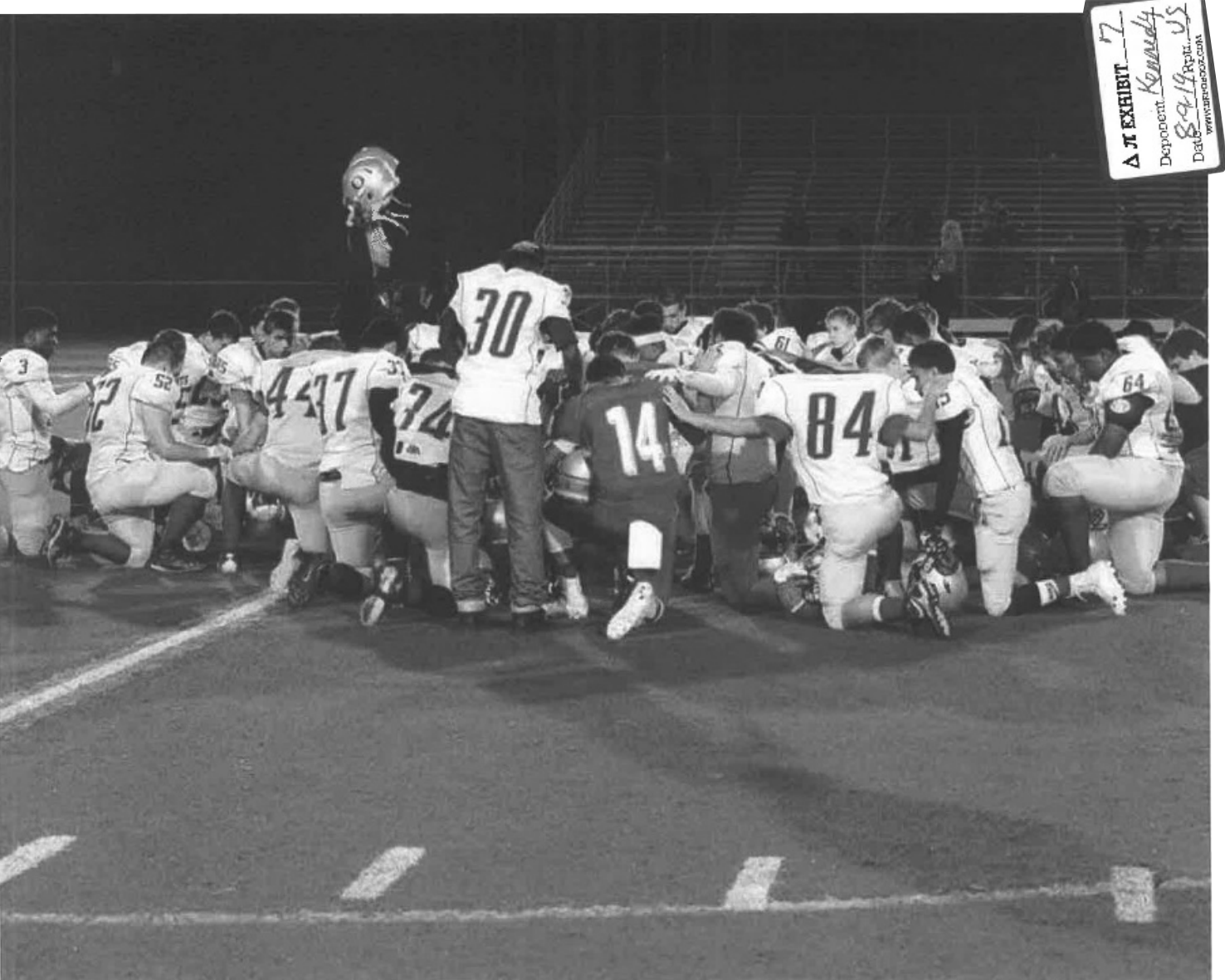
While the District’s inquiry was pending, its athletic director attended BHS’ September 11, 2015, football game and told Kennedy that he should not be conducting prayers with players. After the game, while the athletic director watched, Kennedy led a prayer out loud, holding up a player’s helmet as the players kneeled around him. While riding the bus home with the team, Kennedy posted on Facebook that he thought he might have just been fired for praying.
On September 17, the District’s superintendent sent Kennedy a letter informing him that leading prayers with students on the field and in the locker room would likely be found to violate the Establishment Clause, exposing the District to legal liability. The District acknowledged that Kennedy had “not actively encouraged, or required, participation” but emphasized that “school staff may not indirectly encourage students to engage in religious activity” or “endors[e]” religious activity; rather, the District explained, staff “must remain neutral” “while performing their job duties.” Id., at 41–43. The District instructed Kennedy that any motivational talks to students must remain secular, “so as to avoid alienation of any team member.” Id., at 44.
The District reiterated that “all District staff are free to engage in religious activity, including prayer, so long as it does not interfere with job responsibilities.” Id., at 45. To avoid endorsing student religious exercise, the District instructed that such activity must be nondemonstrative or conducted separately from students, away from student activities. Ibid …
Kennedy stopped participating in locker room prayers and, after a game the following day, gave a secular speech. He returned to pray in the stadium alone after his duties were over and everyone had left the stadium, to which the District had no objection. Kennedy then hired an attorney, who, on October 14, sent a letter explaining that Kennedy was “motivated by his sincerely-held religious beliefs to pray following each football game.” Id., at 63 … The letter further announced that Kennedy would resume his 50-yard-line prayer practice the next day after the October 16 homecoming game.1 Before the homecoming game, Kennedy made multiple media appearances to publicize his plans to pray at the 50- yard line, leading to an article in the Seattle News and a local television broadcast about the upcoming homecoming game. In the wake of this media coverage, the District began receiving a large number of emails, letters, and calls, many of them threatening.
… While Kennedy’s letter asserted that his prayers “occurr[ed] ‘on his own time,’ after his duties as a District employee had ceased,” the District pointed out that Kennedy “remain[ed] on duty” when his prayers occurred “immediately following completion of the football game, when students are still on the football field, in uniform, under the stadium lights, with the audience still in attendance, and while Mr. Kennedy is still in his District-issued and District-logoed attire.” Id., at 78 (emphasis deleted).
… The District stated that it had no objection to Kennedy returning to the stadium when he was off duty to pray at the 50-yard line, nor with Kennedy praying while on duty if it did not interfere with his job duties or suggest the District’s endorsement of religion …
On October 16, after playing of the game had concluded, Kennedy shook hands with the opposing team, and as advertised, knelt to pray while most BHS players were singing the school’s fight song. He quickly was joined by coaches and players from the opposing team. Television news cameras surrounded the group. Members of the public rushed the field to join Kennedy, jumping fences to access the field and knocking over student band members. After the game, the District received calls from Satanists who “‘intended to conduct ceremonies on the field after football games if others were allowed to.’” Id., at 181. To secure the field and enable subsequent games to continue safely, the District was forced to make security arrangements with the local police and to post signs near the field and place robocalls to parents reiterating that the field was not open to the public.
The District sent Kennedy another letter on October 23, explaining that his conduct at the October 16 game was inconsistent with the District’s requirements … Again, the District emphasized that it was happy to accommodate Kennedy’s desire to pray on the job in a way that did not interfere with his duties or risk perceptions of endorsement …
Kennedy did not directly respond or suggest a satisfactory accommodation. Instead, his attorneys told the media that he would accept only demonstrative prayer on the 50- yard line immediately after games. During the October 23 and October 26 games, Kennedy again prayed at the 50- yard line immediately following the game, while postgame activities were still ongoing …
… After the issues with Kennedy arose, several parents reached out to the District saying that their children had participated in Kennedy’s prayers solely to avoid separating themselves from the rest of the team. No BHS students appeared to pray on the field after Kennedy’s suspension …
Kennedy then filed suit. He contended, as relevant, that the District violated his rights under the Free Speech and Free Exercise Clauses of the First Amendment … Properly understood, this case is not about the limits on an individual’s ability to engage in private prayer at work. This case is about whether a school district is required to allow one of its employees to incorporate a public, communicative display of the employee’s personal religious beliefs into a school event, where that display is recognizable as part of a longstanding practice of the employee ministering religion to students as the public watched. A school district is not required to permit such conduct; in fact, the Establishment Clause prohibits it from doing so …
The Establishment Clause protects this freedom by “command[ing] a separation of church and state.” Cutter v. Wilkinson, (2005) …
Indeed, “[t]he Court has been particularly vigilant in monitoring compliance with the Establishment Clause in elementary and secondary schools.” Edwards v. Aguillard, (1987). The reasons motivating this vigilance inhere in the nature of schools themselves and the young people they serve. Two are relevant here. First, government neutrality toward religion is particularly important in the public school context given the role public schools play in our society … Accordingly, the Establishment Clause “proscribes public schools from ‘conveying or attempting to convey a message that religion or a particular religious belief is favored or preferred’” or otherwise endorsing religious beliefs. Lee, (Blackmun, J., concurring).
Second, schools face a higher risk of unconstitutionally “coerc[ing] … support or participat[ion] in religion or its exercise” than other government entities. Id., at 587 (opinion of the Court) … Moreover, the State exercises that great authority over children, who are uniquely susceptible to “subtle coercive pressure.” Lee … Accordingly, this Court has emphasized that “the State may not, consistent with the Establishment Clause, place primary and secondary school children” in the dilemma of choosing between “participating, with all that implies, or protesting” a religious exercise in a public school. Lee.
Given the twin Establishment Clause concerns of endorsement and coercion, it is unsurprising that the Court has consistently held integrating prayer into public school activities to be unconstitutional, including when student participation is not a formal requirement or prayer is silent …
Under these precedents, the Establishment Clause violation at hand is clear … Kennedy’s tradition of a 50-yard line prayer thus strikes at the heart of the Establishment Clause’s concerns about endorsement. For students and community members at the game, Coach Kennedy was the face and the voice of the District during football games … Although the football game itself had ended, the football game events had not; Kennedy himself acknowledged that his responsibilities continued until the players went home. Kennedy’s postgame responsibilities were what placed Kennedy on the 50-yard line in the first place; that was, after all, where he met the opposing team to shake hands after the game. Permitting a school coach to lead students and others he invited onto the field in prayer at a predictable time after each game could only be viewed as a postgame tradition occurring “with the approval of the school administration.” Santa Fe.
Kennedy’s prayer practice also implicated the coercion concerns at the center of this Court’s Establishment Clause jurisprudence … The record before the Court bears this out …
Kennedy does not defend his longstanding practice of leading the team in prayer out loud on the field as they kneeled around him. Instead, he responds, and the Court accepts, that his highly visible and demonstrative prayer at the last three games before his suspension did not violate the Establishment Clause because these prayers were quiet and thus private. This Court’s precedents, however, do not permit isolating government actions from their context in determining whether they violate the Establishment Clause. To the contrary, this Court has repeatedly stated that Establishment Clause inquiries are fact specific and require careful consideration of the origins and practical reality of the specific practice at issue … This Court’s precedent thus does not permit treating Kennedy’s “new” prayer practice as occurring on a blank slate, any more than those in the District’s school community would have experienced Kennedy’s changed practice (to the degree there was one) as erasing years of prior actions by Kennedy. …
Finally, Kennedy stresses that he never formally required students to join him in his prayers. But existing precedents do not require coercion to be explicit, particularly when children are involved …
Despite the overwhelming precedents establishing that school officials leading prayer violates the Establishment Clause, the Court today holds that Kennedy’s midfield prayer practice did not violate the Establishment Clause. This decision rests on an erroneous understanding of the Religion Clauses. It also disregards the balance this Court’s cases strike among the rights conferred by the Clauses. The Court relies on an assortment of pluralities, concurrences, and dissents by Members of the current majority to effect fundamental changes in this Court’s Religion Clauses jurisprudence, all the while proclaiming that nothing has changed at all …
The Free Exercise Clause and Establishment Clause are equally integral in protecting religious freedom in our society. The first serves as “a promise from our government,” while the second erects a “backstop that disables our government from breaking it” and “start[ing] us down the path to the past, when [the right to free exercise] was routinely abridged.” Trinity Lutheran Church of Columbia, Inc. v. Comer, (2017) (Sotomayor, J., dissenting). Today, the Court once again weakens the backstop. It elevates one individual’s interest in personal religious exercise, in the exact time and place of that individual’s choosing, over society’s interest in protecting the separation between church and state, eroding the protections for religious liberty for all. Today’s decision is particularly misguided because it elevates the religious rights of a school official, who voluntarily accepted public employment and the limits that public employment entails, over those of his students, who are required to attend school and who this Court has long recognized are particularly vulnerable and deserving of protection. In doing so, the Court sets us further down a perilous path in forcing States to entangle themselves with religion, with all of our rights hanging in the balance. As much as the Court protests otherwise, today’s decision is no victory for religious liberty. I respectfully dissent.
This chapter was remixed from Civil Rights and Liberties: Excerpts of Landmark Cases edited by Rorie Spill Solberg, licensed under a Creative Commons Attribution 4.0 International License except where otherwise noted.
This chapter was remixed from Civil Rights and Liberties: Excerpts of Landmark Cases edited by Rorie Spill Solberg, licensed under a Creative Commons Attribution 4.0 International License except where otherwise noted.
4.11 What is a religion?
The First Amendment provides: “Congress shall make no law respecting an establishment of religion, or prohibiting the free exercise thereof.” So what exactly is a religion? Clearly it has to mean something more than a set of principles that one is devoted to, or else the Constitution would protect the beliefs of someone who says their religion is “worshipping the almighty dollar.” There is also the concern that excluding some religions by defining core components of a protected religion–such as whether a god or gods are included and whether it or they need to be non-human–would violate either or both portions of this amendment.
The Supreme Court heard very few cases about religion during its first hundred years. This is because Barron v. Baltimore (discussed in unit 3, chapter 1) limited the application of the Bill of Rights to the federal government and Congress did not attempt to establish or interfere with the free exercise of religion. The Supreme Court was not called upon to define religion until 1890, when it reviewed the conviction of a Mormon for falsely swearing that he was not a member of an organization that supported bigamy or polygamy.
Davis v. Beeson, 133 U.S. 333 (1890)
The Territory of Idaho required prospective voters to take an oath that included statement “that I am not a bigamist or polygamist; that I am not a member of any order, organization or association which teaches, advises, counsels or encourages its members, devotees or any other person to commit the crime of bigamy or polygamy, or any other crime defined by law.” Samuel Davis was convicted of violating this oath because he followed the Morman teaching (since rescinded) that bigamy was a duty of male believers. He was fined $500 and sentenced to jail for up to 250 days or until he paid the fine. He sought a writ of habeas corpus on the grounds that the law violated his right of free exercise of religion. The Supreme Court sustained the law unanimously and for the first time defined the constitutional term “religion.”
Justice Stephen Field:
On this hearing, we can only consider whether, these allegations being taken as true, an offense was committed of which the territorial court had jurisdiction to try the defendant. And on this point there can be no serious discussion or difference of opinion. Bigamy and polygamy are crimes by the laws of all civilized and Christian countries. They are crimes by the laws of the United States, and they are crimes by the laws of Idaho. They tend to destroy the purity of the marriage relation, to disturb the peace of families, to degrade woman, and to debase man. Few crimes are more pernicious to the best interests of society, and receive more general or more deserved punishment. To extend exemption from punishment for such crimes would be to shock the moral judgment of the community. To call their advocacy a tenet of religion is to offend the common sense of mankind. If they are crimes, then to teach, advise, and counsel their practice is to aid in their commission, and such teaching and counseling are themselves criminal, and proper subjects of punishment as aiding and abetting crime are in all other cases.
The term “religion” has reference to one’s views of his relations to his Creator, and to the obligations they impose of reverence for his being and character, and of obedience to his will. . . . The First Amendment to the Constitution, in declaring that Congress shall make no law respecting the establishment of religion or forbidding the free exercise thereof, was intended to allow everyone under the jurisdiction of the United States to entertain such notions respecting his relations to his Maker and the duties they impose as may be approved by his judgment and conscience, and to exhibit his sentiments in such form of worship as he may think proper, not injurious to the equal rights of others, and to prohibit legislation for the support of any religious tenets, or the modes of worship of any sect. . . . It was never intended or supposed that the amendment could be invoked as a protection against legislation for the punishment of acts inimical to the peace, good order, and morals of society. With man’s relations to his Maker and the obligations he may think they impose and the manner in which an expression shall be made by him of his belief on those subjects no interference can be permitted, provided always the laws of society, designed to secure its peace and prosperity, and the morals of its people, are not interfered with. However free the exercise of religion may be, it must be subordinate to the criminal laws of the country, passed with reference to actions regarded by general consent as properly the subjects of punitive legislation. There have been sects which denied as a part of their religious tenets that there should be any marriage tie, and advocated promiscuous intercourse of the sexes, as prompted by the passions of its members. And history discloses the fact that the necessity of human sacrifices, on special occasions, has been a tenet of many sects. Should a sect of either of these kinds ever find its way into this country, swift punishment would follow the carrying into effect of its doctrines, and no heed would be given to the pretense that, as religious beliefs, their supporters could be protected in their exercise by the Constitution of the United States. Probably never before in the history of this country has it been seriously contended that the whole punitive power of the government for acts, recognized by the general consent of the Christian world in modern times as proper matters for prohibitory legislation, must be suspended in order that the tenets of a religious sect encouraging crime may be carried out without hindrance.
******
There is no constitutional right to refuse military service on account of one’s religious beliefs. James Madison’s original draft of the Bill of Rights provided: “The civil rights of none shall be abridged on account of religious belief or worship, nor shall any national religion be established, nor shall the full and equal rights of conscience be in any manner, or on any pretext, infringed.”[1] Madison’s proposal to protect the rights of conscience was not adopted by Congress when it approved what ultimately became the First Amendment. However, Congress did provide for conscientious objection when it first conscripted soldiers during the Civil War. During the two world wars those who objected to military service on religious grounds were assigned to alternative citizen service in the US. During the Vietnam War, applications for conscientious objector status escalated, and some of the applicants professed beliefs that were not part of religions. Did belief in a personal moral code suffice as a basis for alternative service?
United States v. Seeger, 380 U.S. 163 (1965)
The Supreme Court consolidated the cases of three applicants for conscientious objector status who claimed their personal religious beliefs precluded combat. None claimed that they were members of organized religions. This case implicated both religion clauses since if the Court were to find that some religious beliefs did not qualify for Free Exercise Clause protection this would establish a distinction between religions that would violate the Establishment Clause. The Court unanimously held that “the test of belief ‘in a relation to a Supreme Being’ is whether a given belief that is sincere and meaningful occupies a place in the life of its possessor parallel to that filled by the orthodox belief in God.” It found that despite the applicants’ lack of belief in God, they were entitled to conscientious objector status because they sincerely believed they were obliged to obey an external authority that mandated they abstain from active participation in combat.
Justice Tom Clark:
These cases involve claims of conscientious objectors under § 6(j) of the Universal Military Training and Service Act, 50 U.S.C. App. § 456(j) (1958 ed.), which exempts from combatant training and service in the armed forces of the United States those persons who, by reason of their religious training and belief, are conscientiously opposed to participation in war in any form. The cases were consolidated for argument, and we consider them together although each involves different facts and circumstances. The parties raise the basic question of the constitutionality of the section which defines the term “religious training and belief,” as used in the Act, as “an individual’s belief in a relation to a Supreme Being involving duties superior to those arising from any human relation, but [not including] essentially political, sociological, or philosophical views or a merely personal moral code.”
The constitutional attack is launched under the First Amendment’s Establishment and Free Exercise Clauses and is twofold: (1) the section does not exempt nonreligious conscientious objectors; and (2) it discriminates between different forms of religious expression in violation of the Due Process Clause of the Fifth Amendment.
. . . We have concluded that Congress, in using the expression “Supreme Being,” rather than the designation “God,” was merely clarifying the meaning of religious training and belief so as to embrace all religions and to exclude essentially political, sociological, or philosophical views. We believe that, under this construction, the test of belief “in a relation to a Supreme Being” is whether a given belief that is sincere and meaningful occupies a place in the life of its possessor parallel to that filled by the orthodox belief in God of one who clearly qualifies for the exemption. Where such beliefs have parallel positions in the lives of their respective holders, we cannot say that one is “in a relation to a Supreme Being” and the other is not. . . .
No. 50: Seeger was convicted in the District Court for the Southern District of New York of having refused to submit to induction in the armed forces. . . . Although he did not adopt verbatim the printed Selective Service System form, he declared that he was conscientiously opposed to participation in war in any form by reason of his “religious” belief; that he preferred to leave the question as to his belief in a Supreme Being open, “rather than answer ‘yes’ or `no'”; that his “skepticism or disbelief in the existence of God” did “not necessarily mean lack of faith in anything whatsoever”; that his was a “belief in and devotion to goodness and virtue for their own sakes, and a religious faith in a purely ethical creed.” He cited such personages as Plato, Aristotle and Spinoza for support of his ethical belief in intellectual and moral integrity “without belief in God, except in the remotest sense.” His belief was found to be sincere, honest, and made in good faith, and his conscientious objection to be based upon individual training and belief, both of which included research in religious and cultural fields. Seeger’s claim, however, was denied solely because it was not based upon a “belief in a relation to a Supreme Being” as required by § 6(j) of the Act. At trial, Seeger’s counsel admitted that Seeger’s belief was not in relation to a Supreme Being as commonly understood, but contended that he was entitled to the exemption because, “under the present law, Mr. Seeger’s position would also include definitions of religion which have been stated more recently,” and could be “accommodated” under the definition of religious training and belief in the Act. He was convicted, and the Court of Appeals reversed, holding that the Supreme Being requirement of the section distinguished “between internally derived and externally compelled beliefs,” and was therefore an “impermissible classification” under the Due Process Clause of the Fifth Amendment.
No. 51: Jakobson was also convicted in the Southern District of New York on a charge of refusing to submit to induction. On his appeal, the Court of Appeals reversed on the ground that rejection of his claim may have rested on the factual finding, erroneously made, that he did not believe in a Supreme Being, as required by § 6(j). Jakobson was originally classified 1-A in 1953, and intermittently enjoyed a student classification until 1956. It was not until April, 1958, that he made claim to noncombatant classification (1-A-O) as a conscientious objector. He stated on the Selective Service System form that he believed in a “Supreme Being” who was “Creator of Man” in the sense of being “ultimately responsible for the existence of” man, and who was “the Supreme Reality” of which “the existence of man is the result.” He explained that his religious and social thinking had developed after much meditation and thought. He had concluded that man must be “partly spiritual,” and, therefore, “partly akin to the Supreme Reality,” and that his “most important religious law” was that “no man ought ever to wilfully sacrifice another man’s life as a means to any other end. . . .” In December, 1958, he requested a 1-O classification, since he felt that participation in any form of military service would involve him in “too many situations and relationships that would be a strain on [his] conscience that [he felt he] must avoid.” He submitted a long memorandum of “notes on religion” in which he defined religion as the “sum and essence of one’s basic attitudes to the fundamental problems of human existence”; he said that he believed in “Godness,” which was “the Ultimate Cause for the fact of the Being of the Universe”; that to deny its existence would but deny the existence of the universe, because “anything that Is, has an Ultimate Cause for its Being.” There was a relationship to Godness, he stated, in two directions, i.e., “vertically, towards Godness directly,” and “horizontally, towards Godness through Mankind and the World.” He accepted the latter one. The Board classified him 1-A-O, and Jakobson appealed. The hearing officer found that the claim was based upon a personal moral code, and that he was not sincere in his claim. The Appeal Board classified him 1-A. It did not indicate upon what ground it based its decision, i.e., insincerity or a conclusion that his belief was only a personal moral code. The Court of Appeals reversed, finding that his claim came within the requirements of § 6(j). Because it could not determine whether the Appeal Board had found that Jakobson’s beliefs failed to come within the statutory definition, or whether it had concluded that he lacked sincerity, it directed dismissal of the indictment.
No. 29: Forest Britt Peter was convicted in the Northern District of California on a charge of refusing to submit to induction. In his Selective Service System form, he stated that he was not a member of a religious sect or organization; he failed to execute section VII of the questionnaire, but attached to it a quotation expressing opposition to war, in which he stated that he concurred. In a later form, he hedged the question as to his belief in a Supreme Being by saying that it depended on the definition, and he appended a statement that he felt it a violation of his moral code to take human life, and that he considered this belief superior to his obligation to the state. As to whether his conviction was religious, he quoted with approval Reverend John Haynes Holmes’ definition of religion as “the consciousness of some power manifest in nature which helps man in the ordering of his life in harmony with its demands . . . ; [it] is the supreme expression of human nature; it is man thinking his highest, feeling his deepest, and living his best.” The source of his conviction he attributed to reading and meditation “in our democratic American culture, with its values derived from the western religious and philosophical tradition.” As to his belief in a Supreme Being, Peter stated that he supposed “you could call that a belief in the Supreme Being or God. These just do not happen to be the words I use.” In 1959, he was classified 1-A, although there was no evidence in the record that he was not sincere in his beliefs. After his conviction for failure to report for induction the Court of Appeals, assuming arguendo that he was sincere, affirmed.
Chief Justice Hughes, in his opinion in United States v. Macintosh, 283 U. S. 605, 633 (1931), enunciated the rationale behind the long recognition of conscientious objection to participation in war accorded by Congress in our various conscription laws when he declared that, “in the forum of conscience, duty to a moral power higher than the state has always been maintained.” In a similar vein, Harlan Fiske Stone, later Chief Justice, drew from the Nation’s past when he declared that “both morals and sound policy require that the state should not violate the conscience of the individual. All our history gives confirmation to the view that liberty of conscience has a moral and social value which makes it worthy of preservation at the hands of the state. . . .”
In adopting the 1940 Selective Training and Service Act, Congress broadened the exemption afforded in the 1917 Act by making it unnecessary to belong to a pacifist religious sect if the claimant’s own opposition to war was based on “religious training and belief.” 54 Stat. 889. Those found to be within the exemption were not inducted into the armed services, but were assigned to noncombatant service under the supervision of the Selective Service System. The Congress recognized that one might be religious without belonging to an organized church just as surely as minority members of a faith not opposed to war might, through religious reading, reach a conviction against participation in war. Indeed, the consensus of the witnesses appearing before the congressional committees was that individual belief–rather than membership in a church or sect–determined the duties that God imposed upon a person in his everyday conduct, and that “there is a higher loyalty than loyalty to this country, loyalty to God.” Thus, while shifting the test from membership in such a church to one’s individual belief, the Congress nevertheless continued its historic practice of excusing from armed service those who believed that they owed an obligation, superior to that due the state, of not participating in war in any form.
Between 1940 and 1948, two courts of appeals held that the phrase “religious training and belief” did not include philosophical, social or political policy. Then, in 1948, the Congress amended the language of the statute and declared that “religious training and belief” was to be defined as “an individual’s belief in a relation to a Supreme Being involving duties superior to those arising from any human relation, but [not including] essentially political, sociological, or philosophical views or a merely personal moral code.”. . .
The crux of the problem lies in the phrase “religious training and belief,” which Congress has defined as “belief in a relation to a Supreme Being involving duties superior to those arising from any human relation.” In assigning meaning to this statutory language, we may narrow the inquiry by noting briefly those scruples expressly excepted from the definition. The section excludes those persons who, disavowing religious belief, decide on the basis of essentially political, sociological or economic considerations that war is wrong and that they will have no part of it. These judgments have historically been reserved for the Government, and, in matters which can be said to fall within these areas, the conviction of the individual has never been permitted to override that of the state. The statute further excludes those whose opposition to war stems from a “merely personal moral code,” a phrase to which we shall have occasion to turn later in discussing the application of § 6(j) to these cases. . . .
Our question, therefore, is the narrow one: does the term “Supreme Being,” as used in § 6(j), mean the orthodox God or the broader concept of a power or being, or a faith, “to which all else is subordinate or upon which all else is ultimately dependent”? Webster’s New International Dictionary (Second Edition). In considering this question, we resolve it solely in relation to the language of § 6(j), and not otherwise.
Few would quarrel, we think, with the proposition that in no field of human endeavor has the tool of language proved so inadequate in the communication of ideas as it has in dealing with the fundamental questions of man’s predicament in life, in death, or in final judgment and retribution. This fact makes the task of discerning the intent of Congress in using the phrase “Supreme Being” a complex one. Nor is it made the easier by the richness and variety of spiritual life in our country. Over 250 sects inhabit our land. Some believe in a purely personal God, some in a supernatural deity; others think of religion as a way of life envisioning, as its ultimate goal, the day when all men can live together in perfect understanding and peace. There are those who think of God as the depth of our being; others, such as the Buddhists, strive for a state of lasting rest through self-denial and inner purification; in Hindu philosophy, the Supreme Being is the transcendental reality which is truth, knowledge and bliss. . . . This vast panoply of beliefs reveals the magnitude of the problem which faced the Congress when it set about providing an exemption from armed service. It also emphasizes the care that Congress realized was necessary in the fashioning of an exemption which would be in keeping with its long established policy of not picking and choosing among religious beliefs.
In spite of the elusive nature of the inquiry, we are not without certain guidelines. In amending the 1940 Act, Congress adopted almost intact the language of Chief Justice Hughes in United States v. Macintosh, 283 U. S. at 633-634: “The essence of religion is belief in a relation to God involving duties superior to those arising from any human relation.” By comparing the statutory definition with those words, however, it becomes readily apparent that the Congress deliberately broaden them by substituting the phrase “Supreme Being” for the appellation “God.” And, in so doing, it is also significant that Congress did not elaborate on the form or nature of this higher authority which it chose to designate as “Supreme Being.” By so refraining, it must have had in mind the admonitions of the Chief Justice when he said in the same opinion that even the word “God” had myriad meanings for men of faith: “[P]utting aside dogmas with their particular conceptions of deity, freedom of conscience itself implies respect for an innate conviction of paramount duty. The battle for religious liberty has been fought and won with respect to religious beliefs and practices, which are not in conflict with good order, upon the very ground of the supremacy of conscience within its proper field.” Id. at 634. . . .
Under the 1940 Act, it was necessary only to have a conviction based upon religious training and belief; we believe that is all that is required here. Within that phrase would come all sincere religious beliefs which are based upon a power or being, or upon a faith, to which all else is subordinate or upon which all else is ultimately dependent. The test might be stated in these words: a sincere and meaningful belief which occupies in the life of its possessor a place parallel to that filled by the God of those admittedly qualifying for the exemption comes within the statutory definition. This construction avoids imputing to Congress an intent to classify different religious beliefs, exempting some and excluding others, and is in accord with the well established congressional policy of equal treatment for those whose opposition to service is grounded in their religious tenets. . . .
In Seeger, No. 50, the Court of Appeals failed to find sufficient “externally compelled beliefs.” However, it did find that “it would seem impossible to say with assurance that [Seeger] is not bowing to ‘external commands’ in virtually the same sense as is the objector who defers to the will of a supernatural power.” It found little distinction between Jakobson’s devotion to a mystical force of “Godness” and Seeger’s compulsion to “goodness.” Of course, as we have said, the statute does not distinguish between externally and internally derived beliefs. Such a determination would, as the Court of Appeals observed, prove impossible as a practical matter, and we have found that Congress intended no such distinction.
The Court of Appeals also found that there was no question of the applicant’s sincerity. . . . In summary, Seeger professed “religious belief” and “religious faith.” He did not disavow any belief “in a relation to a Supreme Being”; indeed, he stated that “the cosmic order does, perhaps, suggest a creative intelligence.” He decried the tremendous “spiritual” price man must pay for his willingness to destroy human life. In light of his beliefs and the unquestioned sincerity with which he held them, we think the Board, had it applied the test we propose today, would have granted him the exemption. We think it clear that the beliefs which prompted his objection occupy the same place in his life as the belief in a traditional deity holds in the lives of his friends, the Quakers. . . . It may be that Seeger did not clearly demonstrate what his beliefs were with regard to the usual understanding of the term “Supreme Being.” But, as we have said, Congress did not intend that to be the test. We therefore affirm the judgment in No. 50.
In Jakobson, No. 51, the Court of Appeals found that the registrant demonstrated that his belief as to opposition to war was related to a Supreme Being. We agree, and affirm that judgment.
We reach a like conclusion in No. 29. It will be remembered that Peter acknowledged “some power manifest in nature . . . the supreme expression” that helps man in ordering his life. As to whether he would call that belief in a Supreme Being, he replied, “you could call that a belief in the Supreme Being or God. These just do not happen to be the words I use.” We think that, under the test we establish here, the Board would grant the exemption to Peter, and we therefore reverse the judgment in No. 29.
******
After this decision, Congress amended the exemption statute to remove the words “in relation to a Supreme Being.” But what about conscientious objectors whose beliefs were based on “political, sociological, or philosophical views or a merely personal moral code”? While Congress had excluded these justifications in 1948, did Seeger mean that the exclusion of those who objected for such reasons would violate the Establishment Clause?
The Court had more difficulty answering this question when it arose in Welsh v. United States, 398 U.S. 333 (1970), five years later. Although the Court held that Elliot Welsh III was entitled to conscientious objector status, a majority of justices could not agree on why he was exempt. A plurality of four led by Justice Hugo Black agreed that a person who believes he is morally compelled to abstain from combat has beliefs that are sufficiently “religious” to qualify for the exemption. Black wrote, “If an individual deeply and sincerely holds beliefs that are purely ethical or moral in source and content, but that nevertheless impose upon him a duty of conscience to refrain from participating in any war at any time, those beliefs certainly occupy in the life of that individual ‘a place parallel to that filled by . . . God’ in traditionally religious persons. Because his beliefs function as a religion in his life, such an individual is as much entitled to a ‘religious’ conscientious objector exemption under § 6(j) as is someone who derives his conscientious opposition to war from traditional religious convictions.”
******
In addition to the requirement that religious beliefs be based on a moral duty, the Court has also required that they be sincerely held. This is illustrated by a case involving a mail fraud prosecution of three family members who were alleged to have solicited contributions by making false statements. Can a court determine the truth or falsehood of religious beliefs? Or does the Establishment Clause prohibit it from doing so?
United States v. Ballard, 322 U.S. 78 (1944)
The United States charged Guy and Edna Ballard and their son Donald with 12 counts of mail fraud for making false statements to encourage donations to the “I am” movement, which claimed that they had been given special healing powers by God. The prosecutors and defense counsel agreed that the truth of these allegations was irrelevant to the charges because they were religious beliefs, and the jury was only asked whether these beliefs were sincerely held. The Ballards were found guilty and appealed on the grounds that the government should have been required to prove that their beliefs were false, and they convinced the Circuit Court that a new trial was justified. The Attorney General convinced the Supreme Court to grant cert, arguing that it was necessary to challenge the truth of the Ballards’ beliefs in order to prevent them from getting away with fraud. However, the Court rejected the government’s contention, holding 5-4 that the trial judge had been correct in ruling that the First Amendment did not permit the jury to consider whether the Ballards’ religious views were factually correct. Whether their religious beliefs are “true” is not an issue for a court to decide.
Justice William O. Douglas:
[W]e do not agree that the truth or verity of respondents’ religious doctrines or beliefs should have been submitted to the jury. Whatever this particular indictment might require, the First Amendment precludes such a course, as the United States seems to concede. “The law knows no heresy, and is committed to the support of no dogma, the establishment of no sect.” Watson v. Jones, 80 U. S. 728. The First Amendment has a dual aspect. It not only “forestalls compulsion by law of the acceptance of any creed or the practice of any form of worship,” but also “safeguards the free exercise of the chosen form of religion.” Cantwell v. Connecticut, 310 U. S. 296, 303.
“Thus, the Amendment embraces two concepts–freedom to believe and freedom to act. The first is absolute but, in the nature of things, the second cannot be.” Id. Freedom of thought, which includes freedom of religious belief, is basic in a society of free men. Board of Education by Barnette, 319 U. S. 624. It embraces the right to maintain theories of life and of death and of the hereafter which are rank heresy to followers of the orthodox faiths. Heresy trials are foreign to our Constitution. Men may believe what they cannot prove. They may not be put to the proof of their religious doctrines or beliefs. Religious experiences which are as real as life to some may be incomprehensible to others. Yet the fact that they may be beyond the ken of mortals does not mean that they can be made suspect before the law. Many take their gospel from the New Testament. But it would hardly be supposed that they could be tried before a jury charged with the duty of determining whether those teachings contained false representations. The miracles of the New Testament, the Divinity of Christ, life after death, the power of prayer are deep in the religious convictions of many. If one could be sent to jail because a jury in a hostile environment found those teachings false, little indeed would be left of religious freedom.
The Fathers of the Constitution were not unaware of the varied and extreme views of religious sects, of the violence of disagreement among them, and of the lack of any one religious creed on which all men would agree. They fashioned a charter of government which envisaged the widest possible toleration of conflicting views. Man’s relation to his God was made no concern of the state. He was granted the right to worship as he pleased, and to answer to no man for the verity of his religious views. The religious views espoused by respondents might seem incredible, if not preposterous, to most people. But if those doctrines are subject to trial before a jury charged with finding their truth or falsity, then the same can be done with the religious beliefs of any sect. When the triers of fact undertake that task, they enter a forbidden domain. The First Amendment does not select any one group or any one type of religion for preferred treatment. . . . As stated in Davis v. Beason, 133 U. S. 333, 342: “With man’s relations to his Maker and the obligations he may think they impose, and the manner in which an expression shall be made by him of his belief on those subjects, no interference can be permitted, provided always the laws of society, designed to secure its peace and prosperity, and the morals of its people, are not interfered with. So we conclude that the District Court ruled properly when it withheld from the jury all questions concerning the truth or falsity of the religious beliefs or doctrines of respondents. . . .
******
Although courts may not evaluate the substantive validity of a person’s religious beliefs, can they take into account the fact that the religion a person belongs to does not mandate the beliefs that person claims? In other words, if a person claims that working a certain job would violate his conscience, can his claim be countered by testimony that his religion does not require that he abstain from working such a job? Or would that mean that a person could not claim a religious belief that was not shared by others, meaning that his right to practice his religion was dependent on what others believed? This issue was settled by the Supreme Court in 1981.
Thomas v. Review Board, Indiana Employment Security Division, 450 U.S. 707 (1980)
A steelworker was transferred to a job making weapons, which he claimed violated his personal religious beliefs as a Jehovah’s Witness. Since the employer had no other jobs available, he quit and applied for unemployment benefits. Although the hearing examiner found that his religious beliefs were sincerely held, the Indiana Supreme Court reversed on the grounds that the steelworker had difficulty articulating his beliefs and that his religion did not mandate he abstain from work on weapons, thus his decision to quit was merely a “personal philosophical choice.” The Supreme Court voted 8-1 to reverse on the ground that it was not up to the courts to rigorously scrutinize the basis of his beliefs: “religious beliefs need not be acceptable, logical, consistent, or comprehensible to others in order to merit First Amendment protection. . . “.
Chief Justice Warren Burger:
We granted certiorari to consider whether the State’s denial of unemployment compensation benefits to the petitioner, a Jehovah’s Witness who terminated his job because his religious beliefs forbade participation in the production of armaments, constituted a violation of his First Amendment right to free exercise of religion.
Thomas terminated his employment in the Blaw-Knox Foundry & Machinery Co. when he was transferred from the roll foundry to a department that produced turrets for military tanks. He claimed his religious beliefs prevented him from participating in the production of war materials. The respondent Review Board denied him unemployment compensation benefits by applying disqualifying provisions of the Indiana Employment Security Act.
Thomas, a Jehovah’s Witness, was hired initially to work in the roll foundry at Blaw-Knox. The function of that department was to fabricate sheet steel for a variety of industrial uses. On his application form, he listed his membership in the Jehovah’s Witnesses, and noted that his hobbies were Bible study and Bible reading. However, he placed no conditions on his employment, and he did not describe his religious tenets in any detail on the form.
Approximately a year later, the roll foundry closed, and Blaw-Knox transferred Thomas to a department that fabricated turrets for military tanks. On his first day at this new job, Thomas realized that the work he was doing was weapons related. He checked the bulletin board where in-plant openings were listed, and discovered that all of the remaining departments at Blaw-Knox were engaged directly in the production of weapons. Since no transfer to another department would resolve his problem, he asked for a layoff. When that request was denied, he quit, asserting that he could not work on weapons without violating the principles of his religion. The record does not show that he was offered any nonweapons work by his employer, or that any such work was available.
Upon leaving Blaw-Knox, Thomas applied for unemployment compensation benefits under the Indiana Employment Security Act. . . . When asked at the hearing to explain what kind of work his religious convictions would permit, Thomas said that he would have no difficulty doing the type of work that he had done at the roll foundry. He testified that he could, in good conscience, engage indirectly in the production of materials that might be used ultimately to fabricate arms–for example, as an employee of a raw material supplier or of a roll foundry.
The hearing referee found that Thomas’ religious beliefs specifically precluded him from producing or directly aiding in the manufacture of items used in warfare. He also found that Thomas had terminated his employment because of these religious convictions. . . . The referee concluded nonetheless that Thomas’ termination was not based upon a “good cause [arising] in connection with [his] work,” as required by the Indiana unemployment compensation statute. Accordingly, he was held not entitled to benefits. The Review Board adopted the referee’s findings and conclusions, and affirmed the denial of benefits.
The Indiana Court of Appeals, accepting the finding that Thomas terminated his employment “due to his religious convictions,” reversed the decision of the Review Board. . . . The Supreme Court of Indiana, dividing 3-2, vacated the decision of the Court of Appeals, and denied Thomas benefits. With reference to the Indiana unemployment compensation statute, the court said: “Good cause which justifies voluntary termination must be job-related and objective in character.”. . .
In discussing the petitioner’s free exercise claim, the court stated: “A personal philosophical choice, rather than a religious choice, does not rise to the level of a first amendment claim.” The court found the basis and the precise nature of Thomas’ belief unclear–but it concluded that the belief was more “personal philosophical choice” than religious belief. Nonetheless, it held that, even assuming that Thomas quit for religious reasons, he would not be entitled to benefits: under Indiana law, a termination motivated by religion is not for “good cause” objectively related to the work. . . .
Only beliefs rooted in religion are protected by the Free Exercise Clause, which, by its terms, gives special protection to the exercise of religion. Sherbert v. Verner. The determination of what is a “religious” belief or practice is more often than not a difficult and delicate task, as the division in the Indiana Supreme Court attests. However, the resolution of that question is not to turn upon a judicial perception of the particular belief or practice in question; religious beliefs need not be acceptable, logical, consistent, or comprehensible to others in order to merit First Amendment protection.
. . . The Indiana Supreme Court . . . concluded that, “although the claimant’s reasons for quitting were described as religious, it was unclear what his belief was, and what the religious basis of his belief was.” In that court’s view, Thomas had made a merely “personal philosophical choice, rather than a religious choice.”
In reaching its conclusion, the Indiana court seems to have placed considerable reliance on the facts that Thomas was “struggling” with his beliefs, and that he was not able to “articulate” his belief precisely. . . . But Thomas’ statements reveal no more than that he found work in the roll foundry sufficiently insulated from producing weapons of war. We see, therefore, that Thomas drew a line, and it is not for us to say that the line he drew was an unreasonable one. Courts should not undertake to dissect religious beliefs because the believer admits that he is “struggling” with his position or because his beliefs are not articulated with the clarity and precision that a more sophisticated person might employ.
The Indiana court also appears to have given significant weight to the fact that another Jehovah’s Witness had no scruples about working on tank turrets; for that other Witness, at least, such work was “scripturally” acceptable. Intrafaith differences of that kind are not uncommon among followers of a particular creed, and the judicial process is singularly ill-equipped to resolve such differences in relation to the Religion Clauses. One can, of course, imagine an asserted claim so bizarre, so clearly nonreligious in motivation, as not to be entitled to protection under the Free Exercise Clause; but that is not the case here, and the guarantee of free exercise is not limited to beliefs which are shared by all of the members of a reljgious sect. Particularly in this sensitive area, it is not within the judicial function and judicial competence to inquire whether the petitioner or his fellow worker more correctly perceived the commands of their common faith. Courts are not arbiters of scriptural interpretation.
The narrow function of a reviewing court in this context is to determine whether there was an appropriate finding that petitioner terminated his work because of an honest conviction that such work was forbidden by his religion. Not surprisingly, the record before the referee and the Review Board was not made with an eye to the microscopic examination often exercised in appellate Judicial review. However, judicial review is confined to the facts as found and conclusions drawn. On this record, it is clear that Thomas terminated his employment for religious reasons.
4.12 Free Exercise of Religion
The Free Exercise Clause explicitly bars Congress from “prohibiting” the free exercise of religion. Interpreted literally, this would bar Congress from banning whatever people consider to be a religious practice. But what if those activities are illegal, such as sacrificing a human life or burning down a neighbor’s house to purge it of demons? The Supreme Court almost a century and a half ago held that a claim of free exercise does not excuse a person from obeying ordinary laws.
Reynolds v. United States, 78 U.S. 145 (1878)
The Mormon church challenged the constitutionality of the federal Morrill Act–which prohibited polygamy–in the late 1870s after George Reynolds, a church official, was convicted of taking a second wife. His conviction was sustained by the Supreme Court of Utah Territory, and he appealed to the Supreme Court. The Court had to address the issue of whether religious beliefs provide an excuse for the violation of a law, which required it to determine what exactly a religion was. The Court had no difficulty concluding unanimously that Mormonism was a religion, it held that preventing polygamy was a legitimate power of Congress and that religious belief did not excuse compliance with the law.
Justice Morrison Waite:
Polygamy has always been odious among the northern and western nations of Europe, and, until the establishment of the Mormon Church, was almost exclusively a feature of the life of Asiatic and of African people. At common law, the second marriage was always void, and from the earliest history of England, polygamy has been treated as an offence against society. . . .
By the statute of 1 James I (c. 11), the offence, if committed in England or Wales, was made punishable in the civil courts, and the penalty was death. As this statute was limited in its operation to England and Wales, it was at a very early period reenacted, generally with some modifications, in all the colonies. In connection with the case we are now considering, it is a significant fact that, on the 8th of December, 1788, after the passage of the act establishing religious freedom, and after the convention of Virginia had recommended as an amendment to the Constitution of the United States the declaration in a bill of rights that “all men have an equal, natural, and unalienable right to the free exercise of religion, according to the dictates of conscience,” the legislature of that State substantially enacted the statute of James I, death penalty included, because, as recited in the preamble, “it hath been doubted whether bigamy or poligamy be punishable by the laws of this Commonwealth.” 12 Hening’s Stat. 691. From that day to this, we think it may safely be said there never has been a time in any State of the Union when polygamy has not been an offence against society, cognizable by the civil courts and punishable with more or less severity. In the face of all this evidence, it is impossible to believe that the constitutional guaranty of religious freedom was intended to prohibit legislation in respect to this most important feature of social life.
Marriage, while from its very nature a sacred obligation, is nevertheless, in most civilized nations, a civil contract, and usually regulated by law. Upon it society may be said to be built, and out of its fruits spring social relations and social obligations and duties with which government is necessarily required to deal. In fact, according as monogamous or polygamous marriages are allowed, do we find the principles on which the government of the people, to a greater or less extent, rests. . . .
In our opinion, the statute immediately under consideration is within the legislative power of Congress. It is constitutional and valid as prescribing a rule of action for all those residing in the Territories, and in places over which the United States have exclusive control. This being so, the only question which remains is whether those who make polygamy a part of their religion are excepted from the operation of the statute. If they are, then those who do not make polygamy a part of their religious belief may be found guilty and punished, while those who do, must be acquitted and go free. This would be introducing a new element into criminal law. Laws are made for the government of actions, and while they cannot interfere with mere religious belief and opinions, they may with practices. Suppose one believed that human sacrifices were a necessary part of religious worship; would it be seriously contended that the civil government under which he lived could not interfere to prevent a sacrifice? Or if a wife religiously believed it was her duty to burn herself upon the funeral pile of her dead husband; would it be beyond the power of the civil government to prevent her carrying her belief into practice?
So here, as a law of the organization of society under the exclusive dominion of the United States, it is provided that plural marriages shall not be allowed. Can a man excuse his practices to the contrary because of his religious belief? To permit this would be to make the professed doctrines of religious belief superior to the law of the land, and, in effect, to permit every citizen to become a law unto himself. Government could exist only in name under such circumstances.
A criminal intent is generally an element of crime, but every man is presumed to intend the necessary and legitimate consequences of what he knowingly does. Here, the accused knew he had been once married, and that his first wife was living. He also knew that his second marriage was forbidden by law. When, therefore, he married the second time, he is presumed to have intended to break the law. And the breaking of the law is the crime. Every act necessary to constitute the crime was knowingly done, and the crime was therefore knowingly committed. Ignorance of a fact may sometimes be taken as evidence of a want of criminal intent, but not ignorance of the law. The only defence of the accused in this case is his belief that the law ought not to have been enacted. It matters not that his belief was a part of his professed religion; it was still belief, and belief only. . . .
******
Reynolds established the principle that while people are free to believe whatever they want, when they act upon those beliefs they are to be treated the same as persons who act upon other motivations. In other words, the Free Exercise Clause protects belief, but not action. However, if that’s all the Free Exercise Clause means, then it effectively adds very little to the Constitution. People are free to do whatever the law permits, whether or not they view their actions as having religious meaning. Can it be that the only protection this clause provides a guarantee that the government cannot punish an otherwise legal action because it is claimed to be a religious practice?
Prior to 1940, the Supreme Court did not view the Free Exercise Clause as limiting state regulatory power because it had not been incorporated through the 14th Amendment Due Process Clause. While the Court had found several unenumerated rights protected as liberty interests, it had only incorporated five enumerated rights: the Just Compensation Clause (1897), the Free Speech and Free Press Clauses (1925), the Assembly Clause (1937), and the Petition Clause (1939). The last four are part of the First Amendment, so it appeared only a matter of time before the Court would address, and incorporate, the religion clauses.
In the 1930s, state and local governments became concerned about the practices of Jehovah’s Witnesses. Members of this Christian religion reject many secular customs as evil and preach the restoration of God’s rule, as set forth in their own translation of the Bible. They reject military service, flag salutes, and many modern medical procedures as contrary to their religion. They believe in spreading their faith through proselytization, and their aggressive approach led local authorities to attempt to restrain their activities. The arrest of three Jehovah’s Witnesses in New Haven, Connecticut led to a case that gave the Supreme Court the opportunity to determine whether the Free Exercise Clause should also be incorporated against the states.
Cantwell v. Connecticut, 310 U.S. 296 (1940)
Connecticut law required individuals who solicited donations to obtain a license from the state’s secretary of the Public Welfare Council. The secretary was authorized to issue licenses only to those promoting religious causes or bona fide subjects of charity. A father and two sons were convicted of violating this law because they had not obtained the required license before seeking donations. The Court unanimously decided that the Free Exercise Clause was incorporated through the 14th Amendment Due Process Clause, and that the state’s procedures for obtaining this license violated the newly-incorporated clause.
Justice Owen Roberts:
We hold that the statute, as construed and applied to the appellants, deprives them of their liberty without due process of law in contravention of the Fourteenth Amendment. . . . The First Amendment declares that Congress shall make no law respecting an establishment of religion or prohibiting the free exercise thereof. The Fourteenth Amendment has rendered the legislatures of the states as incompetent as Congress to enact such laws. The constitutional inhibition of legislation on the subject of religion has a double aspect. On the one hand, it forestalls compulsion by law of the acceptance of any creed or the practice of any form of worship. Freedom of conscience and freedom to adhere to such religious organization or form of worship as the individual may choose cannot be restricted by law. On the other hand, it safeguards the free exercise of the chosen form of religion. Thus, the Amendment embraces two concepts–freedom to believe and freedom to act. The first is absolute, but, in the nature of things, the second cannot be. Conduct remains subject to regulation for the protection of society. The freedom to act must have appropriate definition to preserve the enforcement of that protection. In every case, the power to regulate must be so exercised as not, in attaining a permissible end, unduly to infringe the protected freedom. No one would contest the proposition that a State may not, by statute, wholly deny the right to preach or to disseminate religious views. Plainly, such a previous and absolute restraint would violate the terms of the guarantee. It is equally clear that a State may, by general and nondiscriminatory legislation, regulate the times, the places, and the manner of soliciting upon its streets, and of holding meetings thereon, and may in other respects safeguard the peace, good order, and comfort of the community without unconstitutionally invading the liberties protected by the Fourteenth Amendment. The appellants are right in their insistence that the Act in question is not such a regulation. If a certificate is procured, solicitation is permitted without restraint, but, in the absence of a certificate, solicitation is altogether prohibited.
The appellants urge that to require them to obtain a certificate as a condition of soliciting support for their views amounts to a prior restraint on the exercise of their religion within the meaning of the Constitution. The State insists that the Act, as construed by the Supreme Court of Connecticut, imposes no previous restraint upon the dissemination of religious views or teaching, but merely safeguards against the perpetration of frauds under the cloak of religion. Conceding that this is so, the question remains whether the method adopted by Connecticut to that end transgresses the liberty safeguarded by the Constitution.
The general regulation, in the public interest, of solicitation, which does not involve any religious test and does not unreasonably obstruct or delay the collection of funds is not open to any constitutional objection, even though the collection be for a religious purpose. Such regulation would not constitute a prohibited previous restraint on the free exercise of religion or interpose an inadmissible obstacle to its exercise.
It will be noted, however, that the Act requires an application to the secretary of the public welfare council of the State; that he is empowered to determine whether the cause is a religious one, and that the issue of a certificate depends upon his affirmative action. If he finds that the cause is not that of religion, to solicit for it becomes a crime. He is not to issue a certificate as a matter of course. His decision to issue or refuse it involves appraisal of facts, the exercise of judgment, and the formation of an opinion. He is authorized to withhold his approval if he determines that the cause is not a religious one. Such a censorship of religion as the means of determining its right to survive is a denial of liberty protected by the First Amendment and included in the liberty which is within the protection of the Fourteenth. . . .
The line between a discretionary and a ministerial act is not always easy to mark, and the statute has not been construed by the state court to impose a mere ministerial duty on the secretary of the welfare council. Upon his decision as to the nature of the cause the right to solicit depends. Moreover, the availability of a judicial remedy for abuses in the system of licensing still leaves that system one of previous restraint which, in the field of free speech and press, we have held inadmissible. A statute authorizing previous restraint upon the exercise of the guaranteed freedom by judicial decision after trial is as obnoxious to the Constitution as one providing for like restraint by administrative action. . . .
Nothing we have said is intended even remotely to imply that, under the cloak of religion, persons may, with impunity, commit frauds upon the public. Certainly penal laws are available to punish such conduct. Even the exercise of religion may be at some slight inconvenience in order that the State may protect its citizens from injury. Without doubt, a State may protect its citizens from fraudulent solicitation by requiring a stranger in the community, before permitting him publicly to solicit funds for any purpose, to establish his identity and his authority to act for the cause which he purports to represent. The State is likewise free to regulate the time and manner of solicitation generally, in the interest of public safety, peace, comfort or convenience. But to condition the solicitation of aid for the perpetuation of religious views or systems upon a license, the grant of which rests in the exercise of a determination by state authority as to what is a religious cause, is to lay a forbidden burden upon the exercise of liberty protected by the Constitution. . . .
In the realm of religious faith, and in that of political belief, sharp differences arise. In both fields the tenets of one man may seem the rankest error to his neighbor. To persuade others to his own point of view, the pleader, as we know, at times resorts to exaggeration, to vilification of men who have been, or are, prominent in church or state, and even to false statement. But the people of this nation have ordained, in the light of history, that, in spite of the probability of excesses and abuses, these liberties are, in the long view, essential to enlightened opinion and right conduct on the part of the citizens of a democracy. . . .
******
The Court’s decision in Cantwell did not create any new protections for religious activity. Rules regulating the solicitation of funds applied equally to religious and non-religious causes. However, regulations that created the possibility of arbitrary denial of privileges based on hostility to religion were inconsistent with the Free Exercise Clause. Yet the court’s language could equally be applied to other unpopular causes, and its fear of prior restraints echoed its decision nine years earlier in Near v. Minnesota, which struck down prior restraints on publishing.
Two weeks later, the Court addressed another religious liberty claim involving Jehovah’s Witnesses. This time it also involved the refusal to do something that was required, but this time the outcome was different.
Minersville School District v. Gobitis, 310 U.S. 586 (1940)
Jehovah’s Witnesses believe saluting the American flag violates the Biblical command against worshipping graven images. In the 1930s, they launched a campaign to end this salute, which at the time resembled what has become better known as the “Nazi salute.” In Minersville, Pennsylvania, two children refused to salute the flag and were expelled. They filed suit against the school board that had enacted the policy, and the case reached the Supreme Court. Writing for an 8-1 majority, Justice Felix Frankfurter upheld the flag salute requirement against the claim that it violated the children’s Free Exercise rights.
Justice Felix Frankfurter:
We must decide whether the requirement of participation in such a ceremony, exacted from a child who refuses upon sincere religious grounds, infringes without due process of law the liberty guaranteed by the Fourteenth Amendment.
Centuries of strife over the erection of particular dogmas as exclusive or all-comprehending faiths led to the inclusion of a guarantee for religious freedom in the Bill of Rights. The First Amendment, and the Fourteenth through its absorption of the First, sought to guard against repetition of those bitter religious struggles by prohibiting the establishment of a state religion and by securing to every sect the free exercise of its faith. So pervasive is the acceptance of this precious right that its scope is brought into question, as here, only when the conscience of individuals collides with the felt necessities of society.
Certainly the affirmative pursuit of one’s convictions about the ultimate mystery of the universe and man’s relation to it is placed beyond the reach of law. Government may not interfere with organized or individual expression of belief or disbelief. Propagation of belief–or even of disbelief–in the supernatural is protected, whether in church or chapel, mosque or synagogue, tabernacle or meetinghouse. Likewise, the Constitution assures generous immunity to the individual from imposition of penalties for offending, in the course of his own religious activities, the religious views of others, be they a minority or those who are dominant in government.
But the manifold character of man’s relations may bring his conception of religious duty into conflict with the secular interests of his fellow men. When does the constitutional guarantee compel exemption from doing what society thinks necessary for the promotion of some great common end, or from a penalty for conduct which appears dangerous to the general good?. . .
The religious liberty which the Constitution protects has never excluded legislation of general scope not directed against doctrinal loyalties of particular sects. Judicial nullification of legislation cannot be justified by attributing to the framers of the Bill of Rights views for which there is no historic warrant. Conscientious scruples have not, in the course of the long struggle for religious toleration, relieved the individual from obedience to a general law not aimed at the promotion or restriction of religious beliefs. The mere possession of religious convictions which contradict the relevant concerns of a political society does not relieve the citizen from the discharge of political responsibilities. . . .
Situations like the present are phases of the profoundest problem confronting a democracy–the problem which Lincoln cast in memorable dilemma: “Must a government of necessity be too strong for the liberties of its people, or too weak to maintain its own existence?” No mere textual reading or logical talisman can solve the dilemma. And when the issue demands judicial determination, it is not the personal notion of judges of what wise adjustment requires which must prevail.
The ultimate foundation of a free society is the binding tie of cohesive sentiment. Such a sentiment is fostered by all those agencies of the mind and spirit which may serve to gather up the traditions of a people, transmit them from generation to generation, and thereby create that continuity of a treasured common life which constitutes a civilization. “We live by symbols.” The flag is the symbol of our national unity, transcending all internal differences, however large, within the framework of the Constitution. . . .
The precise issue, then, for us to decide is whether the legislatures of the various states and the authorities in a thousand counties and school districts of this country are barred from determining the appropriateness of various means to evoke that unifying sentiment without which there can ultimately be no liberties, civil or religious. To stigmatize legislative judgment in providing for this universal gesture of respect for the symbol of our national life in the setting of the common school as a lawless inroad on that freedom of conscience which the Constitution protects, would amount to no less than the pronouncement of pedagogical and psychological dogma in a field where courts possess no marked and certainly no controlling competence. . . .
It is not our province to choose among competing considerations in the subtle process of securing effective loyalty to the traditional ideals of democracy, while respecting at the same time individual idiosyncracies among a people so diversified in racial origins and religious allegiances. So to hold would, in effect, make us the school board for the country. That authority has not been given to this Court, nor should we assume it.
We are dealing here with the formative period in the development of citizenship. Great diversity of psychological and ethical opinion exists among us concerning the best way to train children for their place in society. Because of these differences and because of reluctance to permit a single, iron-cast system of education to be imposed upon a nation compounded of so many strains, we have held that, even though public education is one of our most cherished democratic institutions, the Bill of Rights bars a state from compelling all children to attend the public schools. Pierce v. Society of Sisters, 268 U. S. 510. But it is a very different thing for this Court to exercise censorship over the conviction of legislatures that a particular program or exercise will best promote in the minds of children who attend the common schools an attachment to the institutions of their country.
What the school authorities are really asserting is the right to awaken in the child’s mind considerations as to the significance of the flag contrary to those implanted by the parent. In such an attempt, the state is normally at a disadvantage in competing with the parent’s authority, so long–and this is the vital aspect of religious toleration–as parents are unmolested in their right to counteract by their own persuasiveness the wisdom and rightness of those loyalties which the state’s educational system is seeking to promote. Except where the transgression of constitutional liberty is too plain for argument, personal freedom is best maintained–so long as the remedial channels of the democratic process remain open and unobstructed–when it is ingrained in a people’s habits, and not enforced against popular policy by the coercion of adjudicated law. That the flag salute is an allowable portion of a school program for those who do not invoke conscientious scruples is surely not debatable. But for us to insist that, though the ceremony may be required, exceptional immunity must be given to dissidents, is to maintain that there is no basis for a legislative judgment that such an exemption might introduce elements of difficulty into the school discipline, might cast doubts in the minds of the other children which would themselves weaken the effect of the exercise.
Justice Harlan Stone, dissenting:
Two youths, now fifteen and sixteen years of age . . . are ready and willing to obey all its laws which do not conflict with what they sincerely believe to be the higher commandments of God. It is not doubted that these convictions are religious, that they are genuine, or that the refusal to yield to the compulsion of the law is in good faith, and with all sincerity. It would be a denial of their faith, as well as the teachings of most religions, to say that children of their age could not have religious convictions.
The law which is thus sustained is unique in the history of Anglo-American legislation. It does more than suppress freedom of speech, and more than prohibit the free exercise of religion, which concededly are forbidden by the First Amendment and are violations of the liberty guaranteed by the Fourteenth. For, by this law, the state seeks to coerce these children to express a sentiment which, as they interpret it, they do not entertain, and which violates their deepest religious convictions. It is not denied that such compulsion is a prohibited infringement of personal liberty, freedom of speech and religion, guaranteed by the Bill of Rights, except insofar as it may be justified and supported as a proper exercise of the state’s power over public education. Since the state, in competition with parents, may, through teaching in the public schools, indoctrinate the minds of the young, it is said that, in aid of its undertaking to inspire loyalty and devotion to constituted authority and the flag which symbolizes it, it may coerce the pupil to make affirmation contrary to his belief and in violation of his religious faith. And, finally, it is said that, since the Minersville School Board and others are of the opinion that the country will be better served by conformity than by the observance of religious liberty which the Constitution prescribes, the courts are not free to pass judgment on the Board’s choice.
Concededly the constitutional guaranties of personal liberty are not always absolutes. Government has a right to survive and powers conferred upon it are not necessarily set at naught by the express prohibitions of the Bill of Rights. . . But it is a long step, and one which I am unable to take, to the position that government may, as a supposed educational measure and as a means of disciplining the young, compel public affirmations which violate their religious conscience.
The very fact that we have constitutional guaranties of civil liberties and the specificity of their command where freedom of speech and of religion are concerned require some accommodation of the powers which government normally exercises, when no question of civil liberty is involved, to the constitutional demand that those liberties be protected against the action of government itself. . . . [W]here there are competing demands of the interests of government and of liberty under the Constitution, and where the performance of governmental functions is brought into conflict with specific constitutional restrictions, there must, when that is possible, be reasonable accommodation between them so as to preserve the essentials of both, and that it is the function of courts to determine whether such accommodation is reasonably possible. . . . I cannot say that government here is deprived of any interest or function which it is entitled to maintain at the expense of the protection of civil liberties by requiring it to resort to the alternatives which do not coerce an affirmation of belief.
The guaranties of civil liberty are but guaranties of freedom of the human mind and spirit and of reasonable freedom and opportunity to express them. They presuppose the right of the individual to hold such opinions as he will and to give them reasonably free expression, and his freedom, and that of the state as well, to teach and persuade others by the communication of ideas. The very essence of the liberty which they guaranty is the freedom of the individual from compulsion as to what he shall think and what he shall say, at least where the compulsion is to bear false witness to his religion. If these guaranties are to have any meaning, they must, I think, be deemed to withhold from the state any authority to compel belief or the expression of it where that expression violates religious convictions, whatever may be the legislative view of the desirability of such compulsion.
History teaches us that there have been but few infringements of personal liberty by the state which have not been justified, as they are here, in the name of righteousness and the public good, and few which have not been directed, as they are now, at politically helpless minorities. The framers were not unaware that, under the system which they created, most governmental curtailments of personal liberty would have the support of a legislative judgment that the public interest would be better served by its curtailment than by its constitutional protection. I cannot conceive that, in prescribing, as limitations upon the powers of government, the freedom of the mind and spirit secured by the explicit guaranties of freedom of speech and religion, they intended or rightly could have left any latitude for a legislative judgment that the compulsory expression of belief which violates religious convictions would better serve the public interest than their protection. The Constitution may well elicit expressions of loyalty to it and to the government which it created, but it does not command such expressions or otherwise give any indication that compulsory expressions of loyalty play any such part in our scheme of government as to override the constitutional protection of freedom of speech and religion. And while such expressions of loyalty, when voluntarily given, may promote national unity, it is quite another matter to say that their compulsory expression by children in violation of their own and their parents’ religious convictions can be regarded as playing so important a part in our national unity as to leave school boards free to exact it despite the constitutional guarantee of freedom of religion. The very terms of the Bill of Rights preclude, it seems to me, any reconciliation of such compulsions with the constitutional guaranties by a legislative declaration that they are more important to the public welfare than the Bill of Rights.
******
Shortly after the Court announced its decision in Gobitis (it also misspelled the students’ last names), numerous incidents of violence occurred against other Jehovah’s Witnesses. In West Virginia, several were forced to drink Castor Oil, then tied together and paraded through a town. In Wyoming, one was tarred and feathered. In Nebraska, one was lured from his home and castrated. At a Witnesses’ convention in Arkansas, construction workers assaulted numerous Witnesses, shooting four and beating several others with tools. The American Civil Liberties Union compiled a record of 335 separate attacks against over 1500 Witnesses in 44 states in 1940.[2]
The backlash against Jehovah’s Witnesses surprised the Court and led some of its members to reconsider their decision to sign Justice Frankfurter’s opinion. In Jones v. Opelika, 316 U.S. 584, 623-624 (1942), Justices Hugo Black, William O. Douglas and Frank Murphy objected to a decision enforcing a licensing fee against Jehovah’s Witness on the grounds that it was “a logical extension of the principles upon which [Gobitis] rested. Since we joined in the opinion in the Gobitis case, we think this is an appropriate occasion to state that we now believe that it was also wrongly decided. The First Amendment does not put the right freely to exercise religion in a subordinate position. We fear, however, that the opinions in these and in the Gobitis case do exactly that.” This signaled that the Court was ready to revisit Gobitis, and civil rights lawyers obliged by bringing new challenges to flag salute laws. One year later, the Court overturned a law requiring flag salutes by schoolchildren in West Virginia State Board of Education v. Barnette–but it did so on the basis that the law violated the Free Speech Clause. You can find that case in unit 5, chapter 5.
******
The next major issue the Court addressed concerned the effect that state laws mandating Sunday closure had on people whose religions dictated a different day of rest. Pennsylvania law barred most businesses from opening on Sunday, but Abraham Braunfeld, an orthodox Jew, objected to having to close his clothing and home furnishings shop on Sunday since it would mean he could not open over the weekend, when much business was conducted. He and other orthodox Jews sought to enjoin the law on the grounds that the Sunday closing law prevented them from making a living and thus interfered with practicing his religion. They also argued that the choice of Sunday as a day of rest violated the Establishment Clause, an issue that will receive further discussion in the next chapter.
The Supreme Court held in Braunfeld v. Brown, 366 U.S. 599, 605-606 (1961), that the law did not impair the freedom to practice Judaism since it did not force anyone to work on the sabbath. Chief Justice Earl Warren wrote for a plurality: “[T]he Sunday law simply regulates a secular activity and, as applied to appellants, operates so as to make the practice of their religious beliefs more expensive. Furthermore, the law’s effect does not inconvenience all members of the Orthodox Jewish faith, but only those who believe it necessary to work on Sunday. And even these are not faced with as serious a choice as forsaking their religious practices or subjecting themselves to criminal prosecution. Fully recognizing that the alternatives . . . retaining their present occupations and incurring economic disadvantage or engaging in some other commercial activity which does not call for either Saturday or Sunday labor–may well result in some financial sacrifice in order to observe their religious beliefs, still the option is wholly different than when the legislation attempts to make a religious practice itself unlawful.”
But Warren then admitted that there was a point at which a general restriction on conduct might violate the Free Exercise Clause: “Of course, to hold unassailable all legislation regulating conduct which imposes solely an indirect burden on the observance of religion would be a gross oversimplification. If the purpose or effect of a law is to impede the observance of one or all religions, or is to discriminate invidiously between religions, that law is constitutionally invalid even though the burden may be characterized as being only indirect. But if the State regulates conduct by enacting a general law within its power, the purpose and effect of which is to advance the State’s secular goals, the statute is valid despite its indirect burden on religious observance unless the State may accomplish its purpose by means which do not impose such a burden.” Id. at 607. The Court held that granting an exemption to Saturday sabbath observers would cause administrative difficulties and likely give them an economic advantage over Sunday sabbath observers.
However, Justice William Brennan dissented on the issue of Free Exercise: “[T]he Court seems to say . . . , that any substantial state interest will justify encroachments on religious practice, at least if those encroachments are cloaked in the guise of some nonreligious public purpose. . . . [T]he laws do not say that appellants must work on Saturday. But their effect is that appellants may not simultaneously practice their religion and their trade without being hampered by a substantial competitive disadvantage. Their effect is that no one may, at one and the same time, be an Orthodox Jew and compete effectively with his Sunday-observing fellow tradesmen. This clog upon the exercise of religion, this state-imposed burden on Orthodox Judaism, has exactly the same economic effect as a tax levied upon the sale of religious literature. . . .”
“What, then, is the compelling state interest which impels the Commonwealth of Pennsylvania to impede appellants’ freedom of worship? What overbalancing need is so weighty in the constitutional scale that it justifies this substantial, though indirect, limitation of appellants’ freedom? It is not the desire to stamp out a practice deeply abhorred by society, such as polygamy, as in Reynolds. . . . It is not even the interest in seeing that everyone rests one day a week, for appellants’ religion requires that they take such a rest. It is the mere convenience of having everyone rest on the same day. It is to defend this interest that the Court holds that a State need not follow the alternative route of granting an exemption for those who, in good faith, observe a day of rest other than Sunday. . . . [A] majority–21–of the 34 States which have general Sunday regulations have exemptions of this kind. . . . In fine, the Court, in my view, has exalted administrative convenience to a constitutional level high enough to justify making one religion economically disadvantageous.” Id. at 613-616.
******
Two years after Braunfeld was decided, another challenge arose. This involved the enforcement of laws regulating unemployment compensation, a federally-funded program run by states for people who have been involuntarily terminated from employment. It is not open to those who have been fired for cause or are deemed to have quit their jobs. Could a person be denied unemployment compensation if her employment hours change, forcing her to choose between keeping her job and practicing her religion?
Sherbert v. Verner, 374 U.S. 398 (1963)
Adell Sherbert observed the sabbath on Saturday. When she refused to work on Saturday as demanded by the textile mill that employed her, she was terminated. She was found to have refused suitable work and was denied unemployment compensation. She claimed that the state could not deny her claim since given her religious beliefs because her religion prevented her from working on Saturday. The Court voted 7-2 to overturn the denial on the grounds that it violated her right to freely exercise her religion. Justice Potter Stewart concurred only in the result, arguing that the Constitution requires exemptions from non-criminal laws when they come into conflict with individuals’ beliefs. Justice John Harlan, joined by Justice Byron White, dissented on the grounds that the South Carolina law was neutral with respect to religion and thus the Constitution did not require special accommodation for people whose religious beliefs prevented them from working on certain days.
Justice William Brennan:
Plainly enough, appellant’s conscientious objection to Saturday work constitutes no conduct prompted by religious principles of a kind within the reach of state legislation. If, therefore, the decision of the South Carolina Supreme Court is to withstand appellant’s constitutional challenge, it must be either because her disqualification as a beneficiary represents no infringement by the State of her constitutional rights of free exercise, or because any incidental burden on the free exercise of appellant’s religion may be justified by a “compelling state interest in the regulation of a subject within the State’s constitutional power to regulate. . . .” NAACP v. Button, 371 U. S. 415, 438.
We turn first to the question whether the disqualification for benefits imposes any burden on the free exercise of appellant’s religion. We think it is clear that it does. In a sense, the consequences of such a disqualification to religious principles and practices may be only an indirect result of welfare legislation within the State’s general competence to enact; it is true that no criminal sanctions directly compel appellant to work a six-day week. But this is only the beginning, not the end, of our inquiry. For “[i]f the purpose or effect of a law is to impede the observance of one or all religions or is to discriminate invidiously between religions, that law is constitutionally invalid even though the burden may be characterized as being only indirect.” Braunfeld v. Brown, 366 U. S. at 607. Here, not only is it apparent that appellant’s declared ineligibility for benefits derives solely from the practice of her religion, but the pressure upon her to forego that practice is unmistakable. The ruling forces her to choose between following the precepts of her religion and forfeiting benefits, on the one hand, and abandoning one of the precepts of her religion in order to accept work, on the other hand. Governmental imposition of such a choice puts the same kind of burden upon the free exercise of religion as would a fine imposed against appellant for her Saturday worship.
Nor may the South Carolina court’s construction of the statute be saved from constitutional infirmity on the ground that unemployment compensation benefits are not appellant’s “right,” but merely a “privilege.” It is too late in the day to doubt that the liberties of religion and expression may be infringed by the denial of or placing of conditions upon a benefit or privilege. For example, in Flemming v. Nestor, 363 U. S. at 603, the Court recognized with respect to Federal Social Security benefits that “[t]he interest of a covered employee under the Act is of sufficient substance to fall within the protection from arbitrary governmental action afforded by the Due Process Clause.”. . .
Significantly, South Carolina expressly saves the Sunday worshipper from having to make the kind of choice which we here hold infringes the Sabbatarian’s religious liberty. When, in times of “national emergency,” the textile plants are authorized by the State Commissioner of Labor to operate on Sunday, “no employee shall be required to work on Sunday . . . who is conscientiously opposed to Sunday work, and if any employee should refuse to work on Sunday on account of conscientious . . . objections, he or she shall not jeopardize his or her seniority by such refusal or be discriminated against in any other manner.” S.C.Code, § 64-4. No question of the disqualification of a Sunday worshipper for benefits is likely to arise, since we cannot suppose that an employer will discharge him in violation of this statute. The unconstitutionality of the disqualification of the Sabbatarian is thus compounded by the religious discrimination which South Carolina’s general statutory scheme necessarily effects.
We must next consider whether some compelling state interest enforced in the eligibility provisions of the South Carolina statute justifies the substantial infringement of appellant’s First Amendment right. . . . No such abuse or danger has been advanced in the present case. The appellees suggest no more than a possibility that the filing of fraudulent claims by unscrupulous claimants feigning religious objections to Saturday work might not only dilute the unemployment compensation fund, but also hinder the scheduling by employers of necessary Saturday work. But that possibility is not apposite here, because no such objection appears to have been made before the South Carolina Supreme Court, and we are unwilling to assess the importance of an asserted state interest without the views of the state court. Nor, if the contention had been made below, would the record appear to sustain it; there is no proof whatever to warrant such fears of malingering or deceit as those which the respondents now advance. Even if . . . the possibility of spurious claims did threaten to dilute the fund and disrupt the scheduling of work, it would plainly be incumbent upon the appellees to demonstrate that no alternative forms of regulation would combat such abuses without infringing First Amendment rights.
In these respects, then, the state interest asserted in the present case is wholly dissimilar to the interests which were found to justify the less direct burden upon religious practices in Braunfeld v. Brown. The Court recognized that the Sunday closing law which that decision sustained undoubtedly served “to make the practice of [the Orthodox Jewish merchants’] . . . religious beliefs more expensive,” 366 U. S. at 605. But the statute was nevertheless saved by a countervailing factor which finds no equivalent in the instant case–a strong state interest in providing one uniform day of rest for all workers. That secular objective could be achieved, the Court found, only by declaring Sunday to be that day of rest. Requiring exemptions for Sabbatarians, while theoretically possible, appeared to present an administrative problem of such magnitude, or to afford the exempted class so great a competitive advantage, that such a requirement would have rendered the entire statutory scheme unworkable. . . .
Justice Potter Stewart, concurring in the result:
Although fully agreeing with the result which the Court reaches in this case, I cannot join the Court’s opinion. This case presents a double-barreled dilemma which, in all candor, I think the Court’s opinion has not succeeded in papering over. The dilemma ought to be resolved. . . .
I am convinced that no liberty is more essential to the continued vitality of the free society which our Constitution guarantees than is the religious liberty protected by the Free Exercise Clause explicit in the First Amendment and imbedded in the Fourteenth. And I regret that, on occasion, and specifically in Braunfeld v. Brown, the Court has shown what has seemed to me a distressing insensitivity to the appropriate demands of this constitutional guarantee. By contrast, I think that the Court’s approach to the Establishment Clause has, on occasion, and specifically in Engel, Schempp and Murray, been not only insensitive but positively wooden, and that the Court has accorded to the Establishment Clause a meaning which neither the words, the history, nor the intention of the authors of that specific constitutional provision even remotely suggests.
But my views as to the correctness of the Court’s decisions in these cases are beside the point here. The point is that the decisions are on the books. And the result is that there are many situations where legitimate claims under the Free Exercise Clause will run into head-on collision with the Court’s insensitive and sterile construction of the Establishment Clause. The controversy now before us is clearly such a case.
Because the appellant refuses to accept available jobs which would require her to work on Saturdays, South Carolina has declined to pay unemployment compensation benefits to her. Her refusal to work on Saturdays is based on the tenets of her religious faith. The Court says that South Carolina cannot, under these circumstances, declare her to be not “available for work” within the meaning of its statute, because to do so would violate her constitutional right to the free exercise of her religion.
Yet what this Court has said about the Establishment Clause must inevitably lead to a diametrically opposite result. If the appellant’s refusal to work on Saturdays were based on indolence, or on a compulsive desire to watch the Saturday television programs, no one would say that South Carolina could not hold that she was not “available for work” within the meaning of its statute. That being so, the Establishment Clause, as construed by this Court, not only permits but affirmatively requires South Carolina equally to deny the appellant’s claim for unemployment compensation when her refusal to work on Saturdays is based upon her religious creed. For, as said in Everson v. Board of Education, 330 U. S. at 15, the Establishment Clause bespeaks “a government . . . stripped of all power . . . to support, or otherwise to assist any or all religions. . . ,” and no State “can pass laws which aid one religion. . . .”
To require South Carolina to so administer its laws as to pay public money to the appellant under the circumstances of this case is thus clearly to require the State to violate the Establishment Clause as construed by this Court. This poses no problem for me, because I think the Court’s mechanistic concept of the Establishment Clause is historically unsound and constitutionally wrong. . . . I think that the guarantee of religious liberty embodied in the Free Exercise Clause affirmatively requires government to create an atmosphere of hospitality and accommodation to individual belief or disbelief. In short, I think our Constitution commands the positive protection by government of religious freedom–not only for a minority, however small–not only for the majority, however large–but for each of us. . . .
My second difference with the Court’s opinion is that I cannot agree that today’s decision can stand consistently with Braunfeld v. Brown. The Court says that there was a “less direct burden upon religious practices” in that case than in this. With all respect, I think the Court is mistaken, simply as a matter of fact. The Braunfeld case involved a state criminal statute. The undisputed effect of that statute, as pointed out by Mr. Justice Brennan in his dissenting opinion in that case, was that “‘Plaintiff, Abraham Braunfeld, will be unable to continue in his business if he may not stay open on Sunday, and he will thereby lose his capital investment.” In other words, the issue in this case–and we do not understand either appellees or the Court to contend otherwise–is whether a State may put an individual to a choice between his business and his religion.
The impact upon the appellant’s religious freedom in the present case is considerably less onerous. We deal here not with a criminal statute, but with the particularized administration of South Carolina’s Unemployment Compensation Act. Even upon the unlikely assumption that the appellant could not find suitable non-Saturday employment, the appellant, at the worst, would be denied a maximum of 22 weeks of compensation payments. I agree with the Court that the possibility of that denial is enough to infringe upon the appellant’s constitutional right to the free exercise of her religion. But it is clear to me that, in order to reach this conclusion, the Court must explicitly reject the reasoning of Braunfeld v. Brown. I think the Braunfeld case was wrongly decided, and should be overruled, and accordingly I concur in the result reached by the Court in the case before us.
Justice John Marshall Harlan, dissenting:
Today’s decision is disturbing both in its rejection of existing precedent and in its implications for the future. . .
The South Carolina Supreme Court has uniformly applied this law in conformity with its clearly expressed purpose. It has consistently held that one is not “available for work” if his unemployment has resulted not from the inability of industry to provide a job, but rather from personal circumstances, no matter how compelling. . . .
In the present case, all that the state court has done is to apply these accepted principles. Since virtually all of the mills in the Spartanburg area were operating on a six-day week, the appellant was “unavailable for work,” and thus ineligible for benefits, when personal considerations prevented her from accepting employment on a full-time basis in the industry and locality in which she had worked. The fact that these personal considerations sprang from her religious convictions was wholly without relevance to the state court’s application of the law. Thus, in no proper sense can it be said that the State discriminated against the appellant on the basis of her religious beliefs or that she was denied benefits because she was a Seventh-day Adventist. She was denied benefits just as any other claimant would be denied benefits who was not “available for work” for personal reasons.
With this background, this Court’s decision comes into clearer focus. What the Court is holding is that, if the State chooses to condition unemployment compensation on the applicant’s availability for work, it is constitutionally compelled to carve out an exception–and to provide benefits–for those whose unavailability is due to their religious convictions. Such a holding has particular significance in two respects.
First, despite the Court’s protestations to the contrary, the decision necessarily overrules Braunfeld v. Brown, which held that it did not offend the “Free Exercise” Clause of the Constitution for a State to forbid a Sabbatarian to do business on Sunday. The secular purpose of the statute before us today is even clearer than that involved in Braunfeld. And just as in Braunfeld–where exceptions to the Sunday closing laws for Sabbatarians would have been inconsistent with the purpose to achieve a uniform day of rest and would have required case-by-case inquiry into religious beliefs–so here, an exception to the rules of eligibility based on religious convictions would necessitate judicial examination of those convictions and would be at odds with the limited purpose of the statute to smooth out the economy during periods of industrial instability. Finally, the indirect financial burden of the present law is far less than that involved in Braunfeld. Forcing a store owner to close his business on Sunday may well have the effect of depriving him of a satisfactory livelihood if his religious convictions require him to close on Saturday as well. Here we are dealing only with temporary benefits, amounting to a fraction of regular weekly wages and running for not more than 22 weeks. . . .
Second, the implications of the present decision are far more troublesome than its apparently narrow dimensions would indicate at first glance. The meaning of today’s holding, as already noted, is that the State must furnish unemployment benefits to one who is unavailable for work if the unavailability stems from the exercise of religious convictions. The State, in other words, must single out for financial assistance those whose behavior is religiously motivated, even though it denies such assistance to others whose identical behavior (in this case, inability to work on Saturdays) is not religiously motivated. It has been suggested that such singling out of religious conduct for special treatment may violate the constitutional limitations on state action. My own view, however, is that, at least under the circumstances of this case, it would be a permissible accommodation of religion for the State, if it chose to do so, to create an exception to its eligibility requirements for persons like the appellant. The constitutional obligation of “neutrality,” is not so narrow a channel that the slightest deviation from an absolutely straight course leads to condemnation. There are too many instances in which no such course can be charted, too many areas in which the pervasive activities of the State justify some special provision for religion to prevent it from being submerged by an all-embracing secularism. . . . [T]here is, I believe, enough flexibility in the Constitution to permit a legislative judgment accommodating an unemployment compensation law to the exercise of religious beliefs such as appellant’s.
For very much the same reasons, however, I cannot subscribe to the conclusion that the State is constitutionally compelled to carve out an exception to its general rule of eligibility in the present case. Such compulsion in the present case is particularly inappropriate in light of the indirect, remote, and insubstantial effect of the decision below on the exercise of appellant’s religion and in light of the direct financial assistance to religion that today’s decision requires.
******
Would the Court extend the holding of Sherbert to a criminal law? In other words, while the Free Exercise Clause barred denying benefits on the basis of religion, did it also excuse an obligation whose violation was punishable by law? The Court faced this issue less than a decade later when Amish parents refused to send their children to public high school and were fined $5.
Wisconsin v. Yoder, 406 U.S. 205 (1972)
Wisconsin law requires that children attend school until age 16. Members of the Old Order Amish sect refused to allow their children to attend school after eighth grade because they believed the secular environment of high school clashed with the religious beliefs they sought to inculcate in their children. The parents argued that their children would not be harmed because they received practical vocational training when they finished eighth grade. Wisconsin argued that religious beliefs do not justify exemptions from law. The Court voted 6-1 to overturn the fine, finding that the parents’ interest in teaching their religion to their students was greater than the state’s interest in requiring that their children remain in school for two more years. While the state’s goal of educating its children was compelling, mandating two more years of high school in the cases of Old Order Amish children was not the least restrictive means of doing so. Justice Douglas dissented in part on the grounds that while one of the children had agreed with her parents’ decision to keep her home, the other two children did not testify about their preferences, and their rights were at stake as well.
Chief Justice Warren Burger:
Respondents Jonas Yoder and Wallace Miller are members of the Old Order Amish religion, and respondent Adin Yutzy is a member of the Conservative Amish Mennonite Church. They and their families are residents of Green County, Wisconsin. Wisconsin’s compulsory school attendance law required them to cause their children to attend public or private school until reaching age 16, but the respondents declined to send their children, ages 14 and 15, to public school after they completed the eighth grade. The children were not enrolled in any private school, or within any recognized exception to the compulsory attendance law, and they are conceded to be subject to the Wisconsin statute.
On complaint of the school district administrator for the public schools, respondents were charged, tried, and convicted of violating the compulsory attendance law in Green County Court, and were fined the sum of $5 each. . . . The trial testimony showed that respondents believed, in accordance with the tenets of Old Order Amish communities generally, that their children’s attendance at high school, public or private, was contrary to the Amish religion and way of life. They believed that, by sending their children to high school, they would not only expose themselves to the danger of the censure of the church community, but, as found by the county court, also endanger their own salvation and that of their children. The State stipulated that respondents’ religious beliefs were sincere. . . .
Old Order Amish communities today are characterized by a fundamental belief that salvation requires life in a church community separate and apart from the world and worldly influence. This concept of life aloof from the world and its values is central to their faith. . . .
Amish objection to formal education beyond the eighth grade is firmly grounded in these central religious concepts. They object to the high school, and higher education generally, because the values they teach are in marked variance with Amish values and the Amish way of life; they view secondary school education as an impermissible exposure of their children to a “worldly” influence in conflict with their beliefs. The high school tends to emphasize intellectual and scientific accomplishments, self-distinction, competitiveness, worldly success, and social life with other students. Amish society emphasizes informal “learning through doing;” a life of “goodness,” rather than a life of intellect; wisdom, rather than technical knowledge; community welfare, rather than competition; and separation from, rather than integration with, contemporary worldly society.
Formal high school education beyond the eighth grade is contrary to Amish beliefs not only because it places Amish children in an environment hostile to Amish beliefs, with increasing emphasis on competition in class work and sports and with pressure to conform to the styles, manners, and ways of the peer group, but also because it takes them away from their community, physically and emotionally, during the crucial and formative adolescent period of life. During this period, the children must acquire Amish attitudes favoring manual work and self-reliance and the specific skills needed to perform the adult role of an Amish farmer or housewife. They must learn to enjoy physical labor. Once a child has learned basic reading, writing, and elementary mathematics, these traits, skills, and attitudes admittedly fall within the category of those best learned through example and “doing,” rather than in a classroom. And, at this time in life, the Amish child must also grow in his faith and his relationship to the Amish community if he is to be prepared to accept the heavy obligations imposed by adult baptism. . . .
The Amish do not object to elementary education through the first eight grades as a general proposition, because they agree that their children must have basic skills in the “three R’s” in order to read the Bible, to be good farmers and citizens, and to be able to deal with non-Amish people when necessary in the course of daily affairs. They view such a basic education as acceptable because it does not significantly expose their children to worldly values or interfere with their development in the Amish community during the crucial adolescent period. While Amish accept compulsory elementary education generally, wherever possible, they have established their own elementary schools, in many respects like the small local schools of the past. . . .
Although the trial court, in its careful findings, determined that the Wisconsin compulsory school attendance law, “does interfere with the freedom of the Defendants to act in accordance with their sincere religious belief,” it also concluded that the requirement of high school attendance until age 16 was a “reasonable and constitutional” exercise of governmental power, and therefore denied the motion to dismiss the charges. . . .
There is no doubt as to the power of a State, having a high responsibility for education of its citizens, to impose reasonable regulations for the control and duration of basic education. See, e.g., Pierce v. Society of Sisters, 268 U. S. 510, 534 (1925). Providing public schools ranks at the very apex of the function of a State. Yet even this paramount responsibility was, in Pierce, made to yield to the right of parents to provide an equivalent education in a privately operated system. There, the Court held that Oregon’s statute compelling attendance in a public school from age eight to age 16 unreasonably interfered with the interest of parents in directing the rearing of their offspring, including their education in church-operated schools. As that case suggests, the values of parental direction of the religious upbringing and education of their children in their early and formative years have a high place in our society. Thus, a State’s interest in universal education, however highly we rank it, is not totally free from a balancing process when it impinges on fundamental rights and interests, such as those specifically protected by the Free Exercise Clause of the First Amendment, and the traditional interest of parents with respect to the religious upbringing of their children so long as they, in the words of Pierce, “prepare [them] for additional obligations.” 268 U.S. at 535.
It follows that, in order for Wisconsin to compel school attendance beyond the eighth grade against a claim that such attendance interferes with the practice of a legitimate religious belief, it must appear either that the State does not deny the free exercise of religious belief by its requirement or that there is a state interest of sufficient magnitude to override the interest claiming protection under the Free Exercise Clause. Long before there was general acknowledgment of the need for universal formal education, the Religion Clauses had specifically and firmly fixed the right to free exercise of religious beliefs, and buttressing this fundamental right was an equally firm, even if less explicit, prohibition against the establishment of any religion by government. . . .
The essence of all that has been said and written on the subject is that only those interests of the highest order and those not otherwise served can overbalance legitimate claims to the free exercise of religion. We can accept it as settled, therefore, that, however strong the State’s interest in universal compulsory education, it is by no means absolute to the exclusion or subordination of all other interests.
We come then to the quality of the claims of the respondents concerning the alleged encroachment of Wisconsin’s compulsory school attendance statute on their rights and the rights of their children to the free exercise of the religious beliefs they and their forebears have adhered to for almost three centuries. In evaluating those claims, we must be careful to determine whether the Amish religious faith and their mode of life are, as they claim, inseparable and interdependent. . . . [W]e see that the record in this case abundantly supports the claim that the traditional way of life of the Amish is not merely a matter of personal preference, but one of deep religious conviction, shared by an organized group, and intimately related to daily living. . . . [F]or the Old Order Amish, religion is not simply a matter of theocratic belief. As the expert witnesses explained, the Old Order Amish religion pervades and determines virtually their entire way of life, regulating it with the detail of the Talmudic diet through the strictly enforced rules of the church community. . . . Their rejection of telephones, automobiles, radios, and television, their mode of dress, of speech, their habits of manual work do indeed set them apart from much of contemporary society; these customs are both symbolic and practical.
As the society around the Amish has become more populous, urban, industrialized, and complex, particularly in this century, government regulation of human affairs has correspondingly become more detailed and pervasive. The Amish mode of life has thus come into conflict increasingly with requirements of contemporary society exerting a hydraulic insistence on conformity to majoritarian standards. So long as compulsory education laws were confined to eight grades of elementary basic education imparted in a nearby rural schoolhouse, with a large proportion of students of the Amish faith, the Old Order Amish had little basis to fear that school attendance would expose their children to the worldly influence they reject. But modern compulsory secondary education in rural areas is now largely carried on in a consolidated school, often remote from the student’s home and alien to his daily home life. As the record so strongly shows, the values and programs of the modern secondary school are in sharp conflict with the fundamental mode of life mandated by the Amish religion; modern laws requiring compulsory secondary education have accordingly engendered great concern and conflict.
The conclusion is inescapable that secondary schooling, by exposing Amish children to worldly influences in terms of attitudes, goals, and values contrary to beliefs, and by substantially interfering with the religious development of the Amish child and his integration into the way of life of the Amish faith community at the crucial adolescent stage of development, contravenes the basic religious tenets and practice of the Amish faith, both as to the parent and the child.
The impact of the compulsory attendance law on respondents’ practice of the Amish religion is not only severe, but inescapable, for the Wisconsin law affirmatively compels them, under threat of criminal sanction, to perform acts undeniably at odds with fundamental tenets of their religious beliefs. Nor is the impact of the compulsory attendance law confined to grave interference with important Amish religious tenets from a subjective point of view. It carries with it precisely the kind of objective danger to the free exercise of religion that the First Amendment was designed to prevent. As the record shows, compulsory school attendance to age 16 for Amish children carries with it a very real threat of undermining the Amish community and religious practice as they exist today; they must either abandon belief and be assimilated into society at large or be forced to migrate to some other and more tolerant region.
In sum, the unchallenged testimony of acknowledged experts in education and religious history, almost 300 years of consistent practice, and strong evidence of a sustained faith pervading and regulating respondents’ entire mode of life support the claim that enforcement of the State’s requirement of compulsory formal education after the eighth grade would gravely endanger, if not destroy, the free exercise of respondents’ religious beliefs.
. . . Wisconsin concedes that, under the Religion Clauses, religious beliefs are absolutely free from the State’s control, but it argues that “actions,” even though religiously grounded, are outside the protection of the First Amendment. But our decisions have rejected the idea that religiously grounded conduct is always outside the protection of the Free Exercise Clause. It is true that activities of individuals, even when religiously based, are often subject to regulation by the States in the exercise of their undoubted power to promote the health, safety, and general welfare, or the Federal Government in the exercise of its delegated powers. . . . But to agree that religiously grounded conduct must often be subject to the broad police power of the State is not to deny that there are areas of conduct protected by the Free Exercise Clause of the First Amendment, and thus beyond the power of the State to control, even under regulations of general applicability. E.g., Sherbert v. Verner, 374 U. S. 398 (1963). . . .
We turn, then, to the State’s broader contention that its interest in its system of compulsory education is so compelling that even the established religious practices of the Amish must give way. Where fundamental claims of religious freedom are at stake, however, we cannot accept such a sweeping claim; despite its admitted validity in the generality of cases, we must searchingly examine the interests that the State seeks to promote by its requirement for compulsory education to age 16, and the impediment to those objectives that would flow from recognizing the claimed Amish exemption.
The State advances two primary arguments in support of its system of compulsory education. It notes, as Thomas Jefferson pointed out early in our history, that some degree of education is necessary to prepare citizens to participate effectively and intelligently in our open political system if we are to preserve freedom and independence. Further, education prepares individuals to be self-reliant and self-sufficient participants in society. We accept these propositions.
However, the evidence adduced by the Amish in this case is persuasively to the effect that an additional one or two years of formal high school for Amish children in place of their long-established program of informal vocational education would do little to serve those interests. . . . It is one thing to say that compulsory education for a year or two beyond the eighth grade may be necessary when its goal is the preparation of the child for life in modern society as the majority live, but it is quite another if the goal of education be viewed as the preparation of the child for life in the separated agrarian community that is the keystone of the Amish faith. . . .
We must not forget that, in the Middle Ages, important values of the civilization of the Western World were preserved by members of religious orders who isolated themselves from all worldly influences against great obstacles. There can be no assumption that today’s majority is “right,” and the Amish and others like them are “wrong.” A way of life that is odd or even erratic but interferes with no rights or interests of others is not to be condemned because it is different.
The State, however, supports its interest in providing an additional one or two years of compulsory high school education to Amish children because of the possibility that some such children will choose to leave the Amish community, and that, if this occurs, they will be ill-equipped for life. The State argues that, if Amish children leave their church, they should not be in the position of making their way in the world without the education available in the one or two additional years the State requires. However, on this record, that argument is highly speculative. There is no specific evidence of the loss of Amish adherents by attrition, nor is there any showing that, upon leaving the Amish community, Amish children, with their practical agricultural training and habits of industry and self-reliance, would become burdens on society because of educational shortcomings. Indeed, this argument of the State appears to rest primarily on the State’s mistaken assumption . . . that the Amish do not provide any education for their children beyond the eighth grade, but allow them to grow in “ignorance.” To the contrary, not only do the Amish accept the necessity for formal schooling through the eighth grade level, but continue to provide what has been characterized by the undisputed testimony of expert educators as an “ideal” vocational education for their children in the adolescent years. . . .
Insofar as the State’s claim rests on the view that a brief additional period of formal education is imperative to enable the Amish to participate effectively and intelligently in our democratic process, it must fall. The Amish alternative to formal secondary school education has enabled them to function effectively in their day-to-day life under self-imposed limitations on relations with the world, and to survive and prosper in contemporary society as a separate, sharply identifiable and highly self-sufficient community for more than 200 years in this country. In itself, this is strong evidence that they are capable of fulfilling the social and political responsibilities of citizenship without compelled attendance beyond the eighth grade at the price of jeopardizing their free exercise of religious belief. . . .
Contrary to the suggestion of the dissenting opinion of Mr. Justice Douglas, our holding today in no degree depends on the assertion of the religious interest of the child, as contrasted with that of the parents. It is the parents who are subject to prosecution here for failing to cause their children to attend school, and it is their right of free exercise, not that of their children, that must determine Wisconsin’s power to impose criminal penalties on the parent. The dissent argues that a child who expresses a desire to attend public high school in conflict with the wishes of his parents should not be prevented from doing so. There is no reason for the Court to consider that point, since it is not an issue in the case. The children are not parties to this litigation. The State has at no point tried this case on the theory that respondents were preventing their children from attending school against their expressed desires, and, indeed, the record is to the contrary. The state’s position from the outset has been that it is empowered to apply its compulsory attendance law to Amish parents in the same manner as to other parents–that is, without regard to the wishes of the child. That is the claim we reject today.
Justice William O. Douglas, dissenting in part:
I agree with the Court that the religious scruples of the Amish are opposed to the education of their children beyond the grade schools, yet I disagree with the Court’s conclusion that the matter is within the dispensation of parents alone. The Court’s analysis assumes that the only interests at stake in the case are those of the Amish parents, on the one hand, and those of the State, on the other. The difficulty with this approach is that, despite the Court’s claim, the parents are seeking to vindicate not only their own free exercise claims, but also those of their high-school-age children. It is argued that the right of the Amish children to religious freedom is not presented by the facts of the case, as the issue before the Court involves only the Amish parents’ religious freedom to defy a state criminal statute imposing upon them an affirmative duty to cause their children to attend high school.
First, respondents’ motion to dismiss in the trial court expressly asserts not only the religious liberty of the adults, but also that of the children, as a defense to the prosecutions. It is, of course, beyond question that the parents have standing as defendants in a criminal prosecution to assert the religious interests of their children as a defense. Although the lower courts and a majority of this Court assume an identity of interest between parent and child, it is clear that they have treated the religious interest of the child as a factor in the analyis.
Second, it is essential to reach the question to decide the case not only because the question was squarely raised in the motion to dismiss, but also because no analysis of religious liberty claims can take place in a vacuum. If the parents in this case are allowed a religious exemption, the inevitable effect is to impose the parents’ notions of religious duty upon their children. Where the child is mature enough to express potentially conflicting desires, it would be an invasion of the child’s rights to permit such an imposition without canvassing his views. . . . As the child has no other effective forum, it is in this litigation that his rights should be considered. And if an Amish child desires to attend high school, and is mature enough to have that desire respected, the State may well be able to override the parents’ religiously motivated objections.
Religion is an individual experience. It is not necessary, nor even appropriate, for every Amish child to express his views on the subject in a prosecution of a single adult. Crucial, however, are the views of the child whose parent is the subject of the suit. Frieda Yoder has in fact, testified that her own religious views are opposed to high-school education. I therefore join the judgment of the Court as to respondent Jonas Yoder. But Frieda Yoder’s views may not be those of Vernon Yutzy or Barbara Miller. I must dissent, therefore, as to respondents Adin Yutzy and Wallace Miller, as their motion to dismiss also raised the question of their children’s religious liberty.
This issue has never been squarely presented before today. . . . In Tinker v. Des Moines School District, 393 U. S. 503, we dealt with 13-year-old, 15-year-old, and 16-year-old students who wore armbands to public schools and were disciplined for doing so. We gave them relief, saying that their First Amendment rights had been abridged. “Students, in school as well as out of school, are ‘persons’ under our Constitution. They are possessed of fundamental rights which the State must respect, just as they themselves must respect their obligations to the State.” 393 U. S. at 511.
In Board of Education v. Barnette, 319 U. S. 624, we held that school children whose religious beliefs collided with a school rule requiring them to salute the flag could not be required to do so. While the sanction included expulsion of the students and prosecution of the parents, the vice of the regime was its interference with the child’s free exercise of religion. . . .
On this important and vital matter of education, I think the children should be entitled to be heard. While the parents, absent dissent, normally speak for the entire family, the education of the child is a matter on which the child will often have decided views. He may want to be a pianist or an astronaut or an oceanographer. To do so he will have to break from the Amish tradition.
It is the future of the student, not the future of the parents, that is imperiled by today’s decision. If a parent keeps his child out of school beyond the grade school, then the child will be forever barred from entry into the new and amazing world of diversity that we have today. The child may decide that that is the preferred course, or he may rebel. It is the student’s judgment, not his parents’, that is essential if we are to give full meaning to what we have said about the Bill of Rights and of the right of students to be masters of their own destiny. . . .
The views of the two children in question were not canvassed by the Wisconsin courts. The matter should be explicitly reserved so that new hearings can be held on remand of the case. . . .
The Court rightly rejects the notion that actions, even though religiously grounded, are always outside the protection of the Free Exercise Clause of the First Amendment. In so ruling, the Court departs from the teaching of Reynolds v. United States, where it was said, concerning the reach of the Free Exercise Clause of the First Amendment, “Congress was deprived of all legislative power over mere opinion, but was left free to reach actions which were in violation of social duties or subversive of good order.”. . .
Action which the Court deemed to be antisocial could be punished even though it was grounded on deeply held and sincere religious convictions. What we do today, at least in this respect, opens the way to give organized religion a broader base than it has ever enjoyed, and it even promises that in time Reynolds will be overruled.
******
Justice Douglas was hopeful that Yoder would signal a path towards granting more exemptions from the law on the basis of the Free Exercise Clause. But that did not happen, as he and the other Democrats on the Court were mostly replaced by Republicans who were less willing to find that practicing one’s religion justified disobedience. When an Old Order Amish farmer/carpenter refused to pay Social Security taxes on his Amish employees, he claimed that the Amish did not collect Social Security because they had a religious duty to care for elderly relatives. In United States v. Lee, 455 U.S. 252 (1982), the Court found the government’s interest in collecting taxes from all employers to be compelling, and there no other means of achieving this goal by exempting some on grounds of religious duties.
Four years later, an Air Force captain–who was also an ordained rabbi–was directed to remove his yarmulke while at work on a military base. He was working as a clinical psychologist, so the yarmulke did not interfere with his work, but the military insisted that any non-regulation headgear was a breach of discipline. He challenged the regulation as violating his right of free exercise.
Goldman v. Weinberger, 475 U.S. 503 (1986)
While the district court permanently enjoined the Air Force from enforcing its regulation against Simcha Goldman and from penalizing him for wearing his yarmulke, but the D.C. Court of Appeals reversed on the ground that the Air Force’s strong interest in discipline justified the strict enforcement of its uniform dress requirements. The Court did not have to grant review to sustain the military’s directive, but five conservative members of the Court wanted to make it clear that it would defer to military judgments about compelling interests. The Court voted 5-4 to affirm the Court of Appeals, never getting past its recognition that uniformity in dress was a compelling interest of the military. It never addressed the question of whether the least restrictive means had been used since the military was entitled to extremely deferential review. In a scathing dissent, Justice Brennan characterized the military’s arguments as “sub-rational” and mocked its fears that allowing Jews to wear yarmulkes would mean Sikhs would be entitled to carry knives, as their religion requires.
Justice William Rehnquist:
Petitioner Goldman is an Orthodox Jew and ordained rabbi. In 1973, he was accepted into the Armed Forces Health Professions Scholarship Program and placed on inactive reserve status in the Air Force while he studied clinical psychology at Loyola University of Chicago. During his three years in the scholarship program, he received a monthly stipend and an allowance for tuition, books, and fees. After completing his Ph.D. in psychology, petitioner entered active service in the United States Air Force as a commissioned officer, in accordance with a requirement that participants in the scholarship program serve one year of active duty for each year of subsidized education. Petitioner was stationed at March Air Force Base in Riverside, California, and served as a clinical psychologist at the mental health clinic on the base.
Until 1981, petitioner was not prevented from wearing his yarmulke on the base. He avoided controversy by remaining close to his duty station in the health clinic and by wearing his service cap over the yarmulke when out of doors. But in April, 1981, after he testified as a defense witness at a court-martial wearing his yarmulke but not his service cap, opposing counsel lodged a complaint with Colonel Joseph Gregory, the Hospital Commander, arguing that petitioner’s practice of wearing his yarmulke was a violation of Air Force Regulation (AFR) 35-10. This regulation states in pertinent part that “[h]eadgear will not be worn . . . [w]hile indoors except by armed security police in the performance of their duties.” AFR 35-10, section 1-6.h(2)(f) (1980).
Colonel Gregory informed petitioner that wearing a yarmulke while on duty does indeed violate AFR 35-10, and ordered him not to violate this regulation outside the hospital. Although virtually all of petitioner’s time on the base was spent in the hospital, he refused. Later, after petitioner’s attorney protested to the Air Force General Counsel, Colonel Gregory revised his order to prohibit petitioner from wearing the yarmulke even in the hospital. Petitioner’s request to report for duty in civilian clothing pending legal resolution of the issue was denied. The next day, he received a formal letter of reprimand, and was warned that failure to obey AFR 35-10 could subject him to a court-martial. Colonel Gregory also withdrew a recommendation that petitioner’s application to extend the term of his active service be approved, and substituted a negative recommendation.
Petitioner then sued respondent Secretary of Defense and others, claiming that the application of AFR 35-10 to prevent him from wearing his yarmulke infringed upon his First Amendment freedom to exercise his religious beliefs. . . . Petitioner argues that AFR 35-10, as applied to him, prohibits religiously motivated conduct, and should therefore be analyzed under the standard enunciated in Sherbert v. Verner, 374 U. S. 398, 406 (1963). But we have repeatedly held that “the military is, by necessity, a specialized society separate from civilian society.”
Our review of military regulations challenged on First Amendment grounds is far more deferential than constitutional review of similar laws or regulations designed for civilian society. The military need not encourage debate or tolerate protest to the extent that such tolerance is required of the civilian state by the First Amendment; to accomplish its mission, the military must foster instinctive obedience, unity, commitment, and esprit de corps. The essence of military service “is the subordination of the desires and interests of the individual to the needs of the service.” . . .
In the context of the present case, when evaluating whether military needs justify a particular restriction on religiously motivated conduct, courts must give great deference to the professional judgment of military authorities concerning the relative importance of a particular military interest. Not only are courts “ill-equipped to determine the impact upon discipline that any particular intrusion upon military authority might have,'” Chappell v. Wallace, 462 U. S. at 305, quoting Warren, The Bill of Rights and the Military, 37 N.Y.U.L.Rev. 181, 187 (1962), but the military authorities have been charged by the Executive and Legislative Branches with carrying out our Nation’s military policy. “[J]udicial deference . . . is at its apogee when legislative action under the congressional authority to raise and support armies and make rules and regulations for their governance is challenged.” Rostker v. Goldberg, 453 U. S. 57, 70 (1981).
The considered professional judgment of the Air Force is that the traditional outfitting of personnel in standardized uniforms encourages the subordination of personal preferences and identities in favor of the overall group mission. Uniforms encourage a sense of hierarchical unity by tending to eliminate outward individual distinctions except for those of rank. The Air Force considers them as vital during peacetime as during war, because its personnel must be ready to provide an effective defense on a moment’s notice; the necessary habits of discipline and unity must be developed in advance of trouble. . . .
To this end, the Air Force promulgated AFR 35-10, a 190-page document, which states that “Air Force members will wear the Air Force uniform while performing their military duties, except when authorized to wear civilian clothes on duty.” AFR 35-10, section 1-6 (1980). The rest of the document describes in minute detail all of the various items of apparel that must be worn as part of the Air Force uniform. It authorizes a few individualized options with respect to certain pieces of jewelry and hairstyle, but even these are subject to severe limitations. In general, authorized headgear may be worn only out of doors. Indoors, “[h]eadgear [may] not be worn . . . except by armed security police in the performance of their duties.” A narrow exception to this rule exists for headgear worn during indoor religious ceremonies. In addition, military commanders may in their discretion permit visible religious headgear and other such apparel in designated living quarters and nonvisible items generally.
Petitioner Goldman contends that the Free Exercise Clause of the First Amendment requires the Air Force to make an exception to its uniform dress requirements for religious apparel unless the accouterments create a “clear danger” of undermining discipline and esprit de corps. He asserts that, in general, visible but “unobtrusive” apparel will not create such a danger, and must therefore be accommodated. He argues that the Air Force failed to prove that a specific exception for his practice of wearing an unobtrusive yarmulke would threaten discipline. He contends that the Air Force’s assertion to the contrary is mere ipse dixit, with no support from actual experience or a scientific study in the record, and is contradicted by expert testimony that religious exceptions to AFR 35-10 are in fact desirable, and will increase morale by making the Air Force a more humane place.
But whether or not expert witnesses may feel that religious exceptions to AFR 35-10 are desirable is quite beside the point. The desirability of dress regulations in the military is decided by the appropriate military officials, and they are under no constitutional mandate to abandon their considered professional judgment. Quite obviously, to the extent the regulations do not permit the wearing of religious apparel such as a yarmulke, a practice described by petitioner as silent devotion akin to prayer, military life may be more objectionable for petitioner and probably others. But the First Amendment does not require the military to accommodate such practices in the face of its view that they would detract from the uniformity sought by the dress regulations. The Air Force has drawn the line essentially between religious apparel that is visible and that which is not, and we hold that those portions of the regulations challenged here reasonably and evenhandedly regulate dress in the interest of the military’s perceived need for uniformity. The First Amendment therefore does not prohibit them from being applied to petitioner, even though their effect is to restrict the wearing of the headgear required by his religious beliefs. . . .
Justice William Brennan, joined by Justice Thurgood Marshall, dissenting:
Simcha Goldman invokes this Court’s protection of his First Amendment right to fulfill one of the traditional religious obligations of a male Orthodox Jew–to cover his head before an omnipresent God. The Court’s response to Goldman’s request is to abdicate its role as principal expositor of the Constitution and protector of individual liberties in favor of credulous deference to unsupported assertions of military necessity. I dissent.
In ruling that the paramount interests of the Air Force override Dr. Goldman’s free exercise claim, the Court overlooks the sincere and serious nature of his constitutional claim. It suggests that the desirability of certain dress regulations, rather than a First Amendment right, is at issue. . . .
The Court also attempts, unsuccessfully, to minimize the burden that was placed on Dr. Goldman’s rights. The fact that “the regulations do not permit the wearing of . . . a yarmulke,” does not simply render military life for observant Orthodox Jews “objectionable.” It sets up an almost absolute bar to the fulfillment of a religious duty. Dr. Goldman spent most of his time in uniform indoors, where the dress code forbade him even to cover his head with his service cap. Consequently, he was asked to violate the tenets of his faith virtually every minute of every workday.
Dr. Goldman has asserted a substantial First Amendment claim, which is entitled to meaningful review by this Court. The Court, however, evades its responsibility by eliminating, in all but name only, judicial review of military regulations that interfere with the fundamental constitutional rights of service personnel.
Our cases have acknowledged that, in order to protect our treasured liberties, the military must be able to command service members to sacrifice a great many of the individual freedoms they enjoyed in the civilian community, and to endure certain limitations on the freedoms they retain. Notwithstanding this acknowledgment, we have steadfastly maintained that “our citizens in uniform may not be stripped of basic rights simply because they have doffed their civilian clothes.'” Chappell v. Wallace, 462 U. S. 296, 304 (1983) . . .
Today the Court eschews its constitutionally mandated role. It adopts for review of military decisions affecting First Amendment rights a subrational basis standard — absolute, uncritical “deference to the professional judgment of military authorities.” If a branch of the military declares one of its rules sufficiently important to outweigh a service person’s constitutional rights, it seems that the Court will accept that conclusion, no matter how absurd or unsupported it may be.
A deferential standard of review, however, need not, and should not, mean that the Court must credit arguments that defy common sense. When a military service burdens the free exercise rights of its members in the name of necessity, it must provide, as an initial matter and at a minimum, a credible explanation of how the contested practice is likely to interfere with the proffered military interest. Unabashed ipse dixit cannot outweigh a constitutional right.
In the present case, the Air Force asserts that its interests in discipline and uniformity would be undermined by an exception to the dress code permitting observant male Orthodox Jews to wear yarmulkes. The Court simply restates these assertions without offering any explanation how the exception Dr. Goldman requests reasonably could interfere with the Air Force’s interests. Had the Court given actual consideration to Goldman’s claim, it would have been compelled to decide in his favor.
The Government maintains in its brief that discipline is jeopardized whenever exceptions to military regulations are granted. Service personnel must be trained to obey even the most arbitrary command reflexively. Non-Jewish personnel will perceive the wearing of a yarmulke by an Orthodox Jew as an unauthorized departure from the rules, and will begin to question the principle of unswerving obedience. Thus shall our fighting forces slip down the treacherous slope toward unkempt appearance, anarchy, and, ultimately, defeat at the hands of our enemies.
The contention that the discipline of the Armed Forces will be subverted if Orthodox Jews are allowed to wear yarmulkes with their uniforms surpasses belief. It lacks support in the record of this case, and the Air Force offers no basis for it as a general proposition. While the perilous slope permits the services arbitrarily to refuse exceptions requested to satisfy mere personal preferences, before the Air Force may burden free exercise rights, it must advance, at the very least, a rational reason for doing so. . . .
I find totally implausible the suggestion that the overarching group identity of the Air Force would be threatened if Orthodox Jews were allowed to wear yarmulkes with their uniforms. To the contrary, a yarmulke worn with a United States military uniform is an eloquent reminder that the shared and proud identity of United States serviceman embraces and unites religious and ethnic pluralism. . . .
Finally, the Air Force argues that, while Dr. Goldman describes his yarmulke as an “unobtrusive” addition to his uniform, obtrusiveness is a purely relative, standardless judgment. The Government notes that, while a yarmulke might not seem obtrusive to a Jew, neither does a turban to a Sikh, a saffron robe to a Satchidananda Ashram-Integral Yogi, nor dreadlocks to a Rastafarian. If the Court were to require the Air Force to permit yarmulkes, the service must also allow all of these other forms of dress and grooming.
The Government dangles before the Court a classic parade of horribles, the specter of a brightly-colored, “rag-tag band of soldiers.” Although turbans, saffron robes, and dreadlocks are not before us in this case, and must each be evaluated against the reasons a service branch offers for prohibiting personnel from wearing them while in uniform, a reviewing court could legitimately give deference to dress and grooming rules that have a reasoned basis in, for example, functional utility, health and safety considerations, and the goal of a polished, professional appearance. It is the lack of any reasoned basis for prohibiting yarmulkes that is so striking here. . . .
Through our Bill of Rights, we pledged ourselves to attain a level of human freedom and dignity that had no parallel in history. Our constitutional commitment to religious freedom and to acceptance of religious pluralism is one of our greatest achievements in that noble endeavor. Almost 200 years after the First Amendment was drafted, tolerance and respect for all religions still set us apart from most other countries and draws to our shores refugees from religious persecution from around the world.
Guardianship of this precious liberty is not the exclusive domain of federal courts. It is the responsibility as well of the States and of the other branches of the Federal Government. Our military services have a distinguished record of providing for many of the religious needs of their personnel. But that they have satisfied much of their constitutional obligation does not remove their actions from judicial scrutiny. Our Nation has preserved freedom of religion, not through trusting to the good faith of individual agencies of government alone, but through the constitutionally mandated vigilant oversight and checking authority of the judiciary. . . .
The military, with its strong ethic of conformity and unquestioning obedience, may be particularly impervious to minority needs and values. A critical function of the Religion Clauses of the First Amendment is to protect the rights of members of minority religions against quiet erosion by majoritarian social institutions that dismiss minority beliefs and practices as unimportant, because unfamiliar. It is the constitutional role of this Court to ensure that this purpose of the First Amendment be realized.
The Court and the military services have presented patriotic Orthodox Jews with a painful dilemma–the choice between fulfilling a religious obligation and serving their country. Should the draft be reinstated, compulsion will replace choice. Although the pain the services inflict on Orthodox Jewish servicemen is clearly the result of insensitivity, rather than design, it is unworthy of our military, because it is unnecessary. The Court and the military have refused these servicemen their constitutional rights; we must hope that Congress will correct this wrong.
*******
Justice Brennan was not the only person outraged by this decision. Many criticized the Court’s insensitivity to religious freedom, and in 1987 Congress overturned the military regulations at issue in Goldman and passed a law allowing servicemen to wear items of religious apparel while in uniform as long as they were “neat and conservative” and did not interfere with the performance of their military duties. But the Court seemed to be closing the door to constitutionally-mandated religious exemptions from the law. And on the horizon, another case was headed to the Supreme Court–twice.
The case involved participants in religious services held by the Native American Church. As part of all-night services in “sweat lodges,” participants consume peyote, a hallucinogen found in certain cactuses grown in the southwest US. This helps the participants focus on the ceremonies, but it tastes harsh and often causes users to vomit. It is also illegal under both federal and Oregon law to possess or use peyote.
Alfred Smith worked as a drug counselor for a county treatment center, a job that required him to abstain from the use of illegal drugs at all times. Smith attended a ceremony of the Native American Church, where he used peyote. His boss learned about this and informed him that if he continued to use peyote, he would be fired. He did and he was. Smith sought unemployment benefits but was rejected on the grounds that he had been fired for cause.
Smith appealed to an administrative law judge, who reversed the denial based upon the holding of Sherbert v. Verner. Oregon officials were worried that this precedent would open the door to claims for unemployment from members of another church who used cannabis during their worship ceremonies, so they appealed to the Oregon Supreme Court, which upheld Smith’s claim, again applying Sherbert. However, Oregon Attorney General Dave Frohmayer decided to seek certiorari from the US Supreme Court, hoping it would publicize his anti-drug position during his run for Governor.[3] The Court granted cert and in Employment Division v. Smith, 485 U.S. 660 (1988), found that the Oregon Supreme Court had not considered whether the fact that peyote use was a felony influenced the application of the Sherbert test for compelling government interest. Consequently, it remanded the case for redetermination of this issue.
On remand, the Oregon Supreme Court held that respondents’ religiously-inspired use of peyote was illegal, but that the prohibition was unconstitutional because it “makes no exception for the sacramental use” of the drug.[4] The Oregon court therefore reaffirmed its previous ruling that the state could not deny unemployment benefits for their religious use of peyote. Oregon again sought certiorari, which the Court again granted. The Native American Church tried to settle the case before the Court reached a decision, fearing that if it lost all its members could thereafter be prosecuted for using peyote in sweat lodges. It reached an agreement with the Oregon Attorney General that Smith would withdraw his claim for benefits and pay the compensation he had received, with the money to be supplied by donors. However, Smith hadn’t gone this far to give up his chance of winning before the Supreme Court, so he refused the settlement.[5]
The stakes in the case were quite high, for many religious ceremonies incorporate activities that are illegal. The Roman Catholic Church, the largest single religion in the US, allows children as young as 7 to consume a sip of wine as part of its worship services. At the oral argument, Justice Sandra Day O’Connor asked Smith’s lawyer if a decision in his favor would make it legal to use cannabis in a church service. The lawyer responded, “I don’t want to go down that road,” and Justice O’Connor responded, “I bet you don’t.” Nevertheless, neither party briefed the issue of whether the Court should retain the Sherbert test for evaluating claims of religious exemption.
Employment Division v. Smith, 494 U.S. 872 (1990)
In a 5-4 decision, Justice Scalia held the Sherbert test did not apply to generally-applicable criminal laws, meaning that they are constitutional as long as they have a rational relationship to legitimate state objectives. Dissenting Justice O’Connor would have applied the Sherbert test, but found that Oregon had a compelling interest in enforcing its prohibition on peyote and since this was the least restrictive means available, the law would still be constitutional. Dissenters Blackmun, Brennan and Marshall agreed that the Sherbert test should be applied but that it did not require enforcement since Oregon never enforced its law against those who used peyote in religious ceremonies. Both the majority and dissenting opinions called on Congress to review claims for religious exemptions from criminal laws like the one at issue in this case.
Justice Antonin Scalia:
[T]he “exercise of religion” often involves not only belief and profession but the performance of (or abstention from) physical acts: assembling with others for a worship service, participating in sacramental use of bread and wine, proselytizing, abstaining from certain foods or certain modes of transportation. It would be true, we think (though no case of ours has involved the point), that a state would be “prohibiting the free exercise [of religion]” if it sought to ban such acts or abstentions only when they are engaged in for religious reasons. . . .
Respondents in the present case, however, seek to carry the meaning of “prohibiting the free exercise [of religion]” one large step further. They contend that their religious motivation for using peyote places them beyond the reach of a criminal law that is not specifically directed at their religious practice, and that is concededly constitutional as applied to those who use the drug for other reasons. They assert, in other words, that “prohibiting the free exercise [of religion]” includes requiring any individual to observe a generally applicable law that requires (or forbids) the performance of an act that his religious belief forbids (or requires). As a textual matter, we do not think the words must be given that meaning. It is no more necessary to regard the collection of a general tax, for example, as “prohibiting the free exercise [of religion]” by those citizens who believe support of organized government to be sinful than it is to regard the same tax as “abridging the freedom . . . of the press” of those publishing companies that must pay the tax as a condition of staying in business. It is a permissible reading of the text, in the one case as in the other, to say that, if prohibiting the exercise of religion (or burdening the activity of printing) is not the object of the tax, but merely the incidental effect of a generally applicable and otherwise valid provision, the First Amendment has not been offended. . . .
Our decisions reveal that the latter reading is the correct one. We have never held that an individual’s religious beliefs excuse him from compliance with an otherwise valid law prohibiting conduct that the State is free to regulate. On the contrary, the record of more than a century of our free exercise jurisprudence contradicts that proposition. As described succinctly by Justice Frankfurter in Minersville School Dist. Bd. of Educ. v. Gobitis, 310 U. S. 586, 594-595 (1940): “Conscientious scruples have not, in the course of the long struggle for religious toleration, relieved the individual from obedience to a general law not aimed at the promotion or restriction of religious beliefs. The mere possession of religious convictions which contradict the relevant concerns of a political society does not relieve the citizen from the discharge of political responsibilities.” . . .
Our most recent decision involving a neutral, generally applicable regulatory law that compelled activity forbidden by an individual’s religion was United States v. Lee, 455 U. S. at 258-261. There, an Amish employer, on behalf of himself and his employees, sought exemption from collection and payment of Social Security taxes on the ground that the Amish faith prohibited participation in governmental support programs. We rejected the claim that an exemption was constitutionally required. There would be no way, we observed, to distinguish the Amish believer’s objection to Social Security taxes from the religious objections that others might have to the collection or use of other taxes. . . .
The only decisions in which we have held that the First Amendment bars application of a neutral, generally applicable law to religiously motivated action have involved not the Free Exercise Clause alone, but the Free Exercise Clause in conjunction with other constitutional protections, such as freedom of speech and of the press, see Cantwell v. Connecticut, 310 U.S. at 304, 307 (invalidating a licensing system for religious and charitable solicitations under which the administrator had discretion to deny a license to any cause he deemed nonreligious); Murdock v. Pennsylvania, 319 U. S. 105 (1943) (invalidating a flat tax on solicitation as applied to the dissemination of religious ideas); Follett v. McCormick, 321 U. S. 573 (1944) (same), or the right of parents, acknowledged in Pierce v. Society of Sisters, 268 U. S. 510 (1925), to direct the education of their children, see Wisconsin v. Yoder, 406 U. S. 205 (1972) (invalidating compulsory school attendance laws as applied to Amish parents who refused on religious grounds to send their children to school).
Some of our cases prohibiting compelled expression, decided exclusively upon free speech grounds, have also involved freedom of religion, cf. Wooley v. Maynard, 430 U. S. 705 (1977) (invalidating compelled display of a license plate slogan that offended individual religious beliefs); West Virginia Board of Education v. Barnette, 319 U. S. 624 (1943) (invalidating compulsory flag salute statute challenged by religious objectors). . . .
The present case does not present such a hybrid situation, but a free exercise claim unconnected with any communicative activity or parental right. Respondents urge us to hold, quite simply, that when otherwise prohibitable conduct is accompanied by religious convictions, not only the convictions but the conduct itself must be free from governmental regulation. We have never held that, and decline to do so now. There being no contention that Oregon’s drug law represents an attempt to regulate religious beliefs, the communication of religious beliefs, or the raising of one’s children in those beliefs, the rule to which we have adhered ever since Reynolds plainly controls. . . .
Respondents argue that, even though exemption from generally applicable criminal laws need not automatically be extended to religiously motivated actors, at least the claim for a religious exemption must be evaluated under the balancing test set forth in Sherbert v. Verner. Under the Sherbert test, governmental actions that substantially burden a religious practice must be justified by a compelling governmental interest. Applying that test, we have, on three occasions, invalidated state unemployment compensation rules that conditioned the availability of benefits upon an applicant’s willingness to work under conditions forbidden by his religion. See Sherbert v. Verner; Thomas v. Review Board, Indiana Employment Div., 450 U. S. 707 (1981); Hobbie v. Unemployment Appeals Comm’n of Florida, 480 U. S. 136 (1987). We have never invalidated any governmental action on the basis of the Sherbert test except the denial of unemployment compensation. . . .
Even if we were inclined to breathe into Sherbert some life beyond the unemployment compensation field, we would not apply it to require exemptions from a generally applicable criminal law. . . . [O]ur decisions in the unemployment cases stand for the proposition that where the State has in place a system of individual exemptions, it may not refuse to extend that system to cases of “religious hardship” without compelling reason.
. . . We conclude today that the sounder approach, and the approach in accord with the vast majority of our precedents, is to hold the test inapplicable to such challenges. . . . To make an individual’s obligation to obey such a law contingent upon the law’s coincidence with his religious beliefs, except where the State’s interest is “compelling”–permitting him, by virtue of his beliefs, “to become a law unto himself,” Reynolds v. United States, 98 U. S. at 167–contradicts both constitutional tradition and common sense.
If the “compelling interest” test is to be applied at all, then, it must be applied across the board, to all actions thought to be religiously commanded. Moreover, if “compelling interest” really means what it says (and watering it down here would subvert its rigor in the other fields where it is applied), many laws will not meet the test. Any society adopting such a system would be courting anarchy, but that danger increases in direct proportion to the society’s diversity of religious beliefs, and its determination to coerce or suppress none of them. Precisely because “we are a cosmopolitan nation made up of people of almost every conceivable religious preference,” Braunfeld v. Brown, 366 U. S. at 606, and precisely because we value and protect that religious divergence, we cannot afford the luxury of deeming presumptively invalid, as applied to the religious objector, every regulation of conduct that does not protect an interest of the highest order. The rule respondents favor would open the prospect of constitutionally required religious exemptions from civic obligations of almost every conceivable kind. . .
Values that are protected against government interference through enshrinement in the Bill of Rights are not thereby banished from the political process. Just as a society that believes in the negative protection accorded to the press by the First Amendment is likely to enact laws that affirmatively foster the dissemination of the printed word, so also a society that believes in the negative protection accorded to religious belief can be expected to be solicitous of that value in its legislation as well. It is therefore not surprising that a number of States have made an exception to their drug laws for sacramental peyote use. But to say that a nondiscriminatory religious practice exemption is permitted, or even that it is desirable, is not to say that it is constitutionally required, and that the appropriate occasions for its creation can be discerned by the courts. It may fairly be said that leaving accommodation to the political process will place at a relative disadvantage those religious practices that are not widely engaged in; but that unavoidable consequence of democratic government must be preferred to a system in which each conscience is a law unto itself or in which judges weigh the social importance of all laws against the centrality of all religious beliefs.
Justice Sandra Day O’Connor, concurring in the judgment:
Although I agree with the result the Court reaches in this case, I cannot join its opinion. In my view, today’s holding dramatically departs from well settled First Amendment jurisprudence, appears unnecessary to resolve the question presented, and is incompatible with our Nation’s fundamental commitment to individual religious liberty. . . .
The Court today extracts from our long history of free exercise precedents the single categorical rule that “if prohibiting the exercise of religion . . . is . . . merely the incidental effect of a generally applicable and otherwise valid provision, the First Amendment has not been offended.” Indeed, the Court holds that, where the law is a generally applicable criminal prohibition, our usual free exercise jurisprudence does not even apply. To reach this sweeping result, however, the Court must not only give a strained reading of the First Amendment but must also disregard our consistent application of free exercise doctrine to cases involving generally applicable regulations that burden religious conduct.
. . . As the Court recognizes, however, the “free exercise” of religion often, if not invariably, requires the performance of (or abstention from) certain acts. “[B]elief and action cannot be neatly confined in logic-tight compartments.” Wisconsin v. Yoder, 406 U. S. 205, 220 (1972). Because the First Amendment does not distinguish between religious belief and religious conduct, conduct motivated by sincere religious belief, like the belief itself, must therefore be at least presumptively protected by the Free Exercise Clause.
The Court today, however, interprets the Clause to permit the government to prohibit, without justification, conduct mandated by an individual’s religious beliefs, so long as that prohibition is generally applicable. But a law that prohibits certain conduct–conduct that happens to be an act of worship for someone–manifestly does prohibit that person’s free exercise of his religion. A person who is barred from engaging in religiously motivated conduct is barred from freely exercising his religion. Moreover, that person is barred from freely exercising his religion regardless of whether the law prohibits the conduct only when engaged in for religious reasons, only by members of that religion, or by all persons. It is difficult to deny that a law that prohibits religiously motivated conduct, even if the law is generally applicable, does not at least implicate First Amendment concerns.
The Court responds that generally applicable laws are “one large step” removed from laws aimed at specific religious practices. The First Amendment, however, does not distinguish between laws that are generally applicable and laws that target particular religious practices. Indeed, few States would be so naive as to enact a law directly prohibiting or burdening a religious practice as such. Our free exercise cases have all concerned generally applicable laws that had the effect of significantly burdening a religious practice. If the First Amendment is to have any vitality, it ought not be construed to cover only the extreme and hypothetical situation in which a State directly targets a religious practice. . . .
To say that a person’s right to free exercise has been burdened, of course, does not mean that he has an absolute right to engage in the conduct. Under our established First Amendment jurisprudence, we have recognized that the freedom to act, unlike the freedom to believe, cannot be absolute. Instead, we have respected both the First Amendment’s express textual mandate and the governmental interest in regulation of conduct by requiring the Government to justify any substantial burden on religiously motivated conduct by a compelling state interest and by means narrowly tailored to achieve that interest. The compelling interest test effectuates the First Amendment’s command that religious liberty is an independent liberty, that it occupies a preferred position, and that the Court will not permit encroachments upon this liberty, whether direct or indirect, unless required by clear and compelling governmental interests “of the highest order,” Yoder, 406 U. S. at 215. . . .
The Court attempts to support its narrow reading of the Clause by claiming that “[w]e have never held that an individual’s religious beliefs excuse him from compliance with an otherwise valid law prohibiting conduct that the State is free to regulate.” But as the Court later notes, as it must, in cases such as Cantwell and Yoder, we have in fact interpreted the Free Exercise Clause to forbid application of a generally applicable prohibition to religiously motivated conduct. Indeed, in Yoder we expressly rejected the interpretation the Court now adopts: “[T]o agree that religiously grounded conduct must often be subject to the broad police power of the State is not to deny that there are areas of conduct protected by the Free Exercise Clause of the First Amendment and thus beyond the power of the State to control, even under regulations of general applicability. . . . ”
The Court endeavors to escape from our decisions in Cantwell and Yoder by labeling them “hybrid” decisions, but there is no denying that both cases expressly relied on the Free Exercise Clause, and that we have consistently regarded those cases as part of the mainstream of our free exercise jurisprudence. Moreover, in each of the other cases cited by the Court to support its categorical rule, we rejected the particular constitutional claims before us only after carefully weighing the competing interests. That we rejected the free exercise claims in those cases hardly calls into question the applicability of First Amendment doctrine in the first place. Indeed, it is surely unusual to judge the vitality of a constitutional doctrine by looking to the win-loss record of the plaintiffs who happen to come before us. . . .
[R]espondents invoke our traditional compelling interest test to argue that the Free Exercise Clause requires the State to grant them a limited exemption from its general criminal prohibition against the possession of peyote. The Court today, however, denies them even the opportunity to make that argument, concluding that “the sounder approach, and the approach in accord with the vast majority of our precedents, is to hold the [compelling interest] test inapplicable to” challenges to general criminal prohibitions.
In my view, however, the essence of a free exercise claim is relief from a burden imposed by government on religious practices or beliefs, whether the burden is imposed directly through laws that prohibit or compel specific religious practices, or indirectly through laws that, in effect, make abandonment of one’s own religion or conformity to the religious beliefs of others the price of an equal place in the civil community. As we explained in Thomas: “Where the state conditions receipt of an important benefit upon conduct proscribed by a religious faith, or where it denies such a benefit because of conduct mandated by religious belief, thereby putting substantial pressure on an adherent to modify his behavior and to violate his beliefs, a burden upon religion exists.” 450 U. S. at 717-718. . . .
Indeed, we have never distinguished between cases in which a State conditions receipt of a benefit on conduct prohibited by religious beliefs and cases in which a State affirmatively prohibits such conduct. The Sherbert compelling interest test applies in both kinds of cases. . . .
To me, the sounder approach–the approach more consistent with our role as judges to decide each case on its individual merits–is to apply this test in each case to determine whether the burden on the specific plaintiffs before us is constitutionally significant, and whether the particular criminal interest asserted by the State before us is compelling. Even if, as an empirical matter, a government’s criminal laws might usually serve a compelling interest in health, safety, or public order, the First Amendment at least requires a case-by-case determination of the question, sensitive to the facts of each particular claim. Given the range of conduct that a State might legitimately make criminal, we cannot assume, merely because a law carries criminal sanctions and is generally applicable, that the First Amendment never requires the State to grant a limited exemption for religiously motivated conduct. . . .
Finally, the Court today suggests that the disfavoring of minority religions is an “unavoidable consequence” under our system of government, and that accommodation of such religions must be left to the political process. In my view, however, the First Amendment was enacted precisely to protect the rights of those whose religious practices are not shared by the majority and may be viewed with hostility. The history of our free exercise doctrine amply demonstrates the harsh impact majoritarian rule has had on unpopular or emerging religious groups such as the Jehovah’s Witnesses and the Amish. Indeed, the words of Justice Jackson in West Virginia Board of Education v. Barnette (overruling Minersville School District v. Gobitis, 310 U. S. 586 (1940)) are apt: “The very purpose of a Bill of Rights was to withdraw certain subjects from the vicissitudes of political controversy, to place them beyond the reach of majorities and officials and to establish them as legal principles to be applied by the courts. One’s right to life, liberty, and property, to free speech, a free press, freedom of worship and assembly, and other fundamental rights may not be submitted to vote; they depend on the outcome of no elections.” The compelling interest test reflects the First Amendment’s mandate of preserving religious liberty to the fullest extent possible in a pluralistic society. For the Court to deem this command a “luxury,” is to denigrate “[t]he very purpose of a Bill of Rights.”
The Court’s holding today not only misreads settled First Amendment precedent; it appears to be unnecessary to this case. I would reach the same result applying our established free exercise jurisprudence.
There is no dispute that Oregon’s criminal prohibition of peyote places a severe burden on the ability of respondents to freely exercise their religion. Peyote is a sacrament of the Native American Church, and is regarded as vital to respondents’ ability to practice their religion. Under Oregon law, as construed by that State’s highest court, members of the Native American Church must choose between carrying out the ritual embodying their religious beliefs and avoidance of criminal prosecution. That choice is, in my view, more than sufficient to trigger First Amendment scrutiny.
There is also no dispute that Oregon has a significant interest in enforcing laws that control the possession and use of controlled substances by its citizens. As we recently noted, drug abuse is “one of the greatest problems affecting the health and welfare of our population” and thus “one of the most serious problems confronting our society today.” Indeed, under federal law (incorporated by Oregon law in relevant part), peyote is specifically regulated as a Schedule I controlled substance, which means that Congress has found that it has a high potential for abuse, that there is no currently accepted medical use, and that there is a lack of accepted safety for use of the drug under medical supervision. In light of our recent decisions holding that the governmental interests in the collection of income tax, a comprehensive social security system, and military conscription, are compelling, respondents do not seriously dispute that Oregon has a compelling interest in prohibiting the possession of peyote by its citizens.
Thus, the critical question in this case is whether exempting respondents from the State’s general criminal prohibition “will unduly interfere with fulfillment of the governmental interest.” Lee, 455 U. S. at 259. Although the question is close, I would conclude that uniform application of Oregon’s criminal prohibition is “essential to accomplish” its overriding interest in preventing the physical harm caused by the use of a Schedule I controlled substance. Oregon’s criminal prohibition represents that State’s judgment that the possession and use of controlled substances, even by only one person, is inherently harmful and dangerous. Because the health effects caused by the use of controlled substances exist regardless of the motivation of the user, the use of such substances, even for religious purposes, violates the very purpose of the laws that prohibit them. Moreover, in view of the societal interest in preventing trafficking in controlled substances, uniform application of the criminal prohibition at issue is essential to the effectiveness of Oregon’s stated interest in preventing any possession of peyote.
For these reasons, I believe that granting a selective exemption in this case would seriously impair Oregon’s compelling interest in prohibiting possession of peyote by its citizens. Under such circumstances, the Free Exercise Clause does not require the State to accommodate respondents’ religiously motivated conduct.
Justice Harry Blackmun, joined by Justices William Brennan and Thurgood Marshall, dissenting:
This Court over the years painstakingly has developed a consistent and exacting standard to test the constitutionality of a state statute that burdens the free exercise of religion. Such a statute may stand only if the law in general, and the State’s refusal to allow a religious exemption in particular, are justified by a compelling interest that cannot be served by less restrictive means.
Until today, I thought this was a settled and inviolate principle of this Court’s First Amendment jurisprudence. The majority, however, perfunctorily dismisses it as a “constitutional anomaly.” As carefully detailed in Justice O’Connor’s concurring opinion, the majority is able to arrive at this view only by mischaracterizing this Court’s precedents. The Court discards leading free exercise cases such as Cantwell v. Connecticut and Wisconsin v. Yoder as “hybrid.” The Court views traditional free exercise analysis as somehow inapplicable to criminal prohibitions (as opposed to conditions on the receipt of benefits), and to state laws of general applicability (as opposed, presumably, to laws that expressly single out religious practices). The Court cites cases in which, due to various exceptional circumstances, we found strict scrutiny inapposite, to hint that the Court has repudiated that standard altogether. In short, it effectuates a wholesale overturning of settled law concerning the Religion Clauses of our Constitution. One hopes that the Court is aware of the consequences, and that its result is not a product of overreaction to the serious problems the country’s drug crisis has generated.
This distorted view of our precedents leads the majority to conclude that strict scrutiny of a state law burdening the free exercise of religion is a “luxury” that a well-ordered society cannot afford, and that the repression of minority religions is an “unavoidable consequence of democratic government.” I do not believe the Founders thought their dearly bought freedom from religious persecution a “luxury,” but an essential element of liberty–and they could not have thought religious intolerance “unavoidable,” for they drafted the Religion Clauses precisely in order to avoid that intolerance.
For these reasons, I agree with Justice O’Connor’s analysis of the applicable free exercise doctrine. . . . I do disagree, however, with her specific answer to that question.
In weighing respondents’ clear interest in the free exercise of their religion against Oregon’s asserted interest in enforcing its drug laws, it is important to articulate in precise terms the state interest involved. It is not the State’s broad interest in fighting the critical “war on drugs” that must be weighed against respondents’ claim, but the State’s narrow interest in refusing to make an exception for the religious, ceremonial use of peyote.
The State’s interest in enforcing its prohibition, in order to be sufficiently compelling to outweigh a free exercise claim, cannot be merely abstract or symbolic. The State cannot plausibly assert that unbending application of a criminal prohibition is essential to fulfill any compelling interest if it does not, in fact, attempt to enforce that prohibition. In this case, the State actually has not evinced any concrete interest in enforcing its drug laws against religious users of peyote. Oregon has never sought to prosecute respondents, and does not claim that it has made significant enforcement efforts against other religious users of peyote. The State’s asserted interest thus amounts only to the symbolic preservation of an unenforced prohibition. But a government interest in “symbolism, even symbolism for so worthy a cause as the abolition of unlawful drugs,” Treasury Employees v. Von Raab, 489 U. S. 656, 687 (1989) (Scalia, J., dissenting), cannot suffice to abrogate the constitutional rights of individuals.
Similarly, this Court’s prior decisions have not allowed a government to rely on mere speculation about potential harms, but have demanded evidentiary support for a refusal to allow a religious exception. In this case, the State’s justification for refusing to recognize an exception to its criminal laws for religious peyote use is entirely speculative. The State proclaims an interest in protecting the health and safety of its citizens from the dangers of unlawful drugs. It offers, however, no evidence that the religious use of peyote has ever harmed anyone. . . .
The carefully circumscribed ritual context in which respondents used peyote is far removed from the irresponsible and unrestricted recreational use of unlawful drugs. The Native American Church’s internal restrictions on, and supervision of, its members’ use of peyote substantially obviate the State’s health and safety concerns. . . . Moreover, just as in Yoder, the values and interests of those seeking a religious exemption in this case are congruent, to a great degree, with those the State seeks to promote through its drug laws. Not only does the Church’s doctrine forbid nonreligious use of peyote; it also generally advocates self-reliance, familial responsibility, and abstinence from alcohol.
The State also seeks to support its refusal to make an exception for religious use of peyote by invoking its interest in abolishing drug trafficking. There is, however, practically no illegal traffic in peyote. . . . Peyote simply is not a popular drug; its distribution for use in religious rituals has nothing to do with the vast and violent traffic in illegal narcotics that plagues this country.
Finally, the State argues that granting an exception for religious peyote use would erode its interest in the uniform, fair, and certain enforcement of its drug laws. The State fears that, if it grants an exemption for religious peyote use, a flood of other claims to religious exemptions will follow. It would then be placed in a dilemma, it says, between allowing a patchwork of exemptions that would hinder its law enforcement efforts, and risking a violation of the Establishment Clause by arbitrarily limiting its religious exemptions. This argument, however, could be made in almost any free exercise case. This Court, however, consistently has rejected similar arguments in past free exercise cases, and it should do so here as well. The State’s apprehension of a flood of other religious claims is purely speculative. Almost half the States, and the Federal Government, have maintained an exemption for religious peyote use for many years, and apparently have not found themselves overwhelmed by claims to other religious exemptions. Allowing an exemption for religious peyote use would not necessarily oblige the State to grant a similar exemption to other religious groups. The unusual circumstances that make the religious use of peyote compatible with the State’s interests in health and safety and in preventing drug trafficking would not apply to other religious claims.
******
The next major free exercise case was decided three years later, while Congress was in the midst of preparing the legislative response that multiple justices had suggested. The continuing validity of the Sherbert test was not at issue in this case because evidence showed that the ordinance in question had been adopted to restrain the followers of one specific religion.
Senteria is the American adaptation of a religion originated by the Yoruba tribe in Africa. It was adopted by Cuban slaves who turned Catholic saints into minor deities. Worship involved sacrificing animals and sprinkling their blood on a stone representing the deity, after which the flesh of the animal was consumed. Senteria services in Florida were usually in private homes and closed to the public, but Ernesto Pichardo wanted to create a center for practice of Senteria, and rented a building in Hialeah for this purpose.
Pichardo was not aware that the mayor of Hialeah was also interested in purchasing the same building for commercial purposes. The mayor blocked Pichardo’s attempt to rezone the building, and also supported a media campaign that claimed Senteria was satanic. Over 5000 people signed a petition to block the zoning change and ban a Senteria church. The City Council adopted ordinances that banned the possession of animals for ritual slaughter as well as the “sacrifice” of animals in a ceremony not primarily for food consumption.[6] Pichardo filed suit in federal court to challenge these ordinances as unconstitutional restrictions on religious practice. Hialeah’s attorneys claimed these ordinances were justified means of preventing animal cruelty and protecting public health. The trial judge denied the request for an injunction on the grounds that he found Pichardo’s testimony “unbelievable,” and the Eleventh Circuit affirmed in a four-line unpublished opinion.
Church of the Lukumi Babalu Aye v. Hialeah, 508 U.S. 520 (1993)
The Court held unanimously that the three ordinances Hialeah adopted to ban animal sacrifices were unconstitutional, although some justices did not join all parts of Justice Anthony Kennedy’s opinion. The Court found strong evidence that Hialeah was motivated by prejudice against the Senteria religion, and concluded that the ordinances were neither neutral nor generally applicable. Consequently, the Sherbert test applied. The Court then found that the ordinances were not tailored to meet Hialeah’s asserted interests in preventing animal sacrifice and protecting public health, which made the ordinances unconstitutional.
Justice Anthony Kennedy:
The principle that government may not enact laws that suppress religious belief or practice is so well understood that few violations are recorded in our opinions. . . . Our review confirms that the laws in question were enacted by officials who did not understand, failed to perceive, or chose to ignore the fact that their official actions violated the Nation’s essential commitment to religious freedom. The challenged laws had an impermissible object; and in all events the principle of general applicability was violated because the secular ends asserted in defense of the laws were pursued only with respect to conduct motivated by religious beliefs. We invalidate the challenged enactments and reverse the judgment of the Court of Appeals.
This case involves practices of the Santeria religion, which originated in the 19th century. When hundreds of thousands of members of the Yoruba people were brought as slaves from western Africa to Cuba, their traditional African religion absorbed significant elements of Roman Catholicism. The resulting syncretion, or fusion, is Santeria, “the way of the saints.” The Cuban Yoruba express their devotion to spirits, called orishas, through the iconography of Catholic saints, Catholic symbols are often present at Santeria rites, and Santeria devotees attend the Catholic sacraments. . . . The basis of the Santeria religion is the nurture of a personal relation with the oris has, and one of the principal forms of devotion is an animal sacrifice. The sacrifice of animals as part of religious rituals has ancient roots. Animal sacrifice is mentioned throughout the Old Testament. . .
According to Santeria teaching, the orishas are powerful but not immortal. They depend for survival on the sacrifice. Sacrifices are performed at birth, marriage, and death rites, for the cure of the sick, for the initiation of new members and priests, and during an annual celebration. Animals sacrificed in Santeria rituals include chickens, pigeons, doves, ducks, guinea pigs, goats, sheep, and turtles. The animals are killed by the cutting of the carotid arteries in the neck. The sacrificed animal is cooked and eaten, except after healing and death rituals. . . .
Petitioner Church of the Lukumi Babalu Aye, Inc. (Church), is a not-for-profit corporation organized under Florida law in 1973. The Church and its congregants practice the Santeria religion. The president of the Church is petitioner Ernesto Pichardo, who is also the Church’s priest and holds the religious title of Italero, the second highest in the Santeria faith. In April 1987, the Church leased land in the city of Hialeah, Florida, and announced plans to establish a house of worship as well as a school, cultural center, and museum. Pichardo indicated that the Church’s goal was to bring the practice of the Santeria faith, including its ritual of animal sacrifice, into the open. The Church began the process of obtaining utility service and receiving the necessary licensing, inspection, and zoning approvals. Although the Church’s efforts at obtaining the necessary licenses and permits were far from smooth, it appears that it received all needed approvals by early August 1987.
The prospect of a Santeria church in their midst was distressing to many members of the Hialeah community, and the announcement of the plans to open a Santeria church in Hialeah prompted the city council to hold an emergency public session . . .
In September 1987, the city council adopted three substantive ordinances addressing the issue of religious animal sacrifice. Ordinance 87-52 defined “sacrifice” as “to unnecessarily kill, torment, torture, or mutilate an animal in a public or private ritual or ceremony not for the primary purpose of food consumption,” and prohibited owning or possessing an animal “intending to use such animal for food purposes.” It restricted application of this prohibition, however, to any individual or group that “kills, slaughters or sacrifices animals for any type of ritual, regardless of whether or not the flesh or blood of the animal is to be consumed.” The ordinance contained an exemption for slaughtering by “licensed establishment[s]” of animals “specifically raised for food purposes.” Declaring, moreover, that the city council “has determined that the sacrificing of animals within the city limits is contrary to the public health, safety, welfare and morals of the community,” the city council adopted Ordinance 87-71. That ordinance defined “sacrifice” as had Ordinance 87-52, and then provided that “[i]t shall be unlawful for any person, persons, corporations or associations to sacrifice any animal within the corporate limits of the City of Hialeah, Florida.” . . . All ordinances and resolutions passed the city council by unanimous vote. Violations of each of the four ordinances were punishable by fines not exceeding $500 or imprisonment not exceeding 60 days, or both. . . .
In addressing the constitutional protection for free exercise of religion, our cases establish the general proposition that a law that is neutral and of general applicability need not be justified by a compelling governmental interest even if the law has the incidental effect of burdening a particular religious practice. Neutrality and general applicability are interrelated, and, as becomes apparent in this case, failure to satisfy one requirement is a likely indication that the other has not been satisfied. A law failing to satisfy these requirements must be justified by a compelling governmental interest and must be narrowly tailored to advance that interest. These ordinances fail to satisfy the Smith requirements. . . .
The record in this case compels the conclusion that suppression of the central element of the Santeria worship service was the object of the ordinances. First, though use of the words “sacrifice” and “ritual” does not compel a finding of improper targeting of the Santeria religion, the choice of these words is support for our conclusion. There are further respects in which the text of the city council’s enactments discloses the improper attempt to target Santeria.
Resolution 87-66, adopted June 9, 1987, recited that “residents and citizens of the City of Hialeah have expressed their concern that certain religions may propose to engage in practices which are inconsistent with public morals, peace or safety,” and “reiterate[d]” the city’s commitment to prohibit “any and all [such] acts of any and all religious groups.” No one suggests, and on this record it cannot be maintained, that city officials had in mind a religion other than Santeria.
It becomes evident that these ordinances target Santeria sacrifice when the ordinances’ operation is considered. Apart from the text, the effect of a law in its real operation is strong evidence of its object. To be sure, adverse impact will not always lead to a finding of impermissible targeting. . . .
It is a necessary conclusion that almost the only conduct subject to [three] Ordinances is the religious exercise of Santeria church members. The texts show that they were drafted in tandem to achieve this result. We begin with Ordinance 87-71. It prohibits the sacrifice of animals, but defines sacrifice as “to unnecessarily kill . . . an animal in a public or private ritual or ceremony not for the primary purpose of food consumption.” The definition excludes almost all killings of animals except for religious sacrifice, and the primary purpose requirement narrows the proscribed category even further, in particular by exempting kosher slaughter. . . . [F]ew if any killings of animals are prohibited other than Santeria sacrifice, which is proscribed because it occurs during a ritual or ceremony and its primary purpose is to make an offering to the orishas, not food consumption. Indeed, careful drafting ensured that, although Santeria sacrifice is prohibited, killings that are no more necessary or humane in almost all other circumstances are unpunished. . . .
Ordinance 87-40 incorporates the Florida animal cruelty statute, Fla. Stat. § 828.12 (1987). Its prohibition is broad on its face, punishing “[w]hoever . . . unnecessarily . . . kills any animal.” The city claims that this ordinance is the epitome of a neutral prohibition. The problem, however, is the interpretation given to the ordinance by respondent and the Florida attorney general. Killings for religious reasons are deemed unnecessary, whereas most other killings fall outside the prohibition. The city, on what seems to be a per se basis, deems hunting, slaughter of animals for food, eradication of insects and pests, and euthanasia as necessary. . . . Further, because it requires an evaluation of the particular justification for the killing, this ordinance represents a system of “individualized governmental assessment of the reasons for the relevant conduct.” As we noted in Smith, in circumstances in which individualized exemptions from a general requirement are available, the government “may not refuse to extend that system to cases of ‘religious hardship’ without compelling reason.” Respondent’s application of the ordinance’s test of necessity devalues religious reasons for killing by judging them to be of lesser import than nonreligious reasons. Thus, religious practice is being singled out for discriminatory treatment.
The legitimate governmental interests in protecting the public health and preventing cruelty to animals could be addressed by restrictions stopping far short of a fiat prohibition of all Santeria sacrificial practice. If improper disposal, not the sacrifice itself, is the harm to be prevented, the city could have imposed a general regulation on the disposal of organic garbage. It did not do so. . . Thus, these broad ordinances prohibit Santeria sacrifice even when it does not threaten the city’s interest in the public health. . . .
Under similar analysis, narrower regulation would achieve the city’s interest in preventing cruelty to animals. With regard to the city’s interest in ensuring the adequate care of animals, regulation of conditions and treatment, regardless of why an animal is kept, is the logical response to the city’s concern, not a prohibition on possession for the purpose of sacrifice. The same is true for the city’s interest in prohibiting cruel methods of killing. . . .
[W]e may determine the city council’s object from both direct and circumstantial evidence. . . . That the ordinances were enacted “‘because of,’ not merely ‘in spite of,'” their suppression of Santeria religious practice, is revealed by the events preceding their enactment. . . . The minutes and taped excerpts of the June 9 session, both of which are in the record, evidence significant hostility exhibited by residents, members of the city council, and other city officials toward the Santeria religion and its practice of animal sacrifice. . . . Councilman Mejides indicated that he was “totally against the sacrificing of animals” and distinguished kosher slaughter because it had a “real purpose.” The “Bible says we are allowed to sacrifice an animal for consumption,” he continued, “but for any other purposes, I don’t believe that the Bible allows that.” The president of the city council, Councilman Echevarria, asked: “What can we do to prevent the Church from opening?” . . . The chaplain of the Hialeah Police Department told the city council that Santeria was a sin, “foolishness,” “an abomination to the Lord,” and the worship of “demons.” . . .This history discloses the object of the ordinances to target animal sacrifice by Santeria worshippers because of its religious motivation.
In sum, the neutrality inquiry leads to one conclusion: The ordinances had as their object the suppression of religion. The pattern we have recited discloses animosity to Santeria adherents and their religious practices; the ordinances by their own terms target this religious exercise; the texts of the ordinances were gerrymandered with care to proscribe religious killings of animals but to exclude almost all secular killings; and the ordinances suppress much more religious conduct than is necessary in order to achieve the legitimate ends asserted in their defense. These ordinances are not neutral, and the court below committed clear error in failing to reach this conclusion.
We turn next to a second requirement of the Free Exercise Clause, the rule that laws burdening religious practice must be of general applicability. All laws are selective to some extent, but categories of selection are of paramount concern when a law has the incidental effect of burdening religious practice. The Free Exercise Clause “protect[s] religious observers against unequal treatment,” and inequality results when a legislature decides that the governmental interests it seeks to advance are worthy of being pursued only against conduct with a religious motivation. . . .
In this case we need not define with precision the standard used to evaluate whether a prohibition is of general application, for these ordinances fall well below the minimum standard necessary to protect First Amendment rights.
Respondent claims that [the] Ordinances advance two interests: protecting the public health and preventing cruelty to animals. The ordinances are underinclusive for those ends. They fail to prohibit nonreligious conduct that endangers these interests in a similar or greater degree than Santeria sacrifice does. The underinclusion is substantial, not inconsequential. Despite the city’s proffered interest in preventing cruelty to animals, the ordinances are drafted with care to forbid few killings but those occasioned by religious sacrifice. Many types of animal deaths or kills for nonreligious reasons are either not prohibited or approved by express provision. . . .
The ordinances are also underinclusive with regard to the city’s interest in public health, which is threatened by the disposal of animal carcasses in open public places and the consumption of uninspected meat. Neither interest is pursued by respondent with regard to conduct that is not motivated by religious conviction. The health risks posed by the improper disposal of animal carcasses are the same whether Santeria sacrifice or some nonreligious killing preceded it. The city does not, however, prohibit hunters from bringing their kill to their houses, nor does it regulate disposal after their activity. Despite substantial testimony at trial that the same public health hazards result from improper disposal of garbage by restaurants, restaurants are outside the scope of the ordinances. . . .
A law burdening religious practice that is not neutral or not of general application must undergo the most rigorous of scrutiny. To satisfy the commands of the First Amendment, a law restrictive of religious practice must advance” ‘interests of the highest order'” and must be narrowly tailored in pursuit of those interests. . . . A law that targets religious conduct for distinctive treatment or advances legitimate governmental interests only against conduct with a religious motivation will survive strict scrutiny only in rare cases. It follows from what we have already said that these ordinances cannot withstand this scrutiny.
First, even were the governmental interests compelling, the ordinances are not drawn in narrow terms to accomplish those interests. . . . [A]ll four ordinances are overbroad or underinclusive in substantial respects. The proffered objectives are not pursued with respect to analogous nonreligious conduct, and those interests could be achieved by narrower ordinances that burdened religion to a far lesser degree. The absence of narrow tailoring suffices to establish the invalidity of the ordinances.
Respondent has not demonstrated, moreover, that, in the context of these ordinances, its governmental interests are compelling. Where government restricts only conduct protected by the First Amendment and fails to enact feasible measures to restrict other conduct producing substantial harm or alleged harm of the same sort, the interest given in justification of the restriction is not compelling. . . .
******
The Supreme Court’s decision in Lukumi Babalu Aye did not assuage Americans concerned that Smith had limited the Free Exercise Clause’s applicability to cases of overt religious discrimination. Congress responded to their fears by passing the Religious Freedom Restoration Act, or RFRA, in November 1993, and it was signed by President Clinton. RFRA provided: “Government shall not substantially burden a person’s exercise of religion even if the burden results from a rule of general applicability [unless the government can show that the burden] (1) is in furtherance of a compelling government interest and (2) is the least restrictive means of furthering that compelling government interest.” This codified the Sherbert test for all government actions, both federal and state.
Congress had the constitutional power to enact a law permitting free exercise challenges to federal law since RFRA effectively amended all existing federal laws by subjecting them to this standard. Congress claimed authority to apply RFRA to all state and local laws through section five of the 14th Amendment, which gave it the power to enact laws that enforced this amendment. But a case soon arose that presented a challenge to Congress’ attempt to change the Supreme Court’s test for judicial review of state law.
City of Boerne v. Flores, 521 U.S. 507 (1997)
St. Peter the Apostle Roman Catholic Church was denied permission by the Boerne (pronounced ber-nie) Historic Landmarks Commission to enlarge its church. It sued under RFRA, alleging that the denial made it unable to accommodate all the people who wished to attend Sunday Mass, which is an obligation of Catholicism. The City argued that RFRA exceeded Congressional power by imposing substantive limitations on state and local laws that were not intended to discriminate on account of religion. The Court voted 7-2 to find that Congress had no power to use its 14th Amendment, section 5 powers to reinterpret a decision of the Supreme Court, and thus RFRA could not constitutionally be applied to the states. Justice Stevens concurred on the grounds that RFRA gave religious organizations rights that were not granted to non-religious organizations, which violated the Establishment Clause. Sandra Day O’Connor dissented in order to voice her continued opposition to the Court’s decision in Smith v. Employment Division.
Justice Anthony Kennedy:
Situated on a hill in the city of Boerne, Texas, some 28 miles northwest of San Antonio, is St. Peter Catholic Church. Built in 1923, the church’s structure replicates the mission style of the region’s earlier history. The church seats about 230 worshippers, a number too small for its growing parish. Some 40 to 60 parishioners cannot be accommodated at some Sunday masses. In order to meet the needs of the congregation the Archbishop of San Antonio gave permission to the parish to plan alterations to enlarge the building.
A few months later, the Boerne City Council passed an ordinance authorizing the city’s Historic Landmark Commission to prepare a preservation plan with proposed historic landmarks and districts. Under the ordinance, the commission must preapprove construction affecting historic landmarks or buildings in a historic district.
Soon afterwards, the Archbishop applied for a building permit so construction to enlarge the church could proceed. City authorities, relying on the ordinance and the designation of a historic district (which, they argued, included the church), denied the application. The Archbishop brought this suit challenging the permit denial . . . rel[ying] upon RFRA as one basis for relief from the refusal to issue the permit. The District Court concluded that by enacting RFRA Congress exceeded the scope of its enforcement power under § 5 of the Fourteenth Amendment. The court certified its order for interlocutory appeal and the Fifth Circuit reversed, finding RFRA to be constitutional. . . .
Congress enacted RFRA in direct response to the Court’s decision in Employment Div., Dept. of Human Resources of Ore. v. Smith, 494 U. S. 872 (1990). There we considered a Free Exercise Clause claim brought by members of the Native American Church who were denied unemployment benefits when they lost their jobs because they had used peyote. Their practice was to ingest peyote for sacramental purposes, and they challenged an Oregon statute of general applicability which made use of the drug criminal. In evaluating the claim, we declined to apply the balancing test set forth in Sherbert v. Verner, 374 U. S. 398 (1963), under which we would have asked whether Oregon’s prohibition substantially burdened a religious practice and, if it did, whether the burden was justified by a compelling government interest. . . We stated: “[G]overnment’s ability to enforce generally applicable prohibitions of socially harmful conduct . . . cannot depend on measuring the effects of a governmental action on a religious objector’s spiritual development. To make an individual’s obligation to obey such a law contingent upon the law’s coincidence with his religious beliefs, except where the State’s interest is ‘compelling’ . . . contradicts both constitutional tradition and common sense.”
The application of the Sherbert test, the Smith decision explained, would have produced an anomaly in the law, a constitutional right to ignore neutral laws of general applicability. . . .
The Smith decision acknowledged the Court had employed the Sherbert test in considering free exercise challenges to state unemployment compensation rules on three occasions where the balance had tipped in favor of the individual. See Sherbert, supra; Thomas v. Review Board, 450 U. S. 707 (1981); Hobbie v. Unemployment Appeals Comm’n of Fla., 480 U. S. 136 (1987). Those cases, the Court explained, stand for “the proposition that where the State has in place a system of individual exemptions, it may not refuse to extend that system to cases of religious hardship without compelling reason.” 494 U. S., at 884. By contrast, where a general prohibition, such as Oregon’s, is at issue, “the sounder approach, and the approach in accord with the vast majority of our precedents, is to hold the test inapplicable to [free exercise] challenges.” Smith held that neutral, generally applicable laws may be applied to religious practices even when not supported by a compelling governmental interest. . . .
These points of constitutional interpretation were debated by Members of Congress in hearings and floor debates. Many criticized the Court’s reasoning, and this disagreement resulted in the passage of RFRA. Congress announced:
“(1) [T]he framers of the Constitution, recognizing free exercise of religion as an unalienable right, secured its protection in the First Amendment to the Constitution;
“(2) laws ‘neutral’ toward religion may burden religious exercise as surely as laws intended to interfere with religious exercise;
“(3) governments should not substantially burden religious exercise without compelling justification;
“(4) in Employment Division v. Smith, the Supreme Court virtually eliminated the requirement that the government justify burdens on religious exercise imposed by laws neutral toward religion; and
“(5) the compelling interest test as set forth in prior Federal court rulings is a workable test for striking sensible balances between religious liberty and competing prior governmental interests.” 42 U. S. C. § 2000bb(a).
The Act’s stated purposes are:
“(1) to restore the compelling interest test as set forth in Sherbert v. Verner and Wisconsin v. Yoder and to guarantee its application in all cases where free exercise of religion is substantially burdened; and
“(2) to provide a claim or defense to persons whose religious exercise is substantially burdened by government.” § 2000bb(b).
RFRA prohibits “[g]overnment” from “substantially burden[ing]” a person’s exercise of religion even if the burden results from a rule of general applicability unless the government can demonstrate the burden “(1) is in furtherance of a compelling governmental interest; and (2) is the least restrictive means of furthering that compelling governmental interest.” § 2000bb-1. The Act’s mandate applies to any “branch, department, agency, instrumentality, and official (or other person acting under color of law) of the United States,” as well as to any “State, or … subdivision of a State.” § 2000bb-2(1). The Act’s universal coverage is confirmed in § 2000bb-3(a), under which RFRA “applies to all Federal and State law, and the implementation of that law, whether statutory or otherwise, and whether adopted before or after [RFRA’s enactment].” In accordance with RFRA’s usage of the term, we shall use “state law” to include local and municipal ordinances.
Under our Constitution, the Federal Government is one of enumerated powers. McCulloch v. Maryland, 4 Wheat. 316, 405 (1819); see also The Federalist No. 45 (J. Madison). The judicial authority to determine the constitutionality of laws, in cases and controversies, is based on the premise that the “powers of the legislature are defined and limited; and that those limits may not be mistaken, or forgotten, the constitution is written.” Marbury v. Madison, 1 Cranch 137, 176 (1803).
Congress relied on its Fourteenth Amendment enforcement power in enacting the most far-reaching and substantial of RFRA’s provisions, those which impose its requirements on the States. . . .
The parties disagree over whether RFRA is a proper exercise of Congress’ § 5 power “to enforce” by “appropriate legislation” the constitutional guarantee that no State shall deprive any person of “life, liberty, or property, without due process of law,” nor deny any person “equal protection of the laws.”
In defense of the Act, respondent the Archbishop contends, with support from the United States, that RFRA is permissible enforcement legislation. Congress, it is said, is only protecting by legislation one of the liberties guaranteed by the Fourteenth Amendment’s Due Process Clause, the free exercise of religion, beyond what is necessary under Smith. It is said the congressional decision to dispense with proof of deliberate or overt discrimination and instead concentrate on a law’s effects accords with the settled understanding that § 5 includes the power to enact legislation designed to prevent, as well as remedy, constitutional violations. It is further contended that Congress’ § 5 power is not limited to remedial or preventive legislation. . . .
Legislation which deters or remedies constitutional violations can fall within the sweep of Congress’ enforcement power even if in the process it prohibits conduct which is not itself unconstitutional and intrudes into “legislative spheres of autonomy previously reserved to the States.” Fitzpatrick v. Bitzer, 427 U. S. 445, 455 (1976). For example, the Court upheld a suspension of literacy tests and similar voting requirements under Congress’ parallel power to enforce the provisions of the Fifteenth Amendment, as a measure to combat racial discrimination in voting, South Carolina v. Katzenbach, 383 U. S. 301, 308 (1966). . . . We have also concluded that other measures protecting voting rights are within Congress’ power to enforce the Fourteenth and Fifteenth Amendments, despite the burdens those measures placed on the States.
It is also true, however, that “[a]s broad as the congressional enforcement power is, it is not unlimited.” Oregon v. Mitchell. In assessing the breadth of § 5’s enforcement power, we begin with its text. Congress has been given the power “to enforce” the “provisions of this article.” We agree with respondent, of course, that Congress can enact legislation under § 5 enforcing the constitutional right to the free exercise of religion. . . .
Congress’ power under § 5, however, extends only to “enforc[ing]” the provisions of the Fourteenth Amendment. The Court has described this power as “remedial,” South Carolina v. Katzenbach, 383 U.S., at 326. The design of the Amendment and the text of § 5 are inconsistent with the suggestion that Congress has the power to decree the substance of the Fourteenth Amendment’s restrictions on the States. Legislation which alters the meaning of the Free Exercise Clause cannot be said to be enforcing the Clause. Congress does not enforce a constitutional right by changing what the right is. It has been given the power “to enforce,” not the power to determine what constitutes a constitutional violation. Were it not so, what Congress would be enforcing would no longer be, in any meaningful sense, the “provisions of [the Fourteenth Amendment].”. . .
The Fourteenth Amendment’s history confirms the remedial, rather than substantive, nature of the Enforcement Clause. The Joint Committee on Reconstruction of the 39th Congress began drafting what would become the Fourteenth Amendment in January 1866. The objections to the Committee’s first draft of the Amendment, and the rejection of the draft, have a direct bearing on the central issue of defining Congress’ enforcement power. In February, Republican Representative John Bingham of Ohio reported the following draft Amendment to the House of Representatives on behalf of the Joint Committee: “The Congress shall have power to make all laws which shall be necessary and proper to secure to the citizens of each State all privileges and immunities of citizens in the several States, and to all persons in the several States equal protection in the rights of life, liberty, and property.”
The proposal encountered immediate opposition. . . As a result of these objections having been expressed from so many different quarters, the House voted to table the proposal until April. . . . The measure was defeated “chiefly because many members of the legal profession s[aw] in [it] . . . a dangerous centralization of power,” The Nation, and “many leading Republicans of the] House [of Representatives] would not consent to so radical a change in the Constitution,” Congo. Globe, 42d Cong., 1st Sess. (statement of Rep. Garfield). The Amendment in its early form was not again considered. . . .
Section 1 of the new draft Amendment imposed self-executing limits on the States. Section 5 prescribed that “[t]he Congress shall have power to enforce, by appropriate legislation, the provisions of this article.” Under the revised Amendment, Congress’ power was no longer plenary but remedial. Congress was granted the power to make the substantive constitutional prohibitions against the States effective. Representative Bingham said the new draft would give Congress “the power . . . to protect by national law the privileges and immunities of all the citizens of the Republic . . . whenever the same shall be abridged or denied by the unconstitutional acts of any State.” Representative Stevens described the new draft Amendment as “allow[ing] Congress to correct the unjust legislation of the States.” . . . [T]he new measure passed both Houses and was ratified in July 1868 as the Fourteenth Amendment. . . .
As enacted, the Fourteenth Amendment confers substantive rights against the States which, like the provisions of the Bill of Rights, are self-executing. Cf. South Carolina v. Katzenbach, 383 U. S., at 325 (discussing Fifteenth Amendment). The power to interpret the Constitution in a case or controversy remains in the Judiciary. . . .
If Congress could define its own powers by altering the Fourteenth Amendment’s meaning, no longer would the Constitution be “superior paramount law, unchangeable by ordinary means.” It would be “on a level with ordinary legislative acts, and, like other acts, . . . alterable when the legislature shall please to alter it.” Marbury v. Madison. Under this approach, it is difficult to conceive of a principle that would limit congressional power. Shifting legislative majorities could change the Constitution and effectively circumvent the difficult and detailed amendment process contained in Article V. . . .
While preventive rules are sometimes appropriate remedial measures, there must be a congruence between the means used and the ends to be achieved. The appropriateness of remedial measures must be considered in light of the evil presented. Strong measures appropriate to address one harm may be an unwarranted response to another, lesser one.
A comparison between RFRA and the Voting Rights Act is instructive. In contrast to the record which confronted Congress and the Judiciary in the voting rights cases, RFRA’s legislative record lacks examples of modern instances of generally applicable laws passed because of religious bigotry. The history of persecution in this country detailed in the hearings mentions no episodes occurring in the past 40 years. The absence of more recent episodes stems from the fact that, as one witness testified, “deliberate persecution is not the usual problem in this country.” House Hearings 334 (statement of Douglas Laycock). Rather, the emphasis of the hearings was on laws of general applicability which place incidental burdens on religion. Much of the discussion centered upon anecdotal evidence of autopsies performed on Jewish individuals and Hmong immigrants in violation of their religious beliefs, and on zoning regulations and historic preservation laws (like the one at issue here), which, as an incident of their normal operation, have adverse effects on churches and synagogues. It is difficult to maintain that they are examples of legislation enacted or enforced due to animus or hostility to the burdened religious practices or that they indicate some widespread pattern of religious discrimination in this country. . . .
Regardless of the state of the legislative record, RFRA cannot be considered remedial, preventive legislation, if those terms are to have any meaning. RFRA is so out of proportion to a supposed remedial or preventive object that it cannot be understood as responsive to, or designed to prevent, unconstitutional behavior. It appears, instead, to attempt a substantive change in constitutional protections. . . .
The substantial costs RFRA exacts, both in practical terms of imposing a heavy litigation burden on the States and in terms of curtailing their traditional general regulatory power, far exceed any pattern or practice of unconstitutional conduct under the Free Exercise Clause as interpreted in Smith. Simply put, RFRA is not designed to identify and counteract state laws likely to be unconstitutional because of their treatment of religion. In most cases, the state laws to which RFRA applies are not ones which will have been motivated by religious bigotry. If a state law disproportionately burdened a particular class of religious observers, this circumstance might be evidence of an impermissible legislative motive. Cf. Washington v. Davis, 426 U. S. 229, 241 (1976). RFRA’s substantial-burden test, however, is not even a discriminatory-effects or disparate-impact test. It is a reality of the modern regulatory state that numerous state laws, such as the zoning regulations at issue here, impose a substantial burden on a large class of individuals. When the exercise of religion has been burdened in an incidental way by a law of general application, it does not follow that the persons affected have been burdened any more than other citizens, let alone burdened because of their religious beliefs. In addition, the Act imposes in every case a least restrictive means requirement–a requirement that was not used in the pre-Smith jurisprudence RFRA purported to codify–which also indicates that the legislation is broader than is appropriate if the goal is to prevent and remedy constitutional violations. . ., ,
Our national experience teaches that the Constitution is preserved best when each part of the Government respects both the Constitution and the proper actions and determinations of the other branches. When the Court has interpreted the Constitution, it has acted within the province of the Judicial Branch, which embraces the duty to say what the law is. When the political branches of the Government act against the background of a judicial interpretation of the Constitution already issued, it must be understood that in later cases and controversies the Court will treat its precedents with the respect due them under settled principles, including stare decisis, and contrary expectations must be disappointed. RFRA was designed to control cases and controversies, such as the one before us; but as the provisions of the federal statute here invoked are beyond congressional authority, it is this Court’s precedent, not RFRA, which must control. . . .
Justice John Paul Stevens, concurring:
In my opinion, the Religious Freedom Restoration Act of 1993 (RFRA) is a “law respecting an establishment of religion” that violates the First Amendment to the Constitution. If the historic landmark on the hill in Boerne happened to be a museum or an art gallery owned by an atheist, it would not be eligible for an exemption from the city ordinances that forbid an enlargement of the structure. Because the landmark is owned by the Catholic Church, it is claimed that RFRA gives its owner a federal statutory entitlement to an exemption from a generally applicable, neutral civil law. Whether the Church would actually prevail under the statute or not, the statute has provided the Church with a legal weapon that no atheist or agnostic can obtain. This governmental preference for religion, as opposed to irreligion, is forbidden by the First Amendment.
Justice Sandra Day O’Connor, joined by Justice Stephen Breyer, dissenting:
I dissent from the Court’s disposition of this case. I agree with the Court that the issue before us is whether the Religious Freedom Restoration Act of 1993 (RFRA) is a proper exercise of Congress’ power to enforce § 5 of the Fourteenth Amendment. But as a yardstick for measuring the constitutionality of RFRA, the Court uses its holding in Employment Div., Dept. of Human Resources of Ore. v. Smith, 494 U. S. 872 (1990), the decision that prompted Congress to enact RFRA as a means of more rigorously enforcing the Free Exercise Clause. I remain of the view that Smith was wrongly decided, and I would use this case to reexamine the Court’s holding there. Therefore, I would direct the parties to brief the question whether Smith represents the correct understanding of the Free Exercise Clause and set the case for reargument. If the Court were to correct the misinterpretation of the Free Exercise Clause set forth in Smith, it would simultaneously put our First Amendment jurisprudence back on course and allay the legitimate concerns of a majority in Congress who believed that Smith improperly restricted religious liberty. We would then be in a position to review RFRA in light of a proper interpretation of the Free Exercise Clause. . . .
******
Although Congress could not use the 14th Amendment to require that states not burden religious practices without satisfying strict scrutiny, this did not mean that Congress could not regulate state actions using other powers. Since states receive federal aid, Congress could use its powers under the Spending and Commerce Clauses to condition that aid on compliance with a law requiring that states satisfy the Sherbert test for federally-funded activities. This was the justification for the Religious Land Use and Institutionalized Persons Act (RLUIPA) that President Clinton signed into law in 2000. The Act, which amended RFRA, was invoked by a group of Ohio prisoners who claimed that their rights to worship were denied because they denied access to materials needed to celebrate their religions, which included Satanism and Wicca. In Cutter v. Wilkinson, 544 U.S. 709 (2005), the Supreme Court upheld Congressional authority to require states that received federal funds to accommodate religious beliefs, although it accepted the states’ compelling interests in prison safety and discipline. This meant, for example, that prisoners who sought candles for religious purposes could receive them, but not means to light them since it could endanger others.
The Supreme Court also held that RFRA applies to federal laws that bar the importation of substances used in the practice of religion. In Gonzales v. O Centro Espírita Beneficente União do Vegetal, 546 U.S. 418 (2006), the Court held that the government must demonstrate that exempting a banned drug from importation for religious use is not a less restrictive alternative that meets the government’s compelling interest in prohibiting general public use of the drug. In this case, a Brazilian-based church sought to exempt hoasca, a tea that contains the banned drug diemethyltryptamine, which its practitioners consume during religious ceremonies. The church noted that the federal government had made an exemption for another banned drug–peyote–and contended that it could not constitutionally be denied a similar exemption. The Court held that the government’s failure to show why it could not exempt hoasca on similar terms as peyote meant that under RFRA a similar exemption had to be granted.
******
The last issue considered in this chapter is whether the Free Exercise Clause can exempt religious organizations from laws that require them to take actions that would infringe on their religious beliefs. For example, what if an employee of a religious organization is terminated because she has violated that organization’s faith-based code of conduct, but she alleges discrimination on account of a legally-protected category? The Supreme Court adjudicated such a case in 2012.
Hosanna-Tabor Evangelical Lutheran Church and School v. Equal Opportunity Employment Commission, 565 U.S 171 (2012)
Hosanna-Tabor, a Lutheran church, operated a small school in Michigan offering a “Christian-centered education” to students in grades K-8. Teacher Cheryl Perich filed a charge with the EEOC, claiming that her employment had been terminated in violation of the Americans with Disabilities Act (ADA), alleging that she suffered from narcolepsy and that the school had failed to accommodate her disability. The EEOC brought suit against Hosanna-Tabor, alleging that Perich had been fired in retaliation for threatening to file an ADA lawsuit. Invoking what was known as the “ministerial exception,” Hosanna-Tabor argued that the suit was barred by the First Amendment because the claims concerned the employment relationship between a religious institution and one of its ministers, who was employed as a teacher. A unanimous Court held that the Establishment and Free Exercise Clauses of the First Amendment barred suits by ministers against their churches since this would interfere with the church’s freedom to enforce religious requirements for employees engaged in a ministerial function.
Chief Justice John Roberts:
Certain employment discrimination laws authorize employees who have been wrongfully terminated to sue their employers for reinstatement and damages. The question presented is whether the Establishment and Free Exercise Clauses of the First Amendment bar such an action when the employer is a religious group and the employee is one of the group’s ministers. . . .
Petitioner Hosanna-Tabor Evangelical Lutheran Church and School is a member congregation of the Lutheran Church–Missouri Synod, the second largest Lutheran denomination in America. Hosanna-Tabor operated a small school in Redford, Michigan, offering a “Christ-centered education” to students in kindergarten through eighth grade.
The Synod classifies teachers into two categories: “called” and “lay.” “Called” teachers are regarded as having been called to their vocation by God through a congregation. To be eligible to receive a call from a congregation, a teacher must satisfy certain academic requirements. One way of doing so is by completing a “colloquy” program at a Lutheran college or university. The program requires candidates to take eight courses of theological study, obtain the endorsement of their local Synod district, and pass an oral examination by a faculty committee. A teacher who meets these requirements may be called by a congregation. Once called, a teacher receives the formal title “Minister of Religion, Commissioned.”. . . Although teachers at the school generally performed the same duties regardless of whether they were lay or called, lay teachers were hired only when called teachers were unavailable. . . .
Perich became ill in June 2004 with what was eventually diagnosed as narcolepsy. Symptoms included sudden and deep sleeps from which she could not be roused. Because of her illness, Perich began the 2004–2005 school year on disability leave. On January 27, 2005, however, Perich notified the school principal, Stacey Hoeft, that she would be able to report to work the following month. Hoeft responded that the school had already contracted with a lay teacher to fill Perich’s position for the remainder of the school year. Hoeft also expressed concern that Perich was not yet ready to return to the classroom.
On January 30, Hosanna-Tabor held a meeting of its congregation at which school administrators stated that Perich was unlikely to be physically capable of returning to work that school year or the next. The congregation voted to offer Perich a “peaceful release” from her call, whereby the congregation would pay a portion of her health insurance premiums in exchange for her resignation as a called teacher. Perich refused to resign and produced a note from her doctor stating that she would be able to return to work on February 22. The school board urged Perich to reconsider, informing her that the school no longer had a position for her, but Perich stood by her decision not to resign.
On the morning of February 22—the first day she was medically cleared to return to work—Perich presented herself at the school. Hoeft asked her to leave but she would not do so until she obtained written documentation that she had reported to work. Later that afternoon, Hoeft called Perich at home and told her that she would likely be fired. Perich responded that she had spoken with an attorney and intended to assert her legal rights.
Following a school board meeting that evening, board chairman Scott Salo sent Perich a letter. . . As grounds for termination, the letter cited Perich’s “insubordination and disruptive behavior” on February 22, as well as the damage she had done to her “working relationship” with the school by “threatening to take legal action.” The congregation voted to rescind Perich’s call on April 10, and Hosanna-Tabor sent her a letter of termination the next day.
Perich filed a charge with the Equal Employment Opportunity Commission, alleging that her employment had been terminated in violation of the Americans with Disabilities Act, 104 Stat. 327, 42 U. S. C. §12101 et seq. (1990). The ADA prohibits an employer from discriminating against a qualified individual on the basis of disability. §12112(a). It also prohibits an employer from retaliating “against any individual because such individual has opposed any act or practice made unlawful by [the ADA] or because such individual made a charge, testified, assisted, or participated in any manner in an investigation, proceeding, or hearing under [the ADA].” §12203(a).
The EEOC brought suit against Hosanna-Tabor, alleging that Perich had been fired in retaliation for threatening to file an ADA lawsuit. . . . Hosanna-Tabor moved for summary judgment. Invoking what is known as the “ministerial exception,” the Church argued that the suit was barred by the First Amendment because the claims at issue concerned the employment relationship between a religious institution and one of its ministers. According to the Church, Perich was a minister, and she had been fired for a religious reason—namely, that her threat to sue the Church violated the Synod’s belief that Christians should resolve their disputes internally.
The District Court agreed that the suit was barred by the ministerial exception and granted summary judgment in Hosanna-Tabor’s favor. . . . The Court of Appeals for the Sixth Circuit vacated and remanded, directing the District Court to proceed to the merits of Perich’s retaliation claims. The Court of Appeals . . .concluded . . . that Perich did not qualify as a “minister” under the exception, noting in particular that her duties as a called teacher were identical to her duties as a lay teacher. . . .
Familiar with life under the established Church of England, the founding generation sought to foreclose the possibility of a national church. By forbidding the “establishment of religion” and guaranteeing the “free exercise thereof,” the Religion Clauses ensured that the new Federal Government—unlike the English Crown—would have no role in filling ecclesiastical offices. The Establishment Clause prevents the Government from appointing ministers, and the Free Exercise Clause prevents it from interfering with the freedom of religious groups to select their own.
This understanding of the Religion Clauses was reflected in two events involving James Madison, “‘the leading architect of the religion clauses of the First Amendment.’” Arizona Christian School Tuition Organization v. Winn (2011). The first occurred in 1806, when John Carroll, the first Catholic bishop in the United States, solicited the Executive’s opinion on who should be appointed to direct the affairs of the Catholic Church in the territory newly acquired by the Louisiana Purchase. After consulting with President Jefferson, then-Secretary of State Madison responded that the selection of church “functionaries” was an “entirely ecclesiastical” matter left to the Church’s own judgment. . . .
The second episode occurred in 1811, when Madison was President. Congress had passed a bill incorporating the Protestant Episcopal Church in the town of Alexandria in what was then the District of Columbia. Madison vetoed the bill, on the ground that it “exceeds the rightful authority to which Governments are limited, by the essential distinction between civil and religious functions, and violates, in particular, the article of the Constitution of the United States, which declares, that ‘Congress shall make no law respecting a religious establishment.’” . . .
In Watson v. Jones, 13 Wall. 679 (1872), the Court considered a dispute between antislavery and proslavery factions over who controlled the property of the Walnut Street Presbyterian Church in Louisville, Kentucky. The General Assembly of the Presbyterian Church had recognized the antislavery faction, and this Court—applying not the Constitution but a “broad and sound view of the relations of church and state under our system of laws”—declined to question that determination. Id., at 727. We explained that “whenever the questions of discipline, or of faith, or ecclesiastical rule, custom, or law have been decided by the highest of [the] church judicatories to which the matter has been carried, the legal tribunals must accept such decisions as final, and as binding on them.” As we would put it later, our opinion in Watson “radiates . . . a spirit of freedom for religious organizations, an independence from secular control or manipulation—in short, power to decide for themselves, free from state interference, matters of church government as well as those of faith and doctrine.” Kedroff v. Saint Nicholas Cathedral of Russian Orthodox Church in North America, 344 U. S. 94, 116 (1952).
This Court reaffirmed these First Amendment principles in Serbian Eastern Orthodox Diocese for United States and Canada v. Milivojevich, 426 U. S. 696 (1976), a case involving a dispute over control of the American-Canadian Diocese of the Serbian Orthodox Church, including its property and assets. The Church had removed Dionisije Milivojevich as bishop of the American-Canadian Diocese because of his defiance of the church hierarchy. Following his removal, Dionisije brought a civil action in state court challenging the Church’s decision, and the Illinois Supreme Court “purported in effect to reinstate Dionisije as Diocesan Bishop,” on the ground that the proceedings resulting in his removal failed to comply with church laws and regulations.
Reversing that judgment, this Court explained that the First Amendment “permit[s] hierarchical religious organizations to establish their own rules and regulations for internal discipline and government, and to create tribunals for adjudicating disputes over these matters.” When ecclesiastical tribunals decide such disputes, we further explained, “the Constitution requires that civil courts accept their decisions as binding upon them.” We thus held that by inquiring into whether the Church had followed its own procedures, the State Supreme Court had “unconstitutionally undertaken the resolution of quintessentially religious controversies whose resolution the First Amendment commits exclusively to the highest ecclesiastical tribunals” of the Church.
Until today, we have not had occasion to consider whether this freedom of a religious organization to select its ministers is implicated by a suit alleging discrimination in employment. The Courts of Appeals, in contrast, have had extensive experience with this issue. Since the passage of Title VII of the Civil Rights Act of 1964 and other employment discrimination laws, the Courts of Appeals have uniformly recognized the existence of a “ministerial exception,” grounded in the First Amendment, that precludes application of such legislation to claims concerning the employment relationship between a religious institution and its ministers.
We agree that there is such a ministerial exception. The members of a religious group put their faith in the hands of their ministers. Requiring a church to accept or retain an unwanted minister, or punishing a church for failing to do so, intrudes upon more than a mere employment decision. Such action interferes with the internal governance of the church, depriving the church of control over the selection of those who will personify its beliefs. By imposing an unwanted minister, the state infringes the Free Exercise Clause, which protects a religious group’s right to shape its own faith and mission through its appointments. According the state the power to determine which individuals will minister to the faithful also violates the Establishment Clause, which prohibits government involvement in such ecclesiastical decisions. . . .
The EEOC and Perich also contend that our decision in Employment Div. v. Smith, 494 U. S. 872 (1990), precludes recognition of a ministerial exception. . . .
It is true that the ADA’s prohibition on retaliation, like Oregon’s prohibition on peyote use, is a valid and neutral law of general applicability. But a church’s selection of its ministers is unlike an individual’s ingestion of peyote. Smith involved government regulation of only outward physical acts. The present case, in contrast, concerns government interference with an internal church decision that affects the faith and mission of the church itself. The contention that Smith forecloses recognition of a ministerial exception rooted in the Religion Clauses has no merit.
Having concluded that there is a ministerial exception grounded in the Religion Clauses of the First Amendment, we consider whether the exception applies in this case. We hold that it does. . . .
To begin with, Hosanna-Tabor held Perich out as a minister, with a role distinct from that of most of its members. When Hosanna-Tabor extended her a call, it issued her a “diploma of vocation” according her the title “Minister of Religion, Commissioned.” She was tasked with performing that office “according to the Word of God and the confessional standards of the Evangelical Lutheran Church as drawn from the Sacred Scriptures.” . . .
Perich’s title as a minister reflected a significant degree of religious training followed by a formal process of commissioning. . . . Perich held herself out as a minister of the Church by accepting the formal call to religious service, according to its terms. She did so in other ways as well. For example, she claimed a special housing allowance on her taxes that was available only to employees earning their compensation “‘in the exercise of the ministry.’” In a form she submitted to the Synod following her termination, Perich again indicated that she regarded herself as a minister at Hosanna-Tabor, stating: “I feel that God is leading me to serve in the teaching ministry . . . . I am anxious to be in the teaching ministry again soon.”
Perich’s job duties reflected a role in conveying the Church’s message and carrying out its mission. Hosanna-Tabor expressly charged her with “lead[ing] others toward Christian maturity” and “teach[ing] faithfully the Word of God, the Sacred Scriptures, in its truth and purity and as set forth in all the symbolical books of the Evangelical Lutheran Church.” In fulfilling these responsibilities, Perich taught her students religion four days a week, and led them in prayer three times a day. . . . As a source of religious instruction, Perich performed an important role in transmitting the Lutheran faith to the next generation.
In light of these considerations—the formal title given Perich by the Church, the substance reflected in that title, her own use of that title, and the important religious functions she performed for the Church—we conclude that Perich was a minister covered by the ministerial exception. . . .
Because Perich was a minister within the meaning of the exception, the First Amendment requires dismissal of this employment discrimination suit against her religious employer. The EEOC and Perich originally sought an order reinstating Perich to her former position as a called teacher. By requiring the Church to accept a minister it did not want, such an order would have plainly violated the Church’s freedom under the Religion Clauses to select its own ministers.
******
Several years later, the owners of a chain of arts and crafts stores challenged a provision in the Patient Protection and Affordable Care Act of 2010, popularly known as “Obamacare.” This provision required that they provide insurance coverage for contraception to employees for whom they provided medical care. The owners of Hobby Lobby stores argued that they were personally opposed to providing such insurance since it conflicted with their religious beliefs.
Burwell v. Hobby Lobby Stores, Inc., 573 U.S. 682 (2014)
The owners of a closely-held (i.e. family) corporation claimed that their religious beliefs made them exempt from the Affordable Care Act (ACA) requirement to provide contraceptive coverage for their employees. They faced fines of up to $1.3 million/day if they failed to comply. The federal government argued that corporations cannot invoke free exercise rights under RFRA, and that even if they could, ACA’s requirement to provide contraceptive coverage met the strict scrutiny test of RFRA. The Court rejected these arguments in a 5-4 opinion written by Justice Alito, which found that owners of non-public corporations retain their rights to object to federal laws that substantially burden the free exercise of their religious beliefs. Since Congress had already developed an alternative method of providing contraceptive coverage for employees of religious organizations, Alito determined that the government’s objective could be met with a lesser burden to free exercise if the employees of Hobby Lobby were permitted to participate in this program.
Justice Samuel Alito:
We must decide in these cases whether the Religious Freedom Restoration Act of 1993 (RFRA), 107 Stat. 1488, 42 U. S. C. §2000bb et seq., permits the United States Department of Health and Human Services (HHS) to demand that three closely held corporations provide health-insurance coverage for methods of contraception that violate the sincerely held religious beliefs of the companies’ owners. We hold that the regulations that impose this obligation violate RFRA, which prohibits the Federal Government from taking any action that substantially burdens the exercise of religion unless that action constitutes the least restrictive means of serving a compelling government interest.
In holding that the HHS mandate is unlawful, we reject HHS’s argument that the owners of the companies forfeited all RFRA protection when they decided to organize their businesses as corporations rather than sole proprietorships or general partnerships. The plain terms of RFRA make it perfectly clear that Congress did not discriminate in this way against men and women who wish to run their businesses as for-profit corporations in the manner required by their religious beliefs.
Since RFRA applies in these cases, we must decide whether the challenged HHS regulations substantially burden the exercise of religion, and we hold that they do. The owners of the businesses have religious objections to abortion, and according to their religious beliefs the four contraceptive methods at issue are abortifacients. If the owners comply with the HHS mandate, they believe they will be facilitating abortions, and if they do not comply, they will pay a very heavy price—as much as $1.3 million per day, or about $475 million per year, in the case of one of the companies. If these consequences do not amount to a substantial burden, it is hard to see what would.
Under RFRA, a Government action that imposes a substantial burden on religious exercise must serve a compelling government interest, and we assume that the HHS regulations satisfy this requirement. But in order for the HHS mandate to be sustained, it must also constitute the least restrictive means of serving that interest, and the mandate plainly fails that test. There are other ways in which Congress or HHS could equally ensure that every woman has cost-free access to the particular contraceptives at issue here and, indeed, to all FDA-approved contraceptives.
In fact, HHS has already devised and implemented a system that seeks to respect the religious liberty of religious nonprofit corporations while ensuring that the employees of these entities have precisely the same access to all FDA-approved contraceptives as employees of companies whose owners have no religious objections to providing such coverage. The employees of these religious nonprofit corporations still have access to insurance coverage without cost sharing for all FDA-approved contraceptives; and according to HHS, this system imposes no net economic burden on the insurance companies that are required to provide or secure the coverage.
Although HHS has made this system available to religious nonprofits that have religious objections to the contraceptive mandate, HHS has provided no reason why the same system cannot be made available when the owners of for-profit corporations have similar religious objections. We therefore conclude that this system constitutes an alternative that achieves all of the Government’s aims while providing greater respect for religious liberty. And under RFRA, that conclusion means that enforcement of the HHS contraceptive mandate against the objecting parties in these cases is unlawful.
******
Finally, the Supreme Court has yet to decide whether the Free Exercise Clause justifies a business in refusing to perform work to which it objects on religious grounds. In Masterpiece Cakeshop, Ltd. v. Colorado Civil Rights Commission, 584 U.S. 617 (2018), the Court considered a baker’s claim that his religious objections to same-sex marriage allowed him to refuse an order for a cake celebrating a same-sex marriage. However, the Court held that the decision of the state civil rights commission was so infected with anti-religious animus that it constituted straightforward abridgement of religion, and ruled on that ground without reaching the issue of the baker’s right to refuse the order. Five years later, the Court ruled in 303 Creative Ltd.. v. Elenis, included in unit five, chapter 5, that the same Colorado law violated the Constitution because it compelled the speech of a website designer who opposed making a same-sex marriage website on religious grounds. The Court held that the right to refuse to do work that offends one’s beliefs is protected by the First Amendment’s Free Speech Clause, so it did not reach the issue of whether the Free Exercise Clause would also justify non-compliance with this law.
4.13 Making Sense of the Establishment Clause
The first provision of the First Amendment is “Congress shall make no law respecting an establishment of religion.” Before reaching the key term “establishment of religion,” we encounter an unexpected word: “respecting.” The Merriam-Webster Dictionary defines this word as meaning “concerning.” Therefore, it appears that not only is Congress prohibited from establishing a religion in any way, it is barred from legislating on the subject in any way.
This is not surprising given the role of religion in state governments at the time the Bill of Rights was adopted by Congress. Six states had established religions in 1789, and 11 of 13 had religious requirements for office-holding. The specific language of this first right indicates that not only did Congress want to prohibit the national government from establishing a religion, it also wanted to prevent that government from interfering with state and local laws that established religion.[7] As Supreme Court Justice Joseph Story wrote in 1833, “the whole power over the subject of religion is left exclusively to the state governments.”[8] The Supreme Court’s decision that year in Barron v. Baltimore confirmed that the states were not bound by the Establishment Clause and thus not barred from legislating on the subject of religion.
Since Congress never established a religion, and state laws respecting religion did not raise federal constitutional issues, the Court had little to say about the meaning of this clause until for its first 150 years. The meaning of establishment was raised in 1899 when a taxpayer challenged a Congressional appropriation to a Catholic organization that ran a hospital in the District of Columbia. The Court rejected the challenge in Bradfield v. Roberts, 175 U.S. 291, 298 (1899), explaining “Whether the individuals who compose the corporation under its charter happen to be all Roman Catholics, or all Methodists, or Presbyterians, or Unitarians, or members of any other religious organization, or of no organization at all, is of not the slightest consequence with reference to the law of its incorporation, nor can the individual beliefs upon religious matters of the various incorporators be inquired into.” Nor did it matter that the organization that ran the hospital was controlled by the Catholic Church. The contract at issue concerned the provision of medical services, and it was not unconstitutional for DC to pay a private organization for those services even if that organization was religiously-based.
By 1947, the Court had incorporated all the clauses of the First Amendment but the Establishment Clause. Was incorporation of this right inevitable, or was there a good reason to make an exception? Unlike the other clauses, which impose limits on federal actions but do not bar all legislation concerning to their subjects, the Establishment Clause is an absolute bar on federal activity, allocating authority over religion solely to the states. Should the Court now reverse the principal purpose of this clause and use it to impose limits on state authority over religion? Or should it decline to do so on the grounds that the Establishment Clause was never intended to restrict state action relating to religion? The Court addressed this issue when a taxpayer challenged a local school board’s decision to reimburse parents for the transportation costs of sending their children to a local religious school.
Everson v. Board of Education, 330 U.S. 1 (1947)
The Supreme Court held that the Establishment Clause was incorporated, which completed the adoption of the entire First Amendment. It then voted 5-4 to find the transportation subsidies to Catholic students constitutional, relying on the language of the state law that authorized subsidies to any non-profit school. Justice Black’s opinion for the majority invented an interpretation of the Establishment Clause without citing a single source, using a tone that suggested his explanation was beyond doubt. He then found that because the state law allowed for payments to parents of students attending all private schools–religious as well as non-religious–it was constitutional even though the local school board had only authorized payments to parents of students attending Catholic schools.
The dissenters pointed out this discrepancy between the state law and the practice of the Ewing Township Board of Education. While there were no other religions that operated schools in the area, Justice Jackson interpreted the board’s inclusion only of Catholic schools as a preference for a specific religion, which clearly violated Justice Black’s analytical framework. Justice Rutledge suggested that transferring tax revenue to the parents of children attending religious schools was essentially using government funds to support an established religion.
Justice Hugo Black:
A New Jersey statute authorizes its local school districts to make rules and contracts for the transportation of children to and from schools. The appellee, a township board of education, acting pursuant to this statute, authorized reimbursement to parents of money expended by them for the bus transportation of their children on regular busses operated by the public transportation system. Part of this money was for the payment of transportation of some children in the community to Catholic parochial schools. These church schools give their students, in addition to secular education, regular religious instruction conforming to the religious tenets and modes of worship of the Catholic Faith. The superintendent of these schools is a Catholic priest.
The appellant, in his capacity as a district taxpayer, filed suit in a state court challenging the right of the Board to reimburse parents of parochial school students. He contended that the statute and the resolution passed pursuant to it violated both the State and the Federal Constitutions. That court held that the legislature was without power to authorize such payment under the state constitution. The New Jersey Court of Errors and Appeals reversed, holding that neither the statute nor the resolution passed pursuant to it was in conflict with the State constitution or the provisions of the Federal Constitution in issue. . . .
The New Jersey statute is challenged as a “law respecting an establishment of religion.” The First Amendment, as made applicable to the states by the Fourteenth, Murdock v. Pennsylvania, 319 U. S. 105 (1943), commands that a state “shall make no law respecting an establishment of religion, or prohibiting the free exercise thereof. . . .” These words of the First Amendment reflected in the minds of early Americans a vivid mental picture of conditions and practices which they fervently wished to stamp out in order to preserve liberty for themselves and for their posterity. Doubtless their goal has not been entirely reached; but so far has the Nation moved toward it that the expression “law respecting an establishment of religion” probably does not so vividly remind present-day Americans of the evils, fears, and political problems that caused that expression to be written into our Bill of Rights. Whether this New Jersey law is one respecting an “establishment of religion” requires an understanding of the meaning of that language, particularly with respect to the imposition of taxes. Once again, therefore, it is not inappropriate briefly to review the background and environment of the period in which that constitutional language was fashioned and adopted.
A large proportion of the early settlers of this country came here from Europe to escape the bondage of laws which compelled them to support and attend government-favored churches. The centuries immediately before and contemporaneous with the colonization of America had been filled with turmoil, civil strife and persecutions, generated in large part by established sects determined to maintain their absolute political and religious supremacy. With the power of government supporting them, at various times and places, Catholics had persecuted Protestants, Protestants had persecuted Catholics, Protestant sects had persecuted other Protestant sects, Catholics of one shade of belief had persecuted Catholics of another shade of belief, and all of these had from time to time persecuted Jews. In efforts to force loyalty to whatever religious group happened to be on top and in league with the government of a particular time and place, men and women had been fined, cast in jail, cruelly tortured, and killed. Among the offenses for which these punishments had been inflicted were such things as speaking disrespectfully of the views of ministers of government-established churches, non-attendance at those churches, expressions of nonbelief in their doctrines, and failure to pay taxes and tithes to support them.
These practices of the old world were transplanted to, and began to thrive in, the soil of the new America. The very charters granted by the English Crown to the individuals and companies designated to make the laws which would control the destinies of the colonials authorized these individuals and companies to erect religious establishments which all, whether believers or nonbelievers, would be required to support and attend. An exercise of this authority was accompanied by a repetition of many of the old-world practices and persecutions. Catholics found themselves hounded and proscribed because of their faith; Quakers who followed their conscience went to jail; Baptists were peculiarly obnoxious to certain dominant Protestant sects; men and women of varied faiths who happened to be in a minority in a particular locality were persecuted because they steadfastly persisted in worshipping God only as their own consciences dictated. And all of these dissenters were compelled to pay tithes and taxes to support government-sponsored churches whose ministers preached inflammatory sermons designed to strengthen and consolidate the established faith by generating a burning hatred against dissenters.
These practices became so commonplace as to shock the freedom-loving colonials into a feeling of abhorrence. The imposition of taxes to pay ministers’ salaries and to build and maintain churches and church property aroused their indignation. It was these feelings which found expression in the First Amendment. No one locality and no one group throughout the Colonies can rightly be given entire credit for having aroused the sentiment that culminated in adoption of the Bill of Rights’ provisions embracing religious liberty. But Virginia, where the established church had achieved a dominant influence in political affairs and where many excesses attracted wide public attention, provided a great stimulus and able leadership for the movement. The people there, as elsewhere, reached the conviction that individual religious liberty could be achieved best under a government which was stripped of all power to tax, to support, or otherwise to assist any or all religions, or to interfere with the beliefs of any religious individual or group.
The movement toward this end reached its dramatic climax in Virginia in 1785-86 when the Virginia legislative body was about to renew Virginia’s tax levy for the support of the established church. Thomas Jefferson and James Madison led the fight against this tax. Madison wrote his great Memorial and Remonstrance against the law. In it, he eloquently argued that a true religion did not need the support of law; that no person, either believer or nonbeliever, should be taxed to support a religious institution of any kind; that the best interest of a society required that the minds of men always be wholly free, and that cruel persecutions were the inevitable result of government-established religions. Madison’s Remonstrance received strong support throughout Virginia, and the Assembly postponed consideration of the proposed tax measure until its next session. When the proposal came up for consideration at that session, it not only died in committee, but the Assembly enacted the famous “Virginia Bill for Religious Liberty” originally written by Thomas Jefferson. . . . [provided] “That no man shall be compelled to frequent or support any religious worship, place, or ministry whatsoever, nor shall be enforced, restrained, molested, or burthened in his body or goods, nor shall otherwise suffer on account of his religious opinions or belief. . . .”
This Court has previously recognized that the provisions of the First Amendment, in the drafting and adoption of which Madison and Jefferson played such leading roles, had the same objective, and were intended to provide the same protection against governmental intrusion on religious liberty as the Virginia statute. Reynolds v. United States, supra, at 98 U. S. 164; Davis v. Beason, 133 U. S. 333, 342. Prior to the adoption of the Fourteenth Amendment, the First Amendment did not apply as a restraint against the states. Most of them did soon provide similar constitutional protections for religious liberty. But some states persisted for about half a century in imposing restraints upon the free exercise of religion and in discriminating against particular religious groups. In recent years, so far as the provision against the establishment of a religion is concerned, the question has most frequently arisen in connection with proposed state aid to church schools and efforts to carry on religious teachings in the public schools in accordance with the tenets of a particular sect. Some churches have either sought or accepted state financial support for their schools. Here again, the efforts to obtain state aid or acceptance of it have not been limited to any one particular faith. The state courts, in the main, have remained faithful to the language of their own constitutional provisions designed to protect religious freedom and to separate religions and governments. Their decisions, however, show the difficulty in drawing the line between tax legislation which provides funds for the welfare of the general public and that which is designed to support institutions which teach religion. . , .
The “establishment of religion” clause of the First Amendment means at least this: neither a state nor the Federal Government can set up a church. Neither can pass laws which aid one religion, aid all religions, or prefer one religion over another. Neither can force nor influence a person to go to or to remain away from church against his will or force him to profess a belief or disbelief in any religion. No person can be punished for entertaining or professing religious beliefs or disbeliefs, for church attendance or non-attendance. No tax in any amount, large or small, can be levied to support any religious activities or institutions, whatever they may be called, or whatever form they may adopt to teach or practice religion. Neither a state nor the Federal Government can, openly or secretly, participate in the affairs of any religious organizations or groups, and vice versa. In the words of Jefferson, the clause against establishment of religion by law was intended to erect “a wall of separation between church and State.” Reynolds v. United States, 98 U. S. 164.
We must consider the New Jersey statute in accordance with the foregoing limitations imposed by the First Amendment. But we must not strike that state statute down if it is within the State’s constitutional power, even though it approaches the verge of that power. New Jersey cannot, consistently with the “establishment of religion” clause of the First Amendment, contribute tax raised funds to the support of an institution which teaches the tenets and faith of any church. On the other hand, other language of the amendment commands that New Jersey cannot hamper its citizens in the free exercise of their own religion. Consequently, it cannot exclude individual Catholics, Lutherans, Mohammedans, Baptists, Jews, Methodists, Nonbelievers, Presbyterians, or the members of any other faith, because of their faith, or lack of it, from receiving the benefits of public welfare legislation. While we do not mean to intimate that a state could not provide transportation only to children attending public schools, we must be careful, in protecting the citizens of New Jersey against state-established churches, to be sure that we do not inadvertently prohibit New Jersey from extending its general state law benefits to all its citizens without regard to their religious belief.
Measured by these standards, we cannot say that the First Amendment prohibits New Jersey from spending tax-raised funds to pay the bus fares of parochial school pupils as a part of a general program under which it pays the fares of pupils attending public and other schools. It is undoubtedly true that children are helped to get to church schools. There is even a possibility that some of the children might not be sent to the church schools if the parents were compelled to pay their children’s bus fares out of their own pockets when transportation to a public school would have been paid for by the State. The same possibility exists where the state requires a local transit company to provide reduced fares to school children, including those attending parochial schools, or where a municipally owned transportation system undertakes to carry all school children free of charge. Moreover, state-paid policemen, detailed to protect children going to and from church schools from the very real hazards of traffic, would serve much the same purpose and accomplish much the same result as state provisions intended to guarantee free transportation of a kind which the state deems to be best for the school children’s welfare. And parents might refuse to risk their children to the serious danger of traffic accidents going to and from parochial schools the approaches to which were not protected by policemen. Similarly, parents might be reluctant to permit their children to attend schools which the state had cut off from such general government services as ordinary police and fire protection, connections for sewage disposal, public highways and sidewalks. Of course, cutting off church schools from these services so separate and so indisputably marked off from the religious function would make it far more difficult for the schools to operate. But such is obviously not the purpose of the First Amendment. That Amendment requires the state to be a neutral in its relations with groups of religious believers and nonbelievers; it does not require the state to be their adversary. State power is no more to be used so as to handicap religions than it is to favor them. . . .
The State contributes no money to the schools. It does not support them. Its legislation, as applied, does no more than provide a general program to help parents get their children, regardless of their religion, safely and expeditiously to and from accredited schools.
The First Amendment has erected a wall between church and state. That wall must be kept high and impregnable. We could not approve the slightest breach. New Jersey has not breached it here.
Justice Jackson, dissenting:
I find myself, contrary to first impressions, unable to join in this decision. I have a sympathy, though it is not ideological, with Catholic citizens who are compelled by law to pay taxes for public schools, and also feel constrained by conscience and discipline to support other schools for their own children. Such relief to them as this case involves is not, in itself, a serious burden to taxpayers, and I had assumed it to be as little serious in principle. Study of this case convinces me otherwise. The Court’s opinion marshals every argument in favor of state aid, and puts the case in its most favorable light, but much of its reasoning confirms my conclusions that there are no good grounds upon which to support the present legislation. In fact, the undertones of the opinion, advocating complete and uncompromising separation of Church from State, seem utterly discordant with its conclusion, yielding support to their commingling in educational matters. . . .
The Court sustains this legislation by assuming two deviations from the facts of this particular case; first, it assumes a state of facts the record does not support, and secondly, it refuses to consider facts which are inescapable on the record. . . .
The Township of Ewing is not furnishing transportation to the children in any form; it is not operating school busses itself, or contracting for their operation, and it is not performing any public service of any kind with this taxpayer’s money. All school children are left to ride as ordinary paying passengers on the regular busses operated by the public transportation system. What the Township does, and what the taxpayer complains of, is, at stated intervals, to reimburse parents for the fares paid, provided the children attend either public schools or Catholic Church schools. This expenditure of tax funds has no possible effect on the child’s safety or expedition in transit. As passengers on the public busses, they travel as fast, and no faster, and are as safe, and no safer, since their parents are reimbursed, as before.
In addition to thus assuming a type of service that does not exist, the Court also insists that we must close our eyes to a discrimination which does exist. The resolution which authorizes disbursement of this taxpayer’s money limits reimbursement to those who attend public schools and Catholic schools. . . . The Act permits payment for transportation to parochial schools or public schools, but prohibits it to private schools operated in whole or in part for profit. Children often are sent to private schools because their parents feel that they require more individual instruction than public schools can provide, or because they are backward or defective, and need special attention. If all children of the state were objects of impartial solicitude, no reason is obvious for denying transportation reimbursement to students of this class, for these often are as needy and as worthy as those who go to public or parochial schools. Refusal to reimburse those who attend such schools is understandable only in the light of a purpose to aid the schools, because the state might well abstain from aiding a profit-making private enterprise. Thus, under the Act and resolution brought to us by this case, children are classified according to the schools they attend, and are to be aided if they attend the public schools or private Catholic schools, and they are not allowed to be aided if they attend private secular schools or private religious schools of other faiths.
Of course, this case is not one of a Baptist or a Jew or an Episcopalian or a pupil of a private school complaining of discrimination. It is one of a taxpayer urging that he is being taxed for an unconstitutional purpose. I think he is entitled to have us consider the Act just as it is written. The statement by the New Jersey court that it holds the Legislature may authorize use of local funds “for the transportation of pupils to any school,” in view of the other constitutional views expressed, is not a holding that this Act authorizes transportation of all pupils to all schools. As applied to this taxpayer by the action he complains of, certainly the Act does not authorize reimbursement to those who choose any alternative to the public school except Catholic Church schools.
If we are to decide this case on the facts before us, our question is simply this: is it constitutional to tax this complainant to pay the cost of carrying pupils to Church schools of one specified denomination?
Whether the taxpayer constitutionally can be made to contribute aid to parents of students because of their attendance at parochial schools depends upon the nature of those schools and their relation to the Church. The Constitution says nothing of education. It lays no obligation on the states to provide schools, and does not undertake to regulate state systems of education if they see fit to maintain them. But they cannot, through school policy any more than through other means, invade rights secured to citizens by the Constitution of the United States. One of our basic rights is to be free of taxation to support a transgression of the constitutional command that the authorities “shall make no law respecting an establishment of religion, or prohibiting the free exercise thereof. . . .”
Catholic education is the rock on which the whole structure rests, and to render tax aid to its Church school is indistinguishable to me from rendering the same aid to the Church itself.
It is of no importance in this situation whether the beneficiary of this expenditure of tax raised funds is primarily the parochial school and incidentally the pupil, or whether the aid is directly bestowed on the pupil, with indirect benefits to the school. The state cannot maintain a Church, and it can no more tax its citizens to furnish free carriage to those who attend a Church. The prohibition against establishment of religion cannot be circumvented by a subsidy, bonus or reimbursement of expense to individuals for receiving religious instruction and indoctrination. . . .
Of course, the state may pay out tax raised funds to relieve pauperism, but it may not, under our Constitution, do so to induce or reward piety. It may spend funds to secure old age against want, but it may not spend funds to secure religion against skepticism. It may compensate individuals for loss of employment, but it cannot compensate them for adherence to a creed.
It seems to me that the basic fallacy in the Court’s reasoning, which accounts for its failure to apply the principles it avows, is in ignoring the essentially religious test by which beneficiaries of this expenditure are selected. A policeman protects a Catholic, of course–but not because he is a Catholic; it is because he is a man, and a member of our society. The fireman protects the Church school–but not because it is a Church school; it is because it is property, part of the assets of our society. Neither the fireman nor the policeman has to ask before he renders aid, “is this man or building identified with the Catholic Church?” But, before these school authorities draw a check to reimburse for a student’s fare, they must ask just that question, and, if the school is a Catholic one, they may render aid because it is such, while if it is of any other faith or is run for profit, the help must be withheld. . . .
Justice Wiley Rutledge, dissenting:
This case forces us to determine squarely for the first time what was “an establishment of religion” in the First Amendment’s conception, and by that measure to decide whether New Jersey’s action violates its command. . . .
The school board of Ewing Township has provided by resolution for “the transportation of pupils of Ewing to the Trenton and Pennington High Schools and Catholic Schools by way of public carrier. . . .” Named parents have paid the cost of public conveyance of their children from their homes in Ewing to three public high schools and four parochial schools outside the district. Semiannually, the Board has reimbursed the parents from public school funds raised by general taxation. Religion is taught as part of the curriculum in each of the four private schools, as appears affirmatively by the testimony of the superintendent of parochial schools in the Diocese of Trenton. . .
Not simply an established church, but any law respecting an establishment of religion, is forbidden. The Amendment was broadly, but not loosely, phrased. . . . The Amendment’s purpose was not to strike merely at the official establishment of a single sect, creed or religion, outlawing only a formal relation such as had prevailed in England and some of the colonies. Necessarily, it was to uproot all such relationships. But the object was broader than separating church and state in this narrow sense. It was to create a complete and permanent separation of the spheres of religious activity and civil authority by comprehensively forbidding every form of public aid or support for religion. . . .
No one would claim today that the Amendment is constricted, in “prohibiting the free exercise” of religion, to securing the free exercise of some formal or creedal observance, of one sect or of many. It secures all forms of religious expression, creedal, sectarian or nonsectarian, wherever and however taking place, except conduct which trenches upon the like freedoms of others or clearly and presently endangers the community’s good order and security. . . . And on this basis, parents have been held entitled to send their children to private religious schools. Pierce v. Society of Sisters, 268 U. S. 510. Accordingly, daily religious education commingled with secular is “religion” within the guaranty’s comprehensive scope. So are religious training and teaching in whatever form.
. . . The prohibition broadly forbids state support, financial or other, of religion in any guise, form or degree. It outlaws all use of public funds for religious purposes.
No provision of the Constitution is more closely tied to or given content by its generating history than the religious clause of the First Amendment. It is at once the refined product and the terse summation of that history. The history includes not only Madison’s authorship and the proceedings before the First Congress, but also the long and intensive struggle for religious freedom in America, more especially in Virginia, of which the Amendment was the direct culmination. In the documents of the times, particularly of Madison, who was leader in the Virginia struggle before he became the Amendment’s sponsor, but also in the writings of Jefferson and others and in the issues which engendered them is to be found irrefutable confirmation of the Amendment’s sweeping content. . . .
Tithes had been the lifeblood of establishment before and after other compulsions disappeared. Madison and his coworkers made no exceptions or abridgments to the complete separation they created. Their objection was not to small tithes. It was to any tithes whatsoever. “If it were lawful to impose a small tax for religion, the admission would pave the way for oppressive levies.” Not the amount, but “the principle of assessment, was wrong.” And the principle was as much to prevent “the interference of law in religion” as to restrain religious intervention in political matters. In this field, the authors of our freedom would not tolerate “the first experiment on our liberties” or “wait till usurped power had strengthened itself by exercise, and entangled the question in precedents.” Nor should we.
In view of this history, no further proof is needed that the Amendment forbids any appropriation, large or small, from public funds to aid or support any and all religious exercises. . . .
Does New Jersey’s action furnish support for religion by use of the taxing power? Certainly it does. . . The funds used here were raised by taxation. The Court does not dispute, nor could it, that their use does, in fact, give aid and encouragement to religious instruction. . . . Here, parents pay money to send their children to parochial schools, and funds raised by taxation are used to reimburse them. This not only helps the children to get to school and the parents to send them. It aids them in a substantial way to get the very thing which they are sent to the particular school to secure, namely, religious training and teaching.
Believers of all faiths, and others who do not express their feeling toward ultimate issues of existence in any creedal form, pay the New Jersey tax. When the money so raised is used to pay for transportation to religious schools, the Catholic taxpayer, to the extent of his proportionate share, pays for the transportation of Lutheran, Jewish and otherwise religiously affiliated children to receive their non-Catholic religious instruction. Their parents likewise pay proportionately for the transportation of Catholic children to receive Catholic instruction. Each thus contributes to “the propagation of opinions which he disbelieves” in so far as their religions differ, as do others who accept no creed without regard to those differences. Each thus pays taxes also to support the teaching of his own religion, an exaction equally forbidden, since it denies “the comfortable liberty” of giving one’s contribution to the particular agency of instruction he approves. . . .
An appropriation from the public treasury to pay the cost of transportation to Sunday school, to weekday special classes at the church or parish house, or to the meetings of various young people’s religious societies, such as the YMCA, the YWCA, the YMHA, the Epworth League, could not withstand the constitutional attack. This would be true whether or not secular activities were mixed with the religious. If such an appropriation could not stand, then it is hard to see how one becomes valid for the same thing upon the more extended scale of daily instruction. Surely constitutionality does not turn on where or how often the mixed teaching occurs.
Finally, transportation, where it is needed, is as essential to education as any other element. Its cost is as much a part of the total expense, except at times in amount, as the cost of textbooks, of school lunches, of athletic equipment, of writing and other materials; indeed, of all other items composing the total burden. . . . No rational line can be drawn between payment for such larger, but not more necessary, items and payment for transportation. . . .
But we are told that the New Jersey statute is valid in its present application because the appropriation is for a public, not a private, purpose, namely, the promotion of education, and the majority accept this idea in the conclusion that all we have here is “public welfare legislation.” If that is true, and the Amendment’s force can be thus destroyed, what has been said becomes all the more pertinent. For then there could be no possible objection to more extensive support of religious education by New Jersey.
If the fact alone be determinative that religious schools are engaged in education, thus promoting the general and individual welfare, together with the legislature’s decision that the payment of public moneys for their aid makes their work a public function, then I can see no possible basis, except one of dubious legislative policy, for the state’s refusal to make full appropriation for support of private, religious schools, just as is done for public instruction. There could not be, on that basis, valid constitutional objection. . . .
******
If the Establishment Clause did not bar government aid to attend religious schools, what about school policies that allowed clergy to teach religion in public schools once a week? Here the Supreme Court drew the line. In McCollum v. Board of Education, 333 U.S. 203 (1948), the Court voted 8-1 that found this constituted establishment because it utilized tax-supported property for religious instruction and therefore aided those religions that sent clergy to teach in public schools. Dissenting Justice Stanley Reed would have allowed this program to continue since it permitted the students to exercise their religion but did not harm non-participants, who were given free time to study.
In the early 1960s, the Court considered a series of cases involving the constitutionality of prayer in public schools. Non-denominational prayers were common in public schools, as administrators believed they helped reinforce the civic values taught in the classroom. But could a government agency write a prayer and mandate its use in public schools in the state?
Engel v. Vitale, 370 U.S 421 (1962)
The New York State Board of Regents, the agency that supervises New York State’s public schools, wrote a non-denominational prayer and recommended that school districts use it at the beginning of each day. Ten parents sued on the grounds that it represented an establishment of religion. By a vote of 6-1, the Court agreed. Justice Black’s opinion analogized the Board’s prayer to British practices in a theocratic country, and held that government cannot mandate specific prayers in public schools. The lone dissenter, Justice Stewart, noted the importance of God in American institutions. Seeing little difference between daily prayers in Congress and daily prayers in schools, he rejected the conclusion that a ten-second prayer established religion.
Justice Hugo Black:
The respondent Board of Education of Union Free School District No. 9, New Hyde Park, New York, acting in its official capacity under state law, directed the School District’s principal to cause the following prayer to be said aloud by each class in the presence of a teacher at the beginning of each school day: “Almighty God, we acknowledge our dependence upon Thee, and we beg Thy blessings upon us, our parents, our teachers and our Country.” This daily procedure was adopted on the recommendation of the State Board of Regents, a governmental agency created by the State Constitution to which the New York Legislature has granted broad supervisory, executive, and legislative powers over the State’s public school system. These state officials composed the prayer which they recommended and published as a part of their “Statement on Moral and Spiritual Training in the Schools.”. . .
Shortly after the practice of reciting the Regents’ prayer was adopted by the School District, the parents of ten pupils brought this action in a New York State Court insisting that use of this official prayer in the public schools was contrary to the beliefs, religions, or religious practices of both themselves and their children. Among other things, these parents challenged the constitutionality of both the state law authorizing the School District to direct the use of prayer in public schools and the School District’s regulation ordering the recitation of this particular prayer on the ground that these actions of official governmental agencies violate that part of the First Amendment of the Federal Constitution which commands that “Congress shall make no law respecting an establishment of religion.”. . .
We think that, by using its public school system to encourage recitation of the Regents’ prayer, the State of New York has adopted a practice wholly inconsistent with the Establishment Clause. There can, of course, be no doubt that New York’s program of daily classroom invocation of God’s blessings as prescribed in the Regents’ prayer is a religious activity.
. . . It is a matter of history that this very practice of establishing governmentally composed prayers for religious services was one of the reasons which caused many of our early colonists to leave England and seek religious freedom in America. The Book of Common Prayer, which was created under governmental direction and which was approved by Acts of Parliament in 1548 and 1549, set out in minute detail the accepted form and content of prayer and other religious ceremonies to be used in the established, tax supported Church of England. The controversies over the Book and what should be its content repeatedly threatened to disrupt the peace of that country as the accepted forms of prayer in the established church changed with the views of the particular ruler that happened to be in control at the time. Powerful groups representing some of the varying religious views of the people struggled among themselves to impress their particular views upon the Government and obtain amendments of the Book more suitable to their respective notions of how religious services should be conducted in order that the official religious establishment would advance their particular religious beliefs. Other groups, lacking the necessary political power to influence the Government on the matter, decided to leave England and its established church and seek freedom in America from England’s governmentally ordained and supported religion.
It is an unfortunate fact of history that, when some of the very groups which had most strenuously opposed the established Church of England found themselves sufficiently in control of colonial governments in this country to write their own prayers into law, they passed laws making their own religion the official religion of their respective colonies. Indeed, as late as the time of the Revolutionary War, there were established churches in at least eight of the thirteen former colonies and established religions in at least four of the other five. But the successful Revolution against English political domination was shortly followed by intense opposition to the practice of establishing religion by law. This opposition crystallized rapidly into an effective political force in Virginia, where the minority religious groups such as Presbyterians, Lutherans, Quakers and Baptists had gained such strength that the adherents to the established Episcopal Church were actually a minority themselves. In 1785-1786, those opposed to the established Church, led by James Madison and Thomas Jefferson, who, though themselves not members of any of these dissenting religious groups, opposed all religious establishments by law on grounds of principle, obtained the enactment of the famous “Virginia Bill for Religious Liberty” by which all religious groups were placed on an equal footing so far as the State was concerned. . .
By the time of the adoption of the Constitution, our history shows that there was a widespread awareness among many Americans of the dangers of a union of Church and State. . . . The First Amendment was added to the Constitution to stand as a guarantee that neither the power nor the prestige of the Federal Government would be used to control, support or influence the kinds of prayer the American people can say–that the people’s religions must not be subjected to the pressures of government for change each time a new political administration is elected to office. Under that Amendment’s prohibition against governmental establishment of religion, as reinforced by the provisions of the Fourteenth Amendment, government in this country, be it state or federal, is without power to prescribe by law any particular form of prayer which is to be used as an official prayer in carrying on any program of governmentally sponsored religious activity.
There can be no doubt that New York’s state prayer program officially establishes the religious beliefs embodied in the Regents’ prayer. The respondents’ argument to the contrary, which is largely based upon the contention that the Regents’ prayer is “nondenominational” and the fact that the program, as modified and approved by state courts, does not require all pupils to recite the prayer, but permits those who wish to do so to remain silent or be excused from the room, ignores the essential nature of the program’s constitutional defects. Neither the fact that the prayer may be denominationally neutral nor the fact that its observance on the part of the students is voluntary can serve to free it from the limitations of the Establishment Clause. . .
When the power, prestige and financial support of government is placed behind a particular religious belief, the indirect coercive pressure upon religious minorities to conform to the prevailing officially approved religion is plain. . . .
Justice Potter Stewart, dissenting:
With all respect, I think the Court has misapplied a great constitutional principle. I cannot see how an “official religion” is established by letting those who want to say a prayer say it. On the contrary, I think that to deny the wish of these school children to join in reciting this prayer is to deny them the opportunity of sharing in the spiritual heritage of our Nation.
The Court’s historical review of the quarrels over the Book of Common Prayer in England throws no light for me on the issue before us in this case. England had then and has now an established church. Equally unenlightening, I think, is the history of the early establishment and later rejection of an official church in our own States. For we deal here not with the establishment of a state church, which would, of course, be constitutionally impermissible, but with whether school children who want to begin their day by joining in prayer must be prohibited from doing so. Moreover, I think that the Court’s task, in this as in all areas of constitutional adjudication is not responsibly aided by the uncritical invocation of metaphors like the “wall of separation,” a phrase nowhere to be found in the Constitution. What is relevant to the issue here is not the history of an established church in sixteenth century England or in eighteenth century America, but the history of the religious traditions of our people, reflected in countless practices of the institutions and officials of our government.
At the opening of each day’s Session of this Court we stand, while one of our officials invokes the protection of God. Since the days of John Marshall, our Crier has said, “God save the United States and this Honorable Court.” Both the Senate and the House of Representatives open their daily Sessions with prayer. Each of our Presidents, from George Washington to John F. Kennedy, has, upon assuming his Office, asked the protection and help of God. . . .
The Court today says that the state and federal governments are without constitutional power to prescribe any particular form of words to be recited by any group of the American people on any subject touching religion. . . .
In 1954, Congress added a phrase to the Pledge of Allegiance to the Flag so that it now contains the words “one Nation under God, indivisible, with liberty and justice for all.” In 1952, Congress enacted legislation calling upon the President each year to proclaim a National Day of Prayer. Since 1865, the words “IN GOD WE TRUST” have been impressed on our coins. Countless similar examples could be listed. . .
I do not believe that this Court, or the Congress, or the President has, by the actions and practices I have mentioned, established an “official religion” in violation of the Constitution. And I do not believe the State of New York has done so in this case. What each has done has been to recognize and to follow the deeply entrenched and highly cherished spiritual traditions of our Nation. . .
******
While it was relatively easy for the Court to decide that a state-created prayer constituted establishment of religion, what about reading from the Bible? This was a far more common practice in American public schools, but the Bible that was almost always chosen for the readings was a Protestant one.
School District of Abington County v. Schempp, 374 U.S. 204 (1963)
One year after Engel v. Vitale, the Court considered the constitutionality of a state law requiring public schools to read ten verses of the Bible each day, without comment. Student volunteers read the verses over the school public address system, and in each classroom this was followed by a group recitation of the Lord’s Prayer and the Pledge of Allegiance. A student refused to participate in this activity and was suspended from school. His parents contacted the American Civil Liberties Union and obtained the organization’s support for a constitutional challenge on the grounds that the state practices violated the Establishment Clause. The district court struck down the law, and the Supreme Court affirmed, 8-1.
Writing for the majority, Justice Clark held that the state law constituted a “religious ceremony” and hence the Bible reading could not be justified as a study of historic literature. He established a two-prong test for Establishment Clause challenges: “to withstand the strictures of the Establishment Clause there must be a secular legislative purpose and a primary effect that neither advances nor inhibits religion.” Justice Stewart dissented on the grounds that students could obtain parental consent to absent themselves from the classroom during the ceremony and thus they were not subject to coercion. He suggested that if the student had done so permission would have been granted and the case would not have reached the Court.
Justice Tom Clark:
The Commonwealth of Pennsylvania, by law, requires that “At least ten verses from the Holy Bible shall be read, without comment, at the opening of each public school on each school day. Any child shall be excused from such Bible reading, or attending such Bible reading, upon the written request of his parent or guardian.”
The Schempp family, husband and wife and two of their three children, brought suit to enjoin enforcement of the statute, contending that their rights under the Fourteenth Amendment to the Constitution of the United States are, have been, and will continue to be, violated unless this statute be declared unconstitutional as violative of these provisions of the First Amendment. They sought to enjoin the appellant school district, wherein the Schempp children attend school, and its officers and the Superintendent of Public Instruction of the Commonwealth from continuing to conduct such readings and recitation of the Lord’s Prayer in the public schools of the district pursuant to the statute. A three-judge statutory District Court for the Eastern District of Pennsylvania held that the statute is violative of the Establishment Clause . . .
On each school day at the Abington Senior High School between 8:15 and 8:30 a.m., while the pupils are attending their home rooms or advisory sections, opening exercises are . . . broadcast into each room in the school building through an intercommunications system, and are conducted under the supervision of a teacher by students attending the school’s radio and television workshop. Selected students from this course gather each morning in the school’s workshop studio for the exercises, which include readings by one of the students of 10 verses of the Holy Bible, broadcast to each room in the building. This is followed by the recitation of the Lord’s Prayer, likewise over the intercommunications system, but also by the students in the various classrooms, who are asked to stand and join in repeating the prayer in unison. The exercises are closed with the flag salute and such pertinent announcements as are of interest to the students. Participation . . . is voluntary. The student reading the verses from the Bible may select the passages and read from any version he chooses, although the only copies furnished by the school are the King James version. . . During the period in which the exercises have been conducted, the King James, the Douay, and the Revised Standard versions of the Bible have been used, as well as the Jewish Holy Scriptures. There are no prefatory statements, no questions asked or solicited, no comments or explanations made, and no interpretations given at or during the exercises. The students and parents are advised that the student may absent himself from the classroom or, should he elect to remain, not participate in the exercises. . . .
Dr. Solomon Grayzel testified that there were marked differences between the Jewish Holy Scriptures and the Christian Holy Bible, the most obvious of which was the absence of the New Testament in the Jewish Holy Scriptures. Dr. Grayzel testified that portions of the New Testament were offensive to Jewish tradition, and that, from the standpoint of Jewish faith, the concept of Jesus Christ as the Son of God was “practically blasphemous.” He cited instances in the New Testament which, assertedly, were not only sectarian in nature but tended to bring the Jews into ridicule or scorn. Dr. Grayzel gave as his expert opinion that such material from the New Testament could be explained to Jewish children in such a way as to do no harm to them. But if portions of the New Testament were read without explanation, they could be, and, in his specific experience with children, Dr. Grayzel observed, had been, psychologically harmful to the child, and had caused a divisive force within the social media of the school.
Dr. Luther A. Weigle, an expert witness for the defense, testified in some detail as to the reasons for and the methods employed in developing the King James and the Revised Standard Versions of the Bible. On direct examination, Dr. Weigle stated that the Bible was nonsectarian. He later stated that the phrase “nonsectarian” meant to him nonsectarian within the Christian faiths. Dr. Weigle stated that his definition of the Holy Bible would include the Jewish Holy Scriptures, but also stated that the “Holy Bible” would not be complete without the New Testament. He stated that the New Testament “conveyed the message of Christians.” In his opinion, reading of the Holy Scriptures to the exclusion of the New Testament would be a sectarian practice. Dr. Weigle stated that the Bible was of great moral, historical and literary value. This is conceded by all the parties, and is also the view of the court.”. . .
[T]his Court has rejected unequivocally the contention that the Establishment Clause forbids only governmental preference of one religion over another. Almost 20 years ago in Everson, 330 U. S. at 15, the Court said that “[n]either a state nor the Federal Government can set up a church. Neither can pass laws which aid one religion, aid all religions, or prefer one religion over another.”. . .
The wholesome “neutrality” of which this Court’s cases speak . . . stems from a recognition of the teachings of history that powerful sects or groups might bring about a fusion of governmental and religious functions or a concert or dependency of one upon the other to the end that official support of the State or Federal Government would be placed behind the tenets of one or of all orthodoxies. This the Establishment Clause prohibits. And a further reason for neutrality is found in the Free Exercise Clause, which recognizes the value of religious training, teaching and observance and, more particularly, the right of every person to freely choose his own course with reference thereto, free of any compulsion from the state. This the Free Exercise Clause guarantees. Thus, as we have seen, the two clauses may overlap. As we have indicated, the Establishment Clause has been directly considered by this Court eight times in the past score of years and, with only one Justice dissenting on the point, it has consistently held that the clause withdrew all legislative power respecting religious belief or the expression thereof. The test may be stated as follows: what are the purpose and the primary effect of the enactment? If either is the advancement or inhibition of religion, then the enactment exceeds the scope of legislative power as circumscribed by the Constitution. That is to say that, to withstand the strictures of the Establishment Clause, there must be a secular legislative purpose and a primary effect that neither advances nor inhibits religion. Everson v. Board of Education. The Free Exercise Clause . . . withdraws from legislative power, state and federal, the exertion of any restraint on the free exercise of religion. Its purpose is to secure religious liberty in the individual by prohibiting any invasions thereof by civil authority. Hence, it is necessary in a free exercise case for one to show the coercive effect of the enactment as it operates against him in the practice of his religion. The distinction between the two clauses is apparent–a violation of the Free Exercise Clause is predicated on coercion, while the Establishment Clause violation need not be so attended.
Applying the Establishment Clause principles to the cases at bar, we find that the States are requiring the selection and reading at the opening of the school day of verses from the Holy Bible and the recitation of the Lord’s Prayer by the students in unison. These exercises are prescribed as part of the curricular activities of students who are required by law to attend school. They are held in the school buildings under the supervision and with the participation of teachers employed in those schools. . . . The trial court . . . found that such an opening exercise is a religious ceremony, and was intended by the State to be so. We agree with the trial court’s finding as to the religious character of the exercises. Given that finding, the exercises and the law requiring them are in violation of the Establishment Clause. . . .
The conclusion follows that . . . the laws require religious exercises, and such exercises are being conducted in direct violation of the rights of the appellees and petitioners. Nor are these required exercises mitigated by the fact that individual students may absent themselves upon parental request, for that fact furnishes no defense to a claim of unconstitutionality under the Establishment Clause. See Engel v. Vitale, 370 U. S. at 430. Further, it is no defense to urge that the religious practices here may be relatively minor encroachments on the First Amendment. The breach of neutrality that is today a trickling stream may all too soon become a raging torrent . . .
[I]t might well be said that one’s education is not complete without a study of comparative religion or the history of religion and its relationship to the advancement of civilization. It certainly may be said that the Bible is worthy of study for its literary and historic qualities. Nothing we have said here indicates that such study of the Bible or of religion, when presented objectively as part of a secular program of education, may not be effected consistently with the First Amendment. But the exercises here do not fall into those categories. They are religious exercises, required by the States in violation of the command of the First Amendment that the Government maintain strict neutrality, neither aiding nor opposing religion. . . .
The place of religion in our society is an exalted one, achieved through a long tradition of reliance on the home, the church and the inviolable citadel of the individual heart and mind. We have come to recognize through bitter experience that it is not within the power of government to invade that citadel, whether its purpose or effect be to aid or oppose, to advance or retard. In the relationship between man and religion, the State is firmly committed to a position of neutrality. Though the application of that rule requires interpretation of a delicate sort, the rule itself is clearly and concisely stated in the words of the First Amendment.
******
The American public disagreed with the Court’s school prayer decisions. Overnight polls reported only 24% support for its decisions banning prayer and Bible reading.[9] Even today, a majority disagrees with this decision. And while in most urban areas, prayer no longer takes place in public schools, it still flourishes in many parts of rural America, especially where almost all families follow the same faith.
The next major Establishment Clause case concerned a New York state program that required local school boards to loan secular textbooks to non-public schools. In Board of Education v. Allen, 392 U.S. 236, 248 (1968), the Court upheld the law against a challenge by a school board in central New York. The Court followed Everson in holding that the purpose and primary effect was to promote education, not support religion. The Court rejected the school board’s claims that “all teaching in a sectarian school is religious or that the processes of secular and religious training are so intertwined that secular textbooks furnished to students by the public are, in fact, instrumental in the teaching of religion.” The Court had no difficulty finding that providing textbooks to students in religious schools was similar to the provision of bus transportation that it had approved in Everson.
The issue of entanglement of church and state was also at the heart of the next major Establishment Clause case the Court decided two years later. Going back to the States had long exempted property owned by religious organizations from assessments for property taxes. This was challenged by a New York City property owner as violating the Establishment Clause.
Walz v. Tax Commission of New York City, 397 U.S. 664 (1970)
Frederick Walz bought a small property in Staten Island to give him standing to challenge the property tax exemption given to religious-owned property. He argued that this was a subsidy given to organized religions in violation of the Establishment Clause. The Court rejected his argument 8-1, and Chief Justice Burger wrote the first of his many opinions on this Clause. Burger claimed that the purpose of the exemption was to promote the charitable work of religious organizations, and that since it was open to all religions there was no favoritism. He also noted that the challenged tax exemption had existed at the time the Establishment Clause was passed, so it could not be considered unconstitutional. He added a third prong to the test for Establishment Clause cases–that the challenged policy avoid excessive entanglement between church and state. Concurring Justice Harlan noted that this new criterion would help forestall political controversy along religious lines. Dissenting Justice Douglas saw no difference between a subsidy to churches and a tax exemption, and suggested that while religious organizations could be exempted from taxes for their charitable work, if they did not provide charity it was unconstitutional to give them a property tax exemption merely for being a religious organization.
Chief Justice Warren Burger:
Appellant, owner of real estate in Richmond County, New York, sought an injunction in the New York courts to prevent the New York City Tax Commission from granting property tax exemptions to religious organizations for religious properties used solely for religious worship. The exemption from state taxes is authorized by Art. 16, § 1, of the New York Constitution, which provides in relevant part: “Exemptions from taxation may be granted only by general laws. Exemptions may be altered or repealed except those exempting real or personal property used exclusively for religious, educational or charitable purposes as defined by law and owned by any corporation or association organized or conducted exclusively for one or more of such purposes and not operating for profit.”
The essence of appellant’s contention was that the New York City Tax Commission’s grant of an exemption to church property indirectly requires the appellant to make a contribution to religious bodies, and thereby violates provisions prohibiting establishment of religion under the First Amendment which, under the Fourteenth Amendment, is binding on the States. . . .
The Establishment and Free Exercise Clauses of the First Amendment are not the most precisely drawn portions of the Constitution. The sweep of the absolute prohibitions in the Religion Clauses may have been calculated, but the purpose was to state an objective, not to write a statute. In attempting to articulate the scope of the two Religion Clauses, the Court’s opinions reflect the limitations inherent in formulating general principles on a case by-case basis. The considerable internal inconsistency in the opinions of the Court derives from what, in retrospect, may have been too sweeping utterances on aspects of these clauses that seemed clear in relation to the particular cases, but have limited meaning as general principles.
The Court has struggled to find a neutral course between the two Religion Clauses, both of which are cast in absolute terms, and either of which, if expanded to a logical extreme, would tend to clash with the other. . . .
The course of constitutional neutrality in this area cannot be an absolutely straight line; rigidity could well defeat the basic purpose of these provisions, which is to insure that no religion be sponsored or favored, none commanded, and none inhibited. The general principle deducible from the First Amendment and all that has been said by the Court is this: that we will not tolerate either governmentally established religion or governmental interference with religion. Short of those expressly proscribed governmental acts, there is room for play in the joints productive of a benevolent neutrality which will permit religious exercise to exist without sponsorship and without interference.
Each value judgment under the Religion Clauses must therefore turn on whether particular acts in question are intended to establish or interfere with religious beliefs and practices or have the effect of doing so. Adherence to the policy of neutrality that derives from an accommodation of the Establishment and Free Exercise Clauses has prevented the kind of involvement that would tip the balance toward government control of churches or governmental restraint on religious practice. . . .
In Everson, the Court declined to construe the Religion Clauses with a literalness that would undermine the ultimate constitutional objective as illuminated by history. Surely, bus transportation and police protection to pupils who receive religious instruction “aid” that particular religion to maintain schools that plainly tend to assure future adherents to a particular faith by having control of their total education at an early age. No religious body that maintains schools would deny this as an affirmative, if not dominant, policy of church schools. But if, as in Everson, buses can be provided to carry and policemen to protect church school pupils, we fail to see how a broader range of police and fire protection given equally to all churches, along with nonprofit hospitals, art galleries, and libraries receiving the same tax exemption, is different for purposes of the Religion Clauses.
Similarly, making textbooks available to pupils in parochial schools in common with public schools was surely an “aid” to the sponsoring churches, because it relieved those churches of an enormous aggregate cost for those books. Supplying of costly teaching materials was not seen either as manifesting a legislative purpose to aid or as having a primary effect of aid contravening the First Amendment. Board of Education v. Allen, 392 U. S. at 236 (1968). . . .
With all the risks inherent in programs that bring about administrative relationships between public education bodies and church-sponsored schools, we have been able to chart a course that preserved the autonomy and freedom of religious bodies while avoiding any semblance of established religion. This is a “tightrope,” and one we have successfully traversed.
The legislative purpose of the property tax exemption is neither the advancement nor the inhibition of religion; it is neither sponsorship nor hostility. New York, in common with the other States, has determined that certain entities that exist in a harmonious relationship to the community at large, and that foster its “moral or mental improvement,” should not be inhibited in their activities by property taxation or the hazard of loss of those properties for nonpayment of taxes. It has not singled out one particular church or religious group, or even churches as such; rather, it has granted exemption to all houses of religious worship within a broad class of property owned by nonprofit, quasi-public corporations which include hospitals, libraries, playgrounds, scientific, professional, historical, and patriotic groups. The State has an affirmative policy that considers these groups as beneficial and stabilizing influences in community life and finds this classification useful, desirable, and in the public interest. Qualification for tax exemption is not perpetual or immutable; some tax exempt groups lose that status when their activities take them outside the classification and new entities can come into being and qualify for exemption. . . .
We cannot read New York’s statute as attempting to establish religion; it is simply sparing the exercise of religion from the burden of property taxation levied on private profit institutions.
We find it unnecessary to justify the tax exemption on the social welfare services or “good works” that some churches perform for parishioners and others–family counseling, aid to the elderly and the infirm, and to children. Churches vary substantially in the scope of such services; programs expand or contract according to resources and need. . . . To give emphasis to so variable an aspect of the work of religious bodies would introduce an element of governmental evaluation and standards as to the worth of particular social welfare programs, thus producing a kind of continuing day-to-day relationship which the policy of neutrality seeks to minimize. Hence, the use of a social welfare yardstick as a significant element to qualify for tax exemption could conceivably give rise to confrontations that could escalate to constitutional dimensions.
Determining that the legislative purpose of tax exemption is not aimed at establishing, sponsoring, or supporting religion does not end the inquiry, however. We must also be sure that the end result–the effect–is not an excessive government entanglement with religion. The test is inescapably one of degree. Either course, taxation of churches or exemption, occasions some degree of involvement with religion. Elimination of exemption would tend to expand the involvement of government by giving rise to tax valuation of church property, tax liens, tax foreclosures, and the direct confrontations and conflicts that follow in the train of those legal processes.
Granting tax exemptions to churches necessarily operates to afford an indirect economic benefit, and also gives rise to some, but yet a lesser, involvement than taxing them. In analyzing either alternative, the questions are whether the involvement is excessive and whether it is a continuing one calling for official and continuing surveillance leading to an impermissible degree of entanglement. Obviously a direct money subsidy would be a relationship pregnant with involvement and, as with most governmental grant programs, could encompass sustained and detailed administrative relationships for enforcement of statutory or administrative standards, but that is not this case. . . .
The grant of a tax exemption is not sponsorship, since the government does not transfer part of its revenue to churches, but simply abstains from demanding that the church support the state. No one has ever suggested that tax exemption has converted libraries, art galleries, or hospitals into arms of the state or put employees “on the public payroll.” There is no genuine nexus between tax exemption and establishment of religion. . . . The exemption creates only a minimal and remote involvement between church and state, and far less than taxation of churches. It restricts the fiscal relationship between church and state, and tends to complement and reinforce the desired separation insulating each from the other. . .
All of the 50 States provide for tax exemption of places of worship, most of them doing so by constitutional guarantees. For so long as federal income taxes have had any potential impact on churches–over 75 years–religious organizations have been expressly exempt from the tax. Such treatment is an “aid” to churches no more and no less in principle than the real estate tax exemption granted by States. Few concepts are more deeply embedded in the fabric of our national life, beginning with pre-Revolutionary colonial times, than for the government to exercise at the very least this kind of benevolent neutrality toward churches and religious exercise generally so long a none was favored over others and none suffered interference. . . .
Nothing in this national attitude toward religious tolerance and two centuries of uninterrupted freedom from taxation has given the remotest sign of leading to an established church or religion, and, on the contrary, it has operated affirmatively to help guarantee the free exercise of all forms of religious belief. Thus, it is hardly useful to suggest that tax exemption is but the “foot in the door” or the “nose of the camel in the tent” leading to an established church. . . .
Justice John Harlan, concurring:
While I entirely subscribe to the result reached today, and find myself in basic agreement with what the Chief Justice has written, I deem it appropriate, in view of the radiations of the issues involved, to state those considerations that are, for me, controlling in this case, and lead me to conclude that New York’s constitutional provision, as implemented by its real property law, does not offend the Establishment Clause. Preliminarily, I think it relevant to face up to the fact that it is far easier to agree on the purpose that underlies the First Amendment’s Establishment and Free Exercise Clauses than to obtain agreement on the standards that should govern their application. What is at stake as a matter of policy is preventing that kind and degree of government involvement in religious life that, as history teaches us, is apt to lead to strife and frequently strain a political system to the breaking point.
Two requirements frequently articulated and applied in our cases for achieving this goal are “neutrality” and “voluntarism.” E.g., see Abington School Dist. v. Schempp, 374 U. S. 203, 305 (1963) (concurring opinion of Mr. Justice Goldberg); Engel v. Vitale, 370 U. S. 421 (1962). These related and mutually reinforcing concepts are short-form for saying that the Government must neither legislate to accord benefits that favor religion over nonreligion, nor sponsor a particular sect, nor try to encourage participation in or abnegation of religion. Mr. Justice Goldberg’s concurring opinion in Abington, which I joined, set forth these principles: “The fullest realization of true religious liberty requires that government neither engage in nor compel religious practices, that it effect no favoritism among sects or between religion and nonreligion, and that it work deterrence of no religious belief.” 374 U. S. at 305. . . .
While these concepts are at the “core” of the Religion Clauses, they may not suffice, by themselves, to achieve in all cases the purposes of the First Amendment. As Professor Freund has only recently pointed out in Public Aid to Parochial Schools, 82 Harv. L. Rev. 1680 (1969), governmental involvement, while neutral, may be so direct or in such degree as to engender a risk of politicizing religion. Thus, as the opinion of the Chief Justice notes, religious groups inevitably represent certain points of view, and not infrequently assert them in the political arena, as evidenced by the continuing debate respecting birth control and abortion laws. Yet history cautions that political fragmentation on sectarian lines must be guarded against. Although the very fact of neutrality may limit the intensity of involvement, government participation in certain programs, whose very nature is apt to entangle the state in details of administration and planning, may escalate to the point of inviting undue fragmentation. . . .
This legislation neither encourages nor discourages participation in religious life, and thus satisfies the voluntarism requirement of the First Amendment. . . .
The statute also satisfies the requirement of neutrality. Neutrality in its application requires an equal protection mode of analysis. The Court must survey meticulously the circumstances of governmental categories to eliminate, as it were, religious gerrymanders. In any particular case, the critical question is whether the circumference of legislation encircles a class so broad that it can be fairly concluded that religious institutions could be thought to fall within the natural perimeter.
The statute that implements New York’s constitutional provision for tax exemptions to religious organizations has defined a class of nontaxable entities whose common denominator is their nonprofit pursuit of activities devoted to cultural and moral improvement and the doing of “good works” by performing certain social services in the community that might otherwise have to be assumed by government. Included are such broad and divergent groups as historical and literary societies and, more generally, associations “for the moral or mental improvement of men.” The statute, by its terms, grants this exemption in furtherance of moral and intellectual diversity, and would appear not to omit any organization that could be reasonably thought to contribute to that goal.
To the extent that religious institutions sponsor the secular activities that this legislation is designed to promote, it is consistent with neutrality to grant them an exemption just as other organizations devoting resources to these projects receive exemptions. I think, moreover, in the context of a statute so broad as the one before us, churches may properly receive an exemption even though they do not themselves sponsor the secular-type activities mentioned in the statute, but exist merely for the convenience of their interested members. As long as the breadth of exemption includes groups that pursue cultural, moral, or spiritual improvement in multifarious secular ways, including, I would suppose, groups whose avowed tenets may be anti-theological, atheistic, or agnostic, I can see no lack of neutrality in extending the benefit of the exemption to organized religious groups. . . .
I agree with my Brother Douglas that exemptions do not differ from subsidies as an economic matter. Aside from the longstanding tradition behind exemptions, there are other differences, however. Subsidies, unlike exemptions, must be passed on periodically, and thus invite more political controversy than exemptions. Moreover, subsidies or direct aid, as a general rule, are granted on the basis of enumerated and more complicated qualifications, and frequently involve the state in administration to a higher degree, though, to be sure, this is not necessarily the case. . . .
Justice Douglas, dissenting:
Petitioner is the owner of real property in New York, and is a Christian. But he is not a member of any of the religious organizations, “rejecting them as hostile.” The New York statute exempts from taxation real property “owned by a corporation or association organized exclusively for . . . religious . . . purposes” and used “exclusively for carrying out” such purposes. Yet nonbelievers who own realty are taxed at the usual rate. The question in the case therefore is whether believers–organized in church groups–can be made exempt from real estate taxes merely because they are believers, while nonbelievers, whether organized or not, must pay the real estate taxes.
My Brother Harlan says he “would suppose” that the tax exemption extends to “groups whose avowed tenets may be anti-theological, atheistic, or agnostic.” If it does, then the line between believers and nonbelievers has not been drawn. But, with all respect, there is not even a suggestion in the present record that the statute covers property used exclusively by organizations for “anti-theological purposes,” “atheistic purposes,” or “agnostic purposes.”. . .
There is a line between what a State may do in encouraging “religious” activities, Zorach v. Clauson, 343 U. S. 306, and what a State may not do by using its resources to promote “religious” activities, McCollum v. Board of Education, 333 U. S. 203, or bestowing benefits because of them. Yet that line may not always be clear. Closing public schools on Sunday is in the former category; subsidizing churches, in my view, is in the latter. Indeed, I would suppose that, in common understanding, one of the best ways to “establish” one or more religions is to subsidize them, which a tax exemption does. The State may not do that any more than it may prefer “those who believe in no religion over those who do believe.” Zorach v. Clauson, 343 U. S. at 314. . . .
If history be our guide, then tax exemption of church property in this country is indeed highly suspect, as it arose in the early days when the church was an agency of the state. The question here, though, concerns the meaning of the Establishment Clause and the Free Exercise Clause made applicable to the States for only a few decades, at best.
With all due respect, the governing principle is not controlled by Everson [which] involved the use of public funds to bus children to parochial as well as to public schools. Parochial schools teach religion, yet they are also educational institutions offering courses competitive with public schools. They prepare students for the professions and for activities in all walks of life. Education in the secular sense was combined with religious indoctrination at the parochial schools involved in Everson. Even so, the Everson decision was five to four, and, though one of the five, I have since had grave doubts about it, because I have become convinced that grants to institutions teaching a sectarian creed violate the Establishment Clause.
This case, however, is quite different. Education is not involved. The financial support rendered here is to the church, the place of worship. A tax exemption is a subsidy. . . .
The problem takes us back where Madison was in 1784 and 1785, when he battled the Assessment Bill in Virginia. . . . Madison’s protest{ed in the Virginia Remonstrance] a requirement that any person be compelled to contribute even “three pence” to support a church. . . .
The Court seeks to avoid this historic argument as to the meaning of “establishment” and “free exercise” by relying on the long practice of the States in granting the subsidies challenged here. . . .
State aid to places of worship, whether, in the form of direct grants or tax exemption, takes us back to the Assessment Bill and the Remonstrance. The church qua church would not be entitled to that support from believers and from nonbelievers alike. Yet the church qua nonprofit charitable institution is one of many that receive a form of subsidy through tax exemption. To be sure, the New York statute does not single out the church for grant or favor. It includes churches in a long list of nonprofit organizations: for the moral or mental improvement of men and women; for charitable, hospital, or educational purposes; for playgrounds; for scientific or literary objects ; for bar associations, medical societies, or libraries; for patriotic and historical purposes; for cemeteries; for the enforcement of laws relating to children or animals; for opera houses; for fraternal organizations; for academies of music; for veterans’ organizations; for pharmaceutical societies, and for dental societies. While the beneficiaries cover a wide range, “atheistic,” “agnostic,” or “anti-theological” groups do not seem to be included.
Churches perform some functions that a State would constitutionally be empowered to perform. I refer to nonsectarian social welfare operations such as the care of orphaned children and the destitute and people who are sick. A tax exemption to agencies performing those functions would therefore be as constitutionally proper as the grant of direct subsidies to them. Under the First Amendment, a State may not, however, provide worship if private groups fail to do so. . . .
That is a major difference between churches, on the one hand, and the rest of the nonprofit organizations, on the other. Government could provide or finance operas, hospitals, historical societies, and all the rest because they represent social welfare programs within the reach of the police power. In contrast, government may not provide or finance worship because of the Establishment Clause any more than it may single out “atheistic” or “agnostic” centers or groups and create or finance them. . . .
Direct financial aid to churches or tax exemptions to the church qua church is not, in my view, even arguably permitted. Sectarian causes are certainly not anti-public, and many would rate their own church, or perhaps all churches, as the highest form of welfare. The difficulty is that sectarian causes must remain in the private domain, not subject to public control or subsidy. That seems to me to be the requirement of the Establishment Clause. . . .
The exemptions provided here insofar as welfare projects are concerned may have the ring of neutrality. But subsidies, either through direct grant or tax exemption for sectarian causes, whether carried on by church qua church or by church qua welfare agency, must be treated differently lest we in time allow the church qua church to be on the public payroll, which, I fear, is imminent. . . .
We should adhere to what we said in Torcaso v. Watkins, 367 U. S. at 495, that neither a State nor the Federal Government “can constitutionally pass laws or impose requirements which aid all religions as against nonbelievers, and neither can aid those religions based on a belief in the existence of God as against those religions founded on different beliefs.” (Emphasis added.) Unless we adhere to that principle, we do not give full support either to the Free Exercise Clause or to the Establishment Clause.
******
If it was constitutional to provide books and transportation to children attending religious schools, could teachers of secular subjects at those schools also be subsidized, either directly or through their employers? In the 1960s, parents of parochial school students argued that since education was a state function, those schools that provided it should receive assistance because they were reducing the cost of public education. Opponents claimed subsidizing religious education involved excessive entanglement between state and religion. Two challenges to such programs were decided by the Court in the year after it decided Walz.
Lemon v. Kurtzman, 403 U.S. 602 (1971)
This case addressed two state programs that provided aid to religious primary and secondary schools. The Pennsylvania program provided financial support to nonpublic elementary and secondary schools by reimbursing them for the cost of teachers’ salaries, textbooks, and instructional materials in specified secular subjects. The Rhode Island program paid a 15% salary supplement to teachers in nonpublic elementary schools who taught secular subjects. The Court unanimously held both programs unconstitutional under a three-part test that came to be known as the Lemon test. The reason for the finding was that the programs involved excessive entanglement between church and state, a criterion the Court had recently adopted in Walz.
Chief Justice Warren Burger:
These two appeals raise questions as to Pennsylvania and Rhode Island statutes providing state aid to church-related elementary and secondary schools. Both statutes are challenged as violative of the Establishment and Free Exercise Clauses of the First Amendment and the Due Process Clause of the Fourteenth Amendment. . . .
The Rhode Island Salary Supplement Act was enacted in 1969. It rests on the legislative finding that the quality of education available in nonpublic elementary schools has been jeopardized by the rapidly rising salaries needed to attract competent and dedicated teachers. The Act authorizes state officials to supplement the salaries of teachers of secular subjects in nonpublic elementary schools by paying directly to a teacher an amount not in excess of 15% of his current annual salary. As supplemented, however, a nonpublic school teacher’s salary cannot exceed the maximum paid to teachers in the State’s public schools, and the recipient must be certified by the state board of education in substantially the same manner as public school teachers.
In order to be eligible for the Rhode Island salary supplement, the recipient must teach in a nonpublic school at which the average per-pupil expenditure on secular education is less than the average in the State’s public schools during a specified period. Appellant State Commissioner of Education also requires eligible schools to submit financial data. If this information indicates a per-pupil expenditure in excess of the statutory limitation, the records of the school in question must be examined in order to assess how much of the expenditure is attributable to secular education and how much to religious activity.
The Act also requires that teachers eligible for salary supplements must teach only those subjects that are offered in the State’s public schools. They must use “only teaching materials which are used in the public schools.” Finally, any teacher applying for a salary supplement must first agree in writing “not to teach a course in religion for so long as or during such time as he or she receives any salary supplements” under the Act. . . .
A three-judge federal court . . . found that Rhode Island’s nonpublic elementary schools accommodated approximately 25% of the State’s pupils. About 95% of these pupils attended schools affiliated with the Roman Catholic church. To date, some 250 teachers have applied for benefits under the Act. All of them are employed by Roman Catholic schools.
The court held a hearing at which extensive evidence was introduced concerning the nature of the secular instruction offered in the Roman Catholic schools whose teachers would be eligible for salary assistance under the Act. Although the court found that concern for religious values does not necessarily affect the content of secular subjects, it also found that the parochial school system was “an integral part of the religious mission of the Catholic Church.”
The District Court concluded that the Act violated the Establishment Clause, holding that it fostered “excessive entanglement” between government and religion. In addition, two judges thought that the Act had the impermissible effect of giving “significant aid to a religious enterprise.” 316 F. Supp. at 112. We affirm.
Pennsylvania has adopted a program that has some, but not all, of the features of the Rhode Island program. The Pennsylvania Nonpublic Elementary and Secondary Education Act was passed in 1968 in response to a crisis that the Pennsylvania Legislature found existed in the State’s nonpublic schools due to rapidly rising costs. The statute affirmatively reflects the legislative conclusion that the State’s educational goals could appropriately be fulfilled by government support of “those purely secular educational objectives achieved through nonpublic education.”
. . . The statute authorizes appellee state Superintendent of Public Instruction to “purchase” specified “secular educational services” from nonpublic schools. Under the “contracts” authorized by the statute, the State directly reimburses nonpublic schools solely for their actual expenditures for teachers’ salaries, textbooks, and instructional materials. A school seeking reimbursement must maintain prescribed accounting procedures that identify the “separate” cost of the “secular educational service.” These accounts are subject to state audit. . . . Reimbursement is limited to courses “presented in the curricula of the public schools.” It is further limited “solely” to courses in the following “secular” subjects: mathematics, modern foreign languages, physical science, and physical education. Textbooks and instructional materials included in the program must be approved by the state Superintendent of Public Instruction. Finally, the statute prohibits reimbursement for any course that contains “any subject matter expressing religious teaching, or the morals or forms of worship of any sect.”
The Act went into effect on July 1, 1968, and the first reimbursement payments to schools were made on September 2, 1969. It appears that some $5 million has been expended annually under the Act. The State has now entered into contracts with some 1,181 nonpublic elementary and secondary schools with a student population of some 535,215 pupils–more than 20% of the total number of students in the State. More than 96% of these pupils attend church-related schools, and most of these schools are affiliated with the Roman Catholic church. . . .
A three-judge federal court . . . held . . . that the Act violated neither the Establishment nor the Free Exercise Clause, Chief Judge Hastie dissenting. We reverse. . . .
The language of the Religion Clauses of the First Amendment is, at best, opaque, particularly when compared with other portions of the Amendment. Its authors did not simply prohibit the establishment of a state church or a state religion, an area history shows they regarded as very important and fraught with great dangers. Instead, they commanded that there should be “no law respecting an establishment of religion.” A law may be one “respecting” the forbidden objective while falling short of its total realization. A law “respecting” the proscribed result, that is, the establishment of religion, is not always easily identifiable as one violative of the Clause. A given law might not establish a state religion, but nevertheless be one “respecting” that end in the sense of being a step that could lead to such establishment, and hence offend the First Amendment.
In the absence of precisely stated constitutional prohibitions, we must draw lines with reference to the three main evils against which the Establishment Clause was intended to afford protection: “sponsorship, financial support, and active involvement of the sovereign in religious activity.” Walz v. Tax Commission.
Every analysis in this area must begin with consideration of the cumulative criteria developed by the Court over many years. Three such tests may be gleaned from our cases. First, the statute must have a secular legislative purpose; second, its principal or primary effect must be one that neither advances nor inhibits religion, Board of Education v. Allen, 392 U. S. 236, 243 (1968); finally, the statute must not foster “an excessive government entanglement with religion.” Walz, 397 U. S. at 674.
Inquiry into the legislative purposes of the Pennsylvania and Rhode Island statutes affords no basis for a conclusion that the legislative intent was to advance religion. On the contrary, the statutes themselves clearly state that they are intended to enhance the quality of the secular education in all schools covered by the compulsory attendance laws. There is no reason to believe the legislatures meant anything else. A State always has a legitimate concern for maintaining minimum standards in all schools it allows to operate. . . .
In Allen, the Court acknowledged that secular and religious teachings were not necessarily so intertwined that secular textbooks furnished to students by the State were, in fact, instrumental in the teaching of religion. The legislatures of Rhode Island and Pennsylvania have concluded that secular and religious education are identifiable and separable. In the abstract, we have no quarrel with this conclusion.
The two legislatures, however, have also recognized that church-related elementary and secondary schools have a significant religious mission, and that a substantial portion of their activities is religiously oriented. They have therefore sought to create statutory restrictions designed to guarantee the separation between secular and religious educational functions, and to ensure that State financial aid supports only the former. All these provisions are precautions taken in candid recognition that these programs approached, even if they did not intrude upon, the forbidden areas under the Religion Clauses. We need not decide whether these legislative precautions restrict the principal or primary effect of the programs to the point where they do not offend the Religion Clauses, for we conclude that the cumulative impact of the entire relationship arising under the statutes in each State involves excessive entanglement between government and religion. . . .
(a) Rhode Island program
. . . The church schools involved in the program are located close to parish churches. This understandably permits convenient access for religious exercises, since instruction in faith and morals is part of the total educational process. The school buildings contain identifying religious symbols such as crosses on the exterior and crucifixes, and religious paintings and statues either in the classrooms or hallways. Although only approximately 30 minutes a day are devoted to direct religious instruction, there are religiously oriented extracurricular activities. Approximately two-thirds of the teachers in these schools are nuns of various religious orders. Their dedicated efforts provide an atmosphere in which religious instruction and religious vocations are natural and proper parts of life in such schools. Indeed, as the District Court found, the role of teaching nuns in enhancing the religious atmosphere has led the parochial school authorities to attempt to maintain a one-to-one ratio between nuns and lay teachers in all schools, rather than to permit some to be staffed almost entirely by lay teachers.
On the basis of these findings, the District Court concluded that the parochial schools constituted “an integral part of the religious mission of the Catholic Church.” The various characteristics of the schools make them “a powerful vehicle for transmitting the Catholic faith to the next generation.” This process of inculcating religious doctrine is, of course, enhanced by the impressionable age of the pupils, in primary schools particularly. In short, parochial schools involve substantial religious activity and purpose.
The substantial religious character of these church-related schools gives rise to entangling church-state relationships of the kind the Religion Clauses sought to avoid. Although the District Court found that concern for religious values did not inevitably or necessarily intrude into the content of secular subjects, the considerable religious activities of these schools led the legislature to provide for careful governmental controls and surveillance by state authorities in order to ensure that state aid supports only secular education.
The dangers and corresponding entanglements are enhanced by the particular form of aid that the Rhode Island Act provides. Our decisions from Everson to Allen have permitted the States to provide church-related schools with secular, neutral, or nonideological services, facilities, or materials. Bus transportation, school lunches, public health services, and secular textbooks supplied in common to all students were not thought to offend the Establishment Clause. . . .
In Allen, the Court refused to make assumptions, on a meager record, about the religious content of the textbooks that the State would be asked to provide. We cannot, however, refuse here to recognize that teachers have a substantially different ideological character from books. In terms of potential for involving some aspect of faith or morals in secular subjects, a textbook’s content is ascertainable, but a teacher’s handling of a subject is not. We cannot ignore the danger that a teacher under religious control and discipline poses to the separation of the religious from the purely secular aspects of pre-college education. The conflict of functions inheres in the situation.
In our view, the record shows these dangers are present to a substantial degree. The Rhode Island Roman Catholic elementary schools are under the general supervision of the Bishop of Providence and his appointed representative, the Diocesan Superintendent of Schools. In most cases, each individual parish, however, assumes the ultimate financial responsibility for the school, with the parish priest authorizing the allocation of parish funds. . . . Religious authority necessarily pervades the school system.
The teacher is employed by a religious organization, subject to the direction and discipline of religious authorities, and works in a system dedicated to rearing children in a particular faith. These controls are not lessened by the fact that most of the lay teachers are of the Catholic faith. Inevitably, some of a teacher’s responsibilities hover on the border between secular and religious orientation.
We need not and do not assume that teachers in parochial schools will be guilty of bad faith or any conscious design to evade the limitations imposed by the statute and the First Amendment. We simply recognize that a dedicated religious person, teaching in a school affiliated with his or her faith and operated to inculcate its tenets, will inevitably experience great difficulty in remaining religiously neutral. Doctrines and faith are not inculcated or advanced by neutrals. With the best of intentions, such a teacher would find it hard to make a total separation between secular teaching and religious doctrine. What would appear to some to be essential to good citizenship might well for others border on or constitute instruction in religion. . . .
The State must be certain, given the Religion Clauses, that subsidized teachers do not inculcate religion–indeed, the State here has undertaken to do so. To ensure that no trespass occurs, the State has therefore carefully conditioned its aid with pervasive restrictions. An eligible recipient must teach only those courses that are offered in the public schools and use only those texts and materials that are found in the public schools. In addition, the teacher must not engage in teaching any course in religion.
A comprehensive, discriminating, and continuing state surveillance will inevitably be required to ensure that these restrictions are obeyed and the First Amendment otherwise respected. Unlike a book, a teacher cannot be inspected once so as to determine the extent and intent of his or her personal beliefs and subjective acceptance of the limitations imposed by the First Amendment. These prophylactic contacts will involve excessive and enduring entanglement between state and church.
There is another area of entanglement in the Rhode Island program that gives concern. The statute excludes teachers employed by nonpublic schools whose average per-pupil expenditures on secular education equal or exceed the comparable figures for public schools. In the event that the total expenditures of an otherwise eligible school exceed this norm, the program requires the government to examine the school’s records in order to determine how much of the total expenditures is attributable to secular education and how much to religious activity. This kind of state inspection and evaluation of the religious content of a religious organization is fraught with the sort of entanglement that the Constitution forbids. It is a relationship pregnant with dangers of excessive government direction of church schools, and hence of churches. The Court noted “the hazards of government supporting churches” in Walz v. Tax Commission, and we cannot ignore here the danger that pervasive modern governmental power will ultimately intrude on religion and thus conflict with the Religion Clauses.
(b) Pennsylvania program
The Pennsylvania statute also provides state aid to church-related schools for teachers’ salaries. The complaint describes an educational system that is very similar to the one existing in Rhode Island. According to the allegations, the church-related elementary and secondary schools are controlled by religious organizations, have the purpose of propagating and promoting a particular religious faith, and conduct their operations to fulfill that purpose. . . .
As we noted earlier, the very restrictions and surveillance necessary to ensure that teachers play a strictly nonideological role give rise to entanglements between church and state. The Pennsylvania statute, like that of Rhode Island, fosters this kind of relationship. Reimbursement is not only limited to courses offered in the public schools and materials approved by state officials, but the statute excludes “any subject matter expressing religious teaching, or the morals or forms of worship of any sect.” In addition, schools seeking reimbursement must maintain accounting procedures that require the State to establish the cost of the secular, as distinguished from the religious, instruction.
The Pennsylvania statute, moreover, has the further defect of providing state financial aid directly to the church-related school. This factor distinguishes both Everson and Allen, for, in both those cases, the Court was careful to point out that state aid was provided to the student and his parents–not to the church-related school. In Walz v. Tax Commission, 397 U. S. at 675, the Court warned of the dangers of direct payments to religious organizations: “Obviously a direct money subsidy would be a relationship pregnant with involvement and, as with most governmental grant programs, could encompass sustained and detailed administrative relationships for enforcement of statutory or administrative standards. . . .”
The history of government grants of a continuing cash subsidy indicates that such programs have almost always been accompanied by varying measures of control and surveillance. The government cash grants before us now provide no basis for predicting that comprehensive measures of surveillance and controls will not follow. In particular, the government’s post-audit power to inspect and evaluate a church-related school’s financial records and to determine which expenditures are religious and which are secular creates an intimate and continuing relationship between church and state.
A broader base of entanglement of yet a different character is presented by the divisive political potential of these state programs. In a community where such a large number of pupils are served by church-related schools, it can be assumed that state assistance will entail considerable political activity. Partisans of parochial schools, understandably concerned with rising costs and sincerely dedicated to both the religious and secular educational missions of their schools, will inevitably champion this cause and promote political action to achieve their goals. Those who oppose state aid, whether for constitutional, religious, or fiscal reasons, will inevitably respond and employ all of the usual political campaign techniques to prevail. Candidates will be forced to declare, and voters to choose. It would be unrealistic to ignore the fact that many people confronted with issues of this kind will find their votes aligned with their faith.
Ordinarily, political debate and division, however vigorous or even partisan, are normal and healthy manifestations of our democratic system of government, but political division along religious lines was one of the principal evils against which the First Amendment was intended to protect. The potential divisiveness of such conflict is a threat to the normal political process. Walz v. Tax Commission, 397 U. S. at 695 (separate opinion of Harlan, J.). To have States or communities divide on the issues presented by state aid to parochial schools would tend to confuse and obscure other issues of great urgency. . . . The history of many countries attests to the hazards of religion’s intruding into the political arena or of political power intruding into the legitimate and free exercise of religious belief. . . .
Justice William O. Douglas, concurring:
The intrusion of government into religious schools through grants, supervision, or surveillance may result in establishment of religion in the constitutional sense when what the State does enthrones a particular sect for overt or subtle propagation of its faith. Those activities of the State may also intrude on the Free Exercise Clause by depriving a teacher, under threats of reprisals, of the right to give sectarian construction or interpretation of, say, history and literature, or to use the teaching of such subjects to inculcate a religious creed or dogma.
Under these laws, there will be vast governmental suppression, surveillance, or meddling in church affairs. . . Elimination of prayers is only part of the problem. The curriculum presents subtle and difficult problems. The constitutional mandate can in part be carried out by censoring the curricula. What is palpably a sectarian course can be marked for deletion. But the problem only starts there. Sectarian instruction, in which, of course, a State may not indulge, can take place in a course on Shakespeare or in one on mathematics. No matter what the curriculum offers, the question is, what is taught? We deal not with evil teachers, but with zealous ones who may use any opportunity to indoctrinate a class.
It is well known that everything taught in most parochial schools is taught with the ultimate goal of religious education in mind. Rev. Joseph H. Fichter, S.J., stated in Parochial School: A Sociological Study 86 (1958): “It is a commonplace observation that, in the parochial school, religion permeates the whole curriculum, and is not confined to a single half-hour period of the day. Even arithmetic can be used as an instrument of pious thoughts, as in the case of the teacher who gave this problem to her class: “If it takes forty thousand priests and a hundred and forty thousand sisters to care for forty million Catholics in the United States, how many more priests and sisters will be needed to convert and care for the hundred million non-Catholics in the United States?”
One can imagine what a religious zealot, as contrasted to a civil libertarian, can do with the Reformation or with the Inquisition. Much history can be given the gloss of a particular religion. I would think that policing these grants to detect sectarian instruction would be insufferable to religious partisans, and would breed division and dissension between church and state. . . .
In the present cases, we deal with the totality of instruction destined to be sectarian, at least in part, if the religious character of the school is to be maintained. A school which operates to commingle religion with other instruction plainly cannot completely secularize its instruction. Parochial schools, in large measure, do not accept the assumption that secular subjects should be unrelated to religious teaching. . . .
If the government closed its eyes to the manner in which these grants are actually used, it would be allowing public funds to promote sectarian education. If it did not close its eyes, but undertook the surveillance needed, it would, I fear, intermeddle in parochial affairs in a way that would breed only rancor and dissension. . . .
[T]here are those who have the courage to announce that a State may nonetheless finance the secular part of a sectarian school’s educational program. That, however, makes a grave constitutional decision turn merely on cost accounting and bookkeeping entries. A history class, a literature class, or a science class in a parochial school is not a separate institute; it is part of the organic whole which the State subsidizes. The funds are used in these cases to pay or help pay the salaries of teachers in parochial schools; and the presence of teachers is critical to the essential purpose of the parochial school, viz., to advance the religious endeavors of the particular church. It matters not that the teacher receiving taxpayers’ money only teaches religion a fraction of the time. Nor does it matter that he or she teaches no religion. The school is an organism living on one budget. What the taxpayers give for salaries of those who teach only the humanities or science without any trace of proselytizing enables the school to use all of its own funds for religious training. . . .
******
On the same day that the Court decided Lemon, it also decided Tilton v. Richardson, 403 U.S. 672 (1971). This case addressed the constitutionality of the Higher Education Facilities Act, which provided building grants to private colleges and universities as long as they were not used for religious instruction or worship. The Court held that supporting education was a permissible government activity so it did not violate the Establishment Clause to give grants to religious institutions. However, the Court struck down a provision in the Act that allowed the buildings to be used for religious purposes after 20 years, finding this to be an impermissible subsidy to religious institutions.
Another issue the Court addressed was whether public school teachers could constitutionally teach remedial classes in parochial schools as part of a federally-funded program. When this issue was first decided in Aguilar v. Felton, 473 U.S. 402 (1985), the Court voted 5-4 to strike down New York City’s program on the grounds that it violated the third prong of the Lemon test: excessive entanglement of government and religion. Not only were public employees teaching in religious schools, but New York required supervisors to visit these schools and ensure that certain rules were met, such as the classrooms being cleared of religious items.
The Court did not declare the federal program unconstitutional, so how could the remedial services be provided? Since it was logistically impossible to transport the parochial students to other sites, school districts devised a work-around. They purchased vans would be driven to the street where the parochial school was located and parked adjacent to the school grounds. Students left their parochial schools to attend remedial classes in the vans and then returned when the remedial classes finished. This caused disruption of the school day, but van manufacturers made a lot of money in meeting the demand created by the Supreme Court’s decision.
Barring public school teachers from religious schools worked when there were entire classes of students receiving remedial education. But what about an individual student who was entitled to a sign-language interpreter under the Individuals with Disabilities Education Act (IDEA)? Compliance with Aguilar would have required all that students’ classes to move to a van to allow the student to receive the assistance they were entitled to. In Zobrest v. Catalina Foothills School District, 509 U.S. 1, 13 (1993), the Court retreated from its insistence on keeping public employees from entering religious schools. Writing for a 6-3 majority, Chief Justice Rehnquist concluded: “[T]he Establishment Clause lays down no absolute bar to the placing of a public employee in a sectarian schoo1. . . . [The student’s] parents have chosen of their own free will to place him in a pervasively sectarian environment. The sign-language interpreter they have requested will neither add to nor subtract from that environment, and hence the provision of such assistance is not barred by the Establishment Clause.”
Once the prohibition on public teachers entering religious schools had been rejected, it was not long before the Court reconsidered its decision in Aguilar. Later that year, five Justices noted in Board of Education of Kiryas Joel Village School District v. Grumet, 512 U.S. 687 (1994), that they believed that decision should be reconsidered. The following year, in Agostini v. Felton, 521 U.S. 203 (1997), the Court reversed Aguilar, suggesting that the anti-entanglement requirement of Lemon was essentially the same as the second prong, whether the government program aided religion. A 5-4 majority held that since the subjects taught were secular and the aid was provided at the request of the parents, state-provided remedial instruction in religious schools did not violate the Establishment Clause.
******
While the Court was addressing the issue of whether special education teachers could enter parochial schools, it was also presented with the issue of whether public schools could mandate instruction in religious subjects. This had been the subject of the celebrated Scopes trial in 1926, in which a school teacher was charged with violating a Tennessee law prohibiting the teaching of evolution in a state-funded school. The prosecutor was William Jennings Bryan, a three-time Democratic presidential candidate; the defense attorney was civil rights attorney Clarence Darrow. The jury convicted John Thomas Scopes of violating the law, and the judge fined him $100. The case was appealed to the Tennessee Supreme Court, which held in Scopes v. Tennessee (1927) that the law did not violate the Tennessee constitution’s establishment clause. However, it reversed the conviction on the ground that the fine should have been assessed by the jury, and recommended that the case not be retried. The case never reached the Supreme Court, and had it done so it would likely have been dismissed since the Court had not yet incorporated the Establishment Clause.
The Supreme Court did not consider whether the teaching of evolution violated the Establishment Clause until 1966, when it decided Epperson v. Arkansas, 393 U.S. 97 (1968). Arkansas law banned the teaching of evolution, and a teacher who wanted to use a textbook that referred to evolution challenged the law. The Court found that “Arkansas has sought to prevent its teachers from discussing the theory of evolution because it is contrary to the belief of some that the Book of Genesis must be the exclusive source of doctrine as to the origin of man.” Writing for a unanimous Court, Justice Fortas struck down the law, concluding: “There is and can be no doubt that the First Amendment does not permit the State to require that teaching and learning must be tailored to the principles or prohibitions of any religious sect or dogma.”
After Ronald Reagan’s election, Louisiana tried a new strategy: it would allow the teaching of evolution only if a Biblical alternative, creationism, was taught. It was challenged on the grounds that that there was no scientific basis to creationism, which meant the law was an attempt to insert religious teaching into public schools. By the time the case reached the Supreme Court, Ronald Reagan had made three appointments; would the new justices convince the Court to uphold the Louisiana law?
Edwards v. Aguillard, 482 U.S. 578 (1987)
Over the dissents of Reagan’s two most recent appointees, the Court voted 7-2 to strike down the Louisiana statute. Justice Brennan did not get past the first prong of the Lemon test, as he found that there was no secular purpose in requiring the teaching of creationism if evolution was taught. He identified biases in the law that protected creationism, while evolution was not similarly protected. He rejected Louisiana’s claim that the law promoted academic freedom because teachers were not previously prohibited from teaching evolution, as they had been in some other states. In dissent, Justice Scalia pointed out that Lemon only required that a secular purpose existed, not that it be primary or the sole purpose, and claimed that the state senator who introduced the bill was attempting to promote debate over the validity of evolution in the interest of academic inquiry. He would have found the necessary secular purpose and remanded the case for the application of the remainder of the Lemon test.
Justice William Brennan:
Louisiana’s “Balanced Treatment for Creation-Science and Evolution-Science in Public School Instruction” Act (Creationism Act) . . . forbids the teaching of the theory of evolution in public schools unless accompanied by instruction in “creation science.” § 17:286.4A. No school is required to teach evolution or creation science. If either is taught, however, the other must also be taught. The theories of evolution and creation science are statutorily defined as “the scientific evidences for [creation or evolution] and inferences from those scientific evidences.” §§ 17.286.3(2) and (3).
Appellees, who include parents of children attending Louisiana public schools, Louisiana teachers, and religious leaders, challenged the constitutionality of the Act in District Court, seeking an injunction and declaratory relief. Appellants, Louisiana officials charged with implementing the Act, defended on the ground that the purpose of the Act is to protect a legitimate secular interest, namely, academic freedom. Appellees attacked the Act as facially invalid because it violated the Establishment Clause and made a motion for summary judgment. The District Court granted the motion. . . . The Court of Appeals affirmed. . . .
The Establishment Clause forbids the enactment of any law “respecting an establishment of religion.” The Court has applied a three-pronged test to determine whether legislation comports with the Establishment Clause. First, the legislature must have adopted the law with a secular purpose. Second, the statute’s principal or primary effect must be one that neither advances nor inhibits religion. Third, the statute must not result in an excessive entanglement of government with religion. Lemon v. Kurtzman, 403 U. S. 602, 612-613 (1971). State action violates the Establishment Clause if it fails to satisfy any of these prongs.
In this case, the Court must determine whether the Establishment Clause was violated in the special context of the public elementary and secondary school system. States and local school boards are generally afforded considerable discretion in operating public schools. “At the same time . . . we have necessarily recognized that the discretion of the States and local school boards in matters of education must be exercised in a manner that comports with the transcendent imperatives of the First Amendment.” Board of Education, Island Trees Union Free School Dist. No. 26 v. Pico, 457 U. S. 853, 864 (1982).
The Court has been particularly vigilant in monitoring compliance with the Establishment Clause in elementary and secondary schools. Families entrust public schools with the education of their children, but condition their trust on the understanding that the classroom will not purposely be used to advance religious views that may conflict with the private beliefs of the student and his or her family. . . .
Consequently, the Court has been required often to invalidate statutes which advance religion in public elementary and secondary schools. See, e.g., Grand Rapids School Dist. v. Ball (school district’s use of religious school teachers in public schools); Wallace v. Jaffree (Alabama statute authorizing moment of silence for school prayer); Stone v. Graham, 449 U.S. 39 (1980) (posting copy of Ten Commandments on public classroom wall); Epperson v. Arkansas (1968) (statute forbidding teaching of evolution); Abington School Dist. v. Schempp (daily reading of Bible); Engel v. Vitale (1962) (recitation of “denominationally neutral” prayer). . . .
Lemon’s first prong focuses on the purpose that animated adoption of the Act. “The purpose prong of the Lemon test asks whether government’s actual purpose is to endorse or disapprove of religion.” Lynch v. Donnelly, 465 U. S. 668, 690 (1984) (O’Connor, J., concurring). A governmental intention to promote religion is clear when the State enacts a law to serve a religious purpose. This intention may be evidenced by promotion of religion in general, see Wallace v. Jaffree, supra, at 472 U. S. 52-53 (Establishment Clause protects individual freedom of conscience “to select any religious faith or none at all”), or by advancement of a particular religious belief, e.g., Stone v. Graham, supra, at 449 U. S. 41 (invalidating requirement to post Ten Commandments, which are “undeniably a sacred text in the Jewish and Christian faiths”); Epperson v. Arkansas, supra, at 393 U. S. 106 (holding that banning the teaching of evolution in public schools violates the First Amendment, since “teaching and learning” must not “be tailored to the principles or prohibitions of any religious sect or dogma”). If the law was enacted for the purpose of endorsing religion, “no consideration of the second or third criteria [of Lemon] is necessary.” Wallace v. Jaffree, supra, at 472 U. S. 56. In this case, appellants have identified no clear secular purpose for the Louisiana Act.
True, the Act’s stated purpose is to protect academic freedom. La. Rev. Stat. Ann. § 17:286.2 (West 1982). This phrase might, in common parlance, be understood as referring to enhancing the freedom of teachers to teach what they will. The Court of Appeals, however, correctly concluded that the Act was not designed to further that goal. . . . The goal of providing a more comprehensive science curriculum is not furthered either by outlawing the teaching of evolution or by requiring the teaching of creation science.
While the Court is normally deferential to a State’s articulation of a secular purpose, it is required that the statement of such purpose be sincere, and not a sham. . . .
It is clear from the legislative history that the purpose of the legislative sponsor, Senator Bill Keith, was to narrow the science curriculum. During the legislative hearings, Senator Keith stated: “My preference would be that neither [creationism nor evolution] be taught.” Such a ban on teaching does not promote–indeed, it undermines–the provision of a comprehensive scientific education.
It is equally clear that requiring schools to teach creation science with evolution does not advance academic freedom. The Act does not grant teachers a flexibility that they did not already possess to supplant the present science curriculum with the presentation of theories, besides evolution, about the origin of life. Indeed, the Court of Appeals found that no law prohibited Louisiana public school teachers from teaching any scientific theory. . . . Thus, the stated purpose is not furthered by it.
The Alabama statute held unconstitutional in Wallace v. Jaffree is analogous. In Wallace, the State characterized its new law as one designed to provide a 1-minute period for meditation. We rejected that stated purpose as insufficient, because a previously adopted Alabama law already provided for such a 1-minute period. Thus, in this case, as in Wallace, “[a]ppellants have not identified any secular purpose that was not fully served by [existing state law] before the enactment of [the statute in question].” 472 U. S. at 59.
Furthermore, the goal of basic “fairness” is hardly furthered by the Act’s discriminatory preference for the teaching of creation science and against the teaching of evolution. While requiring that curriculum guides be developed for creation science, the Act says nothing of comparable guides for evolution. La. Rev. Stat. Ann. § 17:286.7A (West 1982). Similarly, resource services are supplied for creation science, but not for evolution. § 17:286.7B. Only “creation scientists” can serve on the panel that supplies the resource services. The Act forbids school boards to discriminate against anyone who “chooses to be a creation scientist” or to teach “creationism,” but fails to protect those who choose to teach evolution or any other non-creation-science theory, or who refuse to teach creation science.
If the Louisiana Legislature’s purpose was solely to maximize the comprehensiveness and effectiveness of science instruction, it would have encouraged the teaching of all scientific theories about the origins of humankind. But under the Act’s requirements, teachers who were once free to teach any and all facets of this subject are now unable to do so. Moreover, the Act fails even to ensure that creation science will be taught, but instead requires the teaching of this theory only when the theory of evolution is taught. Thus we agree with the Court of Appeals’ conclusion that the Act does not serve to protect academic freedom, but has the distinctly different purpose of discrediting “evolution by counterbalancing its teaching at every turn with the teaching of creationism. . . .”
Stone v. Graham invalidated the State’s requirement that the Ten Commandments be posted in public classrooms. “The Ten Commandments are undeniably a sacred text in the Jewish and Christian faiths, and no legislative recitation of a supposed secular purpose can blind us to that fact” 449 U. S. at 41. As a result, the contention that the law was designed to provide instruction on a “fundamental legal code” was “not sufficient to avoid conflict with the First Amendment.” Similarly, Abington School Dist. v. Schempp held unconstitutional a statute “requiring the selection and reading at the opening of the school day of verses from the Holy Bible and the recitation of the Lord’s Prayer by the students in unison,” despite the proffer of such secular purposes as the promotion of moral values, the contradiction to the materialistic trends of our times, the perpetuation of our institutions, and the teaching of literature. 374 U. S. at 223.
As in Stone and Abington, we need not be blind in this case to the legislature’s preeminent religious purpose in enacting this statute. There is a historic and contemporaneous link between the teachings of certain religious denominations and the teaching of evolution. It was this link that concerned the Court in Epperson v. Arkansas, 393 U. S. 97 (1968), which also involved a facial challenge to a statute regulating the teaching of evolution. In that case, the Court reviewed an Arkansas statute that made it unlawful for an instructor to teach evolution or to use a textbook that referred to this scientific theory. Although the Arkansas anti-evolution law did not explicitly state its predominate religious purpose, the Court could not ignore that “[t]he statute was a product of the upsurge of fundamentalist’ religious fervor” that has long viewed this particular scientific theory as contradicting the literal interpretation of the Bible. 393 U. S. at 106-107. After reviewing the history of anti-evolution statutes, the Court determined that “there can be no doubt that the motivation for the [Arkansas] law was the same [as other anti-evolution statutes]: to suppress the teaching of a theory which, it was thought, ‘denied’ the divine creation of man.” The Court found that there can be no legitimate state interest in protecting particular religions from scientific views “distasteful to them,” and concluded “that the First Amendment does not permit the State to require that teaching and learning must be tailored to the principles or prohibitions of any religious sect or dogma.”
These same historic and contemporaneous antagonisms between the teachings of certain religious denominations and the teaching of evolution are present in this case. The preeminent purpose of the Louisiana Legislature was clearly to advance the religious viewpoint that a supernatural being created humankind. The term “creation science” was defined as embracing this particular religious doctrine by those responsible for the passage of the Creationism Act. Senator Keith’s leading expert on creation science, Edward Boudreaux, testified at the legislative hearings that the theory of creation science included belief in the existence of a supernatural creator. . . . The legislative history therefore reveals that the term “creation science,” as contemplated by the legislature that adopted this Act, embodies the religious belief that a supernatural creator was responsible for the creation of humankind. . . .
In this case, the purpose of the Creationism Act was to restructure the science curriculum to conform with a particular religious viewpoint. Out of many possible science subjects taught in the public schools, the legislature chose to affect the teaching of the one scientific theory that historically has been opposed by certain religious sects. As in Epperson, the legislature passed the Act to give preference to those religious groups which have as one of their tenets the creation of humankind by a divine creator. The “overriding fact” that confronted the Court in Epperson was “that Arkansas’ law selects from the body of knowledge a particular segment which it proscribes for the sole reason that it is deemed to conflict with . . . a particular interpretation of the Book of Genesis by a particular religious group.” 393 U. S. at 103. Similarly, the Creationism Act is designed either to promote the theory of creation science which embodies a particular religious tenet by requiring that creation science be taught whenever evolution is taught or to prohibit the teaching of a scientific theory disfavored by certain religious sects by forbidding the teaching of evolution when creation science is not also taught. The Establishment Clause, however, “forbids alike the preference of a religious doctrine or the prohibition of theory which is deemed antagonistic to a particular dogma.” Id. at 106-107 (emphasis added). Because the primary purpose of the Creationism Act is to advance a particular religious belief, the Act endorses religion in violation of the First Amendment.
Justice Antonin Scalia, joined by Chief Justice Rehnquist, dissenting:
[A] few principles have emerged from our cases, principles which should, but to an unfortunately large extent do not, guide the Court’s application of Lemon today. It is clear, first of all, that regardless of what “legislative purpose” may mean in other contexts, for the purpose of the Lemon test, it means the “actual” motives of those responsible for the challenged action. The Court recognizes this, as it has in the past. Thus, if those legislators who supported the Balanced Treatment Act in fact acted with a “sincere” secular purpose, the Act survives the first component of the Lemon test, regardless of whether that purpose is likely to be achieved by the provisions they enacted.
Our cases have also confirmed that, when the Lemon Court referred to “a secular . . . purpose,” 403 U.S. at 612, it meant “a secular purpose.” The author of Lemon, writing for the Court, has said that invalidation under the purpose prong is appropriate when “there [is] no question that the statute or activity was motivated wholly by religious considerations.” Lynch v. Donnelly, 465 U. S. 668, 680 (1984) (Burger, C.J.) (emphasis added). . . . Thus, the majority’s invalidation of the Balanced Treatment Act is defensible only if the record indicates that the Louisiana Legislature had no secular purpose. . . .
Our cases in no way imply that the Establishment Clause forbids legislators merely to act upon their religious convictions. We surely would not strike down a law providing money to feed the hungry or shelter the homeless if it could be demonstrated that, but for the religious beliefs of the legislators, the funds would not have been approved. Also, political activism by the religiously motivated is part of our heritage. Notwithstanding the majority’s implication to the contrary, we do not presume that the sole purpose of a law is to advance religion merely because it was supported strongly by organized religions or by adherents of particular faiths. To do so would deprive religious men and women of their right to participate in the political process. Today’s religious activism may give us the Balanced Treatment Act, but yesterday’s resulted in the abolition of slavery, and tomorrow’s may bring relief for famine victims.
Similarly, we will not presume that a law’s purpose is to advance religion merely because it “happens to coincide or harmonize with the tenets of some or all religions,'” Harris v. McRae, 448 U. S. at 319, or because it benefits religion, even substantially. . . . Thus, the fact that creation science coincides with the beliefs of certain religions, a fact upon which the majority relies heavily, does not itself justify invalidation of the Act. . . .
We have relatively little information upon which to judge the motives of those who supported the Act. . . . Nevertheless, there is ample evidence that the majority is wrong in holding that the Balanced Treatment Act is without secular purpose.
At the outset, it is important to note that the Balanced Treatment Act did not fly through the Louisiana Legislature on wings of fundamentalist religious fervor–which would be unlikely, in any event, since only a small minority of the State’s citizens belong to fundamentalist religious denominations. The Act had its genesis (so to speak) in legislation introduced by Senator Bill Keith in June, 1980. . . .
Senator Keith’s statements before the various committees that considered the bill hardly reflect the confidence of a man preaching to the converted. He asked his colleagues to “keep an open mind,” and not to be “biased” by misleading characterizations of creation science. He also urged them to “look at this subject on its merits, and not on some preconceived idea.” Senator Keith’s reception was not especially warm. Over his strenuous objection, the Senate Committee on Education voted 5-1 to amend his bill to deprive it of any force; as amended, the bill merely gave teachers permission to balance the teaching of creation science or evolution with the other. The House Committee restored the “mandatory” language to the bill by a vote of only 6-5. . . .
Most of the testimony in support of Senator Keith’s bill came from the Senator himself, and from scientists and educators he presented, many of whom enjoyed academic credentials that may have been regarded as quite impressive by members of the Louisiana Legislature. To a substantial extent, their testimony was devoted to lengthy, and, to the layman, seemingly expert, scientific expositions on the origin of life. . . .
Senator Keith and his witnesses testified essentially as set forth in the following numbered paragraphs:
- There are two and only two scientific explanations for the beginning of life–evolution and creation science. Both posit a theory of the origin of life, and subject that theory to empirical testing. . . .
- The body of scientific evidence supporting creation science is as strong as that supporting evolution. In fact, it may be stronger. The evidence for evolution is far less compelling than we have been led to believe. Evolution is not a scientific “fact,” since it cannot actually be observed in a laboratory. Rather, evolution is merely a scientific theory or “guess.”. . .
- Creation science is educationally valuable. Students exposed to it better understand the current state of scientific evidence about the origin of life. Creation science can and should be presented to children without any religious content. . . .
- Although creation science is educationally valuable and strictly scientific, it is now being censored from or misrepresented in the public schools. . . .
- The censorship of creation science has at least two harmful effects. First, it deprives students of knowledge of one of the two scientific explanations for the origin of life, and leads them to believe that evolution is proven fact; thus, their education suffers, and they are wrongly taught that science has proved their religious beliefs false. Second, it violates the Establishment Clause. The United States Supreme Court has held that secular humanism is a religion. Thus, by censoring creation science and instructing students that evolution is fact, public school teachers are now advancing religion in violation of the Establishment Clause.
Senator Keith repeatedly and vehemently denied that his purpose was to advance a particular religious doctrine. . . .
Even with nothing more than this legislative history to go on, I think it would be extraordinary to invalidate the Balanced Treatment Act for lack of a valid secular purpose. Striking down a law approved by the democratically elected representatives of the people is no minor matter. . . .
The Louisiana Legislature explicitly set forth its secular purpose (“protecting academic freedom”) in the very text of the Act. La. Rev. Stat. § 17:286.2 (West 1982). We have in the past repeatedly relied upon or deferred to such expressions.
. . . Because I believe that the Balanced Treatment Act had a secular purpose, which is all the first component of the Lemon test requires, I would reverse the judgment of the Court of Appeals and remand for further consideration.
******
Another traditional practice of American schools came under attack around this time. It had long been traditional for clergymen to offer prayers at public school graduations, using in a non-denominational way in order not to offend the listeners. But was this similar to regular school prayer? Or could the tradition of such prayers save religious invocations, as they had in Marsh v. Chambers?
Lee v. Weisman, 505 U.S. 577 (1992)
The City of Providence asked local ministers to give opening and closing prayers at high school graduations. They were given a manual written by the school board that set guidelines for their prayers. The parents of one student sued, claiming that the prayers (and the government instructions) violated the Establishment Clause. The Court voted 5-4 that both practices were unconstitutional, relying on earlier precedents banning school prayer. In his majority opinion, Justice Kennedy distinguished these ceremonial prayers from those at other public functions on the grounds that they were made to an audience of children who were psychologically coerced to attend graduation even though it was not mandatory for graduation. Justice Scalia’s dissent argued that the tradition of such prayers protected it from invalidation, and also that no coercion was involved in having graduation ceremony attendees listen to prayers lasting less than a minute.
Justice Anthony Kennedy:
School principals in the public school system of the city of Providence, Rhode Island, are permitted to invite members of the clergy to offer invocation and benediction prayers as part of the formal graduation ceremonies for middle schools and for high schools. The question before us is whether including clerical members who offer prayers as part of the official school graduation ceremony is consistent with the Religion Clauses of the First Amendment, provisions the Fourteenth Amendment makes applicable with full force to the States and their school districts.
Deborah Weisman graduated from Nathan Bishop Middle School, a public school in Providence, at a formal ceremony in June 1989. She was about 14 years old. For many years it has been the policy of the Providence School Committee and the Superintendent of Schools to permit principals to invite members of the clergy to give invocations and benedictions at middle school and high school graduations. Many, but not all, of the principals elected to include prayers as part of the graduation ceremonies. Acting for himself and his daughter, Deborah’s father, Daniel Weisman, objected to any prayers at Deborah’s middle school graduation, but to no avail. The school principal, petitioner Robert E. Lee, invited a rabbi to deliver prayers at the graduation exercises for Deborah’s class. Rabbi Leslie Gutterman, of the Temple Beth EI in Providence, accepted.
It has been the custom of Providence school officials to provide invited clergy with a pamphlet entitled “Guidelines for Civic Occasions,” prepared by the National Conference of Christians and Jews. The Guidelines recommend that public prayers at nonsectarian civic ceremonies be composed with “inclusiveness and sensitivity,” though they acknowledge that “[p]rayer of any kind may be inappropriate on some civic occasions.” The principal gave Rabbi Gutterman the pamphlet before the graduation and advised him the invocation and benediction should be nonsectarian.
Rabbi Gutterman’s prayers were as follows:
INVOCATION: “God of the Free, Hope of the Brave: For the legacy of America where diversity is celebrated and the rights of minorities are protected, we thank YOU. May these young men and women grow up to enrich it. For the liberty of America, we thank YOU. May these new graduates grow up to guard it. For the political process of America in which all its citizens may participate, for its court system where all may seek justice we thank You. May those we honor this morning always turn to it in trust. For the destiny of America we thank YOU. May the graduates of Nathan Bishop Middle School so live that they might help to share it. May our aspirations for our country and for these young people, who are our hope for the future, be richly fulfilled. Amen.”
BENEDICTION: “0 God, we are grateful to You for having endowed us with the capacity for learning which we have celebrated on this joyous commencement. Happy families give thanks for seeing their children achieve an important milestone. Send Your blessings upon the teachers and administrators who helped prepare them. The graduates now need strength and guidance for the future, help them to understand that we are not complete with academic knowledge alone. We must each strive to fulfill what You require of us all: To do justly, to love mercy, to walk humbly. We give thanks to You, Lord, for keeping us alive, sustaining us and allowing us to reach this special, happy occasion. Amen.”
The record in this case is sparse in many respects, and we are unfamiliar with any fixed custom or practice at middle school graduations, referred to by the school district as “promotional exercises.” We are not so constrained with reference to high schools, however. High school graduations are such an integral part of American cultural life that we can with confidence describe their customary features, confirmed by aspects of the record and by the parties’ representations at oral argument. In the Providence school system, most high school graduation ceremonies are conducted away from the school, while most middle school ceremonies are held on school premises. Classical High School, which Deborah now attends, has conducted its graduation ceremonies on school premises. The parties stipulate that attendance at graduation ceremonies is voluntary. The graduating students enter as a group in a processional, subject to the direction of teachers and school officials, and sit together, apart from their families. We assume the clergy’s participation in any high school graduation exercise would be about what it was at Deborah’s middle school ceremony. There the students stood for the Pledge of Allegiance and remained standing during the rabbi’s prayers. Even on the assumption that there was a respectful moment of silence both before and after the prayers, the rabbi’s two presentations must not have extended much beyond a minute each, if that. We do not know whether he remained on stage during the whole ceremony, or whether the students received individual diplomas on stage, or if he helped to congratulate them.
The school board (and the United States, which supports it as amicus curiae) argued that these short prayers and others like them at graduation exercises are of profound meaning to many students and parents throughout this country who consider that due respect and acknowledgment for divine guidance and for the deepest spiritual aspirations of our people ought to be expressed at an event as important in life as a graduation. . . .
The District Court held that petitioners’ practice of including invocations and benedictions in public school graduations violated the Establishment Clause of the First Amendment, and it enjoined petitioners from continuing the practice. The court applied the three-part Establishment Clause test set forth in Lemon v. Kurtzman. . . . The District Court held that petitioners’ actions violated the second part of the test. . . . On appeal, the United States Court of Appeals for the First Circuit affirmed. . . .
These dominant facts mark and control the confines of our decision: State officials direct the performance of a formal religious exercise at promotional and graduation ceremonies for secondary schools. Even for those students who object to the religious exercise, their attendance and participation in the state-sponsored religious activity are in a fair and real sense obligatory, though the school district does not require attendance as a condition for receipt of the diploma.
. . .The principle that government may accommodate the free exercise of religion does not supersede the fundamental limitations imposed by the Establishment Clause. It is beyond dispute that, at a minimum, the Constitution guarantees that government may not coerce anyone to support or participate in religion or its exercise, or otherwise act in a way which “establishes a [state] religion or religious faith, or tends to do so.” The State’s involvement in the school prayers challenged today violates these central principles.
That involvement is as troubling as it is undenied. A school official, the principal, decided that an invocation and a benediction should be given; this is a choice attributable to the State, and from a constitutional perspective it is as if a state statute decreed that the prayers must occur. The principal chose the religious participant, here a rabbi, and that choice is also attributable to the State. The reason for the choice of a rabbi is not disclosed by the record, but the potential for divisiveness over the choice of a particular member of the clergy to conduct the ceremony is apparent.
Divisiveness, of course, can attend any state decision respecting religions, and neither its existence nor its potential necessarily invalidates the State’s attempts to accommodate religion in all cases. The potential for divisiveness is of particular relevance here though, because it centers around an overt religious exercise in a secondary school environment where, as we discuss below, subtle coercive pressures exist and where the student had no real alternative which would have allowed her to avoid the fact or appearance of participation.
The State’s role did not end with the decision to include a prayer and with the choice of a clergyman. Principal Lee provided Rabbi Gutterman with a copy of the “Guidelines for Civic Occasions,” and advised him that his prayers should be nonsectarian. Through these means the principal directed and controlled the content of the prayers. Even if the only sanction for ignoring the instructions were that the rabbi would not be invited back, we think no religious representative who valued his or her continued reputation and effectiveness in the community would incur the State’s displeasure in this regard. It is a cornerstone principle of our Establishment Clause jurisprudence that “it is no part of the business of government to compose official prayers for any group of the American people to recite as a part of a religious program carried on by government,” Engel v. Vitale, 370 U. S. 421, 425 (1962), and that is what the school officials attempted to do.
Petitioners argue, and we find nothing in the case to refute it, that the directions for the content of the prayers were a good-faith attempt by the school to ensure that the sectarianism which is so often the flashpoint for religious animosity be removed from the graduation ceremony. The concern is understandable, as a prayer which uses ideas or images identified with a particular religion may foster a different sort of sectarian rivalry than an invocation or benediction in terms more neutral. The school’s explanation, however, does not resolve the dilemma caused by its participation. The question is not the good faith of the school in attempting to make the prayer acceptable to most persons, but the legitimacy of its undertaking that enterprise at all when the object is to produce a prayer to be used in a formal religious exercise which students, for all practical purposes, are obliged to attend.
We are asked to recognize the existence of a practice of nonsectarian prayer, prayer within the embrace of what is known as the Judeo-Christian tradition, prayer which is more acceptable than one which, for example, makes explicit references to the God of Israel, or to Jesus Christ, or to a patron saint. There may be some support, as an empirical observation, to the statement of the Court of Appeals for the Sixth Circuit, picked up by Judge Campbell’s dissent in the Court of Appeals in this case, that there has emerged in this country a civic religion, one which is tolerated when sectarian exercises are not. See also Note, Civil Religion and the Establishment Clause, 95 Yale L. J. 1237 (1986). If common ground can be defined which permits once conflicting faiths to express the shared conviction that there is an ethic and a morality which transcend human invention, the sense of community and purpose sought by all decent societies might be advanced. But though the First Amendment does not allow the government to stifle prayers which aspire to these ends, neither does it permit the government to undertake that task for itself.
The First Amendment’s Religion Clauses mean that religious beliefs and religious expression are too precious to be either proscribed or prescribed by the State. The design of the Constitution is that preservation and transmission of religious beliefs and worship is a responsibility and a choice committed to the private sphere, which itself is promised freedom to pursue that mission. It must not be forgotten then, that while concern must be given to define the protection granted to an objector or a dissenting nonbeliever, these same Clauses exist to protect religion from government interference. James Madison, the principal author of the Bill of Rights, did not rest his opposition to a religious establishment on the sole ground of its effect on the minority. A principal ground for his view was: “[E]xperience witnesseth that ecclesiastical establishments, instead of maintaining the purity and efficacy of Religion, have had a contrary operation.” Memorial and Remonstrance Against Religious Assessments (1785), in 8 Papers of James Madison 301.
These concerns have particular application in the case of school officials, whose effort to monitor prayer will be perceived by the students as inducing a participation they might otherwise reject. Though the efforts of the school officials in this case to find common ground appear to have been a good-faith attempt to recognize the common aspects of religions and not the divisive ones, our precedents do not permit school officials to assist in composing prayers as an incident to a formal exercise for their students. Engel v. Vitale, And these same precedents caution us to measure the idea of a civic religion against the central meaning of the Religion Clauses of the First Amendment, which is that all creeds must be tolerated and none favored. The suggestion that government may establish an official or civic religion as a means of avoiding the establishment of a religion with more specific creeds strikes us as a contradiction that cannot be accepted.
The degree of school involvement here made it clear that the graduation prayers bore the imprint of the State and thus put school-age children who objected in an untenable position. . . .
The First Amendment protects speech and religion by quite different mechanisms. Speech is protected by ensuring its full expression even when the government participates, for the very object of some of our most important speech is to persuade the government to adopt an idea as its own. Meese v. Keene, 481 U. S. 465, 480-481 (1987). The method for protecting freedom of worship and freedom of conscience in religious matters is quite the reverse. In religious debate or expression the government is not a prime participant, for the Framers deemed religious establishment antithetical to the freedom of all. The Free Exercise Clause embraces a freedom of conscience and worship that has close parallels in the speech provisions of the First Amendment, but the Establishment Clause is a specific prohibition on forms of state intervention in religious affairs with no precise counterpart in the speech provisions. The explanation lies in the lesson of history that was and is the inspiration for the Establishment Clause, the lesson that in the hands of government what might begin as a tolerant expression of religious views may end in a policy to indoctrinate and coerce. A state-created orthodoxy puts at grave risk that freedom of belief and conscience which are the sole assurance that religious faith is real, not imposed. . . .
As we have observed before, there are heightened concerns with protecting freedom of conscience from subtle coercive pressure in the elementary and secondary public schools. Our decisions in Engel v. Vitale and School Dist. of Abington recognize, among other things, that prayer exercises in public schools carry a particular risk of indirect coercion. The concern may not be limited to the context of schools, but it is most pronounced there. What to most believers may seem nothing more than a reasonable request that the nonbeliever respect their religious practices, in a school context may appear to the nonbeliever or dissenter to be an attempt to employ the machinery of the State to enforce a religious orthodoxy.
We need not look beyond the circumstances of this case to see the phenomenon at work. The undeniable fact is that the school district’s supervision and control of a high school graduation ceremony places public pressure, as well as peer pressure, on attending students to stand as a group or, at least, maintain respectful silence during the invocation and benediction. This pressure, though subtle and indirect, can be as real as any overt compulsion. Of course, in our culture standing or remaining silent can signify adherence to a view or simple respect for the views of others. And no doubt some persons who have no desire to join a prayer have little objection to standing as a sign of respect for those who do. But for the dissenter of high school age, who has a reasonable perception that she is being forced by the State to pray in a manner her conscience will not allow, the injury is no less real. There can be no doubt that for many, if not most, of the students at the graduation, the act of standing or remaining silent was an expression of participation in the rabbi’s prayer. That was the very point of the religious exercise. It is of little comfort to a dissenter, then, to be told that for her the act of standing or remaining in silence signifies mere respect, rather than participation. What matters is that, given our social conventions, a reasonable dissenter in this milieu could believe that the group exercise signified her own participation or approval of it.
Finding no violation under these circumstances would place objectors in the dilemma of participating, with all that implies, or protesting. We do not address whether that choice is acceptable if the affected citizens are mature adults, but we think the State may not, consistent with the Establishment Clause, place primary and secondary school children in this position. Research in psychology supports the common assumption that adolescents are often susceptible to pressure from their peers towards conformity, and that the influence is strongest in matters of social convention. To recognize that the choice imposed by the State constitutes an unacceptable constraint only acknowledges that the government may no more use social pressure to enforce orthodoxy than it may use more direct means. . . .
Assuming, as we must, that the prayers were offensive to the student and the parent who now object, the intrusion was both real and, in the context of a secondary school, a violation of the objectors’ rights. That the intrusion was in the course of promulgating religion that sought to be civic or nonsectarian rather than pertaining to one sect does not lessen the offense or isolation to the objectors. At best it narrows their number, at worst increases their sense of isolation and affront. . . .
[T]o say a teenage student has a real choice not to attend her high school graduation is formalistic in the extreme. True, Deborah could elect not to attend commencement without renouncing her diploma; but we shall not allow the case to turn on this point. Everyone knows that in our society and in our culture high school graduation is one of life’s most significant occasions. A school rule which excuses attendance is beside the point. Attendance may not be required by official decree, yet it is apparent that a student is not free to absent herself from the graduation exercise in any real sense of the term “voluntary,” for absence would require forfeiture of those intangible benefits which have motivated the student through youth and all her high school years. Graduation is a time for family and those closest to the student to celebrate success and express mutual wishes of gratitude and respect, all to the end of impressing upon the young person the role that it is his or her right and duty to assume in the community and all of its diverse parts.
The importance of the event is the point the school district and the United States rely upon to argue that a formal prayer ought to be permitted, but it becomes one of the principal reasons why their argument must fail.
. . . It is a tenet of the First Amendment that the State cannot require one of its citizens to forfeit his or her rights and benefits as the price of resisting conformance to state-sponsored religious practice. To say that a student must remain apart from the ceremony at the opening invocation and closing benediction is to risk compelling conformity in an environment analogous to the classroom setting, where we have said the risk of compulsion is especially high. Just as in Engel v. Vitale and School Dist. of Abington v. Schempp, where we found that provisions within the challenged legislation permitting a student to be voluntarily excused from attendance or participation in the daily prayers did not shield those practices from invalidation, the fact that attendance at the graduation ceremonies is voluntary in a legal sense does not save the religious exercise.
Justice Antonin Scalia, joined by Chief Justice Rehnquist and Justices White and Thomas, dissenting:
In holding that the Establishment Clause prohibits invocations and benedictions at public school graduation ceremonies, the Court–with nary a mention that it is doing so–lays waste a tradition that is as old as public school graduation ceremonies themselves, and that is a component of an even more longstanding American tradition of nonsectarian prayer to God at public celebrations generally. As its instrument of destruction, the bulldozer of its social engineering, the Court invents a boundless, and boundlessly manipulable, test of psychological coercion, which promises to do for the Establishment Clause what the Durham rule did for the insanity defense. See Durham v. United States, 214 F.2d 862 (1954). Today’s opinion shows more forcefully than volumes of argumentation why our Nation’s protection, that fortress which is our Constitution, cannot possibly rest upon the changeable philosophical predilections of the Justices of this Court, but must have deep foundations in the historic practices of our people.
Justice Holmes’ aphorism that “a page of history is worth a volume of logic,” New York Trust Co. v. Eisner, 256 U. S. 345, 349 (1921), applies with particular force to our Establishment Clause jurisprudence. As we have recognized, our interpretation of the Establishment Clause should “compor[t] with what history reveals was the contemporaneous understanding of its guarantees.” Lynch v. Donnelly, 465 U. S. 668, 673 (1984). . . .
The history and tradition of our Nation are replete with public ceremonies featuring prayers of thanksgiving and petition. . . . In addition to this general tradition of prayer at public ceremonies, there exists a more specific tradition of invocations and benedictions at public school graduation exercises. By one account, the first public high school graduation ceremony took place in Connecticut in July 1868–the very month, as it happens, that the Fourteenth Amendment (the vehicle by which the Establishment Clause has been applied against the States) was ratified–when “15 seniors from the Norwich Free Academy marched in their best Sunday suits and dresses into a church hall and waited through majestic music and long prayers.” As the Court obliquely acknowledges in describing the “customary features” of high school graduations, and as respondents do not contest, the invocation and benediction have long been recognized to be “as traditional as any other parts of the [school] graduation program and are widely established.”
The Court presumably would separate graduation invocations and benedictions from other instances of public “preservation and transmission of religious beliefs” on the ground that they involve “psychological coercion.” . . . The Court’s argument that state officials have “coerced” students to take part in the invocation and benediction at graduation ceremonies is, not to put too fine a point on it, incoherent.
The Court identifies two “dominant facts” that it says dictate its ruling that invocations and benedictions at public school graduation ceremonies violate the Establishment Clause. Neither of them is in any relevant sense true. . . .
The Court’s notion that a student who simply sits in “respectful silence” during the invocation and benediction (when all others are standing) has somehow joined-or would somehow be perceived as having joinedin the prayers is nothing short of ludicrous. We indeed live in a vulgar age. But surely “our social conventions” have not coarsened to the point that anyone who does not stand on his chair and shout obscenities can reasonably be deemed to have assented to everything said in his presence. Since the Court does not dispute that students exposed to prayer at graduation ceremonies retain (despite “subtle coercive pressures”) the free will to sit, there is absolutely no basis for the Court’s decision. It is fanciful enough to say that “a reasonable dissenter,” standing head erect in a class of bowed heads, “could believe that the group exercise signified her own participation or approval of it.” It is beyond the absurd to say that she could entertain such a belief while pointedly declining to rise. . . .
The opinion manifests that the Court itself has not given careful consideration to its test of psychological coercion. For if it had, how could it observe, with no hint of concern or disapproval, that students stood for the Pledge of Allegiance, which immediately preceded Rabbi Gutterman’s invocation? The government can, of course, no more coerce political orthodoxy than religious orthodoxy. West Virginia Bd. of Ed. v. Barnette, 319 U. S. 624, 642 (1943). Moreover, since the Pledge of Allegiance has been revised since Barnette to include the phrase “under God,” recital of the Pledge would appear to raise the same Establishment Clause issue as the invocation and benediction. If students were psychologically coerced to remain standing during the invocation, they must also have been psychologically coerced, moments before, to stand for (and thereby, in the Court’s view, take part in or appear to take part in) the Pledge. Must the Pledge therefore be barred from the public schools (both from graduation ceremonies and from the classroom)? In Barnette we held that a public school student could not be compelled to recite the Pledge; we did not even hint that she could not be compelled to observe respectful silence–indeed, even to stand in respectful silence-when those who wished to recite it did so. Logically, that ought to be the next project for the Court’s bulldozer. . . .
The other “dominant fac[t]” identified by the Court is that “[s]tate officials direct the performance of a formal religious exercise” at school graduation ceremonies. “Direct[ing] the performance of a formal religious exercise” has a sound of liturgy to it, summoning up images of the principal directing acolytes where to carry the cross, or showing the rabbi where to unroll the Torah. A Court professing to be engaged in a “delicate and fact-sensitive” line-drawing would better describe what it means as “prescribing the content of an invocation and benediction.” But even that would be false. All the record shows is that principals of the Providence public schools, acting within their delegated authority, have invited clergy to deliver invocations and benedictions at graduations; and that Principal Lee invited Rabbi Gutterman, provided him a two-page pamphlet, prepared by the National Conference of Christians and Jews, giving general advice on inclusive prayer for civic occasions, and advised him that his prayers at graduation should be nonsectarian. How these facts can fairly be transformed into the charges that Principal Lee “directed and controlled the content of [Rabbi Gutterman’s] prayer,” that school officials “monitor prayer,” and attempted to “‘compose official prayers,'” and that the “government involvement with religious activity in this case is pervasive,” is difficult to fathom. The Court identifies nothing in the record remotely suggesting that school officials have ever drafted, edited, screened, or censored graduation prayers, or that Rabbi Gutterman was a mouthpiece of the school officials. . . .
The deeper flaw in the Court’s opinion does not lie in its wrong answer to the question whether there was state induced “peer-pressure” coercion; it lies, rather, in the Court’s making violation of the Establishment Clause hinge on such a precious question. The coercion that was a hallmark of historical establishments of religion was coercion of religious orthodoxy and of financial support by force of law and threat of penalty. Typically, attendance at the state church was required; only clergy of the official church could lawfully perform sacraments; and dissenters, if tolerated, faced an array of civil disabilities. L. Levy, The Establishment Clause 4 (1986). Thus, for example, in the Colony of Virginia, where the Church of England had been established, ministers were required by law to conform to the doctrine and rites of the Church of England; and all persons were required to attend church and observe the Sabbath, were tithed for the public support of Anglican ministers, and were taxed for the costs of building and repairing churches.
The Establishment Clause was adopted to prohibit such an establishment of religion at the federal level (and to protect state establishments of religion from federal interference). I will further acknowledge for the sake of argument that, as some scholars have argued, by 1790 the term “establishment” had acquired an additional meaning–“financial support of religion generally, by public taxation”–that reflected the development of “general or multiple” establishments, not limited to a single church. But that would still be an establishment coerced by force of law. And I will further concede that our constitutional tradition, from the Declaration of Independence and the first inaugural address of Washington, quoted earlier, down to the present day, has, with a few aberrations, see Church of Holy Trinity v. United States, 143 U. S. 457 (1892), ruled out of order government sponsored endorsement of religion–even when no legal coercion is present, and indeed even when no ersatz, “peer pressure” psycho-coercion is present–where the endorsement is sectarian, in the sense of specifying details upon which men and women who believe in a benevolent, omnipotent Creator and Ruler of the world are known to differ (for example, the divinity of Christ). But there is simply no support for the proposition that the officially sponsored nondenominational invocation and benediction read by Rabbi Gutterman–with no one legally coerced to recite them–violated the Constitution of the United States. To the contrary, they are so characteristically American they could have come from the pen of George Washington or Abraham Lincoln himself.
Thus, while I have no quarrel with the Court’s general proposition that the Establishment Clause “guarantees that government may not coerce anyone to support or participate in religion or its exercise,” I see no warrant for expanding the concept of coercion beyond acts backed by threat of penalty–a brand of coercion that, happily, is readily discernible to those of us who have made a career of reading the disciples of Blackstone rather than of Freud. The Framers were indeed opposed to coercion of religious worship by the National Government; but, as their own sponsorship of nonsectarian prayer in public events demonstrates, they understood that “[s]peech is not coercive; the listener may do as he likes.” American Jewish Congress v. Chicago, 827 F. 2d, at 132 (Easterbrook, J., dissenting).
******
Lemon did not end the search for constitutional methods of aiding parents with students in religious schools. This was a particular concern for areas with high concentrations of Catholics, since Protestants were content to send their children to public schools. As the number of Jews and Muslims increased, parents with those religious affiliations also sought religious education for their children. This led several states to adopt voucher programs, which provided grants to parents who send their children to private schools. To comply with the Establishment Clause, these grants had to be open to students of all faiths, as well as to students attending private secular schools. But what if the vast majority of participants in a voucher program attended Catholic schools? Was such a program still in compliance with the Establishment Clause?
Zelman v. Simmons-Harris, 536 U.S. 639 (2002)
The Court held 5-4 that vouchers that allow parents to choose religious schools as an alternative to public education do not violate the Establishment Clause. Chief Justice Rehnquist’s opinion emphasized that the Court need only scrutinize the criteria for participation in the program, and if all religions were treated equally, then the voucher program was constitutional even if one religion had schools that received almost all of the funding given to students attending religious schools. Justice Souter claimed the Establishment Clause was violated because almost all of the students who attended private schools attended Catholic schools even though two-thirds were not Catholic. Although the cost of Catholic schools was less than the maximum voucher, while most non-religious private schools charged more than the maximum voucher, Souter found that there was not genuine choice but a bias toward Catholic schools. Justice Breyer dissented, alluding to the anti-entanglement grounds that the Court had rejected in recent years. He feared that vouchers would spark disagreement between Catholics and non-Catholics that would negatively affect the ability to solve other political issues.
Chief Justice William Rehnquist:
There are more than 75,000 children enrolled in the Cleveland City School District. The majority of these children are from low-income and minority families. Few of these families enjoy the means to send their children to any school other than an inner-city public school. For more than a generation, however, Cleveland’s public schools have been among the worst performing public schools in the Nation. In 1995, a Federal District Court declared a “crisis of magnitude” and placed the entire Cleveland school district under state control. Shortly thereafter, the state auditor found that Cleveland’s public schools were in the midst of a “crisis that is perhaps unprecedented in the history of American education.” The district had failed to meet any of the 18 state standards for minimal acceptable performance. Only 1 in 10 ninth graders could pass a basic proficiency examination, and students at all levels performed at a dismal rate compared with students in other Ohio public schools. More than two-thirds of high school students either dropped or failed out before graduation. Of those students who managed to reach their senior year, one of every four still failed to graduate. Of those students who did graduate, few could read, write, or compute at levels comparable to their counterparts in other cities.
It is against this backdrop that Ohio enacted, among other initiatives, its Pilot Project Scholarship Program, [which] provides financial assistance to families in any Ohio school district that is or has been “under federal court order requiring supervision and operational management of the district by the state superintendent.” § 3313.975(A). Cleveland is the only Ohio school district to fall within that category.
The program provides two basic kinds of assistance to parents of children in a covered district. First, the program provides tuition aid for students in kindergarten through third grade, expanding each year through eighth grade, to attend a participating public or private school of their parent’s choosing. Second, the program provides tutorial aid for students who choose to remain enrolled in public school.
The tuition aid portion of the program is designed to provide educational choices to parents who reside in a covered district. Any private school, whether religious or nonreligious, may participate in the program and accept program students so long as the school is located within the boundaries of a covered district and meets statewide educational standards. Participating private schools must agree not to discriminate on the basis of race, religion, or ethnic background, or to “advocate or foster unlawful behavior or teach hatred of any person or group on the basis of race, ethnicity, national origin, or religion.” Any public school located in a school district adjacent to the covered district may also participate in the program. Adjacent public schools are eligible to receive a $2,250 tuition grant for each program student accepted in addition to the full amount of per-pupil state funding attributable to each additional student. . . .
Tuition aid is distributed to parents according to financial need. . . . Where tuition aid is spent depends solely upon where parents who receive tuition aid choose to enroll their child. If parents choose a private school, checks are made payable to the parents who then endorse the checks over to the chosen school. . . .
The program has been in operation within the Cleveland City School District since the 1996-1997 school year. In the 1999-2000 school year, 56 private schools participated in the program, 46 (or 82%) of which had a religious affiliation. None of the public schools in districts adjacent to Cleveland have elected to participate. More than 3,700 students participated in the scholarship program, most of whom (96%) enrolled in religiously affiliated schools. Sixty percent of these students were from families at or below the poverty line. In the 1998-1999 school year, approximately 1,400 Cleveland public school students received tutorial aid. This number was expected to double during the 1999-2000 school year. . . .
In July 1999, respondents filed this action in United States District Court, seeking to enjoin the reenacted program on the ground that it violated the Establishment Clause of the United States Constitution. In August 1999, the District Court issued a preliminary injunction barring further implementation of the program, which we stayed pending review by the Court of Appeals. . . . In December 2000, a divided panel of the Court of Appeals affirmed the judgment of the District Court, finding that the program had the “primary effect” of advancing religion in violation of the Establishment Clause. The Court of Appeals stayed its mandate pending disposition in this Court. We granted certiorari, and now reverse the Court of Appeals.
The Establishment Clause of the First Amendment, applied to the States through the Fourteenth Amendment, prevents a State from enacting laws that have the “purpose” or “effect” of advancing or inhibiting religion. Agostini v. Felton (1997). There is no dispute that the program challenged here was enacted for the valid secular purpose of providing educational assistance to poor children in a demonstrably failing public school system. Thus, the question presented is whether the Ohio program nonetheless has the forbidden “effect” of advancing or inhibiting religion.
To answer that question, our decisions have drawn a consistent distinction between government programs that provide aid directly to religious schools, and programs of true private choice, in which government aid reaches religious schools only as a result of the genuine and independent choices of private individuals. While our jurisprudence with respect to the constitutionality of direct aid programs has “changed significantly” over the past two decades, our jurisprudence with respect to true private choice programs has remained consistent and unbroken. Three times we have confronted Establishment Clause challenges to neutral government programs that provide aid directly to a broad class of individuals, who, in turn, direct the aid to religious schools or institutions of their own choosing. Three times we have rejected such challenges.
In Mueller, we rejected an Establishment Clause challenge to a Minnesota program authorizing tax deductions for various educational expenses, including private school tuition costs, even though the great majority of the program’s beneficiaries (96%) were parents of children in religious schools. We began by focusing on the class of beneficiaries, finding that because the class included “all parents,” including parents with “children [who] attend nonsectarian private schools or sectarian private schools,” 463 U. S., at 397, the program was “not readily subject to challenge under the Establishment Clause.” Then, viewing the program as a whole, we emphasized the principle of private choice, noting that public funds were made available to religious schools “only as a result of numerous, private choices of individual parents of school-age children.” This, we said, ensured that “no ‘imprimatur of state approval’ can be deemed to have been conferred on any particular religion, or on religion generally.” Id., at 399. We thus found it irrelevant to the constitutional inquiry that the vast majority of beneficiaries were parents of children in religious schools. . . .
In Witters, we used identical reasoning to reject an Establishment Clause challenge to a vocational scholarship program that provided tuition aid to a student studying at a religious institution to become a pastor. Looking at the program as a whole, we observed that “[a]ny aid . . . that ultimately flows to religious institutions does so only as a result of the genuinely independent and private choices of aid recipients.” We further remarked that, as in Mueller, “[the] program is made available generally without regard to the sectarian-nonsectarian, or public-nonpublic nature of the institution benefited.” In light of these factors, we held that the program was not inconsistent with the Establishment Clause. . . .
Finally, in Zobrest, we applied Mueller and Witters to reject an Establishment Clause challenge to a federal program that permitted sign-language interpreters to assist deaf children enrolled in religious schools. Reviewing our earlier decisions, we stated that “government programs that neutrally provide benefits to a broad class of citizens defined without reference to religion are not readily subject to an Establishment Clause challenge.” Looking once again to the challenged program as a whole, we observed that the program “distributes benefits neutrally to any child qualifying as ‘disabled.'”. . . Our focus again was on neutrality and the principle of private choice, not on the number of program beneficiaries attending religious schools. Because the program ensured that parents were the ones to select a religious school as the best learning environment for their handicapped child, the circuit between government and religion was broken, and the Establishment Clause was not implicated.
Mueller, Witters, and Zobrest thus make clear that where a government aid program is neutral with respect to religion, and provides assistance directly to a broad class of citizens who, in turn, direct government aid to religious schools wholly as a result of their own genuine and independent private choice, the program is not readily subject to challenge under the Establishment Clause. A program that shares these features permits government aid to reach religious institutions only by way of the deliberate choices of numerous individual recipients. The incidental advancement of a religious mission, or the perceived endorsement of a religious message, is reasonably attributable to the individual recipient, not to the government, whose role ends with the disbursement of benefits. . . .
We believe that the program challenged here is a program of true private choice, consistent with Mueller, Witters, and Zobrest, and thus constitutional. As was true in those cases, the Ohio program is neutral in all respects toward religion. It is part of a general and multifaceted undertaking by the State of Ohio to provide educational opportunities to the children of a failed school district. It confers educational assistance directly to a broad class of individuals defined without reference to religion, i. e., any parent of a school-age child who resides in the Cleveland City School District. The program permits the participation of all schools within the district, religious or nonreligious. Adjacent public schools also may participate and have a financial incentive to do so. Program benefits are available to participating families on neutral terms, with no reference to religion. The only preference stated anywhere in the program is a preference for low-income families, who receive greater assistance and are given priority for admission at participating schools.
There are no “financial incentive[s]” that “ske[w]” the program toward religious schools. . . . The program here in fact creates financial disincentives for religious schools, with private schools receiving only half the government assistance given to community schools and one-third the assistance given to magnet schools. Adjacent public schools, should any choose to accept program students, are also eligible to receive two to three times the state funding of a private religious school. Families too have a financial disincentive to choose a private religious school over other schools. Parents that choose to participate in the scholarship program and then to enroll their children in a private school (religious or nonreligious) must copay a portion of the school’s tuition. Families that choose a community school, magnet school, or traditional public school pay nothing. Although such features of the program are not necessary to its constitutionality, they clearly dispel the claim that the program “creates . . . financial incentive[s] for parents to choose a sectarian school.” Zobrest.
Respondents suggest that even without a financial incentive for parents to choose a religious school, the program creates a “public perception that the State is endorsing religious practices and beliefs.” But we have repeatedly recognized that no reasonable observer would think a neutral program of private choice, where state aid reaches religious schools solely as a result of the numerous independent decisions of private individuals, carries with it the imprimatur of government endorsement. . . . Any objective observer familiar with the full history and context of the Ohio program would reasonably view it as one aspect of a broader undertaking to assist poor children in failed schools, not as an endorsement of religious schooling in general.
There also is no evidence that the program fails to provide genuine opportunities for Cleveland parents to select secular educational options for their school-age children. Cleveland schoolchildren enjoy a range of educational choices: They may remain in public school as before, remain in public school with publicly funded tutoring aid, obtain a scholarship and choose a religious school, obtain a scholarship and choose a nonreligious private school, enroll in a community school, or enroll in a magnet school. That 46 of the 56 private schools now participating in the program are religious schools does not condemn it as a violation of the Establishment Clause. The Establishment Clause question is whether Ohio is coercing parents into sending their children to religious schools, and that question must be answered by evaluating all options Ohio provides Cleveland schoolchildren, only one of which is to obtain a program scholarship and then choose a religious school.
Respondents and Justice Souter claim that even if we do not focus on the number of participating schools that are religious schools, we should attach constitutional significance to the fact that 96% of scholarship recipients have enrolled in religious schools. They claim that this alone proves parents lack genuine choice, even if no parent has ever said so. We need not consider this argument in detail, since it was flatly rejected in Mueller, where we found it irrelevant that 96% of parents taking deductions for tuition expenses paid tuition at religious schools. Indeed, we have recently found it irrelevant even to the constitutionality of a direct aid program that a vast majority of program benefits went to religious schools. The constitutionality of a neutral educational aid program simply does not turn on whether and why, in a particular area, at a particular time, most private schools are run by religious organizations, or most recipients choose to use the aid at a religious school. . . .
This point is aptly illustrated here. The 96% figure upon which respondents and Justice Souter rely discounts entirely (1) the more than 1,900 Cleveland children enrolled in alternative community schools, (2) the more than 13,000 children enrolled in alternative magnet schools, and (3) the more than 1,400 children enrolled in traditional public schools with tutorial assistance. Including some or all of these children in the denominator of children enrolled in nontraditional schools during the 1999-2000 school year drops the percentage enrolled in religious schools from 96% to under 20%.
Justice David Souter, dissenting:
The applicability of the Establishment Clause to public funding of benefits to religious schools was settled in Everson, which inaugurated the modern era of establishment doctrine. The Court stated the principle in words from which there was no dissent: “No tax in any amount, large or small, can be levied to support any religious activities or institutions, whatever they may be called, or whatever form they may adopt to teach or practice religion.” The Court has never in so many words repudiated this statement, let alone, in so many words, overruled Everson.
Today, however, the majority holds that the Establishment Clause is not offended by Ohio’s Pilot Project Scholarship Program, under which students may be eligible to receive as much as $2,250 in the form of tuition vouchers transferable to religious schools. In the city of Cleveland the overwhelming proportion of large appropriations for voucher money must be spent on religious schools if it is to be spent at all, and will be spent in amounts that cover almost all of tuition. The money will thus pay for eligible students’ instruction not only in secular subjects but in religion as well, in schools that can fairly be characterized as founded to teach religious doctrine and to imbue teaching in all subjects with a religious dimension. Public tax money will pay at a systemic level for teaching the covenant with Israel and Mosaic law in Jewish schools, the primacy of the Apostle Peter and the Papacy in Catholic schools, the truth of reformed Christianity in Protestant schools, and the revelation to the Prophet in Muslim schools, to speak only of major religious groupings in the Republic.
How can a Court consistently leave Everson on the books and approve the Ohio vouchers? The answer is that it cannot. It is only by ignoring Everson that the majority can claim to rest on traditional law in its invocation of neutral aid provisions and private choice to sanction the Ohio law. It is, moreover, only by ignoring the meaning of neutrality and private choice themselves that the majority can even pretend to rest today’s decision on those criteria. . . .
The majority addresses the issue of choice the same way it addresses neutrality, by asking whether recipients or potential recipients of voucher aid have a choice of public schools among secular alternatives to religious schools. Again, however, the majority asks the wrong question and misapplies the criterion. . . . The majority’s view that all educational choices are comparable for purposes of choice thus ignores the whole point of the choice test: it is a criterion for deciding whether indirect aid to a religious school is legitimate because it passes through private hands that can spend or use the aid in a secular school. The question is whether the private hand is genuinely free to send the money in either a secular direction or a religious one. The majority now has transformed this question about private choice in channeling aid into a question about selecting from examples of state spending (on education) including direct spending on magnet and community public schools that goes through no private hands and could never reach a religious school under any circumstance. When the choice test is transformed from where to spend the money to where to go to school, it is cut loose from its very purpose. . . .
If, contrary to the majority, we ask the right question about genuine choice to use the vouchers, the answer shows that something is influencing choices in a way that aims the money in a religious direction: of 56 private schools in the district participating in the voucher program (only 53 of which accepted voucher students in 1999-2000), 46 of them are religious; 96.6% of all voucher recipients go to religious schools, only 3.4% to nonreligious ones. . . .
Evidence shows . . . that almost two out of three families using vouchers to send their children to religious schools did not embrace the religion of those schools. The families made it clear they had not chosen the schools because they wished their children to be proselytized in a religion not their own, or in any religion, but because of educational opportunity.
Even so, the fact that some 2,270 students chose to apply their vouchers to schools of other religions might be consistent with true choice if the students “chose” their religious schools over a wide array of private nonreligious options, or if it could be shown generally that Ohio’s program had no effect on educational choices and thus no impermissible effect of advancing religious education. But both possibilities are contrary to fact. First, even if all existing nonreligious private schools in Cleveland were willing to accept large numbers of voucher students, only a few more than the 129 currently enrolled in such schools would be able to attend, as the total enrollment at all nonreligious private schools in Cleveland for kindergarten through eighth grade is only 510 children, and there is no indication that these schools have many open seats. Second, the $2,500 cap that the program places on tuition for participating low-income pupils has the effect of curtailing the participation of nonreligious schools: “nonreligious schools with higher tuition (about $4,000) stated that they could afford to accommodate just a few voucher students.” By comparison, the average tuition at participating Catholic schools in Cleveland in 1999-2000 was $1,592, almost $1,000 below the cap. . . .
For the overwhelming number of children in the voucher scheme, the only alternative to the public schools is religious. And it is entirely irrelevant that the State did not deliberately design the network of private schools for the sake of channeling money into religious institutions. The criterion is one of genuinely free choice on the part of the private individuals who choose, and a Hobson’s choice is not a choice, whatever the reason for being Hobsonian. . . .
The gross amounts of public money contributed are symptomatic of the scope of what the taxpayers’ money buys for a broad class of religious-school students. In paying for practically the full amount of tuition for thousands of qualifying students, the scholarships purchase everything that tuition purchases, be it instruction in math or indoctrination in faith. . . .
Justice Stephen Breyer, dissenting:
I write separately . . . to emphasize the risk that publicly financed voucher programs pose in terms of religiously based social conflict. I do so because I believe that the Establishment Clause concern for protecting the Nation’s social fabric from religious conflict poses an overriding obstacle to the implementation of this well-intentioned school voucher program. And by explaining the nature of the concern, I hope to demonstrate why, in my view, “parental choice” cannot significantly alleviate the constitutional problem. . . .
In Lemon v. Kurtzman, 403 U. S. 602 (1971), the Court held that the Establishment Clause forbids state funding, through salary supplements, of religious school teachers. It did so in part because of the “threat” that this funding would create religious “divisiveness” that would harm “the normal political process.” . . .
The principle underlying . . . avoiding religiously based social conflict remains of great concern. As religiously diverse as America had become when the Court decided its major 20th-century Establishment Clause cases, we are exponentially more diverse today. America boasts more than 55 different religious groups and subgroups with a significant number of members. Major religions include, among others, Protestants, Catholics, Jews, Muslims, Buddhists, Hindus, and Sikhs. Ibid. And several of these major religions contain different subsidiary sects with different religious beliefs. . . .
School voucher programs finance the religious education of the young. And, if widely adopted, they may well provide billions of dollars that will do so. Why will different religions not become concerned about, and seek to influence, the criteria used to channel this money to religious schools? Why will they not want to examine the implementation of the programs that provide this money–to determine, for example, whether implementation has biased a program toward or against particular sects, or whether recipient religious schools are adequately fulfilling a program’s criteria? If so, just how is the State to resolve the resulting controversies without provoking legitimate fears of the kinds of religious favoritism that, in so religiously diverse a Nation, threaten social dissension?
Consider the voucher program here at issue. That program insists that the religious school accept students of all religions. Does that criterion treat fairly groups whose religion forbids them to do so? The program also insists that no participating school “advocate or foster unlawful behavior or teach hatred of any person or group on the basis of race, ethnicity, national origin, or religion.” And it requires the State to “revoke the registration of any school if, after a hearing, the superintendent determines that the school is in violation” of the program’s rules. As one amicus argues, “it is difficult to imagine a more divisive activity” than the appointment of state officials as referees to determine whether a particular religious doctrine “teaches hatred or advocates lawlessness.” . . .
School voucher programs differ, however, in both kind and degree from aid programs upheld in the past. They differ in kind because they direct financing to a core function of the church: the teaching of religious truths to young children. For that reason the constitutional demand for “separation” is of particular constitutional concern.
Private schools that participate in Ohio’s program, for example, recognize the importance of primary religious education, for they pronounce that their goals are to “communicate the gospel,” “provide opportunities to . . . experience a faith community,” “provide . . . for growth in prayer,” and “provide instruction in religious truths and values.” History suggests, not that such private school teaching of religion is undesirable, but that government funding of this kind of religious endeavor is far more contentious than providing funding for secular textbooks, computers, vocational training, or even funding for adults who wish to obtain a college education at a religious university. . . . [H]istory also shows that government involvement in religious primary education is far more divisive than state property tax exemptions for religious institutions or tax deductions for charitable contributions, both of which come far closer to exemplifying the neutrality that distinguishes, for example, fire protection on the one hand from direct monetary assistance on the other.
. . . I do not believe that the “parental choice” aspect of the voucher program sufficiently offsets the concerns I have mentioned. Parental choice cannot help the taxpayer who does not want to finance the religious education of children. It will not always help the parent who may see little real choice between inadequate nonsectarian public education and adequate education at a school whose religious teachings are contrary to his own. It will not satisfy religious minorities unable to participate because they are too few in number to support the creation of their own private schools. It will not satisfy groups whose religious beliefs preclude them from participating in a government-sponsored program, and who may well feel ignored as government funds primarily support the education of children in the doctrines of the dominant religions. And it does little to ameliorate the entanglement problems or the related problems of social division that Part II, supra, describes. Consequently, the fact that the parent may choose which school can cash the government’s voucher check does not alleviate the Establishment Clause concerns associated with voucher programs.
******
Another Establishment Clause concern is whether government references to religion are unconstitutional. The Court has addressed several cases concerning religious monuments on public grounds, and it has generally permitted them when they are placed in a secular setting or alongside a variety of non-religious symbols. The Court first addressed this in 1984 when objections were made to the inclusion of a créche (a depiction of a baby Jesus in a manger, a common Christmas image) in a municipal holiday display in Pawtucket, Rhode Island.
Lynch v. Donnelly, 465 U.S. 668 (1984)
The issue of whether a crèche could be included in a Christmas display maintained by a local government produced a 5-4 vote. Chief Justice Burger wrote for the majority in concluding that it passed the Lemon test as it was a relevant part of a seasonal display that is named after Jesus Christ. He denied that it advanced religion any more than other religious elements on government property such as slogans on coins and religious paintings in museums. His view of the Establishment Clause is that America’s religious heritage should be accommodated if the effects are largely secular. Dissenting Justice Brennan found that there was no reason a crèche was essential to a Christmas display, that its purpose and principal effect were religious, and thus it failed the Lemon test. He argued that including a crèche suggested that Christianity was a favored religion as it had the imprimatur of the local government, which caused it to violate the Establishment Clause.
Chief Justice Warren Burger:
Each year, in cooperation with the downtown retail merchants’ association, the city of Pawtucket, R.I., erects a Christmas display as part of its observance of the Christmas holiday season. The display is situated in a park owned by a nonprofit organization and located in the heart of the shopping district. The display is essentially like those to be found in hundreds of towns or cities across the Nation–often on public grounds–during the Christmas season. The Pawtucket display comprises many of the figures and decorations traditionally associated with Christmas, including, among other things, a Santa Claus house, reindeer pulling Santa’s sleigh, candy-striped poles, a Christmas tree, carolers, cutout figures representing such characters as a clown, an elephant, and a teddy bear, hundreds of colored lights, a large banner that reads “SEASONS GREETINGS,” and the creche at issue here. All components of this display are owned by the city.
The creche, which has been included in the display for 40 or more years, consists of the traditional figures, including the Infant Jesus, Mary and Joseph, angels, shepherds, kings, and animals, all ranging in height from 5″ to 5′. In 1973, when the present creche was acquired, it cost the city $1,365; it now is valued at $200. The erection and dismantling of the creche costs the city about $20 per year; nominal expenses are incurred in lighting the creche. No money has been expended on its maintenance for the past 10 years.
Respondents, Pawtucket residents and individual members of the Rhode Island affiliate of the American Civil Liberties Union, and the affiliate itself, brought this action in the United States District Court for Rhode Island, challenging the city’s inclusion of the creche in the annual display. The District Court held that the city’s inclusion of the creche in the display violates the Establishment Clause. . . . A divided panel of the Court of Appeals for the First Circuit affirmed. 691 F.2d 1029 (1982). . . .
This Court has explained that the purpose of the Establishment and Free Exercise Clauses of the First Amendment is “to prevent, as far as possible, the intrusion of either [the church or the state] into the precincts of the other.” Lemon v. Kurtzman, 403 U. S. 602, 614 (1971). At the same time, however, the Court has recognized that “total separation is not possible in an absolute sense. Some relationship between government and religious organizations is inevitable.” In every Establishment Clause case, we must reconcile the inescapable tension between the objective of preventing unnecessary intrusion of either the church or the state upon the other, and the reality that, as the Court has so often noted, total separation of the two is not possible.
The Court has sometimes described the Religion Clauses as erecting a “wall” between church and state, see, e.g., Everson v. Board of Education, 330 U. S. 1, 18 (1947). The concept of a “wall” of separation is a useful figure of speech probably deriving from views of Thomas Jefferson. . . .
No significant segment of our society, and no institution within it, can exist in a vacuum or in total or absolute isolation from all the other parts, much less from government. “It has never been thought either possible or desirable to enforce a regime of total separation. . . .” Committee for Public Education & Religious Liberty v. Nyquist, 413 U. S. 756, 760 (1973). Nor does the Constitution require complete separation of church and state; it affirmatively mandates accommodation, not merely tolerance, of all religions, and forbids hostility toward any. Anything less would require the “callous indifference” we have said was never intended by the Establishment Clause. Indeed, we have observed, such hostility would bring us into “war with our national tradition as embodied in the First Amendment’s guaranty of the free exercise of religion.”
The Court’s interpretation of the Establishment Clause has comported with what history reveals was the contemporaneous understanding of its guarantees. A significant example of the contemporaneous understanding of that Clause is found in the events of the first week of the First Session of the First Congress in 1789. In the very week that Congress approved the Establishment Clause as part of the Bill of Rights for submission to the states, it enacted legislation providing for paid Chaplains for the House and Senate. In Marsh v. Chambers, 463 U. S. 783 (1983), we noted that 17 Members of that First Congress had been Delegates to the Constitutional Convention where freedom of speech, press, and religion and antagonism toward an established church were subjects of frequent discussion. We saw no conflict with the Establishment Clause when Nebraska employed members of the clergy as official legislative Chaplains to give opening prayers at sessions of the state legislature. . . .
Our history is replete with official references to the value and invocation of Divine guidance in deliberations and pronouncements of the Founding Fathers and contemporary leaders. Beginning in the early colonial period long before Independence, a day of Thanksgiving was celebrated as a religious holiday to give thanks for the bounties of Nature as gifts from God. President Washington and his successors proclaimed Thanksgiving, with all its religious overtones, a day of national celebration and Congress made it a National Holiday more than a century ago. That holiday has not lost its theme of expressing thanks for Divine aid any more than has Christmas lost its religious significance. . . .
Other examples of reference to our religious heritage are found in the statutorily prescribed national motto “In God We Trust,” 36 U.S.C. § 186, which Congress and the President mandated for our currency, see 31 U.S.C. § 5112(d)(1) (1982 ed.), and in the language “One nation under God,” as part of the Pledge of Allegiance to the American flag. That pledge is recited by many thousands of public school children–and adults every year.
Art galleries supported by public revenues display religious paintings of the 15th and 16th centuries, predominantly inspired by one religious faith. The National Gallery in Washington, maintained with Government support, for example, has long exhibited masterpieces with religious messages, notably the Last Supper, and paintings depicting the Birth of Christ, the Crucifixion, and the Resurrection, among many others with explicit Christian themes and messages. The very chamber in which oral arguments on this case were heard is decorated with a notable and permanent–not seasonal–symbol of religion: Moses with the Ten Commandments. Congress has long provided chapels in the Capitol for religious worship and meditation. . . .
This history may help explain why the Court consistently has declined to take a rigid, absolutist view of the Establishment Clause. We have refused “to construe the Religion Clauses with a literalness that would undermine the ultimate constitutional objective as illuminated by history.” Walz v. Tax Comm’n, 397 U. S. 664, 671 (1970) (emphasis added). In our modern, complex society, whose traditions and constitutional underpinnings rest on and encourage diversity and pluralism in all areas, an absolutist approach in applying the Establishment Clause is simplistic, and has been uniformly rejected by the Court. . . .
In each case, the inquiry calls for line-drawing; no fixed, per se rule can be framed. The Establishment Clause, like the Due Process Clauses, is not a precise, detailed provision in a legal code capable of ready application. The purpose of the Establishment Clause “was to state an objective, not to write a statute.” Walz, 397 U. S. at 668. The line between permissible relationships and those barred by the Clause can no more be straight and unwavering than due process can be defined in a single stroke or phrase or test. The Clause erects a “blurred, indistinct, and variable barrier depending on all the circumstances of a particular relationship.” Lemon, 403 U. S. at 614.
In the line-drawing process, we have often found it useful to inquire whether the challenged law or conduct has a secular purpose, whether its principal or primary effect is to advance or inhibit religion, and whether it creates an excessive entanglement of government with religion. Lemon, supra. But we have repeatedly emphasized our unwillingness to be confined to any single test or criterion in this sensitive area. . . .
In this case, the focus of our inquiry must be on the creche in the context of the Christmas season. . . .
The District Court inferred from the religious nature of the creche that the city has no secular purpose for the display. In so doing, it rejected the city’s claim that its reasons for including the creche are essentially the same as its reasons for sponsoring the display as a whole. The District Court plainly erred by focusing almost exclusively on the creche. When viewed in the proper context of the Christmas Holiday season, it is apparent that, on this record, there is insufficient evidence to establish that the inclusion of the creche is a purposeful or surreptitious effort to express some kind of subtle governmental advocacy of a particular religious message. In a pluralistic society, a variety of motives and purposes are implicated. The city, like the Congresses and Presidents, however, has principally taken note of a significant historical religious event long celebrated in the Western World. The creche in the display depicts the historical origins of this traditional event long recognized as a National Holiday.
The narrow question is whether there is a secular purpose for Pawtucket’s display of the creche. The display is sponsored by the city to celebrate the Holiday and to depict the origins of that Holiday. These are legitimate secular purposes. The District Court’s inference, drawn from the religious nature of the creche, that the city has no secular purpose was, on this record, clearly erroneous.
The District Court found that the primary effect of including the creche is to confer a substantial and impermissible benefit on religion in general, and on the Christian faith in particular. Comparisons of the relative benefits to religion of different forms of governmental support are elusive and difficult to make. But to conclude that the primary effect of including the creche is to advance religion in violation of the Establishment Clause would require that we view it as more beneficial to and more an endorsement of religion, for example, than expenditure of large sums of public money for textbooks supplied throughout the country to students attending church-sponsored schools, Board of Education v. Allen; expenditure of public funds for transportation of students to church-sponsored schools, Everson v. Board of Education; federal grants for college buildings of church-sponsored institutions of higher education combining secular and religious education, Tilton v. Richardson, 403 U. S. 672 (1971); noncategorical grants to church-sponsored colleges and universities, Roemer v. Board of Public Works, 426 U. S. 736 (1976); and the tax exemptions for church properties sanctioned in Walz v. Tax Comm’n, 397 U. S. 664 (1970). It would also require that we view it as more of an endorsement of religion than the Sunday Closing Laws upheld in McGowan v. Maryland, 366 U. S. 420 (1961); the release time program for religious training in Zorach v. Clauson, 343 U. S. 306 (1952); and the legislative prayers upheld in Marsh v. Chambers, 463 U. S. 783 (1983).
We are unable to discern a greater aid to religion deriving from inclusion of the creche than from these benefits and endorsements previously held not violative of the Establishment Clause. What was said about the legislative prayers in Marsh, 463 U. S. at 792, and implied about the Sunday Closing Laws in McGowan is true of the city’s inclusion of the creche: its “reason or effect merely happens to coincide or harmonize with the tenets of some . . . religions.”
The dissent asserts some observers may perceive that the city has aligned itself with the Christian faith by including a Christian symbol in its display, and that this serves to advance religion. . . . Here, whatever benefit there is to one faith or religion or to all religions, is indirect, remote, and incidental; display of the creche is no more an advancement or endorsement of religion than the Congressional and Executive recognition of the origins of the Holiday itself as “Christ’s Mass,” or the exhibition of literally hundreds of religious paintings in governmentally supported museums.
The District Court found that there had been no administrative entanglement between religion and state resulting from the city’s ownership and use of the creche. . . .
We are satisfied that the city has a secular purpose for including the creche, that the city has not impermissibly advanced religion, and that including the creche does not create excessive entanglement between religion and government.
Justice Brennan describes the creche as a “re-creation of an event that lies at the heart of Christian faith.” The creche, like a painting, is passive; admittedly it is a reminder of the origins of Christmas. Even the traditional, purely secular displays extant at Christmas, with or without a creche, would inevitably recall the religious nature of the Holiday. The display engenders a friendly community spirit of goodwill in keeping with the season. The creche may well have special meaning to those whose faith includes the celebration of religious Masses, but none who sense the origins of the Christmas celebration would fail to be aware of its religious implications. That the display brings people into the central city, and serves commercial interests and benefits merchants and their employees, does not, as the dissent points out, determine the character of the display. That a prayer invoking Divine guidance in Congress is preceded and followed by debate and partisan conflict over taxes, budgets, national defense, and myriad mundane subjects, for example, has never been thought to demean or taint the sacredness of the invocation. . . .
Justice William Brennan, joined by Justices Marshall, Blackmun, and Stevens, dissenting:
Despite the narrow contours of the Court’s opinion, our precedents, in my view, compel the holding that Pawtucket’s inclusion of a life-sized display depicting the biblical description of the birth of Christ as part of its annual Christmas celebration is unconstitutional. Nothing in the history of such practices or the setting in which the city’s creche is presented obscures or diminishes the plain fact that Pawtucket’s action amounts to an impermissible governmental endorsement of a particular faith. . . .
After reviewing the Court’s opinion, I am convinced that this case appears hard not because the principles of decision are obscure, but because the Christmas holiday seems so familiar and agreeable. Although the Court’s reluctance to disturb a community’s chosen method of celebrating such an agreeable holiday is understandable, that cannot justify the Court’s departure from controlling precedent. In my view, Pawtucket’s maintenance and display at public expense of a symbol as distinctively sectarian as a creche simply cannot be squared with our prior cases. And it is plainly contrary to the purposes and values of the Establishment Clause to pretend, as the Court does, that the otherwise secular setting of Pawtucket’s nativity scene dilutes in some fashion the creche’s singular religiosity, or that the city’s annual display reflects nothing more than an “acknowledgment” of our shared national heritage. Neither the character of the Christmas holiday itself nor our heritage of religious expression supports this result. . . .
Applying the three-part [Lemon]test to Pawtucket’s creche, I am persuaded that the city’s inclusion of the creche in its Christmas display simply does not reflect a “clearly secular . . . purpose.”. . . Plainly, the city’s interest in celebrating the holiday and in promoting both retail sales and goodwill are fully served by the elaborate display of Santa Claus, reindeer, and wishing wells that are already a part of Pawtucket’s annual Christmas display. More importantly, the nativity scene, unlike every other element of the Hodgson Park display, reflects a sectarian exclusivity that the avowed purposes of celebrating the holiday season and promoting retail commerce simply do not encompass. To be found constitutional, Pawtucket’s seasonal celebration must at least be nondenominational and not serve to promote religion. The inclusion of a distinctively religious element like the creche, however, demonstrates that a narrower sectarian purpose lay behind the decision to include a nativity scene. That the creche retained this religious character for the people and municipal government of Pawtucket is suggested by the Mayor’s testimony at trial, in which he stated that, for him as well as others in the city, the effort to eliminate the nativity scene from Pawtucket’s Christmas celebration “is a step towards establishing another religion, non-religion that it may be.” Plainly, the city and its leaders understood that the inclusion of the creche in its display would serve the wholly religious purpose of “keep[ing] Christ in Christmas.'”. . .
The “primary effect” of including a nativity scene in the city’s display is, as the District Court found, to place the government’s imprimatur of approval on the particular religious beliefs exemplified by the creche. Those who believe in the message of the nativity receive the unique and exclusive benefit of public recognition and approval of their views. For many, the city’s decision to include the creche as part of its extensive and costly efforts to celebrate Christmas can only mean that the prestige of the government has been conferred on the beliefs associated with the creche, thereby providing “a significant symbolic benefit to religion. . . .” The effect on minority religious groups, as well as on those who may reject all religion, is to convey the message that their views are not similarly worthy of public recognition nor entitled to public support. It was precisely this sort of religious chauvinism that the Establishment Clause was intended forever to prohibit. . . .
Finally, it is evident that Pawtucket’s inclusion of a creche as part of its annual Christmas display does pose a significant threat of fostering “excessive entanglement.” As the Court notes, the District Court found no administrative entanglement in this case, primarily because the city had been able to administer the annual display without extensive consultation with religious officials. Of course, there is no reason to disturb that finding, but it is worth noting that, after today’s decision, administrative entanglements may well develop. Jews and other non-Christian groups, prompted perhaps by the Mayor’s remark that he will include a Menorah in future displays, can be expected to press government for inclusion of their symbols, and faced with such requests, government will have to become involved in accommodating the various demands. More importantly, although no political divisiveness was apparent in Pawtucket prior to the filing of respondents’ lawsuit, that act, as the District Court found, unleashed powerful emotional reactions which divided the city along religious lines. . . .
In sum, considering the District Court’s careful findings of fact under the three-part analysis called for by our prior cases, I have no difficulty concluding that Pawtucket’s display of the creche is unconstitutional. . . .
When government decides to recognize Christmas Day as a public holiday, it does no more than accommodate the calendar of public activities to the plain fact that many Americans will expect on that day to spend time visiting with their families, attending religious services, and perhaps enjoying some respite from pre-holiday activities. The Free Exercise Clause, of course, does not necessarily compel the government to provide this accommodation, but neither is the Establishment Clause offended by such a step. Because it is clear that the celebration of Christmas has both secular and sectarian elements, it may well be that, by taking note of the holiday, the government is simply seeking to serve the same kinds of wholly secular goals–for instance, promoting goodwill and a common day of rest–that were found to justify Sunday Closing Laws in McGowan v. Maryland, 366 U. S. 420 (1961). If public officials go further and participate in the secular celebration of Christmas–by, for example, decorating public places with such secular images as wreaths, garlands, or Santa Claus figures–they move closer to the limits of their constitutional power, but nevertheless remain within the boundaries set by the Establishment Clause. But when those officials participate in or appear to endorse the distinctively religious elements of this otherwise secular event, they encroach upon First Amendment freedoms. For it is at that point that the government brings to the forefront the theological content of the holiday, and places the prestige, power, and financial support of a civil authority in the service of a particular faith.
The inclusion of a creche in Pawtucket’s otherwise secular celebration of Christmas clearly violates these principles. Unlike such secular figures as Santa Claus, reindeer, and carolers, a nativity scene represents far more than a mere “traditional” symbol of Christmas. The essence of the creche’s symbolic purpose and effect is to prompt the observer to experience a sense of simple awe and wonder appropriate to the contemplation of one of the central elements of Christian dogma–that God sent His Son into the world to be a Messiah. Contrary to the Court’s suggestion, the creche is far from a mere representation of a “particular historic religious event.” It is, instead, best understood as a mystical re-creation of an event that lies at the heart of Christian faith. To suggest, as the Court does, that such a symbol is merely “traditional,” and therefore no different from Santa’s house or reindeer is not only offensive to those for whom the creche has profound significance but insulting to those who insist, for religious or personal reasons, that the story of Christ is in no sense a part of “history” nor an unavoidable element of our national “heritage.”
******
The Court’s decision in Lynch v. Donnelly established the precedent that religious elements may be included in holiday displays if they are appropriate. When the holiday season is over, they are dismantled and stored, so they do not permanently occupy public space. What about a religious monument in a historical park that is permanently displayed? The Court did not address this issue until two decades later.
Van Orden v. Perry, 545 U.S. 677 (2005)
In 2005, the Court addressed the question of whether a monument to the ten commandments on the grounds of the Texas State capitol violated the Establishment Clause. Although there were five justices who voted to allow the monument to remain where it had been placed 40 years earlier, only four signed the plurality opinion written by Justice Rehnquist. Justice Breyer provided the fifth vote, but he disdained reliance on the Court’s prior tests. Instead, relying on the fact that it had taken 40 years for someone to complain about the monument, he upheld its placement on pragmatic grounds, holding that it was not so divisive as to cause significant harm. Dissenters Stevens and Souter both noted the blatantly religious content of the monument to Judeo-Christian principles and rejected the seeming endorsement of those principles through the monument’s prominent placement at the capitol.
Chief Justice William Rehnquist:
The question here is whether the Establishment Clause of the First Amendment allows the display of a monument inscribed with the Ten Commandments on the Texas State Capitol grounds. We hold that it does.
The 22 acres surrounding the Texas State Capitol contain 17 monuments and 21 historical markers commemorating the “people, ideals, and events that compose Texan identity.” The monolith challenged here stands 6-feet high and 3-feet wide. It is located to the north of the Capitol building, between the Capitol and the Supreme Court building. Its primary content is the text of the Ten Commandments. An eagle grasping the American flag, an eye inside of a pyramid, and two small tablets with what appears to be an ancient script are carved above the text of the Ten Commandments. Below the text are two Stars of David and the superimposed Greek letters Chi and Rho, which represent Christ. The bottom of the monument bears the inscription “Presented to the People and Youth of Texas by the Fraternal Order of Eagles of Texas 1961.”
The legislative record surrounding the State’s acceptance of the monument from the Eagles—a national social, civic, and patriotic organization—is limited to legislative journal entries. After the monument was accepted, the State selected a site for the monument based on the recommendation of the state organization responsible for maintaining the Capitol grounds. The Eagles paid the cost of erecting the monument, the dedication of which was presided over by two state legislators.
Petitioner Thomas Van Orden is a native Texan and a resident of Austin. At one time he was a licensed lawyer, having graduated from Southern Methodist Law School. Van Orden testified that, since 1995, he has encountered the Ten Commandments monument during his frequent visits to the Capitol grounds. His visits are typically for the purpose of using the law library in the Supreme Court building, which is located just northwest of the Capitol building.
Forty years after the monument’s erection and six years after Van Orden began to encounter the monument frequently, he sued numerous state officials in their official capacities under Rev. Stat. §1979, 42 U. S. C. §1983, seeking both a declaration that the monument’s placement violates the Establishment Clause and an injunction requiring its removal. After a bench trial, the District Court held that the monument did not contravene the Establishment Clause. It found that the State had a valid secular purpose in recognizing and commending the Eagles for their efforts to reduce juvenile delinquency. The District Court also determined that a reasonable observer, mindful of the history, purpose, and context, would not conclude that this passive monument conveyed the message that the State was seeking to endorse religion. The Court of Appeals affirmed the District Court’s holdings with respect to the monument’s purpose and effect.
Our cases, Januslike, point in two directions in applying the Establishment Clause. One face looks toward the strong role played by religion and religious traditions throughout our Nation’s history. . . . The other face looks toward the principle that governmental intervention in religious matters can itself endanger religious freedom.
This case, like all Establishment Clause challenges, presents us with the difficulty of respecting both faces. Our institutions presuppose a Supreme Being, yet these institutions must not press religious observances upon their citizens. One face looks to the past in acknowledgment of our Nation’s heritage, while the other looks to the present in demanding a separation between church and state. Reconciling these two faces requires that we neither abdicate our responsibility to maintain a division between church and state nor evince a hostility to religion by disabling the government from in some ways recognizing our religious heritage. . . .
Whatever may be the fate of the Lemon test in the larger scheme of Establishment Clause jurisprudence, we think it not useful in dealing with the sort of passive monument that Texas has erected on its Capitol grounds. Instead, our analysis is driven both by the nature of the monument and by our Nation’s history.
As we explained in Lynch v. Donnelly, 465 U. S. 668, 674 (1984): “There is an unbroken history of official acknowledgment by all three branches of government of the role of religion in American life from at least 1789.” For example, both Houses passed resolutions in 1789 asking President George Washington to issue a Thanksgiving Day Proclamation to “recommend to the people of the United States a day of public thanksgiving and prayer, to be observed by acknowledging, with grateful hearts, the many and signal favors of Almighty God.”. . .
Recognition of the role of God in our Nation’s heritage has also been reflected in our decisions. We have acknowledged, for example, that “religion has been closely identified with our history and government,” School Dist. of Abington Township v. Shempp, 374 U. S., at 212, and that “[t]he history of man is inseparable from the history of religion,” Engel v. Vitale, 370 U. S. at 434 (1962). This recognition has led us to hold that the Establishment Clause permits a state legislature to open its daily sessions with a prayer by a chaplain paid by the State. Marsh v. Chambers, 463 U. S., at 792. Such a practice, we thought, was “deeply embedded in the history and tradition of this country.” As we observed there, “it would be incongruous to interpret [the Establishment Clause] as imposing more stringent First Amendment limits on the states than the draftsmen imposed on the Federal Government.” With similar reasoning, we have upheld laws, which originated from one of the Ten Commandments, that prohibited the sale of merchandise on Sunday.
In this case we are faced with a display of the Ten Commandments on government property outside the Texas State Capitol. Such acknowledgments of the role played by the Ten Commandments in our Nation’s heritage are common throughout America. We need only look within our own Courtroom. Since 1935, Moses has stood, holding two tablets that reveal portions of the Ten Commandments written in Hebrew, among other lawgivers in the south frieze. Representations of the Ten Commandments adorn the metal gates lining the north and south sides of the Courtroom as well as the doors leading into the Courtroom. Moses also sits on the exterior east facade of the building holding the Ten Commandments tablets.
Similar acknowledgments can be seen throughout a visitor’s tour of our Nation’s Capital. For example, a large statue of Moses holding the Ten Commandments, alongside a statue of the Apostle Paul, has overlooked the rotunda of the Library of Congress’ Jefferson Building since 1897. And the Jefferson Building’s Great Reading Room contains a sculpture of a woman beside the Ten Commandments with a quote above her from the Old Testament (Micah 6:8). A medallion with two tablets depicting the Ten Commandments decorates the floor of the National Archives. Inside the Department of Justice, a statue entitled “The Spirit of Law” has two tablets representing the Ten Commandments lying at its feet. In front of the Ronald Reagan Building is another sculpture that includes a depiction of the Ten Commandments. . . .
Of course, the Ten Commandments are religious—they were so viewed at their inception and so remain. The monument, therefore, has religious significance. According to Judeo-Christian belief, the Ten Commandments were given to Moses by God on Mt. Sinai. But Moses was a lawgiver as well as a religious leader. And the Ten Commandments have an undeniable historical meaning, as the foregoing examples demonstrate. Simply having religious content or promoting a message consistent with a religious doctrine does not run afoul of the Establishment Clause.
There are, of course, limits to the display of religious messages or symbols. For example, we held unconstitutional a Kentucky statute requiring the posting of the Ten Commandments in every public schoolroom. Stone v. Graham, 449 U. S. 39 (1980). In the classroom context, we found that the Kentucky statute had an improper and plainly religious purpose. As evidenced by Stone’s almost exclusive reliance upon two of our school prayer cases, (School Dist. of Abington Township v. Schempp (1963), and Engel v. Vitale (1962)), it stands as an example of the fact that we have “been particularly vigilant in monitoring compliance with the Establishment Clause in elementary and secondary schools,” Edwards v. Aguillard, 482 U. S. 578, 583-584 (1987). . . . Neither Stone itself nor subsequent opinions have indicated that Stone’s holding would extend to a legislative chamber, or to capitol grounds.
The placement of the Ten Commandments monument on the Texas State Capitol grounds is a far more passive use of those texts than was the case in Stone, where the text confronted elementary school students every day. Indeed, Van Orden, the petitioner here, apparently walked by the monument for a number of years before bringing this lawsuit. The monument is therefore also quite different from the prayers involved in Schempp and Lee v. Weisman. Texas has treated her Capitol grounds monuments as representing the several strands in the State’s political and legal history. The inclusion of the Ten Commandments monument in this group has a dual significance, partaking of both religion and government. We cannot say that Texas’ display of this monument violates the Establishment Clause of the First Amendment.
Justice Stephen Breyer, concurring in the judgment:
If the relation between government and religion is one of separation, but not of mutual hostility and suspicion, one will inevitably find difficult borderline cases. And in such cases, I see no test-related substitute for the exercise of legal judgment. That judgment is not a personal judgment. Rather, as in all constitutional cases, it must reflect and remain faithful to the underlying purposes of the Clauses, and it must take account of context and consequences measured in light of those purposes. . . .
The case before us is a borderline case. It concerns a large granite monument bearing the text of the Ten Commandments located on the grounds of the Texas State Capitol. On the one hand, the Commandments’ text undeniably has a religious message, invoking, indeed emphasizing, the Deity. On the other hand, focusing on the text of the Commandments alone cannot conclusively resolve this case. Rather, to determine the message that the text here conveys, we must examine how the text is used. And that inquiry requires us to consider the context of the display.
In certain contexts, a display of the tablets of the Ten Commandments can convey not simply a religious message but also a secular moral message (about proper standards of social conduct). And in certain contexts, a display of the tablets can also convey a historical message (about a historic relation between those standards and the law)—a fact that helps to explain the display of those tablets in dozens of courthouses throughout the Nation, including the Supreme Court of the United States.
Here the tablets have been used as part of a display that communicates not simply a religious message, but a secular message as well. The circumstances surrounding the display’s placement on the capitol grounds and its physical setting suggest that the State itself intended the latter, nonreligious aspects of the tablets’ message to predominate. And the monument’s 40-year history on the Texas state grounds indicates that that has been its effect. . . .
The physical setting of the monument, moreover, suggests little or nothing of the sacred. The monument sits in a large park containing 17 monuments and 21 historical markers, all designed to illustrate the “ideals” of those who settled in Texas and of those who have lived there since that time. The setting does not readily lend itself to meditation or any other religious activity. But it does provide a context of history and moral ideals. It (together with the display’s inscription about its origin) communicates to visitors that the State sought to reflect moral principles, illustrating a relation between ethics and law that the State’s citizens, historically speaking, have endorsed. That is to say, the context suggests that the State intended the display’s moral message—an illustrative message reflecting the historical “ideals” of Texans—to predominate.
If these factors provide a strong, but not conclusive, indication that the Commandments’ text on this monument conveys a predominantly secular message, a further factor is determinative here. As far as I can tell, 40 years passed in which the presence of this monument, legally speaking, went unchallenged (until the single legal objection raised by petitioner). And I am not aware of any evidence suggesting that this was due to a climate of intimidation. Hence, those 40 years suggest more strongly than can any set of formulaic tests that few individuals, whatever their system of beliefs, are likely to have understood the monument as amounting, in any significantly detrimental way, to a government effort to favor a particular religious sect, primarily to promote religion over nonreligion, to “engage in” any “religious practic[e],” to “compel” any “religious practic[e],” or to “work deterrence” of any “religious belief.” Schempp, 374 U. S., at 305 (Goldberg, J., concurring). Those 40 years suggest that the public visiting the capitol grounds has considered the religious aspect of the tablets’ message as part of what is a broader moral and historical message reflective of a cultural heritage. . . .
For these reasons, I believe that the Texas display—serving a mixed but primarily nonreligious purpose, not primarily “advanc[ing]” or “inhibit[ing] religion,” and not creating an “excessive government entanglement with religion,”—might satisfy this Court’s more formal Establishment Clause tests. Lemon, 403 U. S., at 612–613. But, as I have said, in reaching the conclusion that the Texas display falls on the permissible side of the constitutional line, I rely less upon a literal application of any particular test than upon consideration of the basic purposes of the First Amendment’s Religion Clauses themselves. This display has stood apparently uncontested for nearly two generations. That experience helps us understand that as a practical matter of degree this display is unlikely to prove divisive. And this matter of degree is, I believe, critical in a borderline case such as this one.
Justice John Paul Stevens, dissenting:
Viewed on its face, Texas’ display has no purported connection to God’s role in the formation of Texas or the founding of our Nation; nor does it provide the reasonable observer with any basis to guess that it was erected to honor any individual or organization. The message transmitted by Texas’ chosen display is quite plain: This State endorses the divine code of the “Judeo-Christian” God. . . .
If any fragment of Jefferson’s metaphorical “wall of separation between church and State” is to be preserved—if there remains any meaning to the “wholesome ‘neutrality’ of which this Court’s [Establishment Clause] cases speak,” School Dist. of Abington Township v. Schempp, 374 U. S. 203, 222 (1963)—a negative answer to that question is mandatory.
In my judgment, at the very least, the Establishment Clause has created a strong presumption against the display of religious symbols on public property. The adornment of our public spaces with displays of religious symbols and messages undoubtedly provides comfort, even inspiration, to many individuals who subscribe to particular faiths. Unfortunately, the practice also runs the risk of “offend[ing] nonmembers of the faith being advertised as well as adherents who consider the particular advertisement disrespectful.”
Government’s obligation to avoid divisiveness and exclusion in the religious sphere is compelled by the Establishment and Free Exercise Clauses, which together erect a wall of separation between church and state. This metaphorical wall protects principles long recognized and often recited in this Court’s cases. The first and most fundamental of these principles, one that a majority of this Court today affirms, is that the Establishment Clause demands religious neutrality—government may not exercise a preference for one religious faith over another. . . .
The plurality is correct to note that “religion and religious traditions” have played a “strong role . . . throughout our nation’s history.” This Court has often recognized “an unbroken history of official acknowledgment . . . of the role of religion in American life.” Lynch v. Donnelly, 465 U. S. 668, 674 (1984). Given this history, it is unsurprising that a religious symbol may at times become an important feature of a familiar landscape or a reminder of an important event in the history of a community. The wall that separates the church from the State does not prohibit the government from acknowledging the religious beliefs and practices of the American people, nor does it require governments to hide works of art or historic memorabilia from public view just because they also have religious significance. . . .
When the Ten Commandments monument was donated to the State of Texas in 1961, it was not for the purpose of commemorating a noteworthy event in Texas history, signifying the Commandments’ influence on the development of secular law, or even denoting the religious beliefs of Texans at that time. To the contrary, the donation was only one of over a hundred largely identical monoliths, and of over a thousand paper replicas, distributed to state and local governments throughout the Nation over the course of several decades. This ambitious project was the work of the Fraternal Order of Eagles, a well-respected benevolent organization whose good works have earned the praise of several Presidents.
As the story goes, the program was initiated by the late Judge E. J. Ruegemer, a Minnesota juvenile court judge and then-Chairman of the Eagles National Commission on Youth Guidance. Inspired by a juvenile offender who had never heard of the Ten Commandments, the judge approached the Minnesota Eagles with the idea of distributing paper copies of the Commandments to be posted in courthouses nationwide. The State’s Aerie undertook this project and its popularity spread. When Cecil B. DeMille, who at that time was filming the movie The Ten Commandments, heard of the judge’s endeavor, he teamed up with the Eagles to produce the type of granite monolith now displayed in front of the Texas Capitol and at courthouse squares, city halls, and public parks throughout the Nation. Granite was reportedly chosen over DeMille’s original suggestion of bronze plaques to better replicate the original Ten Commandments.
The donors were motivated by a desire to “inspire the youth” and curb juvenile delinquency by providing children with a “code of conduct or standards by which to govern their actions.” It is the Eagles’ belief that disseminating the message conveyed by the Ten Commandments will help to persuade young men and women to observe civilized standards of behavior, and will lead to more productive lives. Significantly, although the Eagles’ organization is nonsectarian, eligibility for membership is premised on a belief in the existence of a “Supreme Being.”. . .
The desire to combat juvenile delinquency by providing guidance to youths is both admirable and unquestionably secular. But achieving that goal through biblical teachings injects a religious purpose into an otherwise secular endeavor.
. . . The Establishment Clause, if nothing else, forbids government from “specifying details upon which men and women who believe in a benevolent, omnipotent Creator and Ruler of the world are known to differ.” Given that the chosen text inscribed on the Ten Commandments monument invariably places the State at the center of a serious sectarian dispute, the display is unquestionably unconstitutional under our case law.
Even more than the display of a religious symbol on government property, displaying this sectarian text at the state capitol should invoke a powerful presumption of invalidity. As Justice Souter’s opinion persuasively demonstrates, the physical setting in which the Texas monument is displayed—far from rebutting that presumption—actually enhances the religious content of its message. The monument’s permanent fixture at the seat of Texas government is of immense significance. The fact that a monument: “is installed on public property implies official recognition and reinforcement of its message. That implication is especially strong when the sign stands in front of the seat of government itself. The ‘reasonable observer’ of any symbol placed unattended in front of any capitol in the world will normally assume that the sovereign—which is not only the owner of that parcel of real estate but also the lawgiver for the surrounding territory—has sponsored and facilitated its message.”
Justice David Souter, dissenting:
Although the First Amendment’s Religion Clauses have not been read to mandate absolute governmental neutrality toward religion, cf. Sherbert v. Verner (1963), the Establishment Clause requires neutrality as a general rule, e.g., Everson v. Board of Ed. of Ewing (1947), and thus expresses Madison’s condemnation of “employ[ing] Religion as an engine of Civil policy,” Memorial and Remonstrance Against Religious Assessments. A governmental display of an obviously religious text cannot be squared with neutrality, except in a setting that plausibly indicates that the statement is not placed in view with a predominant purpose on the part of government either to adopt the religious message or to urge its acceptance by others.
Until today, only one of our cases addressed the constitutionality of posting the Ten Commandments, Stone v. Graham, 449 U. S. 39 (1980). A Kentucky statute required posting the Commandments on the walls of public school classrooms, and the Court described the State’s purpose (relevant under the tripartite test laid out in Lemon v. Kurtzman, 403 U. S. 602 (1971)) as being at odds with the obligation of religious neutrality: “The pre-eminent purpose for posting the Ten Commandments on schoolroom walls is plainly religious in nature. The Ten Commandments are undeniably a sacred text in the Jewish and Christian faiths, and no legislative recitation of a supposed secular purpose can blind us to that fact. . . .”
Thus, a pedestrian happening upon the monument at issue here needs no training in religious doctrine to realize that the statement of the Commandments, quoting God himself, proclaims that the will of the divine being is the source of obligation to obey the rules, including the facially secular ones. In this case, moreover, the text is presented to give particular prominence to the Commandments’ first sectarian reference, “I am the Lord thy God.” That proclamation is centered on the stone and written in slightly larger letters than the subsequent recitation. To ensure that the religious nature of the monument is clear to even the most casual passerby, the word “Lord” appears in all capital letters (as does the word “am”), so that the most eye-catching segment of the quotation is the declaration “I AM the LORD thy God.”. . .
Texas . . . says that the Capitol grounds are like a museum for a collection of exhibits, the kind of setting that several Members of the Court have said can render the exhibition of religious artifacts permissible, even though in other circumstances their display would be seen as meant to convey a religious message forbidden to the State.
. . . But 17 monuments with no common appearance, history, or esthetic role scattered over 22 acres is not a museum, and anyone strolling around the lawn would surely take each memorial on its own terms without any dawning sense that some purpose held the miscellany together more coherently than fortuity and the edge of the grass. One monument expresses admiration for pioneer women. One pays respect to the fighters of World War II. And one quotes the God of Abraham whose command is the sanction for moral law. The themes are individual grit, patriotic courage, and God as the source of Jewish and Christian morality; there is no common denominator.
. . . The monument in this case sits on the grounds of the Texas State Capitol. There is something significant in the common term “statehouse” to refer to a state capitol building: it is the civic home of every one of the State’s citizens. If neutrality in religion means something, any citizen should be able to visit that civic home without having to confront religious expressions clearly meant to convey an official religious position that may be at odds with his own religion, or with rejection of religion.
******
The last case in this unit addresses whether prayers before legislative sessions violate the Establishment Clause. Such prayers have been conducted in Congress since it first convened in 1789, both before and after the Establishment Clause was approved. Relying on this historical record, the Supreme Court found in Marsh v. Chambers, 463 U.S. 783 (1983), that it was not unconstitutional for the Nebraska legislature to permit a clergyman to offer a prayer before its legislative meetings. But did this extend to prayers before local government meetings that were predominantly by Christian ministers and referred to Christian concepts?
Town of Greece v. Galloway, 572 U.S. 565 (2014)
The Town of Greece, New York, calls upon a local clergyman to offer a prayer before monthly meetings of the town council. Most of the town’s residents are Christians, and almost all of the prayers reflect the values of Christianity. Local residents offended by this bias towards Christian prayers sued to force the town council to seek a greater diversity of clergy and to limit the prayers to ecumenical principles. The Supreme Court held 5-4 that Greece’s practices did not violate the Establishment Clause, noting the similarities with the Nebraska legislature’s prayers that were upheld in Marsh v. Chambers. In dissent, Justice Kagan focused on the town’s Christian clergy and their overt references to Christianity in arguing that the Greece town council was engaging in a prohibited establishment of religion.
Justice Anthony Kennedy:
Greece, a town with a population of 94,000, is in upstate New York. For some years, it began its monthly town board meetings with a moment of silence. In 1999, the newly elected town supervisor, John Auberger, decided to replicate the prayer practice he had found meaningful while serving in the county legislature. Following the roll call and recitation of the Pledge of Allegiance, Auberger would invite a local clergyman to the front of the room to deliver an invocation. After the prayer, Auberger would thank the minister for serving as the board’s “chaplain for the month” and present him with a commemorative plaque. The prayer was intended to place town board members in a solemn and deliberative frame of mind, invoke divine guidance in town affairs, and follow a tradition practiced by Congress and dozens of state legislatures.
The town followed an informal method for selecting prayer givers, all of whom were unpaid volunteers. A town employee would call the congregations listed in a local directory until she found a minister available for that month’s meeting. The town eventually compiled a list of willing “board chaplains” who had accepted invitations and agreed to return in the future. The town at no point excluded or denied an opportunity to a would-be prayer giver. Its leaders maintained that a minister or layperson of any persuasion, including an atheist, could give the invocation. But nearly all of the congregations in town were Christian; and from 1999 to 2007, all of the participating ministers were too.
Greece neither reviewed the prayers in advance of the meetings nor provided guidance as to their tone or content, in the belief that exercising any degree of control over the prayers would infringe both the free exercise and speech rights of the ministers. The town instead left the guest clergy free to compose their own devotions. The resulting prayers often sounded both civic and religious themes. Typical were invocations that asked the divinity to abide at the meeting and bestow blessings on the community. . . .
Some of the ministers spoke in a distinctly Christian idiom; and a minority invoked religious holidays, scripture, or doctrine, as in the following prayer: “Lord, God of all creation, we give you thanks and praise for your presence and action in the world. We look with anticipation to the celebration of Holy Week and Easter. It is in the solemn events of next week that we find the very heart and center of our Christian faith. We acknowledge the saving sacrifice of Jesus Christ on the cross. We draw strength, vitality, and confidence from his resurrection at Easter. . . .”
Respondents Susan Galloway and Linda Stephens attended town board meetings to speak about issues of local concern, and they objected that the prayers violated their religious or philosophical views. . . . After respondents complained that Christian themes pervaded the prayers, to the exclusion of citizens who did not share those beliefs, the town invited a Jewish layman and the chairman of the local Baha’i temple to deliver prayers. A Wiccan priestess who had read press reports about the prayer controversy requested, and was granted, an opportunity to give the invocation.
Galloway and Stephens brought suit in the United States District Court for the Western District of New York. They alleged that the town violated the First Amendment’s Establishment Clause by preferring Christians over other prayer givers and by sponsoring sectarian prayers. . .
The District Court on summary judgment upheld the prayer practice as consistent with the First Amendment. . . . The Court of Appeals for the Second Circuit reversed. . . .
In Marsh v. Chambers, 463 U. S. 783, the Court found no First Amendment violation in the Nebraska Legislature’s practice of opening its sessions with a prayer delivered by a chaplain paid from state funds. The decision concluded that legislative prayer, while religious in nature, has long been understood as compatible with the Establishment Clause. As practiced by Congress since the framing of the Constitution, legislative prayer lends gravity to public business, reminds lawmakers to transcend petty differences in pursuit of a higher purpose, and expresses a common aspiration to a just and peaceful society. The Court has considered this symbolic expression to be a “tolerable acknowledgement of beliefs widely held,” Marsh, 463 U. S., at 792, rather than a first, treacherous step towards establishment of a state church.
Marsh is sometimes described as “carving out an exception” to the Court’s Establishment Clause jurisprudence, because it sustained legislative prayer without subjecting the practice to “any of the formal ‘tests’ that have traditionally structured” this inquiry. The Court in Marsh found those tests unnecessary because history supported the conclusion that legislative invocations are compatible with the Establishment Clause. The First Congress made it an early item of business to appoint and pay official chaplains, and both the House and Senate have maintained the office virtually uninterrupted since that time. . . . When Marsh was decided, in 1983, legislative prayer had persisted in the Nebraska Legislature for more than a century, and the majority of the other States also had the same, consistent practice. Although no information has been cited by the parties to indicate how many local legislative bodies open their meetings with prayer, this practice too has historical precedent. . . .
Yet Marsh must not be understood as permitting a practice that would amount to a constitutional violation if not for its historical foundation. The case teaches instead that the Establishment Clause must be interpreted “by reference to historical practices and understandings.” That the First Congress provided for the appointment of chaplains only days after approving language for the First Amendment demonstrates that the Framers considered legislative prayer a benign acknowledgment of religion’s role in society. In the 1850’s, the judiciary committees in both the House and Senate reevaluated the practice of official chaplaincies after receiving petitions to abolish the office. The committees concluded that the office posed no threat of an establishment because lawmakers were not compelled to attend the daily prayer; no faith was excluded by law, nor any favored; and the cost of the chaplain’s salary imposed a vanishingly small burden on taxpayers. Marsh stands for the proposition that it is not necessary to define the precise boundary of the Establishment Clause where history shows that the specific practice is permitted. Any test the Court adopts must acknowledge a practice that was accepted by the Framers and has withstood the critical scrutiny of time and political change.
The Court’s inquiry, then, must be to determine whether the prayer practice in the town of Greece fits within the tradition long followed in Congress and the state legislatures. Respondents assert that the town’s prayer exercise falls outside that tradition and transgresses the Establishment Clause for two independent but mutually reinforcing reasons. First, they argue that Marsh did not approve prayers containing sectarian language or themes, such as the prayers offered in Greece that referred to the “death, resurrection, and ascension of the Savior Jesus Christ.” and the saving sacrifice of Jesus Christ on the cross.” Second, they argue that the setting and conduct of the town board meetings create social pressures that force non-adherents to remain in the room or even feign participation in order to avoid offending the representatives who sponsor the prayer and will vote on matters citizens bring before the board. The sectarian content of the prayers compounds the subtle coercive pressures, they argue, because the nonbeliever who might tolerate ecumenical prayer is forced to do the same for prayer that might be inimical to his or her beliefs. . . .
An insistence on nonsectarian or ecumenical prayer as a single, fixed standard is not consistent with the tradition of legislative prayer outlined in the Court’s cases. The Court found the prayers in Marsh consistent with the First Amendment not because they espoused only a generic theism but because our history and tradition have shown that prayer in this limited context could “coexis[t] with the principles of disestablishment and religious freedom.” 463 U. S., at 786. The Congress that drafted the First Amendment would have been accustomed to invocations containing explicitly religious themes of the sort respondents find objectionable. . . .
To hold that invocations must be nonsectarian would force the legislatures that sponsor prayers and the courts that are asked to decide these cases to act as supervisors and censors of religious speech, a rule that would involve government in religious matters to a far greater degree than is the case under the town’s current practice of neither editing or approving prayers in advance nor criticizing their content after the fact. Our Government is prohibited from prescribing prayers to be recited in our public institutions in order to promote a preferred system of belief or code of moral behavior. Engel v. Vitale (1962). It would be but a few steps removed from that prohibition for legislatures to require chaplains to redact the religious content from their message in order to make it acceptable for the public sphere. Government may not mandate a civic religion that stifles any but the most generic reference to the sacred any more than it may prescribe a religious orthodoxy. . . .
In rejecting the suggestion that legislative prayer must be nonsectarian, the Court does not imply that no constraints remain on its content. The relevant constraint derives from its place at the opening of legislative sessions, where it is meant to lend gravity to the occasion and reflect values long part of the Nation’s heritage. Prayer that is solemn and respectful in tone, that invites lawmakers to reflect upon shared ideals and common ends before they embark on the fractious business of governing, serves that legitimate function. If the course and practice over time shows that the invocations denigrate nonbelievers or religious minorities, threaten damnation, or preach conversion, many present may consider the prayer to fall short of the desire to elevate the purpose of the occasion and to unite lawmakers in their common effort. That circumstance would present a different case than the one presently before the Court. . . .
The prayers delivered in the town of Greece do not fall outside the tradition this Court has recognized. A number of the prayers did invoke the name of Jesus, the Heavenly Father, or the Holy Spirit, but they also invoked universal themes, as by celebrating the changing of the seasons or calling for a “spirit of cooperation” among town leaders. . . .
Finally, the Court disagrees with the view taken by the Court of Appeals that the town of Greece contravened the Establishment Clause by inviting a predominantly Christian set of ministers to lead the prayer. The town made reasonable efforts to identify all of the congregations located within its borders and represented that it would welcome a prayer by any minister or layman who wished to give one. That nearly all of the congregations in town turned out to be Christian does not reflect an aversion or bias on the part of town leaders against minority faiths. So long as the town maintains a policy of nondiscrimination, the Constitution does not require it to search beyond its borders for non-Christian prayer givers in an effort to achieve religious balancing. The quest to promote “a ‘diversity’ of religious views” would require the town “to make wholly inappropriate judgments about the number of religions [it] should sponsor and the relative frequency with which it should sponsor each,” a form of government entanglement with religion that is far more troublesome than the current approach.
Respondents further seek to distinguish the town’s prayer practice from the tradition upheld in Marsh on the ground that it coerces participation by non-adherents. They and some amici contend that prayer conducted in the intimate setting of a town board meeting differs in fundamental ways from the invocations delivered in Congress and state legislatures, where the public remains segregated from legislative activity and may not address the body except by occasional invitation. Citizens attend town meetings, on the other hand, to accept awards; speak on matters of local importance; and petition the board for action that may affect their economic interests, such as the granting of permits, business licenses, and zoning variances. Respondents argue that the public may feel subtle pressure to participate in prayers that violate their beliefs in order to please the board members from whom they are about to seek a favorable ruling. In their view the fact that board members in small towns know many of their constituents by name only increases the pressure to conform.
It is an elemental First Amendment principle that government may not coerce its citizens “to support or participate in any religion or its exercise.” On the record in this case the Court is not persuaded that the town of Greece, through the act of offering a brief, solemn, and respectful prayer to open its monthly meetings, compelled its citizens to engage in a religious observance. The inquiry remains a fact-sensitive one that considers both the setting in which the prayer arises and the audience to whom it is directed. . . .
The analysis would be different if town board members directed the public to participate in the prayers, singled out dissidents for opprobrium, or indicated that their decisions might be influenced by a person’s acquiescence in the prayer opportunity. No such thing occurred in the town of Greece. Although board members themselves stood, bowed their heads, or made the sign of the cross during the prayer, they at no point solicited similar gestures by the public. Respondents point to several occasions where audience members were asked to rise for the prayer. These requests, however, came not from town leaders but from the guest ministers, who presumably are accustomed to directing their congregations in this way and might have done so thinking the action was inclusive, not coercive. Respondents suggest that constituents might feel pressure to join the prayers to avoid irritating the officials who would be ruling on their petitions, but this argument has no evidentiary support. Nothing in the record indicates that town leaders allocated benefits and burdens based on participation in the prayer, or that citizens were received differently depending on whether they joined the invocation or quietly declined. In no instance did town leaders signal disfavor toward nonparticipants or suggest that their stature in the community was in any way diminished. . . .
Ceremonial prayer is but a recognition that, since this Nation was founded and until the present day, many Americans deem that their own existence must be understood by precepts far beyond the authority of government to alter or define and that willing participation in civic affairs can be consistent with a brief acknowledgment of their belief in a higher power, always with due respect for those who adhere to other beliefs. The prayer in this case has a permissible ceremonial purpose. It is not an unconstitutional establishment of religion.
Justice Elena Kagan dissenting, joined by Justices Breyer, Ginsburg, and Sotomayor:
I respectfully dissent from the Court’s opinion because I think the Town of Greece’s prayer practices violate that norm of religious equality—the breathtakingly generous constitutional idea that our public institutions belong no less to the Buddhist or Hindu than to the Methodist or Episcopalian. I do not contend that principle translates here into a bright separationist line. To the contrary, I agree with the Court’s decision in Marsh v. Chambers, upholding the Nebraska Legislature’s tradition of beginning each session with a chaplain’s prayer. And I believe that pluralism and inclusion in a town hall can satisfy the constitutional requirement of neutrality; such a forum need not become a religion-free zone. But still, the Town of Greece should lose this case. The practice at issue here differs from the one sustained in Marsh because Greece’s town meetings involve participation by ordinary citizens, and the invocations given—directly to those citizens—were predominantly sectarian in content. Still more, Greece’s Board did nothing to recognize religious diversity: In arranging for clergy members to open each meeting, the Town never sought (except briefly when this suit was filed) to involve, accommodate, or in any way reach out to adherents of non-Christian religions. . . .
Contrary to the majority’s characterization, the prayers there are directed squarely at the citizens. Remember that the chaplain of the month stands with his back to the Town Board; his real audience is the group he is facing—the 10 or so members of the public, perhaps including children. And he typically addresses those people, as even the majority observes, as though he is “directing [his] congregation.” He almost always begins with some version of “Let us all pray together.” Often, he calls on everyone to stand and bow their heads, and he may ask them to recite a common prayer with him. He refers, constantly, to a collective “we”—to “our” savior, for example, to the presence of the Holy Spirit in “our” lives, or to “our brother the Lord Jesus Christ.” In essence, the chaplain leads, as the first part of a town meeting, a highly intimate (albeit relatively brief) prayer service, with the public serving as his congregation. . . .
[N]o one can fairly read the prayers from Greece’s Town meetings as anything other than explicitly Christian—constantly and exclusively so. From the time Greece established its prayer practice in 1999 until litigation loomed nine years later, all of its monthly chaplains were Christian clergy. And after a brief spell surrounding the filing of this suit (when a Jewish layman, a Wiccan priestess, and a Baha’i minister appeared at meetings), the Town resumed its practice of inviting only clergy from neighboring Protestant and Catholic churches. About two-thirds of the prayers given over this decade or so invoked “Jesus,” “Christ,” “Your Son,” or “the Holy Spirit”; in the 18 months before the record closed, 85% included those references. Many prayers contained elaborations of Christian doctrine or recitations of scripture. And the prayers usually close with phrases like “in the name of Jesus Christ” or “in the name of Your son.”
Still more, the prayers betray no understanding that the American community is today, as it long has been, a rich mosaic of religious faiths. The monthly chaplains appear almost always to assume that everyone in the room is Christian (and of a kind who has no objection to government-sponsored worship). The Town itself has never urged its chaplains to reach out to members of other faiths, or even to recall that they might be present. And accordingly, few chaplains have made any effort to be inclusive; none has thought even to assure attending members of the public that they need not participate in the prayer session. . . .
Let’s say that a Muslim citizen of Greece goes before the Board to share her views on policy or request some permit. Maybe she wants the Board to put up a traffic light at a dangerous intersection; or maybe she needs a zoning variance to build an addition on her home. But just before she gets to say her piece, a minister deputized by the Town asks her to pray “in the name of God’s only son Jesus Christ.” She must think—it is hardly paranoia, but only the truth—that Christian worship has become entwined with local governance. And now she faces a choice—to pray alongside the majority as one of that group or somehow to register her deeply felt difference. She is a strong person, but that is no easy call—especially given that the room is small and her every action (or inaction) will be noticed. She does not wish to be rude to her neighbors, nor does she wish to aggravate the Board members whom she will soon be trying to persuade. And yet she does not want to acknowledge Christ’s divinity, any more than many of her neighbors would want to deny that tenet. So assume she declines to participate with the others in the first act of the meeting—or even, as the majority proposes, that she stands up and leaves the room altogether. At the least, she becomes a different kind of citizen, one who will not join in the religious practice that the Town Board has chosen as reflecting its own and the community’s most cherished beliefs. And she thus stands at a remove, based solely on religion, from her fellow citizens and her elected representatives.
Everything about that situation, I think, infringes the First Amendment. (And of course, as I noted earlier, it would do so no less if the Town’s clergy always used the liturgy of some other religion.) That the Town Board selects, month after month and year after year, prayer givers who will reliably speak in the voice of Christianity, and so places itself behind a single creed. That in offering those sectarian prayers, the Board’s chosen clergy members repeatedly call on individuals, prior to participating in local governance, to join in a form of worship that may be at odds with their own beliefs. That the clergy thus put some residents to the unenviable choice of either pretending to pray like the majority or declining to join its communal activity, at the very moment of petitioning their elected leaders. That the practice thus divides the citizenry, creating one class that shares the Board’s own evident religious beliefs and another (far smaller) class that does not. And that the practice also alters a dissenting citizen’s relationship with her government, making her religious difference salient when she seeks only to engage her elected representatives as would any other citizen.
None of this means that Greece’s town hall must be religion- or prayer-free. “[W]e are a religious people,” Marsh observed, 463 U. S., at 792, and prayer draws some warrant from tradition in a town hall, as well as in Congress or a state legislature. What the circumstances here demand is the recognition that we are a pluralistic people too. When citizens of all faiths come to speak to each other and their elected representatives in a legislative session, the government must take especial care to ensure that the prayers they hear will seek to include, rather than serve to divide. No more is required—but that much is crucial—to treat every citizen, of whatever religion, as an equal participant in her government. . . .
If the Town Board had let its chaplains know that they should speak in nonsectarian terms, common to diverse religious groups, then no one would have valid grounds for complaint. Priests and ministers, rabbis and imams give such invocations all the time; there is no great mystery to the project. (And providing that guidance would hardly have caused the Board to run afoul of the idea that “[t]he First Amendment is not a majority rule,” as the Court (headspinningly) suggests; what does that is the Board’s refusal to reach out to members of minority religious groups.) Or if the Board preferred, it might have invited clergy of many faiths to serve as chaplains, as the majority notes that Congress does. . . .
When the citizens of this country approach their government, they do so only as Americans, not as members of one faith or another. And that means that even in a partly legislative body, they should not confront government-sponsored worship that divides them along religious lines. I believe, for all the reasons I have given, that the Town of Greece betrayed that promise. I therefore respectfully dissent from the Court’s decision.
This chapter was remixed from Constitutional Freedoms in the United States by Tom Rozinski, licensed under a Creative Commons Attribution NonCommercial License, except where otherwise noted.
Media Attributions
- New Era 1 is licensed under a Public Domain license
- New Era 2 is licensed under a Public Domain license
- New Era 3 is licensed under a Public Domain license
- Madison also proposed a separate amendment that would bind the states to respect the rights of conscience. James Madison, Speech to the House of Representatives, 1 Congressional Register 418-19, available at Amendments to the Constitution, [8 June] 1789 (archives.gov) ↵
- Vincent Blasi and Seana V. Shiffrin, "The Story of West Virginia State Board of Education v. Barnette: The Pledge of Allegiance and the Freedom of Thought," in Richard W. Garnett and Andrew Koppelman, eds., First Amendment Stories 109-111 (2012). ↵
- Garrett Epps, "The Story of Al Smith: The First Amendment Meets Grandfather Peyote" 463-465, in Michael C. Dorf, ed., Constitutional Law Stories (2004). ↵
- 763 P.2d 146, 148 (1988). ↵
- Epps, "The Story of Al Smith" 472-473. ↵
- Kenneth L. Karst, "The Stories in Lukumi: Of Sacrifice and Rebirth" 452-456, in Richard W. Garnett and Andrew Koppelman, eds., First Amendment Stories (2012). ↵
- Akhil Amar, The Bill of Rights 32-33 (1998). ↵
- Joseph Story, Commentaries on the Constitution of the United States §1879 (1833). ↵
- Lee Epstein, Kevin T. McGuire, and Thomas G. Walker, Constitutional Law for a Changing America 135 (2022). ↵