
The Judiciary
OpenStax and Lumen Learning; Tom Rozinski; and [Author removed at request of original publisher]
2.1 Introduction to the Courts

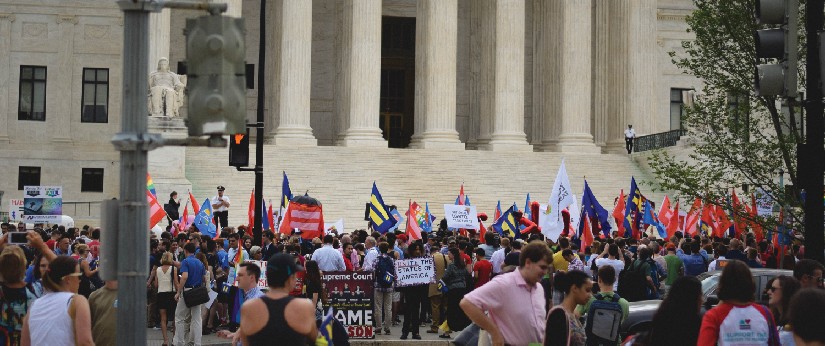
If democratic institutions struggle to balance individual freedoms and collective well-being, the judiciary is arguably the branch where the individual has the best chance to be heard. For those seeking protection on the basis of sexual orientation, for example, in recent years, the courts have expanded rights, such as the 2015 decision in which the Supreme Court ruled that same-sex couples have the right to marry in all fifty states (Figure 2.1).[1]
The U.S. courts pride themselves on two achievements: (1) as part of the system of checks and balances, they protect the sanctity of the U.S. Constitution from breaches by the other branches of government, and (2) they protect individual rights against societal and governmental oppression. At the federal level, nine Supreme Court judges are nominated by the president and confirmed by the Senate for lifetime appointments. This provides them the independence they need to carry out their duties. However, court power is confined to rulings on those cases the courts decide to hear.[2]
How do the courts make decisions, and how do they exercise their power to protect individual rights? How are the courts structured, and what distinguishes the Supreme Court from all others? This chapter answers these and other questions in delineating the power of the judiciary in the United States.
LINK TO LEARNING
-
*Watch this video to learn about the basics of the legal system.
2.2 Guardians of the Constitution and Individual Rights
LEARNING OUTCOMES
By the end of this section, you will be able to:
- Describe the evolving role of the courts since the ratification of the Constitution
- Explain why courts are uniquely situated to protect individual rights
- Recognize how the courts make public policy
Under the Article of Confederation, there was no National judiciary. The U.S. Constitution changed that, but its Article III, which addresses “the judicial power of the United States,” is the shortest and least detailed of the three articles that created the branches of government. It calls for the creation of “one supreme Court” and establishes the Court’s jurisdiction, or its authority to hear cases and make decisions about them, and the types of cases the Court may hear. It distinguishes which are matters of original jurisdiction and which are for appellate jurisdiction. Under original jurisdiction, a case is heard for the first time, whereas under appellate jurisdiction, a court hears a case on appeal from a lower court and may change the lower court’s decision. The Constitution also limits the Supreme Court’s original jurisdiction to those rare cases of disputes between states, or between the United States and foreign ambassadors or ministers. So, for the most part, the Supreme Court is an appeals court, operating under appellate jurisdiction and hearing appeals from the lower courts. the rest of the development of the judicial system and creation of the lower courts were left in the hands of Congress.
To add further explanation to Article III, Alexander Hamilton wrote details about the federal judiciary in Federalist No. 78. In explaining the importance of an independent judiciary separated from the other branches of government, he said “interpretation” was a key role of the courts as they seek to protect people from unjust laws. But he also believed “the Judiciary Department” would “always be the least dangerous” because “with no influence over either the sword or the purse,” it had “neither force nor will, but merely judgment.” The courts would only make decisions, not take action. With no control over how those decisions would be implemented and no power to enforce their choices, they could exercise only judgment, and their power would begin and end there. Hamilton would no doubt be surprised by what the judiciary has become: a key component of the nation’s constitutional democracy, finding its place as the chief interpreter of the Constitution and the equal of the other two branches, though still checked and balanced by them.
The first session of the first U.S. Congress laid the framework for today’s federal judicial system, established in the Judiciary Act of 1789. Although legislative changes over the years have altered it, the basic structure of the judicial branch remains as it was set early on: At the lowest level are the district courts, where federal cases are tried, witnesses testify, and evidence and arguments are presented. A losing party who is unhappy with a district court decision may appeal to the circuit courts, or U.S. courts of appeals, where the decision of the lower court is reviewed. Still further, appeal to the U.S. Supreme Court is possible, but of the thousands of petitions for appeal, the Supreme Court will typically hear fewer than one hundred a year.[3]
LINK TO LEARNING
This public site maintained by the Administrative Office of the U.S. Courts provides detailed information from and about the judicial branch.
Humble Beginnings
Starting in New York in 1790, the early Supreme Court focused on establishing its rules and procedures and perhaps trying to carve its place as the new government’s third branch. However, given the difficulty of getting all the justices even to show up, and with no permanent home or building of its own for decades, finding its footing in the early days proved to be a monumental task. Even when the federal government moved to the nation’s capital in 1800, the Court had to share space with Congress in the Capitol building. This ultimately meant that “the high bench crept into an undignified committee room in the Capitol beneath the House Chamber.”[4]
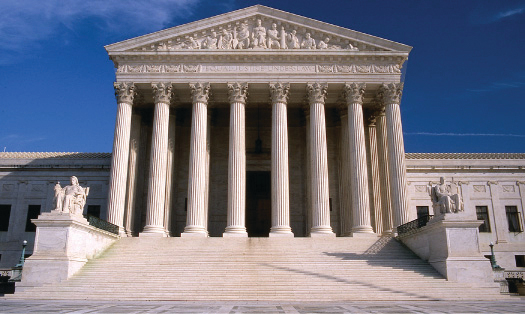
It was not until the Court’s 146th year of operation that Congress, at the urging of Chief Justice—and former president—William Howard Taft, provided the designation and funding for the Supreme Court’s own building, “on a scale in keeping with the importance and dignity of the Court and the Judiciary as a coequal, independent branch of the federal government.”[5] It was a symbolic move that recognized the Court’s growing role as a significant part of the national government (Figure 2.2).
But it took years for the Court to get to that point, and it faced a number of setbacks on the way to such recognition. In their first case of significance, Chisholm v. Georgia (1793), the justices ruled that the federal courts could hear cases brought by a citizen of one state against a citizen of another state, and that Article III, Section 2, of the Constitution did not protect the states from facing such an interstate lawsuit.[6] However, their decision was almost immediately overturned by the Eleventh Amendment, passed by Congress in 1794 and ratified by the states in 1795. In protecting the states, the Eleventh Amendment put a prohibition on the courts by stating, “The Judicial power of the United States shall not be construed to extend to any suit in law or equity, commenced or prosecuted against one of the United States by Citizens of another State, or by Citizens or Subjects of any Foreign State.” It was an early hint that Congress had the power to change the jurisdiction of the courts as it saw fit and stood ready to use it.
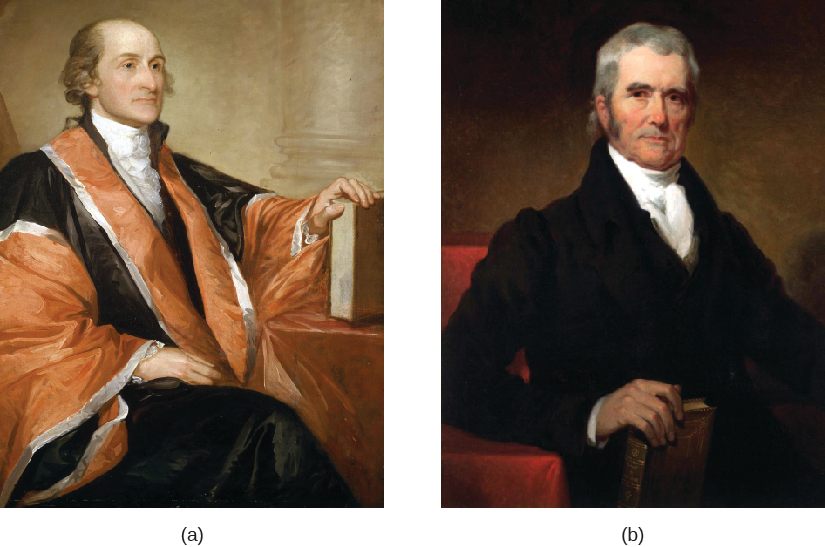
In an atmosphere of perceived weakness, the first chief justice, John Jay, an author of The Federalist Papers and appointed by President George Washington, resigned his post to become governor of New York and later declined President John Adams’s offer of a subsequent term.[7] In fact, the Court might have remained in a state of what Hamilton called its “natural feebleness” if not for the man who filled the vacancy Jay had refused—the fourth chief justice, John Marshall. Often credited with defining the modern court, clarifying its power, and strengthening its role, Marshall served in the chief’s position for thirty-four years. One landmark case during his tenure changed the course of the judicial branch’s history (Figure 2.3).[8]
In 1803, the Supreme Court declared for itself the power of judicial review, a power to which Hamilton had referred but that is not expressly mentioned in the Constitution. Judicial review is the power of the courts, as part of the system of checks and balances, to look at actions taken by the other branches of government and the states and determine whether they are constitutional. If the courts find an action to be unconstitutional, it becomes null and void. Judicial review was established in the Supreme Court case Marbury v. Madison, when, for the first time, the Court declared an act of Congress to be unconstitutional.[9] Wielding this power is a role Marshall defined as the “very essence of judicial duty,” and it continues today as one of the most significant aspects of judicial power. Judicial review lies at the core of the court’s ability to check the other branches of government—and the states.
Since Marbury, the power of judicial review has continually expanded, and the Court has not only ruled actions of Congress and the president to be unconstitutional, but it has also extended its power to include the review of state and local actions. The power of judicial review is not confined to the Supreme Court but is also exercised by the lower federal courts and even the state courts. Any legislative or executive action at the federal or state level inconsistent with the U.S. Constitution or a state constitution can be subject to judicial review.[10]
LINK TO LEARNING
-
*Watch this video to learn about the basics of the legal system.
MILESTONE
Marbury v. Madison (1803)
The Supreme Court found itself in the middle of a dispute between the outgoing presidential administration of John Adams and that of incoming president (and opposition party member) Thomas Jefferson. It was an interesting circumstance at the time, particularly because Jefferson and the man who would decide the case—John Marshall—were themselves political rivals.
President Adams had appointed William Marbury to a position in Washington, DC, but his commission was not delivered before Adams left office. So Marbury petitioned the Supreme Court to use its power under the Judiciary Act of 1789 and issue a writ of mandamus to force the new president’s secretary of state, James Madison, to deliver the commission documents. It was a task Madison refused to do. A unanimous Court under the leadership of Chief Justice John Marshall ruled that although Marbury was entitled to the job, the Court did not have the power to issue the writ and order Madison to deliver the documents, because the provision in the Judiciary Act that had given the Court that power was unconstitutional.[11]
Perhaps Marshall feared a confrontation with the Jefferson administration and thought Madison would refuse his directive anyway. In any case, his ruling shows an interesting contrast in the early Court. On one hand, it humbly declined a power—issuing a writ of mandamus—given to it by Congress, but on the other, it laid the foundation for legitimizing a much more important one—judicial review. Marbury never got his commission, but the Court’s ruling in the case has become more significant for the precedent it established: As the first time the Court declared an act of Congress unconstitutional, it established the power of judicial review, a key power that enables the judicial branch to remain a powerful check on the other branches of government.
Consider the dual nature of John Marshall’s opinion in Marbury v. Madison: On one hand, it limits the power of the courts, yet on the other it also expanded their power. Explain the different aspects of the decision in terms of these contrasting results.
The Courts and Public Policy
Even with judicial review in place, the courts do not always stand ready just to throw out actions of the other branches of government. More broadly, as Marshall put it, “it is emphatically the province and duty of the judicial department to say what the law is.”[12] The United States has a common law system in which law is largely developed through binding judicial decisions. With roots in medieval England, the system was inherited by the American colonies along with many other British traditions.[13] It stands in contrast to code law systems, which provide very detailed and comprehensive laws that do not leave room for much interpretation and judicial decision-making. With code law in place, as it is in many nations of the world, it is the job of judges to simply apply the law. But under common law, as in the United States, they interpret it. Often referred to as a system of judge-made law, common law provides the opportunity for the judicial branch to have stronger involvement in the process of law-making itself, largely through its ruling and interpretation on a case-by-case basis.
In their role as policymakers, Congress and the president tend to consider broad questions of public policy and their costs and benefits. But the courts consider specific cases with narrower questions, thus enabling them to focus more closely than other government institutions on the exact context of the individuals, groups, or issues affected by the decision. This means that while the legislature can make policy through statute, and the executive can form policy through regulations and administration, the judicial branch can also influence policy through its rulings and interpretations. As cases are brought to the courts, court decisions can help shape policy.
Consider health care, for example. In 2010, President Barack Obama signed into law the Patient Protection and Affordable Care Act (ACA), a statute that brought significant changes to the nation’s healthcare system. With its goal of providing more widely attainable and affordable health insurance and health care, “Obamacare” was hailed by some but soundly denounced by others as bad policy. People who opposed the law and understood that a congressional repeal would not happen any time soon looked to the courts for help. They challenged the constitutionality of the law in National Federation of Independent Business v. Sebelius, hoping the Supreme Court would overturn it.[14] The practice of judicial review enabled the law’s critics to exercise this opportunity, even though their hopes were ultimately dashed when, by a narrow 5–4 margin, the Supreme Court upheld the health care law as a constitutional extension of Congress’s power to tax.
Since this 2012 decision, the ACA has continued to face challenges, the most notable of which have also been decided by court rulings. It faced a setback in 2014, for instance, when the Supreme Court ruled in Burwell v. Hobby Lobby that, for religious reasons, some for-profit corporations could be exempt from the requirement that employers provide insurance coverage of contraceptives for their female employees.[15] But the ACA also attained a victory in King v. Burwell, when the Court upheld the ability of the federal government to provide tax credits for people who bought their health insurance through an exchange created by the law.[16]
With each ACA case it has decided, the Supreme Court has served as the umpire, upholding the law and some of its provisions on one hand, but ruling some aspects of it unconstitutional on the other. Both supporters and opponents of the law have claimed victory and faced defeat. In each case, the Supreme Court has further defined and fine-tuned the law passed by Congress and the president, determining which parts stay and which parts go, thus having its say in the way the act has manifested itself, the way it operates, and the way it serves its public purpose.
In this same vein, the courts have become the key interpreters of the U.S. Constitution, continuously interpreting it and applying it to modern times and circumstances. For example, it was in 2015 that we learned a man’s threat to kill his ex-wife, written in rap lyrics and posted to her Facebook wall, was not a real threat and thus could not be prosecuted as a felony under federal law.[17] Certainly, when the Bill of Rights first declared that government could not abridge freedom of speech, its framers could never have envisioned Facebook—or any other modern technology for that matter.
But freedom of speech, just like many constitutional concepts, has come to mean different things to different generations, and it is the courts that have designed the lens through which we understand the Constitution in modern times. It is often said that the Constitution changes less by amendment and more by the way it is interpreted. Rather than collecting dust on a shelf, the nearly 230-year-old document has come with us into the modern age, and the accepted practice of judicial review has helped carry it along the way.
Courts as a Last Resort
While the U.S. Supreme Court and state supreme courts exert power over many when reviewing laws or declaring acts of other branches unconstitutional, they become particularly important when an individual or group comes before them believing there has been a wrong. A citizen or group that feels mistreated can approach a variety of institutional venues in the U.S. system for assistance in changing policy or seeking support. Organizing protests, garnering special interest group support, and changing laws through the legislative and executive branches are all possible, but an individual is most likely to find the courts especially well-suited to analyzing the particulars of a case.
The adversarial judicial system comes from the common law tradition: In a court case, it is one party versus the other, and it is up to an impartial person or group, such as the judge or jury, to determine which party prevails. The federal court system is most often called upon when a case touches on constitutional rights. For example, when Samantha Elauf, a Muslim woman, was denied a job working for the clothing retailer Abercrombie & Fitch because a headscarf she wears as religious practice violated the company’s dress code, the Supreme Court ruled that her First Amendment rights had been violated, making it possible for her to sue the store for monetary damages.
Elauf had applied for an Abercrombie sales job in Oklahoma in 2008. Her interviewer recommended her based on her qualifications, but she was never given the job because the clothing retailer wanted to avoid having to accommodate her religious practice of wearing a headscarf, or hijab. In so doing, the Court ruled, Abercrombie violated Title VII of the Civil Rights Act of 1964, which prohibits employers from discriminating on the basis of race, color, religion, sex, or national origin, and requires them to accommodate religious practices.[18]
Rulings like this have become particularly important for members of religious minority groups, including Muslims, Sikhs, and Jews, who now feel more protected from employment discrimination based on their religious attire, head coverings, or beards.[19] Such decisions illustrate how the expansion of individual rights and liberties for particular persons or groups over the years has come about largely as a result of court rulings made for individuals on a case-by-case basis.
Although the United States prides itself on the Declaration of Independence’s statement that “all men are created equal,” and “equal protection of the laws” is a written constitutional principle of the Fourteenth Amendment, the reality is less than perfect. But it is evolving. Changing times and technology have and will continue to alter the way fundamental constitutional rights are defined and applied, and the courts have proven themselves to be crucial in that definition and application.
Societal traditions, public opinion, and politics have often stood in the way of the full expansion of rights and liberties to different groups, and not everyone has agreed that these rights should be expanded as they have been by the courts. Schools were long segregated by race until the Court ordered desegregation in Brown v. Board of Education (1954), and even then, many stood in opposition and tried to block students at the entrances to all-White schools.[20] Factions have formed on opposite sides of the abortion and handgun debates, because many do not agree that women should have abortion rights or that individuals should have the right to a handgun. People disagree about whether members of the LGBTQ community should be allowed to marry or whether arrested persons should be read their rights, guaranteed an attorney, and/or have their cell phones protected from police search.
But the Supreme Court has ruled in favor of all these issues and others. Even without unanimous agreement among citizens, Supreme Court decisions have made all these possibilities a reality, a particularly important one for the individuals who become the beneficiaries (Table 2.1). The judicial branch has often made decisions the other branches were either unwilling or unable to make, and Hamilton was right in Federalist No. 78 when he said that without the courts exercising their duty to defend the Constitution, “all the reservations of particular rights or privileges would amount to nothing.”
| Examples of Supreme Court Cases Involving Individuals | ||
|---|---|---|
| Case Name | Year | Court’s Decision |
| Brown v. Board of Education | 1954 | Public schools must be desegregated. |
| Gideon v. Wainwright | 1963 | Poor criminal defendants must be provided an attorney. |
| Miranda v. Arizona | 1966 | Criminal suspects must be read their rights. |
| Roe v. Wade | 1973 | Women have a constitutional right to abortion. |
| McDonald v. Chicago | 2010 | An individual has the right to a handgun in his or her home. |
| Riley v. California | 2014 | Police may not search a cell phone without a warrant. |
| Obergefell v. Hodges | 2015 | Same-sex couples have the right to marry in all states. |
The courts seldom if ever grant rights to a person instantly and upon request. In a number of cases, they have expressed reluctance to expand rights without limit, and they still balance that expansion with the government’s need to govern, provide for the common good, and serve a broader societal purpose. For example, the Supreme Court has upheld the constitutionality of the death penalty, ruling that the Eighth Amendment does not prevent a person from being put to death for committing a capital crime and that the government may consider “retribution and the possibility of deterrence” when it seeks capital punishment for a crime that so warrants it.[21] In other words, there is a greater good—more safety and security—that may be more important than sparing the life of an individual who has committed a heinous crime.
Yet the Court has also put limits on the ability to impose the death penalty, ruling, for example, that the government may not execute a person with cognitive disabilities, a person who was under eighteen at the time of the crime, or a child rapist who did not kill his victim.[22] So the job of the courts on any given issue is never quite done, as justices continuously keep their eye on government laws, actions, and policy changes as cases are brought to them and then decide whether those laws, actions, and policies can stand or must go. Even with an issue such as the death penalty, about which the Court has made several rulings, there is always the possibility that further judicial interpretation of what does (or does not) violate the Constitution will be needed.
This happened, for example, as recently as 2015 in a case involving the use of lethal injection as capital punishment in the state of Oklahoma, where death-row inmates are put to death through the use of three drugs—a sedative to bring about unconsciousness (midazolam), followed by two others that cause paralysis and stop the heart. A group of these inmates challenged the use of midazolam as unconstitutional. They argued that since it could not reliably cause unconsciousness, its use constituted an Eighth Amendment violation against cruel and unusual punishment and should be stopped by the courts. The Supreme Court rejected the inmates’ claims, ruling that Oklahoma could continue to use midazolam as part of its three-drug protocol.[23] But with four of the nine justices dissenting from that decision, a sharply divided Court leaves open a greater possibility of more death-penalty cases to come. The 2015–2016 session alone includes four such cases, challenging death-sentencing procedures in such states as Florida, Georgia, and Kansas.[24] In another recent case, Bucklew v. Precythe (2019), the court again rejected an Eighth Amendment claim of the death penalty as torture.[25] Yet, while case outcomes would suggest that it is easier, not harder, to carry out the death penalty, the number of executions across the U.S. has plummeted in recent years.[26]
Therefore, we should not underestimate the power and significance of the judicial branch in the United States. Today, the courts have become a relevant player, gaining enough clout and trust over the years to take their place as a separate yet coequal branch.
2.3 The Dual Court System
LEARNING OUTCOMES
By the end of this section, you will be able to:
- Describe the dual court system and its three tiers
- Explain how you are protected and governed by different U.S. court systems
- Compare the positive and negative aspects of a dual court system
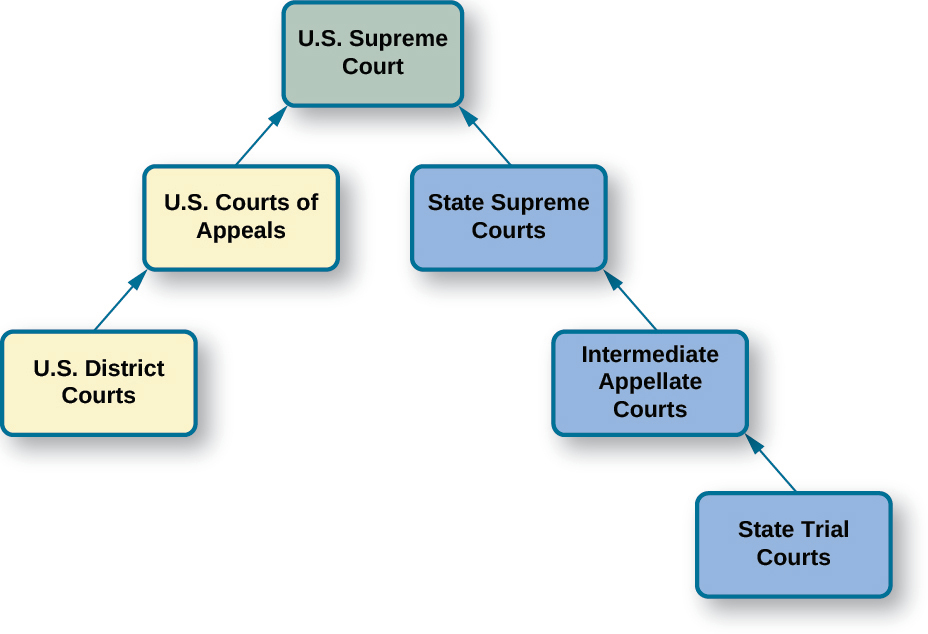
Before the writing of the U.S. Constitution and the establishment of the permanent national judiciary under Article III, the states had courts. Each of the thirteen colonies had also had its own courts, based on the British common law model. The judiciary today continues as a dual court system, with courts at both the national and state levels. Both levels have three basic tiers consisting of appellate courts, and finally courts of last resort, typically called supreme courts, at the top (Figure 2.4).
LINK TO LEARNING
-
*Watch this video to learn about the structure of the court system in the Unites States.
To add to the complexity, the state and federal court systems sometimes intersect and overlap each other, and no two states are exactly alike when it comes to the organization of their courts. Since a state’s court system is created by the state itself, each one differs in structure, the number of courts, and even name and jurisdiction. Thus, the organization of state courts closely resembles but does not perfectly mirror the more clear-cut system found at the federal level.[27] Still, we can summarize the overall three-tiered structure of the dual court model and consider the relationship that the national and state sides share with the U.S. Supreme Court, as illustrated in Figure 2.4.
Cases heard by the U.S. Supreme Court come from two primary pathways: (1) the circuit courts, or U.S. courts of appeals (after the cases have originated in the federal district courts), and (2) state supreme courts (when there is a substantive federal question in the case). In a later section of the chapter, we discuss the lower courts and the movement of cases through the dual court system to the U.S. Supreme Court. But first, to better understand how the dual court system operates, we consider the types of cases state and local courts handle and the types for which the federal system is better designed.
Courts and Federalism
Courts hear two different types of disputes: criminal and civil. Under criminal law, governments establish rules and punishments; laws define conduct that is prohibited because it can harm others and impose punishment for committing such an act. Crimes are usually labeled felonies or misdemeanors based on their nature and seriousness; felonies are the more serious crimes. When someone commits a criminal act, the government (state or national, depending on which law has been broken) charges that person with a crime, and the case brought to court contains the name of the charging government, as in Miranda v. Arizona discussed below.[28] On the other hand, civil law cases involve two or more private (non-government) parties, at least one of whom alleges harm or injury committed by the other. In both criminal and civil matters, the courts decide the remedy and resolution of the case, and in all cases, the U.S. Supreme Court is the final court of appeal.
LINK TO LEARNING
This site provides an interesting challenge: Look at the different cases presented and decide whether each would be heard in the state or federal courts. You can check your results at the end.
Although the Supreme Court tends to draw the most public attention, it typically hears fewer than one hundred cases every year. In fact, the entire federal side—both trial and appellate—handles proportionately very few cases, with about 90 percent of all cases in the U.S. court system being heard at the state level.[29] The several hundred thousand cases handled every year on the federal side pale in comparison to the several million handled by the states.
State courts really are the core of the U.S. judicial system, and they are responsible for a huge area of law. Most crimes and criminal activity, such as robbery, rape, and murder, are violations of state laws, and cases are thus heard by state courts. State courts also handle civil matters; personal injury, malpractice, divorce, family, juvenile, probate, and contract disputes and real estate cases, to name just a few, are usually state-level cases.
The federal courts, on the other hand, will hear any case that involves a foreign government, patent or copyright infringement, Native American rights, maritime law, bankruptcy, or a controversy between two or more states. Cases arising from activities across state lines (interstate commerce) are also subject to federal court jurisdiction, as are cases in which the United States is a party. A dispute between two parties not from the same state or nation and in which damages of at least $75,000 are claimed is handled at the federal level. Such a case is known as a diversity of citizenship case.[30]
However, some cases cut across the dual court system and may end up being heard in both state and federal courts. Any case has the potential to make it to the federal courts if it invokes the U.S. Constitution or federal law. It could be a criminal violation of federal law, such as assault with a gun, the illegal sale of drugs, or bank robbery. Or it could be a civil violation of federal law, such as employment discrimination or securities fraud. Also, any perceived violation of a liberty protected by the Bill of Rights, such as freedom of speech or the protection against cruel and unusual punishment, can be argued before the federal courts. A summary of the basic jurisdictions of the state and federal sides is provided in Table 2.2.
| Jurisdiction of the Courts: State vs. Federal | |
|---|---|
| State Courts | Federal Courts |
| Hear most day-to-day cases, covering 90 percent of all cases | Hear cases that involve a “federal question,” involving the Constitution, federal laws or treaties, or a “federal party” in which the U.S. government is a party to the case |
| Hear both civil and criminal matters | Hear both civil and criminal matters, although many criminal cases involving federal law are tried in state courts |
| Help the states retain their own sovereignty in judicial matters over their state laws, distinct from the national government | Hear cases that involve “interstate” matters, “diversity of citizenship” involving parties of two different states, or between a U.S. citizen and a citizen of another nation (and with a damage claim of at least $75,000) |
While we may certainly distinguish between the two sides of a jurisdiction, looking on a case-by-case basis will sometimes complicate the seemingly clear-cut division between the state and federal sides. It is always possible that issues of federal law may start in the state courts before they make their way over to the federal side. And any case that starts out at the state and/or local level on state matters can make it into the federal system on appeal—but only on points that involve a federal law or question, and usually after all avenues of appeal in the state courts have been exhausted.[31]
Consider the case Miranda v. Arizona.[32] Ernesto Miranda, arrested for kidnapping and rape, which are violations of state law, was easily convicted and sentenced to prison after a key piece of evidence—his own signed confession—was presented at trial in the Arizona court. On appeal first to the Arizona Supreme Court and then to the U.S. Supreme Court to exclude the confession on the grounds that its admission was a violation of his constitutional rights, Miranda won the case. By a slim 5–4 margin, the justices ruled that the confession had to be excluded from evidence because in obtaining it, the police had violated Miranda’s Fifth Amendment right against self-incrimination and his Sixth Amendment right to an attorney. In the opinion of the Court, because of the coercive nature of police interrogation, no confession can be admissible unless a suspect is made aware of his rights and then in turn waives those rights. For this reason, Miranda’s original conviction was overturned.
Yet the Supreme Court considered only the violation of Miranda’s constitutional rights, but not whether he was guilty of the crimes with which he was charged. So there were still crimes committed for which Miranda had to face charges. He was therefore retried in state court in 1967, the second time without the confession as evidence, found guilty again based on witness testimony and other evidence, and sent to prison.
Miranda’s story is a good example of the tandem operation of the state and federal court systems. His guilt or innocence of the crimes was a matter for the state courts, whereas the constitutional questions raised by his trial were a matter for the federal courts. Although he won his case before the Supreme Court, which established a significant precedent that criminal suspects must be read their so-called Miranda rights before police questioning, the victory did not do much for Miranda himself. After serving prison time, he was stabbed to death in a bar fight in 1976 while out on parole, and due to a lack of evidence, no one was ever convicted in his death.
The Implications of a Dual Court System
From an individual’s perspective, the dual court system has both benefits and drawbacks. On the plus side, each person has more than just one court system ready to protect that individual’s rights. The dual court system provides alternate venues in which to appeal for assistance, as Ernesto Miranda’s case illustrates. The U.S. Supreme Court found for Miranda an extension of his Fifth Amendment protections—a constitutional right to remain silent when faced with police questioning. It was a right he could not get solely from the state courts in Arizona, but one those courts had to honor nonetheless.
The fact that a minority voice like Miranda’s can be heard in court, and that grievances can be resolved in a minority voice’s favor if warranted, says much about the role of the judiciary in a democratic republic. In Miranda’s case, a resolution came from the federal courts, but it can also come from the state side. In fact, the many differences among the state courts themselves may enhance an individual’s potential to be heard.
State courts vary in the degree to which they take on certain types of cases or issues, give access to particular groups, or promote certain interests. If a particular issue or topic is not taken up in one place, it may be handled in another, giving rise to many different opportunities for an interest to be heard somewhere across the nation. In their research, Paul Brace and Melinda Hall found that state courts are important instruments of democracy because they provide different alternatives and varying arenas for political access. They wrote, “Regarding courts, one size does not fit all, and the republic has survived in part because federalism allows these critical variations.”[33]
But the existence of the dual court system and variations across the states and nation also mean that there are different courts in which a person could face charges for a crime or for a violation of another person’s rights. Except for the fact that the U.S. Constitution binds judges and justices in all the courts, it is state law that governs the authority of state courts, so judicial rulings about what is legal or illegal may differ from state to state. These differences are particularly pronounced when the laws across the states and the nation are not the same, as we see with marijuana laws today.
FINDING A MIDDLE GROUND
Marijuana Laws and the Courts
There are so many differences in marijuana laws between states, and between the states and the national government, that uniform application of treatment in courts across the nation is nearly impossible (Figure 2.5). What is legal in one state may be illegal in another, and state laws do not cross state geographic boundary lines—but people do. What’s more, a person residing in any of the fifty states is still subject to federal law.

For example, a person over the age of twenty-one may legally buy marijuana for recreational use in sixteen states and for medicinal purpose in more than 80 percent of the country, but could face charges—and time in court—for possession in a neighboring state where marijuana use is not legal. Under federal law, too, marijuana is still regulated as a Schedule 1 (most dangerous) drug, and federal authorities often find themselves pitted against states that have legalized it. Such differences can lead, somewhat ironically, to arrests and federal criminal charges for people who have marijuana in states where it is legal, or to federal raids on growers and dispensaries that would otherwise be operating legally under their state’s law.
Differences among the states have also prompted a number of lawsuits against states with legalized marijuana, as people opposed to those state laws seek relief from (none other than) the courts. They want the courts to resolve the issue, which has left in its wake contradictions and conflicts between states that have legalized marijuana and those that have not, as well as conflicts between states and the national government. These lawsuits include at least one filed by the states of Nebraska and Oklahoma against Colorado. Citing concerns over cross-border trafficking, difficulties with law enforcement, and violations of the Constitution’s supremacy clause, Nebraska and Oklahoma have petitioned the U.S. Supreme Court to intervene and rule on the legality of Colorado’s marijuana law, hoping to get it overturned.[34] The Supreme Court has yet to take up the case.
How do you think differences among the states and differences between federal and state law regarding marijuana use can affect the way a person is treated in court? What, if anything, should be done to rectify the disparities in application of the law across the nation?
Where you are physically located can affect not only what is allowable and what is not, but also how cases are judged. For decades, political scientists have confirmed that political culture affects the operation of government institutions, and when we add to that the differing political interests and cultures at work within each state, we end up with court systems that vary greatly in their judicial and decision-making processes.[35] Each state court system operates with its own individual set of biases. People with varying interests, ideologies, behaviors, and attitudes run the disparate legal systems, so the results they produce are not always the same. Moreover, the selection method for judges at the state and local level varies. In some states, judges are elected rather than appointed, which can affect their rulings.
Just as the laws vary across the states, so do judicial rulings and interpretations, and the judges who make them. That means there may not be uniform application of the law—even of the same law—nationwide. We are somewhat bound by geography and do not always have the luxury of picking and choosing the venue for our particular case. So, while having such a decentralized and varied set of judicial operations affects the kinds of cases that make it to the courts and gives citizens alternate locations to get their case heard, it may also lead to disparities in the way they are treated once they get there.
2.4 The Federal Court System
LEARNING OUTCOMES
By the end of this section, you will be able to:
- Describe the differences between the U.S. district courts, circuit courts, and the Supreme Court
- Explain the significance of precedent in the courts’ operations
- Describe how judges are selected for their positions
Congress has made numerous changes to the federal judicial system throughout the years, but the three-tiered structure of the system is quite clear-cut today. Federal cases typically begin at the lowest federal level, the district (or trial) court. Losing parties may appeal their case to the higher courts—first to the circuit courts, or U.S. courts of appeals, and then, if chosen by the justices, to the U.S. Supreme Court. Decisions of the higher courts are binding on the lower courts. The precedent set by each ruling, particularly by the Supreme Court’s decisions, both builds on principles and guidelines set by earlier cases and frames the ongoing operation of the courts, steering the direction of the entire system. Reliance on precedent has enabled the federal courts to operate with logic and consistency that has helped validate their role as the key interpreters of the Constitution and the law—a legitimacy particularly vital in the United States, where citizens do not elect federal judges and justices but are still subject to their rulings.
The Three Tiers of Federal Courts
There are ninety-four U.S. district courts in the fifty states and U.S. territories, of which eighty-nine are in the states (at least one in each state). The others are in Washington, DC; Puerto Rico; Guam; the U.S. Virgin Islands; and the Northern Mariana Islands. These are the trial courts of the national system, in which federal cases are tried, witness testimony is heard, and evidence is presented. No district court crosses state lines, and a single judge oversees each one. Some cases are heard by a jury, and some are not.
There are thirteen U.S. courts of appeals, or circuit courts, eleven across the nation and two in Washington, DC (the DC circuit and the federal circuit courts). Each court is overseen by a rotating panel of three judges who do not hold trials but instead review the rulings of the trial (district) courts within their geographic circuit. As authorized by Congress, there are currently 179 judges. The circuit courts are often referred to as the intermediate appellate courts of the federal system, since their rulings can be appealed to the U.S. Supreme Court. Moreover, different circuits can hold legal and cultural views, which can lead to differing outcomes on similar legal questions. In such scenarios, clarification from the U.S. Supreme Court might be needed.
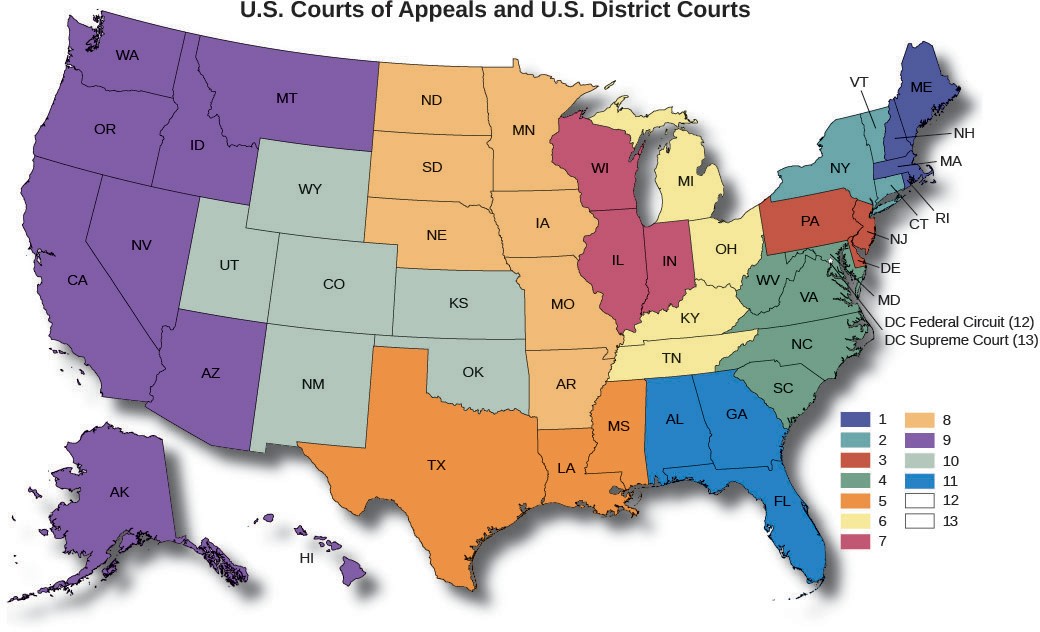
Today’s federal court system was not an overnight creation; it has been changing and transitioning for more than two hundred years through various acts of Congress. Since district courts are not called for in Article III of the Constitution, Congress established them and narrowly defined their jurisdiction, at first limiting them to handling only cases that arose within the district. Beginning in 1789 when there were just thirteen, the district courts became the basic organizational units of the federal judicial system. Gradually over the next hundred years, Congress expanded their jurisdiction, in particular over federal questions, which enables them to review constitutional issues and matters of federal law. In the Judicial Code of 1911, Congress made the U.S. district courts the sole general-jurisdiction trial courts of the federal judiciary, a role they had previously shared with the circuit courts.[36]
The circuit courts started out as the trial courts for most federal criminal cases and for some civil suits, including those initiated by the United States and those involving citizens of different states. But early on, they did not have their own judges; the local district judge and two Supreme Court justices formed each circuit court panel. (That is how the name “circuit” arose—judges in the early circuit courts traveled from town to town to hear cases, following prescribed paths or circuits to arrive at destinations where they were needed.[37]) Circuit courts also exercised appellate jurisdiction (meaning they receive appeals on federal district court cases) over most civil suits that originated in the district courts; however, that role ended in 1891, and their appellate jurisdiction was turned over to the newly created circuit courts, or U.S. courts of appeals. The original circuit courts—the ones that did not have “of appeals” added to their name—were abolished in 1911, fully replaced by these new circuit courts of appeals.[38]
While we often focus primarily on the district and circuit courts of the federal system, other federal trial courts exist that have more specialized jurisdictions, such as the Court of International Trade, Court of Federal Claims, and U.S. Tax Court. Specialized federal appeals courts include the Court of Appeals for the Armed Forces and the Court of Appeals for Veterans Claims. Cases from any of these courts may also be appealed to the Supreme Court, although that result is very rare.
On the U.S. Supreme Court, there are nine justices—one chief justice and eight associate justices. Circuit courts each contain three justices, whereas federal district courts have just one judge each. As the national court of last resort for all other courts in the system, the Supreme Court plays a vital role in setting the standards of interpretation that the lower courts follow. The Supreme Court’s decisions are binding across the nation and establish the precedent by which future cases are resolved in all the system’s tiers.
The U.S. court system operates on the principle of stare decisis (Latin for stand by things decided), which means that today’s decisions are based largely on rulings from the past, and tomorrow’s rulings rely on what is decided today. Stare decisis is especially important in the U.S. common law system, in which the consistency of precedent ensures greater certainty and stability in law and constitutional interpretation, and it also contributes to the solidity and legitimacy of the court system itself. As former Supreme Court justice Benjamin Cardozo summarized it years ago, “Adherence to precedent must then be the rule rather than the exception if litigants are to have faith in the even-handed administration of justice in the courts.”[39]
LINK TO LEARNING
With a focus on federal courts and the public, this website reveals the different ways the federal courts affect the lives of U.S. citizens and how those citizens interact with the courts.
When the legal facts of one case are the same as the legal facts of another, stare decisis dictates that they should be decided the same way, and judges are reluctant to disregard precedent without justification. However, that does not mean there is no flexibility or that new precedents or rulings can never be created. They often are. Certainly, court interpretations can change as times and circumstances change—and as the courts themselves change when new judges are selected and take their place on the bench. For example, the membership of the Supreme Court had changed entirely between Plessy v. Ferguson (1896), which brought the doctrine of “separate but equal” and Brown v. Board of Education (1954), which required integration.[40]
The Selection of Judges
Judges fulfill a vital role in the U.S. judicial system and are carefully selected. At the federal level, the president nominates a candidate to a judgeship or justice position, and the nominee must be confirmed by a majority vote in the U.S. Senate, a function of the Senate’s “advice and consent” role. All judges and justices in the national courts serve lifetime terms of office.
The president sometimes chooses nominees from a list of candidates maintained by the American Bar Association, a national professional organization of lawyers.[41] The president’s nominee is then discussed (and sometimes hotly debated) in the Senate Judiciary Committee. After a committee vote, the candidate must be confirmed by a majority vote of the full Senate. He or she is then sworn in, taking an oath of office to uphold the Constitution and the laws of the United States.
When a vacancy occurs in a lower federal court, by custom, the president consults with that state’s U.S. senators before making a nomination. Through such senatorial courtesy, senators exert considerable influence on the selection of judges in their state, especially those senators who share a party affiliation with the president. In many cases, a senator can block a proposed nominee just by voicing his or her opposition. Thus, a presidential nominee typically does not get far without the support of the senators from the nominee’s home state.
Most presidential appointments to the federal judiciary go unnoticed by the public, but when a president has the rarer opportunity to make a Supreme Court appointment, it draws more attention. That is particularly true now, when many people get their news primarily from the Internet and social media. It was not surprising to see not only television news coverage but also blogs and tweets about President Obama’s nominees to the high court, Sonia Sotomayor and Elena Kagan, or President Trump’s nominees Neil Gorsuch, Brett Kavanaugh, and Amy Coney Barrett.
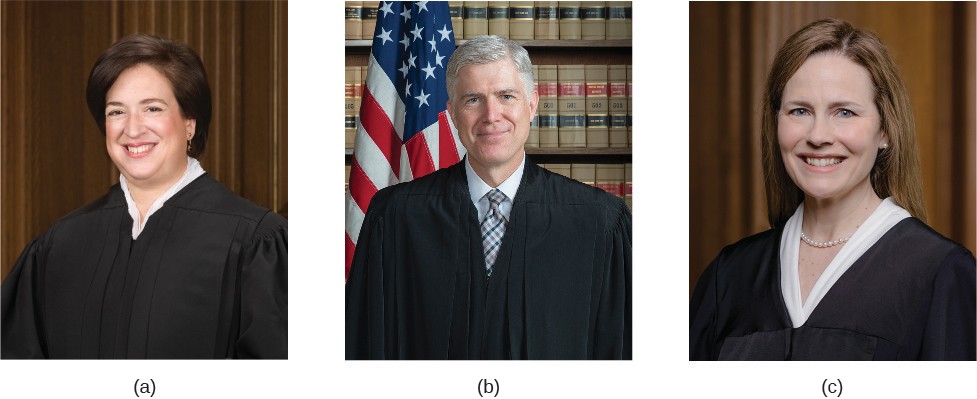
Presidential nominees for the courts typically reflect the chief executive’s own ideological position. With a confirmed nominee serving a lifetime appointment, a president’s ideological legacy has the potential to live on long after the end of the term.[42] President Obama surely considered the ideological leanings of his two Supreme Court appointees, and both Sotomayor and Kagan have consistently ruled in a more liberal ideological direction. The timing of the two nominations also dovetailed nicely with the Democratic Party’s gaining control of the Senate in the 111th Congress of 2009–2011, which helped guarantee their confirmations. Similarly, Republican Donald Trump was able to confirm his three nominations (Neil Gorsuch, Brett Kavanaugh, and Amy Coney Barrett) while Republicans controlled the Senate.
But some nominees turn out to be surprises or end up ruling in ways that the president who nominated them did not anticipate. Democratic-appointed judges sometimes side with conservatives, just as Republican-appointed judges sometimes side with liberals. Republican Dwight D. Eisenhower reportedly called his nomination of Earl Warren as chief justice—in an era that saw substantial broadening of civil and criminal rights—“the biggest damn fool mistake” he had ever made. Sandra Day O’Connor, nominated by Republican President Ronald Reagan, often became a champion for women’s rights. David Souter, nominated by Republican George H. W. Bush, more often than not sided with the Court’s liberal wing. Anthony Kennedy, a Reagan appointee who retired in the summer of 2018, was notorious as the Court’s swing vote, sometimes siding with the more conservative justices but sometimes not. Current chief justice John Roberts, though most typically an ardent member of the Court’s more conservative wing, has twice voted to uphold provisions of the Affordable Care Act.
One of the reasons the framers of the U.S. Constitution included the provision that federal judges would be appointed for life was to provide the judicial branch with enough independence such that it could not easily be influenced by the political winds of the time. The nomination of Brett Kavanaugh tested that notion, as the process became intensely partisan within the Senate and with the nominee himself. (Kavanaugh’s previous nomination to the U.S. Court of Appeals for the D.C. Circuit by President George W. Bush in 2003 also stalled for three years over charges of partisanship.) Sharp divisions emerged early in the confirmation process and an upset Kavanaugh called out several Democratic senators in his impassioned testimony in front of the Judiciary Committee. The high partisan drama of the Kavanaugh confirmation compelled Chief Justice Roberts to express concerns about the process and decry the threat of partisanship and conflict of interest on the Court.
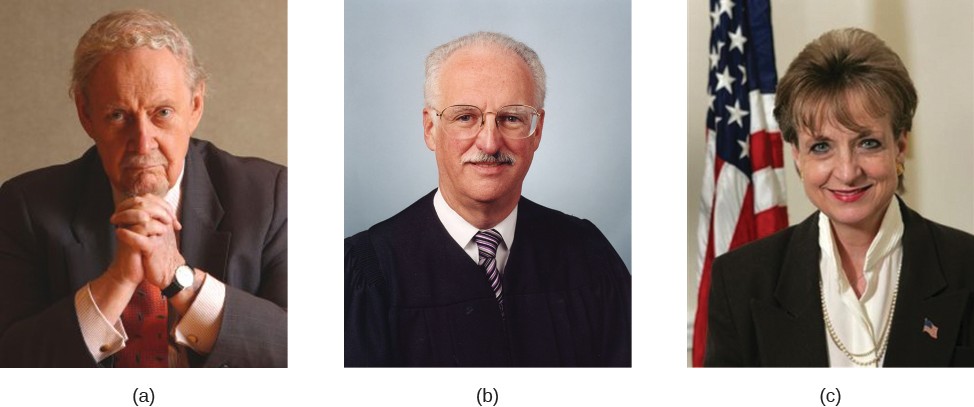
Once a justice has started his or her lifetime tenure on the Court and years begin to pass, many people simply forget which president nominated him or her. For better or worse, sometimes it is only a controversial nominee who leaves a president’s legacy behind. For example, the Reagan presidency is often remembered for two controversial nominees to the Supreme Court—Robert Bork and Douglas Ginsburg, the former accused of taking an overly conservative and “extremist view of the Constitution”[43] and the latter of having used marijuana while a student and then a professor at Harvard University. President George W. Bush’s nomination of Harriet Miers was withdrawn in the face of criticism from both sides of the political spectrum, questioning her ideological leanings and especially her qualifications, suggesting she was not ready for the job.[44] After Miers’ withdrawal, the Senate went on to confirm Bush’s subsequent nomination of Samuel Alito, who remains on the Court today.
Presidential legacy and controversial nominations notwithstanding, there is one certainty about the overall look of the federal court system: What was once a predominantly White, male, Protestant institution is today much more diverse. As a look at the table below reveals, the membership of the Supreme Court has changed with the passing years.
| Supreme Court Justice Firsts | |
|---|---|
| First Catholic | Roger B. Taney (nominated in 1836) |
| First Jew | Louis J. Brandeis (1916) |
| First (and only) former U.S. President | William Howard Taft (1921) |
| First African American | Thurgood Marshall (1967) |
| First Woman | Sandra Day O’Connor (1981) |
| First Hispanic American | Sonia Sotomayor (2009) |
The lower courts are also more diverse today. In the past few decades, the U.S. judiciary has expanded to include more women and minorities at both the federal and state levels.[45] However, the number of women and people of color on the courts still lags behind the overall number of White men. As of 2021, the federal judiciary consists of 67 percent men, 33 percent women. In terms of race and ethnicity, 74 percent of federal judges are White, 12 percent African American, 8 percent Latinx, and 4 percent Asian American.[46]
2.5 The Supreme Court
LEARNING OUTCOMES
By the end of this section, you will be able to:
- Analyze the structure and important features of the Supreme Court
- Explain how the Supreme Court selects cases to hear
- Discuss the Supreme Court’s processes and procedures.
The Supreme Court of the United States, sometimes abbreviated SCOTUS, is a one-of-a-kind institution. While a look at the Supreme Court typically focuses on the nine justices themselves, they represent only the top layer of an entire branch of government that includes many administrators, lawyers, and assistants who contribute to and help run the overall judicial system. The Court has its own set of rules for choosing cases, and it follows a unique set of procedures for hearing them. Its decisions not only affect the outcome of the individual case before the justices, but they also create lasting impacts on legal and constitutional interpretation for the future.
LINK TO LEARNING
*Watch this video to learn more about the Supreme Court.
The Structure of the Supreme Court
The original court in 1789 had six justices, but Congress set the number at nine in 1869, and it has remained there ever since. There is one chief justice, who is the lead or highest-ranking judge on the Court, and eight associate justices. All nine serve lifetime terms, after successful nomination by the president and confirmation by the Senate. There was discussion of expanding the court during Franklin D. Roosevelt’s presidency and also during the 2020 presidential election. Nothing has come of court expansion, however.
The current court is fairly diverse in terms of gender, religion (Christians and Jews), ethnicity (African, European and Latina or Hispanic Americans), and ideology, as well as length of tenure. Some justices have served for three decades, whereas others were only recently appointed by Presidents Trump and Biden. Figure 1 lists the names of the nine justices serving on the Court as of April 2022, along with their year of appointment and the president who nominated them.
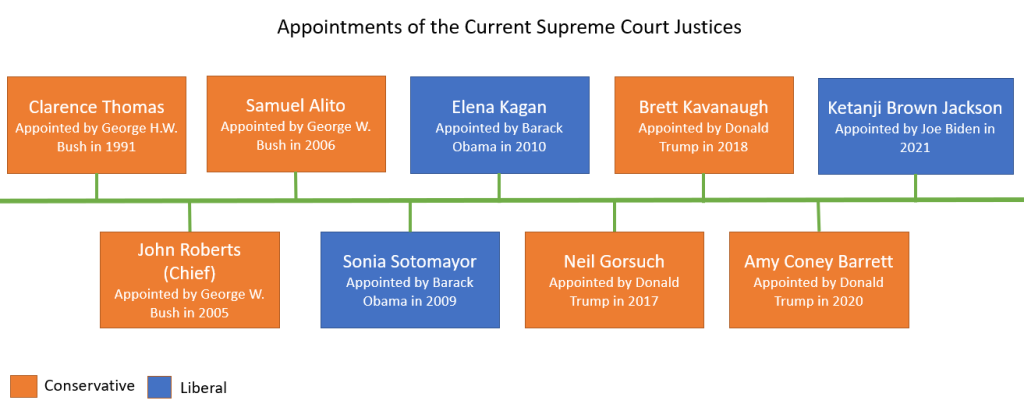
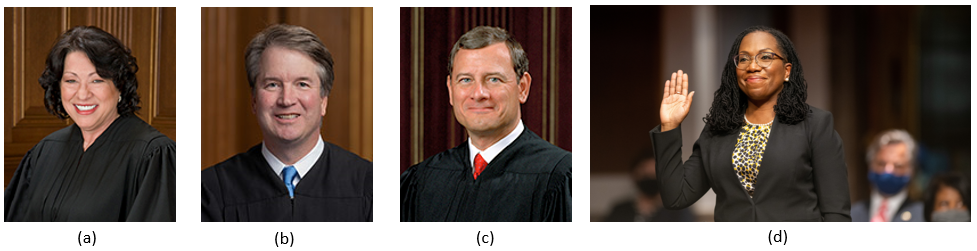
Currently, there are six justices who are considered part of the Court’s more conservative wing—Chief Justice Roberts and Associate Justices Thomas, Alito, Gorsuch, Kavanaugh, and Barrett—while two are considered more liberal-leaning—Justices Sotomayor and Kagan. Following the retirement of Justice Stephens, the Senate on April 7, 2022, by a 53-47 vote affirmed Judge Ketanji Brown Jackson as the 116th Justice. Dr. Jackson is the first and only justice with experience as a public defender, and she is the first Black woman to serve on the court.
LINKS TO LEARNING
While not formally connected with the public the way elected leaders are, the Supreme Court nonetheless offers visitors a great deal of information at its official website.
For unofficial summaries of recent Supreme Court cases or news about the Court, visit the Oyez website or SCOTUS blog.
In fact, none of the justices works completely in an ideological bubble. While their numerous opinions have revealed certain ideological tendencies, they still consider each case as it comes to them, and they don’t always rule in a consistently predictable or expected way. Furthermore, they don’t work exclusively on their own. Each justice has three or four law clerks, recent law school graduates who temporarily work for the justice, do research, help prepare the justice with background information, and assist with the writing of opinions. The law clerks’ work and recommendations influence whether the justices will choose to hear a case, as well as how they will rule. As the profile below reveals, the role of the clerks is as significant as it is varied.
INSIDER PERSPECTIVE
Profile of a United States Supreme Court Clerk
A Supreme Court clerkship is one of the most sought-after legal positions, giving “thirty-six young lawyers each year a chance to leave their fingerprints all over constitutional law.”[47] A number of current and former justices were themselves clerks, including Chief Justice John Roberts, Justices Stephen Breyer and Elena Kagan, and former chief justice William Rehnquist.
Supreme Court clerks are often reluctant to share insider information about their experiences, but it is always fascinating and informative to hear about their jobs. Former clerk Philippa Scarlett, who worked for Justice Stephen Breyer, describes four main responsibilities:[48]
Review the cases: Clerks participate in a “cert. pool” (short for writ of certiorari, a request that the lower court send up its record of the case for review) and make recommendations about which cases the Court should choose to hear.
Prepare the justices for oral argument: Clerks analyze the filed briefs (short arguments explaining each party’s side of the case) and the law at issue in each case waiting to be heard.
Research and draft judicial opinions: Clerks do detailed research to assist justices in writing an opinion, whether it is the majority opinion or a dissenting or concurring opinion.
Help with emergencies: Clerks also assist the justices in deciding on emergency applications to the Court, many of which are applications by prisoners to stay their death sentences and are sometimes submitted within hours of a scheduled execution.
Explain the role of law clerks in the Supreme Court system. What is your opinion about the role they play and the justices’ reliance on them?
How the Supreme Court Selects Cases
The Supreme Court begins its annual session on the first Monday in October and ends late the following June. Every year, there are literally thousands of people who would like to have their case heard before the Supreme Court, but the justices will select only a handful to be placed on the docket, which is the list of cases scheduled on the Court’s calendar. The Court typically accepts fewer than 2 percent of the as many as ten thousand cases it is asked to review every year.[49]
Case names, written in italics, list the name of a petitioner versus a respondent, as in Roe v. Wade, for example.[50] For a case on appeal, you can tell which party lost at the lower level of court by looking at the case name: The party unhappy with the decision of the lower court is the one bringing the appeal and is thus the petitioner, or the first-named party in the case. For example, in Brown v. Board of Education (1954), Oliver Brown was one of the thirteen parents who brought suit against the Topeka public schools for discrimination based on racial segregation.
Most often, the petitioner is asking the Supreme Court to grant a writ of certiorari, a request that the lower court send up its record of the case for review. Once a writ of certiorari (cert. for short) has been granted, the case is scheduled on the Court’s docket. The Supreme Court exercises discretion in the cases it chooses to hear, but four of the nine justices must vote to accept a case. This is called the Rule of Four.
For decisions about cert., the Court’s Rule 10 (Considerations Governing Review on Writ of Certiorari) takes precedence.[51] The Court is more likely to grant certiorari when there is a conflict on an issue between or among the lower courts. Examples of conflicts include (1) conflicting decisions among different courts of appeals on the same matter, (2) decisions by an appeals court or a state court conflicting with precedent, and (3) state court decisions that conflict with federal decisions. Occasionally, the Court will fast-track a case that has special urgency, such as Bush v. Gore in the wake of the 2000 election.[52]
Past research indicated that the amount of interest-group activity surrounding a case before it is granted cert. has a significant impact on whether the Supreme Court puts the case on its agenda. The more activity, the more likely the case will be placed on the docket.[53] But more recent research broadens that perspective, suggesting that too much interest-group activity when the Court is considering a case for its docket may actually have diminishing impact and that external actors may have less influence on the work of the Court than they have had in the past.[54] Still, the Court takes into consideration external influences, not just from interest groups but also from the public, from media attention, and from a very key governmental actor—the solicitor general.
The solicitor general is the lawyer who represents the federal government before the Supreme Court: He or she decides which cases (in which the United States is a party) should be appealed from the lower courts and personally approves each one presented. Most of the cases the solicitor general brings to the Court will be given a place on the docket. About two-thirds of all Supreme Court cases involve the federal government.[55]
The solicitor general determines the position the government will take on a case. The attorneys of the office prepare and file the petitions and briefs, and the solicitor general (or an assistant) presents the oral arguments before the Court.
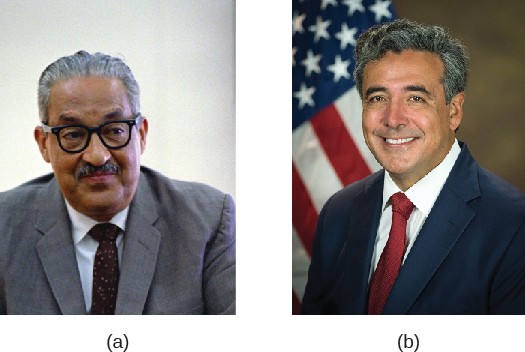
In other cases in which the United States is not the petitioner or the respondent, the solicitor general may choose to intervene or comment as a third party. Before a case is granted cert., the justices will sometimes ask the solicitor general to comment on or file a brief in the case, indicating their potential interest in getting it on the docket. The solicitor general may also recommend that the justices decline to hear a case. Though research has shown that the solicitor general’s special influence on the Court is not unlimited, it remains quite significant. In particular, the Court does not always agree with the solicitor general, and “while justices are not lemmings who will unwittingly fall off legal cliffs for tortured solicitor general recommendations, they nevertheless often go along with them even when we least expect them to.”[56]
Some have credited Donald B. Verrilli, the solicitor general under President Obama, with holding special sway over the five-justice majority ruling on same-sex marriage in June 2015. Indeed, his position that denying same-sex couples the right to marry would mean “thousands and thousands of people are going to live out their lives and go to their deaths without their states ever recognizing the equal dignity of their relationships” became a foundational point of the Court’s opinion, written by then-Justice Anthony Kennedy.[57] With such power over the Court, the solicitor general is sometimes referred to as “the tenth justice.”
Supreme Court Procedures
Once a case has been placed on the docket, briefs, or short arguments explaining each party’s view of the case, must be submitted—first by the petitioner putting forth his or her case, then by the respondent. After initial briefs have been filed, both parties may file subsequent briefs in response to the first. Likewise, people and groups that are not party to the case but are interested in its outcome may file an amicus curiae (“friend of the court”) brief giving their opinion, analysis, and recommendations about how the Court should rule. Interest groups in particular can become heavily involved in trying to influence the judiciary by filing amicus briefs—both before and after a case has been granted cert. And, as noted earlier, if the United States is not party to a case, the solicitor general may file an amicus brief on the government’s behalf.
With briefs filed, the Court hears oral arguments in cases from October through April. The proceedings are quite ceremonial. When the Court is in session, the robed justices make a formal entrance into the courtroom to a standing audience and the sound of a banging gavel. The Court’s marshal presents them with a traditional chant: “The Honorable, the Chief Justice and the Associate Justices of the Supreme Court of the United States. Oyez! Oyez! Oyez! [Hear ye!] All persons having business before the Honorable, the Supreme Court of the United States, are admonished to draw near and give their attention, for the Court is now sitting. God save the United States and this Honorable Court!”[58] It has not gone unnoticed that the Court, which has defended the First Amendment’s religious protection and the traditional separation of church and state, opens its every public session with a mention of God.
During oral arguments, each side’s lawyers have thirty minutes to make their legal case, though the justices often interrupt the presentations with questions. The justices consider oral arguments not as a forum for a lawyer to restate the merits of the case as written in the briefs, but as an opportunity to get answers to any questions they may have.[59] When the United States is party to a case, the solicitor general (or one of the solicitor general’s assistants) will argue the government’s position; even in other cases, the solicitor general may still be given time to express the government’s position on the dispute.
When oral arguments have been concluded, the justices have to decide the case, and they do so in conference, which is held in private twice a week when the Court is in session and once a week when it is not. The conference is also a time to discuss petitions for certiorari, but for those cases already heard, each justice may state their views on the case, ask questions, or raise concerns. The chief justice speaks first about a case, then each justice speaks in turn, in descending order of seniority, ending with the most recently appointed justice.[60] The judges take an initial vote in private before the official announcement of their decisions is made public.
Oral arguments are open to the public, but cameras are not allowed in the courtroom, so the only picture we get is one drawn by an artist’s hand, an illustration or rendering. Cameras seem to be everywhere today, especially to provide security in places such as schools, public buildings, and retail stores, so the lack of live coverage of Supreme Court proceedings may seem unusual or old-fashioned. Over the years, groups have called for the Court to let go of this tradition and open its operations to more “sunshine” and greater transparency. Nevertheless, the justices have resisted the pressure and remain neither filmed nor photographed during oral arguments.[61]
2.6 Judicial Decision-Making and Implementation by the Supreme Court
LEARNING OUTCOMES
By the end of this section, you will be able to:
- Describe how the Supreme Court decides cases and issues opinions
- Identify the various influences on the Supreme Court
- Explain how the judiciary is checked by the other branches of government
The courts are the least covered and least publicly known of the three branches of government. The inner workings of the Supreme Court and its day-to-day operations certainly do not get as much public attention as its rulings, and only a very small number of its announced decisions are enthusiastically discussed and debated. The Court’s 2015 decision on same-sex marriage was the exception, not the rule, since most court opinions are filed away quietly in the United States Reports, sought out mostly by judges, lawyers, researchers, and others with a particular interest in reading or studying them.
Thus, we sometimes envision the justices formally robed and cloistered away in their chambers, unaffected by the world around them, but the reality is that they are not that isolated, and a number of outside factors influence their decisions. Though they lack their own mechanism for enforcement of their rulings and their power remains checked and balanced by the other branches, the effect of the justices’ opinions on the workings of government, politics, and society in the United States is much more significant than the attention they attract might indicate.
LINK TO LEARNING
*Watch this video to learn more about judicial decisions.
Judicial Opinions
Most typically, though, the Court will put forward a majority opinion. If he or she is in the majority, the chief justice decides who will write the opinion. If not, then the most senior justice ruling with the majority chooses the writer. Likewise, the most senior justice in the dissenting group can assign a member of that group to write the dissenting opinion; however, any justice who disagrees with the majority may write a separate dissenting opinion. If a justice agrees with the outcome of the case but not with the majority’s reasoning in it, that justice may write a concurring opinion.
Court decisions are released at different times throughout the Court’s term, but all opinions are announced publicly before the Court adjourns for the summer. Some of the most controversial and hotly debated rulings are released near or on the last day of the term and thus are avidly anticipated.
LINK TO LEARNING
One of the most prominent writers on judicial decision-making in the U.S. system is Dr. Forrest Maltzman of George Washington University. Maltzman’s articles, chapters, and manuscripts, along with articles by other prominent authors in the field, are downloadable at this site.
Influences on the Court
Many of the same players who influence whether the Court will grant cert. in a case, discussed earlier in this chapter, also play a role in its decision-making, including law clerks, the solicitor general, interest groups, and the mass media. But additional legal, personal, ideological, and political influences weigh on the Supreme Court and its decision-making process. On the legal side, courts, including the Supreme Court, cannot make a ruling unless they have a case before them, and even with a case, courts must rule on its facts. Although the courts’ role is interpretive, judges and justices are still constrained by the facts of the case, the Constitution, the relevant laws, and the courts’ own precedent.
Justice’s decisions are influenced by how they define their role as a jurist, with some justices believing strongly in judicial activism, or the need to defend individual rights and liberties, and they aim to stop actions and laws by other branches of government that they see as infringing on these rights. A judge or justice who views the role with an activist lens is more likely to use judicial power to broaden personal liberty, justice, and equality. Still others believe in judicial restraint, which leads them to defer decisions (and thus policymaking) to the elected branches of government and stay focused on a narrower interpretation of the Bill of Rights. These justices are less likely to strike down actions or laws as unconstitutional and are less likely to focus on the expansion of individual liberties. While it is typically the case that liberal actions are described as unnecessarily activist, conservative decisions can be activist as well.
Critics of the judiciary often deride activist courts for involving themselves too heavily in matters they believe are better left to the elected legislative and executive branches. However, as Justice Anthony Kennedy has said, “An activist court is a court that makes a decision you don’t like.”[62]
Another key factor in judicial interpretations is a justice’s judicial philosophy about the Constitution itself. These philosophies involve competing ideas of Originalism and a Living Constitution. The idea of Originalism is the judicial philosophy held by justices that court decisions should consider interpretations based on the original intent of a particular law at the time of its adoption or inception. It values the thinking about the intent of a law as expressed by its authors. The opposing idea of a Living Constitution is the judicial philosophy that suggests that court decisions should heavily consider interpretations based on the realities of modern day or contemporary times that past authors may not consider especially if those realities did not exist in the past. For example, how would conceptions of the law with cyber technology be understood in the context of legal concepts of the framers of the constitution when such technology did not exist?
Justices’ personal beliefs and political attitudes also matter in their decision-making. Although we may prefer to believe a justice can leave political ideology or party identification outside the doors of the courtroom, the reality is that a more liberal-thinking judge may tend to make more liberal decisions and a more conservative-leaning judge may tend toward more conservative ones. Although this is not true 100 percent of the time, and an individual’s decisions are sometimes a cause for surprise, the influence of ideology is real, and at a minimum, it often guides presidents to aim for nominees who mirror their own political or ideological image. It is likely not possible to find a potential justice who is completely apolitical.
And the courts themselves are affected by another “court”—the court of public opinion. Though somewhat isolated from politics and the volatility of the electorate, justices may still be swayed by special-interest pressure, the leverage of elected or other public officials, the mass media, and the general public. As times change and the opinions of the population change, the court’s interpretation is likely to keep up with those changes, lest the courts face the danger of losing their own relevance.
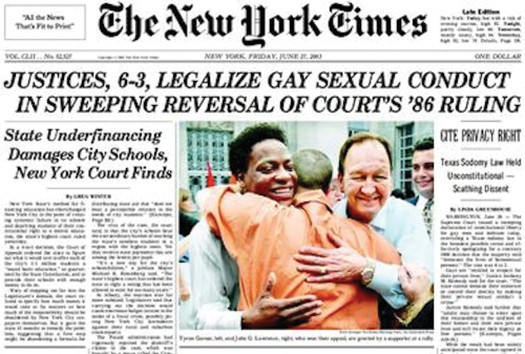
Take, for example, rulings on sodomy laws: In 1986, the Supreme Court upheld the constitutionality of the State of Georgia’s ban on sodomy,[63] but it reversed its decision seventeen years later, invalidating sodomy laws in Texas and thirteen other states.[64] No doubt the Court considered what had been happening nationwide: In the 1960s, sodomy was banned in all the states. By 1986, that number had been reduced by about half. By 2002, thirty-six states had repealed their sodomy laws, and most states were only selectively enforcing them. Changes in state laws, along with an emerging LGBTQ movement, no doubt swayed the Court and led it to the reversal of its earlier ruling with the 2003 decision, Lawrence v. Texas.[65] This decision was an especially important one because it meant all prior and existing laws that formally made same-sex relationships illegal were null and void.
Heralded by advocates of gay rights as important progress toward greater equality, the ruling in Lawrence v. Texas illustrates that the Court is willing to reflect upon what is going on in the world. Even with their heavy reliance on precedent and reluctance to throw out past decisions, justices are not completely inflexible and do tend to change and evolve with the times.
GET CONNECTED!
The Importance of Jury Duty
Since judges and justices are not elected, we sometimes consider the courts removed from the public; however, this is not always the case, and there are times when average citizens may get involved with the courts firsthand as part of their decision-making process at either the state or federal levels. At some point, if you haven’t already been called, you may receive a summons for jury duty from your local court system. You may be asked to serve on federal jury duty, such as U.S. district court duty or federal grand jury duty, but service at the local level, in the state court system, is much more common.
While your first reaction may be to start planning a way to get out of it, participating in jury service is vital to the operation of the judicial system, because it provides individuals in court the chance to be heard and to be tried fairly by a group of their peers. And jury duty has benefits for those who serve as well. You will no doubt come away better informed about how the judicial system works and ready to share your experiences with others. Who knows? You might even get an unexpected surprise, as some citizens in Dallas, Texas, did recently when former President George W. Bush showed up to serve jury duty with them.
Have you ever been called to jury duty? Describe your experience. What did you learn about the judicial process? What advice would you give to someone called to jury duty for the first time? If you’ve never been called to jury duty, what questions do you have for those who have?
The Courts and the Other Branches of Government
Both the executive and legislative branches check and balance the judiciary in many different ways. The president can leave a lasting imprint on the bench through his or her nominations, even long after leaving office. The president may also influence the Court through the solicitor general’s involvement or through the submission of amicus briefs in cases in which the United States is not a party.
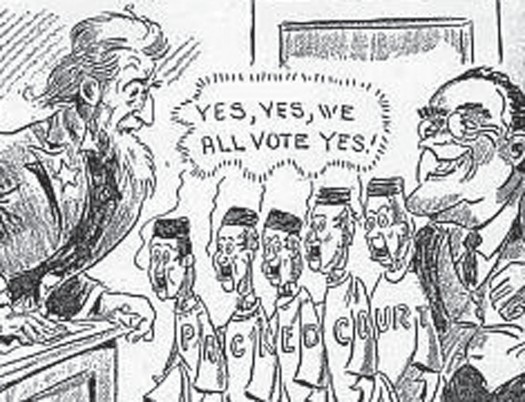
President Franklin D. Roosevelt even attempted to stack the odds in his favor in 1937, with a “court-packing scheme” in which he tried to get a bill passed through Congress that would have reorganized the judiciary and enabled him to appoint up to six additional judges to the high court. The bill never passed, but other presidents have also been accused of trying similar moves at different courts in the federal system.
Likewise, Congress has checks on the judiciary. It retains the power to modify the federal court structure and its appellate jurisdiction, and the Senate may accept or reject presidential nominees to the federal courts. Faced with a court ruling that overturns one of its laws, Congress may rewrite the law or even begin a constitutional amendment process.
But the most significant check on the Supreme Court is executive and legislative leverage over the implementation and enforcement of its rulings. This process is called judicial implementation. While it is true that courts play a major role in policymaking, they have no mechanism to make their rulings a reality. Remember it was Alexander Hamilton in Federalist No. 78 who remarked that the courts had “neither force nor will, but merely judgment.” And even years later, when the 1832 Supreme Court ruled the State of Georgia’s seizing of Native American lands unconstitutional,[66] President Andrew Jackson is reported to have said, “John Marshall has made his decision, now let him enforce it,” and the Court’s ruling was basically ignored.[67] Abraham Lincoln, too, famously ignored Chief Justice Roger B. Taney’s order finding unconstitutional Lincoln’s suspension of habeas corpus rights in 1861, early in the Civil War. Thus, court rulings matter only to the extent they are heeded and followed.
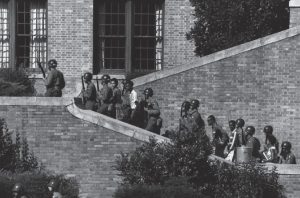
The Court relies on the executive to implement or enforce its decisions and on the legislative branch to fund them. As the Jackson and Lincoln stories indicate, presidents may simply ignore decisions of the Court, and Congress may withhold funding needed for implementation and enforcement. Fortunately for the courts, these situations rarely happen, and the other branches tend to provide support rather than opposition. In general, presidents have tended to see it as their duty to both obey and enforce Court rulings, and Congress seldom takes away the funding needed for the president to do so.
This chapter was remixed from American Government (2e- Second Edition) by Lumen Learning, licensed under a Creative Commons Attribution 4.0 International License, except where otherwise noted.
2.7 How the Supreme Court Selects Cases for Review
Understanding how the Supreme Court selects cases for decision–and then decides those cases–is essential to understanding how the Court defines and changes constitutional freedoms. Article III of the Constitution gives the Supreme Court original jurisdiction over “all Cases affecting Ambassadors, other Public Ministers and Consuls, and those in which a State shall be a Party.” However, the Court has allowed Congress to assign to federal district courts all of these cases except for those in which one state is suing another. Congress also controls the Court’s appellate jurisdiction, and it only requires the Court to hear cases decided by three-judge district courts, such as reapportionment and campaign finance disputes.[69] These two categories together produce very few cases for the Court’s docket; in some years, the total number of cases from these two categories (original and mandatory appellate jurisdiction) is zero.
Until 1925, the Supreme Court was required to hear a wide variety of cases. This overwhelmed its docket, and in many cases it summarily dismissed appeals without writing a decision. In 1925, Chief Justice William Howard Taft–the only Justice to also serve as President–convinced Congress to adopt the “Judges’ Bill,” which required losing litigants in certain cases to seek the Court’s permission for review through a process known as certiorari, usually referred to as “cert.” In 1988, the Judicial Improvements and Access to Justice Act eliminated almost all the remainder of the appeals the Supreme Court was require to hear.[70] Today, losing parties in cases decided by federal courts of appeals can petition the Supreme Court for review. In addition, parties who lose in the highest courts of states can also seek review of federal issues decided by state courts. There are also cases where emergency relief has been denied and losing litigants can seek immediate review through a process known as the Shadow Docket, which is discussed in the next chapter.
Litigants seeking Supreme Court review after they lose in an appellate court must file a petition for certiorai with the Supreme Court explaining why the Court should take the case. Merely alleging that the decision below is erroneous is usually not enough to convince the Court to grant review. Instead, the Court looks for institutional reasons why the judicial system would benefit from review of the case. The most common reason is that the decision below contradicts a decision from another appellate court, so if it is not reviewed federal law would mean different things in different parts of the country. For example, when the Supreme Court granted certiorari in the Sixth Circuit case Obergefell v. Hodges, it sought to remedy a situation where the four states in the Sixth Circuit could bar same-sex marriages while states in other circuits could not. The Court also grants cert when judicial resolution is essential to resolving important problems in federal law, such as determining whether Colorado can exclude Donald Trump from appearing on its Presidential ballot due to section 3 of the Fourteenth Amendment, as the Supreme Court did in Trump v. Anderson, 601 U.S. 100 (2024).
The Supreme Court received 4159 cert petitions in its October 2022 term, which ran from July 1, 2022 to June 30, 2023. Of these, 2907 were in forma pauperis petitions, mostly from incarcerated prisoners unable to pay filing fees, and 1252 were paid petitions.[71] Each of these petitions was distributed to the offices of the nine justices, who assigned them to clerks for review. Seven justices participate in a cert pool in which one of their clerks summarizes the issues in the petition; Justices Alito and Gorsuch require their clerks to review all cert petitions.[72] Conferences are held almost every Friday for the justices to review the petitions and decide which to grant.
Not every cert petition is discussed at the Friday conferences. The Chief Justice prepares a list of the cases that he believes should be discussed, and circulates it to the other justices, who may add additional cases. Between 20-30% of the cases appear on the discussion list; those that do not are automatically denied cert.[73] When the case is called, the Chief Justice ascertains how many justices are willing to grant cert. The Court requires four votes to grant cert, which means that review is denied only if two-thirds of the justices decide not to review the case. In addition to reviewing the cert petitions, the Court also considers submissions by the US Solicitor General, the Justice Department official who oversees the federal government’s litigation in the Supreme Court. If parties interested in the outcome (amici curia) have also filed briefs concerning whether to grant cert, these may also be considered.
The Supreme Court resolves most cert petitions the first time they appear on the discuss list, but not all. Sometimes they are deferred because some justices are undecided, and those voting to grant cert want an opportunity to persuade them. Sometimes the justices want input from the Solicitor General, and they call for the views of the Solicitor General (“CVSG” is the acronym). Sometimes, the Court wants to delay the announcement of its decision for political reasons, as it did in Dobbs, which is discussed in unit seven, chapter 1. And sometimes when there are less than four votes to grant cert, one or more Justices want to write a dissent from denial of certiorari, which puts the cert decision on hold until after this dissent is written. The Court will then return to the case at its next conference and take another vote. If the dissent convinces enough justices to grant cert, it will never be published. Only if it fails in its mission will it be published as a dissent from denial of cert.
This means that the public will never see a successful dissent from denial of certiorari unless it surfaces in the collected papers of a retired Justice. That is what happened in the next case.
Brooks v. Florida, 389 U.S. 413 (1967)
After a riot at a Florida prison, the authorities captured 13 alleged rioters and placed them, three to a cell, in 6 foot by 7 foot holding pens with no furnishings and a hole in the floor to serve as a toilet. They were held under these conditions for two weeks and served only a small amount of soup and water each day. Then they were convinced to sign confessions about participation in the riot, and on the basis of these confessions, convicted and sentenced to additional prison terms. They lost their appeals and sought cert from the Supreme Court.
The justices were reluctant to intervene in cases involving internal prison discipline, and they voted to deny cert. Chief Justice Earl Warren asked clerk Tyrone Brown to write a dissent from the denial of cert for circulation to the Court. According to Brown, Warren told him: “Let’s tell them what really happened. Tell them that the authorities placed these men in threes in tiny sweat boxes for two weeks, naked and on a starvation diet with just a hole in the floor to defecate in! Tell them that they brought these men out, still naked, and forced written confessions from them! . . . Put it in the books, and let posterity decide who was right.”
The justices who had voted to deny cert voted to grant cert at their next conference, and also decided that there was no need for additional briefing or oral argument before it decided that treating prisoners this way was unconstitutional. The Justices then unanimously voted to summarily reverse the lower court, a power they exercise rarely. Chief Justice Warren added six words to the dissent from denial of cert and it became the Court’s published opinion.[74]
Per Curiam.
Petitioner, Bennie Brooks, was convicted of participating in a riot in the Florida prison where he was an inmate and was sentenced to a term of nine years and eight months to run consecutively with the sentence he was already serving. His conviction was affirmed without opinion by the Florida District Court of Appeal, First District, and his petition for writ of certiorari filed in the Florida Supreme Court was dismissed, also without opinion.
The disturbance in the prison occurred on May 27, 1965. The same day, Brooks was ordered confined in a punishment cell for 35 days with two other prisoners also accused of the rioting. Brooks says the cell was 7 feet long and 6 1/2 feet wide; a witness for the State testified it was 6 feet long. This minor difference aside, the parties agree that the punishment cell had no external window, that it contained no bed or other furnishings or facilities except a hole flush with the floor which served as a commode, and that, during the first 14 days he lived in this cell Brooks’ only contact with the outside was an unspecified number of interviews with the prison’s investigating officer. It is also agreed that, while so confined, Brooks was fed a “restricted diet” consisting, according to the testimony of the investigating officer, of “peas and carrots in a soup form” three times daily. Brooks’ more detailed description of this concoction–“they fed us four ounces of soup three times a day and eight ounces of water”–was not controverted, nor was his testimony that he was stripped naked before being thrown into the cell. On the 15th day of confinement under these conditions, Brooks was taken from the punishment cell and again brought directly to the investigating officer. This time, shortly after questioning began, Brooks confessed and dictated his statement into a tape recorder. The recording was introduced at trial. Brooks says that he was brutally beaten by one officer while the other was taking his statement. However, we do not consider this claim because the officer denied it and the judge disbelieved Brooks’ testimony. The judge also concluded that the confession was voluntary. We disagree.
Putting to one side quibbles over the dimensions of the windowless sweatbox into which Brooks was thrown naked with two other men, we cannot accept his statement as the voluntary expression of an uncoerced will. For two weeks, this man’s home was a barren cage fitted only with a hole in one corner into which he and his cell mates could defecate. For two weeks, he subsisted on a daily fare of 12 ounces of thin soup and eight ounces of water. For two full weeks, he saw not one friendly face from outside the prison, but was completely under the control and domination of his jailers. These stark facts belie any contention that the confession extracted from him within minutes after he was brought from the cell was not tainted by the 14 days he spent in such an oppressive hole. In a long line of cases beginning with Brown v. Mississippi, 297 U. S. 278 (1936), and reaffirmed last Term in Clewis v. Texas, 386 U. S. 707 (1967), we have held that the Constitution does not permit prosecutorial use of an involuntary confession. We have also asserted repeatedly that, in adjudicating the question of voluntariness, “we cannot escape the responsibility of making our own examination of the record.” Spano v. New York, 360 U. S. 315, 316 (1959). The record in this case documents a shocking display of barbarism which should not escape the remedial action of this Court. Accordingly, we reverse the judgment below.
*****
H.W. Perry discussed the cert process extensively in his 1994 book Deciding to Decide. Relying on discussions with several Supreme Court Justices and their clerks, he concluded that the justices view the issues presented as either jurisprudential or political. A jurisprudential issue would include resolution of a circuit split or clarification of a federal procedural rule, and in such cases the justices would be primarily focused on resolving the case in a way that would benefit the judicial system. Cert decisions in these cases are often unanimous. In political cases, where the outcome would involve a choice between liberal and conservative values,[75] cert decisions are more focused on the justices’ political objectives. Since denial of cert means that the lower court decision becomes final, there is no reason for the Court to grant cert unless it wants to affirm the case to create a national precedent. Justices who see to do so might thus aggressively grant cert even though the Court’s decision will not change the outcome of the case. Justices who believe they might be outvoted in political cases might defensively deny cert in cases they disagree with if they believe that granting will result in a national precedent that would be worse than the opinion below, which is only binding on courts in the circuit where it is issued.
Finally, when the Court grants cert, it sets forth a list of questions that the parties must answer in their briefs. This allows the Court to limit the scope of the appeal to the issues it wants to answer. This means that although a petitioner may have several grounds for appeal, most of those are effectively dismissed if the Court does not want to consider them. For example, in 303 Creative LLC v. Elenis, discussed in unit five, chapter 5, the petitioner alleged that a Colorado anti-discrimination law was vague and also violated her right of free exercise of religion. In granting review, the Court chose only to review her free speech argument. The Court can also expand the scope of review by introducing questions that were not raised in the petition for cert. For example, when the Supreme Court granted cert in Dobbs, it asked the parties whether Roe v. Wade be overturned even though the issue had not been raised in the cert petition.
2.8 How the Supreme Court Decides Cases
Once the Court announces that certiorari is granted–usually on the Monday after its conference–the clock starts ticking for the case to be heard. The Rules of the Supreme Court (2023) are extremely detailed. Petitioners must generally submit their brief–limited to 13,000 words–within 30 days of the grant of cert, unless the Court sets a different date. Respondents then have 30 days to submit a brief in opposition of up to 13,000 words, and Petitioners may respond within 15 days with a brief of up to 6,000 words. These must be submitted electronically as well as in print.
The Supreme Court also permits the public to participate in the decision-making process by submitting amicus curiae briefs. These “friend of the court” briefs may be submitted by anyone with an interest in the case, whether it is personal to them or shared with a large group of people. These briefs must be filed within 7 days of the brief of the party they support, and are limited to 9000 words. Amici may also file briefs in support of neither party, with the same limits. Often litigants that seek to say more than would fit in their brief will coordinate with amici on their side to ensure presentation of their additional arguments. These briefs signal to the Court the degree of public interest in the case, and may also provide a rough indication of the strength of support on each side. A significant disparity between the sides in amicus briefs may suggest a consensus in favor of one side–but not always.
Oral arguments are generally held Monday through Wednesday mornings, beginning at 10 am. Two cases are usually scheduled for each argument day. In the past, attorneys would come in with a prepared presentation and the justices would interrupt with questions whenever they wished, often cutting off the attorney (and sometimes even other justices) when they were speaking. That changed during the pandemic when the Court switched from in-person hearings to conference calls. Starting in 2020, Chief Justice Roberts began calling on each justice in the order of seniority to ask questions, making the process far more orderly. Today, attorneys typically give a one-minute introduction and then invite questions, relying on the justices to have read their briefs. Instead of cutting off questions when the scheduled argument time has expired, Chief Justice Roberts often allows questions to continue until the Justices stop asking questions. This means that oral arguments often exceed their alloted time, something that rarely happened pre-COVID.
The Court formally discusses the cases it hears each week during its weekly Friday conference. The Chief Justice calls the case and announces his tentative vote. The Associate Justices then vote in order of seniority. If there is a majority, and the Chief is in the majority, then he assigns the opinion. If he is not in the majority, then the most senior justice in the majority makes the assignment. Occasionally, the justices do not reach a decision at the first conference, and the case is deferred until a later conference. In rare cases, the Court may: (1) defer the case until the following term and order additional argument, (2) dismiss the case by classifying its certiorari as improvidently granted (known as “DIG”), or (3) affirm the lower court opinion by tied vote. This last outcome is more likely to occur if a Justice has recused from a case or a seat on the Court is vacant. When the justices are deadlocked, no opinions are written.
There are sometimes good reasons to assign cases to particular justices. The most important reason is to preserve the majority, which means centrist justices are more likely to be assigned decisions in 5-4 cases. A second reason is the importance of the case; Chief Justices are likely to write these decisions as long as they are in the majority. A third reason is that a justice has significant expertise in a particular area of the law. Cases that do not fall into one of these three categories are generally assigned to the justice who is working on the fewest opinions in order to equalize the justices’ workloads.[76]
The purpose of an opinion is to explain the Supreme Court’s reasoning so that it will serve as precedent for subsequent interpretations of the same texts. Knowing that the law has a relatively fixed meaning is an important attribute of constitutional government, which is based on the rule of law. But it is also important to know why the Supreme Court reached its decision, since in most cases the Court tends to follow its precedents. The public’s need to understand why the Supreme Court made its decision is why Chief Justice John Marshall established the practice of having a majority of the Court agree on one opinion setting forth the ratio decidendi, or reason for the decision. Prior to this, each Justice wrote his own opinion, which left the Court’s reasoning in doubt.
Choosing the Frame for Constitutional Interpretation
The Constitution does not specify rules for how it should be interpreted. This means that since the Supreme Court has the responsibility for interpreting its meaning, individual justices may choose the interpretive method that will frame their interpretation of the Constitution–as well as of the laws that are involved in the case.
Justices have used several methods of interpretation in writing their decisions. The first and simplest is textualism, which means looking to the plain meaning of the words at the time they were written. Justice Gorsuch is a proponent of this method, which he used to interpret Title VII of the Civil Rights Act in Bostock v. Clayton County, 590 U.S. 644 (2020). That law bars discrimination that occurs “because of [an employee’s] race, color, religion, sex or national origin.” The Court had to decide whether Title VII protected an employee dismissed because of his sexual orientation. The employer argued that he was not fired because of his sex because if the employee been a gay woman she still would have been fired. Justice Gorsuch ruled that the law encompassed this discrimination because a male employee would not have been dismissed if he had been female since the relevant relationship would have been with someone of the opposite sex. Similarly, discrimination against transgender individuals was also covered since if they had not changed their sex, they would have been permitted to keep their jobs. This constituted discrimination on account of sex because if they had not changed their sex they would not have been fired. Justice Gorsuch acknowledged that Congress had never intended to bar such types of discrimination, but textualist interpretation required faithfulness to the words it had chosen: “Title VII’s effects have unfolded with far-reaching consequences, some likely beyond what many in Congress or elsewhere expected.”
Textualism yields a determinate answer when the meaning of a word is certain, but often the reason that cases end up in court is the ambiguity of a key word. Many Justices look at the original meaning of the word or phrase, reasoning that the writers choose their words because of their meaning at the time.[77] However, the language of the Bill of Rights indicates that its authors knew how to ensure that the meaning of a phrase would not change. Compare the language of the Eighth Amendment phrase “nor cruel and unusual punishments inflicted” with the Seventh Amendment command that “the right of trial by jury shall be preserved.” Whether a punishment is “unusual” will surely vary from time to time, and the same is likely true of whether a punishment is “cruel.” This means that a punishment that was at one time considered neither cruel nor unusual (sentencing a convicted rapist to death) could become both cruel and unusual over time, as the Court found in Kennedy v. Louisiana, 554 U.S. 407 (2008). Contrast this with the phrase “shall be preserved,” which the Supreme Court held in Pernell v. Southall Realty, 416 U.S. 363 (1974), means that the Seventh Amendment right to a federal jury trial is effectively frozen in time, as the test is whether the analogous cause of action in 1789 would convey a right to jury trial.
Since few terms in the Constitution contain a commitment to a preserved meaning (the 9th Amendment protection of “other [rights] retained by the people” is another example), there is no agreed-upon test to determine whether those who ratified the Constitution intended for its meaning to remain static over time. Nor is there evidence that they expected the Constitution to remain in effect for several centuries. After all, the Articles of Confederation were ratified in 1781 and replaced in 1788; how could the framers know how long the new Constitution would last? For example, the meaning of Due Process implies fairness, which also changes over time; the decision not to protect “due process as it is currently understood” suggests the recognition that it would change, and that emerging notions of fairness should also be protected. But there is simply no way to determine the extent to which the framers of the constitution were originalists.
Furthermore, if the Court applies an originalist frame, should it focus on what the framers intended–or what those who ratified their words thought they meant? Consider the Privileges or Immunities Clause of the Fourteenth Amendment, which was intended by at least some Congressmen to require the states to protect the freedoms enshrined in the Bill of Rights. If the state legislators that later ratified this amendment believed that it only incorporated some of those rights, should the Court prefer their interpretation to that of the amendment’s drafters? Or should the Court rely on the drafters’ intentions even if they were not known to the ratifiers when they voted? Accepting this latter interpretation would mean that the people would be bound forever by intentions they were unaware of at the time of ratification.
Even if the framers or the ratifiers believed that the original meaning (or intent) of a constitutional text should remain constant over time, there is often a paucity of information available about what that meaning was. Even more rarely is that information unambiguous. As Justice Jackson stated when he dismissed originalism in Youngstown Sheet & Tube Co. v. Sawyer, 343 U.S. 579, 635 (1952) (concurring opinion), “Just what our forefathers did envision, or would have envisioned had they foreseen modern conditions, must be divined from materials almost as enigmatic as the dreams Joseph was called upon to interpret for Pharaoh.” In the rare instance where the meaning of a phrase or word can be unambiguously ascertained through reference to a contemporaneous statement of meaning or intent, originalism can provide a helpful answer. But often that is not the case.
So if neither textualism nor originalism provide answers to most constitutional questions, what should the Justices rely on when interpreting ambiguous provisions? A third interpretive frame is structuralism, perhaps better termed contextualism. Consider the question of what branch of government is authorized to suspend habeas corpus. The Constitution clearly contemplates suspension in Article I, section 9: “The privilege of the Writ of Habeas Corpus shall not be suspended, unless when in cases of Rebellion or Invasion the public Safety may require it.” Congress is given no power in Article I, section 8, to suspend habeas corpus, and the first section of that Article expressly limits Congressional powers to those defined therein, so there is an argument that Congress was not intended to possess that power. Abraham Lincoln claimed that the ambiguity permitted him to use his executive powers under Article II to find that the terms for suspension were met, especially when Congress was not in session. But if the President is not barred from exercising a constitutional power referenced in Article I, why couldn’t the judiciary also do so and rule that because of a rebellion or invasion it would refuse to grant writs of habeas corpus and allow for indefinite imprisonment without judicial review? And if the structuralist frame forecloses both the executive and the judiciary from exercising a power mentioned only in Article I, and the absence of Congressional authority to suspend habeas corpus means that Congress is likewise disabled from such suspension, could that mean the suspension of habeas corpus is subject to the Tenth Amendment, meaning that only the states have constitutional authority to suspend habeas corpus?
One of the most famous cases of structural analysis arose in McCulloch v. Maryland, 17 U.S. 316 (1819). Congress had chartered a national bank, but the State of Maryland contended that the lack of authority in Article I, section 8 to charter a bank meant that this was not a Congressional power, so only states could charter banks. The Bank of the United States cited the Necessary and Proper Clause as a basis for authorization, but Maryland argued that while a national bank was a proper means of collecting taxes and paying government debts it wasn’t actually necessary since the government had utilized state banks for this purpose between 1811-1816 and could continue to do so. Chief Justice Marshall relied on structural analysis in effectively rendering the word “necessary” meaningless, holding that because the clause was included in a section of the Constitution that granted powers it should not be interpreted as limiting Congressional powers. But if this is the case, then should the word “proper” also have a restrictive meaning? Marshall’s opinion leaves no doubt that he thought it did.
Moving away from contemporaneous sources and dictionaries means expanding the possibilities for interpreting the words of the Constitution. Justices have often claimed to find purposes in the Constitution, such as establishing equality, protecting human dignity, and even promoting the common good. Scholars give this term different names; it is referred to here as purposivism. Obergefell v. Hodges, discussed in unit 7, chapter 4, found that same-sex marriage is justified on the first of these purposes–the establishment of equality–as it holds that states must allow same-sex marriage so that sexual orientation does not become the basis for the denial of benefits. Human dignity was a theme that the Court often cited in cases involving prisoners’ rights, but what exactly comprises dignity in confinement? Can incarceration ever be dignified? Adrian Vermeule argued in Common Good Constitutionalism (2021) that the Justices should interpret the Constitution in order to promote the common good, but does that necessarily mean Christian nationalism (as he suggests)?
Another way of gaining insight into the meaning of provisions in the Bill of Rights is to take into consideration social consensus. This was utilized in Lawrence v. Texas, discussed in unit 7, chapter 1, which noted that most states had repealed laws prohibiting sex between persons of the same sex. It was also relied on in Roper v. Simmons, 543 U.S. 551 (2005), which held that because most countries and states had banned executions of persons who had committed murders while under 18 this practice was cruel and unusual. Aside from the lack of standards governing the use of this consensus approach–how many states must agree for a consensus to exist?–it is inapplicable to most constitutional provisions that lack salience.
Finally, some Justices explicitly adopt a pragmatic balancing approach to constitutional interpretation Unable to discern a clear interpretation, they take into account a variety of factors in explaining their preferred interpretation. This often includes the consideration of cost. For example, in United States v. Leon, 468 U.S. 897 (1984), the Court established a good-faith exception to the Fourth Amendment requirement that a valid warrant be obtained prior to a police search. The Court recognized that the exclusionary rule represented a balance between two values: the need for probative evidence of criminal activity and the desire to prevent unconstitutional searches. Rather than adopt a categorical rule that would exclude evidence obtained from warrants later shown to be based on inaccurate information, the Court held that the cost of excluding evidence of criminal conduct was too high to mandate its exclusion when a neutral magistrate had signed what appeared to be a valid warrant application. In many cases, interpretation comes down to the Court’s best judgment about what balance between conflicting values is best for the US.
Supreme Court justices also rely on stare decisis to justify some of their decisions. This Latin phrase means “let the previous decision stand.” This concept is often invoked when the Court fears that the practical consequences of overturning a previous decision override the value of correcting a previous interpretation of the constitution. In United States v. South-Eastern Underwriters, 322 U.S. 533 (1944), Justice Harlan Fiske Stone summarized the philosophy underlying reliance on stare decisis: “The rule of stare decisis embodies a wise policy because it is often more important that a rule of law be settled than that it is settled right.” These considerations were clearly apparent in the two cases where the Supreme Court considered whether to overturn the right to abortion. In Planned Parenthood v. Casey, further discussed in unit 7, chapter 1, Justice Sandra Day O’Connor wrote that while the Court had grave doubts about whether the Constitution protected the right of abortion, “Liberty has no refuge in a jurisprudence of doubt.” When the Court overturned Roe in 2022, several of the opinions addressed stare decisis and whether ending the right to abortion would cause excessive harm to women who had relied on the right to terminate a pregnancy. See Dobbs v. Jackson Women’s Health Organization, also discussed in unit seven, chapter 1.
Once the assigned justice has finished the first opinion draft, it is circulated to the other justices. They may make one of several possible responses: approving as is, suggesting changes necessary for approval, writing a concurrence to address issues not satisfactorily resolved in the draft, agreeing in part and dissenting in part, and even choosing to switch sides. Most opinions are the product of negotiation between the justices. Rarely is an opinion agreed to without changes; this mostly happens in relatively insignificant cases. Scholars call offers to sign in exchange for revisions “bargaining statements,” as they set off a sequencing of bargaining moves: justice A asks for some changes, the opinion writer may accept them but justice B objects and proposes counter-changes; justice A threatens to write separately; justice C suggests that justice A join his concurrence, etc. This leads to unusual outcomes, such as when Justice William O. Douglass was assigned the majority opinion in Griswold v. Connecticut, discussed in unit seven, chapter 1. Most justices objected to his analysis, and Justice Byron White’s concurrence effectively became the majority opinion for the case. It appears that Chief Justice John Roberts originally voted to strike down the Affordable Care Act in National Federation of Independent Business v. Sebelius, 567 U.S. 519 (2012) but later changed his mind, leaving Justice Alito’s opinion as a 4-person dissent that reads as if it were intended to be the majority opinion in the case.
Types of Judicial Opinions
- A majority opinion requires a majority of the justices to agree on the outcome (who wins) and also on at least one reason for the decision. This establishes a precedential determination of the ratio decidendi (reason for the decisions) in the case.
- In a plurality opinion, a majority of the justices agree on the outcome but there is not a majority for the ratio decidendi. For example, in McDonald v. City of Chicago, discussed in unit three, chapter 2, the Court held that the Second Amendment is incorporated against the states. However, a majority of justices did not agree on why. Four applied the Fourteenth Amendment Due Process Clause, while Justice Thomas applied the Privileges or Immunities Clause. The only precedent the Court established is that the amendment is incorporated through the Fourteenth Amendment . . . somehow.
- A special concurrence is an opinion by one or more justices who agree with the majority’s decision on the outcome of the case but disagree on the ratio decidendi as they have a different reason for their votes.
- A general concurrence is an opinion by one or more justices who agree with the majority’s ratio decidendi but have one or more additional reasons for their decision.
- A per curiam decision is a short statement of the outcome of the case without an extended discussion of the issues. It is issued in a variety of circumstances, and is often the opinion in shadow docket cases (see below).
- A dissent is an opinion by one or more justices who disagree with the outcome of the case.
Once the majority opinion has been approved by all the justices in the majority, the dissenters are able to finish their opinions, since they need to know what arguments are contained in the majority opinion in order to rebut them. The same is true for those writing concurrences. While waiting for those opinions to be completed, the clerks of the majority opinion writer update citations and fix errors in grammar and punctuation. Once drafts of these opinions are ready, then the writer of the majority of the decision is given a chance to respond to the arguments raised in the other opinions, and then the decision is ready for release. This process can be seen in Dobbs, which was leaked in draft form two months before the final opinion was released. The only substantive changes to the draft were 40 paragraphs responding to the arguments of the dissenters. [78]
Prior to the pandemic, the Supreme Court assembled on days on which decisions were issued. Opinion authors read excerpts from their decisions, and writers of other opinions occasionally did the same. In most cases, they declined, so the reading of a dissent came to signal strong opposition to a majority opinion. During the pandemic, the Court only issued decisions electronically, and the decisions were immediately available on the website Home – Supreme Court of the United States. The Court returned to reading its decisions–and some dissents–from the bench in 2022, and continues to do so today.
The Shadow Docket
The Supreme Court’s regular procedures are not designed for quick decisions. The petition for certiorari in Dobbs v. Jackson Women’s Health Organization was filed on June 15, 2020; it was granted the following April; argument took place December 1, 2021, and the decision was released on June 24, 2022, almost two years after the case was first presented to the Supreme Court. Unless a case is set for argument in the term in which it was filed, this two-year timetable is not unusual.
But what if a case arises where an immediate decision needs to be made? For example, a federal judge issues a nationwide injunction against a public assistance program that many rely on for food? Or a prisoner files a cert petition to stop an imminent execution? For such cases, the Court has developed a procedure that in the past decade has come to be known as the “Shadow Docket.”
Until the 1960s, such cases were rare. During the summer, the Court recessed, and justices often left Washington. Occasionally, they were summoned back to the capitol to hear an important case, such as Ex Parte Quirin, 317 U.S. 1 (1942) which determined whether German spies captured during wartime could be tried by military commissions, or whether the President could seize steel plants in order to prevent the workers from striking during the Korean War, which was decided in Youngstown Sheet & Tube Co. v. Sawyer. In the late 1960s, the Court began receiving more emergency habeas corpus petitions from death row prisoners, but these were often decided by the justice responsible for the circuit in which the prisoner was located. In such cases, oral argument would take place before that justice in his chambers, not before the full court. If the Court chose to grant a stay in order to hear the appeal, it would place the case on its regular calendar and the prisoner would remain on death row.[79]
However, in the late 1970s the number of emergency habeas petitions vastly increased due to uncertainly that followed a major Supreme Court decision permitting the restoration of the death penalty.[80] Since the issues that were raised required discussion by the full court, it began resolving them in conference rather than leaving the decision to an individual circuit justice. In 1980, the Court cancelled its formal summer recess to facilitate consideration of these emergency petitions, but since the justices were often out of town it did not hold oral argument. This is when the modern Shadow Docket procedure took shape.[81]
The number of emergency habeas cases remained high until 1996, when Congress limited the number of habeas petitions a convicted prisoner could file. Meanwhile, the Solicitor General rarely used emergency appeals, preferring full consideration on the merits docket. During the 16 years between 2001 and 2017, the George W. Bush and Barack Obama administrations requested emergency consideration an average of twice a year. However, after Donald Trump took office in 2017, his Solicitors General filed over ten cases a year on the emergency docket. This made the availability of emergency relief more salient, and in the past five years the number of shadow docket cases has increased significantly even though the current administration has filed very few applications for this docket.
The process for seeking an immediate stay requires the losing party to file a petition with the justice for their circuit. That justice can act alone, but rarely does so since his or her decision can be immediately appealed to the full Court. The Court may but does not usually order additional briefing; it almost never asks for oral argument.[82] At their Friday conference, the justices focus on four factors when considering whether to grant the petition for relief: (1) whether there are four votes to grant cert; (2) whether there are “fair prospects” for reversal of the decision below; (3) whether the petitioner will suffer irreparable harm if no stay is granted; and (4), in close cases, where the balance of equities lies, including consideration of the public interest.[83] The Court usually issues a brief per curiam decision that states what relief (if any) is granted with little discussion of the Court’s reasoning. Often, there is no indication of the vote on the application. Individual justices may choose to write concurrences or dissents, but these do not establish precedential reasoning unless they are signed by a majority of the justices, which is rare.
The Court has been criticized for its increasing use of the Shadow Docket on the grounds that its truncated procedure does not permit the participation of amici curiae or oral argument, and its per curiam decisions give little guidance as to the principles upon which its decisions are based. While the Court claims these decisions are non-precedential, it appears that it does expect litigants to address them in their papers, and it occasionally refers to them as precedent in subsequent shadow docket decisions. While in some cases the Court will have another chance to review the issues if the courts below make decisions on the merits, in others (such as Roman Catholic Diocese of Brooklyn v. Cuomo, discussed in unit one, chapter 1) the Court’s decision on the stay will resolve the issue and there will be no further proceedings.
This chapter was remixed from Constitutional Freedoms in the United States by Tom Rozinski, licensed under a Creative Commons Attribution Non-Commercial License, except where otherwise noted.
Media Attributions
- image578
- image580
- image582
- court
- courts 4
- image587
- image589
- image591
- image593
- image595
- Obergefell v. Hodges, 576 U.S. 644 (2015) ↵
- In cases of original jurisdiction the courts cannot decide—the U.S. Constitution mandates that the U.S. Supreme Court must hear cases of original jurisdiction ↵
- “The U.S. Supreme Court.” The Judicial Learning Center. http://judiciallearningcenter.org/the-us-supreme-court/ (March 1, 2016). ↵
- Bernard Schwartz. 1993. A History of the Supreme Court. New York: Oxford University Press, 16. ↵
- “Washington D.C. A National Register of Historic Places Travel Itinerary.” U.S. Department of the Interior, National Park Service. http://www.nps.gov/nr/travel/wash/dc78.htm (March 1, 2016) ↵
- Chisholm v. Georgia, 2 U.S. 419 (1793) ↵
- Associated Press. “What You Should Know About Forgotten Founding Father John Jay,” PBS Newshour. July 4, 2015. http://www.pbs.org/newshour/rundown/forgotten-founding-father ↵
- “Life and Legacy.” The John Marshall Foundation. http://www.johnmarshallfoundation.org (March 1, 2016) ↵
- Marbury v. Madison, 5 U.S. 137 (1803). ↵
- Stephen Hass. “Judicial Review.” National Juris University. http://juris.nationalparalegal.edu/(X(1)S(wwbvsi5iswopllt1bfpzfkjd))/JudicialReview.aspx (March 1, 2016) ↵
- Marbury v. Madison, 5 U.S. 137 (1803) ↵
- Marbury v. Madison, 5 U.S. 137 (1803) ↵
- “The Common Law and Civil Law Traditions.” The Robbins Collection. School of Law (Boalt Hall). University of California at Berkeley. https://www.law.berkeley.edu/library/robbins/CommonLawCivilLawTraditions.html (March 1, 2016) ↵
- National Federation of Independent Business v. Sebelius, 567 U.S. 519 (2012) ↵
- Burwell v. Hobby Lobby, 573 U.S. 682 (2014) ↵
- King v. Burwell, 576 U.S. 473 (2015) ↵
- Elonis v. United States, 13-983 U.S. __ (2015) ↵
- Equal Employment Opportunity Commission v. Abercrombie & Fitch Stores, 575 U.S. __ (2015) ↵
- Liptak, Adam. “Muslim Woman Denied Job Over Head Scarf Wins in Supreme Court.” New York Times. 1 June 2015. http://www.nytimes.com/2015/06/02/us/supreme-court-rules-in-samantha-elauf-abercrombie-fitch-case.html?_r=0 ↵
- Brown v. Board of Education of Topeka, 347 U.S. 483 (1954) ↵
- Gregg v. Georgia, 428 U.S. 153 (1976) ↵
- Atkins v. Virginia, 536 U.S. 304 (2002); Roper v. Simmons, 543 U.S. 551 (2005); Kennedy v. Louisiana, 554 U.S. 407 (2008) ↵
- Glossip v. Gross, 576 U.S. __ (2015) ↵
- “October Term 2015.” SCOTUSblog. http://www.scotusblog.com/case-files/terms/ot2015/?sort=mname (March 1, 2016) ↵
- Bucklew v. Precythe, 587 U.S. ___ (2019); Ian Millhiser, "The Constitution's ban on "cruel and unusual" punishment is in grave danger from the Supreme Court," Vox, 16 October 2019 ↵
- Ian Millhiser, "The decline and fall of the American death penalty" punishment is in grave danger from the Supreme Court," Vox, 30 December 2020 ↵
- Bureau of International Information Programs, United States Department of State. Outline of the U.S. Legal System. 2004 ↵
- Miranda v. Arizona, 384 U.S. 436 (1966) ↵
- “State Courts vs. Federal Courts.” The Judicial Learning Center. http://judiciallearningcenter.org/state-courts-vs-federal-courts/ (March 1, 2016) ↵
- “State Courts vs. Federal Courts.” The Judicial Learning Center. http://judiciallearningcenter.org/state-courts-vs-federal-courts/ (March 1, 2016) ↵
- “U.S. Court System.” Syracuse University. http://www2.maxwell.syr.edu/plegal/scales/court.html (March 1, 2016) ↵
- Miranda v. Arizona, 384 U.S. 436 (1966) ↵
- Paul R. Brace and Melinda Gann Hall. 2005. “Is Judicial Federalism Essential to Democracy? State Courts in the Federal System.” In Institutions of American Democracy, The Judicial Branch, eds. Kermit L. Hall and Kevin T. McGuire. New York: Oxford University Press ↵
- States of Nebraska and Oklahoma v. State of Colorado. Motion for Leave to File Complaint, Complaint and Brief in Support. December 2014. http://www.scribd.com/doc/250506006/Nebraska-Oklahoma-Lawsuit. ↵
- Joel B. Grossman and Austin Sarat. 1971. “Political Culture and Judicial Research.” Washington University Law Review. 1971 (2) Symposium: Courts, Judges, Politics—Some Political Science Perspectives. http://openscholarship.wustl.edu/cgi/viewcontent.cgi?article=2777&context=law_lawreview ↵
- "The U.S. District Courts and the Federal Judiciary." Federal Judicial Center. http://www.fjc.gov/history/home.nsf/page/courts_district.html (March 1, 2016). ↵
- "Circuit Riding." Encyclopedia Britannica. http://www.britannica.com/topic/circuit-riding (March 1, 2016). ↵
- "The U.S. Circuit Courts and the Federal Judiciary." Federal Judicial Center. http://www.fjc.gov/history/home.nsf/page/courts_circuit.html (March 1, 2016). ↵
- Benjamin N. Cardozo. 1921. The Nature of the Judicial Process. New Haven: Yale University Press. http://www.constitution.org/cmt/cardozo/jud_proc.htm. ↵
- Plessy v. Ferguson, 163 U.S. 537 (1896); Brown v. Board of Education of Topeka, 347 U.S. 483 (1954). ↵
- American Bar Association Coalition for Justice. 2008. "Judicial Selection." In American Bar Association, eds. American Judicature Society and Malia Reddick. http://www.americanbar.org/content/dam/aba/migrated/JusticeCenter/Justice/PublicDocuments/judicial_selection_roadmap.authcheckdam.pdf. ↵
- American Bar Association Coalition for Justice. 2008. "Judicial Selection." In American Bar Association, eds. American Judicature Society and Malia Reddick. http://www.americanbar.org/content/dam/aba/migrated/JusticeCenter/Justice/PublicDocuments/judicial_selection_roadmap.authcheckdam.pdf ↵
- John M. Broder. "Edward M. Kennedy, Senate Stalwart, Is Dead at 77." New York Times. 26 August 2009. ↵
- Michael A. Fletcher and Charles Babington. "Miers, Under Fire From Right, Withdrawn as Court Nominee." Washington Post. 28 October 2005. http://www.washingtonpost.com/wp-dyn/content/article/2005/10/27/AR2005102700547.html. ↵
- Bureau of International Information Programs. United States Department of State. Outline of the U.S. Legal System. 2004. ↵
- "Diversity of the Federal Bench." American Constitution Society. https://www.acslaw.org/judicial-nominations/diversity-of-the-federal-bench/ (June 1, 2021). ↵
- Dahlia Lithwick. "Who Feeds the Supreme Court?" Slate.com. September 14, 2015. http://www.slate.com/articles/news_and_politics/jurisprudence/2015/09/supreme_court_feeder_judges_men_and_few_women_send_law_clerks_to_scotus.html. ↵
- "Role of Supreme Court Law Clerk: Interview with Philippa Scarlett." IIP Digital. United States of America Embassy. http://iipdigital.usembassy.gov/st/english/publication/2013/02/20130211142365.html#axzz3grjRwiG (March 1, 2016). ↵
- "Supreme Court Procedures." United States Courts. http://www.uscourts.gov/about-federal-courts/educational-resources/about-educational-outreach/activity-resources/supreme-1 (March 1, 2016). ↵
- Roe v. Wade, 410 U.S. 113 (1973). ↵
- "Rule 10. Considerations Governing Review on Certiorari." Rules of the Supreme Court of the United States. Adopted April 19, 2013, Effective July 1, 2013. http://www.supremecourt.gov/ctrules/2013RulesoftheCourt.pdf. ↵
- Bush v. Gore, 531 U.S. 98 (2000). ↵
- Gregory A. Caldeira and John R. Wright. 1988. "Organized Interests and Agenda-Setting in the U.S. Supreme Court," American Political Science Review 82: 1109–1128. ↵
- Gregory A. Caldeira, John R. Wright, and Christopher Zorn. 2012. "Organized Interests and Agenda Setting in the U.S. Supreme Court Revisited." Presentation at the Second Annual Conference on Institutions and Lawmaking, Emory University. http://polisci.emory.edu/home/cslpe/conference-institutions-law-making/2012/papers/caldeira_wright_zorn_cwzpaper.pdf. ↵
- "About the Office." Office of the Solicitor General. The United States Department of Justice. http://www.justice.gov/osg/about-office-1 (March 1, 2016). ↵
- Ryan C. Black and Ryan J. Owens. "Solicitor General Influence and the United States Supreme Court." Vanderbilt University. http://www.vanderbilt.edu/csdi/archived/working%20papers/Ryan%20Owens.pdf (March 1, 2016). ↵
- Mark Joseph Stern., "If SCOTUS Decides in Favor of Marriage Equality, Thank Solicitor General Don Verrilli," Slate.com. April 29, 2015. http://www.slate.com/blogs/outward/2015/04/29/don_verrilli_solicitor_general_was_the_real_hero_of_scotus_gay_marriage.html. ↵
- "The Court and its Procedures." Supreme Court of the United States. May 26, 2015. ↵
- "Supreme Court Procedures." United States Courts. http://www.uscourts.gov/about-federal-courts/educational-resources/about-educational-outreach/activity-resources/supreme-1 (March 1, 2016). ↵
- "Supreme Court Procedures." United States Courts. http://www.uscourts.gov/about-federal-courts/educational-resources/about-educational-outreach/activity-resources/supreme-1 (March 1, 2016). ↵
- Jonathan Sherman. "End the Supreme Court's Ban on Cameras." New York Times. 24 April 2015. http://www.nytimes.com/2015/04/24/opinion/open-the-supreme-court-to-cameras.html. ↵
- Matt Sedensky. "Justice questions way court nominees are grilled." The Associated Press. May 14, 2010. http://www.boston.com/news/nation/articles/2010/05/14/justice_questions_way_court_nominees_are_grilled/. ↵
- Bowers v. Hardwick, 478 U.S. 186 (1986). ↵
- Lawrence v. Texas, 539 U.S. 558 (2003). ↵
- Lawrence v. Texas, 539 U.S. 558 (2003). ↵
- Worcester v. Georgia, 31 U.S. (6 Pet.) 515 (1832). ↵
- "Court History." Supreme Court History: The First Hundred Years. http://www.pbs.org/wnet/supremecourt/antebellum/history2.html (March 1, 2016). ↵
- Dwight D. Eisenhower. "Radio and Television Address to the American People on the Situation in Little Rock." Public Papers of the Presidents of the United States: Eisenhower, Dwight D., The American Presidency Project. September 24, 1957. http://www.presidency.ucsb.edu/ws/?pid=10909. ↵
- Stephen Vladeck, The Shadow Docket 57 (2023). ↵
- David M. O'Brien, Constitutional Law and Politics 175-180 (2008). ↵
- John Roberts, Report on the Federal Judiciary 8 (2023). ↵
- Lee Epstein, Kevin T. McGuire, and Thomas G. Walker, Constitutional Law for a Changing America: Rights, Liberties, and Justice (11th ed.) 14 (2022). ↵
- Id. at 15. ↵
- Tyrone Brown, "Clerking for the Chief Justice," in Bernard Schwartz, ed., The Warren Court: A Retrospective (1996) ↵
- Historically, the Court has split ideologically along these lines rather than along party lines. However, as party lines became more ideologically pure, the ideological split has come to resemble the current split along party lines. ↵
- Epstein, McGuire and Walker, Constitutional Law for a Changing America: Rights, Liberties and Justice 20-21 (2022). ↵
- My favorite example of how the meaning of words can change is the word "intercourse," which two centuries ago meant social or economic relations in addition to the more intimate form that the word denotes today. The Non-Intercourse Act of 1809 sounds draconian, but it only barred trade with Britain and France, not what one might think when applying today's meaning. ↵
- For the details of how the Court added to the leaked version of its opinion, see Track changes between the Supreme Court abortion decision and the leaked draft - CNN. ↵
- Stephen Vladeck, The Shadow Docket 100-108. ↵
- The Supreme Court paused the death penalty in Furman v. Georgia, 408 U.S. 238 (1972). Four years later, it permitted states to resume executions in Gregg v. Georgia, 428 U.S. 153 (1976). ↵
- Vladeck, 106-107. ↵
- An exception is Ohio v. Environmental Protection Agency, 603 U.S. 279 (2024), in which the Court ordered both briefing and oral argument. The Court ultimately granted the stay of enforcement pending full consideration of the case by the D.C. Circuit Court of Appeals. ↵
- Supreme Court Public Information Office, A Reporters Guide to Applications Pending before the Supreme Court 2-3 (2024). ↵
the power of a court to hear a case for the first time
the power of a court to hear a case on appeal from a lower court and possibly change the lower court’s decision
the power of the courts to review actions taken by the other branches of government and the states and to rule on whether those actions are constitutional
the 1803 Supreme Court case that established the courts’ power of judicial review and the first time the Supreme Court ruled an act of Congress to be unconstitutional
the pattern of law developed by judges through case decisions largely based on precedent
the division of the courts into two separate systems, one federal and one state, with each of the fifty states having its own courts
a law that prohibits actions that could harm or endanger others, and establishes punishment for those actions
a non-criminal law defining private rights and remedies
an economic policy based on the idea that economic growth is closely tied to the ability of individuals to consume goods
an economic policy that assumes economic growth is largely a function of a country’s productive capacity
government spending earmarked for entitlement programs guaranteeing support to those who meet certain qualifications
government spending that Congress must pass legislation to authorize each year
an economic policy that assumes the key to economic growth and development is for the government to allow private markets to operate efficiently without interference
a temporary contraction of the economy in which there is no economic growth for two consecutive quarters
a situation in which a country or multiple countries suspend trade or other financial relationships with another country in order to signal their displeasure with the behavior of the other country
the period from shortly after World War II until approximately 1989–1990 when advanced industrial democracies divided behind the two superpowers (East: Soviet Union, West: United States) and the fear of nuclear war abounded
taxes applied to specific goods or services as a source of revenue
the annual amount by which expenditures are greater than revenues
a tax that tends to increase the effective tax rate as the wealth or income of the tax payer increases
the total amount the government owes across all years
a situation in which no one nation or region is much more powerful militarily than any other in the world
an international organization of nation-states that seeks to promote peace, international relations, and economic and environmental programs
a tax applied at a lower overall rate as individuals’ income rises
a government’s goals in dealing with other countries or regions and the strategy used to achieve them
the establishment and maintenance of a formal relationship between countries
a policy in which a country does not permit other countries to sell goods and services within its borders or charges them very high tariffs (import taxes) to do so
a cross-national military organization with bases in Belgium and Germany formed to maintain stability in Europe
a policy in which a country allows the unfettered flow of goods and services between itself and other countries
the relationship between a country’s inflow and outflow of goods