
Race Discrimination and the Foundations of Equal Protection
OpenStax and Lumen Learning and Collected works
13.1 Introduction to Civil Rights
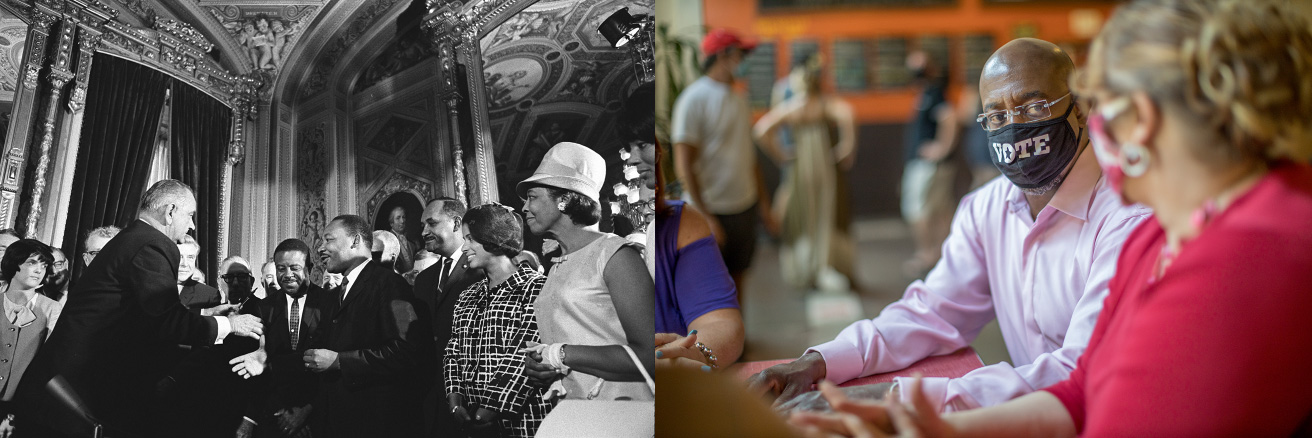
The U.S Constitution and its founding principles of liberty, equality, and justice are admired and emulated the world over. However, not everyone living in the U.S. has enjoyed the same treatment and freedoms the law promises. When we consider the experiences of women, immigrants, people of color, LGBTQ people, people with disabilities, and other groups, a majority of Americans have been deprived of basic rights and opportunities, and sometimes of citizenship itself. This idea of America is, indeed, a work in progress.
The struggle for civil rights is a story of courageous individuals and social movements awakening fellow Americans, compelling lawmakers, and inspiring the courts to make good on these founding promises. While many changes must still be made, the past one hundred years have seen remarkable progress. Yet, as the rash of thinly-veiled voter suppression bills making their way through state legislatures demonstrate, (Figure 13.1), members of these groups still encounter prejudice, discrimination, and even exclusion from civic life.
What is the difference between civil liberties and civil rights? How did the African American struggle for civil rights evolve? What challenges did women overcome in securing the right to vote, and what obstacles do they and other U.S. groups still face? This chapter addresses these and other questions in exploring the essential concepts of civil rights.
13.2 What Are Civil Rights and How Do We Identify Them?
LEARNING OUTCOMES
By the end of this section, you will be able to:
- Define the concept of civil rights
- Describe the standards that courts use when deciding whether a discriminatory law or regulation is unconstitutional
- Identify three core questions for recognizing a civil rights problem
The belief that people should be treated equally under the law is one of the cornerstones of political thought in the United States. Yet not all citizens have been treated equally throughout the nation’s history, and some are treated differently even today. For example, until 1920, nearly all women in the United States lacked the right to vote. Black men received the right to vote in 1870, but as late as 1940, only 3 percent of African American adults living in the South were registered to vote, due largely to laws designed to keep them from the polls.[1] Americans were not allowed to enter into legal marriage with a member of the same sex in many U.S. states until 2015. Some types of unequal treatment are considered acceptable in some contexts, while others are clearly not. No one would consider it acceptable to allow a ten-year-old to vote, because a child lacks the ability to understand important political issues, but all reasonable people would agree that it is wrong to mandate racial segregation or to deny someone voting rights on the basis of race. It is important to understand which types of inequality are unacceptable and why.
Defining Civil Rights
Essentially, civil rights are guarantees by the government that it will treat people equally—particularly people belonging to groups that have historically been denied the same rights and opportunities as others. The due process clause of the Fifth Amendment to the U.S. Constitution enacted the Declaration of Independence’s proclamation that “all men are created equal” by providing de jure equal treatment under the law. According to Chief Justice Earl Warren in the Supreme Court case of Bolling v. Sharpe (1954), “discrimination may be so unjustifiable as to be violative of due process.”[2] Additional guarantees of equality were provided in 1868 by the equal protection clause of the Fourteenth Amendment, which states, in part, that “No State shall . . . deny to any person within its jurisdiction the equal protection of the laws.” Thus, between the Fifth and Fourteenth Amendments, neither state governments nor the federal government may treat people unequally unless unequal treatment is necessary to maintain important governmental interests such as public safety.
We can contrast civil rights with civil liberties, which are limitations on government power designed to protect our fundamental freedoms. For example, the Eighth Amendment prohibits the application of “cruel and unusual punishments” to those convicted of crimes, a limitation on the power of members of each governmental branch: judges, law enforcement, and lawmakers. As another example, the guarantee of equal protection means the laws and the Constitution must be applied on an equal basis, limiting the government’s ability to discriminate or treat some people differently, unless the unequal treatment is based on a valid reason, such as age. A law that imprisons men twice as long as women for the same offense, or restricting people with disabilities from contacting members of Congress, would treat some people differently from others for no valid reason and would therefore be unconstitutional. According to the Supreme Court’s interpretation of the Equal Protection Clause, “all persons similarly circumstanced shall be treated alike.”[3] If people are not similarly circumstanced, however, they may be treated differently. Asian Americans and Latinos overstaying a visa are similarly circumstanced; however, a blind driver or a ten-year-old driver is differently circumstanced than a sighted, adult driver.
Identifying Discrimination
Laws that treat one group of people differently from others are not always unconstitutional. In fact, the government engages in legal discrimination quite often. In most states, you must be eighteen years old to smoke cigarettes and twenty-one to drink alcohol; these laws discriminate against the young. To get a driver’s license so you can legally drive a car on public roads, you have to be a minimum age and pass tests showing your knowledge, practical skills, and vision. Some public colleges and universities run by the government have an open admission policy, which means the school admits all who apply, but others require that students have a high school diploma or a particular score on the SAT or ACT or a GPA above a certain number. This is a kind of discrimination, because these requirements treat people who do not have a high school diploma or a high enough GPA or SAT score differently. How can the federal, state, and local governments discriminate in all these ways even though the equal protection clause seems to suggest that everyone be treated the same?
The answer to this question lies in the purpose of the discriminatory practice. In most cases when the courts are deciding whether discrimination is unlawful, the government has to demonstrate only that it has a good reason to do so. Unless the person or group challenging the law can prove otherwise, the courts will generally decide the discriminatory practice is allowed. In these cases, the courts are applying the rational basis test. That is, as long as there’s a reason for treating some people differently that is “rationally related to a legitimate government interest,” the discriminatory act or law or policy is acceptable.[4] For example, since letting blind people operate cars would be dangerous to others on the road, the law forbidding them to drive is reasonably justified on the grounds of safety and is therefore allowed even though it discriminates against the blind. Similarly, when universities and colleges refuse to admit students who fail to meet a certain test score or GPA, they can discriminate against students with weaker grades and test scores because these students most likely do not yet possess the knowledge or skills needed to do well in their classes and graduate from the institution. The universities and colleges have a legitimate reason for denying these students entrance.
The courts, however, are much more skeptical when it comes to certain other forms of discrimination. Because of the United States’ history of ethnic, racial, gender, and religious discrimination, the courts apply more stringent rules to policies, laws, and actions that discriminate on these bases (race, ethnicity, gender, religion, or national origin).[5]
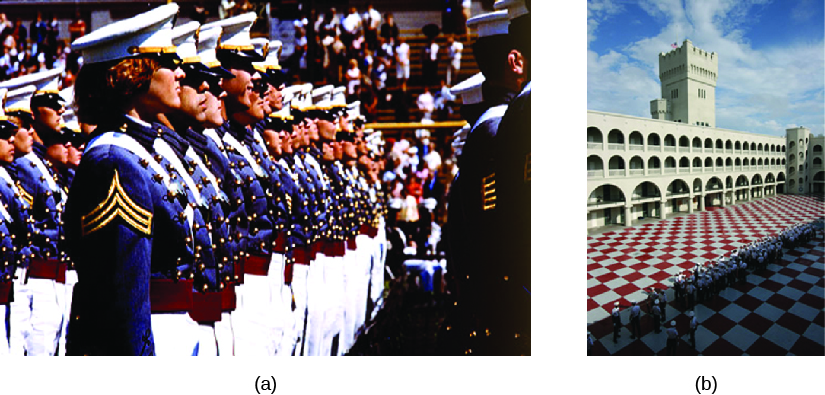
Discrimination based on gender or sex is generally examined with intermediate scrutiny. The standard of intermediate scrutiny was first applied by the Supreme Court in Craig v. Boren (1976) and again in Clark v. Jeter (1988).[6] It requires the government to demonstrate that treating men and women differently is “substantially related to an important governmental objective.” This puts the burden of proof on the government to demonstrate why the unequal treatment is justifiable, not on the individual who alleges unfair discrimination has taken place. In practice, this means laws that treat men and women differently are sometimes upheld, although usually they are not. For example, in the 1980s and 1990s, the courts ruled that states could not operate single-sex institutions of higher education and that such schools, like South Carolina’s military college The Citadel, shown in Figure 13.2, must admit both male and female students.[7] Women in the military are now also allowed to serve in all combat roles, although the courts have continued to allow the Selective Service System (the draft) to register only men and not women.[8]
Discrimination against members of racial, ethnic, or religious groups or those of various national origins is reviewed to the greatest degree by the courts, which apply the strict scrutiny standard in these cases. Under strict scrutiny, the burden of proof is on the government to demonstrate that there is a compelling governmental interest in treating people from one group differently from those who are not part of that group—the law or action can be “narrowly tailored” to achieve the goal in question, and that it is the “least restrictive means” available to achieve that goal.[9] In other words, if there is a non-discriminatory way to accomplish the goal in question, discrimination should not take place. In the modern era, laws and actions that are challenged under strict scrutiny have rarely been upheld. Strict scrutiny, however, was the legal basis for the Supreme Court’s 1944 upholding of the legality of the internment of Japanese Americans during World War II, discussed later in this chapter.[10] Finally, affirmative action consists of government programs and policies designed to benefit members of groups historically subject to discrimination. Much of the controversy surrounding affirmative action is about whether strict scrutiny should be applied to these cases.
LINK TO LEARNING
*Watch this video to learn about affirmative action.
Putting Civil Rights in the Construction
The aftermath of the Civil War marked a turning point for civil rights. The Republican majority in Congress was enraged by the actions of the reconstituted governments of the southern states. In these states, many former Confederate politicians and their sympathizers returned to power and attempted to circumvent the Thirteenth Amendment’s freeing of enslaved men and women by passing laws known as the Black codes. These laws were designed to reduce formerly enslaved people to the status of serfs or indentured servants. Black people were not just denied the right to vote, but also could be arrested and jailed for vagrancy or idleness if they lacked jobs. Black people were excluded from public schools and state colleges and were subject to violence at the hands of White people (Figure 13.3).[11]
![An image of a sketch of a building on fire. Several people are standing outside the building. Some of the people are armed. At the bottom of the image reads “Scenes in Memphis, Tennessee, during the riot—burning a freedmen’s school-house. [Sketched by A. R. W.]”.](https://uark.pressbooks.pub/app/uploads/sites/116/2025/08/fig-5-3.jpeg)
To override the southern states’ actions, lawmakers in Congress proposed two amendments to the Constitution designed to give political equality and power to formerly enslaved people. Once passed by Congress and ratified by the necessary number of states, these became the Fourteenth and Fifteenth Amendments. In addition to including the equal protection clause as noted above, the Fourteenth Amendment also was designed to ensure that the states would respect the civil liberties of freed people. The Fifteenth Amendment was proposed to secure the right to vote for Black men, which will be discussed in more detail later in this chapter.
Identifying Civil Rights Issues
Looking back, it’s relatively easy to identify civil rights issues that arose, looking into the future is much harder. For example, few people fifty years ago would have identified the rights of gay or transgender Americans as an important civil rights issue, or predicted it would become one. Similarly, in past decades the rights of those with disabilities, particularly intellectual disabilities, were often ignored by the public at large. Many people with disabilities were institutionalized and given little further thought, and until very recently, laws remained on the books in some states allowing those with intellectual or developmental disabilities to be subject to forced sterilization.[12] Today, most of us view this treatment as barbaric.
Clearly, then, new civil rights issues can emerge over time. How can we, as citizens, identify them as they emerge and distinguish genuine claims of discrimination from claims by those who have merely been unable to convince a majority to agree with their viewpoints? For example, how do we decide if sixteen-year-olds are discriminated against because they are not allowed to vote, as some U.S. lawmakers are starting to suggest? We can identify true discrimination by applying the following analytical process:
- Which groups? First, identify the group of people who are facing discrimination.
- Which right(s) are threatened? Second, what right or rights are being denied to members of this group?
- What do we do? Third, what can the government do to bring about a fair situation for the affected group? Is proposing and enacting such a remedy realistic?
GET CONNECTED!
Join the Fight for Civil Rights
One way to get involved in the fight for civil rights is to stay informed. The Southern Poverty Law Center (SPLC) is a not-for-profit advocacy group based in Montgomery, Alabama. Lawyers for the SPLC specialize in civil rights litigation and represent many people whose rights have been violated, from victims of hate crimes to undocumented immigrants. They provide summaries of important civil rights cases under their Docket section.
Activity: Visit the SPLC website to find current information about a variety of different hate groups. In what part of the country do hate groups seem to be concentrated? Where are hate incidents most likely to occur? What might be some reasons for this?
LINK TO LEARNING
Civil rights institutes are found throughout the United States and especially in the south. One of the most prominent civil rights institutes is the Birmingham Civil Rights Institute, which is located in Alabama
13.3 The African American Struggle for Equality
LEARNING OUTCOMES
By the end of this section, you will be able to:
- Identify key events in the history of African American civil rights
- Explain how the courts, Congress, and the executive branch supported the civil rights movement
- Describe the role of grassroots efforts in the civil rights movement
Many groups in U.S. history have sought recognition as equal citizens. Although each group’s efforts have been notable and important, arguably the greatest, longest, and most violent struggle remains that of African Americans, whose dehumanization was even written into the text of the Constitution in the clause counting them as three fifths of a person. Their fight for freedom and equality provided the legal and moral foundation for others who sought recognition of their equality later on.
Slavery and the Civil War
In the Declaration of Independence, Thomas Jefferson made the radical statement that “all men are created equal” and “are endowed by their Creator with certain unalienable Rights, that among these are Life, Liberty and the pursuit of Happiness.” Yet, like other wealthy landowners of his time, Jefferson also owned dozens of other human beings as his personal property. He recognized this contradiction, personally considered the institution of slavery to be a “hideous blot” on the nation, and agreed to free those he held in bondage upon his death.[13] However, to forge a political union that would stand the test of time, he and the other founders—and later the framers of the Constitution—chose not to address the issue in any definitive way. Political support for abolition was very much a minority stance in the United States at the time, although after the Revolution many of the northern states followed the European example of fifty years prior in abolishing slavery.[14]
As the new United States expanded westward, however, the issue of slavery became harder to ignore and ignited much controversy. Many opponents of slavery were willing to accept the institution if it remained largely confined to the South but did not want it to spread westward. They feared the expansion of slavery would lead to the political dominance of the South over the North and would deprive small farmers in the newly acquired western territories who could not afford to enslave others.[15] Abolitionists, primarily in the North, argued that slavery was immoral and contrary to the nation’s values and demanded an end to it.
The spread of slavery into the West seemed inevitable, however, following the Supreme Court’s 1857 ruling in the case Dred Scott v. Sandford.[16] The justices rejected Scott’s argument that though he had been born into slavery, his time spent in free states and territories where slavery had been banned by the federal government had made him a free man. In fact, the Court’s majority stated that Scott had no legal right to sue for his freedom at all because Black people (whether free or enslaved) were not, and could not become, U.S. citizens. Thus, Scott lacked the standing to even appear before the court. The Court also held that Congress lacked the power to decide whether slavery would be permitted in a territory that had been acquired after the Constitution was ratified. This decision had the effect of prohibiting the federal government from passing any laws that would limit the expansion of slavery into any part of the West.
Ultimately, of course, the issue was decided by the Civil War (1861–1865), with the southern states seceding to defend “states’ rights,” specifically, the purported right to own human property, without federal interference.[17] Although at the beginning of the war, President Abraham Lincoln had been willing to allow slavery to continue in the South to preserve the Union, he changed his policies regarding abolition over the course of the war. The first step was the issuance of the Emancipation Proclamation on January 1, 1863 (Figure 13.4). Although it stated “all persons held as slaves . . . henceforward shall be free,” the proclamation was limited in effect to the states that had rebelled. Enslaved people in states that had remained within the Union, such as Maryland and Delaware were not set free, nor were they in parts of the Confederacy already occupied by the Union army. Although enslaved people in rebel states were freed by federal decree, the relatively small Union troop presence made it impossible to enforce their release from bondage.[18]

Reconstruction
At the end of the Civil War, the South entered a period called Reconstruction (1865–1877) during which state governments were reorganized before the rebellious states were allowed to be readmitted to the Union. As part of this process, the Republican Party pushed for a permanent end to slavery. A constitutional amendment to this effect was passed by the House of Representatives in January of 1865, after having already been approved by the Senate in April of 1864, and it was ratified in December of 1865 as the Thirteenth Amendment. The amendment’s first section states, “Neither slavery nor involuntary servitude, except as a punishment for crime whereof the party shall have been duly convicted, shall exist within the United States, or any place subject to their jurisdiction.” In effect, this amendment outlawed slavery in the United States.
The changes wrought by the Fourteenth Amendment were more extensive. In addition to introducing the equal protection clause to the Constitution, this amendment also extended the due process clause of the Fifth Amendment to the states, required the states to respect the privileges or immunities of all citizens, and, for the first time, defined citizenship at the national and state levels. People could no longer be excluded from citizenship based solely on their race. Although lack of political or judicial action rendered some of these provisions toothless, others were pivotal in the expansion of civil rights.
The Fifteenth Amendment stated that people could not be denied the right to vote based on “race, color, or previous condition of servitude.” This construction allowed states to continue to decide the qualifications of voters as long as those qualifications seemed to be race-neutral. Thus, while states could not deny Black people the right to vote on the basis of race, they could deny it on any number of arbitrary grounds such as literacy, landownership, affluence, or political knowledge.
Although the immediate effect of these provisions was quite profound, over time the Republicans in Congress gradually lost interest in pursuing Reconstruction policies, and the Reconstruction ended with the end of military rule in the South and the withdrawal of the Union army in 1877.[19] Following the army’s removal, political control of the South fell once again into the hands of White men, and violence was used to discourage Black people from exercising the rights they had been granted.[20] The revocation of voting rights, or disenfranchisement, took a number of forms; not every southern state used the same methods, and some states used more than one, but they all disproportionately affected Black voter registration and turnout.[21]
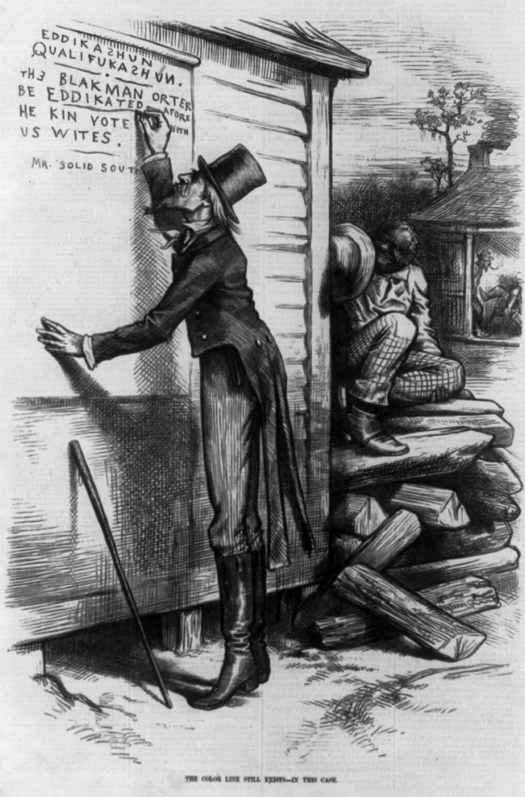
Perhaps the most famous of the tools of disenfranchisement were literacy tests and understanding tests. Literacy tests, which had been used in the North since the 1850s to disqualify naturalized European immigrants from voting, called on the prospective voter to demonstrate his (and later, her) ability to read a particular passage of text. However, since voter registration officials had discretion to decide what text the voter was to read, they could give easy passages to voters they wanted to register (typically, white people) and more difficult passages to those whose registration they wanted to deny (typically, Black people). Understanding tests required the prospective voter to explain the meaning of a particular passage of text, often a provision of the U.S. Constitution, or answer a series of questions related to citizenship. Again, since the official examining the prospective voter could decide which passage or questions to choose, the difficulty of the test might vary dramatically between African American and white applicants.[22] Even had these tests been administered fairly and equitably, however, most African Americans would have been at a huge disadvantage, because few had been taught to read. Although schools for Black people had existed in some places, southern states had made it largely illegal to teach enslaved people to read and write. At the beginning of the Civil War, only 5 percent of Black people could read and write, and most of them lived in the North.[23] Some were able to take advantage of educational opportunities after they were freed, but many were not able to gain effective literacy.
In some states, poorer, less-literate white voters feared being disenfranchised by the literacy and understanding tests. Some states introduced a loophole, known as the grandfather clause, to allow less literate white people to vote. The grandfather clause exempted those who had been allowed to vote in that state prior to the Civil War and their descendants from literacy and understanding tests.[24] Because Black people were not allowed to vote prior to the Civil War, but most White men had been voting at a time when there were no literacy tests, this loophole allowed most illiterate white people to vote (Figure 13.5) while leaving obstacles in place for Black people who wanted to vote as well. Time limits were often placed on these provisions because state legislators realized that they might quickly be declared unconstitutional, but they lasted long enough to allow illiterate White men to register to vote.[25]
In states where the voting rights of poor white people were less of a concern, another tool for disenfranchisement was the poll tax (Figure 13.6). This was an annual per-person tax, typically one or two dollars (on the order of $20 to $50 today), that a person had to pay to register to vote. People who didn’t want to vote didn’t have to pay, but in several states the poll tax was cumulative, so if you decided to vote you would have to pay not only the tax due for that year but any poll tax from previous years as well. Because formerly enslaved people were usually quite poor, they were less likely than White men to be able to pay poll taxes.[26]
![An image of a receipt. The receipt reads “State of Louisiana—Parish of Jefferson. Office of Sherriff and Tax Collector. Received of A. S. White resident of [sic] Ward, the sum of one dollar, poll tax for the year 1917 for the support of public schools”.](https://uark.pressbooks.pub/app/uploads/sites/116/2025/08/fig-5-6.jpeg)
Although these methods were usually sufficient to ensure that Black people were kept away from the polls, some dedicated African Americans did manage to register to vote despite the obstacles placed in their way. To ensure their vote was largely meaningless, the White elites used their control of the Democratic Party to create the white primary: primary elections in which only White people were allowed to vote. The state party organizations argued that as private groups, rather than part of the state government, they had no obligation to follow the Fifteenth Amendment’s requirement not to deny the right to vote on the basis of race. Furthermore, they contended, voting for nominees to run for office was not the same as electing those who would actually hold office. So they held primary elections to choose the Democratic nominee in which only White citizens were allowed to vote.[27] Once the nominee had been chosen, they might face token opposition from a Republican or minor-party candidate in the general election, but since White voters had agreed beforehand to support whoever won the Democrats’ primary, the outcome of the general election was a foregone conclusion.
With Black people effectively disenfranchised, the restored southern state governments undermined guarantees of equal treatment in the Fourteenth Amendment. They passed laws that excluded African Americans from juries and allowed the imprisonment and forced labor of “idle” Black citizens. The laws also called for segregation of White and Black people in public places under the doctrine known as “separate but equal.” As long as nominally equal facilities were provided for both races, it was legal to require members of each race to use the facilities designated for them. Similarly, state and local governments passed laws limiting neighborhoods in which Black and White people could live. Collectively, these discriminatory laws came to be known as Jim Crow laws. The Supreme Court upheld the separate but equal doctrine in 1896 in Plessy v. Ferguson, inconsistent with the Fourteenth Amendment’s equal protection clause, and allowed segregation to continue.[28]
LINK TO LEARNING
*Watch this video to learn about equal protection and the context surrounding the history leading to the Civil Rights movement and greater equality for African-Americans and blacks in the United State.
Civil Rights in the Courts
The NAACP soon focused on a strategy of overturning Jim Crow laws through the courts. Perhaps its greatest series of legal successes consisted of its efforts to challenge segregation in education. Early cases brought by the NAACP dealt with racial discrimination in higher education. In 1938, the Supreme Court essentially gave states a choice: they could either integrate institutions of higher education, or they could establish an equivalent university or college for African Americans.[30] Southern states chose to establish colleges for Black people rather than allow them into all-White state institutions. Although this ruling expanded opportunities for professional and graduate education in areas such as law and medicine for African Americans by requiring states to provide institutions for them to attend, it nevertheless allowed segregated colleges and universities to continue to exist.
LINK TO LEARNING
The NAACP was pivotal in securing African American civil rights and today continues to address civil rights violations, such as police brutality and the disproportionate percentage of African American people that die under the death penalty.
The landmark court decision of the judicial phase of the civil rights movement settled the Brown v. Board of Education case in 1954.[31] In this case, the Supreme Court unanimously overturned its decision in Plessy v. Ferguson as it pertained to public education, stating that a separate but equal education was a logical impossibility. Even with the same funding and equivalent facilities, a segregated school could not have the same teachers or environment as the equivalent school for another race. The court also rested its decision in part on social science studies suggesting that racial discrimination led to feelings of inferiority among Black children. The only way to dispel this sense of inferiority was to end segregation and integrate public schools.
It is safe to say this ruling was controversial. While integration of public schools took place without much incident in some areas of the South, particularly where there were few Black students, elsewhere, it was confrontational—or nonexistent. In recognition of the fact that southern states would delay school integration for as long as possible, civil rights activists urged the federal government to enforce the Supreme Court’s decision. Bayard Rustin and A. Philip Randolph organized a Prayer Pilgrimage for Freedom in Washington, DC, on May 17, 1957, in which approximately twenty-five thousand African Americans participated.[32]
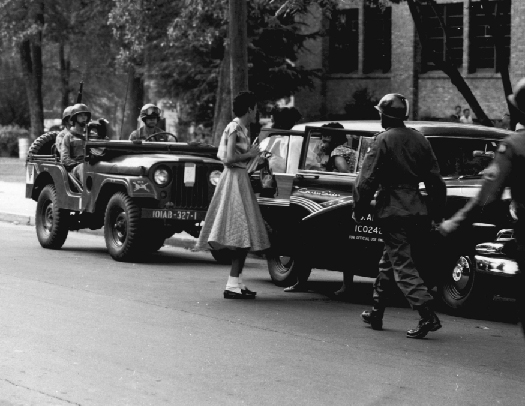
A few months later, in Little Rock, Arkansas, governor Orval Faubus resisted court-ordered integration and mobilized National Guard troops to keep Black students out of Central High School. President Eisenhower then called up the Arkansas National Guard for federal duty (essentially taking the troops out of Faubus’s hands) and sent soldiers of the 101st Airborne Division to escort students to and from classes, as shown in Figure 13.7. To avoid integration, Faubus closed four high schools in Little Rock the following school year.[33]
In Virginia, state leaders employed a strategy of “massive resistance” to school integration, which led to the closure of a large number of public schools across the state, some for years.[34] Although de jure segregation, segregation mandated by law, had ended on paper, in practice, few efforts were made to integrate schools in most school districts with substantial Black student populations until the late 1960s. Many White southerners who objected to sending their children to school with Black students then established private academies that admitted only White students; many of these schools remain overwhelmingly White today.[35]
School and other segregation was and is hardly limited to the South. Many neighborhoods in northern cities remain segregated by virtue of “red lining” districts where minorities were allowed and not allowed to live. Restrictive real estate covenants bound White residents to not sell their houses to African Americans and sometimes not to Chinese, Japanese, Mexicans, Filipinos, Jews, and other ethnic minorities. In New York City in the late 1950s, a group of activist parents led by Mae Mallory protested the inadequate schools in their neighborhood; a court ruled that New York was engaging in de facto segregation, and forced the city to institute policies that would provide more equitable access.[36] More recently, banks have been fined for not lending to people of color to buy homes and start business at rates commensurate with similarly situated prospective White borrowers. Relegation of minority residents to less desirable neighborhoods has the practical effect of diminishing both generational wealth, and the tax base needed to build, maintain, and improve schools and other institutions that might hasten equality and integration.
In the postwar era of White flight, however, the Supreme Court had been evolving into a more progressive force in the promotion and preservation of civil rights. In the case of Shelley v. Kraemer (1948), the Supreme Court held that while such covenants did not violate the Fourteenth Amendment because they consisted of agreements between private citizens, their provisions could not be enforced by courts.[37] Because state courts are government institutions and the Fourteenth Amendment prohibits the government from denying people equal protection of the law, the courts’ enforcement of such covenants would be a violation of the amendment. Thus, if a White family chose to sell its house to a Black family and the other homeowners in the neighborhood tried to sue the seller, the court would not hear the case. In 1967, the Supreme Court struck down a Virginia law that prohibited interracial marriage in Loving v. Virginia.[38]
Legislating Civil Rights
Beyond these favorable court rulings, however, progress toward equality for African Americans remained slow in the 1950s. In 1962, Congress proposed what later became the Twenty-Fourth Amendment, which banned the poll tax in elections to federal (but not state or local) office; the amendment went into effect after being ratified in early 1964. Several southern states continued to require residents to pay poll taxes in order to vote in state elections until 1966 when, in the case of Harper v. Virginia Board of Elections, the Supreme Court declared that requiring payment of a poll tax in order to vote in an election at any level was unconstitutional.[39]
The slow rate of progress led to frustration within the Black community. Newer, grassroots organizations such as the Southern Christian Leadership Conference (SCLC), Congress of Racial Equality (CORE), and Student Non-Violent Coordinating Committee (SNCC) challenged the NAACP’s position as the leading civil rights organization and questioned its legal-focused strategy. These newer groups tended to prefer more confrontational approaches, including the use of direct action campaigns relying on marches and demonstrations. The strategies of nonviolent resistance and civil disobedience, or the refusal to obey an unjust law, had been effective in the campaign led by Mahatma Gandhi to liberate colonial India from British rule in the 1930s and 1940s. Civil rights pioneers adopted these measures in the 1955–1956 Montgomery bus boycott. After Rosa Parks refused to give up her bus seat to a White person and was arrested, a group of Black women carried out a day-long boycott of Montgomery’s public transit system. This boycott was then extended for over a year and overseen by union organizer E. D. Nixon. The effort desegregated public transportation in that city.[40]
Direct action also took such forms as the sit-in campaigns to desegregate lunch counters that began in Greensboro, North Carolina, in 1960, and the 1961 Freedom Rides in which Black and White volunteers rode buses and trains through the South to enforce a 1946 Supreme Court decision that desegregated interstate transportation (Morgan v. Virginia).[41] While such focused campaigns could be effective, they often had little impact in places where they were not replicated. In addition, some of the campaigns led to violence against both the campaigns’ leaders and ordinary people; Rosa Parks, a longtime NAACP member and graduate of the Highlander Folk School for civil rights activists, whose actions had begun the Montgomery boycott, received death threats, E. D. Nixon’s home was bombed, and the Freedom Riders were attacked in Alabama.[42]
As the campaign for civil rights continued and gained momentum, President John F. Kennedy called for Congress to pass new civil rights legislation, which began to work its way through Congress in 1963. The resulting law (pushed heavily and then signed by President Lyndon B. Johnson after Kennedy’s assassination) was the Civil Rights Act of 1964, which had wide-ranging effects on U.S. society. Not only did the act outlaw government discrimination and the unequal application of voting qualifications by race, but it also, for the first time, outlawed segregation and other forms of discrimination by most businesses that were open to the public, including hotels, theaters, and restaurants that were not private clubs. It outlawed discrimination on the basis of race, ethnicity, religion, sex, or national origin by most employers, and it created the Equal Employment Opportunity Commission (EEOC) to monitor employment discrimination claims and help enforce this provision of the law. The provisions that affected private businesses and employers were legally justified not by the Fourteenth Amendment’s guarantee of equal protection of the laws but instead by Congress’s power to regulate interstate commerce.[43]
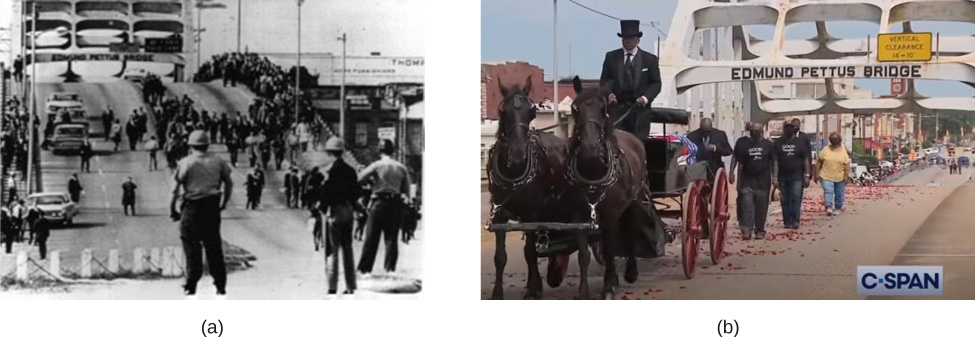
Even though the Civil Rights Act of 1964 had a monumental impact over the long term, it did not end efforts by many southern White people to maintain the White-dominated political power structure in the region. Progress in registering African American voters remained slow in many states despite increased federal activity supporting it, so civil rights leaders including Martin Luther King, Jr. decided to draw the public eye to the area where the greatest resistance to voter registration drives were taking place. The SCLC and SNCC particularly focused their attention on the city of Selma, Alabama, which had been the site of violent reactions against civil rights activities.
The organizations’ leaders planned a march from Selma to Montgomery in March 1965. Their first attempt to march was violently broken up by state police and sheriff’s deputies (Figure 13.8). The second attempt was aborted because King feared it would lead to a brutal confrontation with police and violate a court order from a federal judge who had been sympathetic to the movement in the past. That night, three of the marchers, White ministers from the north, were attacked and beaten with clubs by members of the Ku Klux Klan; one of the victims died from his injuries. Televised images of the brutality against protesters and the death of a minister led to greater public sympathy for the cause. Eventually, a third march was successful in reaching the state capital of Montgomery.[44]
LINK TO LEARNING
The 1987 PBS documentary Eyes on the Prize won several Emmys and other awards for its coverage of major events in the civil rights movement, including the Montgomery bus boycott, the battle for school integration in Little Rock, the march from Selma to Montgomery, and Martin Luther King, Jr.’s leadership of the march on Washington, DC.
The events at Selma galvanized support in Congress for a follow-up bill solely dealing with the right to vote. The Voting Rights Act of 1965 went beyond previous laws by requiring greater oversight of elections by federal officials. Literacy and understanding tests, and other devices used to discriminate against voters on the basis of race, were banned. The Voting Rights Act proved to have much more immediate and dramatic effect than the laws that preceded it; what had been a fairly slow process of improving voter registration and participation was replaced by a rapid increase of Black voter registration rates—although White registration rates increased over this period as well.[45] To many people’s way of thinking, however, the Supreme Court turned back the clocks when it gutted a core aspect of the Voting Rights Act in Shelby County v. Holder (2013).[46] No longer would states need federal approval to change laws and policies related to voting. Indeed, many states with a history of voter discrimination quickly resumed restrictive practices with laws requiring photo ID; limiting early voting, ballot drop-off locations, and hours; and making registering and waiting to vote more onerous. Some of the new restrictions are already being challenged in the courts.[47]
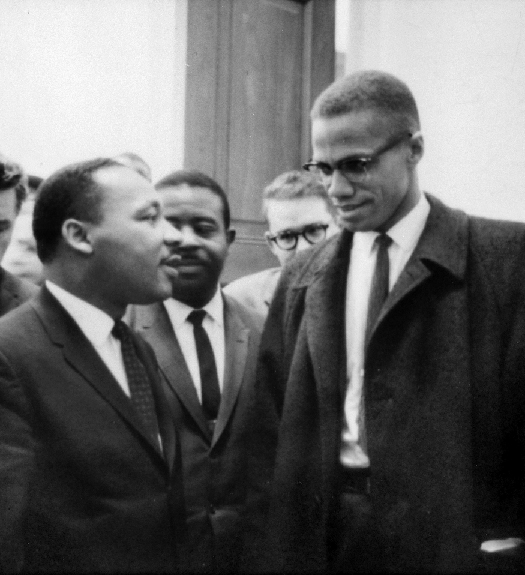
Not all African Americans in the civil rights movement were comfortable with gradual change. Instead of using marches and demonstrations to change people’s attitudes, calling for tougher civil rights laws, or suing for their rights in court, they favored more immediate action to prevent White oppression and protect their communities. Men like Malcolm X, and groups like the Black Panthers were willing to use other means to achieve their goals (Figure 13.9).[48] Faced with continual violence at the hands of police and acts of terrorism like the bombing of a Black church in Alabama that killed four girls, Malcolm X expressed significant distrust of White people. He sought to raise the self-esteem of Black people and advocated for their separation from the United States through eventual emigration to Africa. In general, Malcolm X rejected the mainstream civil right’s movement’s integration and assimilation approach, and laid the foundation for the Black Power movement, which sought self-determination and independence for Black people. His position was attractive to many young African Americans, especially after Martin Luther King, Jr. was assassinated in 1968.
Continuing Challenges for African Americans
The civil rights movement for African Americans did not end with the passage of the Voting Rights Act in 1965. For the last fifty years, the African American community has faced challenges related to both past and current discrimination, and progress on both fronts remains slow, uneven, and often frustrating.
Legacies of the de jure segregation of the past remain in much of the United States. Many Black people still live in predominantly Black neighborhoods where their ancestors were forced by laws and housing covenants to live.[49] Even those who live in the suburbs, once largely populated only by White people, tend to live in suburbs that are mostly populated by Black people.[50] Some two million African American young people attend schools whose student body is composed almost entirely of students of color.[51] During the late 1960s and early 1970s, efforts to tackle these problems were stymied by large-scale public opposition, not just in the South but across the nation. Attempts to integrate public schools through the use of busing—transporting students from one segregated neighborhood to another to achieve more racially balanced schools—were particularly unpopular and helped contribute to “White flight” from cities to the suburbs.[52] This White flight has created de facto segregation, a form of segregation that results from the choices of individuals to live in segregated communities without government action or support.
Today, a lack of well-paying jobs in many urban areas, combined with the poverty resulting from the legacies of slavery, Jim Crow era terror, and persistent racism, has trapped many Black people in under-served neighborhoods with markedly lower opportunity and life expectancy.[53] While the Civil Rights Act of 1964 created opportunities for members of the Black middle class to advance economically and socially, and to live in the same neighborhoods as the White middle class, their departure left many Black neighborhoods mired in poverty and without the strong community ties that existed during the era of legal segregation. Many of these neighborhoods continue to suffer from high rates of crime and violence.[54] Police also appear, consciously or subconsciously, to engage in racial profiling: singling out Black people (and Latino people) for greater attention than members of other racial and ethnic groups, as former FBI director James B. Comey and former New York police commissioner Bill Bratton have admitted.[55] When incidents of real or perceived injustice arise, as recently occurred after a series of deaths of Black people at the hands of police in Ferguson, Missouri; Staten Island, New York; Baltimore, Maryland; Louisville, Kentucky; and Minneapolis, Minnesota, many African Americans turn to the streets to protest because they feel abandoned or ignored by politicians of all races.
While the public mood may have shifted toward greater concern about economic inequality in the United States, substantial policy changes to immediately improve the economic standing of African Americans in general have not followed. The Obama administration proposed new rules under the Fair Housing Act that were intended to lead to more integrated communities in the future; however, the Trump administration repeatedly sought to weaken the Fair Housing Act, primarily through lack of enforcement of existing regulations.[56] Meanwhile, grassroots movements to improve neighborhoods and local schools have taken root in many Black communities across America, and perhaps in those movements is the hope for greater future progress.
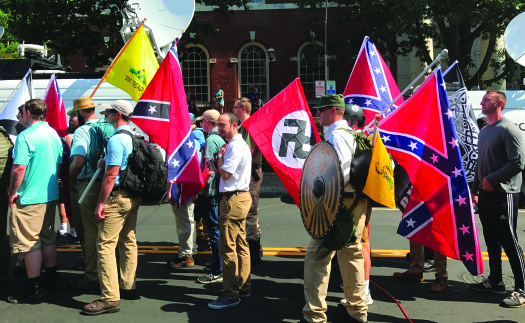
Other recent movements are more troubling, notably the increased presence and influence of White nationalism throughout the country. This movement espouses White supremacy and does not shrink from the threat or use of violence to achieve it. Such violence occurred in Charlottesville, Virginia, in August 2017, when various White supremacist groups and alt-right forces joined together in a “Unite the Right” rally (Figure 13.10). This rally included chants and racial slurs against African Americans and Jews. Those rallying clashed with counter-protestors, one of whom died when an avowed Neo-Nazi deliberately drove his car into a group of peaceful protestors. He has since been convicted and sentenced to life in prison for his actions. This event sent shockwaves through U.S. politics, as leaders tried to grapple with the significance of the event. President Trump said that “good people existed on both sides of the clash,” and later, for inciting a group of protesters to storm the Capitol after a rally of his in which he repeated the false claim that the election had been stolen from him.[57]
FINDING A MIDDLE GROUND
Affirmative Action
One of the major controversies regarding race in the United States today is related to affirmative action, the practice of ensuring that members of historically disadvantaged or underrepresented groups have equal access to opportunities in education, the workplace, and government contracting. The phrase affirmative action originated in the Civil Rights Act of 1964 and Executive Order 11246, and it has drawn controversy ever since. The Civil Rights Act of 1964 prohibited discrimination in employment, and Executive Order 11246, issued in 1965, forbade employment discrimination not only within the federal government but by federal contractors and contractors and subcontractors who received government funds.
Clearly, Black people, as well as other groups, have been subject to discrimination in the past and present, limiting their opportunity to compete on a level playing field with those who face no such challenge. Opponents of affirmative action, however, point out that many of its beneficiaries are ethnic minorities from relatively affluent backgrounds, while White and Asian Americans who grew up in poverty are expected to succeed despite facing challenges related to their socioeconomic status and those related to educational issues in lower income areas.
Because affirmative action attempts to redress discrimination on the basis of race or ethnicity, it is generally subject to the strict scrutiny standard, which means the burden of proof is on the government to demonstrate the necessity of racial discrimination to achieve a compelling governmental interest. In 1978, in Bakke v. California, the Supreme Court upheld affirmative action and said that colleges and universities could consider race when deciding whom to admit but could not establish racial quotas.[58] In 2003, the Supreme Court reaffirmed the Bakke decision in Grutter v. Bollinger, which said that taking race or ethnicity into account as one of several factors in admitting a student to a college or university was acceptable, but a system setting aside seats for a specific quota of minority students was not.[59] All these issues are back under discussion in the Supreme Court with the re-arguing of Fisher v. University of Texas.[60] In Fisher v. University of Texas (2013, known as Fisher I), University of Texas student Abigail Fisher brought suit to declare UT’s race-based admissions policy as inconsistent with Grutter. The court did not see the UT policy that way and allowed it, so long as it remained narrowly tailored and not quota-based. Fisher II (2016) was decided by a 4–3 majority. It allowed race-based admissions, but required that the utility of such an approach had to be re-established on a regular basis.
Should race be a factor in deciding who will be admitted to a particular college? Why or why not?
13.4 The Fight for Women’s Rights
LEARNING OUTCOMES
By the end of this section, you will be able to:
- Describe early efforts to achieve rights for women
- Explain why the Equal Rights Amendment failed to be ratified
- Describe the ways in which women acquired greater rights in the twentieth century
- Analyze why women continue to experience unequal treatment
Along with African Americans, women of all races and ethnicities have long been discriminated against in the United States, and the women’s rights movement began at the same time as the movement to abolish slavery in the United States. Indeed, the women’s movement came about largely as a result of the difficulties women encountered while trying to abolish slavery. The trailblazing Seneca Falls Convention for women’s rights was held in 1848, a few years before the Civil War. But the abolition and African American civil rights movements largely eclipsed the women’s movement throughout most of the nineteenth century. Women began to campaign actively again in the late nineteenth and early twentieth centuries, and another movement for women’s rights began in the 1960s.
LINK TO LEARNING
*Watch this video to learn about the sex discrimination and changes in women’s rights through U.S. history.
The Early Women’s Rights Movement and Women’s Suffrage
Following the Revolution, women’s conditions did not improve. Women were not granted the right to vote by any of the states except New Jersey, which at first allowed all taxpaying property owners to vote. However, in 1807, the law changed to limit the vote to men.[63] Changes in property laws actually hurt women by making it easier for their husbands to sell their real property without their consent.
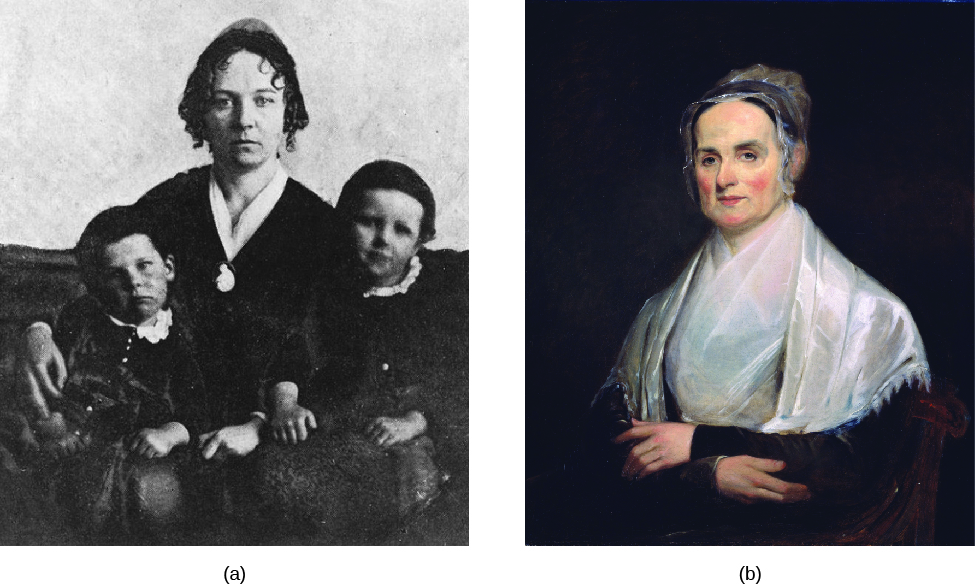
Although women had few rights, they nevertheless played an important role in transforming American society. This was especially true in the 1830s and 1840s, a time when numerous social reform movements swept across the United States. In 1832, for example, African American writer and activist Maria W. Stewart became the first American-born woman to give a speech to a mixed audience. While there was racism within the suffrage movement, including calls for segregated marches and a lack of scrutiny on the topic of lynchings, many women were active in the abolition movement and the temperance movement, which tried to end the excessive consumption of liquor.[64] They often found they were hindered in their efforts, however, either by the law or by widely held beliefs that they were weak, silly creatures who should leave important issues to men.[65] One of the leaders of the early women’s movement, Elizabeth Cady Stanton (Figure 13.11), was shocked and angered when she sought to attend an 1840 antislavery meeting in London, only to learn that women would not be allowed to participate and had to sit apart from the men. At this convention, she made the acquaintance of another American woman abolitionist, Lucretia Mott (Figure 13.11), who was also appalled by the male reformers’ treatment of women.[66]
In 1848, Stanton and Mott called for a women’s rights convention, the first ever held specifically to address the subject, at Seneca Falls, New York. At the Seneca Falls Convention, Stanton wrote the Declaration of Sentiments, which was modeled after the Declaration of Independence and proclaimed women were equal to men and deserved the same rights. Among the rights Stanton wished to see granted to women was suffrage, the right to vote. When called upon to sign the Declaration, many of the delegates feared that if women demanded the right to vote, the movement would be considered too radical and its members would become a laughingstock. The Declaration passed, but the resolution demanding suffrage was the only one that did not pass unanimously.[67]
Along with other feminists (advocates of women’s equality), such as her friend and colleague Susan B. Anthony, Stanton fought for rights for women besides suffrage, including the right to seek higher education. As a result of their efforts, several states passed laws that allowed married women to retain control of their property and let divorced women keep custody of their children.[68] Amelia Bloomer, another activist, also campaigned for dress reform, believing women could lead better lives and be more useful to society if they were not restricted by voluminous heavy skirts and tight corsets.
The women’s rights movement attracted many women who, like Stanton and Anthony, were active in either the temperance movement, the abolition movement, or both movements. Sarah and Angelina Grimke, the daughters of a wealthy slaveholding family in South Carolina, became first abolitionists and then women’s rights activists.[69] Prominent Black and formerly enslaved women such as Sojourner Truth, Frances Ellen Watkins Harper, and Mary Anne Shadd Cary joined the women’s movement after establishing themselves as key figures in the abolition movement. These women were known for direct, unorthodox, and effective arguments for the suffragist cause. Truth’s “Ain’t I A Woman” speech is among the most well known of the movement, and Cary, a lawyer, delivered a critical equality argument before the Senate Judiciary Committee..
Following the Civil War and the abolition of slavery, the women’s rights movement fragmented. Stanton and Anthony denounced the Fifteenth Amendment because it granted voting rights only to Black men and not to women of any race.[70] The fight for women’s rights did not die, however. In 1869, Stanton and Anthony formed the National Woman Suffrage Association (NWSA), which demanded that the Constitution be amended to grant the right to vote to all women. It also called for more lenient divorce laws and an end to sex discrimination in employment. The less radical Lucy Stone formed the American Woman Suffrage Association (AWSA) in the same year; AWSA hoped to win the suffrage for women by working on a state-by-state basis instead of seeking to amend the Constitution.[71] Four western states—Utah, Colorado, Wyoming, and Idaho—did extend the right to vote to women in the late nineteenth century, but no other states did.
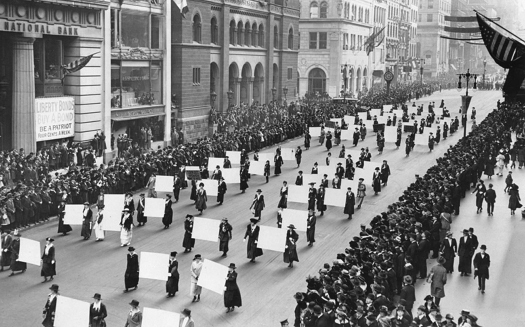
Women were also granted the right to vote on matters involving liquor licenses, in school board elections, and in municipal elections in several states. However, this was often done because of stereotyped beliefs that associated women with moral reform and concern for children, not as a result of a belief in women’s equality. Furthermore, voting in municipal elections was restricted to women who owned property.[72] In 1890, the two suffragist groups united to form the National American Woman Suffrage Association (NAWSA). To call attention to their cause, members circulated petitions, lobbied politicians, and held parades in which hundreds of women and girls marched through the streets (Figure 13.12).
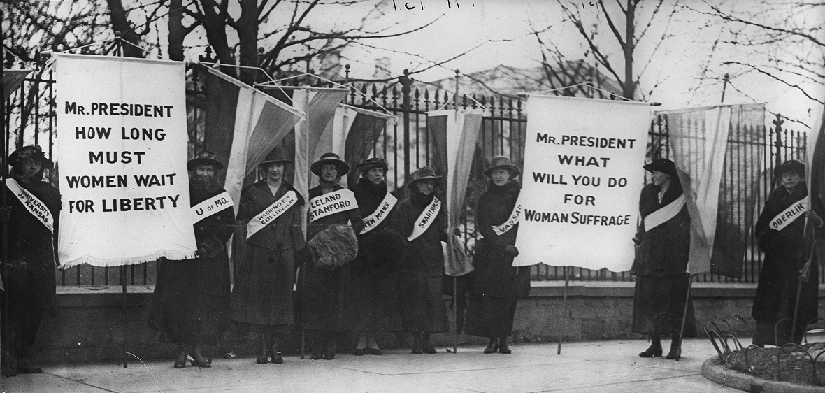
The more radical National Woman’s Party (NWP), led by Alice Paul, advocated the use of stronger tactics. The NWP held public protests and picketed outside the White House (Figure 13.13).[73] Demonstrators were often beaten and arrested, and suffragists were subjected to cruel treatment in jail. When some, like Paul, began hunger strikes to call attention to their cause, their jailers force-fed them, an incredibly painful and invasive experience for the women.[74] Finally, in 1920, the triumphant passage of the Nineteenth Amendment granted all women the right to vote.
Civil Rights and the Equal Rights Amendment
Just as the passage of the Thirteenth, Fourteenth, and Fifteenth Amendments did not result in equality for African Americans, the Nineteenth Amendment did not end discrimination against women in education, employment, or other areas of life, which continued to be legal. Although women could vote, they very rarely ran for or held public office. Women continued to be underrepresented in the professions, and relatively few sought advanced degrees. Until the mid-twentieth century, the ideal in U.S. society was typically for women to marry, have children, and become housewives. Those who sought work for pay outside the home were routinely denied jobs because of their sex and, when they did find employment, were paid less than men. Women who wished to remain childless or limit the number of children they had in order to work or attend college found it difficult to do so. In some states it was illegal to sell contraceptive devices, and abortions were largely illegal and difficult for women to obtain.
A second women’s rights movement emerged in the 1960s to address these problems. Title VII of the Civil Rights Act of 1964 prohibited discrimination in employment on the basis of sex as well as race, color, national origin, and religion. Nevertheless, women continued to be denied jobs because of their sex and were often sexually harassed at the workplace. In 1966, feminists who were angered by the lack of progress made by women and by the government’s lackluster enforcement of Title VII organized the National Organization for Women (NOW). NOW promoted workplace equality, including equal pay for women, and also called for the greater presence of women in public office, the professions, and graduate and professional degree programs.
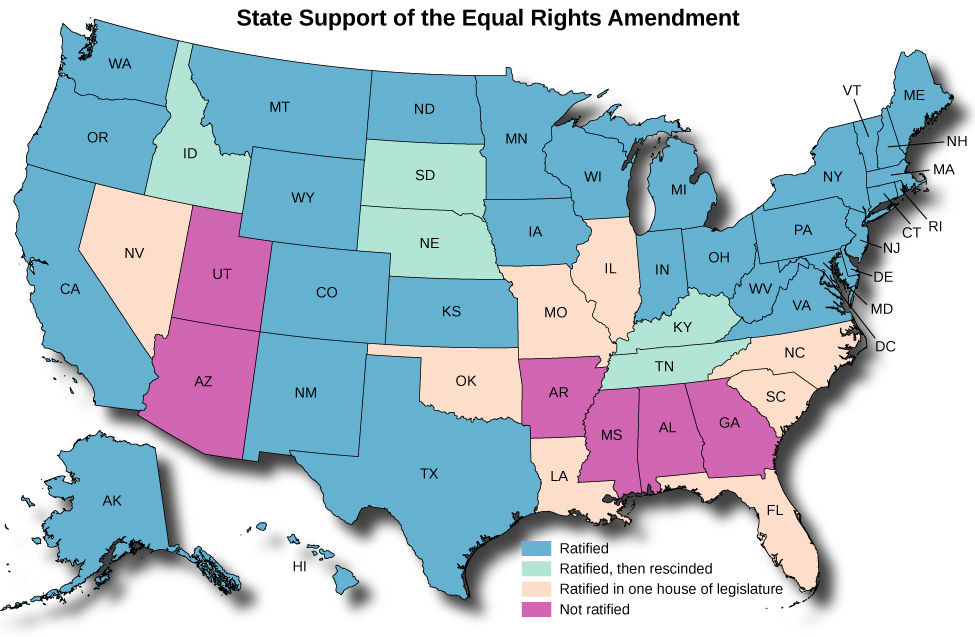
NOW also declared its support for the Equal Rights Amendment (ERA), which mandated equal treatment for all regardless of sex. The ERA, written by Alice Paul and Crystal Eastman, was first proposed to Congress, unsuccessfully, in 1923. It was introduced in every Congress thereafter but did not pass both the House and the Senate until 1972. The amendment was then sent to the states for ratification with a deadline of March 22, 1979. Although many states ratified the amendment in 1972 and 1973, the ERA still lacked sufficient support as the deadline drew near. Opponents, including both women and men, argued that passage would subject women to military conscription and deny them alimony and custody of their children should they divorce.[75] In 1978, Congress voted to extend the deadline for ratification to June 30, 1982. Even with the extension, however, the amendment failed to receive the support of the required thirty-eight states; by the time the deadline arrived, it had been ratified by only thirty-five, some of those had rescinded their ratifications, and no new state had ratified the ERA during the extension period (Figure 13.14). In 2020, Virginia became the thirty-eighth state to ratify, though well after the deadline. That led the U.S. House of Representatives to consider and pass legislation to remove the original deadlines. However, the Senate did not take up the legislation. In 2021, Senator Lisa Murkowski (R-AK) and Senator Ben Cardin (D-MD) introduced a new joint resolution to remove the deadline. That resolution has yet to be taken up by the Senate.[76]
Although the ERA failed to be ratified, Title IX of the United States Education Amendments of 1972 passed into law as a federal statute (not as an amendment, as the ERA was meant to be). Title IX applies to all educational institutions that receive federal aid and prohibits discrimination on the basis of sex in academic programs, dormitory space, health-care access, and school activities including sports. Thus, if a school receives federal aid, it cannot spend more funds on programs for men than on programs for women.
Continuing Challenges for Women
There is no doubt that women have made great progress since the Seneca Falls Convention. Today, more women than men attend college, and they are more likely than men to graduate.[77] Women are represented in all the professions, and approximately half of all law and medical school students are women.[78] Women have held Cabinet positions and have been elected to Congress. They have run for president and vice president, and three female justices currently serve on the Supreme Court. Women are also represented in all branches of the military and can serve in combat. As a result of the 1973 Supreme Court decision in Roe v. Wade, women now have legal access to abortion.[79]
While women’s rights have progressed well beyond where they were in the 1800s, questions of equity continue. In 2021, the massive disparities between the facilities and housing for men and women in their respective NCAA national tournaments became front page news.[80] Also in the news recently were the disparities in pay and resources for the U.S. Men’s and Women’s National Soccer teams. Again, women received much less in terms of resources than men, despite (in this case) being the more successful international team and World Cup champions.[81] In the business world, women are still underrepresented in some jobs and are less likely to hold executive positions than are men.
Many believe the glass ceiling, an invisible barrier caused by discrimination, prevents women from rising to the highest levels of American organizations, including corporations, governments, academic institutions, and religious groups. Women earn less money than men for the same work. As of 2014, fully employed women earned seventy-nine cents for every dollar earned by a fully employed man.[82] This problem may be compounded by other factors, as women from under-represented groups are even more discriminated against than other women.[83] Women are also more likely to be single parents than are men.[84] As a result, more women live below the poverty line than do men, and, as of 2012, households headed by single women are twice as likely to live below the poverty line than those headed by single men.[85] Women remain underrepresented in elective offices. As of June 2021, women held only about 27 percent of seats in Congress and only about 31 percent of seats in state legislatures.[86]
Women remain subject to sexual harassment in the workplace and are more likely than men to be the victims of domestic violence. Approximately one-third of all women have experienced domestic violence; one in five women is assaulted during her college years.[87]
Many in the United States continue to call for a ban on abortion, and states have attempted to restrict women’s access to the procedure. For example, many states have required abortion clinics to meet the same standards set for hospitals, such as corridor size and parking lot capacity, despite lack of evidence regarding the benefits of such standards. Abortion clinics, which are smaller than hospitals, often cannot meet such standards. Other restrictions include mandated counseling before the procedure and the need for minors to secure parental permission before obtaining abortion services.[88] Whole Woman’s Health v. Hellerstedt (2016) cited the lack of evidence for the benefit of larger clinics and further disallowed two Texas laws that imposed special requirements on doctors in order to perform abortions.[89] Furthermore, the federal government will not pay for abortions for low-income women except in cases of rape or incest or in situations in which carrying the fetus to term would endanger the life of the mother.[90]
To address these issues, many have called for additional protections for women. These include laws mandating equal pay for equal work. According to the doctrine of comparable worth, people should be compensated equally for work requiring comparable skills, responsibilities, and effort. Thus, even though women are underrepresented in certain fields, they should receive the same wages as men if performing jobs requiring the same level of accountability, knowledge, skills, and/or working conditions, even though the specific job may be different.
For example, garbage collectors are predominantly male. The chief job requirements are the ability to drive a sanitation truck and to lift heavy bins and toss their contents into the back of truck. The average wage for a garbage collector is $15.34 an hour.[91] Most people employed as daycare workers are female, and the average pay is $9.12 an hour.[92] However, the work arguably requires more skills and is a more responsible position. Daycare workers must be able to feed, clean, and dress small children; prepare meals for them; entertain them; give them medicine if required; and teach them basic skills. They must be educated in first aid and assume responsibility for the children’s safety. In terms of the skills and physical activity required and the associated level of responsibility of the job, daycare workers should be paid at least as much as garbage collectors and perhaps more. Women’s rights advocates also call for stricter enforcement of laws prohibiting sexual harassment, and for harsher punishment, such as mandatory arrest, for perpetrators of domestic violence.
INSIDER PERSPECTIVE
Harry Burn and the Tennessee General Assembly
In 1918, the proposed Nineteenth Amendment to the Constitution, extending the right to vote to all adult female citizens of the United States, was passed by both houses of Congress and sent to the states for ratification. Thirty-six votes were needed. Throughout 1918 and 1919, the Amendment dragged through legislature after legislature as pro- and anti-suffrage advocates made their arguments. By the summer of 1920, only one more state had to ratify it before it became law. The Amendment passed through Tennessee’s state Senate and went to its House of Representatives. Arguments were bitter and intense. Pro-suffrage advocates argued that the amendment would reward women for their service to the nation during World War I and that women’s supposedly greater morality would help to clean up politics. Those opposed claimed women would be degraded by entrance into the political arena and that their interests were already represented by their male relatives. On August 18, the amendment was brought for a vote before the House. The vote was closely divided, and it seemed unlikely it would pass. But as a young anti-suffrage representative waited for his vote to be counted, he remembered a note he had received from his mother that day. In it, she urged him, “Hurrah and vote for suffrage!” At the last minute, Harry Burn abruptly changed his ballot. The amendment passed the House by one vote, and eight days later, the Nineteenth Amendment was added to the Constitution.
How are women perceived in politics today compared to the 1910s? What were the competing arguments for Harry Burn’s vote?
LINK TO LEARNING
The website for the Women’s National History Project contains a variety of resources for learning more about the women’s rights movement and women’s history. It features a history of the women’s movement, a “This Day in Women’s History” page, and quizzes to test your knowledge.
13.5 Civil Rights for Indigenous Groups: Native Americans, Alaskans, and Hawaiians
LEARNING OUTCOMES
By the end of this section, you will be able to:
- Outline the history of discrimination against Native Americans
- Describe the expansion of Native American civil rights from 1960 to 1990
- Discuss the persistence of problems Native Americans face today
Native Americans have long suffered the effects of segregation and discrimination imposed by the U.S. government and the larger White society. Ironically, Native Americans were not granted the full rights and protections of U.S. citizenship until long after African Americans and women were, with many having to wait until the Nationality Act of 1940 to become citizens.[93] This was long after the passage of the Fourteenth Amendment in 1868, which granted citizenship to African Americans but not, the Supreme Court decided in Elk v. Wilkins (1884), to Native Americans.[94] White women had been citizens of the United States since its very beginning even though they were not granted the full rights of citizenship. Furthermore, Native Americans are the only group of Americans who were forcibly removed en masse from the lands on which they and their ancestors had lived so that others could claim this land and its resources. This issue remains relevant today as can be seen in the recent protests of the Dakota Access Pipeline, which have led to intense confrontations between those in charge of the pipeline and Native Americans.
LINK TO LEARNING
*Watch this video to learn more about discrimination in the United States.
Native Americans Lose Their Land and Their Rights
As White settlement spread westward over the course of the nineteenth century, Indian tribes were forced to move from their homelands. Although the federal government signed numerous treaties guaranteeing Indians the right to live in the places where they had traditionally farmed, hunted, or fished, land-hungry White settlers routinely violated these agreements and the federal government did little to enforce them.[97]
In 1830, Congress passed the Indian Removal Act, which forced Native Americans to move west of the Mississippi River.[98] Not all tribes were willing to leave their land, however. The Cherokee in particular resisted, and in the 1820s, the state of Georgia tried numerous tactics to force them from their territory. Efforts intensified in 1829 after gold was discovered there. Wishing to remain where they were, the tribe sued the state of Georgia.[99] In 1831, the Supreme Court decided in Cherokee Nation v. Georgia that Indian tribes were not sovereign nations, but also that tribes were entitled to their ancestral lands and could not be forced to move from them.[100]
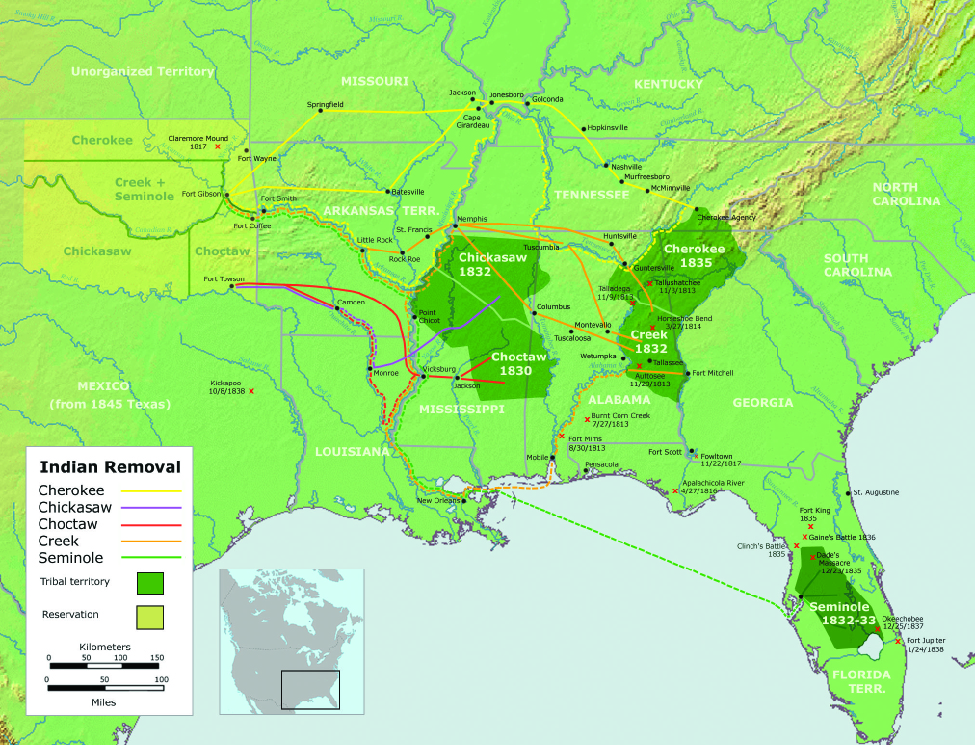
The next year, in Worcester v. Georgia, the Court ruled that non-Native Americans could not enter tribal lands without the tribe’s permission. White Georgians, however, refused to abide by the Court’s decision, and President Andrew Jackson, a former Indian fighter, refused to enforce it.[101] Between 1831 and 1838, members of several southern tribes, including the Cherokees, were forced by the U.S. Army to move west along routes shown in Figure 13.15. The forced removal of the Cherokees to Oklahoma Territory, which had been set aside for settlement by displaced tribes and designated Indian Territory, resulted in the death of one-quarter of the tribe’s population.[102] The Cherokees remember this journey as the Trail of Tears.
By the time of the Civil War, most Indian tribes had been relocated west of the Mississippi. However, once large numbers of White Americans and European immigrants had also moved west after the Civil War, Native Americans once again found themselves displaced. They were confined to reservations, which are federal lands set aside for their use where non-Indians could not settle. Reservation land was usually poor, however, and attempts to farm or raise livestock, not traditional occupations for most western tribes anyway, often ended in failure. Unable to feed themselves, the tribes became dependent on the Bureau of Indian Affairs (BIA) in Washington, DC, for support. Protestant missionaries were allowed to “adopt” various tribes, to convert them to Christianity and thus speed their assimilation. In an effort to hasten this process, Indian children were taken from their parents and sent to boarding schools, many of them run by churches, where they were forced to speak English and abandon their traditional cultures.[103]
In 1887, the Dawes Severalty Act, another effort to assimilate Indians to White society, divided reservation lands into individual allotments. Native Americans who accepted these allotments and agreed to sever tribal ties were also given U.S. citizenship. All lands remaining after the division of reservations into allotments were offered for sale by the federal government to White farmers and ranchers. As a result, Indians swiftly lost control of reservation land.[104] In 1898, the Curtis Act dealt the final blow to Indian sovereignty by abolishing all tribal governments.[105]
The Fight for Native American Rights
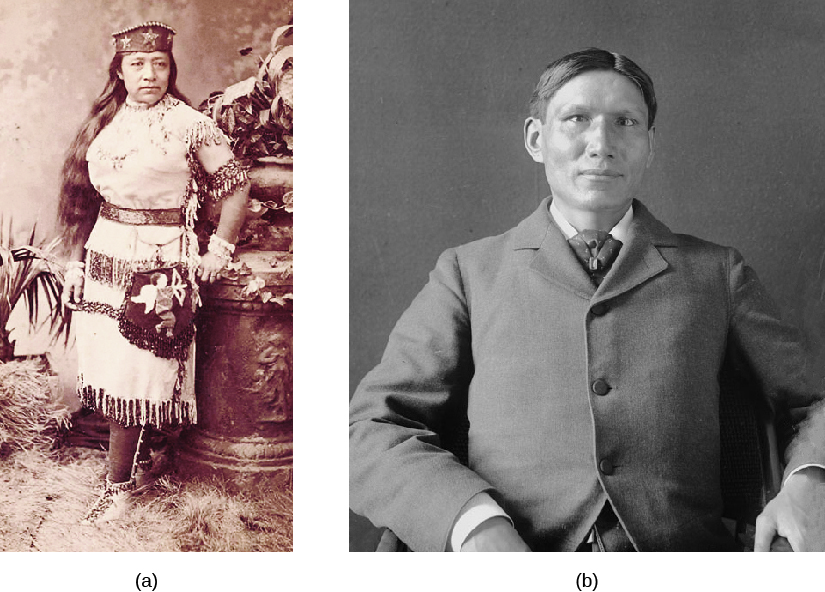
As Indians were removed from their tribal lands and increasingly saw their traditional cultures being destroyed over the course of the nineteenth century, a movement to protect their rights began to grow. Sarah Winnemucca (Figure 13.16), member of the Paiute tribe, lectured throughout the east in the 1880s in order to acquaint White audiences with the injustices suffered by the western tribes.[106] Lakota physician Charles Eastman (Figure 13.16) also worked for Native American rights. In 1924, the Indian Citizenship Act granted citizenship to all Native Americans born after its passage. Native Americans born before the act took effect, who had not already become citizens as a result of the Dawes Severalty Act or service in the army in World War I, had to wait until the Nationality Act of 1940 to become citizens. In 1934, Congress passed the Indian Reorganization Act, which ended the division of reservation land into allotments. It returned to Native American tribes the right to institute self-government on their reservations, write constitutions, and manage their remaining lands and resources. It also provided funds for Native Americans to start their own businesses and attain a college education.[107]
Despite the Indian Reorganization Act, conditions on the reservations did not improve dramatically. Most tribes remained impoverished, and many Native Americans, despite the fact that they were now U.S. citizens, were denied the right to vote by the states in which they lived. States justified this violation of the Fifteenth Amendment by claiming that Native Americans might be U.S. citizens but were not state residents because they lived on reservations. Other states denied Native Americans voting rights if they did not pay taxes.[108] Despite states’ actions, the federal government continued to uphold the rights of tribes to govern themselves. Federal concern for tribal sovereignty was part of an effort on the government’s part to end its control of, and obligations to, Indian tribes.[109]
In the 1960s, a modern Native American civil rights movement, inspired by the African American civil rights movement, began to grow. In 1969, a group of Native American activists from various tribes, part of a new Pan-Indian movement, took control of Alcatraz Island in San Francisco Bay, which had once been the site of a federal prison. Attempting to strike a blow for Red Power, the power of Native Americans united by a Pan-Indian identity and demanding federal recognition of their rights, they maintained control of the island for more than a year and a half. They claimed the land as compensation for the federal government’s violation of numerous treaties and offered to pay for it with beads and trinkets. In January 1970, some of the occupiers began to leave the island. Some may have been disheartened by the accidental death of the daughter of one of the activists. In May 1970, all electricity and telephone service to the island was cut off by the federal government, and more of the occupiers began to leave. In June, the few people remaining on the island were removed by the government. Though the goals of the activists were not achieved, the occupation of Alcatraz had brought national attention to the concerns of Native American activists.[110]
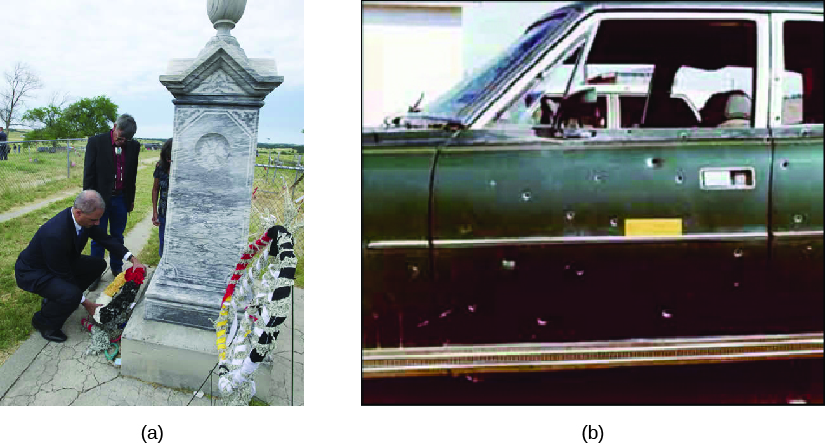
In 1973, members of the American Indian Movement (AIM), a more radical group than the occupiers of Alcatraz, temporarily took over the offices of the Bureau of Indian Affairs in Washington, DC. The following year, members of AIM and some two hundred Oglala Lakota supporters occupied the town of Wounded Knee on the Lakota tribe’s Pine Ridge Reservation in South Dakota, the site of an 1890 massacre of Lakota men, women, and children by the U.S. Army (Figure 13.17). Many of the Oglala were protesting the actions of their half-White tribal chieftain, who they claimed had worked too closely with the BIA. The occupiers also wished to protest the failure of the Justice Department to investigate acts of White violence against Lakota tribal members outside the bounds of the reservation.
The occupation led to a confrontation between the Native American protestors and the FBI and U.S. Marshals. Violence erupted; two Native American activists were killed, and a marshal was shot (Figure 13.17). After the second death, the Lakota called for an end to the occupation and negotiations began with the federal government. Two of AIM’s leaders, Russell Means and Dennis Banks, were arrested, but the case against them was later dismissed.[111] Violence continued on the Pine Ridge Reservation for several years after the siege; the reservation had the highest per capita murder rate in the United States. Two FBI agents were among those who were killed. The Oglala blamed the continuing violence on the federal government.[112]
LINK TO LEARNING
The official website of the American Indian Movement provides information about ongoing issues in Native American communities in both North and South America.
The current relationship between the U.S. government and Native American tribes was established by the Indian Self-Determination and Education Assistance Act of 1975. Under the act, tribes assumed control of programs that had formerly been controlled by the BIA, such as education and resource management, and the federal government provided the funding.[113] Many tribes have also used their new freedom from government control to legalize gambling and to open casinos on their reservations. Although the states in which these casinos are located have attempted to control gaming on Native American lands, the Supreme Court and the Indian Gaming Regulatory Act of 1988 have limited their ability to do so.[114] The 1978 American Indian Religious Freedom Act granted tribes the right to conduct traditional ceremonies and rituals, including those that use otherwise prohibited substances like peyote cactus and eagle bones, which can be procured only from vulnerable or protected species.[115]
In another important recent development, several federal court cases have raised standing for Native American tribes to sue to regain former reservation lands lost to the U.S. government. Through a key 5-4 decision by the Supreme Court in McGirt v. Oklahoma, Native Americans realized the most important advancement in rights since the reapplication of the Winters Doctrine (which led to a stronger footing for tribes in water negotiations). [116] The initial case taken up by the Court in 2019, Carpenter v. Murphy, which revolved around a murder case in Oklahoma, became quite salient, given the history of the Trail of Tears. At issue was whether Mr. Murphy committed murder on private land in the state of Oklahoma or on the Muscogee (Creek) reservation and who should have jurisdiction over his case. If the court decided to proclaim the land as a reservation, that would potentially lead to half the State of Oklahoma being designated as such.[117] After hearing arguments in late 2018, they did not hand down a decision in 2019. However, in the follow-up case, McGirt v. Oklahoma, the Court took the step that strengthened Native American rights. The landmark decision held that a large part of Oklahoma is tribal land. Moreover, the court argued that crimes committed on those lands are subject to federal, not state authority. In this case, Jimcy McGirt was convicted in Oklahoma state court in 1997 of various sexual crimes. McGirt challenged the conviction on the basis that Oklahoma lacked jurisdiction to prosecute a member of the Muscogee Creek Nation tribe for crimes committed on tribal land.[118]
In addition to gains in water rights and land rights, Native American tribes made other gains in recent decades. Tribes have robust and well-recognized governing institutions based on democratic principles. Moreover, many tribes now have governing compacts negotiated with the states where their ancestral lands lay. The proliferation of Indian gaming has further strengthened the success and political influence of the tribes. Finally, the appointment by President Biden, and subsequent Senate confirmation, of Rep. Deb Haaland (D-NM) as Secretary of the Interior was a powerful and pathbreaking moment. She is the first Native American to hold that position at Interior, which includes the Bureau of Indian Affairs.
Alaska Natives and Native Hawaiians Regain Some Rights
Alaska Natives and Native Hawaiians endured many of the same abuses as Native Americans, including loss of land and forced assimilation. Following the discovery of oil in Alaska, however, the state, in an effort to gain undisputed title to oil rich land, settled the issue of Alaska Natives’ land claims with the passage of the Alaska Native Claims Settlement Act in 1971. According to the terms of the act, Alaska Natives received 44 million acres of resource-rich land and more than $900 million in cash in exchange for relinquishing claims to ancestral lands to which the state wanted title.[119]
Native Hawaiians also lost control of their land—nearly two million acres—through the overthrow of the Hawaiian monarchy in 1893 and the subsequent formal annexation of the Hawaiian Islands by the United States in 1898. The indigenous population rapidly decreased in number, and white settlers tried to erase all trace of traditional Hawaiian culture. Two acts passed by Congress in 1900 and 1959, when the territory was granted statehood, returned slightly more than one million acres of federally owned land to the state of Hawaii. The state was to hold it in trust and use profits from the land to improve the condition of Native Hawaiians.[120]
In September 2015, the U.S. Department of Interior, the same department that contains the Bureau of Indian Affairs, created guidelines for Native Hawaiians who wish to govern themselves in a relationship with the federal government similar to that established with Native American and Alaska Native tribes. Such a relationship would grant Native Hawaiians power to govern themselves while remaining U.S. citizens. Voting began in fall 2015 for delegates to a constitutional convention that would determine whether or not such a relationship should exist between Native Hawaiians and the federal government.[121] When non-Native Hawaiians and some Native Hawaiians brought suit on the grounds that, by allowing only Native Hawaiians to vote, the process discriminated against members of other ethnic groups, a federal district court found the election to be legal. While the Supreme Court stopped the election, in September 2016 a separate ruling by the Interior Department allowed for a referendum to be held. Native Hawaiians in favor are working to create their own nation.[122]
Despite significant advances, American Indians, Alaska Natives, and Native Hawaiians still trail behind U.S. citizens of other ethnic backgrounds in many important areas. These groups continue to suffer widespread poverty and high unemployment. Some of the poorest counties in the United States are those in which Native American reservations are located. These minorities are also less likely than white Americans, African Americans, or Asian Americans to complete high school or college.[123] Many American Indian and Alaskan tribes endure high rates of infant mortality, alcoholism, and suicide.[124] Native Hawaiians are also more likely to live in poverty than White people in Hawaii, and they are more likely than white Hawaiians to be unhoused or unemployed.[125]
13.6 Equal Protection for Other Groups
LEARNING OUTCOMES
By the end of this section, you will be able to:
- Discuss the discrimination faced by Hispanic/Latino Americans and Asian Americans
- Describe the influence of the African American civil rights movement on Hispanic/Latino, Asian American, and LGBTQ civil rights movements
- Describe federal actions to improve opportunities for people with disabilities
- Describe discrimination faced by religious minorities
Many groups in American society have faced and continue to face challenges in achieving equality, fairness, and equal protection under the laws and policies of the federal government and/or the states. Some of these groups are often overlooked because they are not as large of a percentage of the U.S. population as women or African Americans, and because organized movements to achieve equality for them are relatively young. This does not mean, however, that the discrimination they face has not been as longstanding or as severe.
Hispanic / Latino Civil Rights
Hispanic and Latino people in the United States have faced many of the same problems as African Americans and Native Americans. Although the terms Hispanic and Latino are often used interchangeably, they are not the same. Hispanic usually refers to native speakers of Spanish or those descended from Spanish-speaking countries. Latino refers to people who come from, or whose ancestors came from, Latin America. Not all Hispanics are Latinos and vice versa. People from Spain are Hispanic but are not Latino, while people from Brazil are Latino but not Hispanic. Both Hispanics and Latinos may be of any race or ethnicity; they may be of European, African, Native American descent, or they may be of mixed racial or ethnic background. We will use the term “Latino” here, while acknowledging that many these days prefer the term Latinx as it is gender neutral.[126]
Many Latinos became part of the U.S. population following the annexation of Texas by the United States in 1845 and of California, Arizona, New Mexico, Nevada, Utah, and Colorado following the War with Mexico in 1848. Most were subject to discrimination and could find employment only as poorly paid migrant farm workers, railroad workers, and unskilled laborers.[127] The Spanish-speaking population of the United States increased following the Spanish-American War in 1898 with the incorporation of Puerto Rico as a U.S. territory. In 1917, during World War I, the Jones Act granted U.S. citizenship to Puerto Ricans.
In the early twentieth century, waves of violence aimed at Mexicans and Mexican Americans swept the Southwest. Mexican Americans in Arizona and in parts of Texas were denied the right to vote, which they had previously possessed, and Mexican American children were barred from attending Anglo-American schools. During the Great Depression of the 1930s, Mexican immigrants and many Mexican Americans, both U.S.-born and naturalized citizens, living in the Southwest and Midwest were deported by the government so that Anglo-Americans could take the jobs that they had once held.[128] When the United States entered World War II, however, Mexicans were invited to immigrate to the United States as farmworkers under the Bracero (bracero meaning “manual laborer” in Spanish) Program to make it possible for these American men to enlist in the armed services.[129]
Mexican Americans and Puerto Ricans did not passively accept discriminatory treatment, however. In 1903, Mexican farmworkers joined with Japanese farmworkers, who were also poorly paid, to form the first union to represent agricultural laborers. In 1929, Latino civil rights activists formed the League of United Latin American Citizens (LULAC) to protest against discrimination and to fight for greater rights for Latinos.[130]
Just as in the case of African Americans, however, true civil rights advances for Hispanic and Latino people did not take place until the end of World War II. Hispanic and Latino activists targeted the same racist practices as did African Americans and used many of the same tactics to end them. In 1946, Mexican American parents in California, with the assistance of the NAACP, sued several California school districts that forced Mexican and Mexican American children to attend segregated schools. In the case of Mendez v. Westminster (1947), the Court of Appeals for the Ninth Circuit Court held that the segregation of Mexican and Mexican American students into separate schools was unconstitutional.[131]
Although Latinos made some civil rights advances in the decades following World War II, discrimination continued. Alarmed by the large number of undocumented Mexicans crossing the border into the United States in the 1950s, the United States government began Operation Wetback (wetback is a derogatory term for Mexicans living unofficially in the United States). From 1953 to 1958, more than three million Mexican immigrants, and some Mexican Americans as well, were deported from California, Texas, and Arizona.[132] To limit the entry of Hispanic and Latino immigrants to the United States, in 1965 Congress imposed an immigration quota of 120,000 newcomers from the Western Hemisphere.
At the same time that the federal government sought to restrict Hispanic and Latino immigration to the United States, the Mexican American civil rights movement grew stronger and more radical, just as the African American civil rights movement had done. While African Americans demanded Black Power and called for Black Pride, young Mexican American civil rights activists called for Brown Power and began to refer to themselves as Chicanos, a term disliked by many older, conservative Mexican Americans, in order to stress their pride in their hybrid Spanish-Native American cultural identity.[133] Demands by Mexican American activists often focused on improving education for their children, and they called upon school districts to hire teachers and principals who were bilingual in English and Spanish, to teach Mexican and Mexican American history, and to offer instruction in both English and Spanish for children with limited ability to communicate in English.[134]
MILESTONE
East L.A. Student Walkouts
In March 1968, Chicano students at five high schools in East Los Angeles went on strike to demand better education for students of Mexican ancestry. Los Angeles schools did not allow Latino students to speak Spanish in class and gave no place to study Mexican history in the curriculum. Guidance counselors also encouraged students, regardless of their interests or ability, to pursue vocational careers instead of setting their sights on college. Some students were placed in specialized classes for people with disabilities. As a result, the dropout rate among Mexican American students was very high.
School administrators refused to meet with the student protestors to discuss their grievances. After a week, police were sent in to end the strike. Thirteen of the organizers of the walkout were arrested and charged with conspiracy to disturb the peace. After Sal Castro, a teacher who had led the striking students, was dismissed from his job, activists held a sit-in at school district headquarters until Castro was reinstated. Student protests spread across the Southwest, and in response many schools did change. That same year, Congress passed the Bilingual Education Act, which required school districts with large numbers of Hispanic or Latino students to provide instruction in Spanish.[135]
Bilingual education remains controversial, even among Hispanic and Latino people. What are some arguments they might raise both for and against it? Are these different from arguments coming from non-Latinos?
Mexican American civil rights leaders were active in other areas as well. Throughout the 1960s, Cesar Chavez and Dolores Huerta fought for the rights of Mexican American agricultural laborers through their organization, the United Farm Workers (UFW), a union for migrant workers they founded in 1962. Chavez, Huerta, and the UFW proclaimed their solidarity with Filipino farm workers by joining them in a strike against grape growers in Delano, California, in 1965. Chavez consciously adopted the tactics of the African American civil rights movement. In 1965, he called upon all U.S. consumers to boycott California grapes (Figure 13.18), and in 1966, he led the UFW on a 300-mile march to Sacramento, the state capital, to bring the state farm workers’ problems to the attention of the entire country. The strike finally ended in 1970 when the grape growers agreed to give the pickers better pay and benefits.[136]
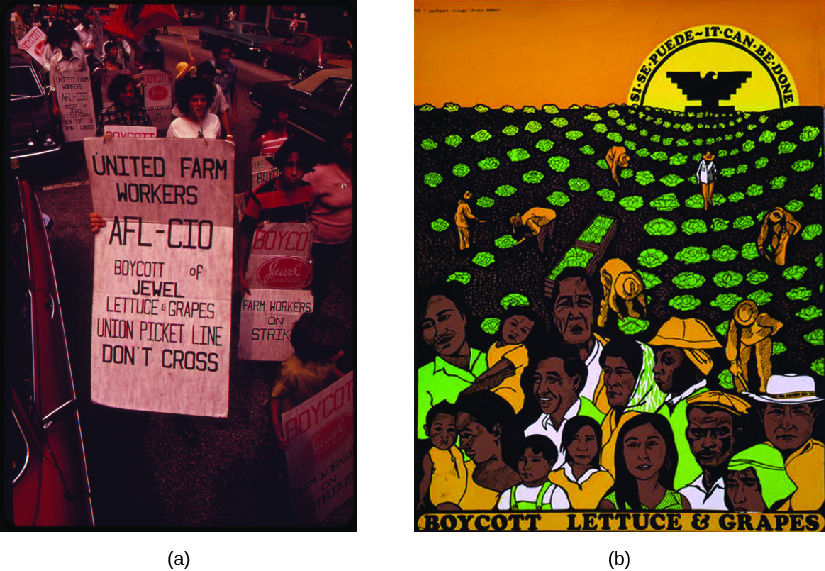
As Latino immigration to the United States increased in the late twentieth and early twenty-first centuries, discrimination also increased in many places. In 1994, California voters passed Proposition 187. The proposition sought to deny non-emergency health services, food stamps, welfare, and Medicaid to undocumented immigrants. It also banned children from attending public school unless they could present proof that they and their parents were legal residents of the United States. A federal court found it unconstitutional in 1997 on the grounds that the law’s intention was to regulate immigration, a power held only by the federal government.[137]
In 2005, discussion began in Congress on proposed legislation that would make it a felony to enter the United States illegally or to give assistance to anyone who had done so. Although the bill quickly died, on May 1, 2006, hundreds of thousands of people, primarily Latinos, staged public demonstrations in major U.S. cities, refusing to work or attend school for one day.[138] The protestors claimed that people seeking a better life should not be treated as criminals and that undocumented immigrants already living in the United States should have the opportunity to become citizens.
Following the failure to make undocumented immigration a felony under federal law, several states attempted to impose their own sanctions on unauthorized entry. In April 2010, Arizona passed a law that made illegal immigration a state crime. The law also forbade undocumented immigrants from seeking work and allowed law enforcement officers to arrest people suspected of being in the U.S. illegally. Thousands protested the law, claiming that it encouraged racial profiling. In 2012, in Arizona v. United States, the U.S. Supreme Court struck down those provisions of the law that made it a state crime to reside in the United States illegally, forbade undocumented immigrants to take jobs, and allowed the police to arrest those suspected of being illegal immigrants.[139] The court, however, upheld the authority of the police to ascertain the immigration status of someone suspected of being an undocumented entrant if the person had been stopped or arrested by the police for other reasons.[140]
Today, Latinos constitute the largest minority group in the United States. They also have one of the highest birth rates of any ethnic group.[141] Although Hispanic people lag behind non-Hispanic White people in terms of income and high school graduation rates, they are enrolling in college at higher rates than non-Hispanic White people.[142] Topics that remain at the forefront of public debate today include immigration reform, the DREAM Act (a proposal for granting undocumented immigrants permanent residency in stages), and court action on executive orders on immigration. The Trump administration was very active on issues of immigration and border security. Aside from the proposal to build a border wall, other areas of action have included various travel bans and the policy of separating families at the border as they attempt to enter the country.[143]
Asian American Civil Rights
As the rash of recent violence against them has shown, Asian Americans have also often been discriminated against and denied their civil rights. Often stereotyped as the “the model minority” (because it is assumed they are generally financially successful and do well academically), the underlying reality is complex. The truth is that Asian Americans have long faced discrimination. Indeed, in the nineteenth century, Asian people were among the most despised of all immigrant groups and were often subjected to the same laws enforcing segregation and forbidding interracial marriage as were African Americans and American Indians.
The Chinese were the first large group of Asian people to immigrate to the United States. They arrived in large numbers in the mid-nineteenth century to work in the mining industry and on the Central Pacific Railroad. Others worked as servants or cooks or operated laundries. Their willingness to work for less money than White workers led White workers in California to call for a ban on Chinese immigration. In 1882, Congress passed the Chinese Exclusion Act, which prevented Chinese from immigrating to the United States for ten years and prevented Chinese already in the country from becoming citizens (Figure 13.19). In 1892, the Geary Act extended the ban on Chinese immigration for another ten years. In 1913, California passed a law preventing all Asian people, not just the Chinese, from owning land. With the passage of the Immigration Act of 1924, all Asian people, with the exception of Filipinos, were prevented from immigrating to the United States or becoming naturalized citizens. Laws in several states barred marriage between Chinese and White Americans, and some cities with large Asian populations required Asian children to attend segregated schools.[144]
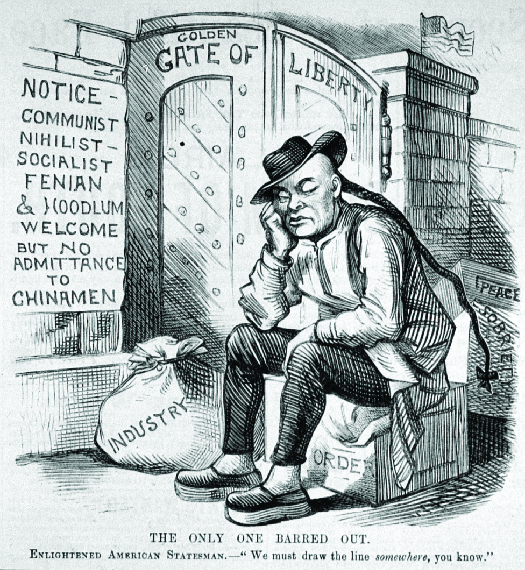
During World War II, citizens of Japanese descent living on the West Coast, whether naturalized immigrants or Japanese Americans born in the United States, were subjected to the indignity of being removed from their communities and interned under Executive Order 9066 (Figure 13.20). The reason was fear that they might prove disloyal to the United States and give assistance to Japan. Although Italians and Germans suspected of disloyalty were also interned by the U.S. government, only the Japanese were imprisoned solely on the basis of their ethnicity. None of the more than 110,000 Japanese and Japanese Americans internees was ever found to have committed a disloyal act against the United States, and many young Japanese American men served in the U.S. army during the war.[145] Although Japanese American Fred Korematsu challenged the right of the government to imprison law-abiding citizens, the Supreme Court decision in the 1944 case of Korematsu v. United States upheld the actions of the government as a necessary precaution in a time of war.[146] When internees returned from the camps after the war was over, many of them discovered that the houses, cars, and businesses they had left behind, often in the care of White neighbors, had been sold or destroyed.[147]
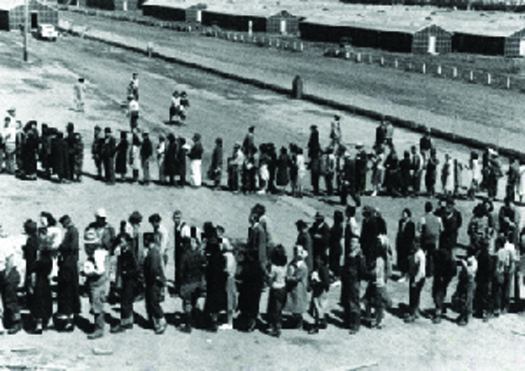
LINK TO LEARNING
Explore the resources at Japanese American Internment and Digital History to learn more about the experiences of Japanese Americans during World War II.
The growth of the African American, Chicano, and Native American civil rights movements in the 1960s inspired many Asian Americans to demand their own rights. Discrimination against Asian Americans, regardless of national origin, increased during the Vietnam War. Ironically, violence directed indiscriminately against Chinese, Japanese, Koreans, and Vietnamese caused members of these groups to unite around a shared pan-Asian identity, much as Native Americans had in the Pan-Indian movement. In 1968, students of Asian ancestry at the University of California at Berkeley formed the Asian American Political Alliance. Asian American students also joined Chicano, Native American, and African American students to demand that colleges offer ethnic studies courses.[148] In 1974, in the case of Lau v. Nichols, Chinese American students in San Francisco sued the school district, claiming its failure to provide them with assistance in learning English denied them equal educational opportunities.[149] The Supreme Court found in favor of the students.
Until recent attacks against Asian Americans during the COVID-19 pandemic, the Asian American movement was not as active as other civil rights movements. While not keeping them free from discrimination, their educational achievement and economic success placed Asian Americans in a much better position to defend their rights. Unfortunately, racist vitriol related to the origin of COVID-19 has recently highlighted discrimination against Asian Americans and the formerly quiet movement has become highly salient. Hate crimes against Asian Americans increased 150 percent in 2020 and rose over 800 percent in New York City.[150]
The Fight for Civil Rights in the LGBTQ Community
Laws against homosexuality, which was regarded as a sin and a moral failing, existed in most states throughout the nineteenth and twentieth centuries. By the late nineteenth century, homosexuality had come to be regarded as a form of mental illness as well as a sin, and gay men were often erroneously believed to be pedophiles.[151] As a result, lesbians, gay men, bisexuals, and transgender people, collectively known as the LGBTQ community, had to keep their sexual orientation hidden or “closeted.” Secrecy became even more important in the 1950s, when fear of gay men increased and the federal government believed they could be led into disloyal acts either as a result of their “moral weakness” or through blackmail by Soviet agents. As a result, many men lost or were denied government jobs. Fears of lesbians also increased after World War II as U.S. society stressed conformity to traditional gender roles and the importance of marriage and childrearing.[152]
The very secrecy in which lesbian, gay, bisexual, and transgender people had to live made it difficult for them to organize to fight for their rights as other, more visible groups had done. Some organizations did exist, however. The Mattachine Society, established in 1950, was one of the first groups to champion the rights of gay men. Its goal was to unite gay men who otherwise lived in secrecy and to fight against abuse. The Mattachine Society often worked with the Daughters of Bilitis, a lesbian rights organization. Among the early issues targeted by the Mattachine Society was police entrapment of gay men.[153]
In the 1960s, the gay and lesbian rights movements began to grow more radical, in a manner similar to other civil rights movements. In 1962, gay Philadelphians demonstrated in front of Independence Hall. In 1966, transgender prostitutes who were tired of police harassment rioted in San Francisco. In June 1969, gay men, lesbians, and transgender people erupted in violence when New York City police attempted to arrest customers at a gay bar in Greenwich Village called the Stonewall Inn. The patrons’ ability to resist arrest and fend off the police inspired many members of New York’s LGBTQ community, and the riots persisted over several nights. New organizations promoting LGBTQ rights that emerged after Stonewall were more radical and confrontational than the Mattachine Society and the Daughters of Bilitis had been. These groups, like the Gay Activists Alliance and the Gay Liberation Front, called not just for equality before the law and protection against abuse but also for “liberation,” Gay Power, and Gay Pride.[154]
Although LGBTQ people gained their civil rights later than many other groups, changes did occur beginning in the 1970s, remarkably quickly when we consider how long other minority groups had fought for their rights. The decade saw 18 states decriminalize same-sex relations, following Illinois and Connecticut, which had done so in the 1960s. In 1973, the American Psychological Association ended its classification of homosexuality as a mental disorder. In 1994, the U.S. military adopted the policy of “Don’t ask, don’t tell.” This act, Department of Defense Directive 1304.26, officially prohibited discrimination against gay, lesbian, and bisexual people by the U.S. military. It also prohibited superior officers from asking about or investigating the sexual orientation of those below them in rank.[155] However, those gay, lesbian, and bisexual people who spoke openly about their sexual orientation were still subject to dismissal because it remained illegal for anyone except straight people to serve in the armed forces. The policy ended in 2011, and now gay, lesbian, and bisexual people may serve openly in the military.[156] Transgender people were banned from serving in the military in 1960. The ban lasted until 2016, when the government began a gradual process of expanding and altering the limitations on their service. In early 2021, the Biden administration announced that there would no longer be restrictions on military service by transgender individuals, that medical support for gender transition would be provided, and that procedures would be developed to change a service member’s official gender marker.
In 2003, in the case of Lawrence v. Texas, the Supreme Court ruled unconstitutional fourteen remaining states’ laws that criminalized sexual intercourse between consenting adults of the same sex.[157] Beginning in 2000, several states made it possible for same-sex couples to enter into legal relationships known as civil unions or domestic partnerships. These arrangements extended many of the same protections enjoyed by heterosexual married couples to same-sex couples. LGBTQ activists, however, continued to fight for the right to marry. Same-sex marriages would allow partners to enjoy exactly the same rights as married heterosexual couples and accord their relationships the same dignity and importance. In 2004, Massachusetts became the first state to grant legal status to same-sex marriage. Other states quickly followed. This development prompted a backlash among many religious conservatives, who considered homosexuality a sin and argued that allowing same-sex couples to marry would lessen the value and sanctity of heterosexual marriage. Many states passed laws banning same-sex marriage, and many gay and lesbian couples challenged these laws, successfully, in the courts. Finally, in Obergefell v. Hodges, the Supreme Court overturned state bans and made same-sex marriage legal throughout the United States on June 26, 2015 (Figure 13.21).[158]
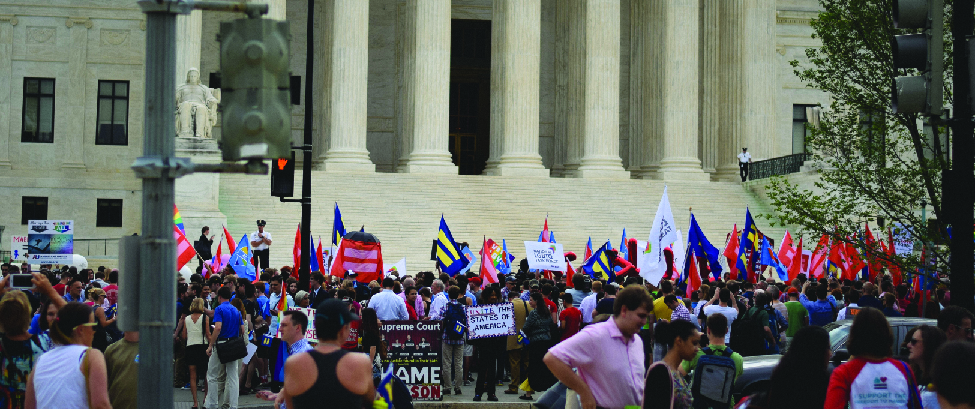
The legalization of same-sex marriage throughout the United States led some people to feel their religious beliefs were under attack, and many religiously conservative business owners have refused to acknowledge LBGT rights or the legitimacy of same-sex marriages. Following swiftly upon the heels of the Obergefell ruling, the Indiana legislature passed a Religious Freedom Restoration Act (RFRA). Congress had already passed such a law in 1993; it was intended to extend protection to minority religions, such as by allowing rituals of the Native American Church. However, the Supreme Court in City of Boerne v. Flores (1997) ruled that the 1993 law applied only to the federal government and not to state governments.[159] Thus several state legislatures later passed their own Religious Freedom Restoration Acts. These laws state that the government cannot “substantially burden an individual’s exercise of religion” unless it would serve a “compelling governmental interest” to do so. They allow individuals, which also include businesses and other organizations, to discriminate against others, primarily same-sex couples and LGBTQ people, if the individual’s religious beliefs are opposed to homosexuality.
LGBTQ Americans still encounter difficulties in other areas as well. While the Supreme Court ruled in 2020 that employers cannot discriminate based on sexual orientation and transgender status, LGBTQ people are not protected from housing discrimination. The federal Department of Housing and Urban Development has indicated that refusing to rent or sell homes to transgender people may be considered sex discrimination, but there is no nationwide clarity on the law.[160] Violence against members of the LGBTQ community remains a serious problem; this violence occurs on the streets and in their homes.[161] The enactment of the Matthew Shepard and James Byrd Jr. Hate Crimes Prevention Act, also known as the Matthew Shepard Act, in 2009 made it a federal hate crime to attack someone based on gender, gender identity, sexual orientation, or disability and made it easier for federal, state, and local authorities to investigate hate crimes, but it has not necessarily made the world safer for LGBTQ Americans. Transgender rights have also been increasingly under scrutiny as 2021 brought a record number of pieces of anti-transgender legislation in state legislatures.[162] The U.S. Supreme Court, however, gave the transgender community a win when they chose not to hear a school’s appeal of a lower court decision on a transgender student bathroom case.[163] Soon after, the federal government indicated that it would follow the approach of many states in including a non-binary gender marker option on official documents, such as passports.
Civil Rights and the Americans with Disabilities Act
People with disabilities make up one of the last groups whose civil rights have been recognized. For a long time, they were denied employment and access to public education. Many were institutionalized. A eugenics movement in the United States in the late nineteenth and early to mid-twentieth centuries sought to encourage childbearing among White people without disabilities and discourage it among those with physical or intellectual disabilities. Many states passed laws prohibiting marriage among people who had what were believed to be hereditary “defects.” Among those affected were people who were blind or deaf, those with epilepsy, people with intellectual or developmental disabilities, and those with mental illnesses. In some states, programs existed to sterilize people considered “feeble minded” by the standards of the time, without their will or consent.[164] When this practice was challenged by a woman in a state institution in Virginia, the Supreme Court, in the 1927 case of Buck v. Bell, upheld the right of state governments to sterilize those people believed likely to have children who would become dependent upon public welfare.[165] Some of these programs persisted into the 1970s, as Figure 13.22 shows.[166]
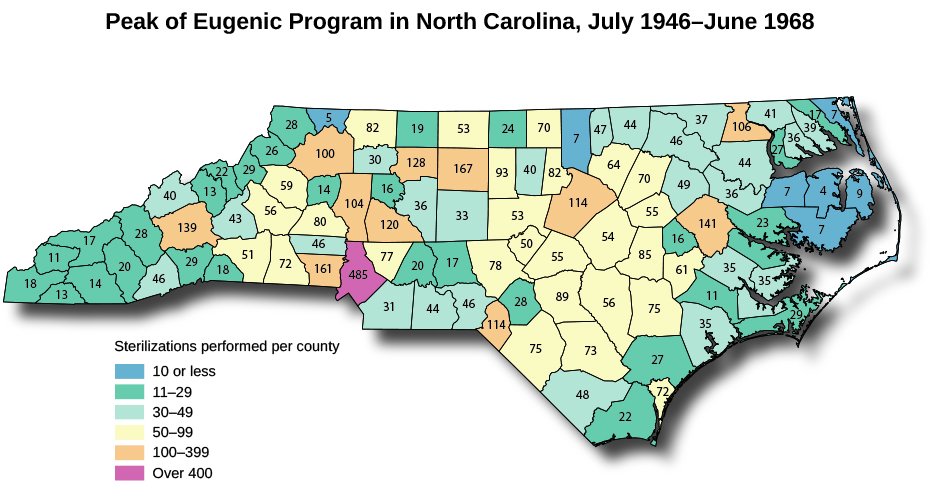
By the 1970s, however, concern for extending equal opportunities to all led to the passage of two important acts by Congress. In 1973, the Rehabilitation Act made it illegal to discriminate against people with disabilities in federal employment or in programs run by federal agencies or receiving federal funding. This was followed by the Education for all Handicapped Children Act of 1975, which required public schools to educate children with disabilities. The act specified that schools consult with parents to create a plan tailored for each child’s needs that would provide an educational experience as close as possible to that received by other children.
In 1990, the Americans with Disabilities Act (ADA) greatly expanded opportunities and protections for people of all ages with disabilities. It also significantly expanded the categories and definition of disability. The ADA prohibits discrimination in employment based on disability. It also requires employers to make reasonable accommodations available to workers who need them. Finally, the ADA mandates that public transportation and public accommodations be made accessible to those with disabilities. The Act was passed despite the objections of some who argued that the cost of providing accommodations would be prohibitive for small businesses. While the ADA has inarguably improved opportunities for Americans with disabilities to receive public services equally and to pursue educational opportunities, challenges continue in this space. On college campuses, disability resource centers are often slow and understaffed, causing stress for students and professors alike.[167] And, in schools and colleges, full access to certain buildings and spaces remains elusive.[168]
LINK TO LEARNING
The community of people with disabilities is well organized in the twenty-first century, as evidenced by the considerable network of disability rights organizations in the United States.
The Rights of Religious Minorities
The right to worship as a person chooses was one of the reasons for the initial settlement of the United States. Thus, it is ironic that many people throughout U.S. history have been denied their civil rights because of their status as members of a religious minority. Beginning in the early nineteenth century with the immigration of large numbers of Irish Catholics to the United States, anti-Catholicism became a common feature of American life and remained so until the mid-twentieth century. Catholic immigrants were denied jobs, and in the 1830s and 1840s anti-Catholic literature accused Catholic priests and nuns of committing horrific acts. Anti-Mormon sentiment was also quite common, and members of the Church of Jesus Christ of Latter-day Saints were accused of kidnapping women and building armies for the purpose of dominating their neighbors. At times, these fears led to acts of violence. A convent in Charlestown, Massachusetts, was burned to the ground in 1834.[169] In 1844, Joseph Smith, the founder of the Church of Christ, and his brother were murdered by a mob in Illinois.[170]
For many years, Jewish Americans faced discrimination in employment, education, and housing based on their religion. Many of the restrictive real estate covenants that prohibited people from selling their homes to Black people also prohibited them from selling to Jewish people, and a “gentlemen’s agreement” among the most prestigious universities in the United States limited the number of Jewish students accepted. Indeed, a tradition of confronting discrimination led many American Jews to become actively involved in the civil rights movements for women and African Americans.[171]
Anti-semitism remains a significant issue in the United States and worldwide. According to the FBI, Jewish people or property are the most frequent targets of hate crimes motivated by religious bias. Jewish cemeteries and places of worship are frequently attacked or defaced, and insensitive jokes and frequent references to the Holocaust are widely used. Muslims have also experienced a rise in discrimination and hate crimes, and most Americans, including non-Muslims, report a belief that significant anti-Muslim sentiment exists in the United States. Although Title VII of the Civil Rights Act of 1964 prevents employment discrimination on the basis of religion and requires employers to make reasonable accommodations so that employees can engage in religious rituals and practices, Muslim employees are often discriminated against. Often the source of controversy is the wearing of head coverings by observant Muslims, which some employers claim violates uniform policies or dress codes, even when non-Muslim coworkers are allowed to wear head coverings that are not part of work uniforms.[172] Hate crimes against Muslims have also increased, and many Muslims believe they are subject to racial profiling by law enforcement officers who suspect them of being terrorists.[173]
Many Christians have recently argued that they are being deprived of their rights because of their religious beliefs and have used this claim to justify their refusal to acknowledge the rights of others. The owner of Hobby Lobby Stores, for example, a conservative Christian, argued that his company’s health-care plan should not have to pay for contraception because his religious beliefs are opposed to the practice. In 2014, in the case of Burwell v. Hobby Lobby Stores, Inc., the Supreme Court ruled in his favor.[174] As discussed earlier, many conservative Christians have also argued that they should not have to recognize same-sex marriages because they consider homosexuality to be a sin.
This chapter was remixed from American Government (2e- Second Edition) by Lumen Learning, licensed under a Creative Commons Attribution 4.0 International License, except where otherwise noted.
13.7 From Separate but Equal to Desegregation
Strauder v. W. Va. (1880)
100 U.S. 303 (1880)
Vote: 7-2
Opinion: Strong
Decision: Reversed
Majority: Strong, joined by Waite, Swayne, Miller, Bradley, Hunt, and Harlan
Dissent: Field and Clifford
MR. JUSTICE STRONG delivered the opinion of the court.
The plaintiff in error, a colored man, was indicted for murder in the Circuit Court of Ohio County, in West Virginia, on the 20th of October, 1874, and upon trial was convicted and sentenced. The record was then ‘removed to the Supreme Court of the State, and there the judgment of the Circuit Court was affirmed. The present case is a writ of error to that court, and it is now, in substance, averred that at the trial in the State court the defendant (now plaintiff in error) was denied rights to which he was entitled under the Constitution and laws of the United States.
…
In this court, several errors have been assigned, and the controlling questions underlying them all are, first, whether, by the Constitution and laws of the United States, every citizen of the United States has a right to a trial of an indictment against him by a jury selected and impaneled without discrimination against his race or color, because of race or color; and, second, if he has such a right, and is denied its enjoyment by the State in which he is indicted, may he cause the case to be removed into the Circuit Court of the United States?
It is to be observed that the first of these questions is not whether a colored man, when an indictment has been preferred against him, has a right to a grand or a petit jury composed in whole or in part of persons of his own race or color, but it is whether, in the composition or selection of jurors by whom he is to be indicted or tried, all persons of his race or color may be excluded by law, solely because of their race or color, so that by no possibility can any colored man sit upon the jury.
The questions are important, for they demand a construction of the recent amendments of the Constitution. If the defendant has a right to have a jury selected for the trial of his case without discrimination against all persons of his race or color, because of their race or color, the right, if not created, is protected by those amendments, and the legislation of Congress under them. The Fourteenth Amendment ordains that ‘all persons born or naturalized in the United States and subject to the jurisdiction thereof are citizens of the United States and of the State wherein they reside. No State shall make or enforce any laws which shall abridge the privileges or immunities of citizens of the United States, nor shall any State deprive any person of life, liberty, or property, without due process of law, nor deny to any person within its jurisdiction the equal protection of the laws.’
This is one of a series of constitutional provisions having a common purpose; namely, securing to a race recently emancipated, a race that through many generations had been held in slavery, all the civil rights that the superior race enjoy. The true spirit and meaning of the amendments, as we said in the Slaughter-House Cases, (1873), cannot be understood without keeping in view the history of the times when they were adopted, and the general objects they plainly sought to accomplish. At the time when they were incorporated into the Constitution, it required little knowledge of human nature to anticipate that those who had long been regarded as an inferior and subject race would, when suddenly raised to the rank of citizenship, be looked upon with jealousy and positive dislike, and that State laws might be enacted or enforced to perpetuate the-distinctions that had before existed. Discriminations against them had been habitual. It was well known that in some States laws making such discriminations then existed, and others might well be expected. The colored race, as a race, was abject and ignorant, and in that condition was unfitted to command the respect of those who had superior intelligence. Their training had left them mere children, and as such they needed the protection which a wise government extends to those who are unable to protect themselves. They especially needed protection against unfriendly action in the States where they were resident. It was in view of these considerations the Fourteenth Amendment was framed and adopted. It was designed to assure to the colored race the enjoyment of all the civil rights that under the law are enjoyed by white persons, and to give to that race the protection of the general government, in that enjoyment, whenever it should be denied by the States. It not only gave citizenship and the privileges of citizenship to persons of color, but it denied to any State the power to withhold from them the equal protection of the laws, and authorized Congress to enforce its provisions by appropriate legislation. To quote the language used by us in the Slaughter-House Cases, “No one can fail to be impressed with the one pervading purpose found in all the amendments, lying at the foundation of each, and without which none of them would have been suggested, we mean the freedom of the slave race, the security and firm establishment of that freedom, and the protection of the newly made freeman and citizen from the oppressions of those who had formerly exercised unlimited dominion over them.” So again: “The existence of laws in the States where the newly emancipated negroes resided, which discriminated with gross injustice and hardship against them as a class, was the evil to be remedied, and by it [the Fourteenth Amendment] such laws were forbidden. If, however, the States did not conform their laws to its requirements, then, by the fifth section of the article of amendment, Congress was authorized to enforce it by suitable legislation.” …
If this is the spirit and meaning of the amendment, whether it means more or not, it is to be construed liberally, to carry out the purposes of its framers. It ordains that no State shall make or enforce any laws which shall abridge the privileges or immunities of citizens of the United States (evidently referring to the newly made citizens, who, being citizens of the United States, are declared to be also citizens of the State in which they reside). It ordains that no State shall deprive any person of life, liberty, or property, without due process of law, or deny to any person within its jurisdiction the equal protection of the laws. What is this but declaring that the law in the States shall be the same for the black as for the white; that all persons, whether colored or white, shall stand equal before the laws of the States, and, in regard to the colored race, for whose protection the amendment was primarily designed, that no discrimination shall be made against them by law because of their color? The words of the amendment, it is true, are prohibitory, but they contain a necessary implication of a positive immunity, or right, most valuable to the colored race, the right to exemption from unfriendly legislation against them distinctively as colored, exemption from legal discriminations, implying inferiority in civil society, lessening the security of their enjoyment of the rights which others enjoy, and discriminations which are steps towards reducing them to the condition of a subject race …
The right to a trial by jury is guaranteed to every citizen of West Virginia by the Constitution of that State, and the constitution of juries is a very essential part of the protection such a mode of trial is intended to secure. The very idea of a jury is a body of men composed of the peers or equals of the person whose rights it is selected or summoned to determine; that is, of his neighbors, fellows, associates, persons having the same legal status in society as that which he holds …
… it is hard to see why the statute of West Virginia should not be regarded as discriminating against a colored man when he is put upon trial for an alleged criminal offence against the State. It is not easy to comprehend how it can be said that while every white man is entitled to a trial by a jury selected from persons of his own race or color, or, rather, selected without discrimination against his color, and a negro is not, the latter is equally protected by the law with the former … We do not say that within the limits from which it is not excluded by the amendment a State may not prescribe the qualifications of its jurors, and in so doing make discriminations. It may confine the selection to males, to freeholders, to citizens, to persons within certain ages, or to persons having educational qualifications. We do not believe the Fourteenth Amendment was ever intended to prohibit this …
The Fourteenth Amendment makes no attempt to enumerate the rights it designed to protect. It speaks in general terms, and those are as comprehensive as possible. Its language is prohibitory; but every prohibition implies the existence of rights and immunities, prominent among which is an immunity from inequality of legal protection, either for life, liberty, or property. Any State action that denies this immunity to a colored man is in conflict with the Constitution.
Concluding, therefore, that the statute of West Virginia, discriminating in the selection of jurors, as it does, against negroes because of their color, amounts to a denial of the equal protection of the laws to a colored man when he is put upon trial for an alleged offence against the State, it remains only to be considered whether the power of Congress to enforce the provisions of the Fourteenth Amendment by appropriate legislation is sufficient to justify the enactment of sect. 641 of the Revised Statutes.
…
There was error, therefore, in proceeding to the trial of the indictment against him after his petition was filed, as also in overruling his challenge to the array of the jury, and in refusing to quash the panel.
The judgment of the Supreme Court of West Virginia will be reversed, and the case remitted with instructions to reverse the judgment of the Circuit Court of Ohio county; and it is
So ordered.
Yick Wo v. Hopkins (1886)
118 U.S. 356 (1886)
Vote: 9-0
Decision: Reversed and remanded
Majority: Matthews, joined by Waite, Miller, Field, Bradley, Harlan, Woods, Gray and Blatchford
Opinion: Matthews
{Herein is the ordinance referenced, which is listed later in the opinion but should probably be here:
“SEC. 1. It shall be unlawful, from and after the passage of this order, for any person or persons to establish […] a laundry within the corporate limits of the city and county of San Francisco without having first obtained the consent of the board of supervisors, except the same be located in a building constructed either of brick or stone.
SEC. 2. It shall be unlawful for any person to erect, build, or maintain, or cause to be erected, built, or maintained, over or upon the roof of any building now erected or which may hereafter be erected within the limits of said city and county, any scaffolding without first obtaining the written permission of the board of supervisors, which permit shall state fully for what purpose said scaffolding is to be erected and used, and such scaffolding shall not be used for any other purpose than that designated in such permit.
SEC. 3. Any person who shall violate any of the provisions of this order shall be deemed guilty of a misdemeanor, and upon conviction thereof shall be punished by a fine of not more than one thousand dollars, or by imprisonment in the county jail not more than six months, or by both such fine and imprisonment.”}
Mr. JUSTICE MATTHEWS delivered the opinion of the court.
In the case of the petitioner, brought here by writ of error to the Supreme Court of California, our jurisdiction is limited to the question whether the plaintiff in error has been denied a right in violation of the Constitution, laws, or treaties of the United States …
That, however, does not preclude this court from putting upon the ordinances of the supervisors of the county and city of San Francisco an independent construction, for the determination of the question whether the proceedings under these ordinances and in enforcement of them are in conflict with the Constitution and laws of the United States necessarily involves the meaning of the ordinance, which, for that purpose, we are required to ascertain and adjudge …
We are consequently constrained, at the outset, to differ from the Supreme Court of California upon the real meaning of the ordinances in question. That court considered these ordinances as vesting in the board of supervisors a not unusual discretion in granting or withholding their assent to the use of wooden buildings as laundries, to be exercised in reference to the circumstances of each case with a view to the protection of the public against the dangers of fire …
The ordinance drawn in question in the present case is of a very different character. It does not prescribe a rule and conditions for the regulation of the use of property for laundry purposes to which all similarly situated may conform. It allows without restriction the use for such purposes of buildings of brick or stone, but, as to wooden buildings, constituting nearly all those in previous use, it divides the owners or occupiers into two classes, not having respect to their personal character and qualifications for the business, nor the situation and nature and adaptation of the buildings themselves, but merely by an arbitrary line, on one side of which are those who are permitted to pursue their industry by the mere will and consent of the supervisors, and on the other those from whom that consent is withheld at their mere will and pleasure. And both classes are alike only in this, that they are tenants at will, under the supervisors, of their means of living. The ordinance, therefore, also differs from the not unusual case where discretion is lodged by law in public officers or bodies to grant or withhold licenses to keep taverns, or places for the sale of spirituous liquors, and the like, when one of the conditions is that the applicant shall be a fit person for the exercise of the privilege, because, in such cases, the fact of fitness is submitted to the judgment of the officer, and calls for the exercise of a discretion of a judicial nature.
The rights of the petitioners, as affected by the proceedings of which they complain, are not less because they are aliens and subjects of the Emperor of China …
The Fourteenth Amendment to the Constitution is not confined to the protection of citizens. It says:
“Nor shall any State deprive any person of life, liberty, or property without due process of law; nor deny to any person within its jurisdiction the equal protection of the laws.”
These provisions are universal in their application to all persons within the territorial jurisdiction, without regard to any differences of race, of color, or of nationality, and the equal protection of the laws is a pledge of the protection of equal laws …
The questions we have to consider and decide in these cases, therefore, are to be treated as invoking the rights of every citizen of the United States equally with those of the strangers and aliens who now invoke the jurisdiction of the court.
It is contended on the part of the petitioners that the ordinances for violations of which they are severally sentenced to imprisonment are void on their face as being within the prohibitions of the Fourteenth Amendment, and, in the alternative, if not so, that they are void by reason of their administration, operating unequally so as to punish in the present petitioners what is permitted to others as lawful, without any distinction of circumstances — an unjust and illegal discrimination, it is claimed, which, though not made expressly by the ordinances, is made possible by them.
When we consider the nature and the theory of our institutions of government … and review the history of their development, we are constrained to conclude that they do not mean to leave room for the play and action of purely personal and arbitrary power … It is … true that there must always be … in some person or body, the authority of final decision, and in many cases of mere administration, the responsibility is purely political, no appeal lying except to the ultimate tribunal of the public judgment, exercised either in the pressure of opinion or by means of the suffrage. But the fundamental rights to life, liberty, and the pursuit of happiness … are secured by those maxims of constitutional law which are the monuments showing the … blessings of civilization under the reign of just and equal laws, so that, in the famous language of the Massachusetts Bill of Rights, the government of the commonwealth “may be a government of laws, and not of men.” For the very idea that one man may be compelled to hold … any material right essential to the enjoyment of life at the mere will of another seems to be intolerable in any country where freedom prevails …
…
This conclusion, and the reasoning on which it is based, are deductions from the face of the ordinance, as to its necessary tendency and ultimate actual operation. In the present cases, we are not obliged to reason from the probable to the actual … of unequal and unjust discrimination in their administration. For the cases present the ordinances in actual operation, and the facts shown establish an administration directed so exclusively against a particular class of persons as to warrant and require the conclusion that, whatever may have been the intent of the ordinances as adopted, they are applied by the public authorities charged with their administration … with a mind so unequal and oppressive as to amount to a practical denial by the State of that equal protection of the laws which is secured to the petitioners …
… It appears that both petitioners have complied with every requisite deemed by the law or by the public officers charged with its administration necessary for the protection of neighboring property from fire or as a precaution against injury to the public health. No reason whatever, except the will of the supervisors, is assigned why they should not be permitted to carry on, in … their harmless and useful occupation, on which they depend for a livelihood. And while this consent of the supervisors is withheld from them and from two hundred others who have also petitioned, all of whom happen to be Chinese subjects, eighty others, not Chinese subjects, are permitted to carry on the same business under similar conditions. The fact of this discrimination is admitted. No reason for it is shown, and the conclusion cannot be resisted that no reason for it exists except hostility to the race and nationality to which the petitioners belong, and which, in the eye of the law, is not justified. The discrimination is, therefore, illegal, and the public administration which enforces it is a denial of the equal protection of the laws and a violation of the Fourteenth Amendment of the Constitution. The imprisonment of the petitioners is, therefore, illegal, and they must be discharged. To this end,
The judgment of the Supreme Court of California in the case of Yick Wo, and that of the Circuit Court of the United States for the District of California in the case of Wo Lee, are severally reversed, and the cases remanded, each to the proper court, with directions to discharge the petitioners from custody and imprisonment.
Plessy v. Ferguson (1896)
163 U.S. 537 (1896)
Vote: 7-1
Decision: Affirmed
Opinion: Brown
Majority: Brown, joined by Fuller, Field, Gray, Shiras, White, Peckham
Dissent: Harlan
Not participating: Brewer
Mr. Justice Brown, after stating the case, delivered the opinion of the Court.
This case turns upon the constitutionality of an act of the General Assembly of the State of Louisiana, passed in 1890, providing for separate railway carriages for the white and colored races.
…
The constitutionality of this act is attacked upon the ground that it conflicts both with the Thirteenth Amendment of the Constitution, abolishing slavery, and the Fourteenth Amendment, which prohibits certain restrictive legislation on the part of the States.
That it does not conflict with the Thirteenth Amendment, which abolished slavery and involuntary servitude, except as a punishment for crime, is too clear for argument. Slavery implies involuntary servitude –a state of bondage; the ownership of mankind as a chattel, or at least the control of the labor and services of one man for the benefit of another, and the absence of a legal right to the disposal of his own person, property and services. ..it was said [in the Civil Rights Cases] that the act of a mere individual, the owner of an inn, a public conveyance or place of amusement, refusing accommodations to colored people cannot be justly regarded as imposing any badge of slavery or servitude upon the applicant, but only as involving an ordinary civil injury …
A statute which implies merely a legal distinction between the white and colored races –a distinction which is founded in the color of the two races and which must always exist so long as white men are distinguished from the other race by color- has no tendency to destroy the legal equality of the two races, or reestablish a state of involuntary servitude. Indeed, we do not understand that the Thirteenth Amendment is strenuously relied upon by the plaintiff in error in this connection.
By the Fourteenth Amendment, all persons born or naturalized in the United States and subject to the jurisdiction thereof are made citizens of the United States and of the State wherein they reside, and the States are forbidden from making or enforcing any law which shall abridge the privileges or immunities of citizens of the United States, or shall deprive any person of life, liberty, or property without due process of law, or deny to any person within their jurisdiction the equal protection of the laws.
The object of the amendment was undoubtedly to enforce the absolute equality of the two races before the law, but, in the nature of things, it could not have been intended to abolish distinctions based upon color. Laws permitting, and even requiring, their separation in places where they are liable to be brought into contact do not necessarily imply the inferiority of either race to the other, and have been generally, if not universally, recognized as within the competency of the state legislatures in the exercise of their police power. The most common instance of this is connected with the establishment of separate schools for white and colored children, which has been held to be a valid exercise of the legislative power even by courts of States where the political rights of the colored race have been longest and most earnestly enforced.
The distinction between laws interfering with the political equality of the negro and those requiring the separation of the two races in schools, theatres and railway carriages has been frequently drawn by this court …
So far, then, as a conflict with the Fourteenth Amendment is concerned, the case reduces itself to the question whether the statute of Louisiana is a reasonable regulation, and, with respect to this, there must necessarily be a large discretion on the part of the legislature. In determining the question of reasonableness, it is at liberty to act with reference to the established usages, customs, and traditions of the people, and with a view to the promotion of their comfort and the preservation of the public peace and good order. Gauged by this standard, we cannot say that a law which authorizes or even requires the separation of the two races in public conveyances is unreasonable, or more obnoxious to the Fourteenth Amendment than the acts of Congress requiring separate schools for colored children in the District of Columbia, the constitutionality of which does not seem to have been questioned, or the corresponding acts of state legislatures.
We consider the underlying fallacy of the plaintiff’s argument to consist in the assumption that the enforced separation of the two races stamps the colored race with a badge of inferiority. If this be so, it is not by reason of anything found in the act, but solely because the colored race chooses to put that construction upon it. The argument necessarily assumes that if, as has been more than once the case and is not unlikely to be so again, the colored race should become the dominant power in the state legislature, and should enact a law in precisely similar terms, it would thereby relegate the white race to an inferior position. We imagine that the white race, at least, would not acquiesce in this assumption. The argument also assumes that social prejudices may be overcome by legislation, and that equal rights cannot be secured to the negro except by an enforced commingling of the two races. We cannot accept this proposition. If the two races are to meet upon terms of social equality, it must be the result of natural affinities, a mutual appreciation of each other’s merits, and a voluntary consent of individuals.
Legislation is powerless to eradicate racial instincts or to abolish distinctions based upon physical differences, and the attempt to do so can only result in accentuating the difficulties of the present situation. If the civil and political rights of both races be equal, one cannot be inferior to the other civilly or politically. If one race be inferior to the other socially, the Constitution of the United States cannot put them upon the same plane.
The judgment of the court below is, therefore,
Affirmed.
Mr. Justice Harlan, dissenting.
By the Louisiana statute the validity of which is here involved, all railway companies (other than street railroad companies) carrying passengers in that State are required to have separate but equal accommodations for white and colored persons
“by providing two or more passenger coaches for each passenger train, or by dividing the passenger coaches by a partition so as to secure separate accommodations.”
Under this statute, no colored person is permitted to occupy a seat in a coach assigned to white persons, nor any white person to occupy a seat in a coach assigned to colored persons … If a passenger insists upon going into a coach or compartment not set apart for persons of his race, he is subject to be fined or to be imprisoned in the parish jail. Penalties are prescribed for the refusal or neglect of the officers, directors, conductors and employees of railroad companies to comply with the provisions of the act.
…
Thus, the State regulates the use of a public highway by citizens of the United States solely upon the basis of race.
However apparent the injustice of such legislation may be, we have only to consider whether it is consistent with the Constitution of the United States.
…
Indeed, such legislation as that here in question is inconsistent not only with that equality of rights which pertains to citizenship, National and State, but with the personal liberty enjoyed by everyone within the United States.
…
The Thirteenth Amendment does not permit the withholding or the deprivation of any right necessarily inhering in freedom. It not only struck down the institution of slavery as previously existing in the United States, but it prevents the imposition of any burdens or disabilities that constitute badges of slavery or servitude. It decreed universal civil freedom in this country. This court has so adjudged. But that amendment having been found inadequate to the protection of the rights of those who had been in slavery, it was followed by the Fourteenth Amendment, which added greatly to the dignity and glory of American citizenship and to the security of personal liberty …
These two amendments, if enforced according to their true intent and meaning, will protect all the civil rights that pertain to freedom and citizenship …
These notable additions to the fundamental law were welcomed by the friends of liberty throughout the world. They removed the race line from our governmental systems. They had, as this court has said, a common purpose, namely to secure to a race recently emancipated, a race that through many generations have been held in slavery, all the civil rights that the superior race enjoy.
It was said in argument that the statute of Louisiana does not discriminate against either race, but prescribes a rule applicable alike to white and colored citizens. But this argument does not meet the difficulty. Everyone knows that the statute in question had its origin in the purpose not so much to exclude white persons from railroad cars occupied by blacks as to exclude colored people from coaches occupied by or assigned to white persons. The thing to accomplish was, under the guise of giving equal accommodation for whites and blacks, to compel the latter to keep to themselves while traveling in railroad passenger coaches. No one would be so wanting in candor a to assert the contrary. If a white man and a black man choose to occupy the same public conveyance on a public highway, it is their right to do so, and no government, proceeding alone on grounds of race, can prevent it without infringing the personal liberty of each.
It is one thing for railroad carriers to furnish, or to be required by law to furnish, equal accommodations for all whom they are under a legal duty to carry. It is quite another thing for government to forbid citizens of the white and black races from traveling in the same public conveyance, and to punish officers of railroad companies for permitting persons of the two races to occupy the same passenger coach. If a State can prescribe, as a rule of civil conduct, that whites and blacks shall not travel as passengers in the same railroad coach, why may it not so regulate the use of the streets of its cities and towns as to compel white citizens to keep on one side of a street and black citizens to keep on the other? Why may it not, upon like grounds, punish whites and blacks who ride together in streetcars or in open vehicles on a public road or street? […] if this statute of Louisiana is consistent with the personal liberty of citizens, why may not the State require the separation in railroad coaches of native and naturalized citizens of the United States, or of Protestants and Roman Catholics?
…
The white race deems itself to be the dominant race in this country. And so it is in prestige, in achievements, in education, in wealth and in power. So, I doubt not, it will continue to be for all time if it remains true to its great heritage and holds fast to the principles of constitutional liberty. But in view of the Constitution, in the eye of the law, there is in this country no superior, dominant, ruling class of citizens. There is no caste here. Our Constitution is color-blind, and neither knows nor tolerates classes among citizens. In respect of civil rights, all citizens are equal before the law. The humblest is the peer of the most powerful. The law regards man as man, and takes no account of his surroundings or of his color when his civil rights as guaranteed by the supreme law of the land are involved. It is therefore to be regretted that this high tribunal, the final expositor of the fundamental law of the land, has reached the conclusion that it is competent for a State to regulate the enjoyment by citizens of their civil rights solely upon the basis of race.
…
The arbitrary separation of citizens on the basis of race while they are on a public highway is a badge of servitude wholly inconsistent with the civil freedom and the equality before the law established by the Constitution. It cannot be justified upon any legal grounds.
If evils will result from the commingling of the two races upon public highways established for the benefit of all, they will be infinitely less than those that will surely come from state legislation regulating the enjoyment of civil rights upon the basis of race. We boast of the freedom enjoyed by our people above all other peoples. But it is difficult to reconcile that boast with a state of the law which, practically, puts the brand of servitude and degradation upon a large class of our fellow citizens, our equals before the law. The thin disguise of “equal” accommodations for passengers in railroad coaches will not mislead anyone, nor atone for the wrong this day done.
I am of opinion that the statute of Louisiana is inconsistent with the personal liberty of citizens, white and black, in that State, and hostile to both the spirit and letter of the Constitution of the United States. If laws of like character should be enacted in the several States of the Union, the effect would be in the highest degree mischievous. Slavery, as an institution tolerated by law would, it is true, have disappeared from our country, but there would remain a power in the States, by sinister legislation, to interfere with the full enjoyment of the blessings of freedom to regulate civil rights, common to all citizens, upon the basis of race, and to place in a condition of legal inferiority a large body of American citizens now constituting a part of the political community called the People of the United States, for whom and by whom, through representatives, our government is administered. Such a system is inconsistent with the guarantee given by the Constitution to each State of a republican form of government, and may be stricken down by Congressional action, or by the courts in the discharge of their solemn duty to maintain the supreme law of the land, anything in the constitution or laws of any State to the contrary notwithstanding.
For the reasons stated, I am constrained to withhold my assent from the opinion and judgment of the majority.
Missouri ex rel. Gaines v. Canada (1938)
305 U.S. 337 (1938)
Vote: 6-2
Decision: Reversed
Majority: Hughes, joined by Brandeis, Stone, Roberts, Black, and Reed
Dissent: McReynolds, joined by Butler
MR. CHIEF JUSTICE HUGHES delivered the opinion of the Court.
Petitioner Lloyd Gaines, a negro, was refused admission to the School of Law at the State University of Missouri. Asserting that this refusal constituted a denial by the State of the equal protection of the laws in violation of the Fourteenth Amendment of the Federal Constitution … We granted certiorari, October 10, 1938.
Petitioner is a citizen of Missouri. In August, 1935, he was graduated with the degree of Bachelor of Arts at the Lincoln University, an institution maintained by the State of Missouri for the higher education of negroes. That University has no law school. Upon the filing of his application for admission to the law school of the University of Missouri, the registrar advised him to communicate with the president of Lincoln University, and the latter directed petitioner’s attention to § 9622 of the Revised Statutes of Missouri (1929), providing as follows:
“Sec. 9622. […]. — Pending the full development of the Lincoln university, the board of curators shall have the authority to arrange for the attendance of negro residents of the state of Missouri at the university of any adjacent state to take any course or to study any subjects provided for at the state university of Missouri, and which are not taught at the Lincoln university and to pay the reasonable tuition fees for such attendance; provided that, whenever the board of curators deem it advisable, they shall have the power to open any necessary school or department. (Laws 1921, p. 86, § 7.)”
[…] It was admitted on the trial that petitioner’s
“work and credits at the Lincoln University would qualify him for admission to the School of Law of the University of Missouri if he were found otherwise eligible.”
He was refused admission upon the ground that it was “contrary to the constitution, laws and public policy of the State to admit a negro as a student in the University of Missouri.” It appears that there are schools of law in connection with the state universities of four adjacent States, Kansas, Nebraska, Iowa and Illinois, where nonresident negroes are admitted.
The clear and definite conclusions of the state court in construing the pertinent state legislation narrow the issue. The action of the curators … must be regarded as state action.
While there is no express constitutional provision requiring that the white and negro races be separated for the purpose of higher education, the state court … held that it was intended to separate the white and negro races for that purpose also. Referring in particular to Lincoln University, the court deemed it to be clear
“that the Legislature intended to bring the Lincoln University up to the standard of the University of Missouri, and give to the whites and negroes an equal opportunity for higher education — the whites at the University of Missouri, and the negroes at Lincoln University.”
Further, the court concluded that the provisions of § 9622 to the effect that negro residents “may attend the university of any adjacent State with their tuition paid, pending the full development of Lincoln University,” made it evident “that the Legislature did not intend that negroes and whites should attend the same university in this State.” In that view, it necessarily followed that the curators of the University of Missouri acted in accordance with the policy of the State in denying petitioner admission to its School of Law upon the sole ground of his race.
In answering petitioner’s contention that this discrimination constituted a denial of his constitutional right, the state court has fully recognized the obligation of the State to provide negroes with advantages for higher education substantially equal to the advantages afforded to white students. The State has sought to fulfill that obligation by furnishing equal facilities in separate schools …
… It is said that Missouri … is the only State in the Union which has established a separate university for negroes on the same basis as the state university for white students. But, commendable as is that action, the fact remains that instruction in law for negroes is not now afforded by the State, either at Lincoln University or elsewhere within the State, and that the State excludes negroes from the advantages of the law school it has established at the University of Missouri.
It is manifest that this discrimination … would constitute a denial of equal protection …
The Supreme Court of Missouri in the instant case has distinguished … (1) that, in Missouri … there is “a legislative declaration of a purpose to establish a law school for negroes at Lincoln University whenever necessary or practical”, and (2) that,
“pending the establishment of such a school, adequate provision has been made for the legal education of negro students in recognized schools outside of this State.”
As to the first ground, it appears that the policy of establishing a law school at Lincoln University has not yet ripened into an actual establishment, and it cannot be said that a mere declaration of purpose, still unfulfilled, is enough …
… In the light of its ruling, we must regard the question whether the provision for the legal education in other States of negroes resident in Missouri is sufficient to satisfy the constitutional requirement of equal protection as the pivot upon which this case turns.
The state court stresses the advantages that are afforded by the law schools of the adjacent States — Kansas, Nebraska, Iowa and Illinois — which admit nonresident negroes. The court considered that these were schools of high standing where one desiring to practice law in Missouri can get “as sound, comprehensive, valuable legal education” as in the University of Missouri […].
[…]
We think that these matters are beside the point. The basic consideration is not as to what sort of opportunities other States provide, or whether they are as good as those in Missouri, but as to what opportunities Missouri itself furnishes to white students and denies to negroes solely upon the ground of color … The question here is not of a duty of the State to supply legal training, or of the quality of the training which it does supply, but of its duty when it provides such training to furnish it to the residents of the State upon the basis of an equality of right. By the operation of the laws of Missouri, a privilege has been created for white law students which is denied to negroes by reason of their race. The white resident is afforded legal education within the State; the negro resident having the same qualifications is refused it there, and must go outside the State to obtain it. That is a denial of the equality of legal right to the enjoyment of the privilege which the State has set up, and the provision for the payment of tuition fees in another State does not remove the discrimination.
… Manifestly, the obligation of the State to give the protection of equal laws can be performed only where its laws operate, that is, within its own jurisdiction … It is an obligation the burden of which cannot be cast by one State upon another, and no State can be excused from performance by what another State may do or fail to do …
… We must conclude that, in so doing, the court denied the federal right which petitioner set up and the question as to the correctness of that decision is before us. We are of the opinion that the ruling was error, and that petitioner was entitled to be admitted to the law school of the State University in the absence of other and proper provision for his legal training within the State.
The judgment of the Supreme Court of Missouri is reversed, and the cause is remanded for further proceedings not inconsistent with this opinion.
Reversed.
Sweatt v. Painter (1950)
339 U.S. 629 (1950)
Vote: 9-0
Decision: Reversed
Majority: Vinson, joined by Black, Reed, Frankfurter, Douglas, Jackson, Burton, Clark and Minton
Mr. Chief Justice Vinson delivered the opinion of the Court.
This case and McLaurin v. Oklahoma State Regents (1950), present different aspects of this general question: to what extent does the Equal Protection Clause of the Fourteenth Amendment limit the power of a state to distinguish between students of different races in professional and graduate education in a state university? Broader issues have been urged for our consideration, but we adhere to the principle of deciding constitutional questions only in the context of the particular case before the Court …
… Petitioner filed an application for admission to the University of Texas Law School for the February, 1946, term. His application was rejected solely because he is a Negro. Petitioner thereupon brought this suit for mandamus against the appropriate school officials, respondents here, to compel his admission. At that time, there was no law school in Texas which admitted Negroes.
The state trial court recognized that the action of the State in denying petitioner the opportunity to gain a legal education while granting it to others deprived him of the equal protection of the laws guaranteed by the Fourteenth Amendment. The court did not grant the relief requested, however, but continued the case for six months to allow the State to supply substantially equal facilities. At the expiration of the six months, in December, 1946, the court denied the writ on the showing that the authorized university officials had adopted an order calling for the opening of a law school for Negroes the following February.
Finding that the new school offered petitioner
“privileges, advantages, and opportunities for the study of law substantially equivalent to those offered by the State to white students at the University of Texas,”
the trial court denied mandamus. The Court of Civil Appeals affirmed. Petitioner’s application for a writ of error was denied by the Texas Supreme Court. We granted certiorari, because of the manifest importance of the constitutional issues involved.
The University of Texas Law School, from which petitioner was excluded, was staffed by a faculty of sixteen full-time and three part-time professors, some of whom are nationally recognized authorities in their field. Its student body numbered 850. The library contained over 65,000 volumes … It may properly be considered one of the nation’s ranking law schools.
The law school for Negroes which was to have opened in February, 1947, would have had no independent faculty or library. The teaching was to be carried on by four members of the University of Texas Law School faculty, who were to maintain their offices at the University of Texas while teaching at both institutions. Few of the 10,000 volumes ordered for the library had arrived, nor was there any full-time librarian. The school lacked accreditation.
… [R]espondents report the opening of a law school at the Texas State University for Negroes. It is apparently on the road to full accreditation. It has a faculty of five full-time professors; a student body of 23; a library of some 16,500 volumes serviced by a full-time staff; a practice court and legal aid association, and one alumnus who has become a member of the Texas Bar.
Whether the University of Texas Law School is compared with the original or the new law school for Negroes, we cannot find substantial equality in the educational opportunities offered white and Negro law students by the State. In terms of number of the faculty, variety of courses and opportunity for specialization, size of the student body, scope of the library, availability of law review and similar activities, the University of Texas Law School is superior. What is more important, the University of Texas Law School possesses to a far greater degree those qualities which are incapable of objective measurement but which make for greatness in a law school. Such qualities, to name but a few, include reputation of the faculty, experience of the administration, position and influence of the alumni, standing in the community, traditions and prestige. It is difficult to believe that one who had a free choice between these law schools would consider the question close.
Moreover, although the law is a highly learned profession, we are well aware that it is an intensely practical one … The law school to which Texas is willing to admit petitioner excludes from its student body members of the racial groups which number 85% of the population of the State and include most of the lawyers, witnesses, jurors, judges and other officials with whom petitioner will inevitably be dealing when he becomes a member of the Texas Bar. With such a substantial and significant segment of society excluded, we cannot conclude that the education offered petitioner is substantially equal to that which he would receive if admitted to the University of Texas Law School.
It may be argued that excluding petitioner from that school is no different from excluding white students from the new law school. This contention overlooks realities. It is unlikely that a member of a group so decisively in the majority, attending a school with rich traditions and prestige which only a history of consistently maintained excellence could command, would claim that the opportunities afforded him for legal education were unequal to those held open to petitioner.
…
In Missouri ex rel. Gaines v. Canada, (1938), the Court, speaking through Chief Justice Hughes, declared that
“petitioner’s right was a personal one. It was as an individual that he was entitled to the equal protection of the laws, and the State was bound to furnish him within its borders facilities for legal education substantially equal to those which the State there afforded for persons of the white race, whether or not other negroes sought the same opportunity.”
These are the only cases in this Court which present the issue of the constitutional validity of race distinctions in state supported graduate and professional education.
In accordance with these cases, petitioner may claim his full constitutional right: legal education equivalent to that offered by the State to students of other races. Such education is not available to him in a separate law school as offered by the State. We cannot, therefore, agree with respondents that the doctrine of Plessy v. Ferguson, (1896), requires affirmance of the judgment below. Nor need we reach petitioner’s contention that Plessy v. Ferguson should be reexamined in the light of contemporary knowledge respecting the purposes of the Fourteenth Amendment and the effects of racial segregation.
We hold that the Equal Protection Clause of the Fourteenth Amendment requires that petitioner be admitted to the University of Texas Law School. The judgment is reversed, and the cause is remanded for proceedings not inconsistent with this opinion.
Reversed.
McLaurin v. Oklahoma State Regents (1950)
339 U.S. 637 (1950)
Vote: 9-0
Decision: Reversed
Majority: Vinson, joined by Black, Reed, Frankfurter, Douglas, Jackson, Burton, Clark and Minton
Mr. Chief Justice Vinson delivered the opinion of the Court.
In this case, we are faced with the question whether a state may, after admitting a student to graduate instruction in its state university, afford him different treatment from other students solely because of his race.
…
Appellant is a Negro citizen of Oklahoma. Possessing a Master’s degree, he applied for admission to the University of Oklahoma in order to pursue studies and courses leading to a Doctorate in Education. At that time, his application was denied, solely because of his race. The school authorities were required to exclude him by the Oklahoma statutes, 70 Okl.Stat. (1941) §§ 455, 456, 457, which made it a misdemeanor to maintain or operate, teach or attend a school at which both whites and Negroes are enrolled or taught. Appellant filed a complaint requesting injunctive relief, alleging that the action of the school authorities and the statutes upon which their action was based were unconstitutional and deprived him of the equal protection of the laws … a … three-judge District Court held … that the State had a constitutional duty to provide him with the education he sought … further held that to the extent the Oklahoma statutes denied him admission they were unconstitutional and void …
Following this decision, the Oklahoma legislature amended these statutes to permit the admission of Negroes to institutions of higher learning attended by white students, in cases where such institutions offered courses not available in the Negro schools. The amendment provided, however, that, in such cases the program of instruction “shall be given at such colleges or institutions of higher education upon a segregated basis.” … Appellant was thereupon admitted … he was required to sit apart at a designated desk in an anteroom adjoining the classroom; to sit at a designated desk on the mezzanine floor of the library, but not to use the desks in the regular reading room, and to sit at a designated table and to eat at a different time from the other students in the school cafeteria.
…
In the interval between the decision of the court below and the hearing in this Court, the treatment afforded appellant was altered. For some time, the section of the classroom in which appellant sat was surrounded by a rail on which there was a sign stating, ‘Reserved for Colored,’ but these have been removed. He is now assigned to a seat in the classroom in a row specified for colored students; he is assigned to a table in the library on the main floor, and he is permitted to eat at the same time in the cafeteria as other students, although here again he is assigned to a special table.
These restrictions were obviously imposed in order to comply, as nearly as could be, with the statutory requirements of Oklahoma. But they signify that the State, in administering the facilities it affords for professional and graduate study, sets McLaurin apart from the other students. The result is that appellant is handicapped in his pursuit of effective graduate instruction. Such restrictions impair and inhibit his ability to study, to engage in discussions and exchange views with other students, and, in general, to learn his profession.
…
It may be argued that appellant will be in no better position when these restrictions are removed, for he may still be set apart by his fellow students. This we think irrelevant. There is a vast difference—a Constitutional difference—between restrictions imposed by the state which prohibit the intellectual commingling of students, and the refusal of individuals to commingle where the state presents no such bar …
We conclude that the conditions under which this appellant is required to receive his education deprive him of his personal and present right to the equal protection of the laws. See Sweatt v. Painter, ante, p. 339 U. S. 629. We hold that, under these circumstances, the Fourteenth Amendment precludes differences in treatment by the state based upon race. Appellant, having been admitted to a state-supported graduate school, must receive the same treatment at the hands of the state as students of other races. The judgment is
Reversed.
Brown v. Board of Education of Topeka (1954)
347 U.S. 483 (1954)
Argued December 9, 1952
Reargued December 8, 1953
Decided May 17, 1954*
Vote: 9-0
Decision: Remanded
Majority: Warren, joined by Black, Reed, Frankfurter, Douglas, Jackson, Clark, Burton and Minton
Mr. Chief Justice Warren delivered the opinion of the Court.
These cases come to us from the States of Kansas, South Carolina, Virginia, and Delaware. They are premised on different facts and different local conditions, but a common legal question justifies their consideration together in this consolidated opinion.
In each of the cases, minors of the Negro race, through their legal representatives, seek the aid of the courts in obtaining admission to the public schools of their community on a nonsegregated basis. In each instance, they had been denied admission to schools attended by white children under laws requiring or permitting segregation according to race. In each of the cases other than the Delaware case, a three-judge federal district court denied relief to the plaintiffs on the so-called “separate but equal” doctrine announced by this Court in Plessy v. Fergson. Under that doctrine, equality of treatment is accorded when the races are provided substantially equal facilities, even though these facilities be separate …
The plaintiffs contend that segregated public schools are not “equal” and cannot be made “equal,” and that hence they are deprived of the equal protection of the laws. Because of the obvious importance of the question presented, the Court took jurisdiction. Argument was heard in the 1952 Term, and reargument was heard this Term on certain questions propounded by the Court.
Reargument was largely devoted to the circumstances surrounding the adoption of the Fourteenth Amendment in 1868. It covered exhaustively consideration of the Amendment in Congress, ratification by the states, then-existing practices in racial segregation, and the views of proponents and opponents of the Amendment. This discussion and our own investigation convince us that, although these sources cast some light, it is not enough to resolve the problem with which we are faced. At best, they are inconclusive. The most avid proponents of the post-War Amendments undoubtedly intended them to remove all legal distinctions among “all persons born or naturalized in the United States.” Their opponents, just as certainly, were antagonistic to both the letter and the spirit of the Amendments and wished them to have the most limited effect. What others in Congress and the state legislatures had in mind cannot be determined with any degree of certainty.
…
In the first cases in this Court construing the Fourteenth Amendment, decided shortly after its adoption, the Court interpreted it as proscribing all state-imposed discriminations against the Negro race. The doctrine of separate but equal” did not make its appearance in this Court until 1896 in the case of Plessy v. Ferguson, involving not education but transportation. American courts have since labored with the doctrine for over half a century. In this Court, there have been six cases involving the “separate but equal” doctrine in the field of public education … In none of these cases was it necessary to reexamine the doctrine to grant relief to the Negro plaintiff …
In the instant cases, that question is directly presented. Here, unlike Sweatt v. Painter, there are findings below that the Negro and white schools involved have been equalized, or are being equalized, with respect to buildings, curricula, qualifications and salaries of teachers, and other “tangible” factors. Our decision, therefore, cannot turn on merely a comparison of these tangible factors in the Negro and white schools involved in each of the cases. We must look instead to the effect of segregation itself on public education.
In approaching this problem, we cannot turn the clock back to 1868, when the Amendment was adopted, or even to 1896, when Plessy v. Ferguson was written. We must consider public education in the light of its full development and its present place in American life throughout the Nation. Only in this way can it be determined if segregation in public schools deprives these plaintiffs of the equal protection of the laws.
Today, education is perhaps the most important function of state and local governments. Compulsory school attendance laws and the great expenditures for education both demonstrate our recognition of the importance of education to our democratic society. It is required in the performance of our most basic public responsibilities, even service in the armed forces. It is the very foundation of good citizenship. Today it is a principal instrument in awakening the child to cultural values, in preparing him for later professional training, and in helping him to adjust normally to his environment. In these days, it is doubtful that any child may reasonably be expected to succeed in life if he is denied the opportunity of an education. Such an opportunity, where the state has undertaken to provide it, is a right which must be made available to all on equal terms.
We come then to the question presented: does segregation of children in public schools solely on the basis of race, even though the physical facilities and other “tangible” factors may be equal, deprive the children of the minority group of equal educational opportunities? We believe that it does.
In Sweatt v. Painter, supra, in finding that a segregated law school for Negroes could not provide them equal educational opportunities, this Court relied in large part on “those qualities which are incapable of objective measurement but which make for greatness in a law school.” … Such considerations apply with added force to children in grade and high schools. To separate them from others of similar age and qualifications solely because of their race generates a feeling of inferiority as to their status in the community that may affect their hearts and minds in a way unlikely ever to be undone … Whatever may have been the extent of psychological knowledge at the time of Plessy v. Ferguson, this finding is amply supported by modern authority. Any language in Plessy v. Ferguson contrary to this finding is rejected.
We conclude that, in the field of public education, the doctrine of “separate but equal” has no place. Separate educational facilities are inherently unequal. Therefore, we hold that the plaintiffs and others similarly situated for whom the actions have been brought are, by reason of the segregation complained of, deprived of the equal protection of the laws guaranteed by the Fourteenth Amendment. This disposition makes unnecessary any discussion whether such segregation also violates the Due Process Clause of the Fourteenth Amendment.
Because these are class actions, because of the wide applicability of this decision, and because of the great variety of local conditions, the formulation of decrees in these cases presents problems of considerable complexity. On reargument, the consideration of appropriate relief was necessarily subordinated to the primary question — the constitutionality of segregation in public education. We have now announced that such segregation is a denial of the equal protection of the laws.
It is so ordered.
Brown v. Board of Education of Topeka (1955)
349 U.S. 294 (1955)
Vote: 9-0
Decision: Reversed and remanded
Majority: Warren, joined by Black, Reed, Frankfurter, Douglas, Jackson, Clark, Burton and Minton
Mr. Chief Justice Warren delivered the opinion of the Court.
[…]
Because these cases arose under different local conditions and their disposition will involve a variety of local problems, we requested further argument on the question of relief. In view of the nationwide importance of the decision, we invited the Attorney General of the United States and the Attorneys General of all states requiring or permitting racial discrimination in public education to present their views on that question.
[…]
Full implementation of these constitutional principles may require solution of varied local school problems. School authorities have the primary responsibility for elucidating, assessing, and solving these problems; courts will have to consider whether the action of school authorities constitutes good faith implementation of the governing constitutional principles. Because of their proximity to local conditions and the possible need for further hearings, the courts which originally heard these cases can best perform this judicial appraisal. Accordingly, we believe it appropriate to remand the cases to those courts.
[…]
While giving weight to these public and private considerations, the courts will require that the defendants make a prompt and reasonable start toward full compliance with our May 17, 1954, ruling. […] the courts may consider problems related to administration, arising from the physical condition of the school plant, the school transportation system, personnel, revision of school districts and attendance areas into compact units to achieve a system of determining admission to the public schools on a nonracial basis, and revision of local laws and regulations which may be necessary in solving the foregoing problems. They will also consider the adequacy of any plans the defendants may propose to meet these problems and to effectuate a transition to a racially nondiscriminatory school system. During this period of transition, the courts will retain jurisdiction of these cases.
The judgments below, except that, in the Delaware case, are accordingly reversed, and the cases are remanded to the District Courts to take such proceedings and enter such orders and decrees consistent with this opinion as are necessary and proper to admit to public schools on a racially nondiscriminatory basis with all deliberate speed the parties to these cases. The judgment in the Delaware case — ordering the immediate admission of the plaintiffs to schools previously attended only by white children — is affirmed on the basis of the principles stated in our May 17, 1954, opinion, but the case is remanded to the Supreme Court of Delaware for such further proceedings as that Court may deem necessary in light of this opinion.
It is so ordered.
Green v. County Sch. Bd. of New Kent County (1968)
391 U.S. 430 (1968)
Vote: 9-0
Decision: Reversed and remanded
Majority: Brennan, joined by Warren, Black, Douglas, Harlan II, Stewart, White, Fortas and Marshall
Mr. Chief Justice Brennan delivered the opinion of the Court.
The question for decision is whether, under all the circumstances here, respondent School Board’s adoption of a “freedom of choice” plan which allows a pupil to choose his own public school constitutes adequate compliance with the Board’s responsibility “to achieve a system of determining admission to the public schools on a nonracial basis. …” Brown v. Board of Education (Brown II).
Petitioners brought this action in March, 1965, seeking injunctive relief against respondent’s continued maintenance of an alleged racially segregated school system. New Kent County is a rural county in Eastern Virginia … In a memorandum filed May 17, 1966, the District Court found that the
“school system serves approximately 1,300 pupils, of which 740 are Negro and 550 are White. The School Board operates one white combined elementary and high school [New Kent], and one Negro combined elementary and high school [George W. Watkins]. There are no attendance zones. Each school serves the entire County.”
…
The segregated system was initially established and maintained under the compulsion of Virginia constitutional and statutory provisions mandating racial segregation in public education … These provisions were held to violate the Federal Constitution in Davis v. County School Board of Prince Edward County, decided with Brown v. Board of Education (Brown I). The respondent School Board continued the segregated operation of the system after the Brown decisions, presumably on the authority of several statutes enacted by Virginia in resistance to those decisions. Some of these statutes were held to be unconstitutional on their face or as applied. One statute, the Pupil Placement Act, Va.Code § 22-232.1 et seq. (1964), not repealed until 1966, divested local boards of authority to assign children to particular schools and placed that authority in a State Pupil Placement Board. Under that Act, children were each year automatically reassigned to the school previously attended unless, upon their application, the State Board assigned them to another school; students seeking enrollment for the first time were also assigned at the discretion of the State Board. To September 1964, no Negro pupil had applied for admission to the New Kent school under this statute and no white pupil had applied for admission to the Watkins school.
… on August 2, 1965, five months after the suit was brought, respondent School Board, in order to remain eligible for federal financial aid, adopted a “freedom of choice” plan for desegregating the schools. Under that plan, each pupil, except those entering the first and eighth grades, may annually choose between the New Kent and Watkins schools and pupils not making a choice are assigned to the school previously attended; first and eighth grade pupils must affirmatively choose a school. After the plan was filed the District Court denied petitioners’ prayer for an injunction and granted respondent leave to submit an amendment to the plan with respect to employment and assignment of teachers and staff on a racially nondiscriminatory basis. The amendment was duly filed and on June 2, 1966, the District Court approved the “freedom of choice” plan as so amended.
The pattern of separate “white” and “Negro” schools in the New Kent County school system established under compulsion of state laws is precisely the pattern of segregation to which Brown I and Brown II were particularly addressed, and which Brown I declared unconstitutionally denied Negro school children equal protection of the laws. Racial identification of the system’s schools was complete, extending not just to the composition of student bodies at the two schools, but to every facet of school operations — faculty, staff, transportation, extracurricular activities and facilities. In short, the State, acting through the local school board and school officials, organized and operated a dual system, part “white” and part “Negro.”
It was such dual systems that, 14 years ago, Brown I held unconstitutional, and, a year later, Brown II held must be abolished; school boards operating such school systems were required by Brown II “to effectuate a transition to a racially nondiscriminatory school system.” It is, of course, true that, for the time immediately after Brown II, the concern was with making an initial break in a long-established pattern of excluding Negro children from schools attended by white children. The principal focus was on obtaining for those Negro children courageous enough to break with tradition a place in the “white” schools. See, e.g., Cooper v. Aaron. Under Brown II, that immediate goal was only the first step, however. The transition to a unitary, nonracial system of public education was and is the ultimate end to be brought about; it was because of the “complexities arising from the transition to a system of public education freed of racial discrimination” that we provided for “all deliberate speed” in the implementation of the principles of Brown I.
…
It is against this background that 13 years after Brown II commanded the abolition of dual systems we must measure the effectiveness of respondent School Board’s “freedom of choice” plan to achieve that end. The School Board contends that it has fully discharged its obligation by adopting a plan by which every student, regardless of race, may “freely” choose the school he will attend. The Board attempts to cast the issue in its broadest form by arguing that its “freedom of choice” plan may be faulted only by reading the Fourteenth Amendment as universally requiring “compulsory integration,” a reading it insists the wording of the Amendment will not support. But that argument ignores the thrust of Brown II. In the light of the command of that case, what is involved here is the question whether the Board has achieved the “racially nondiscriminatory school system” Brown II held must be effectuated in order to remedy the established unconstitutional deficiencies of its segregated system. In the context of the state-imposed segregated pattern of long standing, the fact that, in 1965, the Board opened the doors of the former “white” school to Negro children and of the “Negro” school to white children merely begins, not ends, our inquiry whether the Board has taken steps adequate to abolish its dual, segregated system. Brown II was a call for the dismantling of well entrenched dual systems tempered by an awareness that complex and multifaceted problems would arise which would require time and flexibility for a successful resolution.
…
In determining whether respondent School Board met that command by adopting its “freedom of choice” plan, it is relevant that this first step did not come until some 11 years after Brown I was decided and 10 years after Brown II directed the making of a “prompt and reasonable start.” This deliberate perpetuation of the unconstitutional dual system can only have compounded the harm of such a system … Moreover, a plan that, at this late date, fails to provide meaningful assurance of prompt and effective disestablishment of a dual system is also intolerable.
…
The obligation of the district courts, as it always has been, is to assess the effectiveness of a proposed plan in achieving desegregation. There is no universal answer to complex problems of desegregation; there is obviously no one plan that will do the job in every case … Where the court finds the board to be acting in good faith and the proposed plan to have real prospects for dismantling the state-imposed dual system “at the earliest practicable date,” then the plan may be said to provide effective relief. Of course, the availability to the board of other more promising courses of action may indicate a lack of good faith, and, at the least, it places a heavy burden upon the board to explain its preference for an apparently less effective method. Moreover, whatever plan is adopted will require evaluation in practice, and the court should retain jurisdiction until it is clear that state-imposed segregation has been completely removed.
…
We do not hold that “freedom of choice” can have no place in such a plan. We do not hold that a “freedom of choice” plan might of itself be unconstitutional, although that argument has been urged upon us. Rather, all we decide today is that, in desegregating a dual system, a plan utilizing “freedom of choice” is not an end in itself.
The New Kent School Board’s “freedom of choice” plan cannot be accepted as a sufficient step to “effectuate a transition” to a unitary system. In three years of operation, not a single white child has chosen to attend Watkins school, and, although 115 Negro children enrolled in New Kent school in 1967 (up from 35 in 1965 and 111 in 1966) 85% of the Negro children in the system still attend the all-Negro Watkins school. In other words, the school system remains a dual system. Rather than further the dismantling of the dual system, the plan has operated simply to burden children and their parents with a responsibility which Brown II placed squarely on the School Board. The Board must be required to formulate a new plan and, in light of other courses which appear open to the Board, such as zoning,] fashion steps which promise realistically to convert promptly to a system without a “white” school and a “Negro” school, but just schools.
The judgment of the Court of Appeals is vacated insofar as it affirmed the District Court, and the case is remanded to the District Court for further proceedings consistent with this opinion.
It is so ordered.
Note, what is the big deal about busing? Listen or read: https://www.npr.org/2019/06/30/737393607/a-history-of-school-busing
Note, read: https://www.latimes.com/local/lanow/la-me-busing-schools-los-angeles-harris-biden-20190628-story.html
Swann v. Charlotte-Mecklenburg Bd. of Educ. (1971)
402 U.S. 1 (1971)
Vote: 9-0
Decision: Affirmed
Majority: Burger, joined by Black, Douglas, Harlan II, Brennan, Stewart, White, Marshall and Blackmun
Mr. Chief Justice Burger delivered the opinion of the Court.
We granted certiorari in this case to review important issues as to the duties of school authorities and the scope of powers of federal courts under this Court’s mandates to eliminate racially separate public schools established and maintained by state action. Brown v. Board of Education (Brown I).
This case and those argued with it arose in States having a long history of maintaining two sets of schools in a single school system deliberately operated to carry out a governmental policy to separate pupils in schools solely on the basis of race. That was what Brown v. Board of Education was all about … This Court, in Brown I, appropriately dealt with the large constitutional principles; other federal courts had to grapple with the flinty, intractable realities of day-to-day implementation of those constitutional commands. Their efforts, of necessity, embraced a process of “trial and error,” and our effort to formulate guidelines must take into account their experience.
The Charlotte-Mecklenburg school system, the 43d largest in the Nation, encompasses the city of Charlotte and surrounding Mecklenburg County, North Carolina … As of June, 1969, there were approximately 24,000 Negro students in the system, of whom 21,000 attended schools within the city of Charlotte. Two-thirds of those 21,000 — approximately 14,000 Negro students — attended 21 schools which were either totally Negro or more than 99% Negro.
The District Court held numerous hearings and received voluminous evidence. In addition to finding certain actions of the school board to be discriminatory, the court also found that residential patterns in the city and county resulted in part from federal, state, and local government action other than school board decisions. School board action based on these patterns, for example, by locating schools in Negro residential areas and fixing the size of the schools to accommodate the needs of immediate neighborhoods, resulted in segregated education. These findings were subsequently accepted by the Court of Appeals.
In April, 1969, the District Court ordered the school board to come forward with a plan for both faculty and student desegregation. Proposed plans were accepted by the court in June and August, 1969, on an interim basis only, and the board was ordered to file a third plan by November, 1969 … In December, 1969, the District Court held that the board’s submission was unacceptable and appointed an expert in education administration, Dr. John Finger, to prepare a desegregation plan. Thereafter in February, 1970, the District Court was presented with two alternative pupil assignment plans- the finalized “board plan” and the “Finger plan.”
As finally submitted, the school board plan closed seven schools and reassigned their pupils. It restructured school attendance zones to achieve greater racial balance but maintained existing grade structures … The plan created a single athletic league, eliminated the previously racial basis of the school bus system, provided racially mixed faculties and administrative staffs, and modified its free-transfer plan into an optional majority-to-minority transfer system.
…
The board plan with respect to elementary schools relied entirely upon gerrymandering of geographic zones. More than half of the Negro elementary pupils were left in nine schools that were 86% to 100% Negro; approximately half of the white elementary pupils were assigned to schools 86% to 100% white.
The Finger Plan. The plan submitted by the court-appointed expert, Dr. Finger, adopted the school board zoning plan for senior high schools with one modification: it required that an additional 300 Negro students be transported from the Negro residential area of the city to the nearly all-white Independence High School.
…
The Finger plan departed from the board plan chiefly in its handling of the system’s 76 elementary schools. Rather than relying solely upon geographic zoning, Dr. Finger proposed use of zoning, pairing, and grouping techniques, with the result that student bodies throughout the system would range from 9% to 38% Negro.
[…]
On February 5, 1970, the District Court adopted the board plan, as modified by Dr. Finger, for the junior and senior high schools. The court rejected the board elementary school plan and adopted the Finger plan as presented. Implementation was partially stayed by the Court of Appeals for the Fourth Circuit on March 5, and this Court declined to disturb the Fourth Circuit’s order, (1970).
On appeal, the Court of Appeals affirmed the District Court’s order as to faculty desegregation and the secondary school plans, but vacated the order respecting elementary schools. […] The case was remanded to the District Court for reconsideration and submission of further plans. This Court granted certiorari, 399 U.S. 926, and directed reinstatement of the District Court’s order pending further proceedings in that court.
[…]
After a lengthy evidentiary hearing, the District Court concluded that its own plan (the Finger plan), the minority plan, and an earlier draft of the Finger plan were all reasonable and acceptable. It directed the board to adopt one of the three or, in the alternative, to come forward with a new, equally effective plan of its own; the court ordered that the Finger plan would remain in effect in the event the school board declined to adopt a new plan. On August 7, the board indicated it would “acquiesce” in the Finger plan, reiterating its view that the plan was unreasonable. The District Court, by order dated August 7, 1970, directed that the Finger plan remain in effect.
Nearly 17 years ago, this Court held, in explicit terms, that state-imposed segregation by race in public schools denies equal protection of the laws. At no time has the Court deviated in the slightest degree from that holding or its constitutional underpinnings. […]
Over the 16 years since Brown II, many difficulties were encountered in implementation of the basic constitutional requirement that the State not discriminate between public school children on the basis of their race. Nothing in our national experience prior to 1955 prepared anyone for dealing with changes and adjustments of the magnitude and complexity encountered since then. Deliberate resistance of some to the Court’s mandates has impeded the good faith efforts of others to bring school systems into compliance. The detail and nature of these dilatory tactics have been noted frequently by this Court and other courts.
[…]
The problems encountered by the district courts and courts of appeals make plain that we should now try to amplify guidelines, however incomplete and imperfect, for the assistance of school authorities and courts. The failure of local authorities to meet their constitutional obligations aggravated the massive problem of converting from the state-enforced discrimination of racially separate school systems. […]
The objective today remains to eliminate from the public schools all vestiges of state-imposed segregation. Segregation was the evil struck down by Brown I as contrary to the equal protection guarantees of the Constitution. That was the violation sought to be corrected by the remedial measures of Brown II.
[…]
If school authorities fail in their affirmative obligations under these holdings, judicial authority may be invoked. Once a right and a violation have been shown, the scope of a district court’s equitable powers to remedy past wrongs is broad, for breadth and flexibility are inherent in equitable remedies.
The school authorities argue that the equity powers of federal district courts have been limited by Title IV of the Civil Rights Act of 1964, 42 U.S.C. § 2000c. The language and the history of Title IV show that it was enacted not to limit, but to define, the role of the Federal Government in the implementation of the Brown I decision. … The legislative history of Title IV indicates that Congress was concerned that the Act might be read as creating a right of action under the Fourteenth Amendment in the situation of so-called “de facto segregation,” where racial imbalance exists in the schools but with no showing that this was brought about by discriminatory action of state authorities. In short, there is nothing in the Act that provides us material assistance in answering the question of remedy for state-imposed segregation in violation of Brown I. The basis of our decision must be the prohibition of the Fourteenth Amendment that no State shall “deny to any person within its jurisdiction the equal protection of the laws.”
We turn now to the problem of defining with more particularity the responsibilities of school authorities in desegregating a state-enforced dual school system in light of the Equal Protection Clause. […]
[…] Independent of student assignment, where it is possible to identify a “white school” or a “Negro school” simply by reference to the racial composition of teachers and staff, the quality of school buildings and equipment, or the organization of sports activities, a prima facie case of violation of substantive constitutional rights under the Equal Protection Clause is shown.
When a system has been dual in these respects, the first remedial responsibility of school authorities is to eliminate invidious racial distinctions. With respect to such matters as transportation, supporting personnel, and extracurricular activities, no more than this may be necessary. Similar corrective action must be taken with regard to the maintenance of buildings and the distribution of equipment. In these areas, normal administrative practice should produce schools of like quality, facilities, and staffs. Something more must be said, however, as to faculty assignment and new school construction.
[…]
The construction of new schools and the closing of old ones are two of the most important functions of local school authorities and also two of the most complex. They must decide questions of location and capacity in light of population growth, finances, land values, site availability, through an almost endless list of factors to be considered. The result of this will be a decision which, when combined with one technique or another of student assignment, will determine the racial composition of the student body in each school in the system. Over the long run, the consequences of the choices will be far-reaching. People gravitate toward school facilities, just as schools are located in response to the needs of people. The location of schools may thus influence the patterns of residential development of a metropolitan area and have important impact on composition of inner-city neighborhoods.
In the past, choices in this respect have been used as a potent weapon for creating or maintaining a state-segregated school system. In addition to the classic pattern of building schools specifically intended for Negro or white students, school authorities have sometimes, since Brown, closed schools which appeared likely to become racially mixed through changes in neighborhood residential patterns. This was sometimes accompanied by building new schools in the areas of white suburban expansion farthest from Negro population centers in order to maintain the separation of the races with a minimum departure from the formal principles of “neighborhood zoning.” Such a policy does more than simply influence the short-run composition of the student body of a new school. It may well promote segregated residential patterns which, when combined with “neighborhood zoning,” further lock the school system into the mold of separation of the races. Upon a proper showing, a district court may consider this in fashioning a remedy.
In ascertaining the existence of legally imposed school segregation, the existence of a pattern of school construction and abandonment is thus a factor of great weight. In devising remedies where legally imposed segregation has been established, it is the responsibility of local authorities and district courts to see to it that future school construction and abandonment are not used and do not serve to perpetuate or reestablish the dual system. When necessary, district courts should retain jurisdiction to assure that these responsibilities are carried out.
The central issue in this case is that of student assignment, and there are essentially four problem areas:
- to what extent racial balance or racial quotas may be used as an implement in a remedial order to correct a previously segregated system;
- whether every all-Negro and all-white school must be eliminated as an indispensable part of a remedial process of desegregation;
- what the limits are, if any, on the rearrangement of school districts and attendance zones, as a remedial measure; and
- what the limits are, if any, on the use of transportation facilities to correct state-enforced racial school segregation.
(1) Racial Balances or Racial Quotas.
The constant theme and thrust of every holding from Brown I to date is that state-enforced separation of races in public schools is discrimination that violates the Equal Protection Clause. The remedy commanded was to dismantle dual school systems.
We are concerned in these cases with the elimination of the discrimination inherent in the dual school systems, not with myriad factors of human existence which can cause discrimination in a multitude of ways on racial, religious, or ethnic grounds. The target of the cases from Brown I to the present was the dual school system. The elimination of racial discrimination in public schools is a large task, and one that should not be retarded by efforts to achieve broader purposes lying beyond the jurisdiction of school authorities. One vehicle can carry only a limited amount of baggage. It would not serve the important objective of Brown I to seek to use school desegregation cases for purposes beyond their scope, although desegregation of schools ultimately will have impact on other forms of discrimination. We do not reach in this case the question whether a showing that school segregation is a consequence of other types of state action, without any discriminatory action by the school authorities, is a constitutional violation requiring remedial action by a school desegregation decree. This case does not present that question and we therefore do not decide it.
Our objective in dealing with the issues presented by these cases is to see that school authorities exclude no pupil of a racial minority from any school, directly or indirectly, on account of race; it does not and cannot embrace all the problems of racial prejudice, even when those problems contribute to disproportionate racial concentrations in some schools.
As the voluminous record in this case shows, the predicate for the District Court’s use of the 71%-29% ratio was twofold: first, its express finding, approved by the Court of Appeals and not challenged here, that a dual school system had been maintained by the school authorities at least until 1969; second, its finding, also approved by the Court of Appeals, that the school board had totally defaulted in its acknowledged duty to come forward with an acceptable plan of its own, notwithstanding the patient efforts of the District Judge who, on at least three occasions, urged the board to submit plans. […]
We see therefore that the use made of mathematical ratios was no more than a starting point in the process of shaping a remedy, rather than an inflexible requirement. From that starting point, the District Court proceeded to frame a decree that was within its discretionary powers, as an equitable remedy for the particular circumstances. As we said in Green, a school authority’s remedial plan or a district court’s remedial decree is to be judged by its effectiveness. Awareness of the racial composition of the whole school system is likely to be a useful starting point in shaping a remedy to correct past constitutional violations. In sum, the very limited use made of mathematical ratios was within the equitable remedial discretion of the District Court.
(2) One-race Schools.
The record in this case reveals the familiar phenomenon that, in metropolitan areas, minority groups are often found concentrated in one part of the city. In some circumstances, certain schools may remain all or largely of one race until new schools can be provided or neighborhood patterns change. Schools all or predominately of one race in a district of mixed population will require close scrutiny to determine that school assignments are not part of state-enforced segregation.
[…] No per se rule can adequately embrace all the difficulties of reconciling the competing interests involved; but, in a system with a history of segregation, the need for remedial criteria of sufficient specificity to assure a school authority’s compliance with its constitutional duty warrants a presumption against schools that are substantially disproportionate in their racial composition. Where the school authority’s proposed plan for conversion from a dual to a unitary system contemplates the continued existence of some schools that are all or predominately of one race, they have the burden of showing that such school assignments are genuinely nondiscriminatory. The court should scrutinize such schools, and the burden upon the school authorities will be to satisfy the court that their racial composition is not the result of present or past discriminatory action on their part.
(3) Remedial Altering of Attendance Zones.
[…]
No fixed or even substantially fixed guidelines can be established as to how far a court can go, but it must be recognized that there are limits. The objective is to dismantle the dual school system. “Racially neutral” assignment plans proposed by school authorities to a district court may be inadequate; such plans may fail to counteract the continuing effects of past school segregation resulting from discriminatory location of school sites or distortion of school size in order to achieve or maintain an artificial racial separation. When school authorities present a district court with a “loaded game board,” affirmative action in the form of remedial altering of attendance zones is proper to achieve truly nondiscriminatory assignments. In short, an assignment plan is not acceptable simply because it appears to be neutral.
In this area, we must of necessity rely to a large extent, as this Court has for more than 16 years, on the informed judgment of the district courts in the first instance and on courts of appeals.
We hold that the pairing and grouping of noncontiguous school zones is a permissible tool, and such action is to be considered in light of the objectives sought. Judicial steps in shaping such zones going beyond combinations of contiguous areas should be examined in light of what is said in subdivisions (1), (2), and (3) of this opinion concerning the objectives to be sought. Maps do not tell the whole story, since noncontiguous school zones may be more accessible to each other in terms of the critical travel time, because of traffic patterns and good highways, than schools geographically closer together. Conditions in different localities will vary so widely that no rigid rules can be laid down to govern all situations.
(4) Transportation of Students.
The scope of permissible transportation of students as an implement of a remedial decree has never been defined by this Court, and, by the very nature of the problem, it cannot be defined with precision. No rigid guidelines as to student transportation can be given for application to the infinite variety of problems presented in thousands of situations. Bus transportation has been an integral part of the public education system for years, and was perhaps the single most important factor in the transition from the one-room schoolhouse to the consolidated school. […]
Thus, the remedial techniques used in the District Court’s order were within that court’s power to provide equitable relief; implementation of the decree is well within the capacity of the school authority.
The decree provided that the buses used to implement the plan would operate on direct routes. Students would be picked up at schools near their homes and transported to the schools they were to attend. The trips for elementary school pupils average about seven miles, and the District Court found that they would take “not over 35 minutes, at the most.” This system compares favorably with the transportation plan previously operated in Charlotte, under which, each day, 23,600 students on all grade levels were transported an average of 15 miles one way for an average trip requiring over an hour. In these circumstances, we find no basis for holding that the local school authorities may not be required to employ bus transportation as one tool of school desegregation. Desegregation plans cannot be limited to the walk-in school.
[…]
An objection to transportation of students may have validity when the time or distance of travel is so great as to either risk the health of the children or significantly impinge on the educational process. District courts must weigh the soundness of any transportation plan in light of what is said in subdivisions (1), (2), and (3) above. It hardly needs stating that the limits on time of travel will vary with many factors, but probably with none more than the age of the students. The reconciliation of competing values in a desegregation case is, of course, a difficult task with many sensitive facets, but fundamentally no more so than remedial measures courts of equity have traditionally employed.
The Court of Appeals, searching for a term to define the equitable remedial power of the district courts, used the term “reasonableness.” […] On the facts of this case, we are unable to conclude that the order of the District Court is not reasonable, feasible and workable. […]
At some point, these school authorities and others like them should have achieved full compliance with this Court’s decision in Brown I. The systems would then be “unitary” in the sense required by our decisions in Green and Alexander.
It does not follow that the communities served by such systems will remain demographically stable, for, in a growing, mobile society, few will do so. Neither school authorities nor district courts are constitutionally required to make year-by-year adjustments of the racial composition of student bodies once the affirmative duty to desegregate has been accomplished and racial discrimination through official action is eliminated from the system. This does not mean that federal courts are without power to deal with future problems; but, in the absence of a showing that either the school authorities or some other agency of the State has deliberately attempted to fix or alter demographic patterns to affect the racial composition of the schools, further intervention by a district court should not be necessary.
For the reasons herein set forth, the judgment of the Court of Appeals is affirmed as to those parts in which it affirmed the judgment of the District Court. The order of the District Court, dated August 7, 1970, is also affirmed.
It is so ordered.
Keyes v. School Dist. No. 1 (1973)
413 U.S. 189 (1973)
Vote: 7-1
Decision: Vacated and remanded
Majority: Brennan, joined by Douglas, Stewart, Marshall and Blackmun
Concurrence: Burger
Concurrence: Douglas
Concurrence/Dissent: Powell
Dissent: Rehnquist
Not participating: White
MR. JUSTICE BRENNAN delivered the opinion of the Court.
This school desegregation case concerns the Denver, Colorado, school system. That system has never been operated under a constitutional or statutory provision that mandated or permitted racial segregation in public education. Rather, the gravamen of this action, brought in June, 1969, in the District Court for the District of Colorado by parents of Denver schoolchildren, is that respondent School Board alone, by use of various techniques such as the manipulation of student attendance zones, school site selection and a neighborhood school policy, created or maintained racially or ethnically (or both racially and ethnically) segregated schools throughout the school district, entitling petitioners to a decree directing desegregation of the entire school district.
The boundaries of the school district are coterminous with the boundaries of the city and county of Denver. There were, in 1969, 119 schools with 96,580 pupils in the school system. In early 1969, the respondent School Board adopted three resolutions … designed to desegregate the schools in the Park Hill area in the northeast portion of the city. Following an election which produced a Board majority opposed to the resolutions, the resolutions were rescinded and replaced with a voluntary student transfer program. Petitioners then filed this action, requesting an injunction against the rescission of the resolutions and an order directing that the respondent School Board desegregate … The District Court found that, by the construction of a new, relatively small elementary school, Barrett, in the middle of the Negro community west of Park Hill, by the gerrymandering of student attendance zones, by the use of so-called “optional zones,” and by the excessive use of mobile classroom units, among other things, the respondent School Board had engaged over almost a decade after 1960 in an unconstitutional policy of deliberate racial segregation with respect to the Park Hill schools. The court therefore ordered the Board to desegregate those schools through the implementation of the three rescinded resolutions.
Segregation in Denver schools is not limited, however, to the schools in the Park Hill area … petitioners pressed their prayer that the District Court order desegregation of all segregated schools in the city of Denver, particularly the heavily segregated schools in the core city area. But that court concluded that its finding of a purposeful and systematic program of racial segregation affecting thousands of students in the Park Hill area did not, in itself, impose on the School Board an affirmative duty to eliminate segregation throughout the school district. Instead, the court fractionated the district and held that petitioners had to make a fresh showing of de jure segregation in each area of the city for which they sought relief. Moreover, the District Court held that its finding of intentional segregation in Park Hill was not in any sense material to the question of segregative intent in other areas of the city. Under this restrictive approach, the District Court concluded that petitioners’ evidence of intentionally discriminatory School Board action in areas of the district other than Park Hill was insufficient …
Nevertheless, the District Court went on to hold that the proofs established that the segregated core city schools were educationally inferior to the predominantly “white” or “Anglo” schools in other parts of the district … Thus, the court held that, under the doctrine of Plessy v. Ferguson (1896), respondent School Board constitutionally “must at a minimum … offer an equal educational opportunity,” 313 F. Supp. at 83, and, therefore, although all-out desegregation “could not be decreed, … the only feasible and constitutionally acceptable program — the only program which furnishes anything approaching substantial equality — is a system of desegregation and integration which provides compensatory education in an integrated environment.”
Respondent School Board appealed, and petitioners cross-appealed, to the Court of Appeals for the Tenth Circuit. That court sustained the District Court’s finding that the Board had engaged in an unconstitutional policy of deliberate racial segregation with respect to the Park Hill schools, and … As to the core city schools … reversed the legal determination of the District Court that those schools were maintained in violation of the Fourteenth Amendment …
We granted petitioners’ petition for certiorari to review the Court of Appeals’ judgment insofar as it reversed that part of the District Court’s Final Decree as pertained to the core city schools.
Before turning to the primary question we decide today, a word must be said about the District Court’s method of defining a “segregated” school. Denver is a tri-ethnic, as distinguished from a bi-racial, community. The overall racial and ethnic composition of the Denver public schools is 66% Anglo, 14% Negro, and 20% Hispano. The District Court, in assessing the question of de jure segregation in the core city schools, preliminarily resolved that Negroes and Hispanos should not be placed in the same category to establish the segregated character of a school …
We conclude, however, that the District Court erred in separating Negroes and Hispanos for purposes of defining a “segregated” school. We have held that Hispanos constitute an identifiable class for purposes of the Fourteenth Amendment … This is agreement that, though of different origins, Negroes and Hispanos in Denver suffer identical discrimination in treatment when compared with the treatment afforded Anglo students. In that circumstance, we think petitioners are entitled to have schools with a combined predominance of Negroes and Hispanos included in the category of “segregated” schools.
In our view, the only other question that requires our decision at this time is … whether the District Court and the Court of Appeals applied an incorrect legal standard in addressing petitioners’ contention that respondent School Board engaged in an unconstitutional policy of deliberate segregation in the core city schools. Our conclusion is that those courts did not apply the correct standard in addressing that contention.
Petitioners apparently concede for the purposes of this case that, in the case of a school system like Denver’s, where no statutory dual system has ever existed, plaintiffs must prove not only that segregated schooling exists but also that it was brought about or maintained by intentional state action. Petitioners proved that, for almost a decade after 1960, respondent School Board had engaged in an unconstitutional policy of deliberate racial segregation in the Park Hill schools. … We have never suggested that plaintiffs in school desegregation cases must bear the burden of proving the elements of de jure segregation as to each and every school or each and every student within the school system. Rather, we have held that, where plaintiffs prove that a current condition of segregated schooling exists within a school district where a dual system was compelled or authorized by statute at the time of our decision in Brown v. Board of Education (1954) (Brown I), the State automatically assumes an affirmative duty … to eliminate from the public schools within their school system “all vestiges of state-imposed segregation.” Swann v. Charlotte-Mecklenburg Board of Education (1971).
This is not a case, however, where a statutory dual system has ever existed. Nevertheless, where plaintiffs prove that the school authorities have carried out. a systematic program of segregation affecting a substantial portion of the students, schools, teachers, and facilities within the school system, it is only common sense to conclude that there exists a predicate for a finding of the existence of a dual school system …
In short, common sense dictates the conclusion that racially inspired school board actions have an impact beyond the particular schools that are the subjects of those actions. This is not to say, of course, that there can never be a case in which the geographical structure of, or the natural boundaries within, a school district may have the effect of dividing the district into separate, identifiable and unrelated units. Such a determination is essentially a question of fact to be resolved by the trial court in the first instance, but such cases must be rare. In the absence of such a determination, proof of state-imposed segregation in a substantial portion of the district will suffice to support a finding by the trial court of the existence of a dual system. Of course, where that finding is made, as in cases involving statutory dual systems, the school authorities have an affirmative duty “to effectuate a transition to a racially nondiscriminatory school system.” Brown II …
The District Court proceeded on the premise that the finding as to the Park Hill schools was irrelevant to the consideration of the rest of the district, and began its examination of the core city schools by requiring that petitioners prove all of the essential elements of de jure segregation — that is, stated simply, a current condition of segregation resulting from intentional state action directed specifically to the core city schools. The segregated character of the core city schools could not be and is not denied. Petitioners’ proof showed that, at the time of trial 22 of the schools in the core city area were less than 30% in Anglo enrollment and 11 of the schools were less than 10% Anglo. Petitioners also introduced substantial evidence demonstrating the existence of a disproportionate racial and ethnic composition of faculty and staff at these schools. On the question of segregative intent, petitioners presented evidence tending to show that the Board, through its actions over a period of years, intentionally created and maintained the segregated character of the core city schools …
Although petitioners had already proved the existence of intentional school segregation in the Park Hill schools, this crucial finding was totally ignored when attention turned to the core city schools. Plainly, a finding of intentional segregation as to a portion of a school system is not devoid of probative value in assessing the school authorities’ intent with respect to other parts of the same school system. On the contrary, where, as here, the case involves one school board, a finding of intentional segregation on its part in one portion of a school system is highly relevant to the issue of the board’s intent with respect to other segregated schools in the system. This is merely an application of the well-settled evidentiary principle that
“the prior doing of other similar acts, whether clearly a part of a scheme or not, is useful as reducing the possibility that the act in question was done with innocent intent.” …
Applying these principles in the special context of school desegregation cases, we hold that a finding of intentionally segregative school board actions in a meaningful portion of a school system, as in this case, creates a presumption that other segregated schooling within the system is not adventitious. It establishes, in other words, a prima facie case of unlawful segregative design on the part of school authorities, and shifts to those authorities the burden of proving that other segregated schools within the system are not also the result of intentionally segregative actions …
…
Thus, respondent School Board having been found to have practiced deliberate racial segregation in schools attended by over one-third of the Negro school population, that crucial finding establishes a prima facie case of intentional segregation in the core city schools. In such case, respondent’s neighborhood school policy is not to be determinative “simply because it appears to be neutral.”
In summary, the District Court on remand, first, will afford respondent School Board the opportunity to prove its contention that the Park Hill area is a separate, identifiable and unrelated section of the school district that should be treated as isolated from the rest of the district. If respondent School Board fails to prove that contention, the District Court, second, will determine whether respondent School Board’s conduct over almost a decade after 1960 in carrying out a policy of deliberate racial segregation in the Park Hill schools constitutes the entire school system a dual school system.
The judgment of the Court of Appeals is modified to vacate, instead of reverse, the parts of the Final Decree that concern the core city schools, and the case is remanded to the District Court for further proceedings consistent with this opinion.
It is so ordered.
Milliken v. Bradley (1974)
418 U.S. 717 (1974)
Vote: 5-4
Decision: Reversed and remanded
Majority: Burger, joined by Stewart, Blackmun, Powell and Rehnquist
Concurrence: Stewart
Dissent: Douglas
Dissent: White, joined by Douglas, Brennan and Marshall
Dissent: Marshall, joined by Douglas, Brennan and White
Mr. Chief Justice Burger delivered the opinion of the Court.
We granted certiorari in these consolidated cases to determine whether a federal court may impose a multi-district, area-wide remedy to a single-district de jure segregation problem absent any finding that the other included school district have failed to operate unitary school systems within their districts, absent any claim or finding that the boundary lines of any affected school district were established with the purpose of fostering racial segregation in public schools, absent any finding that the included districts committed acts which effected segregation within the other districts, and absent a meaningful opportunity for the included neighboring school districts to present evidence or be heard on the propriety of a multi-district remedy or on the question of constitutional violations by those neighboring districts.
…
Ever since Brown v. Board of Education (1954), judicial consideration of school desegregation cases has begun with the standard:
“[I]n the field of public education, the doctrine of ‘separate but equal’ has no place. Separate educational facilities are inherently unequal.”
This has been reaffirmed time and again as the meaning of the Constitution and the controlling rule of law.
The target of the Brown holding was clear and forthright: the elimination of state-mandated or deliberately maintained dual school systems with certain schools for Negro pupils and others for white pupils. This duality and racial segregation were held to violate the Constitution in the cases subsequent to 1954. …
Proceeding from these basic principles, we first note that, in the District Court, the complainants sought a remedy aimed at the condition alleged to offend the Constitution — the segregation within the Detroit City School District.
…
… [H]owever, the District Court abruptly rejected the proposed Detroit-only plans on the ground that,
“while [they] would provide a racial mix more in keeping with the Black-White proportions of the student population [they] would accentuate the racial identifiability of the [Detroit] district as a Black school system, and would not accomplish desegregation.”
…
Viewing the record as a whole, it seems clear that the District Court and the Court of Appeals shifted the primary focus from a Detroit remedy to the metropolitan area only because of their conclusion that total desegregation of Detroit would not produce the racial balance which they perceived as desirable. Both courts proceeded on an assumption that the Detroit schools could not be truly desegregated — in their view of what constituted desegregation — unless the racial composition of the student body of each school substantially reflected the racial composition of the population of the metropolitan area as a whole. The metropolitan area was then defined as Detroit plus 53 of the outlying school districts. That this was the approach the District Court expressly and frankly employed is shown by the order which expressed the court’s view of the constitutional standard:
“Within the limitations of reasonable travel time and distance factors, pupil reassignments shall be effected within the clusters described … so as to achieve the greatest degree of actual desegregation to the end that, upon implementation, no school, grade or classroom [will be] substantially disproportionate to the overall pupil racial composition.”
In Swann, which arose in the context of a single independent school district, the Court held:
“If we were to read the holding of the District Court to require, as a matter of substantive constitutional right, any particular degree of racial balance or mixing, that approach would be disapproved and we would be obliged to reverse.”
402 U.S. at 402 U. S. 24. The clear import of this language from Swann is that desegregation, in the sense of dismantling a dual school system, does not require any particular racial balance in each “school, grade or classroom.”
Here, the District Court’s approach to what constituted “actual desegregation” raises the fundamental question, not presented in Swann, as to the circumstances in which a federal court may order desegregation relief that embraces more than a single school district. The court’s analytical starting point was its conclusion that school district lines are no more than arbitrary lines on a map drawn “for political convenience.” Boundary lines may be bridged where there has been a constitutional violation calling for inter-district relief, but the notion that school district lines may be casually ignored or treated as a mere administrative convenience is contrary to the history of public education in our country. No single tradition in public education is more deeply rooted than local control over the operation of schools; local autonomy has long been thought essential both to the maintenance of community concern and support for public schools and to quality of the educational process …
… The metropolitan remedy would require, in effect, consolidation of 54 independent school districts historically administered as separate units into a vast new super school district. Entirely apart from the logistical and other serious problems attending large-scale transportation of students, the consolidation would give rise to an array of other problems in financing and operating this new school system …
… [I]t is obvious from the scope of the inter-district remedy itself that, absent a complete restructuring of the laws of Michigan relating to school districts, the District Court will become first, a de facto “legislative authority” to resolve these complex questions, and then the “school superintendent” for the entire area. This is a task which few, if any, judges are qualified to perform and one which would deprive the people of control of schools through their elected representatives.
… School district lines and the present laws with respect to local control are not sacrosanct, and, if they conflict with the Fourteenth Amendment, federal courts have a duty to prescribe appropriate remedies. But our prior holdings have been confined to violations and remedies within a single school district. We therefore turn to address, for the first time, the validity of a remedy mandating cross-district or inter-district consolidation to remedy a condition of segregation found to exist in only one district.
… With no showing of significant violation by the 53 outlying school districts and no evidence of any inter-district violation or effect, the court went beyond the original theory of the case as framed by the pleadings and mandated a metropolitan area remedy. To approve the remedy ordered by the court would impose on the outlying districts, not shown to have committed any constitutional violation, a wholly impermissible remedy based on a standard not hinted at in Brown I and II or any holding of this Court.
… Brown, supra; Green, supra; Swann, supra; Scotland Neck, supra; and Emporia … each addressed the issue of constitutional wrong in terms of an established geographic and administrative school system populated by both Negro and white children. In such a context, terms such as “unitary” and “dual” systems, and “racially identifiable schools,” have meaning, and the necessary federal authority to remedy the constitutional wrong is firmly established. But the remedy is necessarily designed, as all remedies are, to restore the victims of discriminatory conduct to the position they would have occupied in the absence of such conduct. Disparate treatment of white and Negro students occurred within the Detroit school system, and not elsewhere, and, on this record, the remedy must be limited to that system.
…
… In light of our holding that, absent an inter-district violation, there is no basis for an inter-district remedy … It is clear, however, that the District Court, with the approval of the Court of Appeals, has provided an inter-district remedy in the face of a record which shows no constitutional violations that would call for equitable relief except within the city of Detroit. In these circumstances, there was no occasion for the parties to address, or for the District Court to consider, whether there were racially discriminatory acts for which any of the 53 outlying districts were responsible and which had direct and significant segregative effect on schools of more than one district.
We conclude that the relief ordered by the District Court and affirmed by the Court of Appeals was based upon an erroneous standard and was unsupported by record evidence that acts of the outlying districts effected the discrimination found to exist in the schools of Detroit.
Accordingly, the judgment of the Court of Appeals is reversed and the case is remanded for further proceedings consistent with this opinion leading to prompt formulation of a decree directed to eliminating the segregation found to exist in Detroit city schools, a remedy which has been delayed since 1970.
It is so ordered.
Note, listen: https://www.npr.org/2019/07/24/744884767/milliken-v-bradley
Pasadena City Bd. of Educ. v. Spangler (1976)
427 U.S. 424 (1976)
Vote: 6-2
Decision: Vacated and remanded
Majority: Rehnquist, joined by Burger, Stewart, White, Blackmun, Powell
Dissent: Marshall, joined by Brennan
No participation: Stevens
Justice Rehnquist delivered the opinion of the Court.
In 1968, several students in the public schools of Pasadena, Cal., joined by their parents, instituted an action in the United States District Court for the Central District of California seeking injunctive relief from allegedly unconstitutional segregation of the high schools of the Pasadena Unified School District (PUSD). This action named as defendants the Pasadena City Board of Education, which operates the PUSD, and several of its officials. Before the defendants had filed an answer, the United States moved to intervene in the case pursuant to Title IX … The District Court granted this motion. Later … the court granted defendant Board’s motion to strike those portions of the United States’ complaint … which sought to include in the case other areas of the Pasadena public school system: the elementary schools, the junior high schools, and the special schools. This ruling was the subject of an interlocutory appeal[175] to the Court of Appeals for the Ninth Circuit … that court reversed the District Court and ordered the United States’ demand for systemwide relief reinstated … No further review of this decision was sought.
Following remand from this decision, the District Court held a trial on the allegations that the Pasadena school system was unconstitutionally segregated. On January 23, 1970, the court entered a judgment in which it concluded that the defendants’ educational policies and procedures were violative of the Fourteenth Amendment. The court ordered the defendants “enjoined from failing to prepare and adopt a plan to correct racial imbalance at all levels in the Pasadena Unified School District.” The defendants were further ordered to submit to the District Court a plan for desegregating the Pasadena schools … The District Court ordered that
“[t]he plan shall provide for student assignments in such a manner that, by or before the beginning of the school year that commences in September of 1970, there shall be no school in the District, elementary or junior high or senior high school, with a majority of any minority students.”
In February, the defendants submitted their proposed plan, the “Pasadena Plan,” and on March 10, 1970, the District Court approved the plan … The “Pasadena Plan” was implemented the following September, and the Pasadena schools have been under its terms ever since.
… Petitioners, successors to the original defendants in this action, filed a motion with the District Court seeking relief from the court’s 1970 order. Petitioners sought four changes: to have the judgment modified so as to eliminate the requirement that there be “no school in the District, elementary or junior high or senior high school, with a majority of any minority students”; to have the District Court’s injunction dissolved; to have the District Court terminate its “retained jurisdiction” over the actions of the Board; or, as an alternative, to obtain approval of petitioners’ propose modifications of the “Pasadena Plan.”
The District Court held hearings on these motions and, on March 1, 1974, denied them in their entirety … Because the case seemed to present issues of importance regarding the extent of a district court’s authority in imposing a plan designed to achieve a unitary school system, we granted certiorari. 423 U.S. 945 (1975). We vacate the judgment of the Court of Appeals and remand the case to that court for further proceedings.
Petitioners requested the District Court to dissolve its injunctive order requiring that there be no school in the PUSD with a majority of any minority students enrolled. The District Court refused this request, and ordered the injunction continued … It was apparently the view of the majority of the Court of Appeals’ panel that this failure to maintain literal compliance with the 1970 injunction indicated that the District Court had not abused its discretion in refusing to grant so much of petitioner’s motion for modification as pertained to this aspect of the order. We think this view was wrong.
…
All that is now before us are the questions of whether the District Court was correct in denying relief when petitioners, in 1974, sought to modify the “no majority” requirement as then interpreted by the District Court.
The meaning of this requirement, as originally established by the District Court, was apparently unclear even to the parties. In opposing the petitioners’ request for relief in 1974, counsel for the original individual plaintiffs and counsel for the Government jointly stipulated that they were aware “of no violations of the Pasadena Plan up to and including the present.” These parties were, of course, aware that some of the Pasadena schools had “slipped out of compliance” with the literal terms of the order.
…
When the District Court’s order in this case, as interpreted and applied by that court, is measured against what this Court said in its intervening decision in Swann v. Board of Education (1971), regarding the scope of the judicially created relief which might be available to remedy violations of the Fourteenth Amendment, we think the inconsistency between the two is clear. The District Court’s interpretation of the order appears to contemplate the “substantive constitutional right [to a] particular degree of racial balance or mixing” which the Court in Swann expressly disapproved.
The District Court apparently believed it had authority to impose this requirement even though subsequent changes in the racial mix in the Pasadena schools might be caused by factors for which the defendants could not be considered responsible … While the District Court found such a violation in 1970, and while this unappealed finding afforded a basis for its initial requirement that the defendants prepare a plan to remedy such racial segregation, its adoption of the Pasadena Plan in 1970 established a racially neutral system of student assignment in the PUSD. Having done that, we think that, in enforcing its order so as to require annual readjustment of attendance zones so that there would not be a majority of any minority in any Pasadena public school, the District Court exceeded its authority.
…
The fact that black student enrollment at 5 out of 32 of the regular Pasadena schools came to exceed 50% during the 4-year period from 1970 to 1974 apparently resulted from people’s randomly moving into, out of, and around the PUSD area. This quite normal pattern of human migration resulted in some changes in the demographics of Pasadena’s residential patterns, with resultant shifts in the racial makeup of some of the schools. But, as these shifts were not attributed to any segregative actions on the part of the petitioners, we think this case comes squarely within the sort of situation foreseen in Swann:
“It does not follow that the communities served by [unitary] systems will remain demographically stable, for, in a growing, mobile society, few will do so. Neither school authorities nor district courts are constitutionally required to make year-by-year adjustments of the racial composition of student bodies once the affirmative duty to desegregate has been accomplished and racial discrimination through official action is eliminated from the system.”
…
No one disputes that the initial implementation of this plan accomplished that objective. That being the case, the District Court was not entitled to require the PUSD to rearrange its attendance zones each year so as to ensure that the racial mix desired by the court was maintained in perpetuity. For having once implemented a racially neutral attendance pattern in order to remedy the perceived constitutional violations on the part of the defendants, the District Court had fully performed its function of providing the appropriate remedy for previous racially discriminatory attendance patterns.
…
Even had the District Court’s decree been unambiguous and clearly understood by the parties to mean what that court declared it to mean in 1974, the “no majority of any minority” provision would, as we have indicated previously, be contrary to the intervening decision of this Court in Swann, supra.
…
Petitioners have plainly established that they were entitled to relief from the District Court’s injunction insofar as it required them to alter school attendance zones in response to shifts in demographics within the PUSD. The order of the District Court which was affirmed by the Court of Appeals equally plainly envisioned the continuation of such a requirement. We do not think petitioners must be satisfied with what may have been the implicit assumption of the Court of Appeals that the District Court would heed the “disapproval” expressed by each member of the panel of that court in his opinion. Instead, we think petitioners were entitled on this phase of the case to a judgment of the Court of Appeals reversing the District Court with respect to its treatment of that portion of the order.
Because the case is to be returned to the Court of Appeals, that court will have an opportunity to reconsider its decision in light of our observations regarding the appropriate scope of equitable relief in this case. We thus think it unnecessary for us to consider petitioners’ other contentions. … Accordingly the judgment of the Court of Appeals is vacated, and the case is remanded to that court for further proceedings not inconsistent with this opinion.
Freeman v. Pitts (1992)
503 U.S. 467 (1992)
Vote: 8-0
Decision: Reversed and remanded
Majority: Kennedy, joined by Rehnquist, White, Scalia and Souter
Concurrence: Scalia
Concurrence: Souter
Concurrence: Blackmun, joined by Stevens and O’Connor
Not participating: Thomas
Justice Kennedy delivered the opinion of the Court.
DeKalb County, Georgia, is a major suburban area of Atlanta. This case involves a court-ordered desegregation decree for the DeKalb County School System (DCSS) …
DCSS has been subject to the supervision and jurisdiction of the United States District Court for the Northern District of Georgia since 1969, when it was ordered to dismantle its dual school system. In 1986, petitioners filed a motion for final dismissal. The District Court ruled that DCSS had not achieved unitary status in all respects but had done so in student attendance and three other categories. In its order the District Court relinquished remedial control as to those aspects of the system in which unitary status had been achieved, and retained supervisory authority only for those aspects of the school system in which the district was not in full compliance. The Court of Appeals for the Eleventh Circuit reversed, holding that a district court should retain full remedial authority over a school system until it achieves unitary status in six categories at the same time for several years. We now reverse the judgment of the Court of Appeals and remand, holding that a district court is permitted to withdraw judicial supervision with respect to discrete categories in which the school district has achieved compliance with a court-ordered desegregation plan. A district court need not retain active control over every aspect of school administration until a school district has demonstrated unitary status in all facets of its system.
…
For decades before our decision in Brown v. Board of Education (1954) (Brown I), and our mandate in Brown v. Board of Education (1955) (Brown II),which ordered school districts to desegregate with “all deliberate speed,” DCSS was segregated by law. DCSS’ initial response to the mandate of Brown II was an all too familiar one. Interpreting “all deliberate speed” as giving latitude to delay steps to desegregate, DCSS took no positive action toward desegregation until the 1966-1967 school year, when it did nothing more than adopt a freedom of choice transfer plan. Some black students chose to attend former de jure white schools, but the plan had no significant effect on the former de jure black schools.
In 1968, we decided Green v. School Bd. of New Kent County. We held that adoption of a freedom of choice plan does not, by itself, satisfy a school district’s mandatory responsibility to eliminate all vestiges of a dual system. Green was a turning point in our law in a further respect. Concerned by more than a decade of inaction, we stated that” ‘[t]he time for mere “deliberate speed” has run out.”’ … We said that the obligation of school districts once segregated by law was to come forward with a plan that “promises realistically to work, and promises realistically to work now.” … (emphasis in original) …
Within two months of our ruling in Green, respondents, who are black schoolchildren and their parents, instituted this class action in the United States District Court for the Northern District of Georgia. After the suit was filed, DCSS voluntarily began working with the Department of Health, Education, and Welfare to devise a comprehensive and final plan of desegregation. The District Court, in June 1969, entered a consent order approving the proposed plan, which was to be implemented in the 1969-1970 school year. The order abolished the freedom of choice plan and adopted a neighborhood school attendance plan that had been proposed by DCSS and accepted by the Department of Health, Education, and Welfare subject to a minor modification. Under the plan all of the former de jure black schools were closed, and their students were reassigned among the remaining neighborhood schools. The District Court retained jurisdiction.
…
In 1986, petitioners filed a motion for final dismissal of the litigation. They sought a declaration that DCSS had satisfied its duty to eliminate the dual education system, that is to say a declaration that the school system had achieved unitary status … The District Court approached the question whether DCSS had achieved unitary status by asking whether DCSS was unitary with respect to each of the factors identified in Green. The court considered an additional factor that is not named in Green: the quality of education being offered to the white and black student populations. The District Court found DCSS to be “an innovative school system that has travelled the often long road to unitary status almost to its end,” noting that “the court has continually been impressed by the successes of the DCSS and its dedication to providing a quality education for all students within that system.” … It found that DCSS is a unitary system with regard to student assignments, transportation, physical facilities, and extracurricular activities, and ruled that it would order no further relief in those areas. The District Court stopped short of dismissing the case, however, because it found that DCSS was not unitary in every respect. The court said that vestiges of the dual system remain in the areas of teacher and principal assignments, resource allocation, and quality of education. DCSS was ordered to take measures to address the remaining problems.
…
Both parties appealed to the United States Court of Appeals for the Eleventh Circuit. The Court of Appeals affirmed the District Court’s ultimate conclusion that DCSS has not yet achieved unitary status, but reversed the District Court’s ruling that DCSS has no further duties in the area of student assignment … held that the District Court erred by considering the six Green factors as separate categories. The Court of Appeals rejected the District Court’s incremental approach, an approach that has also been adopted by the Court of Appeals for the First Circuit … and held that a school system achieves unitary status only after it has satisfied all six factors at the same time for several years … We granted certiorari …
Two principal questions are presented. The first is whether a district court may relinquish its supervision and control over those aspects of a school system in which there has been compliance with a desegregation decree if other aspects of the system remain in noncompliance. As we answer this question in the affirmative, the second question is whether the Court of Appeals erred in reversing the District Court’s order providing for incremental withdrawal of supervision in all the circumstances of this case.
…
We hold that, in the course of supervising desegregation plans, federal courts have the authority to relinquish supervision and control of school districts in incremental stages, before full compliance has been achieved in every area of school operations. While retaining jurisdiction over the case, the court may determine that it will not order further remedies in areas where the school district is in compliance with the decree. That is to say, upon a finding that a school system subject to a court-supervised desegregation plan is in compliance in some but not all areas, the court in appropriate cases may return control to the school system in those areas where compliance has been achieved, limiting further judicial supervision to operations that are not yet in full compliance with the court decree. In particular, the district court may determine that it will not order further remedies in the area of student assignments where racial imbalance is not traceable, in a proximate way, to constitutional violations.
We reach now the question whether the Court of Appeals erred in prohibiting the District Court from returning to DCSS partial control over some of its affairs. We decide that the Court of Appeals did err in holding that, as a matter of law, the District Court had no discretion to permit DCSS to regain control over student assignment, transportation, physical facilities, and extracurricular activities, while retaining court supervision over the areas of faculty and administrative assignments and the quality of education, where full compliance had not been demonstrated.
…
As the de jure violation becomes more remote in time and these demographic changes intervene, it becomes less likely that a current racial imbalance in a school district is a vestige of the prior de jure system …
To say, as did the Court of Appeals, that a school district must meet all six Green factors before the trial court can declare the system unitary and relinquish its control over school attendance zones, and to hold further that racial balancing by all necessary means is required in the interim, is simply to vindicate a legal phrase. The law is not so formalistic. A proper rule must be based on the necessity to find a feasible remedy that ensures system-wide compliance with the court decree and that is directed to curing the effects of the specific violation.
…
The judgment is reversed, and the case is remanded to the Court of Appeals. It should determine what issues are open for its further consideration in light of the previous briefs and arguments of the parties and in light of the principles set forth in this opinion. Thereupon it should order further proceedings as necessary or order an appropriate remand to the District Court …
It is so ordered.
Parents Involved in Community Schools v. Seattle School District No. 1 (2007)
551 U.S. 701 (2007)
Vote: 5-4
Decision: Reversed and remanded
Plurality: Roberts, joined by Scalia, Thomas, and Alito
Concurrence: Thomas
Concurrence: Kennedy (in part)
Dissent: Stevens
Dissent: Breyer, joined by Stevens, Ginsburg, and Souter
Chief Justice Roberts announced the judgment of the Court, and delivered the opinion of the Court with respect to Parts I, II, III–A, and III–C, and an opinion with respect to Parts III–B and IV, in which Justices Scalia, Thomas, and Alito join.
The school districts in these cases voluntarily adopted student assignment plans that rely upon race to determine which public schools certain children may attend. The Seattle school district classifies children as white or nonwhite; the Jefferson County school district as black or “other.” In Seattle, this racial classification is used to allocate slots in oversubscribed high schools. In Jefferson County, it is used to make certain elementary school assignments and to rule on transfer requests. In each case, the school district relies upon an individual student’s race in assigning that student to a particular school, so that the racial balance at the school falls within a predetermined range based on the racial composition of the school district as a whole. Parents of students denied assignment to particular schools under these plans solely because of their race brought suit, contending that allocating children to different public schools on the basis of race violated the Fourteenth Amendment guarantee of equal protection. The Courts of Appeals below upheld the plans. We granted certiorari, and now reverse.
Both cases present the same underlying legal question—whether a public school that had not operated legally segregated schools or has been found to be unitary may choose to classify students by race and rely upon that classification in making school assignments. Although we examine the plans under the same legal framework, the specifics of the two plans, and the circumstances surrounding their adoption, are in some respects quite different.
Seattle School District No. 1 operates 10 regular public high schools. In 1998, it adopted the plan at issue in this case for assigning students to these schools. The plan allows incoming ninth graders to choose from among any of the district’s high schools, ranking however many schools they wish in order of preference.
… If too many students list the same school as their first choice, the district employs a series of “tiebreakers” to determine who will fill the open slots at the oversubscribed school. The first tiebreaker selects for admission students who have a sibling currently enrolled in the chosen school. The next tiebreaker depends upon the racial composition of the particular school and the race of the individual student. In the district’s public schools approximately 41 percent of enrolled students are white; the remaining 59 percent, comprising all other racial groups, are classified by Seattle for assignment purposes as nonwhite. If an oversubscribed school is not within 10 percentage points of the district’s overall white/nonwhite racial balance, it is what the district calls “integration positive,” and the district employs a tiebreaker that selects for assignment students whose race “will serve to bring the school into balance.” If it is still necessary to select students for the school after using the racial tiebreaker, the next tiebreaker is the geographic proximity of the school to the student’s residence.
Seattle has never operated segregated schools—legally separate schools for students of different races—nor has it ever been subject to court-ordered desegregation. It nonetheless employs the racial tiebreaker in an attempt to address the effects of racially identifiable housing patterns on school assignments. Most white students live in the northern part of Seattle, most students of other racial backgrounds in the southern part. Four of Seattle’s high schools are located in the north—Ballard, Nathan Hale, Ingraham, and Roosevelt—and five in the south—Rainier Beach, Cleveland, West Seattle, Chief Sealth, and Franklin. One school—Garfield—is more or less in the center of Seattle.
For the 2000–2001 school year, five of these schools were oversubscribed … so much so that 82 percent of incoming ninth graders ranked one of these schools as their first choice. Three of the oversubscribed schools were “integration positive” because the school’s white enrollment the previous school year was greater than 51 percent … Thus, more nonwhite students … who selected one of these three schools as a top choice received placement at the school than would have been the case had race not been considered, and proximity been the next tiebreaker …
Petitioner Parents Involved in Community Schools (Parents Involved) is a nonprofit corporation comprising the parents of children who have been or may be denied assignment to their chosen high school in the district because of their race. The concerns of Parents Involved are illustrated by Jill Kurfirst, who sought to enroll her ninth-grade son, Andy Meeks, in Ballard High School’s special Biotechnology Career Academy. Andy suffered from attention deficit hyperactivity disorder and dyslexia, but had made good progress with hands-on instruction, and his mother and middle school teachers thought that the smaller biotechnology program held the most promise for his continued success. Andy was accepted into this selective program but, because of the racial tiebreaker, was denied assignment to Ballard High School. Parents Involved commenced this suit in the Western District of Washington, alleging that Seattle’s use of race in assignments violated the Equal Protection Clause of the Fourteenth Amendment, Title VI of the Civil Rights Act of 1964, and the Washington Civil Rights Act.
The District Court granted summary judgment to the school district, finding that state law did not bar the district’s use of the racial tiebreaker and that the plan survived strict scrutiny on the federal constitutional claim because it was narrowly tailored to serve a compelling government interest. The Ninth Circuit initially reversed … The panel determined that while achieving racial diversity and avoiding racial isolation are compelling government interests, Seattle’s use of the racial tiebreaker was not narrowly tailored to achieve these interests. The Ninth Circuit granted rehearing en banc, and overruled the panel decision, affirming the District Court’s determination that Seattle’s plan was narrowly tailored to serve a compelling government interest. We granted certiorari.
Jefferson County Public Schools operates the public school system in metropolitan Louisville, Kentucky. In 1973 a federal court found that Jefferson County had maintained a segregated school system, and in 1975 the District Court entered a desegregation decree. Jefferson County operated under this decree until 2000, when the District Court dissolved the decree after finding that the district had achieved unitary status by eliminating “[t]o the greatest extent practicable” the vestiges of its prior policy of segregation.
In 2001, after the decree had been dissolved, Jefferson County adopted the voluntary student assignment plan at issue in this case. Approximately 34 percent of the district’s 97,000 students are black; most of the remaining 66 percent are white. The plan requires all nonmagnet schools to maintain a minimum black enrollment of 15 percent, and a maximum black enrollment of 50 percent.
At the elementary school level, based on his or her address, each student is designated a “resides” school to which students within a specific geographic area are assigned; elementary resides schools are “grouped into clusters in order to facilitate integration.” The district assigns students to nonmagnet schools in one of two ways: Parents of kindergartners, first-graders, and students new to the district may submit an application indicating a first and second choice among the schools within their cluster; students who do not submit such an application are assigned within the cluster by the district.”Decisions to assign students to schools within each cluster are based on available space within the schools and the racial guidelines in the District’s current student assignment plan.” If a school has reached the “extremes of the racial guidelines,” a student whose race would contribute to the school’s racial imbalance will not be assigned there. After assignment, students at all grade levels are permitted to apply to transfer between nonmagnet schools in the district. Transfers may be requested for any number of reasons, and may be denied because of lack of available space or on the basis of the racial guidelines.
When petitioner Crystal Meredith moved into the school district in August 2002, she sought to enroll her son, Joshua McDonald, in kindergarten for the 2002–2003 school year. His resides school was only a mile from his new home, but it had no available space—assignments had been made in May, and the class was full. Jefferson County assigned Joshua to another elementary school in his cluster, Young Elementary. This school was 10 miles from home, and Meredith sought to transfer Joshua to a school in a different cluster, Bloom Elementary, which—like his resides school—was only a mile from home. Space was available at Bloom, and intercluster transfers are allowed, but Joshua’s transfer was nonetheless denied because, in the words of Jefferson County, “[t]he transfer would have an adverse effect on desegregation compliance” of Young.
Meredith brought suit in the Western District of Kentucky, alleging violations of the Equal Protection Clause of the Fourteenth Amendment. The District Court found that Jefferson County had asserted a compelling interest in maintaining racially diverse schools, and that the assignment plan was (in all relevant respects) narrowly tailored to serve that compelling interest. The Sixth Circuit affirmed in a per curiam opinion relying upon the reasoning of the District Court, concluding that a written opinion “would serve no useful purpose.” We granted certiorari.
…
It is well established that when the government distributes burdens or benefits on the basis of individual racial classifications, that action is reviewed under strict scrutiny. Grutter v. Bollinger (2003) … As the Court recently reaffirmed, “‘racial classifications are simply too pernicious to permit any but the most exact connection between justification and classification.’” Gratz v. Bollinger (2003) … School districts must demonstrate that the use of individual racial classifications in the assignment plans here under review is “narrowly tailored” to achieve a “compelling” government interest.
Without attempting in these cases to set forth all the interests a school district might assert, it suffices to note that our prior cases … have recognized two interests that qualify as compelling. The first is the compelling interest of remedying the effects of past intentional discrimination. See Freeman v. Pitts (1992). Yet the Seattle public schools have not shown that they were ever segregated by law … The Jefferson County public schools were previously segregated by law and were subject to a desegregation decree … In 2000, the District Court that entered that decree dissolved it, finding that Jefferson County had “eliminated the vestiges associated with the former policy of segregation and its pernicious effects … Jefferson County accordingly does not rely upon an interest in remedying the effects of past intentional discrimination in defending its present use of race in assigning students.
Nor could it … Once Jefferson County achieved unitary status, it had remedied the constitutional wrong that allowed race-based assignments. Any continued use of race must be justified on some other basis.
The second government interest we have recognized as compelling for purposes of strict scrutiny is the interest in diversity in higher education upheld in Grutter. The specific interest found compelling in Grutter was student body diversity “in the context of higher education.” The diversity interest was not focused on race alone but encompassed “all factors that may contribute to student body diversity.” …
The entire gist of the analysis in Grutter was that the admissions program at issue there focused on each applicant as an individual, and not simply as a member of a particular racial group. The classification of applicants by race upheld … was only as part of a “highly individualized, holistic review.” As the Court explained, “[t]he importance of this individualized consideration in the context of a race-conscious admissions program is paramount.” The point of the narrow tailoring analysis in which the Grutter Court engaged was to ensure that the use of racial classifications was indeed part of a broader assessment of diversity, and not simply an effort to achieve racial balance, which the Court explained would be “patently unconstitutional.”
In the present cases, by contrast, race is not considered as part of a broader effort to achieve “exposure to widely diverse people, cultures, ideas, and viewpoints;” race, for some students, is determinative standing alone … Like the University of Michigan undergraduate plan struck down in Gratz … the plans here “do not provide for a meaningful individualized review of applicants” but instead rely on racial classifications in a “nonindividualized, mechanical” way.
Even when it comes to race, the plans here employ only a limited notion of diversity, viewing race exclusively in white/nonwhite terms in Seattle and black/“other” terms in Jefferson County. The Seattle “Board Statement Reaffirming Diversity Rationale” speaks of the “inherent educational value” in “[p]roviding students the opportunity to attend schools with diverse student enrollment.” But under the Seattle plan, a school with 50 percent Asian-American students and 50 percent white students but no African-American, Native-American, or Latino students would qualify as balanced, while a school with 30 percent Asian-American, 25 percent African-American, 25 percent Latino, and 20 percent white students would not. It is hard to understand how a plan that could allow these results can be viewed as being concerned with achieving enrollment that is “ ‘broadly diverse,’” Grutter …
In upholding the admissions plan in Grutter, though, this Court relied upon considerations unique to institutions of higher education, noting that in light of “the expansive freedoms of speech and thought associated with the university environment, universities occupy a special niche in our constitutional tradition.” … The Court in Grutter expressly articulated key limitations on its holding—defining a specific type of broad-based diversity and noting the unique context of higher education—but these limitations were largely disregarded by the lower courts in extending Grutter to uphold race-based assignments in elementary and secondary schools. The present cases are not governed by Grutter.
Perhaps recognizing that reliance on Grutter cannot sustain their plans, both school districts assert additional interests, distinct from the interest upheld in Grutter, to justify their race-based assignments. In briefing and argument before this Court, Seattle contends that its use of race helps to reduce racial concentration in schools and to ensure that racially concentrated housing patterns do not prevent nonwhite students from having access to the most desirable schools. Jefferson County has articulated a similar goal, phrasing its interest in terms of educating its students “in a racially integrated environment.” Each school district argues that educational and broader socialization benefits flow from a racially diverse learning environment, and each contends that because the diversity they seek is racial diversity—not the broader diversity at issue in Grutter—it makes sense to promote that interest directly by relying on race alone.
… Accepting racial balancing as a compelling state interest would justify the imposition of racial proportionality throughout American society, contrary to our repeated recognition that “[a]t the heart of the Constitution’s guarantee of equal protection lies the simple command that the Government must treat citizens as individuals, not as simply components of a racial, religious, sexual or national class.” Allowing racial balancing as a compelling end in itself would “effectively assur[e] that race will always be relevant in American life, and that the ‘ultimate goal’ of ‘eliminating entirely from governmental decisionmaking such irrelevant factors as a human being’s race’ will never be achieved.” Croson v. Richmond (1989) [quoting Wygant v. Jackson Bd. Of Ed. (1986)] …
The principle that racial balancing is not permitted is one of substance, not semantics. Racial balancing is not transformed from “patently unconstitutional” to a compelling state interest simply by relabeling it “racial diversity.” While the school districts use various verbal formulations to describe the interest they seek to promote—racial diversity, avoidance of racial isolation, racial integration—they offer no definition of the interest that suggests it differs from racial balance …
However closely related race-based assignments may be to achieving racial balance, that itself cannot be the goal, whether labeled “racial diversity” or anything else. To the extent the objective is sufficient diversity so that students see fellow students as individuals rather than solely as members of a racial group, using means that treat students solely as members of a racial group is fundamentally at cross-purposes with that end.
…
While we do not suggest that greater use of race would be preferable, the minimal impact of the districts’ racial classifications on school enrollment casts doubt on the necessity of using racial classifications … Classifying and assigning schoolchildren according to a binary conception of race is an extreme approach in light of our precedents and our Nation’s history of using race in public schools, and requires more than such an amorphous end to justify it …
Justice Breyer’s dissent takes a different approach to these cases, one that fails to ground the result it would reach in law … Justice Breyer’s dissent candidly dismisses the significance of this Court’s repeated holdings that all racial classifications must be reviewed under strict scrutiny, arguing that a different standard of review should be applied because the districts use race for beneficent rather than malicious purposes.
… Justice Breyer nonetheless relies on the good intentions and motives of the school districts, stating that he has found “no case that … repudiated this constitutional asymmetry between that which seeks to exclude and that which seeks to include members of minority races.” We have found many …
This argument that different rules should govern racial classifications designed to include rather than exclude is not new … and has been repeatedly rejected.
… Our established strict scrutiny test for racial classifications, however, insists on “detailed examination, both as to ends and as to means.” Adarand Constructors v. Pena, at 236 (1995) … Simply because the school districts may seek a worthy goal does not mean they are free to discriminate on the basis of race to achieve it, or that their racial classifications should be subject to less exacting scrutiny.
…
If the need for the racial classifications embraced by the school districts is unclear, even on the districts’ own terms, the costs are undeniable … Government action dividing us by race is inherently suspect because such classifications promote “notions of racial inferiority and lead to a politics of racial hostility,” Croson …”reinforce the belief, held by too many for too much of our history, that individuals should be judged by the color of their skin,” Shaw v. Reno (1993) … and “endorse race-based reasoning and the conception of a Nation divided into racial blocs, thus contributing to an escalation of racial hostility and conflict.” Metro Broadcasting v. FCC (1990) (O’Connor, J., dissenting) …
All this is true enough in the contexts in which these statements were made—government contracting, voting districts, allocation of broadcast licenses, and electing state officers—but when it comes to using race to assign children to schools, history will be heard. In Brown v. Board of Education (1954) (Brown I), we held that segregation deprived black children of equal educational opportunities regardless of whether school facilities and other tangible factors were equal, because government classification and separation on grounds of race themselves denoted inferiority. It was not the inequality of the facilities but the fact of legally separating children on the basis of race on which the Court relied to find a constitutional violation in 1954 … What do the racial classifications do in these cases, if not determine admission to a public school on a racial basis? Before Brown, schoolchildren were told where they could and could not go to school based on the color of their skin. The school districts in these cases have not carried the heavy burden of demonstrating that we should allow this once again—even for very different reasons. For schools that never segregated on the basis of race, such as Seattle, or that have removed the vestiges of past segregation, such as Jefferson County, the way “to achieve a system of determining admission to the public schools on a nonracial basis,” Brown II, is to stop assigning students on a racial basis. The way to stop discrimination on the basis of race is to stop discriminating on the basis of race.
The judgments of the Courts of Appeals for the Sixth and Ninth Circuits are reversed, and the cases are remanded for further proceedings.
Justice Breyer, with whom Justice Stevens, Justice Souter, and Justice Ginsburg join, dissenting
These cases consider the longstanding efforts of two local school boards to integrate their public schools. The school board plans before us resemble many others adopted in the last 50 years by primary and secondary schools throughout the Nation. All of those plans represent local efforts to bring about the kind of racially integrated education that Brown v. Board of Education (1954), long ago promised—efforts that this Court has repeatedly required, permitted, and encouraged local authorities to undertake. This Court has recognized that the public interests at stake in such cases are “compelling.” We have approved of “narrowly tailored” plans that are no less race-conscious than the plans before us. And we have understood that the Constitution permits local communities to adopt desegregation plans even where it does not require them to do so.
The plurality pays inadequate attention to this law, to past opinions’ rationales, their language, and the contexts in which they arise. As a result, it reverses course and reaches the wrong conclusion. In doing so, it distorts precedent, it misapplies the relevant constitutional principles, it announces legal rules that will obstruct efforts by state and local governments to deal effectively with the growing resegregation of public schools, it threatens to substitute for present calm a disruptive round of race-related litigation, and it undermines Brown’s promise of integrated primary and secondary education that local communities have sought to make a reality. This cannot be justified in the name of the Equal Protection Clause.
Facts
The historical and factual context in which these cases arise is critical. In Brown, this Court held that the government’s segregation of schoolchildren by race violates the Constitution’s promise of equal protection … In dozens of subsequent cases, this Court told school districts previously segregated by law what they must do at a minimum to comply with Brown’s constitutional holding. The measures required by those cases often included race-conscious practices, such as mandatory busing and race-based restrictions on voluntary transfers …
Beyond those minimum requirements, the Court left much of the determination of how to achieve integration to the judgment of local communities. Thus, in respect to race-conscious desegregation measures that the Constitution permitted, but did not require (measures similar to those at issue here) …
Overall these efforts brought about considerable racial integration. More recently, however, progress has stalled. Between 1968 and 1980, the number of black children attending a school where minority children constituted more than half of the school fell from 77% to 63% in the Nation … Similarly, between 1968 and 1980, the number of black children attending schools that were more than 90% minority fell from 64% to 33% in the Nation (from 78% to 23% in the South) … As of 2002, almost 2.4 million students, or over 5% of all public school enrollment, attended schools with a white population of less than 1%. Of these, 2.3 million were black and Latino students, and only 72,000 were white. Today, more than one in six black children attend a school that is 99–100% minority … In light of the evident risk of a return to school systems that are in fact (though not in law) resegregated, many school districts have felt a need to maintain or to extend their integration efforts.
[The opinion then provides a long history of both school districts … ]
The histories I have set forth describe the extensive and ongoing efforts of two school districts to bring about greater racial integration of their public schools. In both cases the efforts were in part remedial. Louisville began its integration efforts in earnest when a federal court in 1975 entered a school desegregation order. Seattle undertook its integration efforts in response to the filing of a federal lawsuit and as a result of its settlement of a segregation complaint filed with the federal OCR.
…
Both districts sought greater racial integration for educational and democratic, as well as for remedial, reasons …
The Legal Standard
A longstanding and unbroken line of legal authority tells us that the Equal Protection Clause permits local school boards to use race-conscious criteria to achieve positive race-related goals, even when the Constitution does not compel it. Because of its importance, I shall repeat what this Court said about the matter in Swann. Chief Justice Burger, on behalf of a unanimous Court in a case of exceptional importance, wrote:
“School authorities are traditionally charged with broad power to formulate and implement educational policy and might well conclude, for example, that in order to prepare students to live in a pluralistic society each school should have a prescribed ratio of Negro to white students reflecting the proportion for the district as a whole. To do this as an educational policy is within the broad discretionary powers of school authorities.” Swann v. Charlotte-Mecklenburg Bd. Of Ed. (1971), 16 …
This Court has also held that school districts may be required by federal statute to undertake race-conscious desegregation efforts even when there is no likelihood that de jure segregation can be shown …
There is reason to believe that those who drafted an Amendment with this basic purpose in mind would have understood the legal and practical difference between the use of race-conscious criteria in defiance of that purpose, namely to keep the races apart, and the use of race-conscious criteria to further that purpose, namely to bring the races together …
The upshot is that the cases to which the plurality refers, though all applying strict scrutiny, do not treat exclusive and inclusive uses the same. Rather, they apply the strict scrutiny test in a manner that is “fatal in fact” only to racial classifications that harmfully exclude; they apply the test in a manner that is not fatal in fact to racial classifications that seek to include.
…
The upshot is that these plans’ specific features—(1) their limited and historically-diminishing use of race, (2) their strong reliance upon other non-race-conscious elements, (3) their history and the manner in which the districts developed and modified their approach, (4) the comparison with prior plans, and (5) the lack of reasonably evident alternatives—together show that the districts’ plans are “narrowly tailored” to achieve their “compelling” goals. In sum, the districts’ race-conscious plans satisfy “strict scrutiny” and are therefore lawful.
…
Consequences
…
The districts’ past and current plans are not unique …
At the state level, 46 States and Puerto Rico have adopted policies that encourage or require local school districts to enact interdistrict or intradistrict open choice plans. Eight of those States condition approval of transfers to another school or district on whether the transfer will produce increased racial integration. Eleven other States require local boards to deny transfers that are not in compliance with the local school board’s desegregation plans.
…
Until today, this Court understood the Constitution as affording the people, acting through their elected representatives, freedom to select the use of “race-conscious” criteria from among their available options … Today, however, the Court restricts (and some Members would eliminate) that leeway. I fear the consequences of doing so for the law, for the schools, for the democratic process, and for America’s efforts to create, out of its diversity, one Nation.
…
Indeed, the consequences of the approach the Court takes today are serious. Yesterday, the plans under review were lawful. Today, they are not. Yesterday, the citizens of this Nation could look for guidance to this Court’s unanimous pronouncements concerning desegregation. Today, they cannot. Yesterday, school boards had available to them a full range of means to combat segregated schools. Today, they do not.
…
The last half-century has witnessed great strides toward racial equality, but we have not yet realized the promise of Brown. To invalidate the plans under review is to threaten the promise of Brown. The plurality’s position, I fear, would break that promise. This is a decision that the Court and the Nation will come to regret.
I must dissent.
13.8 How Courts Review Racial Discrimination
Hirabayashi v. United States (1943)
320 U.S. 81 (1943)
Vote: 9-0
Decision: Affirmed
Majority: Stone, joined by Roberts, Black, Reed, Frankfurter and Jackson
Concurrence: Douglas
Concurrence: Murphy
Concurrence: Rutledge
Mr. Chief Justice Stone delivered the opinion of the Court.
Appellant, an American citizen of Japanese ancestry, was convicted in the district court of violating the Act of Congress of March 21, 1942, 56 Stat. 173, 18 U.S.C. § 97a, which makes it a misdemeanor knowingly to disregard restrictions made applicable by a military commander to persons in a military area prescribed by him as such, all as authorized by an Executive Order of the President.
The questions for our decision are whether the particular restriction violated, namely that all persons of Japanese ancestry residing in such an area be within their place of residence daily between the hours of 8:00 p.m. and 6:00 a.m., was adopted by the military commander in the exercise of an unconstitutional delegation by Congress of its legislative power, and whether the restriction unconstitutionally discriminated between citizens of Japanese ancestry and those of other ancestries in violation of the Fifth Amendment.
…
[The evidence showed that] appellant was born in Seattle in 1918, of Japanese parents who had come from Japan to the United States, and who had never afterward returned to Japan; that he was educated in the Washington public schools and at the time of his arrest was a senior in the University of Washington; that he had never been in Japan or had any association with Japanese residing there.
The evidence showed that appellant had failed to report to the Civil Control Station on May 11 or May 12, 1942, as directed, to register for evacuation from the military area. He admitted failure to do so, and stated it had at all times been his belief that he would be waiving his rights as an American citizen by so doing. The evidence also showed that for like reason he was away from his place of residence after 8:00 p.m. on May 9, 1942. The jury returned a verdict of guilty on both counts and appellant was sentenced to imprisonment for a term of three months on each, the sentences to run concurrently …
The curfew order which appellant violated, and to which the sanction prescribed by the Act of Congress has been deemed to attach, purported to be issued pursuant to an Executive Order of the President. In passing upon the authority of the military commander to make and execute the order, it becomes necessary to consider in some detail the official action which preceded or accompanied the order and from which it derives its purported authority.
…
[We therefore conclude that] Executive Order No. 9066, promulgated in time of war for the declared purpose of prosecuting the war by protecting national defense resources from sabotage and espionage, and the Act of March 21, 1942, ratifying and confirming the Executive Order, were each an exercise of the power to wage war conferred on the Congress and on the President, as Commander in Chief of the armed forces, by Articles I and II of the Constitution …
In the critical days of March, 1942, the danger to our war production by sabotage and espionage in this area seems obvious … Espionage by persons in sympathy with the Japanese Government had been found to have been particularly effective in the surprise attack on Pearl Harbor. At a time of threatened Japanese attack upon this country, the nature of our inhabitants’ attachments to the Japanese enemy was consequently a matter of grave concern. Of the 126,000 persons of Japanese descent in the United States, citizens and non-citizens, approximately 112,000 resided in California, Oregon and Washington at the time of the adoption of the military regulations. Of these approximately two-thirds are citizens because [they were] born in the United States. Not only did the great majority of such persons reside within the Pacific Coast states but they were concentrated in or near three of the large cities, Seattle, Portland and Los Angeles, all in Military Area No. 1.
There is support for the view that social, economic and political conditions which have prevailed since the close of the last century, when the Japanese began to come to this country in substantial numbers, have intensified their solidarity and have in large measure prevented their assimilation as an integral part of the white population … The large number of resident alien Japanese, approximately one-third of all Japanese inhabitants of the country, are of mature years and occupy positions of influence in Japanese communities. The association of influential Japanese residents with Japanese Consulates has been deemed a ready means for the dissemination of propaganda and for the maintenance of the influence of the Japanese Government with the Japanese population in this country …
Viewing these data in all their aspects, Congress and the Executive could reasonably have concluded that these conditions have encouraged the continued attachment of members of this group to Japan and Japanese institutions …
But appellant insists that the exercise of the power is inappropriate and unconstitutional because it discriminates against citizens of Japanese ancestry, in violation of the Fifth Amendment. The Fifth Amendment contains no equal protection clause and it restrains only such discriminatory legislation by Congress as amounts to a denial of due process. Congress may hit at a particular danger where it is seen, without providing for others which are not so evident or so urgent.
Distinctions between citizens solely because of their ancestry are by their very nature odious to a free people whose institutions are founded upon the doctrine of equality. For that reason, legislative classification or discrimination based on race alone has often been held to be a denial of equal protection … We may assume that these considerations would be controlling here were it not for the fact that the danger of espionage and sabotage, in time of war and of threatened invasion, calls upon the military authorities to scrutinize every relevant fact bearing on the loyalty of populations in the danger areas. Because racial discriminations are in most circumstances irrelevant and therefore prohibited, it by no means follows that, in dealing with the perils of war, Congress and the Executive are wholly precluded from taking into account those facts and circumstances which are relevant to measures for our national defense and for the successful prosecution of the war, and which may in fact place citizens of one ancestry in a different category from others …
Our investigation here does not go beyond the inquiry whether, in the light of all the relevant circumstances preceding and attending their promulgation, the challenged orders and statute afforded a reasonable basis for the action taken in imposing the curfew. We cannot close our eyes to the fact, demonstrated by experience, that in time of war residents having ethnic affiliations with an invading enemy may be a greater source of danger than those of a different ancestry. Nor can we deny that Congress, and the military authorities acting with its authorization, have constitutional power to appraise the danger in the light of facts of public notoriety. We need not now attempt to define the ultimate boundaries of the war power. We decide only the issue as we have defined it—we decide only that the curfew order as applied, and at the time it was applied, was within the boundaries of the war power. In this case it is enough that circumstances within the knowledge of those charged with the responsibility for maintaining the national defense afforded a rational basis for the decision which they made. Whether we would have made it is irrelevant …
Affirmed.
Korematsu v. United States (1944)
323 U.S. 214 (1944)
Vote: 6-3
Decision: Affirmed
Majority: Black, joined by Reed, Frankfurter, Douglas, and Rutledge, and Stone
Concurrence: Frankfurter
Dissent: Jackson
Dissent: Murphy
Dissent: Roberts
Mr. Justice Black delivered the opinion of the Court.
The petitioner, an American citizen of Japanese descent, was convicted in a federal district court for remaining in San Leandro, California, a “Military Area,” contrary to Civilian Exclusion Order No. 34 of the Commanding General of the Western Command, U.S. Army, which directed that, after May 9, 1942, all persons of Japanese ancestry should be excluded from that area. No question was raised as to petitioner’s loyalty to the United States. The Circuit Court of Appeals affirmed and the importance of the constitutional question involved caused us to grant certiorari.
It should be noted, to begin with, that all legal restrictions which curtail the civil rights of a single racial group are immediately suspect. That is not to say that all such restrictions are unconstitutional. It is to say that courts must subject them to the most rigid scrutiny. Pressing public necessity may sometimes justify the existence of such restrictions; racial antagonism never can.
… In Hirabayashi, it was argued that] to apply the curfew order against none but citizens of Japanese ancestry amounted to a constitutionally prohibited discrimination solely on account of race. To these questions, we gave the serious consideration which their importance justified. We upheld the curfew order as an exercise of the power of the government to take steps necessary to prevent espionage and sabotage in an area threatened by Japanese attack.
In the light of the principles we announced in the Hirabayashi case, we are unable to conclude that it was beyond the war power of Congress and the Executive to exclude those of Japanese ancestry from the West Coast war area at the time they did. True, exclusion from the area in which one’s home is located is a far greater deprivation than constant confinement to the home from 8 p.m. to 6 a.m. Nothing short of apprehension by the proper military authorities of the gravest imminent danger to the public safety can constitutionally justify either. But exclusion from a threatened area, no less than curfew, has a definite and close relationship to the prevention of espionage and sabotage. The military authorities, charged with the primary responsibility of defending our shores, concluded that curfew provided inadequate protection and ordered exclusion. They did so, as pointed out in our Hirabayashi opinion, in accordance with Congressional authority to the military to say who should, and who should not, remain in the threatened areas …
It is said that we are dealing here with the case of imprisonment of a citizen in a concentration camp solely because of his ancestry, without evidence or inquiry concerning his loyalty and good disposition towards the United States. Our task would be simple, our duty clear, were this a case involving the imprisonment of a loyal citizen in a concentration camp because of racial prejudice. Regardless of the true nature of the assembly and relocation centers—and we deem it unjustifiable to call them concentration camps, with all the ugly connotations that term implies—we are dealing specifically with nothing but an exclusion order. To cast this case into outlines of racial prejudice, without reference to the real military dangers which were presented, merely confuses the issue. Korematsu was not excluded from the Military Area because of hostility to him or his race. He was excluded because we are at war with the Japanese Empire, because the properly constituted military authorities feared an invasion of our West Coast and felt constrained to take proper security measures, because they decided that the military urgency of the situation demanded that all citizens of Japanese ancestry be segregated from the West Coast temporarily, and, finally, because Congress, reposing its confidence in this time of war in our military leaders—as inevitably it must—determined that they should have the power to do just this. There was evidence of disloyalty on the part of some, the military authorities considered that the need for action was great, and time was short. We cannot—by availing ourselves of the calm perspective of hindsight—now say that, at that time, these actions were unjustified.
Affirmed.
Mr. Justice Murphy, dissenting.
This exclusion of “all persons of Japanese ancestry, both alien and non-alien,” from the Pacific Coast area on a plea of military necessity in the absence of martial law ought not to be approved. Such exclusion goes over “the very brink of constitutional power,” and falls into the ugly abyss of racism.
In dealing with matters relating to the prosecution and progress of a war, we must accord great respect and consideration to the judgments of the military authorities who are on the scene and who have full knowledge of the military facts. The scope of their discretion must, as a matter of necessity and common sense, be wide. And their judgments ought not to be overruled lightly by those whose training and duties ill-equip them to deal intelligently with matters so vital to the physical security of the nation.
At the same time, however, it is essential that there be definite limits to military discretion, especially where martial law has not been declared. Individuals must not be left impoverished of their constitutional rights on a plea of military necessity that has neither substance nor support. Thus, like other claims conflicting with the asserted constitutional rights of the individual, the military claim must subject itself to the judicial process of having its reasonableness determined and its conflicts with other interests reconciled.
…
The judicial test of whether the Government, on a plea of military necessity, can validly deprive an individual of any of his constitutional rights is whether the deprivation is reasonably related to a public danger that is so “immediate, imminent, and impending” as not to admit of delay and not to permit the intervention of ordinary constitutional processes to alleviate the danger. United States v. Russell (1871) … Being an obvious racial discrimination, the order deprives all those within its scope of the equal protection of the laws as guaranteed by the Fifth Amendment. It further deprives these individuals of their constitutional rights to live and work where they will, to establish a home where they choose and to move about freely. In excommunicating them without benefit of hearings, this order also deprives them of all their constitutional rights to procedural due process. Yet no reasonable relation to an “immediate, imminent, and impending” public danger is evident to support this racial restriction, which is one of the most sweeping and complete deprivations of constitutional rights in the history of this nation in the absence of martial law.
It must be conceded that the military and naval situation in the spring of 1942 was such as to generate a very real fear of invasion of the Pacific Coast, accompanied by fears of sabotage and espionage in that area. The military command was therefore justified in adopting all reasonable means necessary to combat these dangers. In adjudging the military action taken in light of the then apparent dangers, we must not erect too high or too meticulous standards; it is necessary only that the action have some reasonable relation to the removal of the dangers of invasion, sabotage and espionage. But the exclusion, either temporarily or permanently, of all persons with Japanese blood in their veins has no such reasonable relation. And that relation is lacking because the exclusion order necessarily must rely for its reasonableness upon the assumption that all persons of Japanese ancestry may have a dangerous tendency to commit sabotage and espionage and to aid our Japanese enemy in other ways. It is difficult to believe that reason, logic, or experience could be marshalled in support of such an assumption.
That this forced exclusion was the result in good measure of this erroneous assumption of racial guilt, rather than bona fide military necessity is evidenced by the Commanding General’s Final Report on the evacuation from the Pacific Coast area. In it, he refers to all individuals of Japanese descent as “subversive,” as belonging to “an enemy race” whose “racial strains are undiluted,” and as constituting “over 112,000 potential enemies … at large today” along the Pacific Coast. In support of this blanket condemnation of all persons of Japanese descent, however, no reliable evidence is cited to show that such individuals were generally disloyal, or had generally so conducted themselves in this area as to constitute a special menace to defense installations or war industries, or had otherwise, by their behavior, furnished reasonable ground for their exclusion as a group.
Justification for the exclusion is sought, instead, mainly upon questionable racial and sociological grounds not ordinarily within the realm of expert military judgment, supplemented by certain semi-military conclusions drawn from an unwarranted use of circumstantial evidence … No adequate reason is given for the failure to treat these Japanese Americans on an individual basis by holding investigations and hearings to separate the loyal from the disloyal, as was done in the case of persons of German and Italian ancestry … It is asserted merely that the loyalties of this group “were unknown and time was of the essence.” …
I dissent, therefore, from this legalization of racism. Racial discrimination in any form and in any degree has no justifiable part whatever in our democratic way of life. It is unattractive in any setting, but it is utterly revolting among a free people who have embraced the principles set forth in the Constitution of the United States.
All residents of this nation are kin in some way by blood or culture to a foreign land. Yet they are primarily and necessarily a part of the new and distinct civilization of the United States. They must, accordingly, be treated at all times as the heirs of the American experiment, and as entitled to all the rights and freedoms guaranteed by the Constitution.
McLaughlin v. Florida (1964)
379 U.S. 184 (1964)
Vote: 9-0
Decision: Reversed
Majority: White, joined by Warren, Black, Clark, Brennan and Goldberg
Concurrence: Harlan
Concurrence: Stewart, joined by Douglas
MR. JUSTICE WHITE delivered the opinion of the Court.
At issue in this case is the validity of a conviction under § 798.05 of the Florida statutes, F.S.A., providing that:
“Any negro man and white woman, or any white man and negro woman, who are not married to each other, who shall habitually live in and occupy in the night-time the same room shall each be punished by imprisonment not exceeding twelve months, or by fine not exceeding five hundred dollars.”
Because the section applies only to a white person and a Negro who commit the specified acts, and because no couple other than one made up of a white and a Negro is subject to conviction upon proof of the elements comprising the offense it proscribes, we hold § 798.05 invalid as a denial of the equal protection of the laws guaranteed by the Fourteenth Amendment …
Appellants were charged with a violation of § 798.05. The elements of the offense as described by the trial judge are the (1) habitual occupation of a room at night, (2) by a Negro and a white person (3) who are not married. The State presented evidence going to each factor, appellants’ constitutional contentions were overruled and the jury returned a verdict of guilty … Solely on the authority of Pace v. Alabama 106 U. S. 583, the Florida Supreme Court affirmed and sustained the validity of § 798.05 as against appellants’ claims that the section denied them equal protection of the laws guaranteed by the Fourteenth Amendment. We noted probable jurisdiction … We deal with the single issue of equal protection and on this basis set aside these convictions.
It is readily apparent that § 798.05 treats the interracial couple made up of a white person and a Negro differently than it does any other couple …
In this situation, Pace v. Alabama … is relied upon as controlling authority. In our view, however, Pace represents a limited view of the Equal Protection Clause which has not withstood analysis in the subsequent decisions of this Court. In that case, the Court let stand a conviction under an Alabama statute forbidding adultery or fornication between a white person and a Negro and imposing a greater penalty than allowed under another Alabama statute of general application and proscribing the same conduct whatever the race of the participants … [T]he Court pointed out that Alabama had designated as a separate offense the commission by a white person and a Negro of the identical acts forbidden by the general provisions. There was, therefore, no impermissible discrimination, because the difference in punishment was “directed against the offence designated,” and because, in the case of each offense, all who committed it, white and Negro, were treated alike … Because each of the Alabama laws applied equally to those to whom it was applicable, the different treatment accorded interracial and interracial couples was irrelevant.
…
Judicial inquiry under the Equal Protection Clause … does not end with a showing of equal application among the members of the class defined by the legislation. The courts must reach and determine the question whether the classifications drawn in a statute are reasonable in light of its purpose — in this case, whether there is an arbitrary or invidious discrimination between those classes covered by Florida’s cohabitation law and those excluded. That question is what Pace ignored, and what must be faced here.
…
The Florida Supreme Court, relying upon Pace v. Alabama … found no legal discrimination at all and gave no consideration to statutory purpose. The State in its brief in this Court, however, says that the legislative purpose of § 798.05, like the other sections of chapter 798, was to prevent breaches of the basic concepts of sexual decency, and we see no reason to quarrel with the State’s characterization of this statute, dealing as it does with illicit extramarital and premarital promiscuity.
We find nothing in this suggested legislative purpose, however, which makes it essential to punish promiscuity of one racial group and not that of another. There is no suggestion that a white person and a Negro are any more likely habitually to occupy the same room together than the white or the Negro couple or to engage in illicit intercourse if they do. Sections 798.01-798.05 indicate no legislative conviction that promiscuity by the interracial couple presents any particular problems requiring separate or different treatment if the suggested over-all policy of the chapter is to be adequately served.
Florida’s remaining argument is related to its law against interracial marriage, § 741.11, which, in the light of certain legislative history of the Fourteenth Amendment, is said to be immune from attack under the Equal Protection Clause. Its interracial cohabitation law, § 798.05, is likewise valid, it is argued, because it is ancillary to and serves the same purpose as the miscegenation law itself.
We reject this argument, without reaching the question of the validity of the State’s prohibition against interracial marriage or the soundness of the arguments rooted in the history of the Amendment. For even if we posit the constitutionality of the ban against the marriage of a Negro and a white, it does not follow that the cohabitation law is not to be subjected to independent examination under the Fourteenth Amendment …
There is involved here an exercise of the state police power which trenches upon the constitutionally protected freedom from invidious official discrimination based on race. Such a law, even though enacted pursuant to a valid state interest, bears a heavy burden of justification, as we have said, and will be upheld only if it is necessary, and not merely rationally related, to the accomplishment of a permissible state policy … Those provisions of chapter 798 which are neutral as to race express a general and strong state policy against promiscuous conduct, whether engaged in by those who are married, those who may marry or those who may not. These provisions, if enforced, would reach illicit relations of any kind, and, in this way, protect the integrity of the marriage laws of the State, including what is claimed to be a valid ban on interracial marriage. These same provisions, moreover, punish premarital sexual relations as severely or more severely in some instances than do those provisions which focus on the interracial couple. Florida has offered no argument that the State’s policy against interracial marriage cannot be as adequately served by the general, neutral, and existing ban on illicit behavior … In short, it has not been shown that § 798.05 is a necessary adjunct to the State’s ban on interracial marriage. We accordingly invalidate § 798.05 without expressing any views about the State’s prohibition of interracial marriage, and reverse these convictions.
Reversed.
Loving v. Virginia (1967)
388 U.S. 1 (1967)
Vote: 9-0
Decision: Reversed
Majority: Warren, joined by Black, Douglas, Clark, Harlan, Brennan, Stewart, White and Fortas
Concurrence: Stewart
Mr. Chief Justice Warren delivered the opinion of the Court.
This case presents a constitutional question never addressed by this Court: whether a statutory scheme adopted by the State of Virginia to prevent marriages between persons solely on the basis of racial classifications violates the Equal Protection and Due Process Clauses of the Fourteenth Amendment. For reasons which seem to us to reflect the central meaning of those constitutional commands, we conclude that these statutes cannot stand consistently with the Fourteenth Amendment.
In June, 1958, two residents of Virginia, Mildred Jeter, a Negro woman, and Richard Loving, a white man, were married in the District of Columbia pursuant to its laws. Shortly after their marriage, the Lovings returned to Virginia and established their marital abode in Caroline County. At the October Term, 1958, of the Circuit Court of Caroline County, a grand jury issued an indictment charging the Lovings with violating Virginia’s ban on interracial marriages. On January 6, 1959, the Lovings pleaded guilty to the charge, and were sentenced to one year in jail; however, the trial judge suspended the sentence for a period of 25 years on the condition that the Lovings leave the State and not return to Virginia together for 25 years. He stated in an opinion that:
Almighty God created the races white, black, yellow, malay and red, and he placed them on separate continents. And, but for the interference with his arrangement, there would be no cause for such marriage. The fact that he separated the races shows that he did not intend for the races to mix.
After their convictions, the Lovings took up residence in the District of Columbia. On November 6, 1963, they filed a motion in the state trial court to vacate the judgment and set aside the sentence on the ground that the statutes which they had violated were repugnant to the Fourteenth Amendment … we noted probable jurisdiction …
The two statutes under which appellants were convicted and sentenced are part of a comprehensive statutory scheme aimed at prohibiting and punishing interracial marriages. The Lovings were convicted of violating § 258 of the Virginia Code:
Leaving State to evade law.—If any white person and colored person shall go out of this State, for the purpose of being married, and with the intention of returning, and be married out of it, and afterwards return to and reside in it, cohabiting as man and wife, they shall be punished as provided in § 20-59, and the marriage shall be governed by the same law as if it had been solemnized in this State. The fact of their cohabitation here as man and wife shall be evidence of their marriage.
Section 259, which defines the penalty for miscegenation, provides:
Punishment for marriage.—If any white person intermarry with a colored person, or any colored person intermarry with a white person, he shall be guilty of a felony and shall be punished by confinement in the penitentiary for not less than one nor more than five years.
Other central provisions in the Virginia statutory scheme are § 20-57, which automatically voids all marriages between “a white person and a colored person” without any judicial proceeding, and §§ 20-54 and 1-14 which, respectively, define “white persons” and “colored persons and Indians” for purposes of the statutory prohibitions. The Lovings have never disputed in the course of this litigation that Mrs. Loving is a “colored person” or that Mr. Loving is a “white person” within the meanings given those terms by the Virginia statutes.
Virginia is now one of 16 States which prohibit and punish marriages on the basis of racial classifications. Penalties for miscegenation arose as an incident to slavery, and have been common in Virginia since the colonial period. The present statutory scheme dates from the adoption of the Racial Integrity Act of 1924, passed during the period of extreme nativism which followed the end of the First World War. The central features of this Act, and current Virginia law, are the absolute prohibition of a “white person” marrying other than another “white person,” a prohibition against issuing marriage licenses until the issuing official is satisfied that the applicants’ statements as to their race are correct, certificates of “racial composition” to be kept by both local and state registrars, and the carrying forward of earlier prohibitions against racial intermarriage.
In upholding the constitutionality of these provisions in the decision below, the Supreme Court of Appeals of Virginia referred to its 1965 decision in Naim v. Naim as stating the reasons supporting the validity of these laws. In Naim, the state court concluded that the State’s legitimate purposes were “to preserve the racial integrity of its citizens,” and to prevent “the corruption of blood,” “a mongrel breed of citizens,” and “the obliteration of racial pride,” obviously an endorsement of the doctrine of White Supremacy. The court also reasoned that marriage has traditionally been subject to state regulation without federal intervention, and, consequently, the regulation of marriage should be left to exclusive state control by the Tenth Amendment.
While the state court is no doubt correct in asserting that marriage is a social relation subject to the State’s police power, Maynard v. Hill (1888), the State does not contend in its argument before this Court that its powers to regulate marriage are unlimited notwithstanding the commands of the Fourteenth Amendment. Nor could it do so in light of Meyer v. Nebraska (1923), and Skinner v. Oklahoma (1942). Instead, the State argues that the meaning of the Equal Protection Clause, as illuminated by the statements of the Framers, is only that state penal laws containing an interracial element as part of the definition of the offense must apply equally to whites and Negroes in the sense that members of each race are punished to the same degree. Thus, the State contends that, because its miscegenation statutes punish equally both the white and the Negro participants in an interracial marriage, these statutes, despite their reliance on racial classifications, do not constitute an invidious discrimination based upon race. The second argument advanced by the State assumes the validity of its equal application theory. The argument is that, if the Equal Protection Clause does not outlaw miscegenation statutes because of their reliance on racial classifications, the question of constitutionality would thus become whether there was any rational basis for a State to treat interracial marriages differently from other marriages. On this question, the State argues, the scientific evidence is substantially in doubt and, consequently, this Court should defer to the wisdom of the state legislature in adopting its policy of discouraging interracial marriages.
Because we reject the notion that the mere “equal application” of a statute containing racial classifications is enough to remove the classifications from the Fourteenth Amendment’s proscription of all invidious racial discriminations, we do not accept the State’s contention that these statutes should be upheld if there is any possible basis for concluding that they serve a rational purpose. The mere fact of equal application does not mean that our analysis of these statutes should follow the approach we have taken in cases involving no racial discrimination where the Equal Protection Clause has been arrayed against a statute discriminating between the kinds of advertising which may be displayed on trucks in New York City, Railway Express Agency, Inc. v. New York (1949) … In these cases, involving distinctions not drawn according to race, the Court has merely asked whether there is any rational foundation for the discriminations, and has deferred to the wisdom of the state legislatures. In the case at bar, however, we deal with statutes containing racial classifications, and the fact of equal application does not immunize the statute from the very heavy burden of justification which the Fourteenth Amendment has traditionally required of state statutes drawn according to race.
The State argues that statements in the Thirty-ninth Congress about the time of the passage of the Fourteenth Amendment indicate that the Framers did not intend the Amendment to make unconstitutional state miscegenation laws. Many of the statements alluded to by the State concern the debates over the Freedmen’s Bureau Bill, which President [Andrew] Johnson vetoed, and the Civil Rights Act of 1866, enacted over his veto. While these statements have some relevance to the intention of Congress in submitting the Fourteenth Amendment, it must be understood that they pertained to the passage of specific statutes, and not to the broader, organic purpose of a constitutional amendment … The most avid proponents of the post-War Amendments undoubtedly intended them to remove all legal distinctions among “all persons born or naturalized in the United States.” Their opponents, just as certainly, were antagonistic to both the letter and the spirit of the Amendments, and wished them to have the most limited effect. Brown v. Board of Education (1954). See also Strauder v. West Virginia (1880). We have rejected the proposition that the debates in the Thirty-ninth Congress or in the state legislatures which ratified the Fourteenth Amendment supported the theory advanced by the State, that the requirement of equal protection of the laws is satisfied by penal laws defining offenses based on racial classifications so long as white and Negro participants in the offense were similarly punished.
The State finds support for its “equal application” theory in the decision of the Court in Pace v. Alabama (1883). In that case, the Court upheld a conviction under an Alabama statute forbidding adultery or fornication between a white person and a Negro which imposed a greater penalty than that of a statute proscribing similar conduct by members of the same race. The Court reasoned that the statute could not be said to discriminate against Negroes because the punishment for each participant in the offense was the same. However, as recently as the 1964 Term, in rejecting the reasoning of that case, we stated “Pace represents a limited view of the Equal Protection Clause which has not withstood analysis in the subsequent decisions of this Court.” McLaughlin v. Florida. As we there demonstrated, the Equal Protection Clause requires the consideration of whether the classifications drawn by any statute constitute an arbitrary and invidious discrimination. The clear and central purpose of the Fourteenth Amendment was to eliminate all official state sources of invidious racial discrimination in the States. Slaughter-House Cases (1873) …
There can be no question but that Virginia’s miscegenation statutes rest solely upon distinctions drawn according to race. The statutes proscribe generally accepted conduct if engaged in by members of different races. Over the years, this Court has consistently repudiated “[d]istinctions between citizens solely because of their ancestry” as being “odious to a free people whose institutions are founded upon the doctrine of equality.” Hirabayashi v. United States (1943). At the very least, the Equal Protection Clause demands that racial classifications, especially suspect in criminal statutes, be subjected to the “most rigid scrutiny,” Korematsu v. United States (1944), and, if they are ever to be upheld, they must be shown to be necessary to the accomplishment of some permissible state objective, independent of the racial discrimination which it was the object of the Fourteenth Amendment to eliminate. Indeed, two members of this Court have already stated that they cannot conceive of a valid legislative purpose … which makes the color of a person’s skin the test of whether his conduct is a criminal offense. McLaughlin v. Florida (Stewart, J., joined by Douglas, J., concurring).
There is patently no legitimate overriding purpose independent of invidious racial discrimination which justifies this classification. The fact that Virginia prohibits only interracial marriages involving white persons demonstrates that the racial classifications must stand on their own justification, as measures designed to maintain White Supremacy. We have consistently denied the constitutionality of measures which restrict the rights of citizens on account of race. There can be no doubt that restricting the freedom to marry solely because of racial classifications violates the central meaning of the Equal Protection Clause.
These statutes also deprive the Lovings of liberty without due process of law in violation of the Due Process Clause of the Fourteenth Amendment. The freedom to marry has long been recognized as one of the vital personal rights essential to the orderly pursuit of happiness by free men.
Marriage is one of the “basic civil rights of man,” fundamental to our very existence and survival. Skinner v. Oklahoma (1942). See also Maynard v. Hill (1888). To deny this fundamental freedom on so unsupportable a basis as the racial classifications embodied in these statutes, classifications so directly subversive of the principle of equality at the heart of the Fourteenth Amendment, is surely to deprive all the State’s citizens of liberty without due process of law. The Fourteenth Amendment requires that the freedom of choice to marry not be restricted by invidious racial discriminations. Under our Constitution, the freedom to marry, or not marry, a person of another race resides with the individual, and cannot be infringed by the State.
These convictions must be reversed.
It is so ordered.
Palmore v. Sidoti (1984)
466 U.S. 429 (1984)
Vote: 9-0
Decision: Reversed
Majority: Burger, joined by Brennan, White, Marshall, Blackmun, Powell, Rehnquist, Stevens, and O’Connor
Chief Justice Burger delivered the opinion of the Court.
We granted certiorari to review a judgment of a state court divesting a natural mother of the custody of her infant child because of her remarriage to a person of a different race.
When petitioner Linda Sidoti Palmore and respondent Anthony Sidoti, both Caucasians, were divorced in May, 1980, in Florida, the mother was awarded custody of their 3-year-old daughter.
In September, 1981, the father sought custody of the child by filing a petition to modify the prior judgment because of changed conditions. The change was that the child’s mother was then cohabiting with a Negro, Clarence Palmore, Jr., whom she married two months later. Additionally, the father made several allegations of instances in which the mother had not properly cared for the child.
After hearing testimony from both parties and considering a court counselor’s investigative report, the court noted that the father had made allegations about the child’s care, but the court made no findings with respect to these allegations …
The court then addressed the recommendations of the court counselor, who had made an earlier report
“in [another] case coming out of this circuit also involving the social consequences of an interracial marriage. Niles v. Niles, 299 So. 2d 162.”
From this vague reference to that earlier case, the court turned to the present case and noted the counselor’s recommendation for a change in custody because
“[t]he wife [petitioner] has chosen for herself, and for her child, a lifestyle unacceptable to the father and to society. … The child … is, or at school age will be, subject to environmental pressures not of choice.”
The court then concluded that the best interests of the child would be served by awarding custody to the father. The court’s rationale is contained in the following:
“The father’s evident resentment of the mother’s choice of a black partner is not sufficient to wrest custody from the mother. It is of some significance, however, that the mother did see fit to bring a man into her home and carry on a sexual relationship with him without being married to him. Such action tended to place gratification of her own desires ahead of her concern for the child’s future welfare. This Court feels that despite the strides that have been made in bettering relations between the races in this country, it is inevitable that Melanie will, if allowed to remain in her present situation and attains school age, and thus more vulnerable to peer pressures, suffer from the social stigmatization that is sure to come.“
The Second District Court of Appeal affirmed without opinion … thus denying the Florida Supreme Court jurisdiction to review the case. We granted certiorari and we reverse.
The judgment of a state court determining or reviewing a child custody decision is not ordinarily a likely candidate for review by this Court. However, the court’s opinion, after stating that the “father’s evident resentment of the mother’s choice of a black partner is not sufficient” to deprive her of custody, then turns to what it regarded as the damaging impact on the child from remaining in a racially mixed household. This raises important federal concerns arising from the Constitution’s commitment to eradicating discrimination based on race.
The Florida court did not focus directly on the parental qualifications of the natural mother or her present husband, or indeed on the father’s qualifications to have custody of the child. The court found that
“there is no issue as to either party’s devotion to the child, adequacy of housing facilities, or respectability of the new spouse of either parent.”
…
The court correctly stated that the child’s welfare was the controlling factor. But that court was entirely candid, and made no effort to place its holding on any ground other than race. Taking the court’s findings and rationale at face value, it is clear that the outcome would have been different had petitioner married a Caucasian male of similar respectability.
…
The State, of course, has a duty of the highest order to protect the interests of minor children, particularly those of tender years. In common with most states, Florida law mandates that custody determinations be made in the best interests of the children involved … The goal of granting custody based on the best interests of the child is indisputably a substantial governmental interest for purposes of the Equal Protection Clause.
It would ignore reality to suggest that racial and ethnic prejudices do not exist, or that all manifestations of those prejudices have been eliminated. There is a risk that a child living with a stepparent of a different race may be subject to a variety of pressures and stresses not present if the child were living with parents of the same racial or ethnic origin.
The question, however, is whether the reality of private biases and the possible injury they might inflict are permissible considerations for removal of an infant child from the custody of its natural mother. We have little difficulty concluding that they are not. The Constitution cannot control such prejudices, but neither can it tolerate them. Private biases may be outside the reach of the law, but the law cannot, directly or indirectly, give them effect.
…
Whatever problems racially mixed households may pose for children in 1984 can no more support a denial of constitutional rights than could the stresses that residential integration was thought to entail in 1917. The effects of racial prejudice, however real, cannot justify a racial classification removing an infant child from the custody of its natural mother found to be an appropriate person to have such custody.
The judgment of the District Court of Appeal is reversed.
It is so ordered.
Washington v. Davis (1976)
426 U.S. 229 (1976)
Vote: 7-2
Decision: Reversed
Majority: White, joined by Burger, Blackmun, Powell, Rehnquist, Stevens, and Stewart (Parts I and II).
Concurrence: Stevens
Dissent: Brennan, joined by Marshall
Mr. Justice White delivered the opinion of the Court.
This case involves the validity of a qualifying test administered to applicants for positions as police officers in the District of Columbia Metropolitan Police Department. The test was sustained by the District Court but invalidated by the Court of Appeals. We are in agreement with the District Court and hence reverse the judgment of the Court of Appeals.
[The issue involved an assertion] that their applications to become officers in the Department had been rejected, and that the Department’s recruiting procedures discriminated on the basis of race against black applicants by a series of practices including, but not limited to, a written personnel test which excluded a disproportionately high number of Negro applicants. These practices were asserted to violate respondents’ rights “under the due process clause of the Fifth Amendment to the United States Constitution … Defendants answered, and discovery and various other proceedings followed. Respondents then filed a motion for partial summary judgment with respect to the recruiting phase of the case, seeking a declaration that the test administered to those applying to become police officers is “unlawfully discriminatory and thereby in violation of the due process clause of the Fifth Amendment . . .” No issue under any statute or regulation was raised by the motion. The District of Columbia defendants, petitioners here, and the federal parties also filed motions for summary judgment with respect to the recruiting aspects of the case, asserting that respondents were entitled to relief on neither constitutional nor statutory grounds. The District Court granted petitioners’ and denied respondents’ motions.
According to the findings and conclusions of the District Court, to be accepted by the Department and to enter an intensive 17-week training program, the police recruit was required to satisfy certain physical and character standards, to be a high school graduate or its equivalent, and to receive a grade of at least 40 out of 80 on “Test 21,” which is “an examination that is used generally throughout the federal service,” which “was developed by the Civil Service Commission, not the Police Department,” and which was “designed to test verbal ability, vocabulary, reading and comprehension.”
The validity of Test 21 was the sole issue before the court on the motions for summary judgment. The District Court noted that there was no claim of “an intentional discrimination or purposeful discriminatory acts” but only a claim that Test 21 bore no relationship to job performance and “has a highly discriminatory impact in screening out black candidates.” Respondents’ evidence, the District Court said, warranted three conclusions: “(a) The number of black police officers, while substantial, is not proportionate to the population mix of the city. (b) A higher percentage of blacks fail the Test than whites. (c) The Test has not been validated to establish its reliability for measuring subsequent job performance.” This showing was deemed sufficient to shift the burden of proof to the defendants in the action, petitioners here; but the court nevertheless concluded that on the undisputed facts respondents were not entitled to relief. The District Court relied on several factors. Since August 1969, 44% of new police force recruits had been black; that figure also represented the proportion of blacks on the total force and was roughly equivalent to 20- to 29-year-old blacks in the 50-mile radius in which the recruiting efforts of the Police Department had been concentrated. It was undisputed that the Department had systematically and affirmatively sought to enroll black officers many of whom passed the test but failed to report for duty. The District Court rejected the assertion that Test 21 was culturally slanted to favor whites and was “satisfied that the undisputable facts prove the test to be reasonably and directly related to the requirements of the police recruit training program and that it is neither so designed nor operates [sic] to discriminate against otherwise qualified blacks.” It was thus not necessary to show that Test 21 was not only a useful indicator of training school performance but had also been validated in terms of job performance – “The lack of job performance validation does not defeat the Test, given its direct relationship to recruiting and the valid part it plays in this process.” The District Court ultimately concluded that “[t]he proof is wholly lacking that a police officer qualifies on the color of his skin rather than ability” and that the Department “should not be required on this showing to lower standards or to abandon efforts to achieve excellence.”
Having lost on both constitutional and statutory issues in the District Court, respondents brought the case to the Court of Appeals claiming that their summary judgment motion, which rested on purely constitutional grounds, should have been granted. The tendered constitutional issue was whether the use of Test 21 invidiously discriminated against Negroes and hence denied them due process of law contrary to the commands of the Fifth Amendment … The Court of Appeals … would be guided by Griggs v. Duke Power Co (1971), a case involving … Title VII … and … over a dissent … reversed the judgment of the District Court and directed that respondents’ motion for partial summary judgment be granted. We granted the petition for certiorari …
Because the Court of Appeals erroneously applied the legal standards applicable to Title VII cases in resolving the constitutional issue before it, we reverse its judgment in respondents’ favor …
… We have never held that the constitutional standard for adjudicating claims of invidious racial discrimination is identical to the standards applicable under Title VII, and we decline to do so today.
The central purpose of the Equal Protection Clause of the Fourteenth Amendment is the prevention of official conduct discriminating on the basis of race. It is also true that the Due Process Clause of the Fifth Amendment contains an equal protection component prohibiting the United States from invidiously discriminating between individuals or groups. Bolling v. Sharpe (1954). But our cases have not embraced the proposition that a law or other official act, without regard to whether it reflects a racially discriminatory purpose, is unconstitutional solely because it has a racially disproportionate impact.
Almost 100 years ago, Strauder v. West Virginia (1880), established that the exclusion of Negroes from grand and petit juries in criminal proceedings violated the Equal Protection Clause, but the fact that a particular jury or a series of juries does not statistically reflect the racial composition of the community does not in itself make out an invidious discrimination forbidden by the Clause. “A purpose to discriminate must be present which may be proven by systematic exclusion of eligible jurymen of the proscribed race or by unequal application of the law to such an extent as to show intentional discrimination.” Akins v. Texas (1945) …
The school desegregation cases have also adhered to the basic equal protection principle that the invidious quality of a law claimed to be racially discriminatory must ultimately be traced to a racially discriminatory purpose …
This is not to say that the necessary discriminatory racial purpose must be express or appear on the face of the statute, or that a law’s disproportionate impact is irrelevant in cases involving Constitution-based claims of racial discrimination. A statute, otherwise neutral on its face, must not be applied so as invidiously to discriminate on the basis of race. Yick Wo v. Hopkins (1886). It is also clear from the cases dealing with racial discrimination in the selection of juries that the systematic exclusion of Negroes is itself such an “unequal application of the law … as to show intentional discrimination.” Akins v. Texas …
Necessarily, an invidious discriminatory purpose may often be inferred from the totality of the relevant facts, including the fact, if it is true, that the law bears more heavily on one race than another … Nevertheless, we have not held that a law, neutral on its face and serving ends otherwise within the power of government to pursue, is invalid under the Equal Protection Clause simply because it may affect a greater proportion of one race than of another. Disproportionate impact is not irrelevant, but it is not the sole touchstone of an invidious racial discrimination forbidden by the Constitution. Standing alone, it does not trigger the rule, McLaughlin v. Florida (1964), that racial classifications are to be subjected to the strictest scrutiny and are justifiable only by the weightiest of considerations …
As an initial matter, we have difficulty understanding how a law establishing a racially neutral qualification for employment is nevertheless racially discriminatory and denies “any person … equal protection of the laws” simply because a greater proportion of Negroes fail to qualify than members of other racial or ethnic groups … Test 21, which is administered generally to prospective Government employees, concededly seeks to ascertain whether those who take it have acquired a particular level of verbal skill; and it is untenable that the Constitution prevents the Government from seeking modestly to upgrade the communicative abilities of its employees rather than to be satisfied with some lower level of competence, particularly where the job requires special ability to communicate orally and in writing. Respondents, as Negroes, could no more successfully claim that the test denied them equal protection than could white applicants who also failed. The conclusion would not be different in the face of proof that more Negroes than whites had been disqualified by Test 21. That other Negroes also failed to score well would, alone, not demonstrate that respondents individually were being denied equal protection of the laws by the application of an otherwise valid qualifying test being administered to prospective police recruits.
Nor on the facts of the case before us would the disproportionate impact of Test 21 warrant the conclusion that it is a purposeful device to discriminate against Negroes and hence an infringement of the constitutional rights of respondents as well as other black applicants. As we have said, the test is neutral on its face and rationally may be said to serve a purpose the Government is constitutionally empowered to pursue. Even agreeing with the District Court that the differential racial effect of Test 21 called for further inquiry, we think the District Court correctly held that the affirmative efforts of the Metropolitan Police Department to recruit black officers, the changing racial composition of the recruit classes and of the force in general, and the relationship of the test to the training program negated any inference that the Department discriminated on the basis of race or that “a police officer qualifies on the color of his skin rather than ability.”
…
A rule that a statute designed to serve neutral ends is nevertheless invalid, absent compelling justification, if in practice it benefits or burdens one race more than another would be far reaching and would raise serious questions about, and perhaps invalidate, a whole range of tax, welfare, public service, regulatory, and licensing statutes that may be more burdensome to the poor and to the average black than to the more affluent white.
Given that rule, such consequences would perhaps be likely to follow. However, in our view, extension of the rule beyond those areas where it is already applicable by reason of statute, such as in the field of public employment, should await legislative prescription.
As we have indicated, it was error to direct summary judgment for respondents based on the Fifth Amendment.
…
The judgment of the Court of Appeals accordingly is reversed.
So ordered.
Arlington Heights v. Metropolitan Housing Dev. Corp. (1977)
429 U.S. 252 (1977)
Vote: 5-3
Decision: Reversed and remanded
Majority: Powell, joined by Burger, Stewart, Blackmun, and Rehnquist
Concur/Dissent: Marshall, joined by Brennan
Dissent: White.
Not participating: Stevens
Justice Powell delivered the opinion of the Court.
In 1971, respondent Metropolitan Housing Development Corporation (MHDC) applied to petitioner, the Village of Arlington Heights, Ill., for the rezoning of a 15-acre parcel from single-family to multiple family classification. Using federal financial assistance, MHDC planned to build 190 clustered townhouse units for low- and moderate-income tenants. The Village denied the rezoning request. MHDC, joined by other plaintiffs who are also respondents here, brought suit in the United States District Court for the Northern District of Illinois. They alleged that the denial was racially discriminatory and that it violated, inter alia, the Fourteenth Amendment and the Fair Housing Act of 1968. Following a bench trial, the District Court entered judgment for the Village and respondents appealed. The Court of Appeals for the Seventh Circuit reversed, finding that the “ultimate effect” of the denial was racially discriminatory, and that the refusal to rezone therefore violated the Fourteenth Amendment. We granted the Village’s petition for certiorari and now reverse.
Arlington Heights is a suburb of Chicago, located about 26 miles northwest of the downtown Loop area. Most of the land in Arlington Heights is zoned for detached single-family homes, and this is in fact the prevailing land use. The Village experienced substantial growth during the 1960’s, but, like other communities in northwest Cook County, its population of racial minority groups remained quite low. According to the 1970 census, only 27 of the Village’s 64,000 residents were black.
The Clerics of St. Viator, a religious order (Order), own an 80-acre parcel just east of the center of Arlington Heights. Part of the site is occupied by the Viatorian high school, and part by the Order’s three-story novitiate building, which houses dormitories and a Montessori school. Much of the site, however, remains vacant. Since 1959, when the Village first adopted a zoning ordinance, all the land surrounding the Viatorian property has been zoned R-3, a single-family specification with relatively small minimum lot-size requirements. On three sides of the Viatorian land there are single-family homes just across a street; to the east, the Viatorian property directly adjoins the backyards of other single-family homes.
The Order decided in 1970 to devote some of its land to low- and moderate-income housing. Investigation revealed that the most expeditious way to build such housing was to work through a nonprofit developer experienced in the use of federal housing subsidies under § 236 of the National Housing Act. MHDC is such a developer. It was organized in 1968 by several prominent Chicago citizens for the purpose of building low- and moderate-income housing throughout the Chicago area. In 1970, MHDC was in the process of building one § 236 development near Arlington Heights, and already had provided some federally assisted housing on a smaller scale in other parts of the Chicago area.
…
The planned development did not conform to the Village’s zoning ordinance, and could not be built unless Arlington Heights rezoned the parcel to R-5, its multiple family housing classification. Accordingly, MHDC filed with the Village Plan Commission a petition for rezoning, accompanied by supporting materials describing the development and specifying that it would be subsidized under § 236. The materials made clear that one requirement under § 236 is an affirmative marketing plan designed to assure that a subsidized development is racially integrated. MHDC also submitted studies demonstrating the need for housing of this type and analyzing the probable impact of the development. To prepare for the hearings before the Plan Commission and to assure compliance with the Village building code, fire regulations, and related requirements, MHDC consulted with the Village staff for preliminary review of the development. The parties have stipulated that every change recommended during such consultations was incorporated into the plans.
During the spring of 1971, the Plan Commission considered the proposal at a series of three public meetings, which drew large crowds. Although many of those attending were quite vocal and demonstrative in opposition … a number of individuals and representatives of community groups spoke in support of rezoning. Some of the comments, both from opponents and supporters, addressed what was referred to as the “social issue”—the desirability or undesirability of introducing at this location in Arlington Heights low- and moderate income housing, housing that would probably be racially integrated.
Many of the opponents, however, focused on the zoning aspects of the petition, stressing two arguments. First, the area always had been zoned single-family, and the neighboring citizens had built or purchased there in reliance on that classification. Rezoning threatened to cause a measurable drop in property value for neighboring sites. Second, the Village’s apartment policy, adopted by the Village Board in 1962 and amended in 1970, called for R-5 zoning primarily to serve as a buffer between single-family development and land uses thought incompatible, such as commercial or manufacturing districts. [This project] did not meet this requirement …
At the close of the third meeting, the Plan Commission adopted a motion to recommend to the Village’s Board of Trustees that it deny the request … The Village Board met on September 28, 1971, to consider MHDC’s request and the recommendation of the Plan Commission. After a public hearing, the Board denied the rezoning by a 6-1 vote.
The following June, MHDC and three Negro individuals filed this lawsuit against the Village, seeking declaratory and injunctive relief. A second nonprofit corporation and an individual of Mexican-American descent intervened as plaintiffs.
The trial resulted in a judgment for petitioners. Assuming that MHDC had standing to bring the suit, the District Court held that the petitioners were not motivated by racial discrimination or intent to discriminate against low income groups when they denied rezoning, but rather by a desire “to protect property values and the integrity of the Village’s zoning plan.” The District Court concluded also that the denial would not have a racially discriminatory effect.
A divided Court of Appeals reversed … ruled that the denial … had racially discriminatory effects and could be tolerated only if it served compelling interests. Neither the buffer policy nor the desire to protect property values met this exacting standard. The court therefore concluded that the denial violated the Equal Protection Clause of the Fourteenth Amendment.
…
Our decision last Term, in Washington v. Davis (1976) made it clear that official action will not be held unconstitutional solely because it results in a racially disproportionate impact … Proof of racially discriminatory intent or purpose is required to show a violation of the Equal Protection Clause. Although some contrary indications may be drawn from some of our cases, the holding in Davis reaffirmed a principle well established in a variety of contexts.
Davis does not require a plaintiff to prove that the challenged action rested solely on racially discriminatory purposes. Rarely can it be said that a legislature or administrative body operating under a broad mandate made a decision motivated solely by a single concern, or even that a particular purpose was the “dominant” or “primary” one. In fact, it is because legislators and administrators are properly concerned with balancing numerous competing considerations that courts refrain from reviewing the merits of their decisions, absent a showing of arbitrariness or irrationality … When there is a proof that a discriminatory purpose has been a motivating factor in the decision, this judicial deference is no longer justified.
Determining whether invidious discriminatory purpose was a motivating factor demands a sensitive inquiry into such circumstantial and direct evidence of intent as may be available. The impact of the official action—whether it “bears more heavily on one race than another,” Washington v. Davis,—may provide an important starting point. Sometimes a clear pattern, unexplainable on grounds other than race, emerges from the effect of the state action even when the governing legislation appears neutral on its face. Yick Wo v. Hopkins (1886) …
Departures from the normal procedural sequence also might afford evidence that improper purposes are playing a role …
The foregoing summary identifies, without purporting to be exhaustive, subjects of proper inquiry in determining whether racially discriminatory intent existed. With these in mind, we now address the case before us.
This case was tried in the District Court and reviewed in the Court of Appeals before our decision in Washington v. Davis. The respondents proceeded on the erroneous theory that the Village’s refusal to rezone carried a racially discriminatory effect and was, without more, unconstitutional. But both courts below understood that at least part of their function was to examine the purpose underlying the decision.
In making its findings on this issue, the District Court noted that some of the opponents … might have been motivated by opposition to minority groups. The court held, however, that the evidence “does not warrant the conclusion that this motivated the defendants.”
On appeal, the Court of Appeals focused primarily on respondents’ claim that the Village’s buffer policy had not been consistently applied and was being invoked with a strictness here that could only demonstrate some other underlying motive. The court concluded that the buffer policy, though not always applied with perfect consistency, had on several occasions formed the basis for the Board’s decision to deny other rezoning proposals. “The evidence does not necessitate a finding that Arlington Heights administered this policy in a discriminatory manner.” The Court of Appeals therefore approved the District Court’s findings concerning the Village’s purposes in denying rezoning to MHDC.
We also have reviewed the evidence … [T]here is little about the sequence of events leading up to the decision that would spark suspicion. The area around the Viatorian property has been zoned R-3 since 1959, the year when Arlington Heights first adopted a zoning map. Single-family homes surround the 80-acre site, and the Village is undeniably committed to single-family homes as its dominant residential land use. The rezoning request progressed according to the usual procedures. The Plan Commission even scheduled two additional hearings, at least in part to accommodate MHDC and permit it to supplement its presentation with answers to questions generated at the first hearing.
The statements by the Plan Commission and Village Board members, as reflected in the official minutes, focused almost exclusively on the zoning aspects of the MHDC petition, and the zoning factors on which they relied are not novel criteria in the Village’s rezoning decisions. There is no reason to doubt that there has been reliance by some neighboring property owners on the maintenance of single-family zoning in the vicinity. The Village originally adopted its buffer policy long before MHDC entered the picture, and has applied the policy too consistently for us to infer discriminatory purpose from its application in this case. Finally, MHDC called one member of the Village Board to the stand at trial. Nothing in her testimony supports an inference of invidious purpose.
In sum, the evidence does not warrant overturning the concurrent findings of both courts below. Respondents simply failed to carry their burden of proving that discriminatory purpose was a motivating factor in the Village’s decision.
This conclusion ends the constitutional inquiry. The Court of Appeals’ further finding that the Village’s decision carried a discriminatory “ultimate effect” is without independent constitutional significance.
Reversed and remanded.
13.9 Defining State Action
Shelley v. Kraemer (1948)
334 U.S. 1 (1948)
Vote: 6-0
Decision: Reversed
Majority: Vinson, joined by Black, Frankfurter, Douglas, Murphy and Burton
Not participating: Reed, Jackson, and Rutledge
Chief Justice Vinson delivered the Opinion of the Court.
These cases present for our consideration questions relating to the validity of court enforcement of private agreements, generally described as restrictive covenants, which have as their purpose the exclusion of persons of designated race or color from the ownership or occupancy of real property. Basic constitutional issues of obvious importance have been raised.
The first of these cases comes to this Court on certiorari to the Supreme Court of Missouri. On February 16, 1911, thirty out of a total of thirty-nine owners of property fronting both sides of Labadie Avenue between Taylor Avenue and Cora Avenue in the city of St. Louis, signed an agreement, which was subsequently recorded, providing in part:
“ … the said property is hereby restricted to the use and occupancy for the term of Fifty (50) years from this date, so that it shall be a condition all the time and whether recited and referred to as [sic] not in subsequent conveyances and shall attach to the land as a condition precedent to the sale of the same, that hereafter no part of said property or any portion thereof shall be, for said term of Fifty-years, occupied by any person not of the Caucasian race, it being intended hereby to restrict the use of said property for said period of time against the occupancy as owners or tenants of any portion of said property for resident or other purpose by people of the Negro or Mongolian Race.”
The entire district described in the agreement included fifty-seven parcels of land. The thirty owners who signed the agreement held title to forty-seven parcels, including the particular parcel involved in this case. At the time the agreement was signed, five of the parcels in the district were owned by Negroes. One of those had been occupied by Negro families since 1882, nearly thirty years before the restrictive agreement was executed. The trial court found that owners of seven out of nine homes on the south side of Labadie Avenue, within the restricted district and “in the immediate vicinity” of the premises in question, had failed to sign the restrictive agreement in 1911. At the time this action was brought, four of the premises were occupied by Negroes, and had been so occupied for periods ranging from twenty-three to sixty-three years. A fifth parcel had been occupied by Negroes until a year before this suit was instituted.
On August 11, 1945, pursuant to a contract of sale, petitioners Shelley, who are Negroes, for valuable consideration received from one Fitzgerald a warranty deed to the parcel in question. The trial court found that petitioners had no actual knowledge of the restrictive agreement at the time of the purchase.
On October 9, 1945, respondents, as owners of other property subject to the terms of the restrictive covenant, brought suit in the Circuit Court of the city of St. Louis praying that petitioners Shelley be restrained from taking possession of the property and that judgment be entered divesting title out of petitioners Shelley and revesting title in the immediate grantor or in such other person as the court should direct. The trial court denied the requested relief on the ground that the restrictive agreement, upon which respondents based their action, had never become final and complete because it was the intention of the parties to that agreement that it was not to become effective until signed by all property owners in the district, and signatures of all the owners had never been obtained.
The Supreme Court of Missouri sitting en banc reversed and directed the trial court to grant the relief for which respondents had prayed. That court held the agreement effective and concluded that enforcement of its provisions violated no rights guaranteed to petitioners by the Federal Constitution. At the time the court rendered its decision, petitioners were occupying the property in question.
The second of the cases under consideration comes to this Court from the Supreme Court of Michigan. The circumstances presented do not differ materially from the Missouri case …
Whether the equal protection clause of the Fourteenth Amendment inhibits judicial enforcement by state courts of restrictive covenants based on race or color is a question which this Court has not heretofore been called upon to consider …
[But it is] clear that restrictions on the right of occupancy of the sort sought to be created by the private agreements in these cases could not be squared with the requirements of the Fourteenth Amendment if imposed by state statute or local ordinance. We do not understand respondents to urge the contrary …
Here the particular patterns of discrimination and the areas in which the restrictions are to operate, are determined, in the first instance, by the terms of agreements among private individuals. Participation of the State consists in the enforcement of the restrictions so defined. The crucial issue with which we are here confronted is whether this distinction removes these cases from the operation of the prohibitory provisions of the Fourteenth Amendment.
Since the decision of this Court in the Civil Rights Cases, 109 U.S. 3 (1883), the principle has become firmly embedded in our constitutional law that the action inhibited by the first section of the Fourteenth Amendment is only such action as may fairly be said to be that of the States. That Amendment erects no shield against merely private conduct, however discriminatory or wrongful.
We conclude, therefore, that the restrictive agreements standing alone cannot be regarded as a violation of any rights guaranteed to petitioners by the Fourteenth Amendment. So long as the purposes of those agreements are effectuated by voluntary adherence to their terms, it would appear clear that there has been no action by the state and the provisions of the Amendment have not been violated.
But here there was more. These are cases in which the purposes of the agreements were secured only by judicial enforcement by state courts of the restrictive terms of the agreements. The respondents urge that judicial enforcement of private agreements does not amount to state action; or, in any event, the participation of the State is so attenuated in character as not to amount to state action within the meaning of the Fourteenth Amendment. Finally, it is suggested, even if the States in these cases may be deemed to have acted in the constitutional sense, their action did not deprive petitioners of rights guaranteed by the Fourteenth Amendment. We move to a consideration of these matters.
… [T]he examples of state judicial action which have been held by this Court to violate the Amendment’s commands are not restricted to situations in which the judicial proceedings were found in some manner to be procedurally unfair. It has been recognized that the action of state courts in enforcing a substantive common-law rule formulated by those courts, may result in the denial of rights guaranteed by the Fourteenth Amendment, even though the judicial proceedings in such cases may have been in complete accord with the most rigorous conceptions of procedural due process …
The short of the matter is that from the time of the adoption of the Fourteenth Amendment until the present, it has been the consistent ruling of this Court that the action of the States to which the Amendment has reference, includes action of state courts and state judicial officials … [I]t has never been suggested that state court action is immunized from the operation of those provisions simply because the act is that of the judicial branch of the state government.
Against this background of judicial construction, extending over a period of some three-quarters of a century, we are called upon to consider whether enforcement by state courts of the restrictive agreements in these cases may be deemed to be the acts of those States; and, if so, whether that action has denied these petitioners the equal protection of the laws which the Amendment was intended to insure.
We have no doubt that there has been state action in these cases in the full and complete sense of the phrase. The undisputed facts disclose that petitioners were willing purchasers of properties upon which they desired to establish homes. The owners of the properties were willing sellers; and contracts of sale were accordingly consummated. It is clear that but for the active intervention of the state courts, supported by the full panoply of state power, petitioners would have been free to occupy the properties in question without restraint.
…
The enforcement of the restrictive agreements by the state courts in these cases was directed pursuant to the common-law policy of the States as formulated by those courts in earlier decisions. In the Missouri case, enforcement of the covenant was directed in the first instance by the highest court of the State after the trial court had determined the agreement to be invalid for want of the requisite number of signatures. In the Michigan case, the order of enforcement by the trial court was affirmed by the highest state court. The judicial action in each case bears the clear and unmistakable imprimatur of the State. We have noted that previous decisions of this Court have established the proposition that judicial action is not immunized from the operation of the Fourteenth Amendment simply because it is taken pursuant to the state’s common-law policy. Nor is the Amendment ineffective simply because the particular pattern of discrimination, which the State has enforced, was defined initially by the terms of a private agreement …
Respondents urge, however, that since the state courts stand ready to enforce restrictive covenants excluding white persons from the ownership or occupancy of property covered by such agreements, enforcement of covenants excluding colored persons may not be deemed a denial of equal protection of the laws to the colored persons who are thereby affected. This contention does not bear scrutiny. The parties have directed our attention to no case in which a court, state or federal, has been called upon to enforce a covenant excluding members of the white majority from ownership or occupancy of real property on grounds of race or color. But there are more fundamental considerations. The rights created by the first section of the Fourteenth Amendment are, by its terms, guaranteed to the individual. The rights established are personal rights. It is, therefore, no answer to these petitioners to say that the courts may also be induced to deny white persons rights of ownership and occupancy on grounds of race or color. Equal protection of the laws is not achieved through indiscriminate imposition of inequalities.
Nor do we find merit in the suggestion that property owners who are parties to these agreements are denied equal protection of the laws if denied access to the courts to enforce the terms of restrictive covenants and to assert property rights which the state courts have held to be created by such agreements. The Constitution confers upon no individual the right to demand action by the State which results in the denial of equal protection of the laws to other individuals. And it would appear beyond question that the power of the State to create and enforce property interests must be exercised within the boundaries defined by the Fourteenth Amendment. Cf. Marsh v. Alabama (1946). […]
Reversed.
Burton v. Wilmington Parking Authority (1961)
365 U.S. 715 (1961)
Vote: 6-3
Decision: Reversed
Majority: Clark, joined by Warren, Black, Douglas, and Brennan
Concurrence: Stewart
Dissent: Frankfurter
Dissent: Harlan, joined by and Whittaker
Mr. Justice Clark delivered the opinion of the Court.
In this action for declaratory and injunctive relief, it is admitted that the Eagle Coffee Shoppe, Inc., a restaurant located within an off-street automobile parking building in Wilmington, Delaware, has refused to serve appellant food or drink solely because he is a Negro. The parking building is owned and operated by the Wilmington Parking Authority, an agency of the State of Delaware, and the restaurant is the Authority’s lessee. Appellant claims that such refusal abridges his rights under the Equal Protection Clause of the Fourteenth Amendment to the United States Constitution. The Supreme Court of Delaware has held that Eagle was acting in “a purely private capacity” under its lease; that its action was not that of the Authority, and was not, therefore, state action within the contemplation of the prohibitions contained in that Amendment … On appeal here from the judgment as having been based upon a statute construed unconstitutionally, we postponed consideration of the question of jurisdiction under 28 U.S.C. § 1257(2), to the hearing on the merits … We agree with the respondents that the appeal should be dismissed, and accordingly the motion to dismiss is granted. However, since the action of Eagle in excluding appellant raises an important constitutional question, the papers whereon the appeal was taken are treated as a petition for a writ of certiorari, 28 U.S.C. § 2103, and the writ is granted. 28 U.S.C. § 1257(3). On the merits, we have concluded that the exclusion of appellant under the circumstances shown to be present here was discriminatory state action in violation of the Equal Protection Clause of the Fourteenth Amendment.
…
Agreeing to pay an annual rental of $28,700, Eagle covenanted to
“occupy and use the leased premises in accordance with all applicable laws, statutes, ordinances and rules and regulations of any federal, state or municipal authority.”
Its lease, however, contains no requirement that its restaurant services be made available to the general public on a nondiscriminatory basis, in spite of the fact that the Authority has power to adopt rules and regulations respecting the use of its facilities except any as would impair the security of its bondholders …
In August, 1958, appellant parked his car in the building and walked around to enter the restaurant by its front door on Ninth Street. Having entered and sought service, he was refused it. Thereafter, he filed this declaratory judgment action in the Court of Chancery. On motions for summary judgment, based on the pleadings and affidavits, the Chancellor concluded, contrary to the contentions of respondents, that whether in fact the lease was a “device” or was executed in good faith, it would not “serve to insulate the public authority from the force and effect of the Fourteenth Amendment.” … The Supreme Court of Delaware reversed … holding that Eagle, “in the conduct of its business, is acting in a purely private capacity.” It therefore denied appellant’s claim under the Fourteenth Amendment … Delaware’s highest court has thus denied the equal protection claim of the appellant …
…
… It is clear, as it always has been since the Civil Rights Cases, supra, that “Individual invasion of individual rights is not the subject matter of the amendment,” at 109 U. S. 11, and that private conduct abridging individual rights does no violence to the Equal Protection Clause unless, to some significant extent, the State, in any of its manifestations, has been found to have become involved in it … to fashion and apply a precise formula for recognition of state responsibility under the Equal Protection Clause is an “impossible task” which “This Court has never attempted.” Kotch v. Board of River Port Pilot Comm’rs [1947]. Only by sifting facts and weighing circumstances can the nonobvious involvement of the State in private conduct be attributed its true significance.
… [T]he Delaware Supreme Court seems to have placed controlling emphasis on its conclusion, as to the accuracy of which there is doubt, that only some 15% of the total cost of the facility was “advanced” from public funds; … that the Authority had no original intent to place a restaurant in the building, it being only a happenstance resulting from the bidding; that Eagle expended considerable moneys on furnishings; that the restaurant’s main and marked public entrance is on Ninth Street, without any public entrance direct from the parking area; and that
“the only connection Eagle has with the public facility … is the furnishing of the sum of $28,700 annually in the form of rent which is used by the Authority to defray a portion of the operating expense of an otherwise unprofitable enterprise.”
… While these factual considerations are indeed validly accountable aspects of the enterprise upon which the State has embarked, we cannot say that they lead inescapably to the conclusion that state action is not present. Their persuasiveness is diminished when evaluated in the context of other factors which must be acknowledged.
The land and building were publicly owned. As an entity, the building was dedicated to “public uses” in performance of the Authority’s “essential governmental functions.” 22 Del.Code, §§ 501, 514. The costs of land acquisition, construction, and maintenance are defrayed entirely from donations by the City of Wilmington, from loans and revenue bonds, and from the proceeds of rentals and parking services out of which the loans and bonds were payable. Assuming that the distinction would be significant, cf. Derrington v. Plummer, the commercially leased areas were not surplus state property, but constituted a physically and financially integral and, indeed, indispensable part of the State’s plan to operate its project as a self-sustaining unit. Upkeep and maintenance of the building, including necessary repairs, were responsibilities of the Authority, and were payable out of public funds. It cannot be doubted that the peculiar relationship of the restaurant to the parking facility in which it is located confers on each an incidental variety of mutual benefits. Guests of the restaurant are afforded a convenient place to park their automobiles, even if they cannot enter the restaurant directly from the parking area. Similarly, its convenience for diners may well provide additional demand for the Authority’s parking facilities. Should any improvements effected in the leasehold by Eagle become part of the realty, there is no possibility of increased taxes’ being passed on to it, since the fee is held by a tax-exempt government agency. Neither can it be ignored, especially in view of Eagle’s affirmative allegation that for it to serve Negroes would injure its business, that profits earned by discrimination not only contribute to, but also are indispensable elements in, the financial success of a governmental agency.
Addition of all these activities, obligations and responsibilities of the Authority, the benefits mutually conferred, together with the obvious fact that the restaurant is operated as an integral part of a public building devoted to a public parking service, indicates that degree of state participation and involvement in discriminatory action which it was the design of the Fourteenth Amendment to condemn. It is irony amounting to grave injustice that, in one part of a single building, erected and maintained with public funds by an agency of the State to serve a public purpose, all persons have equal rights, while in another portion, also serving the public, a Negro is a second-class citizen, offensive because of his race, without rights and unentitled to service, but at the same time fully enjoys equal access to nearby restaurants in wholly privately owned buildings … By its inaction, the Authority, and through it the State, has not only made itself a party to the refusal of service, but has elected to place its power, property and prestige behind the admitted discrimination. The State has so far insinuated itself into a position of interdependence with Eagle that it must be recognized as a joint participant in the challenged activity, which, on that account, cannot be considered to have been so “purely private” as to fall without the scope of the Fourteenth Amendment.
Because readily applicable formulae may not be fashioned, the conclusions drawn from the facts and circumstances of this record are by no means declared as universal truths on the basis of which every state leasing agreement is to be tested. Owing to the very “largeness” of government, a multitude of relationships might appear to some to fall within the Amendment’s embrace, but that, it must be remembered, can be determined only in the framework of the peculiar facts or circumstances present. Therefore, respondents’ prophecy of nigh universal application of a constitutional precept so peculiarly dependent for its invocation upon appropriate facts fails to take into account “Differences in circumstances [which] beget appropriate differences in law,” Whitney v. State Tax Comm’n, 309 U. S. 530, 309 U. S. 542. Specifically defining the limits of our inquiry, what we hold today is that, when a State leases public property in the manner and for the purpose shown to have been the case here, the proscriptions of the Fourteenth Amendment must be complied with by the lessee as certainly as though they were binding covenants written into the agreement itself.
The judgment of the Supreme Court of Delaware is reversed, and the cause remanded for further proceedings consistent with this opinion.
Reversed and remanded.
Reitman v. Mulkey (1967)
387 U.S. 369 (1967)
Vote: 5-4
Decision: Affirmed
Majority: Warren, joined by Douglas, Brennan, White, and Fortas
Dissent: Harlan, joined by Black, Clark, and Stewart
Justice White delivered the opinion of the Court.
The question here is whether Art. I, § 26, of the California Constitution denies “to any person … the equal protection of the laws” within the meaning of the Fourteenth Amendment of the Constitution of the United States. Section 26 of Art. I, an initiated measure submitted to the people as Proposition 14 in a statewide ballot in 1964, provides in part as follows:
“Neither the State nor any subdivision or agency thereof shall deny, limit or abridge, directly or indirectly, the right of any person, who is willing or desires to sell, lease or rent any part or all of his real property, to decline to sell, lease or rent such property to such person or persons as he, in his absolute discretion, chooses.”
The real property covered by § 26 is limited to residential property, and contains an exception for state-owned real estate.
The issue arose in two separate actions in the California courts, Mulkey v. Reitman and Prendergast v. Snyder. In Reitman, the Mulkeys, who are husband and wife and respondents here, sued under § 51 and § 52 of the California Civil Code alleging that petitioners had refused to rent them an apartment solely on account of their race. An injunction and damages were demanded. Petitioners moved for summary judgment on the ground that §§ 51 and 52, insofar as they were the basis for the Mulkeys’ action, had been rendered null and void by the adoption of Proposition 14 after the filing of the complaint. The trial court granted the motion, and respondents took the case to the California Supreme Court.
…
In the Prendergast case, respondents, husband and wife, filed suit in December, 1964, seeking to enjoin eviction from their apartment; respondents alleged that the eviction was motivated by racial prejudice, and therefore would violate § 51 and § 52 of the Civil Code. Petitioner Snyder cross-complained for a judicial declaration that he was entitled to terminate the month-to-month tenancy even if his action was based on racial considerations. In denying petitioner’s motion for summary judgment, the trial court found it unnecessary to consider the validity of Proposition 14, because it concluded that judicial enforcement of an eviction based en racial grounds would, in any event, violate the Equal Protection Clause of the United States Constitution. The cross-complaint was dismissed with prejudice and petitioner Snyder appealed to the California Supreme Court, which considered the case along with Mulkey v. Reitman. That court, in reversing the Reitman case, held that Art. I, § 26, was invalid as denying the equal protection of the laws guaranteed by the Fourteenth Amendment. 64 Cal. 2d 529, 413 P.2d 825. For similar reasons, the court affirmed the judgment in the Prendergast case. 64 Cal. 2d 877, 413 P.2d 847. We granted certiorari because the cases involve an important issue arising under the Fourteenth Amendment.
We affirm the judgments of the California Supreme Court. We first turn to the opinion of that court in Reitman, which quite properly undertook to examine the constitutionality of § 26 in terms of its “immediate objective” its “ultimate effect” and its “historical context and the conditions existing prior to its enactment.” Judgments such as these we have frequently undertaken ourselves …
[Describes the California Supreme Court decision … ]
There is no sound reason for rejecting this judgment. Petitioners contend that the California court has misconstrued the Fourteenth Amendment, since the repeal of any statute prohibiting racial discrimination, which is constitutionally permissible, may be said to “authorize” and “encourage” discrimination because it makes legally permissible that which was formerly proscribed … [The California Supreme Court] did not read either our cases or the Fourteenth Amendment as establishing an automatic constitutional barrier to the repeal of an existing law prohibiting racial discriminations in housing; nor did the court rule that a State may never put in statutory form an existing policy of neutrality with respect to private discrimination. What the court below did was first to reject the notion that the State was required to have a statute prohibiting racial discriminations in housing. Second, it held the intent of § 26 was to authorize private racial discriminations in the housing market … and to create a constitutional right to discriminate on racial grounds in the sale and leasing of real property. Hence, the court dealt with § 26 as though it expressly authorized and constitutionalized the private right to discriminate. Third, the court assessed the ultimate impact of § 26 in the California environment, and concluded that the section would encourage and significantly involve the State in private racial discrimination contrary to the Fourteenth Amendment.
The California court could very reasonably conclude that § 26 would and did have wider impact than a mere repeal of existing statutes. Section 26 … announced the constitutional right of any person to decline to sell or lease his real property to anyone to whom he did not desire to sell or lease … But the section struck more deeply and more widely. Private discriminations in housing were now not only free from [statutory authority], but they also enjoyed a far different status than was true before the passage of those statutes. The right to discriminate, including the right to discriminate on racial grounds, was now embodied in the State’s basic charter, immune from legislative, executive, or judicial regulation at any level of the state government. Those practicing racial discriminations need no longer rely solely on their personal choice. They could now invoke express constitutional authority, free from censure or interference of any kind from official sources.
This Court has never attempted the “impossible task” of formulating an infallible test for determining whether the State “in any of its manifestations” has become significantly involved in private discriminations. “Only by sifting facts and weighing circumstances” on a case-by-case basis can a “nonobvious involvement of the State in private conduct be attributed its true significance.” Burton v. Wilmington Parking Authority, (1961). Here, the California court, armed as it was with the knowledge of the facts and circumstances concerning the passage and potential impact of § 26, and familiar with the milieu in which that provision would operate, has determined that the provision would involve the State in private racial discriminations to an unconstitutional degree. We accept this holding of the California court.
… Here we are dealing with a provision which does not just repeal an existing law forbidding private racial discriminations. Section 26 was intended to authorize, and does authorize, racial discrimination in the housing market. The right to discriminate is now one of the basic policies of the State. The California Supreme Court believes that the section will significantly encourage and involve the State in private discriminations. We have been presented with no persuasive considerations indicating that these judgments should be overturned.
Affirmed.
Moose Lodge v. Irvis (1972)
407 U.S. 163 (1972)
Vote: 6-3
Decision: Reversed and remanded
Majority: Rehnquist, joined by Burger, Stewart, White, Blackmun, and Powell
Dissent: Douglas, joined by Marshall
Dissent: Brennan, joined by Marshall
Justice Rehnquist delivered the opinion of the Court.
Appellee Irvis, a Negro (hereafter appellee), was refused service by appellant Moose Lodge, a local branch of the national fraternal organization located in Harrisburg, Pennsylvania. Appellee then brought this action under 42 U.S.C. § 1983 for injunctive relief in the United States District Court … He claimed that, because the Pennsylvania liquor board had issued appellant Moose Lodge a private club license that authorized the sale of alcoholic beverages on its premises, the refusal of service to him was “state action” for the purposes of the Equal Protection Clause of the Fourteenth Amendment. He named both Moose Lodge and the Pennsylvania Liquor Authority as defendants, seeking injunctive relief that would have required the defendant liquor board to revoke Moose Lodge’s license so long as it continued its discriminatory practices. Appellee sought no damages.
A three-judge district court, convened at appellee’s request, upheld his contention on the merits, and entered a decree declaring invalid the liquor license issued to Moose Lodge “as long as it follows a policy of racial discrimination in its membership or operating policies or practices.” Moose Lodge alone appealed from the decree …
…
The District Court did not find, and it could not have found on this record, that appellee had sought membership in Moose Lodge and been denied it. Appellant contends that, because of this fact, appellee had no standing to litigate the constitutional issue respecting Moose Lodge’s membership requirements, and that, therefore, the decree of the court below erred insofar as it decided that issue.
Any injury to appellee from the conduct of Moose Lodge stemmed not from the lodge’s membership requirements, but from its policies with respect to the serving of guests of members. Appellee has standing to seek redress for injuries done to him, but may not seek redress for injuries done to others.
…
Because appellee had no standing to litigate a constitutional claim arising out of Moose Lodge’s membership practices, the District Court erred in reaching that issue on the merits. But it did not err in reaching the constitutional claim of appellee that Moose Lodge’s guest service practices under these circumstances violated the Fourteenth Amendment. Nothing in the positions taken by the parties since the entry of the District Court decree has mooted that claim, and we therefore turn to its disposition.
…
Appellee, while conceding the right of private clubs to choose members upon a discriminatory basis, asserts that the licensing of Moose Lodge to serve liquor by the Pennsylvania Liquor Control Board amounts to such state involvement with the club’s activities as to make its discriminatory practices forbidden by the Equal Protection Clause of the Fourteenth Amendment. The relief sought and obtained by appellee in the District Court was an injunction forbidding the licensing by the liquor authority of Moose Lodge until it ceased its discriminatory practices. We conclude that Moose Lodge’s refusal to serve food and beverages to a guest by reason of the fact that he was a Negro does not, under the circumstances here presented, violate the Fourteenth Amendment.
The Court has never held, of course, that discrimination by an otherwise private entity would be violative of the Equal Protection Clause if the private entity receives any sort of benefit or service at all from the State, or if it is subject to state regulation in any degree whatever. Since state-furnished services include such necessities of life as electricity, water, and police and fire protection, such a holding would utterly emasculate the distinction between private, as distinguished from state, conduct set forth in The Civil Rights Cases, supra, and adhered to in subsequent decisions. Our holdings indicate that, where the impetus for the discrimination is private, the State must have “significantly involved itself with invidious discriminations,” (1967), in order for the discriminatory action to fall within the ambit of the constitutional prohibition.
…
With the exception hereafter noted, the Pennsylvania Liquor Control Board plays absolutely no part in establishing or enforcing the membership or guest policies of the club that it licenses to serve liquor. There is no suggestion in this record that Pennsylvania law, either as written or as applied, discriminates against minority groups either in their right to apply for club licenses themselves or in their right to purchase and be served liquor in places of public accommodation. The only effect that the state licensing of Moose Lodge to serve liquor can be said to have on the right of any other Pennsylvanian to buy or be served liquor on premises other than those of Moose Lodge is that, for some purposes, club licenses are counted in the maximum number of licenses that may be issued in a given municipality …
… We therefore hold that, with the exception hereafter noted, the operation of the regulatory scheme enforced by the Pennsylvania Liquor Control Board does not sufficiently implicate the State in the discriminatory guest policies of Moose Lodge to make the latter “state action” within the ambit of the Equal Protection Clause of the Fourteenth Amendment.
…
Reversed and remanded.
Hills v. Gautreaux (1976)
425 U.S. 284 (1976)
Vote: 8-0
Decision: Affirmed
Majority: Stewarts, joined by Burger, Blackmun, Powell and Rehnquist
Concurrence: Marshall, joined by Brennan and White
Justice Stevens took no part in the consideration or decision of the case.
Mr. Justice Steward delivered the opinion of the Court.
The United States Department of Housing and Urban Development (HUD) has been judicially found to have violated the Fifth Amendment and the Civil Rights Act of 1964 in connection with the selection of sites for public housing in the city of Chicago. The issue before us is whether the remedial order of the federal trial court may extend beyond Chicago’s territorial boundaries.
This extended litigation began in 1966, when the respondents, six Negro tenants in or applicants for public housing in Chicago, brought separate actions on behalf of themselves and all other Negro tenants and applicants similarly situated against the Chicago Housing Authority (CHA) and HUD. The complaint filed against CHA in the United States District Court for the Northern District of Illinois alleged that, between 1950 and 1965, substantially all of the sites for family public housing selected by CHA and approved by the Chicago City Council were “at the time of such selection, and are now,” located “within the areas known as the Negro Ghetto.” The respondents further alleged that CHA deliberately selected the sites to “avoid the placement of Negro families in white neighborhoods” in violation of federal statutes and the Fourteenth Amendment. In a companion suit against HUD, the respondents claimed that it had “assisted in the carrying on and continues to assist in the carrying on of a racially discriminatory public housing system within the City of Chicago” by providing financial assistance and other support for CHA’s discriminatory housing projects.
The District Court stayed the action against HUD pending resolution of the CHA suit. In February, 1969, the court entered summary judgment against CHA on the ground that it had violated the respondents’ constitutional rights by selecting public housing sites and assigning tenants on the basis of race. Gautreaux v. Chicago Housing Authority. Uncontradicted evidence submitted to the District Court established that the public housing system operated by CHA was racially segregated, with four overwhelmingly white projects located in white neighborhoods and with 99 1/2% of the remaining family units located in Negro neighborhoods and 99% of those units occupied by Negro tenants. Id. at 910. In order to prohibit future violations and to remedy the effects of past unconstitutional practices, the court directed CHA to build its next 700 family units in predominantly white areas of Chicago, and thereafter to locate at least 75% of its new family public housing in predominantly white areas inside Chicago or in Cook County. Gautreaux v. Chicago Housing Authority. In addition, CHA was ordered to modify its tenant assignment and site selection procedures and to use its best efforts to increase the supply of dwelling units as rapidly as possible in conformity with the judgment.
The District Court then turned to the action against HUD. In September, 1970, it granted HUD’s motion to dismiss the complaint for lack of jurisdiction and failure to state a claim on which relief could be granted. The United States Court of Appeals for the Seventh Circuit reversed, and ordered the District Court to enter summary judgment for the respondents, holding that HUD had violated both the Fifth Amendment and § 601 of the Civil Rights Act of 1964, 78 Stat. 252, 42 U.S.C. § 2000d, by knowingly sanctioning and assisting CHA’s racially discriminatory public housing program. Gautreaux v. Romney.
On remand, the trial court addressed the difficult problem of providing an effective remedy for the racially segregated public housing system that had been created by the unconstitutional conduct of CHA and HUD. The court granted the respondents’ motion to consolidate the CHA and HUD cases and ordered the parties to formulate “a comprehensive plan to remedy the past effects of unconstitutional site selection procedures.” The order directed the parties to “provide the Court with as broad a range of alternatives as seem … feasible,” including “alternatives which are not confined in their scope to the geographic boundary of the City of Chicago.” After consideration of the plans submitted by the parties and the evidence adduced in their support, the court denied the respondents’ motion to consider metropolitan area relief and adopted the petitioner’s proposed order requiring HUD to use its best efforts to assist CHA in increasing the supply of dwelling units and enjoining HUD from funding family public housing programs in Chicago that were inconsistent with the previous judgment entered against CHA. The court found that metropolitan area relief was unwarranted because “the wrongs were committed within the limits of Chicago and solely against residents of the City” and there were no allegations that “CHA and HUD discriminated or fostered racial discrimination in the suburbs.” On appeal, the Court of Appeals for the Seventh Circuit, with one judge dissenting, reversed and remanded the case for
“the adoption of a comprehensive metropolitan area plan that will not only disestablish the segregated public housing system in the City of Chicago … but will increase the supply of dwelling units as rapidly as possible.”
503 F.2d 930, 939. Shortly before the Court of Appeals announced its decision, this Court, in Milliken v. Bradley … had reversed a judgment of the Court of Appeals for the Sixth Circuit that had approved a plan requiring the consolidation of 54 school districts in the Detroit metropolitan area to remedy racial discrimination in the operation of the Detroit public schools. Understanding Milliken “to hold that the relief sought there would be an impractical and unreasonable overresponse to a violation limited to one school district,” the Court of Appeals concluded that the Milliken decision did not bar a remedy extending beyond the limits of Chicago in the present case because of the equitable and administrative distinctions between a metropolitan public housing plan and the consolidation of numerous local school districts. 503 F.2d at 935-936. In addition, the appellate court found that, in contrast to Milliken, there was evidence of suburban discrimination and of the likelihood that there had been an “extra-city impact” of the petitioner’s “intra-city discrimination.” Id. at 936-937, 939-940. The appellate court’s determination that a remedy extending beyond the city limits was both “necessary and equitable” rested in part on the agreement of the parties and the expert witnesses that “the metropolitan area is a single relevant locality for low rent housing purposes and that a city-only remedy will not work.” Id. at 936-937. HUD subsequently sought review in this Court of the permissibility in light of Milliken of “inter-district relief for discrimination in public housing in the absence of a finding of an inter-district violation.” We granted certiorari to consider this important question. 421 U.S. 962.
In Milliken v. Bradley, supra, this Court considered the proper scope of a federal court’s equity decree in the context of a school desegregation case … After finding that constitutional violations committed by the Detroit School Board and state officials had contributed to racial segregation in the Detroit schools, the trial court had proceeded to the formulation of a remedy. Although there had been neither proof of unconstitutional actions on the part of neighboring school districts nor a demonstration that the Detroit violations had produced significant segregative effects in those districts, the court established a desegregation panel and ordered it to prepare a remedial plan consolidating the Detroit school system and 53 independent suburban school districts. Id. at 733-734. The Court of Appeals for the Sixth Circuit affirmed the desegregation order … This Court reversed the Court of Appeals, holding that the multidistrict remedy contemplated by the desegregation order was an erroneous exercise of the equitable authority of the federal courts.
Although the Milliken opinion discussed the many practical problems that would be encountered in the consolidation of numerous school districts by judicial decree, the Court’s decision rejecting the metropolitan area desegregation order was actually based on fundamental limitations on the remedial powers of the federal courts to restructure the operation of local and state governmental entities. That power is not plenary. It “may be exercised only on the basis of a constitutional violation.'” quoting Swann v. Charlotte-Mecklenburg Board of Education … Once a constitutional violation is found, a federal court is required to tailor “the scope of the remedy” to fit “the nature and extent of the constitutional violation.” Swann, supra … In Milliken, there was no finding of unconstitutional action on the part of the suburban school officials and no demonstration that the violations committed in the operation of the Detroit school system had had any significant segregative effects in the suburbs. The desegregation order in Milliken requiring the consolidation of local school districts in the Detroit metropolitan area thus constituted direct federal judicial interference with local governmental entities without the necessary predicate of a constitutional violation by those entities or of the identification within them of any significant segregative effects resulting from the Detroit school officials’ unconstitutional conduct. Under these circumstances, the Court held that the inter-district decree was impermissible because it was not commensurate with the constitutional violation to be repaired.
Since the Milliken decision was based on basic limitations on the exercise of the equity power of the federal courts, and not on a balancing of particular considerations presented by school desegregation cases, it is apparent that the Court of Appeals erred in finding Milliken inapplicable on that ground to this public housing case. The school desegregation context of the Milliken case is nonetheless important to an understanding of its discussion of the limitations on the exercise of federal judicial power … The District Court’s desegregation order in Milliken was held to be an impermissible remedy not because it envisioned relief against a wrongdoer extending beyond the city in which the violation occurred, but because it contemplated a judicial decree restructuring the operation of local governmental entities that were not implicated in any constitutional violation.
The question presented in this case concerns only the authority of the District Court to order HUD to take remedial action outside the city limits of Chicago. HUD does not dispute the Court of Appeals’ determination that it violated the Fifth Amendment and § 601 of the Civil Rights Act of 1964 by knowingly funding CHA’s racially discriminatory family public housing program, nor does it question the appropriateness of a remedial order designed to alleviate the effects of past segregative practices by requiring that public housing be developed in areas that will afford respondents an opportunity to reside in desegregated neighborhoods. But HUD contends that the Milliken decision bars a remedy affecting its conduct beyond the boundaries of Chicago for two reasons. First, it asserts that such a remedial order would constitute the grant of relief incommensurate with the constitutional violation to be repaired. And second, it claims that a decree regulating HUD’s conduct beyond Chicago’s boundaries would inevitably have the effect of “consolidat[ing] for remedial purposes” governmental units not implicated in HUD’s and CHA’s violations.
We reject the contention that, since HUD’s constitutional and statutory violations were committed in Chicago, Milliken precludes an order against HUD that will affect its conduct in the greater metropolitan area. The critical distinction between HUD and the suburban school districts in Milliken is that HUD has been found to have violated the Constitution. That violation provided the necessary predicate for the entry of a remedial order against HUD and, indeed, imposed a duty on the District Court to grant appropriate relief … As the Court observed in Swann v. Charlotte-Mecklenburg Board of Education:
“Once a right and a violation have been shown, the scope of a district court’s equitable powers to remedy past wrongs is broad, for breadth and flexibility are inherent in equitable remedies.”
Nothing in the Milliken decision suggests a per se rule that federal courts lack authority to order parties found to have violated the Constitution to undertake remedial efforts beyond the municipal boundaries of the city where the violation occurred …
In this case, it is entirely appropriate and consistent with Milliken to order CHA and HUD to attempt to create housing alternatives for the respondents in the Chicago suburbs. Here, the wrong committed by HUD confined the respondents to segregated public housing. The relevant geographic area for purposes of the respondents’ housing options is the Chicago housing market, not the Chicago city limits.
…
An order directing HUD to use its discretion under the various federal housing programs to foster projects located in white areas of the Chicago housing market would be consistent with and supportive of well established federal housing policy.
…
A remedial plan designed to insure that HUD will utilize its funding and administrative powers in a manner consistent with affording relief to the respondents need not abrogate the role of local governmental units in the federal housing-assistance programs. Under the major housing programs in existence at the time the District Court entered its remedial order pertaining to HUD, local housing authorities and municipal governments had to make application for funds or approve the use of funds in the locality before HUD could make housing assistance money available. See 42 U.S.C. §§ 1415(7)(b), 1421b(a)(2). An order directed solely to HUD would not force unwilling localities to apply for assistance under these programs, but would merely reinforce the regulations guiding HUD’s determination of which of the locally authorized projects to assist with federal funds.
…
Use of the § 8 program to expand low income housing opportunities outside areas of minority concentration would not have a coercive effect on suburban municipalities. For under the program, the local governmental units retain the right to comment on specific assistance proposals, to reject certain proposals that are inconsistent with their approved housing assistance plans, and to require that zoning and other land use restrictions be adhered to by builders.
In sum, there is no basis for the petitioner’s claim that court-ordered metropolitan area relief in this case would be impermissible as a matter of law under the Milliken decision. In contrast to the desegregation order in that case, a metropolitan area relief order directed to HUD would not consolidate or in any way restructure local governmental units. The remedial decree would neither force suburban governments to submit public housing proposals to HUD nor displace the rights and powers accorded local government entities under federal or state housing statutes or existing land use laws. The order would have the same effect on the suburban governments as a discretionary decision by HUD to use its statutory powers to provide the respondents with alternatives to the racially segregated Chicago public housing system created by CHA and HUD.
Since we conclude that a metropolitan area remedy in this case is not impermissible as a matter of law, we affirm the judgment of the Court of Appeals remanding the case to the District Court “for additional evidence and for further consideration of the issue of metropolitan area relief.” 503 F.2d at 940. Our determination that the District Court has the authority to direct HUD to engage in remedial efforts in the metropolitan area outside the city limits of Chicago should not be interpreted as requiring a metropolitan area order. The nature and scope of the remedial decree to be entered on remand is a matter for the District Court in the exercise of its equitable discretion, after affording the parties an opportunity to present their views.
The judgment of the Court of Appeals remanding this case to the District Court is affirmed, but further proceedings in the District Court are to be consistent with this opinion.
It is so ordered.
13.10 Educational Affirmative Action
Grutter v. Bollinger (2003)
539 U.S. 306 (2003)
Vote: 5-4
Decision: Affirmed
Majority: O’Connor, joined by Stevens, Souter, Ginsburg, and Breyer
Concurrence: Ginsburg, joined by Breyer
Concurrence/Dissent: Scalia, joined by Thomas
Concurrence/Dissent: Thomas, joined by Scalia (Parts I-VII)
Dissent: Rehnquist, joined by Scalia, Kennedy and Thomas
Dissent: Kennedy
Justice O’Connor delivered the opinion of the Court.
This case requires us to decide whether the use of race as a factor in student admissions by the University of Michigan Law School (Law School) is unlawful.
The Law School ranks among the Nation’s top law schools. It receives more than 3,500 applications each year for a class of around 350 students. Seeking to “admit a group of students who individually and collectively are among the most capable,” the Law School looks for individuals with “substantial promise for success in law school” and “a strong likelihood of succeeding in the practice of law and contributing in diverse ways to the well-being of others.” More broadly, the Law School seeks “a mix of students with varying backgrounds and experiences who will respect and learn from each other.” …
The hallmark of [the school’s] policy is its focus on academic ability coupled with a flexible assessment of applicants’ talents, experiences, and potential “to contribute to the learning of those around them.” The policy requires admissions officials to evaluate each applicant based on all the information available in the file, including a personal statement, letters of recommendation, and an essay describing the ways in which the applicant will contribute to the life and diversity of the Law School. In reviewing an applicant’s file, admissions officials must consider the applicant’s undergraduate grade point average (GPA) and Law School Admissions Test (LSAT) score because they are important (if imperfect) predictors of academic success in law school. The policy stresses that “no applicant should be admitted unless we expect that applicant to do well enough to graduate with no serious academic problems.”
The policy makes clear, however, that even the highest possible score does not guarantee admission to the Law School. Nor does a low score automatically disqualify an applicant. Rather, the policy requires admissions officials to look beyond grades and test scores to other criteria that are important to the Law School’s educational objectives. So-called “soft’ variables” such as “the enthusiasm of recommenders, the quality of the undergraduate institution, the quality of the applicant’s essay, and the areas and difficulty of undergraduate course selection” are all brought to bear in assessing an “applicant’s likely contributions to the intellectual and social life of the institution.”
The policy aspires to “achieve that diversity which has the potential to enrich everyone’s education and thus make a law school class stronger than the sum of its parts.” Id., at 118. The policy does not restrict the types of diversity contributions eligible for “substantial weight” in the admissions process, but instead recognizes “many possible bases for diversity admissions.” Id., at 118, 120. The policy does, however, reaffirm the Law School’s longstanding commitment to “one particular type of diversity,” that is, “racial and ethnic diversity with special reference to the inclusion of students from groups which have been historically discriminated against, like African-Americans, Hispanics and Native Americans, who without this commitment might not be represented in our student body in meaningful numbers.” Id., at 120. By enrolling a ” ‘critical mass’ of [underrepresented] minority students,” the Law School seeks to “ensur[e] their ability to make unique contributions to the character of the Law School.” Id., at 120-121.
The policy does not define diversity “solely in terms of racial and ethnic status.” Id., at 121. Nor is the policy “insensitive to the competition among all students for admission to the [L]aw [S]chool.” Ibid. Rather, the policy seeks to guide admissions officers in “producing classes both diverse and academically outstanding, classes made up of students who promise to continue the tradition of outstanding contribution by Michigan Graduates to the legal profession.” Ibid.
…
Petitioner Barbara Grutter is a white Michigan resident who applied to the Law School in 1996 with a 3.8 GPA and 161 LSAT score. The Law School initially placed petitioner on a waiting list, but subsequently rejected her application. In December 1997, petitioner filed suit in the United States District Court for the Eastern District of Michigan against the Law School, the Regents of the University of Michigan, Lee Bollinger (Dean of the Law School from 1987 to 1994, and President of the University of Michigan from 1996 to 2002), Jeffrey Lehman (Dean of the Law School), and Dennis Shields (Director of Admissions at the Law School from 1991
until 1998). Petitioner alleged that respondents discriminated against her on the basis of race in violation of the Fourteenth Amendment; Title VI of the Civil Rights Act of 1964, 78 Stat. 252, 42 U. S. C. § 2000d; and Rev. Stat. § 1977, as amended, 42 U. S. C. § 1981.
Petitioner further alleged that her application was rejected because the Law School uses race as a “predominant” factor, giving applicants who belong to certain minority groups “a significantly greater chance of admission than students with similar credentials from disfavored racial groups.” App.33-34. Petitioner also alleged that respondents “had no compelling interest to justify their use of race in the admissions process.” Id., at 34. Petitioner requested compensatory and punitive damages, an order requiring the Law School to offer her admission, and an injunction prohibiting the Law School from continuing to discriminate on the basis of race. Id., at 36..
In the end, the District Court concluded that the Law School’s use of race as a factor in admissions decisions was unlawful. Applying strict scrutiny, the District Court determined that the Law School’s asserted interest in assembling a diverse student body was not compelling because “the attainment of a racially diverse class … was not recognized as such by Bakke and it is not a remedy for past discrimination.” Id., at 246a. The District Court went on to hold that even if diversity were compelling, the Law School had not narrowly tailored its use of race to further that interest. The District Court granted petitioner’s request for declaratory relief and enjoined the Law School from using race as a factor in its admissions decisions …
Sitting en banc, the Court of Appeals reversed the District Court’s judgment and vacated the injunction. The Court of Appeals first held that Justice Powell’s opinion in Bakke was binding precedent establishing diversity as a compelling state interest.
…
We last addressed the use of race in public higher education over 25 years ago. In the landmark Bakke case, we reviewed a racial set-aside program that reserved 16 out of 100 seats in a medical school class for members of certain minority groups. (1978) … The only holding for the Court in Bakke was that a “State has a substantial interest that legitimately may be served by a properly devised admissions program involving the competitive consideration of race and ethnic origin.” Id., at 320.
We have held that all racial classifications imposed by government “must be analyzed by a reviewing court under strict scrutiny.” Adarand (1995). This means that such classifications are constitutional only if they are narrowly tailored to further compelling governmental interests.”Absent searching judicial inquiry into the justification for such race-based measures,” we have no way to determine what “classifications are ‘benign’ or ‘remedial’ and what classifications are in fact motivated by illegitimate notions of racial inferiority or simple racial politics.” Richmond v. A. Croson Co. (1989) (plurality opinion). We apply strict scrutiny to all racial classifications to “ ‘smoke out’ illegitimate uses of race by assuring that [government] is pursuing a goal important enough to warrant use of a highly suspect tool.” Croson.
Strict scrutiny is not “strict in theory, but fatal in fact.” Adarand. Although all governmental uses of race are subject to strict scrutiny, not all are invalidated by it. As we have explained, “whenever the government treats any person unequally because of his or her race, that person has suffered an injury that falls squarely within the language and spirit of the Constitution’s guarantee of equal protection.” Adarand. But that observation “says nothing about the ultimate validity of any particular law; that determination is the job of the court applying strict scrutiny.” Id. When race-based action is necessary to further a compelling governmental interest, such action does not violate the constitutional guarantee of equal protection so long as the narrow-tailoring requirement is also satisfied.
…
With these principles in mind, we turn to the question whether the Law School’s use of race is justified by a compelling state interest. Before this Court, as they have throughout this litigation, respondents assert only one justification for their use of race in the admissions process: obtaining “the educational benefits that flow from a diverse student body.” In other words, the Law School asks us to recognize, in the context of higher education, a compelling state interest in student body diversity.
We first wish to dispel the notion that the Law School’s argument has been foreclosed, either expressly or implicitly, by our affirmative-action cases decided since Bakke … But we have never held that the only governmental use of race that can survive strict scrutiny is remedying past discrimination. Nor, since Bakke, have we directly addressed the use of race in the context of public higher education. Today, we hold that the Law School has a compelling interest in attaining a diverse student body.
The Law School’s educational judgment that such diversity is essential to its educational mission is one to which we defer. The Law School’s assessment that diversity will, in fact, yield educational benefits is substantiated by respondents and their amici. Our scrutiny of the interest asserted by the Law School is no less strict for taking into account complex educational judgments in an area that lies primarily within the expertise of the university. Our holding today is in keeping with our tradition of giving a degree of deference to a university’s academic decisions, within constitutionally prescribed limits.
We have long recognized that, given the important purpose of public education and the expansive freedoms of speech and thought associated with the university environment, universities occupy a special niche in our constitutional tradition. In announcing the principle of student body diversity as a compelling state interest, Justice Powell invoked our cases recognizing a constitutional dimension, grounded in the First Amendment, of educational autonomy: “The freedom of a university to make its own judgments as to education includes the selection of its student body.” Bakke. From this premise, Justice Powell reasoned that by claiming “the right to select those students who will contribute the most to the ‘robust exchange of ideas,’ ” a university “seek[s] to achieve a goal that is of paramount importance in the fulfillment of its mission.” Our conclusion that the Law School has a compelling interest in a diverse student body is informed by our view that attaining a diverse student body is at the heart of the Law School’s proper institutional mission, and that “good faith” on the part of a university is “presumed” absent “a showing to the contrary.”
As part of its goal of “assembling a class that is both exceptionally academically qualified and broadly diverse,” the Law School seeks to “enroll a ‘critical mass’ of minority students.” The Law School’s interest is not simply “to assure within its student body some specified percentage of a particular group merely because of its race or ethnic origin.” Bakke (opinion of Powell, J.). That would amount to outright racial balancing, which is patently unconstitutional. Bakke; Freeman v. Pitts (1992) (“Racial balance is not to be achieved for its own sake”); Richmond v. A. Croson Co. Rather, the Law School’s concept of critical mass is defined by reference to the educational benefits that diversity is designed to produce.
These benefits are substantial. As the District Court emphasized, the Law School’s admissions policy promotes “cross-racial understanding,” helps to break down racial stereotypes, and “enables [students] to better understand persons of different races.” These benefits are “important and laudable,” because “classroom discussion is livelier, more spirited, and simply more enlightening and interesting” when the students have “the greatest possible variety of backgrounds.”
…
In order to cultivate a set of leaders with legitimacy in the eyes of the citizenry, it is necessary that the path to leadership be visibly open to talented and qualified individuals of every race and ethnicity. All members of our heterogeneous society must have confidence in the openness and integrity of the educational institutions that provide this training. As we have recognized, law schools “cannot be effective in isolation from the individuals and institutions with which the law interacts.” See Sweatt v. Painter. Access to legal education (and thus the legal profession) must be inclusive of talented and qualified individuals of every race and ethnicity, so that all members of our heterogeneous society may participate in the educational institutions that provide the training and education necessary to succeed in America.
The Law School does not premise its need for critical mass on “any belief that minority students always (or even consistently) express some characteristic minority viewpoint on any issue.” To the contrary, diminishing the force of such stereotypes is both a crucial part of the Law School’s mission, and one that it cannot accomplish with only token numbers of minority students. Just as growing up in a particular region or having particular professional experiences is likely to affect an individual’s views, so too is one’s own, unique experience of being a racial minority in a society, like our own, in which race unfortunately still matters. The Law School has determined, based on its experience and expertise, that a “critical mass” of underrepresented minorities is necessary to further its compelling interest in securing the educational benefits of a diverse student body.
Even in the limited circumstance when drawing racial distinctions is permissible to further a compelling state interest, government is still “constrained in how it may pursue that end: [T]he means chosen to accomplish the [government’s] asserted purpose must be specifically and narrowly framed to accomplish that purpose.” The purpose of the narrow tailoring requirement is to ensure that “the means chosen ‘fit’ … th[e] compelling goal so closely that there is little or no possibility that the motive for the classification was illegitimate racial prejudice or stereotype.” Richmond v. A. Croson Co. (plurality opinion).
… To be narrowly tailored, a race-conscious admissions program cannot use a quota system–it cannot “insulat[e] each category of applicants with certain desired qualifications from competition with all other applicants.” Bakke (opinion of Powell, J.). Instead, a university may consider race or ethnicity only as a “ ‘plus’ in a particular applicant’s file,” without “insulat[ing] the individual from comparison with all other candidates for the available seats.” In other words, an admissions program must be “flexible enough to consider all pertinent elements of diversity in light of the particular qualifications of each applicant, and to place them on the same footing for consideration, although not necessarily according them the same weight.”
We find that the Law School’s admissions program bears the hallmarks of a narrowly tailored plan. As Justice Powell made clear in Bakke, truly individualized consideration demands that race be used in a flexible, nonmechanical way. It follows from this mandate that universities cannot establish quotas for members of certain racial groups or put members of those groups on separate admissions tracks. Nor can universities insulate applicants who belong to certain racial or ethnic groups from the competition for admission. Universities can, however, consider race or ethnicity more flexibly as a “plus” factor in the context of individualized consideration of each and every applicant.
…
That a race-conscious admissions program does not operate as a quota does not, by itself, satisfy the requirement of individualized consideration. When using race as a “plus” factor in university admissions, a university’s admissions program must remain flexible enough to ensure that each applicant is evaluated as an individual and not in a way that makes an applicant’s race or ethnicity the defining feature of his or her application. The importance of this individualized consideration in the context of a race-conscious admissions program is paramount. See Bakke (opinion of Powell, J.) (identifying the “denial … of th[e] right to individualized consideration” as the “principal evil” of the medical school’s admissions program).
Here, the Law School engages in a highly individualized, holistic review of each applicant’s file, giving serious consideration to all the ways an applicant might contribute to a diverse educational environment. The Law School affords this individualized consideration to applicants of all races. There is no policy, either de jure or de facto, of automatic acceptance or rejection based on any single “soft” variable. Unlike the program at issue in Gratz v. Bollinger, the Law School awards no mechanical, predetermined diversity “bonuses” based on race or ethnicity. Like the Harvard plan, the Law School’s admissions policy “is flexible enough to consider all pertinent elements of diversity in light of the particular qualifications of each applicant, and to place them on the same footing for consideration, although not necessarily according them the same weight.” Bakke (opinion of Powell, J.).
We also find that, like the Harvard plan Justice Powell referenced in Bakke, the Law School’s race-conscious admissions program adequately ensures that all factors that may contribute to student body diversity are meaningfully considered alongside race in admissions decisions. With respect to the use of race itself, all underrepresented minority students admitted by the Law School have been deemed qualified. By virtue of our Nation’s struggle with racial inequality, such students are both likely to have experiences of particular importance to the Law School’s mission, and less likely to be admitted in meaningful numbers on criteria that ignore those experiences.
The Law School does not, however, limit in any way the broad range of qualities and experiences that may be considered valuable contributions to student body diversity. To the contrary, the 1992 policy makes clear “[t]here are many possible bases for diversity admissions,” and provides examples of admittees who have lived or traveled widely abroad, are fluent in several languages, have overcome personal adversity and family hardship, have exceptional records of extensive community service, and have had successful careers in other fields. The Law School seriously considers each “applicant’s promise of making a notable contribution to the class by way of a particular strength, attainment, or characteristic–e.g., an unusual intellectual achievement, employment experience, nonacademic performance, or personal background.” All applicants have the opportunity to highlight their own potential diversity contributions through the submission of a personal statement, letters of recommendation, and an essay describing the ways in which the applicant will contribute to the life and diversity of the Law School.
What is more, the Law School actually gives substantial weight to diversity factors besides race. The Law School frequently accepts nonminority applicants with grades and test scores lower than underrepresented minority applicants (and other nonminority applicants) who are rejected. This shows that the Law School seriously weighs many other diversity factors besides race that can make a real and dispositive difference for nonminority applicants as well. By this flexible approach, the Law School sufficiently takes into account, in practice as well as in theory, a wide variety of characteristics besides race and ethnicity that contribute to a diverse student body. Justice Kennedy [in dissenting opinion] speculates that “race is likely outcome determinative for many members of minority groups” who do not fall within the upper range of LSAT scores and grades. But the same could be said of the Harvard plan discussed approvingly by Justice Powell in Bakke, and indeed of any plan that uses race as one of many factors.
…
We agree with the Court of Appeals that the Law School sufficiently considered workable race-neutral alternatives. The District Court took the Law School to task for failing to consider race-neutral alternatives such as “using a lottery system” or “decreasing the emphasis for all applicants on undergraduate GPA and LSAT scores.” But these alternatives would require a dramatic sacrifice of diversity, the academic quality of all admitted students, or both.
The Law School’s current admissions program considers race as one factor among many, in an effort to assemble a student body that is diverse in ways broader than race … The United States advocates “percentage plans,” recently adopted by public undergraduate institutions in Texas, Florida, and California to guarantee admission to all students above a certain class-rank threshold in every high school in the State. Brief for United States as Amicus Curiae 14—18. The United States does not, however, explain how such plans could work for graduate and professional schools. Moreover, even assuming such plans are race-neutral, they may preclude the university from conducting the individualized assessments necessary to assemble a student body that is not just racially diverse, but diverse along all the qualities valued by the university. We are satisfied that the Law School adequately considered race-neutral alternatives currently capable of producing a critical mass without forcing the Law School to abandon the academic selectivity that is the cornerstone of its educational mission.
We acknowledge that “there are serious problems of justice connected with the idea of preference itself.” Bakke (opinion of Powell, J.). Narrow tailoring, therefore, requires that a race-conscious admissions program not unduly harm members of any racial group. Even remedial race-based governmental action generally “remains subject to continuing oversight to assure that it will work the least harm possible to other innocent persons competing for the benefit.” Id. To be narrowly tailored, a race-conscious admissions program must not “unduly burden individuals who are not members of the favored racial and ethnic groups.” Metro Broadcasting, Inc. v. FCC (1990) (O’Connor, J., dissenting).
We are satisfied that the Law School’s admissions program does not. Because the Law School considers “all pertinent elements of diversity,” it can (and does) select nonminority applicants who have greater potential to enhance student body diversity over underrepresented minority applicants. See Bakke (opinion of Powell, J.). As Justice Powell recognized in Bakke, so long as a race-conscious admissions program uses race as a “plus” factor in the context of individualized consideration, a rejected applicant “will not have been foreclosed from all consideration for that seat simply because he was not the right color or had the wrong surname. … His qualifications would have been weighed fairly and competitively, and he would have no basis to complain of unequal treatment under the Fourteenth Amendment.”
We agree that, in the context of its individualized inquiry into the possible diversity contributions of all applicants, the Law School’s race-conscious admissions program does not unduly harm nonminority applicants. We are mindful, however, that “[a] core purpose of the Fourteenth Amendment was to do away with all governmentally imposed discrimination based on race.” Palmore v. Sidoti (1984). Accordingly, race-conscious admissions policies must be limited in time. This requirement reflects that racial classifications, however compelling their goals, are potentially so dangerous that they may be employed no more broadly than the interest demands. Enshrining a permanent justification for racial preferences would offend this fundamental equal protection principle. We see no reason to exempt race-conscious admissions programs from the requirement that all governmental use of race must have a logical end point. The Law School, too, concedes that all “race-conscious programs must have reasonable durational limits.”
In the context of higher education, the durational requirement can be met by sunset provisions in race-conscious admissions policies and periodic reviews to determine whether racial preferences are still necessary to achieve student body diversity …
We take the Law School at its word that it would “like nothing better than to find a race-neutral admissions formula” and will terminate its race-conscious admissions program as soon as practicable. It has been 25 years since Justice Powell first approved the use of race to further an interest in student body diversity in the context of public higher education. Since that time, the number of minority applicants with high grades and test scores has indeed increased. We expect that 25 years from now, the use of racial preferences will no longer be necessary to further the interest approved today.
In summary, the Equal Protection Clause does not prohibit the Law School’s narrowly tailored use of race in admissions decisions to further a compelling interest in obtaining the educational benefits that flow from a diverse student body … The judgment of the Court of Appeals for the Sixth Circuit, accordingly, is affirmed.
Regents of the Univ. of Calif. v. Bakke (1978)
438 U.S. 265 (1978)
Vote: 8-1
Decision: Affirmed in part and reversed in part
Majority: Powell (Parts I, and V-C), joined by Brennan, White, Marshall and Blackmun
Plurality: Powell (Part II-A), joined by White
Concurrence: Powell (Parts I, II-B, III-C, IV, V-A, and VI
Concurrence/Dissent: Brennan, joined by Marshall, White and Blackmun
Concurrence/Dissent: White
Concurrence/Dissent: Marshall
Concurrence/Dissent: Blackmun
Concurrence/Dissent: Stevens, joined by Burger, Stewart and Rehnquist
Justice Powell announced the judgement of the Court.
This case presents a challenge to the special admissions program of the petitioner, the Medical School of the University of California at Davis, which is designed to assure the admission of a specified number of students from certain minority groups.
…
The Medical School of the University of California at Davis opened in 1968 with an entering class of 50 students. In 1971, the size of the entering class was increased to 100 students, a level at which it remains. No admissions program for disadvantaged or minority students existed when the school opened, and the first class contained three Asians but no blacks, no Mexican-Americans, and no American Indians. Over the next two years, the faculty devised a special admissions program to increase the representation of “disadvantaged” students in each Medical School class. The special program consisted of a separate admissions system operating in coordination with the regular admissions process … While the overall class size was still 50, the prescribed number was 8; in 1973 and 1974, when the class size had doubled to 100, the prescribed number of special admissions also doubled, to 16.
[…]
From the year of the increase in class size – 1971 – through 1974, the special program resulted in the admission of 21 black students, 30 Mexican-Americans, and 12 Asians, for a total of 63 minority students. Over the same period, the regular admissions program produced 1 black, 6 Mexican-Americans, and 37 Asians, for a total of 44 minority students. Although disadvantaged whites applied to the special program in large numbers, none received an offer of admission through that process. Indeed, in 1974, at least, the special committee explicitly considered only “disadvantaged” special applicants who were members of one of the designated minority groups.
Allan Bakke is a white male who applied to the Davis Medical School in both 1973 and 1974. In both years, Bakke’s application was considered under the general admissions program, and he received an interview. His 1973 interview was with Dr. Theodore C. West, who considered Bakke “a very desirable applicant to [the] medical school.” [Record] at 225. Despite a strong benchmark score of 468 out of 500, Bakke was rejected. His application had come late in the year, and no applicants in the general admissions process with scores below 470 were accepted after Bakke’s application was completed …
Bakke’s 1974 application was completed early in the year … Again, Bakke’s application was rejected. In neither year did the chairman of the admissions committee, Dr. Lowrey, exercise his discretion to place Bakke on the waiting list. Id. at 64. In both years, applicants were admitted under the special program with grade point averages, MCT scores, and benchmark scores significantly lower than Bakke’s.
After the second rejection, Bakke filed the instant suit in the Superior Court of California. He sought mandatory, injunctive, and declaratory relief compelling his admission to the Medical School. He alleged that the Medical School’s special admissions program operated to exclude him from the school on the basis of his race, in violation of his rights under the Equal Protection Clause of the Fourteenth Amendment … The University cross-complained for a declaration that its special admissions program was lawful. The trial court found that the special program operated as a racial quota because minority applicants in the special program were rated only against one another, Record 388, and 16 places in the class of 100 were reserved for them. Id. at 295-296. Declaring that the University could not take race into account in making admissions decisions, the trial court held the challenged program violative of the Federal Constitution, the State Constitution, and Title VI. The court refused to order Bakke’s admission, however, holding that he had failed to carry his burden of proving that he would have been admitted but for the existence of the special program.
Bakke appealed from the portion of the trial court judgment denying him admission, and the University appealed from the decision that its special admissions program was unlawful and the order enjoining it from considering race in the processing of applications. The Supreme Court of California transferred the case directly from the trial court, “because of the importance of the issues involved.” The California court accepted the findings of the trial court with respect to the University’s program …
Turning to Bakke’s appeal, the court ruled that, since Bakke had established that the University had discriminated against him on the basis of his race, the burden of proof shifted to the University to demonstrate that he would not have been admitted even in the absence of the special admissions program … The California court thereupon amended its opinion to direct that the trial court enter judgment ordering Bakke’s admission to the Medical School. 18 Cal. 3d at 64, 553. P.2d at 1172. That order was stayed pending review in this Court. 429 U.S. 953 (1976). We granted certiorari to consider the important constitutional issue.
[Discussion of Title VI omitted]
The parties do disagree as to the level of judicial scrutiny to be applied to the special admissions program. Petitioner argues that the court below erred in applying strict scrutiny, as this inexact term has been applied in our cases. That level of review, petitioner asserts, should be reserved for classifications that disadvantage “discrete and insular minorities.” See United States v. Carolene Products Co., (1938). Respondent, on the other hand, contends that the California court correctly rejected the notion that the degree of Judicial scrutiny accorded a particular racial or ethnic classification hinges upon membership in a discrete and insular minority and duly recognized that the “[r]ights established [by the Fourteenth Amendment] are personal rights.” Shelley v. Kraemer (1948).
…
The guarantees of the Fourteenth Amendment extend to all persons. Its language is explicit: “No State shall … deny to any person within its jurisdiction the equal protection of the laws.” It is settled beyond question that the
“rights created by the first section of the Fourteenth Amendment are, by its terms, guaranteed to the individual. The rights established are personal rights,”
Shelley v. Kraemer, supra … The guarantee of equal protection cannot mean one thing when applied to one individual and something else when applied to a person of another color. If both are not accorded the same protection, then it is not equal.
…
[Discussion of precedent history omitted]
The special admissions program purports to serve the purposes of: (i) “reducing the historic deficit of traditionally disfavored minorities in medical schools and in the medical profession,” Brief for Petitioner 32; (ii) countering the effects of societal discrimination; (iii) increasing the number of physicians who will practice in communities currently underserved; and (iv) obtaining the educational benefits that flow from an ethnically diverse student body. It is necessary to decide which, if any, of these purposes is substantial enough to support the use of a suspect classification.
… If petitioner’s purpose is to assure within its student body some specified percentage of a particular group merely because of its race or ethnic origin, such a preferential purpose must be rejected not as insubstantial, but as facially invalid. Preferring members of any one group for no reason other than race or ethnic origin is discrimination for its own sake. This the Constitution forbids.
… [T]he purpose of helping certain groups whom the faculty of the Davis Medical School perceived as victims of “societal discrimination” does not justify a classification that imposes disadvantages upon persons like respondent, who bear no responsibility for whatever harm the beneficiaries of the special admissions program are thought to have suffered. To hold otherwise would be to convert a remedy heretofore reserved for violations of legal rights into a privilege that all institutions throughout the Nation could grant at their pleasure to whatever groups are perceived as victims of societal discrimination. That is a step we have never approved.
… Petitioner simply has not carried its burden of demonstrating that it must prefer members of particular ethnic groups over all other individuals in order to promote better health care delivery to deprived citizens. Indeed, petitioner has not shown that its preferential classification is likely to have any significant effect on the problem.
The fourth goal asserted by petitioner is the attainment of a diverse student body. This clearly is a constitutionally permissible goal for an institution of higher education. Academic freedom, though not a specifically enumerated constitutional right, long has been viewed as a special concern of the First Amendment. The freedom of a university to make its own judgments as to education includes the selection of its student body …
…
Ethnic diversity, however, is only one element in a range of factors a university properly may consider in attaining the goal of a heterogeneous student body. Although a university must have wide discretion in making the sensitive judgments as to who should be admitted, constitutional limitations protecting individual rights may not be disregarded. Respondent urges — and the courts below have held — that petitioner’s dual admissions program is a racial classification that impermissibly infringes his rights under the Fourteenth Amendment. As the interest of diversity is compelling in the context of a university’s admissions program, the question remains whether the program’s racial classification is necessary to promote this interest.
…
It has been suggested that an admissions program which considers race only as one factor is simply a subtle and more sophisticated — but no less effective — means of according racial preference than the Davis program. A facial intent to discriminate, however, is evident in petitioner’s preference program, and not denied in this case. No such facial infirmity exists in an admissions program where race or ethnic background is simply one element — to be weighed fairly against other elements — in the selection process.
[…]
In summary, it is evident that the Davis special admissions program involves the use of an explicit racial classification never before countenanced by this Court. It tells applicants who are not Negro, Asian, or Chicano that they are totally excluded from a specific percentage of the seats in an entering class. No matter how strong their qualifications, quantitative and extracurricular, including their own potential for contribution to educational diversity, they are never afforded the chance to compete with applicants from the preferred groups for the special admissions seats. At the same time, the preferred applicants have the opportunity to compete for every seat in the class.
The fatal flaw in petitioner’s preferential program is its disregard of individual rights as guaranteed by the Fourteenth Amendment. Shelley v. Kraemer. Such rights are not absolute. But when a State’s distribution of benefits or imposition of burdens hinges on ancestry or the color of a person’s skin, that individual is entitled to a demonstration that the challenged classification is necessary to promote a substantial state interest. Petitioner has failed to carry this burden. For this reason, that portion of the California court’s judgment holding petitioner’s special admissions program invalid under the Fourteenth Amendment must be affirmed.
In enjoining petitioner from ever considering the race of any applicant, however, the courts below failed to recognize that the State has a substantial interest that legitimately may be served by a properly devised admissions program involving the competitive consideration of race and ethnic origin. For this reason, so much of the California court’s judgment as enjoins petitioner from any consideration of the race of any applicant must be reversed.
With respect to respondent’s entitlement to an injunction directing his admission to the Medical School, petitioner has conceded that it could not carry its burden of proving that, but for the existence of its unlawful special admissions program, respondent still would not have been admitted. Hence, respondent is entitled to the injunction, and that portion of the judgment must be affirmed.
Gratz v. Bollinger (2003)
539 U.S. 244 (2003)
Vote: 6-3
Decision: Reversed in part and remanded
Majority: Rehnquist, joined by O’Connor, Scalia, Kennedy, and Thomas
Concurrence: O’Connor, joined by Breyer (in part)
Concurrence: Thomas
Concurrence: Breyer
Dissent: Stevens, joined by Souter
Dissent: Souter, joined by Ginsburg (in part)
Dissent: Ginsburg, joined by Souter and Breyer (in part)
Chief Justice Rehnquist delivered the opinion of the Court.
We granted certiorari in this case to decide whether “the University of Michigan’s use of racial preferences in undergraduate admissions violate[s] the Equal Protection Clause of the Fourteenth Amendment, Title VI of the Civil Rights Act of 1964 (42 U.S.C. § 2000d), or 42 U.S.C. § 1981.” Brief for Petitioners i. Because we find that the manner in which the University considers the race of applicants in its undergraduate admissions guidelines violates these constitutional and statutory provisions, we reverse that portion of the District Court’s decision upholding the guidelines.
Petitioners Jennifer Gratz and Patrick Hamacher both applied for admission to the University of Michigan’s (University) College of Literature, Science, and the Arts (LSA) as residents of the State of Michigan. Both petitioners are Caucasian. Gratz, who applied for admission for the fall of 1995, was notified in January of that year that a final decision regarding her admission had been delayed until April. This delay was based upon the University’s determination that, although Gratz was” ‘well qualified,'” she was” ‘less competitive than the students who ha[d] been admitted on first review.'” App. to Pet. for Cert. 109a. Gratz was notified in April that the LSA was unable to offer her admission. She enrolled in the University of Michigan at Dearborn, from which she graduated in the spring of 1999.
Hamacher applied for admission to the LSA for the fall of 1997. A final decision as to his application was also postponed because, though his “‘academic credentials [were] in the qualified range, they [were] not at the level needed for first review admission.'” Ibid. Hamacher’s application was subsequently denied in April 1997, and he enrolled at Michigan State University.
In October 1997, Gratz and Hamacher filed a lawsuit in the United States District Court for the Eastern District of Michigan against the University, the LSA. James Duderstadt, and Lee Bollinger. Petitioners’ complaint was a class-action suit alleging “violations and threatened violations of the rights of the plaintiffs and the class they represent to equal protection of the laws under the Fourteenth Amendment …, and for racial discrimination in violation of 42 U.S.C. §§ 1981, 1983 and 2000d et seq.” App. 33. The liability phase was to determine “whether [respondents’] use of race as a factor in admissions decisions violates the Equal Protection Clause of the Fourteenth Amendment to the Constitution.” Id., at 70.
The University has changed its admissions guidelines a number of times during the period relevant to this litigation, and we summarize the most significant of these changes briefly.
…
During 1995 and 1996, OUA counselors evaluated applications according to grade point average combined with what were referred to as the “SCUGA” factors. These factors included the quality of an applicant’s high school (S), the strength of an applicant’s high school curriculum (C), an applicant’s unusual circumstances (U), an applicant’s geographical residence (G), and an applicant’s alumni relationships (A). After these scores were combined to produce an applicant’s “GPA 2” score, the reviewing admissions counselors referenced a set of “Guidelines” tables, which listed GPA 2 ranges on the vertical axis, and American College Test/Scholastic Aptitude Test (ACT/SAT) scores on the horizontal axis. Each table was divided into cells that included one or more courses of action to be taken, including admit, reject, delay for additional information, or postpone for reconsideration.
In both years, applicants with the same GPA 2 score and ACT/SAT score were subject to different admissions outcomes based upon their racial or ethnic status. For example, as a Caucasian in-state applicant, Gratz’s GPA 2 score and ACT score placed her within a cell calling for a postponed decision on her application. An in-state or out-of-state minority applicant with Gratz’s scores would have fallen within a cell calling for admission.
In 1997, the University modified its admissions procedure … Under the 1997 procedures, Hamacher’s GPA 2 score and ACT score placed him in a cell on the in-state applicant table calling for postponement of a final admissions decision. An underrepresented minority applicant placed in the same cell would generally have been admitted.
… [F]rom 1995 through 1998, the University carefully managed its rolling admissions system to permit consideration of certain applications submitted later in the academic year through the use of “protected seats.” Specific groups-including athletes, foreign students, ROTC candidates, and underrepresented minorities-were “protected categories” eligible for these seats. A committee called the Enrollment Working Group (EWG) projected how many applicants from each of these protected categories the University was likely to receive after a given date and then paced admissions decisions to permit full consideration of expected applications from these groups. If this space was not filled by qualified candidates from the designated groups toward the end of the admissions season, it was then used to admit qualified candidates remaining in the applicant pool, including those on the waiting list.
During 1999 and 2000, the OUA used the selection index, under which every applicant from an underrepresented racial or ethnic minority group was awarded 20 points. Starting in 1999, however, the University established an Admissions Review Committee (ARC), to provide an additional level of consideration for some applications. Under the new system, counselors may, in their discretion, “flag” an application for the ARC to review after determining that the applicant (1) is academically prepared to succeed at the University, (2) has achieved a minimum selection index score, and (3) possesses a quality or characteristic important to the University’s composition of its freshman class, such as high class rank, unique life experiences, challenges, circumstances, interests or talents, socioeconomic disadvantage, and underrepresented race, ethnicity, or geography. After reviewing “flagged” applications, the ARC determines whether to admit, defer, or deny each applicant.
[…]
Petitioners argue, first and foremost, that the University’s use of race in undergraduate admissions violates the Fourteenth Amendment. Specifically, they contend that this Court has only sanctioned the use of racial classifications to remedy identified discrimination, a justification on which respondents have never relied. Brief for Petitioners 15-16. Petitioners further argue that “diversity as a basis for employing racial preferences is simply too open-ended, illdefined, and indefinite to constitute a compelling interest capable of supporting narrowly-tailored means.” Id., at 17-18, 40-41. But for the reasons set forth today in Grutter v. Bollinger, post, at 327-333, the Court has rejected these arguments of petitioner.
Petitioners alternatively argue that even if the University’s interest in diversity can constitute a compelling state interest, the District Court erroneously concluded that the University’s use of race in its current freshman admissions policy is narrowly tailored to achieve such an interest. Petitioners argue that the guidelines the University began using in 1999 do not “remotely resemble the kind of consideration of race and ethnicity that Justice Powell endorsed in Bakke.” Brief for Petitioners 18. Respondents reply that the University’s current admissions program is narrowly tailored and avoids the problems of the Medical School of the University of California at Davis program CD. C. Davis) rejected by Justice Powell. They claim that their program “hews closely” to both the admissions program described by Justice Powell as well as the Harvard College admissions program that he endorsed …
It is by now well established that “all racial classifications reviewable under the Equal Protection Clause must be strictly scrutinized.” Adarand Constructors, Inc. v. Pena, (1995) …
To withstand our strict scrutiny analysis, respondents must demonstrate that the University’s use of race in its current admissions program employs “narrowly tailored measures that further compelling governmental interests.” Id., at 227. Because “[r]acial classifications are simply too pernicious to permit any but the most exact connection between justification and classification,” Fullilove v. Klutznick, (1980) (STEVENS, J., dissenting), our review of whether such requirements have been met must entail “‘a most searching examination.'” Adarand, supra, at 223 … We find that the University’s policy, which automatically distributes 20 points, or one-fifth of the points needed to guarantee admission, to every single “underrepresented minority” applicant solely because of race, is not narrowly tailored to achieve the interest in educational diversity that respondents claim justifies their program.
…
Justice Powell’s opinion in Bakke emphasized the importance of considering each particular applicant as an individual, assessing all of the qualities that individual possesses, and in turn, evaluating that individual’s ability to contribute to the unique setting of higher education …
The current LSA policy does not provide such individualized consideration. The LSA’s policy automatically distributes 20 points to every single applicant from an “underrepresented minority” group, as defined by the University. The only consideration that accompanies this distribution of points is a factual review of an application to determine whether an individual is a member of one of these minority groups. Moreover … the LSA’s automatic distribution of 20 points has the effect of making “the factor of race … decisive” for virtually every minimally qualified underrepresented minority applicant.
…
Respondents contend that “[t]he volume of applications and the presentation of applicant information make it impractical for [LSA] to use the … admissions system” upheld by the Court today in Grutter. Brief for Respondent Bollinger et al. 6, n. 8. But the fact that the implementation of a program capable of providing individualized consideration might present administrative challenges does not render constitutional an otherwise problematic system … Nothing in Justice Powell’s opinion in Bakke signaled that a university may employ whatever means it desires to achieve the stated goal of diversity without regard to the limits imposed by our strict scrutiny analysis.
We conclude, therefore, that because the University’s use of race in its current freshman admissions policy is not narrowly tailored to achieve respondents’ asserted compelling interest in diversity, the admissions policy violates the Equal Protection Clause of the Fourteenth Amendment. We further find that the admissions policy also violates Title VI and 42 U.S.C. § 1981.
Accordingly, we reverse that portion of the District Court’s decision granting respondents summary judgment with respect to liability and remand the case for proceedings consistent with this opinion.
It is so ordered.
Fisher v. Texas (II) (2016)
579 U.S. 365 (2016)
Vote: 4-3
Decision: Affirmed
Majority: Kennedy, joined by Ginsburg, Breyer, and Sotomayor
Dissent: Thomas
Dissent: Alito, joined by Roberts and Thomas
Not participating: Kagan
Justice Kennedy delivered the opinion of the Court.
The Court is asked once again to consider whether the race-conscious admissions program at the University of Texas is lawful under the Equal Protection Clause.
…
The University’s program is sui generis [unique]. Unlike other approaches to college admissions considered by this Court, it combines holistic review with a percentage plan. This approach gave rise to an unusual consequence in this case: The component of the University’s admissions policy that had the largest impact on petitioner’s chances of admission was not the school’s consideration of race under its holistic-review process but rather the Top Ten Percent Plan. Because petitioner did not graduate in the top 10 percent of her high school class, she was categorically ineligible for more than three-fourths of the slots in the incoming freshman class. It seems quite plausible, then, to think that petitioner would have had a better chance of being admitted to the University if the school used race-conscious holistic review to select its entire incoming class, as was the case in Grutter.
Despite the Top Ten Percent Plan’s outsized effect on petitioner’s chances of admission, she has not challenged it …
Furthermore, as discussed above, the University lacks any authority to alter the role of the Top Ten Percent Plan in its admissions process …
That does not diminish, however, the University’s continuing obligation to satisfy the burden of strict scrutiny in light of changing circumstances …
Here, however, the Court is necessarily limited to the narrow question before it: whether, drawing all reasonable inferences in her favor, petitioner has shown by a preponderance of the evidence that she was denied equal treatment at the time her application was rejected.
In seeking to reverse the judgment of the Court of Appeals, petitioner makes four arguments. First, she argues that the University has not articulated its compelling interest with sufficient clarity. According to petitioner, the University must set forth more precisely the level of minority enrollment that would constitute a “critical mass.” Without a clearer sense of what the University’s ultimate goal is, petitioner argues, a reviewing court cannot assess whether the University’s admissions program is narrowly tailored to that goal.
As this Court’s cases have made clear, however, the compelling interest that justifies consideration of race in college admissions is not an interest in enrolling a certain number of minority students. Rather, a university may institute a race-conscious admissions program as a means of obtaining “the educational benefits that flow from student body diversity.” Fisher I, see also Grutter … Equally important, “student body diversity promotes learning outcomes, and better prepares students for an increasingly diverse workforce and society.” Ibid.
Increasing minority enrollment may be instrumental to these educational benefits, but it is not, as petitioner seems to suggest, a goal that can or should be reduced to pure numbers. Indeed, since the University is prohibited from seeking a particular number or quota of minority students, it cannot be faulted for failing to specify the particular level of minority enrollment at which it believes the educational benefits of diversity will be obtained.
On the other hand, asserting an interest in the educational benefits of diversity writ large is insufficient. A university’s goals cannot be elusory or amorphous—they must be sufficiently measurable to permit judicial scrutiny of the policies adopted to reach them.
The record reveals that in first setting forth its current admissions policy, the University articulated concrete and precise goals … All of these objectives, as a general matter, mirror the “compelling interest” this Court has approved in its prior cases.
The University has provided in addition a “reasoned, principled explanation” for its decision to pursue these goals. Fisher I. The University’s 39-page proposal was written following a year-long study, which concluded that “[t]he use of race-neutral policies and programs ha[d] not been successful” in “provid[ing] an educational setting that fosters cross-racial understanding, provid[ing] enlightened discussion and learning, [or] prepar[ing] students to function in an increasingly diverse workforce and society.” Further support for the University’s conclusion can be found in the depositions and affidavits from various admissions officers, all of whom articulate the same, consistent “reasoned, principled explanation.” Petitioner’s contention that the University’s goal was insufficiently concrete is rebutted by the record.
…
The record itself contains significant evidence, both statistical and anecdotal, in support of the University’s position. To start, the demographic data the University has submitted show consistent stagnation in terms of the percentage of minority students enrolling at the University from 1996 to 2002 … Although demographics alone are by no means dispositive, they do have some value as a gauge of the University’s ability to enroll students who can offer underrepresented perspectives.
In addition to this broad demographic data, the University put forward evidence that minority students admitted under the Hopwood regime experienced feelings of loneliness and isolation. This anecdotal evidence is, in turn, bolstered by further, more nuanced quantitative data … Though a college must continually reassess its need for race-conscious review, here that assessment appears to have been done with care, and a reasonable determination was made that the University had not yet attained its goals.
Third, petitioner argues that considering race was not necessary because such consideration has had only a “‘minimal impact’ in advancing the [University’s] compelling interest.” Brief for Petitioner 46 … Again, the record does not support this assertion. In 2003, 11 percent of the Texas residents enrolled through holistic review were Hispanic and 3.5 percent were African-American. In 2007, by contrast, 16.9 percent of the Texas holistic-review freshmen were Hispanic and 6.8 percent were African-American. Those increases—of 54 percent and 94 percent, respectively—show that consideration of race has had a meaningful, if still limited, effect on the diversity of the University’s freshman class.
In any event, it is not a failure of narrow tailoring for the impact of racial consideration to be minor. The fact that race consciousness played a role in only a small portion of admissions decisions should be a hallmark of narrow tailoring, not evidence of unconstitutionality.
Petitioner’s final argument is that “there are numerous other available race-neutral means of achieving” the University’s compelling interest. A review of the record reveals, however, that, at the time of petitioner’s application, none of her proposed alternatives was a workable means for the University to attain the benefits of diversity it sought … Perhaps more significantly, in the wake of Hopwood, the University spent seven years attempting to achieve its compelling interest using race-neutral holistic review. None of these efforts succeeded, and petitioner fails to offer any meaningful way in which the University could have improved upon them at the time of her application.
Petitioner also suggests altering the weight given to academic and socioeconomic factors in the University’s admissions calculus. This proposal ignores the fact that the University tried, and failed, to increase diversity through enhanced consideration of socioeconomic and other factors. And it further ignores this Court’s precedent making clear that the Equal Protection Clause does not force universities to choose between a diverse student body and a reputation for academic excellence. Grutter.
Petitioner’s final suggestion is to uncap the Top Ten Percent Plan, and admit more—if not all—the University’s students through a percentage plan. As an initial matter, petitioner overlooks the fact that the Top Ten Percent Plan, though facially neutral, cannot be understood apart from its basic purpose, which is to boost minority enrollment. Percentage plans are “adopted with racially segregated neighborhoods and schools front and center stage.” Fisher I (Ginsburg, J., dissenting).”It is race consciousness, not blindness to race, that drives such plans.” Ibid. Consequently, petitioner cannot assert simply that increasing the University’s reliance on a percentage plan would make its admissions policy more race neutral.
Even if, as a matter of raw numbers, minority enrollment would increase under such a regime, petitioner would be hard-pressed to find convincing support for the proposition that college admissions would be improved if they were a function of class rank alone. That approach would sacrifice all other aspects of diversity in pursuit of enrolling a higher number of minority students. A system that selected every student through class rank alone would exclude the star athlete or musician whose grades suffered because of daily practices and training. It would exclude a talented young biologist who struggled to maintain above-average grades in humanities classes. And it would exclude a student whose freshman-year grades were poor because of a family crisis but who got herself back on track in her last three years of school, only to find herself just outside of the top decile of her class.
These are but examples of the general problem. Class rank is a single metric, and like any single metric, it will capture certain types of people and miss others. This does not imply that students admitted through holistic review are necessarily more capable or more desirable than those admitted through the Top Ten Percent Plan. It merely reflects the fact that privileging one characteristic above all others does not lead to a diverse student body. Indeed, to compel universities to admit students based on class rank alone is in deep tension with the goal of educational diversity as this Court’s cases have defined it … At its center, the Top Ten Percent Plan is a blunt instrument that may well compromise the University’s own definition of the diversity it seeks.
…
In short, none of petitioner’s suggested alternatives—nor other proposals considered or discussed in the course of this litigation—have been shown to be “available” and “workable” means through which the University could have met its educational goals, as it understood and defined them in 2008. Fisher I. The University has thus met its burden of showing that the admissions policy it used at the time it rejected petitioner’s application was narrowly tailored …
A university is in large part defined by those intangible “qualities which are incapable of objective measurement but which make for greatness.” Sweatt v. Painter (1950). Considerable deference is owed to a university in defining those intangible characteristics, like student body diversity, that are central to its identity and educational mission. But still, it remains an enduring challenge to our Nation’s education system to reconcile the pursuit of diversity with the constitutional promise of equal treatment and dignity.
In striking this sensitive balance, public universities, like the States themselves, can serve as “laboratories for experimentation.” The University of Texas at Austin has a special opportunity to learn and to teach. The University now has at its disposal valuable data about the manner in which different approaches to admissions may foster diversity or instead dilute it. The University must continue to use this data to scrutinize the fairness of its admissions program; to assess whether changing demographics have undermined the need for a race-conscious policy; and to identify the effects, both positive and negative, of the affirmative-action measures it deems necessary.
The Court’s affirmance of the University’s admissions policy today does not necessarily mean the University may rely on that same policy without refinement. It is the University’s ongoing obligation to engage in constant deliberation and continued reflection regarding its admissions policies. The judgment of the Court of Appeals is affirmed.
Schuette v. BAMN (2014)
572 U.S. ___ (2014)
Vote: 6-2
Decision: Reversed
Plurality: Kennedy, joined by Roberts and Alito
Concurrence: Roberts
Concurrence: Scalia (in judgment), joined by Thomas
Concurrence: Breyer (in judgment)
Dissent: Sotomayor, joined by Ginsburg
Not participating: Kagan
Justice Kennedy announced the judgment of the Court and delivered an opinion, in which the Chief Justice and Justice Alito join.
The Court in this case must determine whether an amendment to the Constitution of the State of Michigan, approved and enacted by its voters, is invalid under the Equal Protection Clause of the Fourteenth Amendment to the Constitution of the United States.
In 2003 the Court reviewed the constitutionality of two admissions systems at the University of Michigan, one for its undergraduate class and one for its law school. The undergraduate admissions plan was addressed in Gratz v. Bollinger. The law school admission plan was addressed in Grutter v. Bollinger. Each admissions process permitted the explicit consideration of an applicant’s race. In Gratz, the Court invalidated the undergraduate plan as a violation of the Equal Protection Clause. In Grutter, the Court found no constitutional flaw in the law school admission plan’s more limited use of race-based preferences.
In response to the Court’s decision in Gratz, the university revised its undergraduate admissions process, but the revision still allowed limited use of race-based preferences. After a statewide debate on the question of racial preferences in the context of governmental decision making, the voters, in 2006, adopted an amendment to the State Constitution prohibiting state and other governmental entities in Michigan from granting certain preferences, including race-based preferences, in a wide range of actions and decisions. Under the terms of the amendment, race-based preferences cannot be part of the admissions process for state universities. That particular prohibition is central to the instant case.
The ballot proposal was called Proposal 2 and, after it passed by a margin of 58 percent to 42 percent, the resulting enactment became Article I, § 26, of the Michigan Constitution. As noted, the amendment is in broad terms. Section 26 states, in relevant part, as follows:
“(1) The University of Michigan, Michigan State University, Wayne State University, and any other public college or university, community college, or school district shall not discriminate against, or grant preferential treatment to, any individual or group on the basis of race, sex, color, ethnicity, or national origin in the operation of public employment, public education, or public contracting.
“(2) The state shall not discriminate against, or grant preferential treatment to, any individual or group on the basis of race, sex, color, ethnicity, or national origin in the operation of public employment, public education, or public contracting.
“(3) For the purposes of this section ‘state’ includes, but is not necessarily limited to, the state itself, any city, county, any public college, university, or community college, school district, or other political subdivision or governmental instrumentality of or within the State of Michigan not included in sub-section 1.”
…
Before the Court addresses the question presented, it is important to note what this case is not about. It is not about the constitutionality, or the merits, of race-conscious admissions policies in higher education … The question here concerns not the permissibility of race-conscious admissions policies under the Constitution but whether, and in what manner, voters in the States may choose to prohibit the consideration of racial preferences in governmental decisions, in particular with respect to school admissions.
…
In Michigan, the State Constitution invests independent boards of trustees with plenary authority over public universities, including admissions policies. Mich. Const., Art. VIII, § 5. Although the members of the boards are elected, some evidence in the record suggests they delegated authority over admissions policy to the faculty. But whether the boards or the faculty set the specific policy, Michigan’s public universities did consider race as a factor in admissions decisions before 2006.
In holding § 26 invalid in the context of student admissions at state universities, the Court of Appeals relied in primary part on Washington v. Seattle School Dist. No. 1 (1982) … But that determination extends Seattle’s holding in a case presenting quite different issues to reach a conclusion that is mistaken here …
Seattle is best understood as a case in which the state action in question (the bar on busing enacted by the State’s voters) had the serious risk, if not purpose, of causing specific injuries on account of race … Although there had been no judicial finding of de jure segregation with respect to Seattle’s school district, it appears as though school segregation in the district in the 1940’s and 1950’s may have been the partial result of school board policies that “permitted white students to transfer out of black schools while restricting the transfer of black students into white schools.” Parents Involved in Community Schools v. Seattle School Dist. (2007) (Breyer, J., dissenting) …
The broad language used in Seattle, however, went well beyond the analysis needed to resolve the case … Seattle stated that where a government policy “inures primarily to the benefit of the minority” and “minorities … consider” the policy to be “‘in their interest,’” then any state action that “place[s] effective decisionmaking authority over” that policy “at a different level of government” must be reviewed under strict scrutiny. In essence, according to the broad reading of Seattle, any state action with a “racial focus” that makes it “more difficult for certain racial minorities than for other groups” to “achieve legislation that is in their interest” is subject to strict scrutiny. It is this reading of Seattle that the Court of Appeals found to be controlling here. And that reading must be rejected.
… The [Sixth Circuit’s] expansive reading of Seattle has no principled limitation and raises serious questions of compatibility with the Court’s settled equal protection jurisprudence. To the extent Seattle is read to require the Court to determine and declare which political policies serve the “interest” of a group defined in racial terms, that rationale was unnecessary to the decision in Seattle; it has no support in precedent; and it raises serious constitutional concerns. That expansive language does not provide a proper guide for decisions and should not be deemed authoritative or controlling. The rule that the Court of Appeals elaborated and respondents seek to establish here would contradict central equal protection principles.
In cautioning against “impermissible racial stereotypes,” this Court has rejected the assumption that “members of the same racial group—regardless of their age, education, economic status, or the community in which they live—think alike, share the same political interests, and will prefer the same candidates at the polls.” Shaw v. Reno (1993); see also Metro Broadcasting, Inc. v. FCC (1990) (Kennedy, J., dissenting) … It cannot be entertained as a serious proposition that all individuals of the same race think alike. Yet that proposition would be a necessary beginning point were the Seattle formulation to control, as the Court of Appeals held it did in this case. And if it were deemed necessary to probe how some races define their own interest in political matters, still another beginning point would be to define individuals according to race …
Even assuming these initial steps could be taken in a manner consistent with a sound analytic and judicial framework, the court would next be required to determine the policy realms in which certain groups—groups defined by race—have a political interest. That undertaking, again without guidance from any accepted legal standards, would risk, in turn, the creation of incentives for those who support or oppose certain policies to cast the debate in terms of racial advantage or disadvantage. Thus could racial antagonisms and conflict tend to arise in the context of judicial decisions as courts undertook to announce what particular issues of public policy should be classified as advantageous to some group defined by race. This risk is inherent in adopting the Seattle formulation.
…
By approving Proposal 2 and thereby adding § 26 to their State Constitution, the Michigan voters exercised their privilege to enact laws as a basic exercise of their democratic power. In the federal system States “respond, through the enactment of positive law, to the initiative of those who seek a voice in shaping the destiny of their own times.” Michigan voters used the initiative system to bypass public officials who were deemed not responsive to the concerns of a majority of the voters with respect to a policy of granting race-based preferences that raises difficult and delicate issues.
…
The respondents in this case insist that a difficult question of public policy must be taken from the reach of the voters, and thus removed from the realm of public discussion, dialogue, and debate in an election campaign. Quite in addition to the serious First Amendment implications of that position with respect to any particular election, it is inconsistent with the underlying premises of a responsible, functioning democracy. One of those premises is that a democracy has the capacity—and the duty—to learn from its past mistakes; to discover and confront persisting biases; and by respectful, rationale deliberation to rise above those flaws and injustices. That process is impeded, not advanced, by court decrees based on the proposition that the public cannot have the requisite repose to discuss certain issues. It is demeaning to the democratic process to presume that the voters are not capable of deciding an issue of this sensitivity on decent and rational grounds. The process of public discourse and political debate should not be foreclosed even if there is a risk that during a public campaign there will be those, on both sides, who seek to use racial division and discord to their own political advantage. An informed public can, and must, rise above this. The idea of democracy is that it can, and must, mature. Freedom embraces the right, indeed the duty, to engage in a rational, civic discourse in order to determine how best to form a consensus to shape the destiny of the Nation and its people. These First Amendment dynamics would be disserved if this Court were to say that the question here at issue is beyond the capacity of the voters to debate and then to determine.
These precepts are not inconsistent with the well-established principle that when hurt or injury is inflicted on racial minorities by the encouragement or command of laws or other state action, the Constitution requires redress by the courts …
For reasons already discussed, Mulkey, Hunter, and Seattle are not precedents that stand for the conclusion that Michigan’s voters must be disempowered from acting. Those cases were ones in which the political restriction in question was designed to be used, or was likely to be used, to encourage infliction of injury by reason of race. What is at stake here is not whether injury will be inflicted but whether government can be instructed not to follow a course that entails, first, the definition of racial categories and, second, the grant of favored status to persons in some racial categories and not others. The electorate’s instruction to governmental entities not to embark upon the course of race-defined and race-based preferences was adopted, we must assume, because the voters deemed a preference system to be unwise, on account of what voters may deem its latent potential to become itself a source of the very resentments and hostilities based on race that this Nation seeks to put behind it. Whether those adverse results would follow is, and should be, the subject of debate. Voters might likewise consider, after debate and reflection, that programs designed to increase diversity—consistent with the Constitution—are a necessary part of progress to transcend the stigma of past racism.
This case is not about how the debate about racial preferences should be resolved. It is about who may resolve it. There is no authority in the Constitution of the United States or in this Court’s precedents for the Judiciary to set aside Michigan laws that commit this policy determination to the voters. Deliberative debate on sensitive issues such as racial preferences all too often may shade into rancor. But that does not justify removing certain court-determined issues from the voters’ reach. Democracy does not presume that some subjects are either too divisive or too profound for public debate.
The judgment of the Court of Appeals for the Sixth Circuit is reversed.
It is so ordered.
Students for Fair Admissions, Inc. v. President and Fellows of Harvard; Students for Fair Admissions, Inc. v. University of North Carolina (2023)
600 U.S. ___ (2023)
Vote: 6-2
Decision: Reversed
Majority: Roberts, joined by Thomas, Alito, Gorsuch, Kavanaugh, and Barrett
Concurrence: Gorsuch joined by Thomas
Concurrence: Thomas
Concurrence: Kavanaugh
Dissent: Sotomayor, joined by Kagan, and Jackson (as it applies to UNC)
Dissent: Jackson, joined by Kagan and Sotomayor (as it applies to UNC)
*Justice Jackson took no part in the consideration or decision of Students for Fair Admissions, Inc. v. President and Fellows of Harvard
Chief Justice Roberts delivered the opinion of the Court.
In these cases we consider whether the admissions systems used by Harvard College and the University of North Carolina, two of the oldest institutions of higher learning in the United States, are lawful under the Equal Protection Clause of the Fourteenth Amendment.
Founded in 1636, Harvard College has one of the most selective application processes in the country…. Gaining admission to Harvard is thus no easy feat. It can depend on having excellent grades, glowing recommendation letters, or overcoming significant adversity…. It can also depend on your race.
The admissions process at Harvard … is initially screened by a “first reader,” who assigns scores in six categories: academic, extracurricular, athletic, school support, personal, and overall…. A rating of “1” is the best; a rating of “6” the worst…. In assigning the overall rating, the first readers “can and do take an applicant’s race into account.”….
Once the first read process is complete, Harvard convenes admissions subcommittees … for three to five days and evaluates all applicants from a particular geographic area…. The subcommittees can and do take an applicant’s race into account when making their recommendations….
The next step of the Harvard process is the full committee meeting…. At the beginning of the meeting, the committee discusses the relative breakdown of applicants by race. The “goal,” according to Harvard’s director of admissions, “is to make sure that [Harvard does] not hav[e] a dramatic drop-off ” in minority admissions from the prior class…. Only when an applicant secures a majority of the full committee’s votes is he or she tentatively accepted for admission…. At the end of the full committee meeting, the racial composition of the pool of tentatively admitted students is disclosed to the committee….
…. Any applicants that Harvard considers cutting at this stage are placed on a “lop list,” which contains only four pieces of information: legacy status, recruited athlete status, financial aid eligibility, and race…. The full committee decides as a group which students to lop…. Once the lop process is complete, Harvard’s admitted class is set….
Founded shortly after the Constitution was ratified, the University of North Carolina (UNC) prides itself on being the “nation’s first public university.”…. In a typical year, the school “receives approximately 43,500 applications for its freshman class of 4,200.”….
Every application the University receives is initially reviewed by one of approximately 40 admissions office readers…. Readers are required to consider “[r]ace and ethnicity … as one factor” in their review…. Other factors include academic performance and rigor, standardized testing results, extracurricular involvement, essay quality, personal factors, and student background…. Readers are responsible for providing numerical ratings for the academic, extracurricular, personal, and essay categories…. During the years at issue in this litigation, underrepresented minority students were “more likely to score [highly] on their personal ratings than their white and Asian American peers,” but were more likely to be “rated lower by UNC readers on their academic program, academic performance, … extracurricular activities,” and essays….
Following the first read process, “applications then go to a process called ‘school group review’ … where a committee composed of experienced staff members reviews every [initial] decision.”…. The review committee either approves or rejects each admission recommendation made by the first reader, after which the admissions decisions are finalized … the review committee may also consider the applicant’s race….
Petitioner, Students for Fair Admissions (SFFA), is a nonprofit organization founded in 2014…. In November 2014, SFFA filed separate lawsuits against Harvard College and the University of North Carolina, arguing that their race-based admissions programs violated, respectively, Title VI of the Civil Rights Act of 1964 … and the Equal Protection Clause of the Fourteenth Amendment…. Trial in the Harvard case lasted 15 days and included testimony from 30 witnesses, after which the Court concluded that Harvard’s admissions program comported with our precedents on the use of race in college admissions…. The First Circuit affirmed that determination…. Similarly, in the UNC case, the District Court concluded after an eight-day trial that UNC’s admissions program was permissible under the Equal Protection Clause….
We granted certiorari in the Harvard case and certiorari before judgment in the UNC case….
Before turning to the merits, we must assure ourselves of our jurisdiction…. UNC argues that SFFA lacks standing to bring its claims because it is not a “genuine” membership organization…. Every court to have considered this argument has rejected it, and so do we….
Article III of the Constitution limits “[t]he judicial power of the United States” to “cases” or “controversies,” ensuring that federal courts act only “as a necessity in the determination of real, earnest and vital” disputes. Muskrat v. United States (1911)…. “…. [A] plaintiff must establish standing.” Arizona Christian School Tuition Organization v. Winn (2011). That, in turn, requires a plaintiff to demonstrate that it has “(1) suffered an injury in fact, (2) that is fairly traceable to the challenged conduct of the defendant, and (3) that is likely to be redressed by a favorable judicial decision.” Spokeo, Inc. v. Robins (2016).
In cases like these, where the plaintiff is an organization, the standing requirements of Article III can be satisfied in two ways. Either the organization can claim that it suffered an injury in its own right or, alternatively, it can assert “standing solely as the representative of its members.” Warth v. Seldin (1975) … known as representational or organizational standing…. To invoke it, an organization must demonstrate that “(a) its members would otherwise have standing to sue in their own right; (b) the interests it seeks to protect are germane to the organization’s purpose; and (c) neither the claim asserted nor the relief requested requires the participation of individual members in the lawsuit.” Hunt v. Washington State Apple Advertising Comm’n (1977).
Respondents do not contest that SFFA satisfies the three-part test for organizational standing articulated in Hunt, and like the courts below, we find no basis in the record to conclude otherwise…. Respondents instead argue that SFFA was not a “genuine ‘membership organization’ ” when it filed suit, and thus that it could not invoke the doctrine of organizational standing in the first place…. According to respondents, our decision in Hunt established that groups qualify as genuine membership organizations only if they are controlled and funded by their members. And because SFFA’s members did neither at the time this litigation commenced, respondents’ argument goes, SFFA could not represent its members for purposes of Article III standing…. The indicia of membership analysis employed in Hunt has no applicability in these cases. Here, SFFA is indisputably a voluntary membership organization with identifiable members—it is not, as in Hunt, a state agency that concededly has no members … at the time SFFA filed suit, it was “a validly incorporated 501(c)(3) nonprofit with forty-seven members who joined voluntarily to support its mission.”…. Where, as here, an organization has identified members and represents them in good faith, our cases do not require further scrutiny into how the organization operates. Because SFFA complies with the standing requirements demanded of organizational plaintiffs in Hunt, its obligations under Article III are satisfied.
In the wake of the Civil War, Congress proposed and the States ratified the Fourteenth Amendment, providing that no State shall “deny to any person … the equal protection of the laws.” … the Equal Protection Clause represented a “foundation[al] principle”—“the absolute equality of all citizens….” … because any “law which operates upon one man [should] operate equally upon all,” Cong. Globe, 39th Cong., 1st Sess., 431 (1866) (statement of Rep. Bingham) (Cong. Globe)….
At first, this Court embraced the transcendent aims of the Equal Protection Clause…. Despite our early recognition of the broad sweep of the Equal Protection Clause, this Court—alongside the country—quickly failed to live up to the Clause’s core commitments. For almost a century after the Civil War, state-mandated segregation was in many parts of the Nation a regrettable norm. This Court played its own role in that ignoble history, allowing in Plessy v. Ferguson [(1896)] the separate but equal regime that would come to deface much of America….
After Plessy … the inherent folly of that approach—of trying to derive equality from inequality—soon became apparent. As the Court subsequently recognized, even racial distinctions that were argued to have no palpable effect worked to subordinate the afflicted students…. By 1950, the inevitable truth of the Fourteenth Amendment had thus begun to reemerge: Separate cannot be equal.
The culmination of this approach came finally in Brown v. Board of Education [(1954)]… that … decision … set firmly on the path of invalidating all de jure racial discrimination by the States and Federal Government….
The conclusion reached by the Brown Court was thus unmistakably clear: the right to a public education “must be made available to all on equal terms.”…. The Court reiterated that rule just one year later, holding that “full compliance” with Brown required schools to admit students “on a racially nondiscriminatory basis.” Brown v. Board of Education … (1955). The time for making distinctions based on race had passed….
So too in other areas of life. Immediately after Brown, we began routinely affirming lower court decisions that invalidated all manner of race-based state action…. These decisions reflect the “core purpose” of the Equal Protection Clause: “do[ing] away with all governmentally imposed discrimination based on race.” Palmore v. Sidoti, (1984). We have recognized that repeatedly. “The clear and central purpose of the Fourteenth Amendment was to eliminate all official state sources of invidious racial discrimination in the States.” Loving [v. Virginia (1967)]…. Eliminating racial discrimination means eliminating all of it. And the Equal Protection Clause, we have accordingly held, applies “without regard to any differences of race, of color, or of nationality”—it is “universal in [its] application.” Yick Wo [v. Hopkins (1886)]….
Any exception to the Constitution’s demand for equal protection must survive a daunting two-step examination known in our cases as “strict scrutiny.” Adarand Constructors, Inc. v. Peña (1995). Under that standard we ask, first, whether the racial classification is used to “further compelling governmental interests.” Grutter v. Bollinger (2003). Second, if so, we ask whether the government’s use of race is “narrowly tailored”—meaning “necessary”—to achieve that interest. Fisher v. University of Tex. at Austin (2013)….
Outside the circumstances of these cases, our precedents have identified only two compelling interests that permit resort to race-based government action. One is remediating specific, identified instances of past discrimination that violated the Constitution or a statute…. The second is avoiding imminent and serious risks to human safety in prisons, such as a race riot…. Our acceptance of race-based state action has been rare for a reason. “Distinctions between citizens solely because of their ancestry are by their very nature odious to a free people whose institutions are founded upon the doctrine of equality.” Rice v. Cayetano (2000)….
These cases involve whether a university may make admissions decisions that turn on an applicant’s race. Our Court first considered that issue in Regents of University of California v. Bakke [(1978)], which involved a set-aside admissions program…. Each year, the school held 16 of its 100 seats open for members of certain minority groups, who were reviewed on a special admissions track separate from those in the main admissions pool…. In a deeply splintered decision that produced six different opinions—none of which commanded a majority of the Court—we ultimately ruled in part in favor of the school and in part in favor of Bakke….
In the years that followed our “fractured decision in Bakke,” lower courts “struggled to discern….” [the] opinion…. We accordingly took up the matter again in 2003, in the case Grutter v. Bollinger, which concerned the admissions system used by the University of Michigan law school…. There, in another sharply divided decision, the Court for the first time “endorse[d] … view that student body diversity is a compelling state interest that can justify the use of race in university admissions.”…. As for compelling interest, the Court held that “[t]he Law School’s educational judgment that such diversity is essential to its educational mission is one to which we defer.”…. In achieving that goal, however, the Court made clear … that the law school was limited in the means that it could pursue. The school could not “establish quotas for members of certain racial groups or put members of those groups on separate admissions tracks.”…. Neither could it “insulate applicants who belong to certain racial or ethnic groups from the competition for admission.”…. Nor still could it desire “some specified percentage of a particular group merely because of its race or ethnic origin.”….
These limits, Grutter explained, were intended to guard against two dangers that all race-based government action portends. The first is the risk that the use of race will devolve into “illegitimate … stereotyp[ing].” Richmond v. J. A. Croson Co (1989).… The second risk is that race would be used not as a plus, but as a negative—to discriminate against those racial groups that were not the beneficiaries of the race-based preference…. The Court stressed the fundamental principle that “there are serious problems of justice connected with the idea of [racial] preference itself.”…. And it cautioned that all “race-based governmental action” should “remai[n] subject to continuing oversight….
To manage these concerns, Grutter imposed one final limit on race-based admissions programs. At some point, the Court held, they must end…. Grutter … concluded with the following caution: “It has been 25 years since Justice Powell first approved the use of race to further an interest in student body diversity in the context of public higher education…. We expect that 25 years from now, the use of racial preferences will no longer be necessary to further the interest approved today.”….
Twenty years later, no end is in sight. “Harvard’s view about when [race-based admissions will end] doesn’t have a date on it.” … [n]either does UNC’s…. They must therefore be invalidated under the Equal Protection Clause of the Fourteenth Amendment….
But we have permitted race-based admissions only within the confines of narrow restrictions. University programs must comply with strict scrutiny, they may never use race as a stereotype or negative, and—at some point—they must end. Respondents’ admissions systems—however well intentioned and implemented in good faith—fail each of these criteria. They must therefore be invalidated under the Equal Protection Clause of the Fourteenth Amendment.
Because “[r]acial discrimination [is] invidious in all contexts,” Edmonson v. Leesville Concrete Co (1991), we have required that universities operate their race-based admissions programs in a manner that is “sufficiently measurable to permit judicial [review]” under the rubric of strict scrutiny, Fisher v. University of Tex. at Austin, (2016) (Fisher II). “Classifying and assigning” students based on their race “requires more than . . . an amorphous end to justify it.” Parents Involved, [(2007)].
Respondents have fallen short of satisfying that burden. First, the interests they view as compelling cannot be subjected to meaningful judicial review. Harvard identifies the following educational benefits that it is pursuing: (1) “training future leaders in the public and private sectors”; (2) preparing graduates to “adapt to an increasingly pluralistic society”; (3) “better educating its students through diversity”; and (4) “producing new knowledge stemming from diverse outlooks.”…. UNC points to similar benefits, namely, “(1) promoting the robust exchange of ideas; (2) broadening and refining understanding; (3) fostering innovation and problem-solving; (4) preparing engaged and productive citizens and leaders; [and] (5) enhancing appreciation, respect, and empathy, cross-racial understanding, and breaking down stereotypes.”
Although these are commendable goals, they are not sufficiently coherent for purposes of strict scrutiny. At the outset, it is unclear how courts are supposed to measure any of these goals…. Even if these goals could somehow be measured, moreover, how is a court to know when they have been reached…? … Finally, the question in this context is not one of no diversity or of some: it is a question of degree. How many fewer leaders Harvard would create without racial preferences, or how much poorer the education at Harvard would be, are inquiries no court could resolve.
Comparing respondents’ asserted goals to interests we have recognized as compelling further illustrates their elusive nature. In the context of racial violence in a prison, for example, courts can ask whether temporary racial segregation of inmates will prevent harm to those in the prison…. Nothing like that is possible when it comes to evaluating the interests respondents assert here. Unlike discerning whether a prisoner will be injured … the question whether a particular mix of minority students produces “engaged and productive citizens,” sufficiently “enhance[s] appreciation, respect, and empathy,” or effectively “train[s] future leaders” is standardless….
Second, respondents’ admissions programs fail to articulate a meaningful connection between the means they employ and the goals they pursue. To achieve the educational benefits of diversity, UNC works to avoid the underrepresentation of minority groups … while Harvard likewise “guard[s ] against inadvertent drop-offs in representation”…. To accomplish both of those goals, in turn, the universities measure the racial composition of their classes using the following categories: (1) Asian; (2) Native Hawaiian or Pacific Islander; (3) Hispanic; (4) White; (5) African-American; and (6) Native American….
[T]he categories are themselves imprecise in many ways. Some of them are plainly overbroad: by grouping together all Asian students, for instance, respondents are apparently uninterested in whether South Asian or East Asian students are adequately represented, so long as there is enough of one to compensate for a lack of the other….
By focusing on underrepresentation, respondents would apparently prefer a class with 15% of students from Mexico over a class with 10% of students from several Latin American countries, simply because the former contains more Hispanic students than the latter.
…. [G]iven the mismatch between the means respondents employ and the goals they seek, it is especially hard to understand how courts are supposed to scrutinize the admissions programs that respondents use. The universities’ main response to these criticisms is, essentially, “trust us.” None of the questions recited above need answering, they say, because universities are “owed deference” when using race to benefit some applicants but not others…. It is true that our cases have recognized a “tradition of giving a degree of deference to a university’s academic decisions.” Grutter … any deference must exist “within constitutionally prescribed limits,” … and that “deference does not imply abandonment or abdication of judicial review,” Miller–El v. Cockrell (2003)….
The race-based admissions systems that respondents employ also fail to comply with the twin commands of the Equal Protection Clause that race may never be used as a “negative” and that it may not operate as a stereotype…. Here, however … Harvard’s consideration of race has led to an 11.1% decrease in the number of Asian-Americans admitted to Harvard….
Respondents nonetheless contend that an individual’s race is never a negative factor in their admissions programs, but that assertion cannot withstand scrutiny…. A benefit provided to some applicants but not to others necessarily advantages the former group at the expense of the latter.
Respondents also suggest that race is not a negative factor because it does not impact many admissions decisions … at the same time, respondents also maintain that the demographics of their admitted classes would meaningfully change if race-based admissions were abandoned….
Respondents’ admissions programs are infirm for a second reason as well. We have long held that universities may not operate their admissions programs on the “belief that minority students always (or even consistently) express some characteristic minority viewpoint on any issue.” Grutter….
Yet by accepting race-based admissions programs in which some students may obtain preferences on the basis of race alone, respondents’ programs tolerate the very thing that Grutter foreswore: stereotyping. The point of respondents’ admissions programs is that there is an inherent benefit in race qua race—in race for race’s sake. Respondents admit as much. Harvard’s admissions process rests on the pernicious stereotype that “a black student can usually bring something that a white person cannot offer.” Bakke…. UNC is much the same. It argues that race in itself “says [something] about who you are.”….
If all this were not enough, respondents’ admissions programs also lack a “logical end point.” Grutter…. Respondents and the Government first suggest that respondents’ race-based admissions programs will end when, in their absence, there is “meaningful representation and meaningful diversity” on college campuses….
Respondents assert that universities will no longer need to engage in race-based admissions when, in their absence, students nevertheless receive the educational benefits of diversity. But as we have already explained, it is not clear how a court is supposed to determine when stereotypes have broken down or “productive citizens and leaders” have been created…. [R]espondents suggest that race-based preferences must be allowed to continue for at least five more years, based on the Court’s statement in Grutter that it “expect[ed] that 25 years from now, the use of racial preferences will no longer be necessary.”…. The 25-year mark articulated in Grutter, however, reflected only that Court’s view that race-based preferences would, by 2028, be unnecessary to ensure a requisite level of racial diversity on college campuses…. That expectation was oversold. Neither Harvard nor UNC believes that race-based admissions will in fact be unnecessary in five years, and both universities thus expect to continue using race as a criterion well beyond the time limit that Grutter suggested….
Finally, respondents argue that their programs need not have an end point at all because they frequently review them to determine whether they remain necessary…. But Grutter never suggested that periodic review could make unconstitutional conduct constitutional. To the contrary, the Court made clear that race-based admissions programs eventually had to end—despite whatever periodic review universities conducted….
The dissenting opinions … would … uphold respondents’ admissions programs based on their view that the Fourteenth Amendment permits state actors to remedy the effects of societal discrimination through explicitly race-based measures…. The dissents’ interpretation of the Equal Protection Clause is not new.
In Bakke, four Justices would have permitted race-based admissions … Justice Powell, who provided the fifth vote and controlling opinion in Bakke, firmly rejected the notion that societal discrimination constituted a compelling interest…. It cannot “justify a [racial] classification that imposes disadvantages upon persons … who bear no responsibility for whatever harm the beneficiaries of the [race-based] admissions program are thought to have suffered.”….
The dissents are no more faithful to our precedent on race-based admissions. To hear the principal dissent tell it, Grutter blessed such programs indefinitely, until “racial inequality will end.” … (opinion of Sotomayor, J.). But Grutter did no such thing. It emphasized—not once or twice, but at least six separate times—that race-based admissions programs “must have reasonable durational limits” and that their “deviation from the norm of equal treatment” must be “a temporary matter.”….
Most troubling of all is what the dissent must make these omissions to defend: a judiciary that picks winners and losers based on the color of their skin. While the dissent would certainly not permit university programs that discriminated against black and Latino applicants, it is perfectly willing to let the programs here continue. In its view, this Court is supposed to tell state actors when they have picked the right races to benefit….
For the reasons provided above, the Harvard and UNC admissions programs cannot be reconciled with the guarantees of the Equal Protection Clause. Both programs lack sufficiently focused and measurable objectives warranting the use of race, unavoidably employ race in a negative manner, involve racial stereotyping, and lack meaningful end points. We have never permitted admissions programs to work in that way, and we will not do so today.
At the same time, as all parties agree, nothing in this opinion should be construed as prohibiting universities from considering an applicant’s discussion of how race affected his or her life, be it through discrimination, inspiration, or otherwise…. A benefit to a student who overcame racial discrimination, for example, must be tied to that student’s courage and determination…. In other words, the student must be treated based on his or her experiences as an individual—not on the basis of race.
…. The judgments of the Court of Appeals for the First Circuit and of the District Court for the Middle District of North Carolina are reversed.
It is so ordered.
….
Justice Sotomayor, with whom Justice Kagan and Justice Jackson join, dissenting.
The Equal Protection Clause of the Fourteenth Amendment enshrines a guarantee of racial equality. The Court long ago concluded that this guarantee can be enforced through race-conscious means in a society that is not, and has never been, colorblind. In Brown v. Board of Education (1954), the Court recognized the constitutional necessity of racially integrated schools in light of the harm inflicted by segregation and the “importance of education to our democratic society.”
Brown was a race-conscious decision that emphasized the importance of education in our society. Central to the Court’s holding was the recognition that, as Justice Harlan emphasized in Plessy, segregation perpetuates a caste system wherein Black children receive inferior educational opportunities “solely because of their race,” denoting “inferiority as to their status in the community.”…. The desegregation cases that followed Brown confirm that the ultimate goal of that seminal decision was to achieve a system of integrated schools that ensured racial equality of opportunity, not to impose a formalistic rule of race-blindness…. If there was a Member of this Court who understood the Brown litigation, it was Justice Thurgood Marshall, who … “rejected the hollow, race-ignorant conception of equal protection” endorsed by the Court’s ruling today…. The Court’s recharacterization of Brown is nothing but revisionist history and an affront to the legendary life of Justice Marshall, a great jurist who was a champion of true equal opportunity, not rhetorical flourishes about colorblindness.
Two decades after Brown, in Bakke, a plurality of the Court held that “the attainment of a diverse student body” is a “compelling” and “constitutionally permissible goal for an institution of higher education.”…. In short, for more than four decades, it has been this Court’s settled law that the Equal Protection Clause of the Fourteenth Amendment authorizes a limited use of race in college admissions in service of the educational benefits that flow from a diverse student body….
Today, the Court concludes that indifference to race is the only constitutionally permissible means to achieve racial equality in college admissions. That interpretation of the Fourteenth Amendment is not only contrary to precedent and the entire teachings of our history … but is also grounded in the illusion that racial inequality was a problem of a different generation…. Ignoring race will not equalize a society that is racially unequal. What was true in the 1860s, and again in 1954, is true today: Equality requires acknowledgment of inequality.
After more than a century of government policies enforcing racial segregation by law, society remains highly segregated…. To this day, the U. S. Department of Justice continues to enter into desegregation decrees with schools that have failed to “eliminat[e] the vestiges of de jure segregation.”
…. Both UNC and Harvard have sordid legacies of racial exclusion. Because “[c]ontext matters” when reviewing race-conscious college admissions programs, Grutter … this reality informs the exigency of respondents’ current admissions policies and their racial diversity goals.
For much of its history, UNC was a bastion of white supremacy. Its leadership included “slaveholders, the leaders of the Ku Klux Klan, the central figures in the white supremacy campaigns of 1898 and 1900, and many of the State’s most ardent defenders of Jim Crow and race-based Social Darwinism in the twentieth century.”…. It resisted racial integration after this Court’s decision in Brown, and was forced to integrate by court order in 1955 … [i]t took almost 10 more years for the first Black woman to enroll at the university in 1963…. UNC officials openly resisted racial integration well into the 1980s, years after the youngest Member of this Court was born … the student body remains predominantly white: approximately 72% of UNC students identify as white, while only 8% identify as Black…. These numbers do not reflect the diversity of the State, particularly Black North Carolinians, who make up 22% of the population….
From Harvard’s founding, slavery and racial subordination were integral parts of the institution’s funding, intellectual production, and campus life. Harvard and its donors had extensive financial ties to, and profited from, the slave trade, the labor of enslaved people, and slavery-related investments. As Harvard now recognizes, the accumulation of this wealth was “vital to the University’s growth” and establishment as an elite, national institution…. Exclusion and discrimination continued to be a part of campus life well into the 20th century. Harvard’s leadership and prominent professors openly promoted “ ‘race science,’ ” racist eugenics, and other theories rooted in racial hierarchy….
These may be uncomfortable truths to some, but they are truths nonetheless…. It is against this historical backdrop that Harvard and UNC have reckoned with their past and its lingering effects. Acknowledging the reality that race has always mattered and continues to matter, these universities have established institutional goals of diversity and inclusion. Consistent with equal protection principles and this Court’s settled law, their policies use race in a limited way with the goal of recruiting, admitting, and enrolling underrepresented racial minorities to pursue the well-documented benefits of racial integration in education.
…. It is a disturbing feature of today’s decision that the Court does not even attempt to make the extraordinary showing required by stare decisis. The Court simply moves the goalposts … it is clear why the Court is forced to change the rules of the game to reach its desired outcome: Under a faithful application of the Court’s settled legal framework, Harvard and UNC’s admissions programs are constitutional and comply with Title VI of the Civil Rights Act of 1964….
As to narrow tailoring, the … use of race is narrowly tailored unless “workable” and “available” race-neutral approaches exist, meaning race-neutral alternatives promote the institution’s diversity goals and do so at “ ‘tolerable administrative expense.’ ” Fisher…. Narrow tailoring does not mean perfect tailoring. The Court’s precedents make clear that “[n]arrow tailoring does not require exhaustion of every conceivable race-neutral alternative.” Grutter….
The Court concludes that Harvard’s and UNC’s policies are unconstitutional because they serve objectives that are insufficiently measurable, employ racial categories that are imprecise and overbroad, rely on racial stereotypes and disadvantage nonminority groups, and do not have an end point … the Court claims those supposed issues with respondents’ programs render the programs insufficiently “narrow” under the strict scrutiny framework that the Court’s precedents command….
The Court concludes that Harvard’s and UNC’s policies are unconstitutional because they serve objectives that are insufficiently measurable, employ racial categories that are imprecise and overbroad, rely on racial stereotypes and disadvantage nonminority groups, and do not have an end point. Ante, at 21–34, 39. In reaching this conclusion, the Court claims those supposed issues with respondents’ programs render the programs insufficiently “narrow” under the strict scrutiny framework that the Court’s precedents command. Ante, at 22. In reality, however, “the Court today cuts through the kudzu” and overrules its “higher-education precedents” following Bakke. Ante, at 22 (Gorsuch, J., concurring).
There is no better evidence that the Court is overruling the Court’s precedents than those precedents themselves. “Every one of the arguments made by the majority can be found in the dissenting opinions filed in [the] cases” the majority now overrules. Payne v. Tennessee, (1991) (Marshall, J., dissenting)….
Lost arguments are not grounds to overrule a case. When proponents of those arguments, greater now in number on the Court, return to fight old battles anew, it betrays an unrestrained disregard for precedent. It fosters the People’s suspicions that “bedrock principles are founded … in the proclivities of individuals” on this Court, not in the law, and it degrades “the integrity of our constitutional system of government.” Vasquez v. Hillery (1986). Nowhere is the damage greater than in cases like these that touch upon matters of representation and institutional legitimacy.
A limited use of race in college admissions is consistent with the Fourteenth Amendment and this Court’s broader equal protection jurisprudence. The text and history of the Fourteenth Amendment make clear that the Equal Protection Clause permits race-conscious measures. Consistent with that view, the Court has explicitly held that “race-based action” is sometimes “within constitutional constraints.” Adarand Constructors, Inc. v. Peña, (1995)….
Tellingly, in sharp contrast with today’s decision, the Court has allowed the use of race when that use burdens minority populations….The result of today’s decision is that a person’s skin color may play a role in assessing individualized suspicion, but it cannot play a role in assessing that person’s individualized contributions to a diverse learning environment. That indefensible reading of the Constitution is not grounded in law and subverts the Fourteenth Amendment’s guarantee of equal protection.
….
In the end, when the Court speaks of a “colorblind” Constitution, it cannot really mean it, for it is faced with a body of law that recognizes that race-conscious measures are permissible under the Equal Protection Clause. Instead, what the Court actually lands on is an understanding of the Constitution that is “colorblind” sometimes, when the Court so chooses. Behind those choices lie the Court’s own value judgments about what type of interests are sufficiently compelling to justify race-conscious measures.
….
The Court argues that Harvard’s and UNC’s programs must end because they unfairly disadvantage some racial groups. According to the Court, college admissions are a “zero-sum” game and respondents’ use of race unfairly “advantages” underrepresented minority students “at the expense of ” other students. Ante, at 27.
That is not the role race plays in holistic admissions. Consistent with the Court’s precedents, respondents’ holistic review policies consider race in a very limited way. Race is only one factor out of many….
That type of multidimensional system benefits all students. In fact, racial groups that are not underrepresented tend to benefit disproportionately from such a system. Harvard’s holistic system, for example, provides points to applicants who qualify as “ALDC,” meaning “athletes, legacy applicants, applicants on the Dean’s Interest List [primarily relatives of donors], and children of faculty or staff.” Harvard II… ALDC applicants are predominantly white: Around 67.8% are white, 11.4% are Asian American, 6% are Black, and 5.6% are Latino. Ibid. By contrast, only 40.3% of non-ALDC applicants are white, 28.3% are Asian American, 11% are Black, and 12.6% are Latino. Ibid. Although “ALDC applicants make up less than 5% of applicants to Harvard,” they constitute “around 30% of the applicants admitted each year.” Ibid. Similarly, because of achievement gaps that result from entrenched racial inequality in K–12 education, see infra, at 18–21, a heavy emphasis on grades and standardized test scores disproportionately disadvantages underrepresented racial minorities. Stated simply, race is one small piece of a much larger admissions puzzle where most of the pieces disfavor underrepresented racial minorities. That is precisely why underrepresented racial minorities remain underrepresented. The Court’s suggestion that an already advantaged racial group is “disadvantaged” because of a limited use of race is a myth.
The majority’s true objection appears to be that a limited use of race in college admissions does, in fact, achieve what it is designed to achieve: It helps equalize opportunity and advances respondents’ objectives by increasing the number of underrepresented racial minorities on college campuses, particularly Black and Latino students….
By singling out race, the Court imposes a special burden on racial minorities for whom race is a crucial component of their identity. Holistic admissions require “truly individualized consideration” of the whole person. Id., at 334. Yet, “by foreclosing racial considerations, colorblindness denies those who racially self-identify the full expression of their identity” and treats “racial identity as inferior” among all “other forms of social identity.” E. Boddie, The Indignities of Colorblindness, 64 UCLA L. Rev. Discourse, 64, 67 (2016). The Court’s approach thus turns the Fourteenth Amendment’s equal protection guarantee on its head and creates an equal protection problem of its own.
There is no question that minority students will bear the burden of today’s decision….
The use of race in college admissions has had profound consequences by increasing the enrollment of underrepresented minorities on college campuses…. By ending race-conscious college admissions, this Court closes the door of opportunity that the Court’s precedents helped open to young students of every race. It creates a leadership pipeline that is less diverse than our increasingly diverse society, reserving “positions of influence, affluence, and prestige in America” for a predominantly white pool of college graduates. Bakke…. At its core, today’s decision exacerbates segregation and diminishes the inclusivity of our Nation’s institutions in service of superficial neutrality that promotes indifference to inequality and ignores the reality of race….
13.11 Economic Affirmative Action
Fullilove v. Klutznick (1980)
448 U.S. 448 (1980)
Vote: 6-3
Decision: Affirmed
Plurality: Burger, joined by White and Powell
Concurrence: Marshall, joined by Brennan and Blackmun
Concurrence: Powell
Dissent: Stewart, joined by Rehnquist
Dissent: Stevens
Mr. Chief Justice Burger announced the judgment of the Court and delivered an opinion.
We granted certiorari to consider a facial constitutional challenge to a requirement in a congressional spending program that, absent an administrative waiver, 10% of the federal funds granted for local public works projects must be used by the state or local grantee to procure services or supplies from businesses owned and controlled by members of statutorily identified minority groups.
In May, 1977, Congress enacted the Public Works Employment Act of 1977 which amended the Local Public Works Capital Development and Investment Act of 1976. The 1977 amendments authorized an additional $4 billion appropriation for federal grants to be made by the Secretary of Commerce, acting through the Economic Development Administration (EDA), to state and local governmental entities for use in local public works projects. Among the changes made was the addition of the provision that has become the focus of this litigation. Section 103(f)(2) of the 1977 Act, referred to as the “minority business enterprise” or “MBE” provision, requires that:
“Except to the extent that the Secretary determines otherwise, no grant shall be made under this Act for any local public works project unless the applicant gives satisfactory assurance to the Secretary that at least 10 per centum of the amount of each grant shall be expended for minority business enterprises. For purposes of this paragraph, the term ‘minority business enterprise’ means a business at least 50 per centum of which is owned by minority group members or, in case of a publicly owned business, at least 51 per centum of the stock of which is owned by minority group members. For the purposes of the preceding sentence, minority group members are citizens of the United States who are Negroes, Spanish-speaking, Orientals, Indians, Eskimos, and Aleuts.”
…
On November 30, 1977, petitioners filed a complaint in the United States District Court for the Southern District of New York seeking declaratory and injunctive relief to enjoin enforcement of the MBE provision. Named as defendants were the Secretary of Commerce, as the program administrator, and the State and City of New York, as actual and potential project grantees. Petitioners are several associations of construction contractors and subcontractors, and a firm engaged in heating, ventilation, and air conditioning work. Their complaint alleged that they had sustained economic injury due to enforcement of the 10% MBE requirement, and that the MBE provision, on its face, violated the Equal Protection Clause of the Fourteenth Amendment, the equal protection component of the Due Process Clause of the Fifth Amendment, and various statutory antidiscrimination provisions.
…
The MBE provision was enacted as part of the Public Works Employment Act of 1977, which made various amendments to Title I of the Local Public Works Capital Development and Investment Act of 1976. The 1976 Act was intended as a short-term measure to alleviate the problem of national unemployment and to stimulate the national economy by assisting state and local governments to build needed public facilities. To accomplish these objectives, the Congress authorized the Secretary of Commerce, acting through the EDA, to make grants to state and local governments for construction, renovation, repair, or other improvement of local public works projects …
The device of a 10% MBE participation requirement, subject to administrative waiver, was thought to be required to assure minority business participation; otherwise, it was thought that repetition of the prior experience could be expected, with participation by minority business accounting for an inordinately small percentage of government contracting. The causes of this disparity were perceived as involving the longstanding existence and maintenance of barriers impairing access by minority enterprises to public contracting opportunities, or sometimes as involving more direct discrimination … In the words of its sponsor, the MBE provision was “designed to begin to redress this grievance that has been extant for so long.”
The legislative objectives of the MBE provision must be considered against the background of ongoing efforts directed toward deliverance of the century-old promise of equality of economic opportunity. The sponsors of the MBE provision in the House and the Senate expressly linked the provision to the existing administrative programs promoting minority opportunity in government procurement …
Civil Rights Commission report discussed at some length the barriers encountered by minority businesses in gaining access to government contracting opportunities at the federal, state, and local levels …
Against this backdrop of legislative and administrative programs, it is inconceivable that Members of both Houses were not fully aware of the objectives of the MBE provision and of the reasons prompting its enactment.
Although the statutory MBE provision itself outlines only the bare bones of the federal program, it makes a number of critical determinations: the decision to initiate a limited racial and ethnic preference; the specification of a minimum level for minority business participation; the identification of the minority groups that are to be encompassed by the program; and the provision for an administrative waiver where application of the program is not feasible. Congress relied on the administrative agency to flesh out this skeleton, pursuant to delegated rulemaking authority, and to develop an administrative operation consistent with legislative intentions and objectives.
… A program that employs racial or ethnic criteria, even in a remedial context, calls for close examination; yet we are bound to approach our task with appropriate deference to the Congress, a coequal branch charged by the Constitution with the power to “provide for the … general Welfare of the United States” and “to enforce, by appropriate legislation,” the equal protection guarantees of the Fourteenth Amendment. In Columbia Broadcasting System, Inc. v. Democratic National Committee, (1973), we accorded “great weight to the decisions of Congress” even though the legislation implicated fundamental constitutional rights guaranteed by the First Amendment. The rule is not different when a congressional program raises equal protection concerns.
…
Our analysis proceeds in two steps. At the outset, we must inquire whether the objectives of this legislation are within the power of Congress. If so, we must go on to decide whether the limited use of racial and ethnic criteria, in the context presented, is a constitutionally permissible means for achieving the congressional objectives and does not violate the equal protection component of the Due Process Clause of the Fifth Amendment.
In enacting the MBE provision, it is clear that Congress employed an amalgam of its specifically delegated powers. The Public Works Employment Act of 1977, by its very nature, is primarily an exercise of the Spending Power. U.S. Const., Art. I, 8, cl. 1. This Court has recognized that the power to “provide for the … general Welfare” is an independent grant of legislative authority, distinct from other broad congressional powers. Buckley v. Valeo, (1976); United States v. Butler, (1936). Congress has frequently employed the Spending Power to further broad policy objectives by conditioning receipt of federal moneys upon compliance by the recipient with federal statutory and administrative directives. This Court has repeatedly upheld against constitutional challenge the use of this technique to induce governments and private parties to cooperate voluntarily with federal policy …
… Insofar as the MBE program pertains to the actions of private prime contractors, the Congress could have achieved its objectives under the Commerce Clause. We conclude that, in this respect, the objectives of the MBE provision are within the scope of the Spending Power.
…
With respect to the MBE provision, Congress had abundant evidence from which it could conclude that minority businesses have been denied effective participation in public contracting opportunities by procurement practices that perpetuated the effects of prior discrimination. Congress, of course, may legislate without compiling the kind of “record” appropriate with respect to judicial or administrative proceedings. Congress had before it, among other data, evidence of a long history of marked disparity in the percentage of public contracts awarded to minority business enterprises. This disparity was considered to result not from any lack of capable and qualified minority businesses, but from the existence and maintenance of barriers to competitive access which had their roots in racial and ethnic discrimination, and which continue today, even absent any intentional discrimination or other unlawful conduct. Although much of this history related to the experience of minority businesses in the area of federal procurement, there was direct evidence before the Congress that this pattern of disadvantage and discrimination existed with respect to state and local construction contracting as well. In relation to the MBE provision, Congress acted within its competence to determine that the problem was national in scope.
Although the Act recites no preambulary “findings” on the subject, we are satisfied that Congress had abundant historical basis from which it could conclude that traditional procurement practices, when applied to minority businesses, could perpetuate the effects of prior discrimination. Accordingly, Congress reasonably determined that the prospective elimination of these barriers to minority firm access to public contracting opportunities generated by the 1977 Act was appropriate to ensure that those businesses were not denied equal opportunity to participate in federal grants to state and local governments, which is one aspect of the equal protection of the laws.
…
We now turn to the question whether, as a means to accomplish these plainly constitutional objectives, Congress may use racial and ethnic criteria, in this limited way, as a condition attached to a federal grant … Congress may employ racial or ethnic classifications in exercising its Spending or other legislative powers only if those classifications do not violate the equal protection component of the Due Process Clause of the Fifth Amendment. We recognize the need for careful judicial evaluation to assure that any congressional program that employs racial or ethnic criteria to accomplish the objective of remedying the present effects of past discrimination is narrowly tailored to the achievement of that goal.
…
Our review of the regulations and guidelines governing administration of the MBE provision reveals that Congress enacted the program as a strictly remedial measure; moreover, it is a remedy that functions prospectively, in the manner of an injunctive decree. Pursuant to the administrative program, grantees and their prime contractors are required to seek out all available, qualified, bona fide MBE’s; they are required to provide technical assistance as needed, to lower or waive bonding requirements where feasible, to solicit the aid of the Office of Minority Business Enterprise, the SBA, or other sources for assisting MBE’s to obtain required working capital, and to give guidance through the intricacies of the bidding process … There is available to the grantee a provision authorized by Congress for administrative waiver on a case-by-case basis should there be a demonstration that, despite affirmative efforts, this level of participation cannot be achieved without departing from the objectives of the program. Supra at 448 U. S. 469-470. There is also an administrative mechanism, including a complaint procedure, to ensure that only bona fide MBE’s are encompassed by the remedial program, and to prevent unjust participation in the program by those minority firms whose access to public contracting opportunities is not impaired by the effects of prior discrimination.
As a threshold matter, we reject the contention that, in the remedial context, the Congress must act in a wholly “color-blind” fashion …
…
Here we deal, as we noted earlier, not with the limited remedial powers of a federal court, for example, but with the broad remedial powers of Congress. It is fundamental that in no organ of government, state or federal, does there repose a more comprehensive remedial power than in the Congress, expressly charged by the Constitution with competence and authority to enforce equal protection guarantees. Congress not only may induce voluntary action to assure compliance with existing federal statutory or constitutional antidiscrimination provisions, but also where Congress has authority to declare certain conduct unlawful, it may, as here, authorize and induce state action to avoid such conduct.
A more specific challenge to the MBE program is the charge that it impermissibly deprives nonminority businesses of access to at least some portion of the government contracting opportunities generated by the Act. It must be conceded that, by its objective of remedying the historical impairment of access, the MBE provision can have the effect of awarding some contracts to MBE’s which otherwise might be awarded to other businesses, who may themselves be innocent of any prior discriminatory actions. Failure of nonminority firms to receive certain contracts is, of course, an incidental consequence of the program, not part of its objective; similarly, past impairment of minority-firm access to public contracting opportunities may have been an incidental consequence of “business as usual” by public contracting agencies and among prime contractors.
It is not a constitutional defect in this program that it may disappoint the expectations of nonminority firms. When effectuating a limited and properly tailored remedy to cure the effects of prior discrimination, such “a sharing of the burden” by innocent parties is not impermissible. Franks, supra … The actual “burden” shouldered by nonminority firms is relatively light in this connection when we consider the scope of this public works program as compared with overall construction contracting opportunities. Moreover, although we may assume that the complaining parties are innocent of any discriminatory conduct, it was within congressional power to act on the assumption that in the past some nonminority businesses may have reaped competitive benefit over the years from the virtual exclusion of minority firms from these contracting opportunities.
Another challenge to the validity of the MBE program is the assertion that it is underinclusive — that it limits its benefit to specified minority groups, rather than extending its remedial objectives to all businesses whose access to government contracting is impaired by the effects of disadvantage or discrimination. Such an extension would, of course, be appropriate for Congress to provide; it is not a function for the courts.
…
It is also contended that the MBE program is overinclusive — that it bestows a benefit on businesses identified by racial or ethnic criteria which cannot be justified on the basis of competitive criteria or as a remedy for the present effects of identified prior discrimination. It is conceivable that a particular application of the program may have this effect; however, the peculiarities of specific applications are not before us in this case. We are not presented here with a challenge involving a specific award of a construction contract or the denial of a waiver request; such questions of specific application must await future cases.
…
That the use of racial and ethnic criteria is premised on assumptions rebuttable in the administrative process gives reasonable assurance that application of the MBE program will be limited to accomplishing the remedial objectives contemplated by Congress, and that misapplications of the racial and ethnic criteria can be remedied. In dealing with this facial challenge to the statute, doubts must be resolved in support of the congressional judgment that this limited program is a necessary step to effectuate the constitutional mandate for equality of economic opportunity. The MBE provision may be viewed as a pilot project, appropriately limited in extent and duration, and subject to reassessment and reevaluation by the Congress prior to any extension or reenactment. Miscarriages of administration could have only a transitory economic impact on businesses not encompassed by the program, and would not be irremediable.
Any preference based on racial or ethnic criteria must necessarily receive a most searching examination to make sure that it does not conflict with constitutional guarantees. This case is one which requires, and which has received, that kind of examination. This opinion does not adopt, either expressly or implicitly, the formulas of analysis articulated in such cases as University of California Regents v. Bakke, (1978). However, our analysis demonstrates that the MBE provision would survive judicial review under either “test” articulated in the several Bakke opinions. The MBE provision of the Public Works Employment Act of 1977 does not violate the Constitution.
Affirmed.
Wygant v. Jackson Board of Ed. (1986)
476 U.S. 267 (1986)
Vote: 5-4
Decision: Reversed
Plurality: Powell, joined by Burger, Rehnquist, O’Connor (all but part IV)
Concurrence: White (in judgment)
Concurrence: O’Connor (in part, in judgment)
Dissent: Marshall, joined by Brennan, and Blackmun
Dissent: Stevens
Justice Powell announced the judgment of the Court and delivered an opinion.
This case presents the question whether a school board, consistent with the Equal Protection Clause, may extend preferential protection against layoffs to some of its employees because of their race or national origin.
In 1972, the Jackson Board of Education, because of racial tension in the community that extended to its schools, considered adding a layoff provision to the Collective Bargaining Agreement (CBA) between the Board and the Jackson Education Association (Union) that would protect employees who were members of certain minority groups against layoffs. The Board and the Union eventually approved a new provision, Article XII of the CBA, covering layoffs. It stated:
“In the event that it becomes necessary to reduce the number of teachers through layoff from employment by the Board, teachers with the most seniority in the district shall be retained, except that at no time will there be a greater percentage of minority personnel laid off than the current percentage of minority personnel employed at the time of the layoff. In no event will the number given notice of possible layoff be greater than the number of positions to be eliminated. Each teacher so affected will be called back in reverse order for position for which he is certificated maintaining the above minority balance.”
When layoffs became necessary in 1974, it was evident that adherence to the CBA would result in the layoff of tenured nonminority teachers while minority teachers on probationary status were retained. Rather than complying with Article XII, the Board retained the tenured teachers and laid off probationary minority teachers, thus failing to maintain the percentage of minority personnel that existed at the time of the layoff. The Union, together with two minority teachers who had been laid off, brought suit in federal court, id. at 30 (Jackson Education Assn. v. Board of Education (Jackson I) (mem. op.)), claiming that the Board’s failure to adhere to the layoff provision violated the Equal Protection Clause of the Fourteenth Amendment … Following trial, the District Court sua sponte concluded that it lacked jurisdiction over the case …
Rather than taking an appeal, the plaintiffs instituted a suit in state court, Jackson Education Assn. v. Board of Education, No. 77-011484CZ (Jackson Cty. Cir. Ct.1979) (Jackson II), raising in essence the same claims that had been raised in Jackson I … In entering judgment for the plaintiffs, the state court found that the Board had breached its contract with the plaintiffs …
… As a result, during the 1976-1977 and 1981-1982 school years, nonminority teachers were laid off, while minority teachers with less seniority were retained. The displaced nonminority teachers, petitioners here, brought suit in Federal District Court, alleging violations of the Equal Protection Clause …
With respect to the equal protection claim, the District Court held that the racial preferences granted by the Board need not be grounded on a finding of prior discrimination. Instead, the court decided that the racial preferences were permissible under the Equal Protection Clause as an attempt to remedy societal discrimination by providing “role models” for minority schoolchildren, and upheld the constitutionality of the layoff provision.
The Court of Appeals for the Sixth Circuit affirmed, largely adopting the reasoning and language of the District Court. 746 F.2d 1152 (1984). We granted certiorari, 471 U.S. 1014 (1985), to resolve the important issue of the constitutionality of race-based layoffs by public employers. We now reverse.
Petitioners’ central claim is that they were laid off because of their race in violation of the Equal Protection Clause of the Fourteenth Amendment. Decisions by faculties and administrators of public schools based on race or ethnic origin are reviewable under the Fourteenth Amendment.
…
The Court has recognized that the level of scrutiny does not change merely because the challenged classification operates against a group that historically has not been subject to governmental discrimination. Mississippi University for Women v. Hogan, (1982); Bakke, supra; see Shelley v. Kraemer, (1948) …
“Any preference based on racial or ethnic criteria must necessarily receive a most searching examination to make sure that it does not conflict with constitutional guarantees.” Fullilove v. Klutznick, (1980) (opinion of BURGER, C.J.). There are two prongs to this examination. First, any racial classification “must be justified by a compelling governmental interest.” Palmore v. Sidoti, (1984); see Loving v. Virginia, supra, cf. Graham v. Richardson, (1971) (alienage). Second, the means chosen by the State to effectuate its purpose must be “narrowly tailored to the achievement of that goal.” Fullilove, supra. We must decide whether the layoff provision is supported by a compelling state purpose and whether the means chosen to accomplish that purpose are narrowly tailored.
This Court never has held that societal discrimination alone is sufficient to justify a racial classification. Rather, the Court has insisted upon some showing of prior discrimination by the governmental unit involved before allowing limited use of racial classifications in order to remedy such discrimination …
Societal discrimination, without more, is too amorphous a basis for imposing a racially classified remedy … No one doubts that there has been serious racial discrimination in this country. But as the basis for imposing discriminatory legal remedies that work against innocent people, societal discrimination is insufficient and overexpansive. In the absence of particularized findings, a court could uphold remedies that are ageless in their reach into the past, and timeless in their ability to affect the future.
…
Respondents also now argue that their purpose in adopting the layoff provision was to remedy prior discrimination against minorities by the Jackson School District in hiring teachers.
Evidentiary support for the conclusion that remedial action is warranted becomes crucial when the remedial program is challenged in court by nonminority employees. In this case, for example, petitioners contended at trial that the remedial program — Article XII — had the purpose and effect of instituting a racial classification that was not justified by a remedial purpose. 546 F. Supp. at 1199. In such a case, the trial court must make a factual determination that the employer had a strong basis in evidence for its conclusion that remedial action was necessary. The ultimate burden remains with the employees to demonstrate the unconstitutionality of an affirmative action program. But unless such a determination is made, an appellate court reviewing a challenge by nonminority employees to remedial action cannot determine whether the race-based action is justified as a remedy for prior discrimination.
Despite the fact that Article XII has spawned years of litigation and three separate lawsuits, no such determination ever has been made. Although its litigation position was different, the Board in Jackson I and Jackson II denied the existence of prior discriminatory hiring practices. App. 33. This precise issue was litigated in both those suits. Both courts concluded that any statistical disparities were the result of general societal discrimination, not of prior discrimination by the Board. The Board now contends that, given another opportunity, it could establish the existence of prior discrimination. Although this argument seems belated at this point in the proceedings, we need not consider the question, since we conclude below that the layoff provision was not a legally appropriate means of achieving even a compelling purpose.
…
While hiring goals impose a diffuse burden, often foreclosing only one of several opportunities, layoffs impose the entire burden of achieving racial equality on particular individuals, often resulting in serious disruption of their lives. That burden is too intrusive. We therefore hold that, as a means of accomplishing purposes that otherwise may be legitimate, the Board’s layoff plan is not sufficiently narrowly tailored. Other less intrusive means of accomplishing similar purposes — such as the adoption of hiring goals — are available. For these reasons, the Board’s selection of layoffs as the means to accomplish even a valid purpose cannot satisfy the demands of the Equal Protection Clause.
We accordingly reverse the judgment of the Court of Appeals for the Sixth Circuit.
It is so ordered.
City of Richmond v. J.A. Croson Co (1989)
488 U.S. 469 (1989)
Vote: 6-3
Decision: Affirmed
Majority: O’Connor (Parts I, III-B, and IV), joined by Rehnquist, White, Stevens and Kennedy
Plurality: O’Connor (Part II), joined by Rehnquist and White
Plurality: O’Connor (Parts III-A and V), joined by Rehnquist, White and Kennedy
Concurrence: Stevens (in part)
Concurrence: Kennedy (in part)
Concurrence: Scalia (in judgment)
Dissent: Marshall, joined by Brennan and Blackmun
Dissent: Blackmun, joined by Brennan
Justice O’Connor delivered the opinion of the Court.
In this case, we confront once again the tension between the Fourteenth Amendment’s guarantee of equal treatment to all citizens, and the use of race-based measures to ameliorate the effects of past discrimination on the opportunities enjoyed by members of minority groups in our society.
On April 11, 1983, the Richmond City Council adopted the Minority Business Utilization Plan (the Plan). The Plan required prime contractors to whom the city awarded construction contracts to subcontract at least 30% of the dollar amount of the contract to one or more Minority Business Enterprises (MBE’s). Ordinance No. 83-69-59, codified in Richmond, Va., City Code, 12-156(a) (1985). The 30% set-aside did not apply to city contracts awarded to minority-owned prime contractors.
… The Plan expired on June 30, 1988, and was in effect for approximately five years.
The Plan authorized the Director of the Department of General Services to promulgate rules which “shall allow waivers in those individual situations where a contractor can prove to the satisfaction of the director that the requirements herein cannot be achieved.” …
The Director also promulgated “purchasing procedures” to be followed in the letting of city contracts in accordance with the Plan. Bidders on city construction contracts were provided with a “Minority Business Utilization Plan Commitment Form.” Within 10 days of the opening of the bids, the lowest otherwise responsive bidder was required to submit a commitment form naming the MBE’s to be used on the contract and the percentage of the total contract price awarded to the minority firm or firms …
…
The parties and their supporting amici fight an initial battle over the scope of the city’s power to adopt legislation designed to address the effects of past discrimination. Relying on our decision in Wygant, appellee argues that the city must limit any race-based remedial efforts to eradicating the effects of its own prior discrimination. This is essentially the position taken by the Court of Appeals below. Appellant argues that our decision in Fullilove is controlling, and that as a result the city of Richmond enjoys sweeping legislative power to define and attack the effects of prior discrimination in its local construction industry. We find that neither of these two rather stark alternatives can withstand analysis.
…
The principal opinion in Fullilove, written by Chief Justice Burger, did not employ “strict scrutiny” or any other traditional standard of equal protection review. The Chief Justice noted at the outset that although racial classifications call for close examination, the Court was at the same time “bound to approach [its] task with appropriate deference to the Congress, a co-equal branch charged by the Constitution with the power to ‘provide for the … general Welfare of the United States’ and ‘to enforce by appropriate legislation,’ the equal protection guarantees of the Fourteenth Amendment.” …
Because of [Congress’s] unique powers, the Chief Justice concluded that “Congress not only may induce voluntary action to assure compliance with existing federal statutory or constitutional antidiscrimination provisions, but also, where Congress has authority to declare certain conduct unlawful, it may, as here, authorize and induce state action to avoid such conduct.”
In reviewing the legislative history behind the Act, the principal opinion focused on the evidence before Congress that a nationwide history of past discrimination had reduced minority participation in federal construction grants. The Chief Justice also noted that Congress drew on its experience under 8(a) of the Small Business Act of 1953, which had extended aid to minority businesses. The Chief Justice concluded that “Congress had abundant historical basis from which it could conclude that traditional procurement practices, when applied to minority businesses, could perpetuate the effects of prior discrimination.”
The second factor emphasized by the principal opinion in Fullilove was the flexible nature of the 10% set-aside. […]The Chief Justice indicated that without this fine tuning to remedial purpose, the statute would not have “pass[ed] muster.”
…
Appellant and its supporting amici rely heavily on Fullilove for the proposition that a city council, like Congress, need not make specific findings of discrimination to engage in race-conscious relief …
That Congress may identify and redress the effects of society-wide discrimination does not mean that, a fortiori, the States and their political subdivisions are free to decide that such remedies are appropriate. Section 1 of the Fourteenth Amendment is an explicit constraint on state power, and the States must undertake any remedial efforts in accordance with that provision … The mere recitation of a benign or compensatory purpose for the use of a racial classification would essentially entitle the States to … insulate any racial classification from judicial scrutiny … We believe that such a result would be contrary to the intentions of the Framers of the Fourteenth Amendment, who desired to place clear limits on the States’ use of race as a criterion for legislative action, and to have the federal courts enforce those limitations …
It would seem equally clear, however, that a state or local subdivision (if delegated the authority from the State) has the authority to eradicate the effects of private discrimination within its own legislative jurisdiction. This authority must, of course, be exercised within the constraints of 1 of the Fourteenth Amendment …
Thus, if the city could show that it had essentially become a “passive participant” in a system of racial exclusion practiced by elements of the local construction industry, we think it clear that the city could take affirmative steps to dismantle such a system. It is beyond dispute that any public entity, state or federal, has a compelling interest in assuring that public dollars, drawn from the tax contributions of all citizens, do not serve to finance the evil of private prejudice.
…
The Richmond Plan denies certain citizens the opportunity to compete for a fixed percentage of public contracts based solely upon their race. To whatever racial group these citizens belong, their “personal rights” to be treated with equal dignity and respect are implicated by a rigid rule erecting race as the sole criterion in an aspect of public decision-making.
Absent searching judicial inquiry into the justification for such race-based measures, there is simply no way of determining what classifications are “benign” or “remedial” and what classifications are in fact motivated by illegitimate notions of racial inferiority or simple racial politics. Indeed, the purpose of strict scrutiny is to “smoke out” illegitimate uses of race by assuring that the legislative body is pursuing a goal important enough to warrant use of a highly suspect tool. The test also ensures that the means chosen “fit” this compelling goal so closely that there is little or no possibility that the motive for the classification was illegitimate racial prejudice or stereotype.
Classification based on race carry a danger of stigmatic harm. Unless they are strictly reserved for remedial settings, they may in fact promote notions of racial inferiority and lead to a politics of racial hostility. We thus reaffirm the view expressed by the plurality in Wygant that the standard of review under the Equal Protection Clause is not dependent on the race of those burdened or benefited by a particular classification.
…
In Bakke, supra, the Court confronted a racial quota employed by the University of California at Davis Medical School. Under the plan, 16 out of 100 seats in each entering class at the school were reserved exclusively for certain minority groups … His opinion decisively rejected the first justification for the racially segregated admissions plan. The desire to have more black medical students or doctors, standing alone, was not merely insufficiently compelling to justify a racial classification, it was “discrimination for its own sake,” forbidden by the Constitution. Id. Nor could the second concern, the history of discrimination in society at large, justify a racial quota in medical school admissions.
Justice Powell’s opinion applied heightened scrutiny under the Equal Protection Clause to the racial classification at issue …
In Wygant, (1986), four Members of the Court applied heightened scrutiny to a race-based system of employee layoffs. Justice Powell, writing for the plurality, again drew the distinction between “societal discrimination” which is an inadequate basis for race-conscious classifications, and the type of identified discrimination that can support and define the scope of race-based relief …
We think it clear that the factual predicate offered in support of the Richmond Plan suffers from the same two defects identified as fatal in Wygant. The District Court found the city council’s “findings sufficient to ensure that, in adopting the Plan, it was remedying the present effects of past discrimination in the construction industry.” Like the “role model” theory employed in Wygant, a generalized assertion that there has been past discrimination in an entire industry provides no guidance for a legislative body to determine the precise scope of the injury it seeks to remedy. It “has no logical stopping point.” Wygant (plurality opinion).”Relief” for such an ill-defined wrong could extend until the percentage of public contracts awarded to MBE’s in Richmond mirrored the percentage of minorities in the population as a whole …
While there is no doubt that the sorry history of both private and public discrimination in this country has contributed to a lack of opportunities for black entrepreneurs, this observation, standing alone, cannot justify a rigid racial quota in the awarding of public contracts in Richmond, Virginia. Like the claim that discrimination in primary and secondary schooling justifies a rigid racial preference in medical school admissions, an amorphous claim that there has been past discrimination in a particular industry cannot justify the use of an unyielding racial quota.
It is sheer speculation how many minority firms there would be in Richmond absent past societal discrimination, just as it was sheer speculation how many minority medical students would have been admitted to the medical school at Davis absent past discrimination in educational opportunities. Defining these sorts of injuries as “identified discrimination” would give local governments license to create a patchwork of racial preferences based on statistical generalizations about any particular field of endeavor …
…
In sum, none of the evidence presented by the city points to any identified discrimination in the Richmond construction industry. We, therefore, hold that the city has failed to demonstrate a compelling interest in apportioning public contracting opportunities on the basis of race. To accept Richmond’s claim that past societal discrimination alone can serve as the basis for rigid racial preferences would be to open the door to competing claims for “remedial relief” for every disadvantaged group. The dream of a Nation of equal citizens in a society where race is irrelevant to personal opportunity and achievement would be lost in a mosaic of shifting preferences based on inherently unmeasurable claims of past wrongs. We think such a result would be contrary to both the letter and spirit of a constitutional provision whose central command is equality.
…
As noted by the court below, it is almost impossible to assess whether the Richmond Plan is narrowly tailored to remedy prior discrimination since it is not linked to identified discrimination in any way. We limit ourselves to two observations in this regard.
First, there does not appear to have been any consideration of the use of race-neutral means to increase minority business participation in city contracting … The principal opinion in Fullilove found that Congress had carefully examined and rejected race-neutral alternatives before enacting the MBE set-aside. There is no evidence in this record that the Richmond City Council has considered any alternatives to a race-based quota.
Second, the 30% quota cannot be said to be narrowly tailored to any goal, except perhaps outright racial balancing. It rests upon the “completely unrealistic” assumption that minorities will choose a particular trade in lockstep proportion to their representation in the local population.
Since the city must already consider bids and waivers on a case-by-case basis, it is difficult to see the need for a rigid numerical quota. Unlike the program upheld in Fullilove, the Richmond Plan’s waiver system focuses solely on the availability of MBE’s; there is no inquiry into whether or not the particular MBE seeking a racial preference has suffered from the effects of past discrimination by the city or prime contractors.
Given the existence of an individualized procedure, the city’s only interest in maintaining a quota system rather than investigating the need for remedial action in particular cases would seem to be simple administrative convenience. But the interest in avoiding the bureaucratic effort necessary to tailor remedial relief to those who truly have suffered the effects of prior discrimination cannot justify a rigid line drawn on the basis of a suspect classification. Under Richmond’s scheme, a successful black, Hispanic, or Oriental entrepreneur from anywhere in the country enjoys an absolute preference over other citizens based solely on their race. We think it obvious that such a program is not narrowly tailored to remedy the effects of prior discrimination.
Nothing we say today precludes a state or local entity from taking action to rectify the effects of identified discrimination within its jurisdiction …
Because the city of Richmond has failed to identify the need for remedial action in the awarding of its public construction contracts, its treatment of its citizens on a racial basis violates the dictates of the Equal Protection Clause. Accordingly, the judgment of the Court of Appeals for the Fourth Circuit is
Affirmed.
Adarand Constructors, Inc. v. Pena (1995)
515 U.S. 200 (1995)
Vote: 5-4
Decision: Vacated and remanded
Majority: O’Connor, joined by Kennedy, Rehnquist, Thomas (all but Part II-C) and Scalia (in part)
Concurrence: Scalia (in part)
Concurrence: Thomas (in part)
Dissent: Stevens, joined by Ginsburg
Dissent: Souter, joined by Ginsberg and Breyer
Dissent: Ginsburg, joined by Breyer
Justice O’Connor announced the judgment of the Court and delivered an opinion with respect to Parts I, II, III-A, III-B, III-D, and IV, which is for the Court except insofar as it might be inconsistent with the views expressed in JUSTICE SCALIA’S concurrence, and an opinion with respect to Part III-C in which JUSTICE KENNEDY joins.
Petitioner Adarand Constructors, Inc., claims that the Federal Government’s practice of giving general contractors on government projects a financial incentive to hire subcontractors controlled by “socially and economically disadvantaged individuals,” and, in particular, the Government’s use of race-based presumptions in identifying such individuals, violates the equal protection component of the Fifth Amendment’s Due Process Clause …
In 1989, the Central Federal Lands Highway Division (CFLHD), which is part of the United States Department of Transportation (DOT), awarded the prime contract for a highway construction project in Colorado to Mountain Gravel & Construction Company. Mountain Gravel then solicited bids from subcontractors for the guardrail portion of the contract. Adarand, a Colorado-based highway construction company specializing in guardrail work, submitted the low bid. Gonzales Construction Company also submitted a bid.
The prime contract’s terms provide that Mountain Gravel would receive additional compensation if it hired subcontractors certified as small businesses controlled by “socially and economically disadvantaged individuals.” Gonzales is certified as such a business; Adarand is not. Mountain Gravel awarded the subcontract to Gonzales, despite Adarand’s low bid, and Mountain Gravel’s Chief Estimator has submitted an affidavit stating that Mountain Gravel would have accepted Adarand’s bid had it not been for the additional payment it received by hiring Gonzales instead. Federal law requires that a subcontracting clause similar to the one used here must appear in most federal agency contracts, and it also requires the clause to state that [t]he contractor shall presume that socially and economically disadvantaged individuals include Black Americans, Hispanic Americans, Native Americans, Asian Pacific Americans, and other minorities, or any other individual found to be disadvantaged by the [Small Business] Administration pursuant to section 8(a) of the Small Business Act.15 U.S.C. §§ 637(d)(2), (3). Adarand claims that the presumption set forth in that statute discriminates on the basis of race in violation of the Federal Government’s Fifth Amendment obligation not to deny anyone equal protection of the laws.
…
Adarand’s claim arises under the Fifth Amendment to the Constitution, which provides that “No person shall … be deprived of life, liberty, or property, without due process of law.” Although this Court has always understood that Clause to provide some measure of protection against arbitrary treatment by the Federal Government, it is not as explicit a guarantee of equal treatment as the Fourteenth Amendment, which provides that “No State shall … deny to any person within its jurisdiction the equal protection of the laws” (emphasis added). Our cases have accorded varying degrees of significance to the difference in the language of those two Clauses. We think it necessary to revisit the issue here.
…
In Bolling v. Sharpe, (1954), the Court for the first time explicitly questioned the existence of any difference between the obligations of the Federal Government and the States to avoid racial classifications. Bolling did note that “[t]he ‘equal protection of the laws’ is a more explicit safeguard of prohibited unfairness than ‘due process of law,'” id., at 499. But Bolling then concluded that, “[i]n view of [the] decision that the Constitution prohibits the states from maintaining racially segregated public schools, it would be unthinkable that the same Constitution would impose a lesser duty on the Federal Government.” Id.
…
Later cases in contexts other than school desegregation did not distinguish between the duties of the States and the Federal Government to avoid racial classifications …
Most of the cases discussed above involved classifications burdening groups that have suffered discrimination in our society. In 1978, the Court confronted the question whether race-based governmental action designed to benefit such groups should also be subject to “the most rigid scrutiny.” Regents of Univ. of Cal. v. Bakke, involved an equal protection challenge to a state-run medical school’s practice of reserving a number of spaces in its entering class for minority students … In a passage joined by Justice White, Justice Powell wrote that “[t]he guarantee of equal protection cannot mean one thing when applied to one individual and something else when applied to a person of another color.” 438 U. S., at 289-290. He concluded that “[r]acial and ethnic distinctions of any sort are inherently suspect and thus call for the most exacting judicial examination.” Id …
Two years after Bakke, the Court faced another challenge to remedial race-based action, this time involving action undertaken by the Federal Government. In Fullilove v. Klutznick, (1980), the Court upheld Congress’ inclusion of a 10% set-aside for minority-owned businesses in the Public Works Employment Act of 1977. As in Bakke, there was no opinion for the Court. Chief Justice Burger, in an opinion joined by Justices White and Powell, observed that “[a]ny preference based on racial or ethnic criteria must necessarily receive a most searching examination to make sure that it does not conflict with constitutional guarantees.” Id. That opinion, however, “d[id] not adopt, either expressly or implicitly, the formulas of analysis articulated in such cases as [Bakke].” Id. It employed instead a two-part test which asked, first, “whether the objectives of thee] legislation are within the power of Congress,” and second, “whether the limited use of racial and ethnic criteria, in the context presented, is a constitutionally permissible means for achieving the congressional objectives.” Id …
In Wygant v. Jackson Bd. of Ed., (1986), the Court considered a Fourteenth Amendment challenge to another form of remedial racial classification …”racial classifications of any sort must be subjected to ‘strict scrutiny.'” Id …
The Court’s failure to produce a majority opinion in Bakke, Fullilove, and Wygant left unresolved the proper analysis for remedial race-based governmental action …
With Croson, the Court finally agreed that the Fourteenth Amendment requires strict scrutiny of all race-based action by state and local governments. But Croson of course had no occasion to declare what standard of review the Fifth Amendment requires for such action taken by the Federal Government …
Despite lingering uncertainty in the details, however, the Court’s cases through Croson had established three general propositions with respect to governmental racial classifications. First, skepticism: “‘[a]ny preference based on racial or ethnic criteria must necessarily receive a most searching examination,’” Wygant … Second, consistency: “the standard of review under the Equal Protection Clause is not dependent on the race of those burdened or benefited by a particular classification,” Croson … And third, congruence: “[e]qual protection analysis in the Fifth Amendment area is the same as that under the Fourteenth Amendment,” Buckley v. Valeo, (1976) … Taken together, these three propositions lead to the conclusion that any person, of whatever race, has the right to demand that any governmental actor subject to the Constitution justify any racial classification subjecting that person to unequal treatment under the strictest judicial scrutiny …
A year later [after Croson], however, the Court took a surprising turn. Metro Broadcasting, Inc. v. FCC (1990), involved a Fifth Amendment challenge to two race-based policies of the Federal Communications Commission. In Metro Broadcasting, the Court repudiated the long-held notion that “it would be unthinkable that the same Constitution would impose a lesser duty on the Federal Government” than it does on a State to afford equal protection of the laws, Bolling. It did so by holding that “benign” federal racial classifications need only satisfy intermediate scrutiny, even though Croson had recently concluded that such classifications enacted by a State must satisfy strict scrutiny.”[B]enign” federal racial classifications, the Court said,
—even if those measures are not “remedial” in the sense of being designed to compensate victims of past governmental or societal discrimination—are constitutionally permissible to the extent that they serve important governmental objectives within the power of Congress and are substantially related to achievement of those objectives. The Court did not explain how to tell whether a racial classification should be deemed “benign,” other than to express confiden[ce] that an “examination of the legislative scheme and its history” will separate benign measures from other types of racial classifications.
…
The three propositions undermined by Metro Broadcasting all derive from the basic principle that the Fifth and Fourteenth Amendments to the Constitution protect persons, not groups. It follows from that principle that all governmental action based on race – – – a group classification long recognized as “in most circumstances irrelevant and therefore prohibited,” Hirabayashi [v. US, (1943)] – – – should be subjected to detailed judicial inquiry to ensure that the personal right to equal protection of the laws has not been infringed. These ideas have long been central to this Court’s understanding of equal protection, and holding “benign” state and federal racial classifications to different standards does not square with them … Accordingly, we hold today that all racial classifications, imposed by whatever federal, state, or local governmental actor, must be analyzed by a reviewing court under strict scrutiny. In other words, such classifications are constitutional only if they are narrowly tailored measures that further compelling governmental interests.
Finally, we wish to dispel the notion that strict scrutiny is “strict in theory, but fatal in fact.” Fullilove (Marshall, J., concurring in judgment). The unhappy persistence of both the practice and the lingering effects of racial discrimination against minority groups in this country is an unfortunate reality, and government is not disqualified from acting in response to it … When race-based action is necessary to further a compelling interest, such action is within constitutional constraints if it satisfies the “narrow tailoring” test this Court has set out in previous cases.
Because our decision today alters the playing field in some important respects, we think it best to remand the case to the lower courts for further consideration in light of the principles we have announced …
The question whether any of the ways in which the Government uses subcontractor compensation clauses can survive strict scrutiny, and any relevance distinctions such as these may have to that question, should be addressed in the first instance by the lower courts.
Accordingly, the judgment of the Court of Appeals is vacated, and the case is remanded for further proceedings consistent with this opinion.
It is so ordered.
This chapter was remixed from Civil Rights and Liberties: Excerpts of Landmark Cases edited by Rorie Spill Solberg, licensed under a Creative Commons Attribution 4.0 International License except where otherwise noted.
- Constitutional Rights Foundation. “Race and Voting in the Segregated South,” http://www.crf-usa.org/black-history-month/race-and-voting-in-the-segregated-south (April 10, 2016). ↵
- Bolling v. Sharpe, 347 U.S. 497 (1954). ↵
- Phyler v. Doe, 457 U.S. 202 (1982); F. S. Royster Guano v. Virginia, 253 U.S. 412 (1920). ↵
- Cornell University Law School: Legal Information Institute. “Rational Basis,” https://www.law.cornell.edu/wex/rational_basis (April 10, 2016); Nebbia v. New York, 291 U.S. 502 (1934). ↵
- United States v. Carolene Products Co., 304 U.S. 144 (1938). ↵
- Craig v. Boren, 429 U.S. 190 (1976); Clark v. Jeter, 486 U.S. 456 (1988). ↵
- Mississippi University for Women v. Hogan, 458 U.S. 718 (1982); United States v. Virginia, 518 U.S. 515 (1996). ↵
- Matthew Rosenberg and Dave Philipps, “All Combat Roles Open to Women, Defense Secretary Says,” New York Times, 3 December 2015; Rostker v. Goldberg, 453 U.S. 57 (1981). ↵
- Johnson v. California, 543 U.S. 499 (2005). ↵
- Korematsu v. United States, 323 U.S. 214 (1944). ↵
- “Mississippi Black Code,” https://chnm.gmu.edu/courses/122/recon/code.html (April 10, 2016); “Black Codes and Pig Laws,” http://www.pbs.org/tpt/slavery-by-another-name/themes/black-codes/ (April 10, 2016). ↵
- Catherine K. Harbour, and Pallab K. Maulik. 2010. “History of Intellectual Disability.” In International Encyclopedia of Rehabilitation, eds. J. H. Stone and M. Blouin. http://cirrie.buffalo.edu/encyclopedia/en/article/143/ (April 10, 2016). ↵
- Lucia Stanton. 2008. “Thomas Jefferson and Slavery,” https://www.monticello.org/site/plantation-and-slavery/thomas-jefferson-and-slavery#footnoteref3_srni04n. ↵
- “How Did Slavery Disappear in the North?” http://www.abolitionseminar.org/how-did-northern-states-gradually-abolish-slavery/ (April 10, 2016); Nicholas Boston and Jennifer Hallam, “The Slave Experience: Freedom and Emancipation,” http://www.pbs.org/wnet/slavery/experience/freedom/history.html (April 10, 2016). ↵
- Eric Foner. 1970. Free Soil, Free Labor, Free Men: The Ideology of the Republican Party Before the Civil War. New York: Oxford University Press, 28, 50, 54. ↵
- Dred Scott v. Sandford, 60 U.S. 393 (1857). ↵
- David M. Potter. 1977. The Impending Crisis, 1848–1861. New York: Harper & Row, 45. ↵
- David Herbert Donald. 1995. Lincoln. New York: Simon & Schuster, 407. ↵
- Erik Foner. 1988. Reconstruction: America’s Unfinished Revolution, 1863–1877. New York: Harper & Row, 524–527. ↵
- Ibid., 595; Alexander Keyssar. 2000. The Right to Vote: The Contested History of Democracy in the United States. New York: Basic Books, 105–106. ↵
- Keyssar, 114–115. ↵
- Keyssar, 111–112. ↵
- Kimberly Sambol-Tosco, “The Slave Experience: Education, Arts, and Culture,” http://www.pbs.org/wnet/slavery/experience/education/history2.html (April 10, 2016). ↵
- Keyssar, 112. ↵
- Alan Greenblat, “The Racial History of the ‘Grandfather Clause,” NPR Code Switch, 22 October 2013. http://www.npr.org/sections/codeswitch/2013/10/21/239081586/the-racial-history-of-the-grandfather-clause. ↵
- Keyssar, 111. ↵
- Keyssar, 247. ↵
- Plessy v. Ferguson, 163 U.S. 537 (1896). ↵
- “NAACP: 100 Years of History,” https://donate.naacp.org/pages/naacp-history (April 10, 2016). ↵
- Missouri ex rel. Gaines v. Canada, 305 U.S. 337 (1938). ↵
- Brown v. Board of Education of Topeka, 347 U.S. 483 (1954). ↵
- “Prayer Pilgrimage for Freedom,” http://kingencyclopedia.stanford.edu/encyclopedia/encyclopedia/enc_prayer_pilgrimage_for_freedom_1957/ (April 10, 2016). ↵
- Jason Sokol. 2006. There Goes My Everything: White Southerners in the Age of Civil Rights. New York: Alfred A. Knopf, 116–117. ↵
- Ibid., 118–120. ↵
- Ibid., 120, 171, 173. ↵
- Robert M. Fogelson. 2005. Bourgeois Nightmares: Suburbia, 1870–1930. New Haven, CT: Yale University Press, 102–103. ↵
- Shelley v. Kraemer, 334 U.S. 1 (1948). ↵
- Loving v. Virginia, 388 U.S. 1 (1967). ↵
- Harper v. Virginia Board of Elections, 383 U.S. 663 (1966). ↵
- “Gandhi, Mohandas Karamchand (1869–1948),” http://kingencyclopedia.stanford.edu/encyclopedia/encyclopedia/enc_gandhi_mohandas_karamchand_1869_1948/index.html (April 10, 2016); “Nixon, E. D. (1899–1987),” http://www.blackpast.org/aah/nixon-e-d-nixon-1899-1987(April 10, 2016). ↵
- Morgan v. Virginia, 328 U.S. 373 (1946). ↵
- See Lynne Olson. 2002. Freedom’s Daughters: The Unsung Heroines of the Civil Rights Movement from 1830–1970. New York: Scribner, 97; D. F. Gore et al. 2009. Want to Start a Revolution? Radical Women in the Black Freedom Struggle. New York: New York University Press; Raymond Arsenault. 2007. Freedom Riders: 1961 and the Struggle for Racial Justice. New York: Oxford University Press. ↵
- See Heart of Atlanta Motel, Inc. v. United States, 379 U.S. 241 (1964); Katzenbach v. McClung, 379 U.S. 294 (1964), which built on Wickard v. Filburn, 317 U.S. 111 (1942). ↵
- See David Garrow. 1978. Protest at Selma. New Haven, CT: Yale University Press; David J. Garrow.1988. Bearing the Cross: Martin Luther King Jr. and the Southern Christian Leadership Conference. London: Jonathan Cape. ↵
- Keyssar, 263–264. ↵
- Shelby County v. Holder, 570 U.S. 529 (2013). ↵
- Adam Liptak, “Supreme Court Invalidates Key Part of Voting Rights Act,” The New York Times, 25 June 2013. http://www.nytimes.com/2013/06/26/us/supreme-court-ruling.html; Wendy R. Weiser and Erik Opsal, “The State of Voting in 2014,” Brennan Center for Justice, 17 June 2014. http://www.brennancenter.org/analysis/state-voting-2014. ↵
- Louis E. Lomax. 1963. When the Word is Given: A Report on Elijah Muhammad, Malcolm X, and the Black Muslim World. Cleveland, OH: World Publishing, 173–174; David Farber. 1994. The Age of Great Dreams: America in the 1960s. New York: Hill and Wang, 207. ↵
- Dan Keating, “Why Whites Don’t Understand Black Segregation,” Washington Post, 21 November 2014. https://www.washingtonpost.com/news/wonk/wp/2014/11/21/why-whites-dont-understand-black-segregation/. ↵
- Alana Semuels, “White Flight Never Ended,” The Atlantic, 30 July 2015. http://www.theatlantic.com/business/archive/2015/07/white-flight-alive-and-well/399980/. ↵
- Lindsey Cook, “U.S. Education: Still Separate and Unequal,” U.S. News and World Report, 28 January 2015. http://www.usnews.com/news/blogs/data-mine/2015/01/28/us-education-still-separate-and-unequal. ↵
- Sokol, 175–177. ↵
- Kriston McIntosh, Emily Moss, Ryan Nunn, and Jay Shambaugh, "Examining the Black-white Wealth Gap," Brookings, 27 February 2020, https://www.brookings.edu/blog/up-front/2020/02/27/examining-the-black-white-wealth-gap/. ↵
- Jacqueline Jones. 1992. The Dispossessed: America’s Underclasses From the Civil War to the Present. New York: Basic Books, 274, 290–292. ↵
- James B. Comey. February 12, 2015. “Hard Truths: Law Enforcement and Race” (speech). https://www.fbi.gov/news/speeches/hard-truths-law-enforcement-and-race. ↵
- Julie Hirschfeld Davis and Binyamin Appelbaum. 8 July 2015. “Obama Unveils Stricter Rules against Segregation in Housing.” New York Times. http://www.nytimes.com/2015/07/09/us/hud-issuing-newrules-to-fight-segregation.html?_r=0. Tracy Jan. 24 December 2018. “Ben Carson’s HUD Dials Back Investigations into Housing Discrimination.” Washington Post. https://www.washingtonpost.com/business/economy/ben-carsons-hud-dials-back-investigations-into-housing-discrimination/2018/12/21/65510cea-f743-11e8-863c-9e2f864d47e7_story.html?utm_term=.1776fde23f6b. Diane Yentel. 23 August 2018. “Trump Administration Continues to Undermine Fair Housing Act.” The Hill. https://thehill.com/opinion/civil-rights/403115-trump-administration-continues-to-undermine-fair-housing-act. ↵
- Politico Magazine. 12 August 2018. "What Charlottesville Changed." Politico. https://www.politico.com/magazine/story/2018/08/12/charlottesville-anniversary-supremacists-protests-dc-virginia-219353 ↵
- Bakke v. California, 438 U.S. 265 (1978). ↵
- Grutter v. Bollinger, 539 U.S. 306 (2003). ↵
- Fisher v. University of Texas, 570 U.S. 297 (2013); Fisher v. University of Texas, 579 U.S. ___ (2016). ↵
- Mary Beth Norton. 1980. Liberty’s Daughters: The Revolutionary Experience of American Women, 1750–1800. New York: Little, Brown, and Company, 46. ↵
- Ibid., 47. ↵
- Jan Ellen Lewis. 2011. “Rethinking Women’s Suffrage in New Jersey, 1776–1807,” Rutgers Law Review 63, No. 3, http://www.rutgerslawreview.com/wp-content/uploads/archive/vol63/Issue3/Lewis.pdf. ↵
- DeNeen L. Brown, "Ida B. Wells Gets Her Due as a Black Suffragist Who Rejected Movement's Racism," 25 August 2020, The Washington Post, https://www.washingtonpost.com/history/2020/08/25/mosaic-ida-b-wells-black-suffragist-union-station/. ↵
- Keyssar, 174. ↵
- Elizabeth Cady Stanton. 1993. Eighty Years and More: Reminiscences, 1815–1897. Boston: Northeastern University Press, 148. ↵
- Elizabeth Cady Stanton et al. 1887. History of Woman Suffrage, vol. 1. Cambridge, MA: Harvard University Press, 73. ↵
- Jean H. Baker. 2005. Sisters: The Lives of America’s Suffragists. New York: Hill and Wang, 109. ↵
- Angelina Grimke. October 2, 1837. “Letter XII Human Rights Not Founded on Sex.” In Letters to Catherine E. Beecher: In Reply to an Essay on Slavery and Abolitionism. Boston: Knapp, 114–121. ↵
- Keyssar, 178. ↵
- Keyssar, 184. ↵
- Keyssar, 175, 186–187. ↵
- Keyssar, 214. ↵
- “Alice Paul,” https://www.nwhm.org/education-resources/biography/biographies/alice-paul/ (April 10, 2016). ↵
- Deborah Rhode. 2009. Justice and Gender: Sex Discrimination and the Law. Cambridge, MA: Harvard University Press, 66–67. ↵
- Daniel Villarreal, "GOP Senator Lisa Murkowski Backs Legislation to Ratify ERA Now After Mitch McConnell Blocked Senate Vote," Newsweek, 22 January 2021, https://www.newsweek.com/gop-senator-backs-legislation-ratify-era-now-after-mcconnell-blocked-senate-vote-1563853. ↵
- Mark Hugo Lopez and Ana Gonzalez-Barrera. 6 March 2014. “Women’s College Enrollment Gains Leave Men Behind,” http://www.pewresearch.org/fact-tank/2014/03/06/womens-college-enrollment-gains-leave-men-behind/; Allie Bidwell, “Women More Likely to Graduate College, but Still Earn Less Than Men,” U.S. News & World Report, 31 October 2014. ↵
- “A Current Glance at Women in the Law–July 2014,” American Bar Association, July 2014; “Medical School Applicants, Enrollment Reach All-Time Highs,” Association of American Medical Colleges, October 24, 2013. ↵
- Roe v. Wade, 410 U.S. 113 (1973). ↵
- Emine Yücel, "Men's and Women's NCAA March Madness Facilities, Separate and Unequal, Spark Uproar," NPR, 19 March 2021, https://www.npr.org/2021/03/19/979395795/mens-and-womens-ncaa-march-madness-facilities-separate-and-unequal-spark-uproar. ↵
- "USWNT Lawsuit versus U.S. Soccer Explained: Defining the Pay Gaps, What's at Stake for Both Sides," ESPN, 3 June 2020, https://www.espn.com/soccer/united-states-usaw/story/4071258/uswnt-lawsuit-versus-us-soccer-explained-defining-the-pay-gapswhats-at-stake-for-both-sides. ↵
- “Pay Equity and Discrimination,” http://www.iwpr.org/initiatives/pay-equity-and-discrimination (April 10, 2016). ↵
- Bonnie Chiu, "Invisibility of Race in Gender Pay Gap Discussions," Forbes, 13 June 2019, https://www.forbes.com/sites/bonniechiu/2019/06/13/invisibility-of-race-in-gender-pay-gap-discussions/?sh=4eab21f85664. ↵
- Gretchen Livingston. 2 July 2013. “The Rise of Single Fathers,” http://www.pewsocialtrends.org/2013/07/02/the-rise-of-single-fathers/. ↵
- “Poverty in the U.S.: A Snapshot,” National Center for Law and Economic Justice, http://www.nclej.org/poverty-in-the-us.php. ↵
- “Current Numbers,” http://www.cawp.rutgers.edu/current-numbers (January 10, 2019). ↵
- “Statistics,” http://www.ncadv.org/learn/statistics (April 10, 2016); “Statistics About Sexual Violence,” http://www.nsvrc.org/sites/default/files/publications_nsvrc_factsheet_media-packet_statistics-about-sexual-violence_0.pdf (April 10, 2016). ↵
- Heather D. Boonstra and Elizabeth Nash. 2014. “A Surge of State Abortion Restrictions Puts Providers–and the Women They Serve–in the Crosshairs,” Guttmacher Policy Review 17, No. 1, https://www.guttmacher.org/about/gpr/2014/03/surge-state-abortion-restrictions-puts-providers-and-women-they-serve-crosshairs. ↵
- Whole Woman’s Health v. Hellerstedt, 579 U.S. ___ (2016). ↵
- Heather D. Boonstra. 2013. “Insurance Coverage of Abortion: Beyond the Exceptions for Life Endangerment, Rape and Incest,” Guttmacher Policy Review 16, No. 3, https://www.guttmacher.org/about/gpr/2013/09/insurance-coverage-abortion-beyond-exceptions-life-endangerment-rape-and-incest. ↵
- “Garbage Man Salary (United States),” http://www.payscale.com/research/US/Job=Garbage_Man/Hourly_Rate (April 10, 2016). ↵
- “Child Care/Day Care Worker Salary (United States),” http://www.payscale.com/research/US/Job=Child_Care_%2F_Day_Care_Worker/Hourly_Rate (April 10, 2016). ↵
- Theodore Haas. 1957. “The Legal Aspects of Indian Affairs from 1887 to 1957,” American Academy of Political Science 311, 12–22. ↵
- Elk v. Wilkins, (1884)112 U.S. 94. ↵
- See Alan Gallay. 2009. Indian Slavery in Colonial America. Lincoln: University of Nebraska Press. ↵
- See James Wilson. 1998. The Earth Shall Weep: A History of Native America. New York: Grove Press. ↵
- Ibid; Gloria Jahoda. 1975. Trail of Tears: The Story of American Indian Removal, 1813–1855. New York: Henry Holt. ↵
- See Wilson. 1998. The Earth Shall Weep. ↵
- See John Ehle. 1988. Trail of Tears: The Rise and Fall of the Cherokee Nation. New York: Doubleday; Theda Perdue and Michael Green. 2007. The Cherokee Nation and the Trail of Tears. New York: Penguin Books. ↵
- Cherokee Nation v. Georgia, 30 U.S. 1 (1831). ↵
- Francis Paul Prucha. 1984. The Great Father: The United States Government and American Indians, vol. 1. Lincoln: University of Nebraska Press, 212; Robert V. Remini. 2001. Andrew Jackson and His Indian Wars. New York: Viking, 257; Worcester v. Georgia, 31 U.S. 515 (1832). ↵
- Prucha, 241; Ehle, 390–392; Russell Thornton. 1991. “Demography of the Trail of Tears,” In Cherokee Removal: Before and After, ed. William L. Anderson. Athens: University of Georgia Press, 75–93. ↵
- “Indian Reservations,” http://ic.galegroup.com/ic/uhic/ReferenceDetailsPage/ReferenceDetailsWindow?zid=2a87fa28f20f1e66b5f663e76873fd8c&action=2&catId=&documentId= GALE|CX3401802046&userGroupName=lnoca_hawken&jsid=f44511ddfece4faafab082109e34a539 (April 10, 2016). ↵
- Ibid. ↵
- “Curtis Act (1898),” http://www.okhistory.org/publications/enc/entry.php?entry=CU006 (April 10, 2016). ↵
- See Gae Whitney Canfield. 1988. Sarah Winnemucca of the Northern Paiutes. Norman: University of Oklahoma Press. ↵
- Indian Reorganization Act of 1934 (P.L. 73–383); “Indian Reservations,” http://ic.galegroup.com/ic/uhic/ReferenceDetailsPage/ReferenceDetailsWindow?zid=2a87fa28f20f1e66b5f663e76873fd8c&action=2&catId=&documentId= GALE|CX3401802046&userGroupName=lnoca_hawken&jsid=f44511ddfece4faafab082109e34a539 (April 10, 2016). ↵
- Daniel McCool, Susan M. Olson, and Jennifer L. Robinson. 2007. Native Vote. Cambridge, MA: Cambridge University Press, 9, 19. ↵
- “Indian Reservations,” http://ic.galegroup.com/ic/uhic/ReferenceDetailsPage/ReferenceDetailsWindow?zid=2a87fa28f20f1e66b5f663e76873fd8c&action=2&catId=&documentId= GALE|CX3401802046&userGroupName=lnoca_hawken&jsid=f44511ddfece4faafab082109e34a539 (April 10, 2016). ↵
- See Troy R. Johnson. 1996. The Occupation of Alcatraz Island: Indian Self-Determination and the Rise of Indian Activism. Urbana: University of Illinois Press. ↵
- Emily Chertoff, “Occupy Wounded Knee: A 71-Day Siege and a Forgotten Civil Rights Movement,” The Atlantic, 23 October 2012. http://www.theatlantic.com/national/archive/2012/10/occupy-wounded-knee-a-71-day-siege-and-a-forgotten-civil-rights-movement/263998/. ↵
- Ibid. ↵
- Public Law 93–638: Indian Self-Determination and Education Assistance Act, as Amended. ↵
- W. Dale Mason. 2000. Indian Gaming: Tribal Sovereignty and American Politics. Norman: University of Oklahoma Press, 60–64. ↵
- Public Law 95–341: American Indian Religious Freedom, Joint Resolution. ↵
- Winters v. United States, 207 U.S. 564 (1908). ↵
- Adam Liptak.27 November 2018. “Is Half of Oklahoma an Indian Reservation? The Supreme Court Sifts the Merits.” New York Times. https://www.nytimes.com/2018/11/27/us/politics/oklahoma-indian-territory-supreme-court.html. ↵
- "Questions Remain about State Jurisdiction over Crimes in Post-McGirt Oklahoma," American Bar Association, 26 January 2021, https://www.americanbar.org/groups/committees/death_penalty_representation/project_press/2020/year-end-2020/jurisdictional-issues-in-post-mcgirt-oklahoma/. ↵
- U.S. Commission on Civil Rights, “Racism’s Frontier: The Untold Story of Discrimination and Division in Alaska,” http://www.usccr.gov/pubs/sac/ak0402/ch1.htm (April 10, 2016). ↵
- Ryan Mielke, “Hawaiians’ Years of Mistreatment,” Chicago Tribune, 4 September 1999. http://articles.chicagotribune.com/1999-09-04/news/9909040141_1_hawaiians-oha-land-trust. ↵
- Brittany Lyte, “Historic Election Could Return Sovereignty to Native Hawaiians,” Aljazeera America 30 Oct. 2015, http://america.aljazeera.com/articles/2015/10/30/historic-election-could-return-sovereignty-to-native-hawaiians.html. ↵
- Jason Daley. 28 September 2016. “Rule Allows Native Hawaiians to Form Their Own Government.” Smithosian.com. https://www.smithsonianmag.com/smart-news/rule-allows-native-hawaiians-form-their-own-government-180960598/. Brittany Lyte. 5 November 2017. “Native Hawaiians Again Seek Political Sovereignty with a New Constitution.” Washington Post. https://www.washingtonpost.com/national/native-hawaiians-again-seek-political-sovereignty-with-a-new-constitution/2017/11/05/833842d2-b905-11e7-be94-fabb0f1e9ffb_story.html?noredirect=on&utm_term=.b456552351c1. ↵
- Jens Manuel Krogstad. 13 June 2014. “One-in-Four Native Americans and Alaska Natives Are Living in Poverty,” http://www.pewresearch.org/fact-tank/2014/06/13/1-in-4-native-americans-and-alaska-natives-are-living-in-poverty/. ↵
- Karina L. Walters, Jane M. Simoni, and Teresa Evans-Campbell. 2002. “Substance Use Among American Indians and Alaska Natives: Incorporating Culture in an ‘Indigenist’ Stess-Coping Paradigm,” Public Health Reports 117: S105. ↵
- Kehaulani Lum, “Native Hawaiians’ Trail of Tears,” Chicago Tribune, 24 August 1999. http://articles.chicagotribune.com/1999-08-24/news/9908240280_1_native-hawaiians-hawaiian-people-aleuts. ↵
- “Hispanic v. Latino,” http://www.soaw.org/resources/anti-opp-resources/108-race/830-hispanic-vs-latino (April 10, 2016). ↵
- David G. Gutierrez. 1995. Walls and Mirrors: Mexican Americans, Mexican Immigrants, and the Politics of Ethnicity. Berkeley: University of California Press, chapter 1. ↵
- See Abraham Hoffman. 1974. Unwanted Americans in the Great Depression: Repatriation Pressures, 1929–1939. Tucson: University of Arizona Press. ↵
- See Michael Snodgrass. 2011. “The Bracero Program,1942–1964” In Beyond the Border: The History of Mexican–U.S. Migration, ed. Mark Overmyer-Velásquez. New York: Oxford University Press, 79–102. ↵
- See Benjamin Marquez. 1993. LULAC: The Evolution of a Mexican American Political Organization. Austin: University of Texas Press. ↵
- Mendez v. Westminister School District, 64 F. Supp. 544 (S.D. Cal. 1946). ↵
- See Avi Astor. 2009. “Unauthorized Immigration, Securitization, and the Making of Operation Wetback,” Latino Studies 7: 5–29. ↵
- See John R. Chavez. 1997. “The Chicano Image and the Myth of Aztlan Rediscovered.” In Myth America: A Historical Anthology (volume II), eds. Patrick Gerster and Nicholas Cords. New York: Brandywine Press; F. Arturo Rosales. 1996. Chicano! The History of the Mexican American Civil Rights Movement. Houston, Texas: Arte Público Press. ↵
- See Rosales, American Civil Rights Movement. ↵
- See Sal Castro. 2011. Blowout! Sal Castro and the Chicano Struggle for Educational Justice. Chapel Hill: University of North Carolina Press. ↵
- See Randy Shaw. 2008. Beyond the Fields: Cesar Chavez, the UFW, and the Struggle for Justice in the 21st Century. Berkeley: University of California Press; Susan Ferriss, Ricardo Sandoval, and Diana Hembree. 1998. The Fight in the Fields: Cesar Chavez and the Farmworkers Movement. New York: Houghton Mifflin Harcourt. ↵
- CNN. 19 March 1998. “Most of California’s Prop. 187 Ruled Unconstitutional,” http://www.cnn.com/ALLPOLITICS/1998/03/19/prop.187/; Patrick J. McDonnell, “Prop. 187 Found Unconstitutional by Federal Judge,” Los Angeles Times, 15 November 1997. http://articles.latimes.com/1997/nov/15/news/mn-54053. ↵
- Teresa Watanabe and Hector Becerra, “500,000 Pack Streets to Protest Immigration Bills,” Los Angeles Times, 26 March 2006. ↵
- Arizona v. United States, 567 U.S. 387 (2012). ↵
- Arizona, 567 U.S. ↵
- Center for Public Affairs Research. 24 November 2015. “UNO Study: Fertility Rate Gap Between Races, Ethnicities is Shrinking,” http://www.unomaha.edu/news/2015/01/fertility.php. ↵
- Rakesh Kochhar and Richard Fry. 12 December 2014. “Wealth Inequality Has Widened Along Racial, Ethnic Lines Since End of Great Recession,” http://www.pewresearch.org/fact-tank/2014/12/12/racial-wealth-gaps-great-recession/; “State High School Graduation Rates By Race, Ethnicity,” http://www.governing.com/gov-data/education-data/state-high-school-graduation-rates-by-race-ethnicity.html (April 10, 2016); Mark Hugo Lopez and Richard Fry. 4 September 2013. “Among Recent High School Grads, Hispanic College Enrollment Rates Surpasses That of Whites,” http://www.pewresearch.org/fact-tank/2013/09/04/hispanic-college-enrollment-rate-surpasses-whites-for-the-first-time/. ↵
- Perry Bacon Jr. 6 December 2018. "Trump Has Made U.S. Policy Much More Resistant to Immigration — Without the Wall." https://fivethirtyeight.com/features/trump-hasnt-needed-the-wall-to-remake-u-s-immigration-policy/. ↵
- See Gabriel Chin and Hrishi Kathrikeyan. 2002. “Preserving Racial Identity: Population Patterns and the Application of Anti-Miscegenation Statutes to Asian Americans, 1910–1950,” Asian Law Journal 9. ↵
- See Greg Robinson. 2010. A Tragedy of Democracy: Japanese Confinement in North America. New York: Columbia University Press. ↵
- Korematsu v. United States, 323 U.S. 214 (1944). ↵
- Robinson, Tragedy of Democracy. ↵
- See William Wei. 1993. The Asian American Movement. Philadelphia: Temple University Press. ↵
- Lau v. Nichols, 414 U.S. 563 (1974). ↵
- Alexandra Hutzler, "Man Kicked Woman in Back, Hurled Anti-Asian Statements in New York City," Newsweek, 23 June 2021, https://www.newsweek.com/man-kicked-woman-back-hurled-anti-asian-statements-new-york-city-1603444. ↵
- See Jonathan Ned Katz. 1995. Gay and American History: Lesbians and Gay Men in the United States. New York: Thomas Crowell. ↵
- See David K. Johnson. 2004. The Lavender Scare: The Cold War Persecution of Gays and Lesbians. Chicago: University of Chicago Press. ↵
- See Vern L. Bullough. 2002. Before Stonewall: Activists for Gay and Lesbian Rights in Historical Context. New York: Harrington Park Press. ↵
- See David Carter. 2004. Stonewall: The Riots That Sparked the Gay Revolution. New York: St. Martin’s Press; Martin Duberman.1993. Stonewall. New York: Penguin Books. ↵
- Public Law 103–160: National Defense Authorization Act for Fiscal Year 1994. ↵
- NBC News. 22 July 2011. “Obama Certifies End of Military’s Gay Ban,” http://www.nbcnews.com/id/43859711/ns/us_news-life/#.VrAzFlLxh-U. ↵
- Lawrence v. Texas, 539 U.S. 558 (2003). ↵
- Obergefell v. Hodges, 576 U.S. 644 (2015). ↵
- City of Boerne v. Flores, 521 U.S. 507 (1997). ↵
- “Know Your Rights: Transgender People and the Law,” https://www.aclu.org/know-your-rights/transgender-people-and-law (April 10, 2016). ↵
- Lila Shapiro. 2 Apr. 2015. “Record Number of Reported LGBT Homicides in 2015,” http://www.huffingtonpost.com/2015/04/02/lgbt-homicides_n_6993484.html. ↵
- Ivette Feliciano, "Pride: 2021 Has Set a Record in Anti-Trans Bills in America," PBS, 6 June 2021, https://www.pbs.org/newshour/show/pride-2021-has-set-a-record-in-anti-trans-bills-in-america. ↵
- "US Supreme Court Declines Transgender Bathroom Appeal in Win for Student," BBC, 29 June 2021, https://www.bbc.com/news/world-us-canada-57643727. ↵
- See Edward J. Larson. 1995. Sex, Race, and Science: Eugenics in The Deep South. Baltimore, MD: Johns Hopkins University Press; Rebecca M. Kluchin. 2009. Fit to Be Tied: Sterilization and Reproductive Rights in America 1950–1980. New Brunswick, NJ: Rutgers University Press. ↵
- Buck v. Bell, 274 U.S. 200 (1927). ↵
- Kim Severson, “Thousands Sterilized, A State Weighs Restitution,” New York Times, 9 December 2011. http://www.nytimes.com/2011/12/10/us/redress-weighed-for-forced-sterilizations-in-north-carolina.html?_r=1&hp. ↵
- Pavithra Rajesh, "Virtual Learning for Students with Disabilities Creates New Problems, Exacerbates Old Ones," The Huntington News, 26 January 2021, https://huntnewsnu.com/64756/campus/virtual-learning-for-students-with-disabilities-creates-new-problems-exacerbates-old-ones/. ↵
- Dan Hounsell, "30 Years Later, Schools Struggle with ADA," FacilitiesNet, 30 July 2020, https://www.facilitiesnet.com/ada/tip/30-Years-Later-Schools-Struggle-with-ADA--46658. ↵
- See Nancy Lusignan Schultz. 2000. Fire and Roses: The Burning of the Charlestown Convent. New York: Free Press. ↵
- See Richard L. Bushman. 2005. Joseph Smith: Rough Stone Rolling. New York: Alfred A. Knopf. ↵
- See Frederic Cople Jaher. 1994. A Scapegoat in the Wilderness: The Origins and Rise of Anti-Semitism in America. Cambridge, MA: Harvard University Press. ↵
- “Combatting Religious Discrimination and Protecting Religious Freedom,” http://www.justice.gov/crt/combating-religious-discrimination-and-protecting-religious-freedom-16 (April 10, 2016). ↵
- Eric Lichtblau, “Crimes Against Muslim Americans and Mosques Rise Sharply,” New York Times, 17 December 2015. http://www.nytimes.com/2015/12/18/us/politics/crimes-against-muslim-americans-and-mosques-rise-sharply.html?_r=0. ↵
- Burwell v. Hobby Lobby Stores, Inc., 573 U.S. 682 (2014). ↵
- Defined as a party's application to an appellate court challenging a non-final trial court order that decides an issue but does not result in final judgment. ↵
a provision of the Fourteenth Amendment that requires the states to treat all residents equally under the law
the standard used by the courts to decide most forms of discrimination; the burden of proof is on those challenging the law or action to demonstrate there is no good reason for treating them differently from other citizens
the standard used by the courts to decide cases of discrimination based on gender and sex; burden of proof is on the government to demonstrate an important governmental interest is at stake in treating men differently from women
the standard used by the courts to decide cases of discrimination based on race, ethnicity, national origin, or religion; burden of proof is on the government to demonstrate a compelling governmental interest is at stake and no alternative means are available to accomplish its goals
the use of programs and policies designed to assist groups that have historically been subject to discrimination
laws passed immediately after the Civil War that discriminated against freed people and other African Americans and deprived them of their rights
the period from 1865 to 1877 during which the governments of Confederate states were reorganized prior to being readmitted to the Union
the revocation of someone’s right to vote
tests that required the prospective voter in some states to be able to read a passage of text and answer questions about it; often used as a way to disenfranchise racial or ethnic minorities
tests requiring prospective voters in some states to be able to explain the meaning of a passage of text or to answer questions related to citizenship; often used as a way to disenfranchise Black voters
the provision in some southern states that allowed illiterate White people to vote because their ancestors had been able to vote before the Fifteenth Amendment was ratified
annual tax imposed by some states before a person was allowed to vote
a primary election in which only White people are allowed to vote
state and local laws that promoted racial segregation and undermined Black voting rights in the south after Reconstruction
the 1896 Supreme Court ruling that allowed “separate but equal” racial segregation under the equal protection clause of the Fourteenth Amendment
the 1954 Supreme Court ruling that struck down Plessy v. Ferguson and declared segregation and “separate but equal” to be unconstitutional in public education
segregation that results from government discrimination
civil rights campaigns that directly confronted segregationist practices through public demonstrations
an action taken in violation of the letter of the law to demonstrate that the law is unjust
segregation that results from the private choices of individuals
a legal status of married women in which their separate legal identities were erased
the proposed amendment to the Constitution that would have prohibited all discrimination based on sex
the section of the U.S. Education Amendments of 1972 that prohibits discrimination in education on the basis of sex
an invisible barrier caused by discrimination that prevents women from rising to the highest levels of an organization—including corporations, governments, academic institutions, and religious organizations
a doctrine calling for the same pay for workers whose jobs require the same level of education, responsibility, training, or working conditions
the name given to the forced migration of the Cherokees from Georgia to Oklahoma in 1838–1839
the Native American civil rights group responsible for the occupation of Wounded Knee, South Dakota, in 1973
a term adopted by some Mexican American civil rights activists to describe themselves and those like them
a bar in Greenwich Village, New York, where the modern Gay Pride movement began after rioters protested the police treatment of the LGBTQ community there
harassment, bullying, or other criminal acts directed against someone because of bias against that person’s sex, gender, sexual orientation, religion, race, ethnicity, or disability