
Foundations of Freedom of Expression
OpenStax and Lumen Learning; Tom Rozinski; and Collected works
5.1 Introduction to The Media
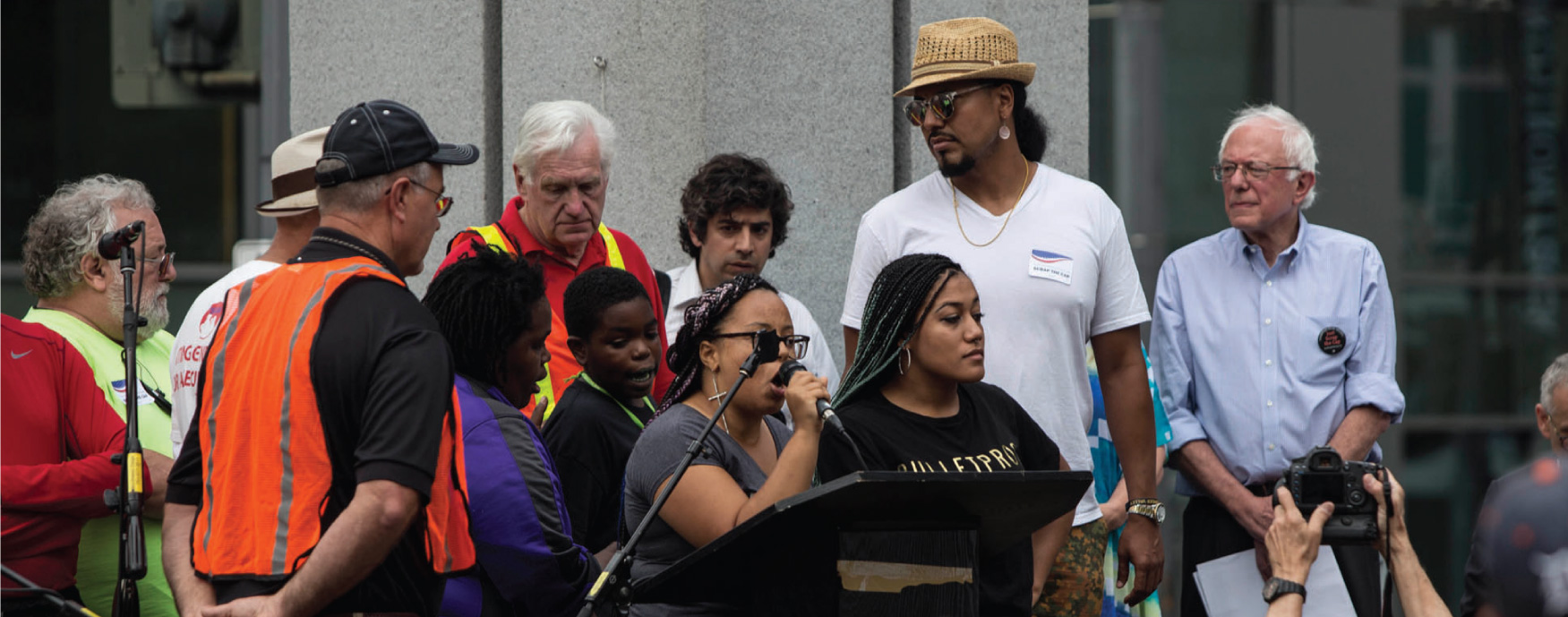
Democratic primary candidate Bernie Sanders arrived in Seattle on August 8, 2015, to give a speech at a rally to promote his presidential campaign. Instead, the rally was interrupted—and eventually co-opted—by activists for Black Lives Matter (Figure 5.1).[1] Why did the group risk alienating Democratic voters by preventing Sanders from speaking? Because Black Lives Matter had been trying to raise awareness of the treatment of Black citizens in the United States, and the media has the power to elevate such issues.[2] While some questioned its tactics, the organization’s move underscores how important the media are to gaining recognition, and the lengths to which organizations are willing to go to get media attention.[3]
Freedom of the press and an independent media are important dimensions of a liberal society and a necessary part of a healthy democracy. “No government ought to be without censors,” said Thomas Jefferson, “and where the press is free, no one ever will.”[4] What does it mean to have a free news media? What regulations limit what media can do? How do the media contribute to informing citizens and monitoring politicians and the government, and how do we measure their impact? This chapter explores these and other questions about the role of the media in the United States.
5.2 What Is the Media?
LEARNING OUTCOMES
By the end of this section, you will be able to:
- Explain what the media are and how they are organized
- Describe the main functions of the media in a free society
- Compare different media formats and their respective audiences
Ours is an exploding media system. What started as print journalism was subsequently supplemented by radio coverage, then network television, followed by cable television. Now, with the addition of the Internet, blogs and social media—a set of applications or web platforms that allow users to immediately communicate with one another—give citizens a wide variety of sources for instant news of all kinds. The Internet also allows citizens to initiate public discussion by uploading images and video for viewing, such as videos documenting interactions between citizens and the police, for example. Provided we are connected digitally, we have a bewildering amount of choices for finding information about the world. In fact, some might say that compared to the tranquil days of the 1970s, when we might read the morning newspaper over breakfast and take in the network news at night, there are now too many choices in today’s increasingly complex world of information. This reality may make the news media all the more important to structuring and shaping narratives about U.S. politics. Or the proliferation of competing information sources like blogs and social media may actually weaken the power of the news media relative to the days when news media monopolized our attention.
Media Basics
The term media defines a number of different communication formats from television media, which share information through broadcast airwaves, to print media, which rely on printed documents. The collection of all forms of media that communicate information to the general public is called mass media, including television, print, radio, and Internet. One of the primary reasons citizens turn to the media is for news. We expect the media to cover important political and social events and information in a concise and neutral manner.
To accomplish its work, the media employs a number of people in varied positions. Journalists and reporters are responsible for uncovering news stories by keeping an eye on areas of public interest, like politics, business, and sports. Once a journalist has a lead or a possible idea for a story, they research background information and interview people to create a complete and balanced account. Editors work in the background of the newsroom, assigning stories, approving articles or packages, and editing content for accuracy and clarity. Publishers are people or companies that own and produce print or digital media. They oversee both the content and finances of the publication, ensuring the organization turns a profit and creates a high-quality product to distribute to consumers. Producers oversee the production and finances of visual media, like television, radio, and film.
The work of the news media differs from public relations, which is communication carried out to improve the image of companies, organizations, or candidates for office. Public relations is not a neutral information form. While journalists write stories to inform the public, a public relations spokesperson is paid to help an individual or organization get positive press. Public relations materials normally appear as press releases or paid advertisements in newspapers and other media outlets. Some less reputable publications, however, publish paid articles under the news banner, blurring the line between journalism and public relations.
Media Types
LINK TO LEARNING
*Watch this video to learn more about the power and influence of media in politics.
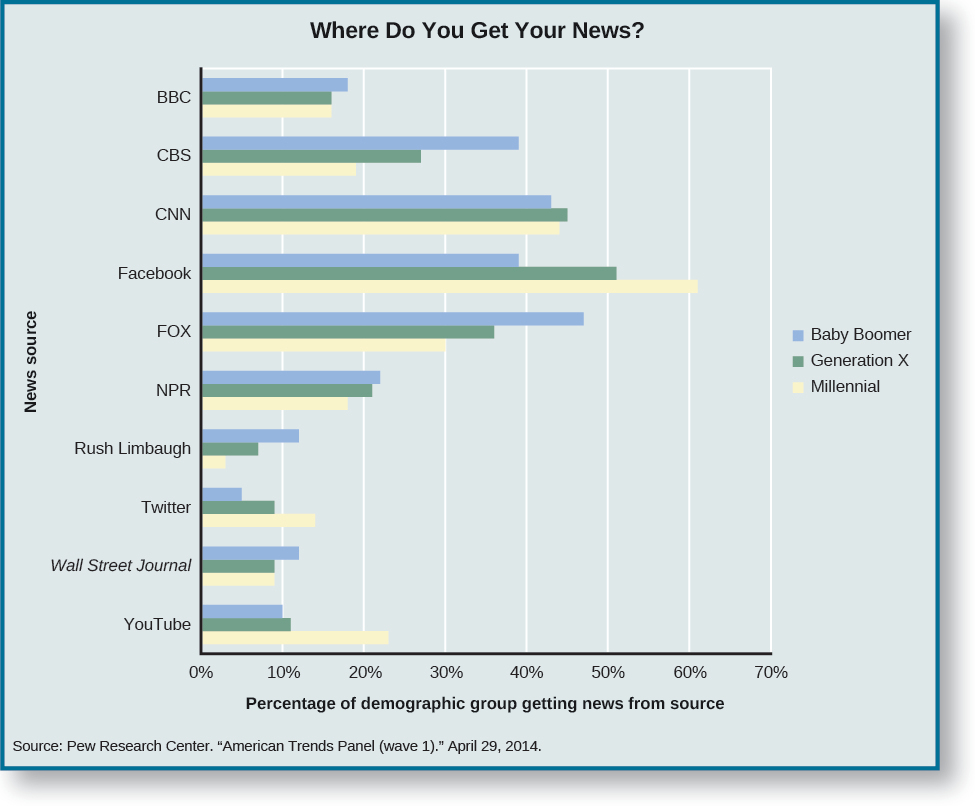
Each form of media has its own complexities and is used by different demographics. Millennials (those born between 1981 and 1996) and Generation Z (those born between 1997 and 2012) are more likely to get news and information from social media, such as Instagram, TikTok, Twitter, and YouTube, while Baby Boomers (born between 1946 and 1964) are most likely to get their news from television, either national broadcasts or local news (Figure 5.2).
Television alone offers viewers a variety of formats. Programming may be scripted, like dramas or comedies. It may be unscripted, like game shows or reality programs, or informative, such as news programming. Although most programs are created by a television production company, national networks—like CBS or NBC—purchase the rights to programs they distribute to local stations across the United States. Most local stations are affiliated with a national network corporation, and they broadcast national network programming to their local viewers.
Before the existence of cable and fiber optics, networks needed to own local affiliates to have access to the local station’s transmission towers. Towers have a limited radius, so each network needed an affiliate in each major city to reach viewers. While cable technology has lessened networks’ dependence on aerial signals, some viewers still use antennas and receivers to view programming broadcast from local towers.
Affiliates, by agreement with the networks, give priority to network news and other programming chosen by the affiliate’s national media corporation. Local affiliate stations are told when to air programs or commercials, and they diverge only to inform the public about a local or national emergency. For example, ABC affiliates broadcast the popular television show Black-ish at a specific time on a specific day. Should a fire threaten homes and businesses in a local area, the affiliate might preempt it to update citizens on the fire’s dangers and return to regularly scheduled programming after the danger has ended.
Most affiliate stations will show local news before and after network programming to inform local viewers of events and issues. Network news has a national focus on politics, international events, the economy, and more. Local news, on the other hand, is likely to focus on matters close to home, such as regional business, crime, sports, and weather.[5] The NBC Nightly News, for example, covers presidential campaigns and the White House or skirmishes between North Korea and South Korea, while the NBC affiliate in Los Angeles (KNBC-TV) and the NBC affiliate in Dallas (KXAS-TV) report on the governor’s activities or weekend festivals in the region.
Cable programming offers national networks a second method to directly reach local viewers. As the name implies, cable stations transmit programming directly to a local cable company hub, which then sends the signals to homes through coaxial or fiber optic cables. Because cable does not broadcast programming through the airwaves, cable networks can operate across the nation directly without local affiliates. Instead, they purchase broadcasting rights for the cable stations they believe their viewers want. For this reason, cable networks often specialize in different types of programming.
The Cable News Network (CNN) was the first news station to take advantage of this specialized format, creating a 24-hour news station with live coverage and interview programs. Other news stations quickly followed, such as MSNBC and FOX News. A viewer might tune in to Nickelodeon and catch family programs and movies or watch ESPN to catch up with the latest baseball or basketball scores. The Cable-Satellite Public Affairs Network, known better as C-SPAN, now has three channels covering Congress, the president, the courts, and matters of public interest.
Cable and satellite providers also offer on-demand programming for most stations. Citizens can purchase cable, satellite, and Internet subscription services (like Netflix) to find programs to watch instantly, without being tied to a schedule. Initially, on-demand programming was limited to rebroadcasting old content and was commercial-free. Yet many networks and programs now allow their new programming to be aired within a day or two of its initial broadcast. In return they often add commercials the user cannot fast-forward or avoid. Thus networks expect advertising revenues to increase.[6]
The on-demand nature of the Internet has created many opportunities for news outlets. While early media providers were those who could pay the high cost of printing or broadcasting, modern media require just a URL and ample server space. The ease of online publication has made it possible for more niche media outlets to form. The websites of the New York Times and other newspapers often focus on matters affecting the United States, while channels like BBC America present world news. FOX News presents political commentary and news in a conservative vein, while the Internet site Daily Kos offers a liberal perspective on the news. Politico.com is perhaps the leader in niche journalism.
Unfortunately, the proliferation of online news has also increased the amount of poorly written material with little editorial oversight, and readers must be cautious when reading Internet news sources. Sites like Buzzfeed allow members to post articles without review by an editorial board, leading to articles of varied quality and accuracy. The Internet has also made publication speed a consideration for professional journalists. No news outlet wants to be the last to break a story, and the rush to publication often leads to typographical and factual errors. Even large news outlets, like the Associated Press, have published articles with errors in their haste to get a story out.
The Internet also facilitates the flow of information through social media, which allows users to instantly communicate with one another and share with audiences that can grow exponentially. Facebook and Twitter have millions of daily users. Social media changes more rapidly than the other media formats. While people in many different age groups use sites like Facebook, Twitter, and YouTube, other sites like Snapchat and TikTok appeal mostly to younger users. The platforms also serve different functions. Tumblr and Reddit facilitate discussion that is topic-based and controversial, while Instagram is mostly social. A growing number of these sites also allow users to comment anonymously, leading to increases in threats and abuse. The 2020 QAnon conspiracy, which absurdly alleged a connection between liberal elites and child sex trafficking, was promulgated in part through social media posts on many platforms, including Facebook and Twitter. Both companies attempted to kick QAnon off their platforms.[7]
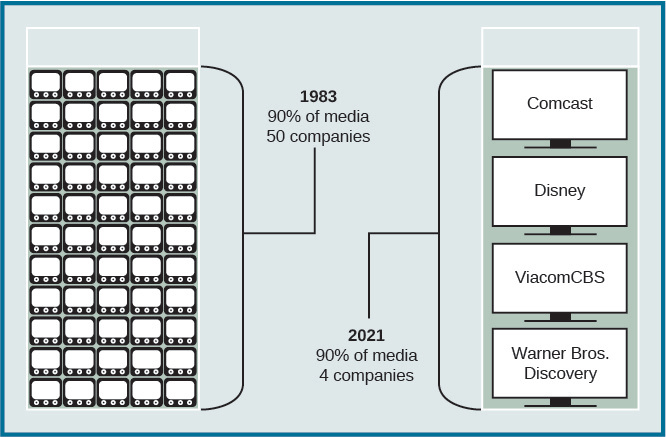
Regardless of where we get our information, the various media avenues available today, versus years ago, make it much easier for everyone to be engaged. The question is: Who controls the media we rely on? Most media are controlled by a limited number of conglomerates. A conglomerate is a corporation made up of a number of companies, organizations, and media networks. In the 1980s, more than fifty companies owned the majority of television and radio stations and networks. By 2011, six conglomerates controlled most of the broadcast media in the United States: CBS Corporation, Comcast, Time Warner, 21st Century Fox (formerly News Corporation), Viacom, and The Walt Disney Company (Figure 5.3).[8]
Newspapers too have experienced the pattern of concentrated ownership. Gannett Company, while also owning television media, holds a large number of newspapers and news magazines in its control. Many of these were acquired quietly, without public notice or discussion. Gannett’s 2013 acquisition of publishing giant A.H. Belo Corporation caused some concern and news coverage, however. The sale would have allowed Gannett to own both an NBC and a CBS affiliate in St. Louis, Missouri, giving it control over programming and advertising rates for two competing stations. The U.S. Department of Justice required Gannett to sell the station owned by Belo to ensure market competition and multi-ownership in St. Louis.[9]
LINK TO LEARNING
If you are concerned about the lack of variety in the media and the market dominance of media conglomerates, the non-profit organization, Free Press, tracks and promotes open communication.
These changes in the format and ownership of media raise the question whether the media still operate as an independent source of information. Is it possible that corporations and CEOs now control the information flow, making profit more important than the impartial delivery of information? The reality is that media outlets, whether newspaper, television, radio, or Internet, are businesses. They have expenses and must raise revenues. Yet at the same time, we expect the media to entertain, inform, and alert us without bias. They must provide some public services, while following laws and regulations. Reconciling these goals may not always be possible.
Functions of the Media
The media exist to fill a number of functions. Whether the medium is a newspaper, a radio, or a television newscast, a corporation behind the scenes must bring in revenue and pay for the cost of the product. Revenue comes from advertising and sponsors, like McDonald’s, Ford Motor Company, and other large corporations. But corporations will not pay for advertising if there are no viewers or readers. So all programs and publications need to entertain, inform, or interest the public and maintain a steady stream of consumers. In the end, what attracts viewers and advertisers is what survives.
The media are also watchdogs of society and of public officials. Some refer to the media as the fourth estate, with the branches of government being the first three estates and the media equally participating as the fourth. This role helps maintain democracy and keeps the government accountable for its actions, even if a branch of the government is reluctant to open itself to public scrutiny. As much as social scientists would like citizens to be informed and involved in politics and events, the reality is that we are not. So the media, especially journalists, keep an eye on what is happening and sounds an alarm when the public needs to pay attention.[10]
The media also engages in agenda setting, which is the act of choosing which issues or topics deserve public discussion. For example, in the early 1980s, famine in Ethiopia drew worldwide attention, which resulted in increased charitable giving to the country. Yet the famine had been going on for a long time before it was discovered by western media. Even after the discovery, it took video footage to gain the attention of the British and U.S. populations and start the aid flowing.[11] Today, numerous examples of agenda setting show how important the media are when trying to prevent further emergencies or humanitarian crises. In the spring of 2015, when the Dominican Republic was preparing to exile Haitians and undocumented (or under documented) residents, major U.S. news outlets remained silent. However, once the story had been covered several times by Al Jazeera, a state-funded broadcast company based in Qatar, ABC, the New York Times, and other network outlets followed.[12] With major network coverage came public pressure for the U.S. government to act on behalf of the Haitians.[13]
INSIDER PERSPECTIVE
Christiane Amanpour on “What Should Be News?”
The media are our connection to the world. Some events are too big to ignore, yet other events, such as the destruction of Middle Eastern monuments or the plight of foreign refugees, are far enough from our shores that they often go unnoticed. What we see is carefully selected, but who decides what should be news?

As the chief international correspondent for CNN, Christiane Amanpour is one media decision maker (Figure 5.4). Over the years, Amanpour has covered events around the world from war to genocide. In an interview with Oprah Winfrey, Amanpour explains that her duty, and that of other journalists, is to make a difference in the world. To do that, “we have to educate people and use the media responsibly.”[14] Journalists cannot passively sit by and wait for stories to find them. “Words have consequences: the stories we decide to do, the stories we decide not to do . . . it all matters.”[15]
As Amanpour points out, journalists are often “on the cutting edge of reform,” so if they fail to shed light on events, the results can be tragic. One of her biggest regrets was not covering the genocide in Rwanda in 1994, which cost nearly a million lives. She said the media ignored the event in favor of covering democratic elections in South Africa and a war in Bosnia, and ultimately she believes the media failed the people. “If we don’t respect our profession and we see it frittering away into the realm of triviality and sensationalism, we’ll lose our standing,” she said. “That won’t be good for democracy. A thriving society must have a thriving press.”
This feeling of responsibility extends to covering moral topics, like genocide. Amanpour feels there shouldn’t be equal time given to all sides. “I’m not just a stenographer or someone with a megaphone; when I report, I have to do it in context, to be aware of the moral conundrum. . . . I have to be able to draw a line between victim and aggressor.”
Amanpour also believes the media should cover more. When given the full background and details of events, society pays attention to the news. “Individual Americans had an incredible reaction to the [2004 Indian Ocean] tsunami—much faster than their government’s reaction,” she said. “Americans are a very moral and compassionate people who believe in extending a helping hand, especially when they get the full facts instead of one-minute clips.” If the news fulfills its responsibility, as she sees it, the world can show its compassion and help promote freedom.
Why does Amanpour believe the press has a responsibility to report all that they see? Are there situations in which it is acceptable to display partiality in reporting the news? Why or why not?
Before the Internet, traditional media determined whether citizen photographs or video footage would become “news.” In 1991, a private citizen’s camcorder footage showed four police officers beating an African American motorist named Rodney King in Los Angeles. After appearing on local independent television station, KTLA-TV, and then the national news, the event began a national discussion on police brutality and ignited riots in Los Angeles.[16] The agenda-setting power of traditional media has begun to be appropriated by social media and smartphones, however. Twitter, Facebook, YouTube, and other Internet sites allow witnesses to instantly upload images and accounts of events and forward the link to friends. Some uploads go viral and attract the attention of the mainstream media, but large network newscasts and major newspapers are still more powerful at initiating or changing a discussion.
The media also promote the public good by offering a platform for public debate and improving citizen awareness. Network news informs the electorate about national issues, elections, and international news. The New York Times, Los Angeles Times, NBC Nightly News, and other outlets make sure voters can easily find out what issues affect the nation. Is terrorism on the rise? Is the dollar weakening? The network news hosts national debates during presidential elections, broadcasts major presidential addresses, and interviews political leaders during times of crisis. Cable news networks now provide coverage of all these topics as well.
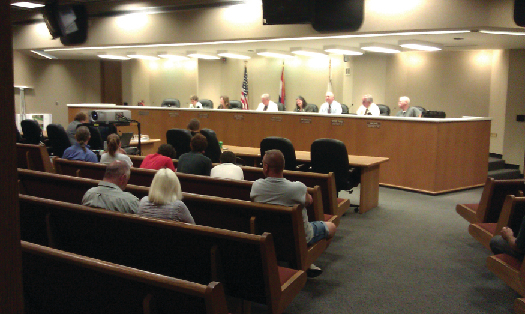
Local news has a larger job, despite small budgets and fewer resources (Figure 5.5). Local government and local economic policy have a strong and immediate effect on citizens. Is the city government planning on changing property tax rates? Will the school district change the way Common Core tests are administered? When and where is the next town hall meeting or public forum to be held? Local and social media provide a forum for protest and discussion of issues that matter to the community.
LINK TO LEARNING
Want a snapshot of local and state political and policy news? The magazine Governing keeps an eye on what is happening in each state, offering articles and analysis on events that occur across the country.
While journalists reporting the news try to present information in an unbiased fashion, sometimes the public seeks opinion and analysis of complicated issues that affect various populations differently, like healthcare reform and the Affordable Care Act. This type of coverage may come in the form of editorials, commentaries, Op-Ed columns, and blogs. These forums allow the editorial staff and informed columnists to express a personal belief and attempt to persuade. If opinion writers are trusted by the public, they have influence.
Walter Cronkite, reporting from Vietnam, had a loyal following. In a broadcast following the Tet Offensive in 1968, Cronkite expressed concern that the United States was mired in a conflict that would end in a stalemate.[17] His coverage was based on opinion after viewing the war from the ground.[18] Although the number of people supporting the war had dwindled by this time, Cronkite’s commentary bolstered opposition. Like editorials, commentaries contain opinion and are often written by specialists in a field. Larry Sabato, a prominent political science professor at the University of Virginia, occasionally writes his thoughts for the New York Times. These pieces are based on his expertise in politics and elections.[19] Blogs offer more personalized coverage, addressing specific concerns and perspectives for a limited group of readers. As of 2021, the most popular blog on U.S. politics was The Daily Kos, a liberal blog with 25 million followers each month.[20]
5.3 The Evolution of the Media
LEARNING OUTCOMES
By the end of this section, you will be able to:
- Discuss the history of major media formats
- Compare important changes in media types over time
- Explain how citizens learn political information from the media
The evolution of the media has been fraught with concerns and problems. Accusations of mind control, bias, and poor quality have been thrown at the media on a regular basis. Yet the growth of communications technology allows people today to find more information more easily than any previous generation. Mass media can be print, radio, television, or Internet news. They can be local, national, or international. They can be broad or limited in their focus. The choices are tremendous.
Print Media
Early news was presented to local populations through the print press. While several colonies had printers and occasional newspapers, high literacy rates combined with the desire for self-government made Boston a perfect location for the creation of a newspaper, and the first continuous press was started there in 1704.[21] Newspapers spread information about local events and activities. The Stamp Tax of 1765 raised costs for publishers, however, leading several newspapers to fold under the increased cost of paper. The repeal of the Stamp Tax in 1766 quieted concerns for a short while, but editors and writers soon began questioning the right of the British to rule over the colonies. Newspapers took part in the effort to inform citizens of British misdeeds and incite attempts to revolt. Readership across the colonies increased to nearly forty thousand homes (among a total population of two million), and daily papers sprang up in large cities.[22]
Although newspapers united for a common cause during the Revolutionary War, the divisions that occurred during the Constitutional Convention and the United States’ early history created a change. The publication of the Federalist Papers, as well as the Anti-Federalist Papers, in the 1780s, moved the nation into the party press era, in which partisanship and political party loyalty dominated the choice of editorial content. One reason was cost. Subscriptions and advertisements did not fully cover printing costs, and political parties stepped in to support presses that aided the parties and their policies. Papers began printing party propaganda and messages, even publicly attacking political leaders like George Washington. Despite the antagonism of the press, Washington and several other founders felt that freedom of the press was important for creating an informed electorate. Indeed, freedom of the press is enshrined in the Bill of Rights in the first amendment.
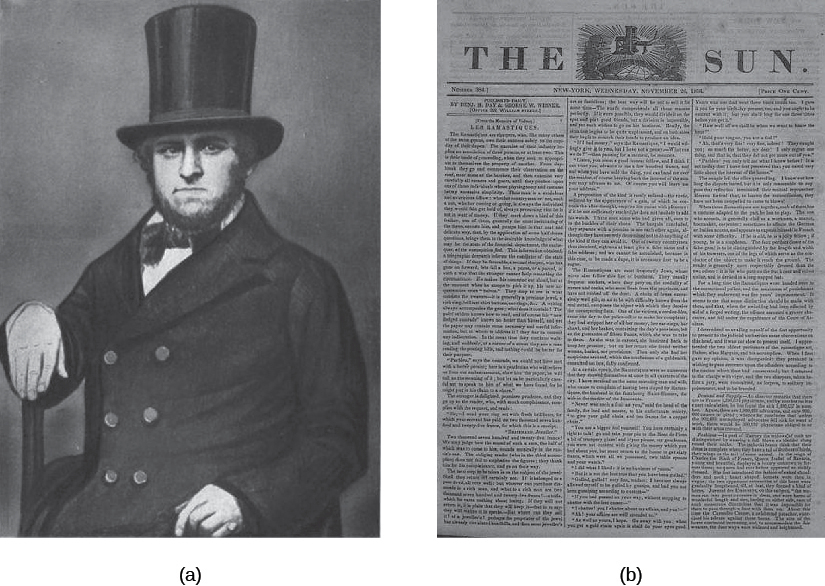
Between 1830 and 1860, machines and manufacturing made the production of newspapers faster and less expensive. Benjamin Day’s paper, the New York Sun, used technology like the linotype machine to mass-produce papers (Figure 5.6). Roads and waterways were expanded, decreasing the costs of distributing printed materials to subscribers. New newspapers popped up. The popular penny press papers and magazines contained more gossip than news, but they were affordable at a penny per issue. Over time, papers expanded their coverage to include racing, weather, and educational materials. By 1841, some news reporters considered themselves responsible for upholding high journalistic standards, and under the editor (and politician) Horace Greeley, the New-York Tribune became a nationally respected newspaper. By the end of the Civil War, more journalists and newspapers were aiming to meet professional standards of accuracy and impartiality.[23]
Yet readers still wanted to be entertained. Joseph Pulitzer and the New York World gave them what they wanted. The tabloid-style paper included editorial pages, cartoons, and pictures, while the front-page news was sensational and scandalous. This style of coverage became known as yellow journalism. Ads sold quickly thanks to the paper’s popularity, and the Sunday edition became a regular feature of the newspaper. As the New York World’s circulation increased, other papers copied Pulitzer’s style in an effort to sell papers. Competition between newspapers led to increasingly sensationalized covers and crude issues.
In 1896, Adolph Ochs purchased the New York Times with the goal of creating a dignified newspaper that would provide readers with important news about the economy, politics, and the world rather than gossip and comics. The New York Times brought back the informational model, which exhibits impartiality and accuracy and promotes transparency in government and politics. With the arrival of the Progressive Era, the media began muckraking: the writing and publishing of news coverage that exposed corrupt business and government practices. Investigative work like Upton Sinclair’s serialized novel The Jungle led to changes in the way industrial workers were treated and local political machines were run. The Pure Food and Drug Act and other laws were passed to protect consumers and employees from unsafe food processing practices. Local and state government officials who participated in bribery and corruption became the centerpieces of exposés.
Some muckraking journalism still appears today, and the quicker movement of information through the system would seem to suggest an environment for yet more investigative work and the punch of exposés than in the past. However, at the same time there are fewer journalists being hired than there used to be. The scarcity of journalists and the lack of time to dig for details in a 24-hour, profit-oriented news model make investigative stories rare.[24] There are two potential concerns about the decline of investigative journalism in the digital age. First, one potential shortcoming is that the quality of news content will become uneven in depth and quality, which could lead to a less informed citizenry. Second, if investigative journalism in its systematic form declines, then the cases of wrongdoing that are the objects of such investigations would have a greater chance of going on undetected.
In the twenty-first century, newspapers have struggled to stay financially stable. Print media earned $46 billion from ads in 2012, but only $20.5 billion from ads in 2020.[25] Given the countless alternate forms of news, many of which are free, newspaper subscriptions have fallen. Advertising and especially classified ad revenue dipped. Many newspapers now maintain both a print and an Internet presence in order to compete for readers. The rise of free news blogs, such as the Huffington Post, have made it difficult for newspapers to force readers to purchase online subscriptions to access material they place behind a digital paywall. Some local newspapers, in an effort to stay visible and profitable, have turned to social media, like Facebook and Twitter. Stories can be posted and retweeted, allowing readers to comment and forward material.[26] Yet, overall, newspapers have adapted, becoming leaner—though less thorough and investigative—versions of their earlier selves. However, despite this adaptation, one-fifth of small-town newspapers have folded. The fear is that Americans will know less about their community as a result.[27] This drop-off in available news has also occurred at the state level, as state legislative press corps have shrunk considerably. Many surviving small-town papers have been acquired by larger conglomerates. National newspapers have done comparatively better, although consolidation has occurred there to some degree, too.[28]
Radio
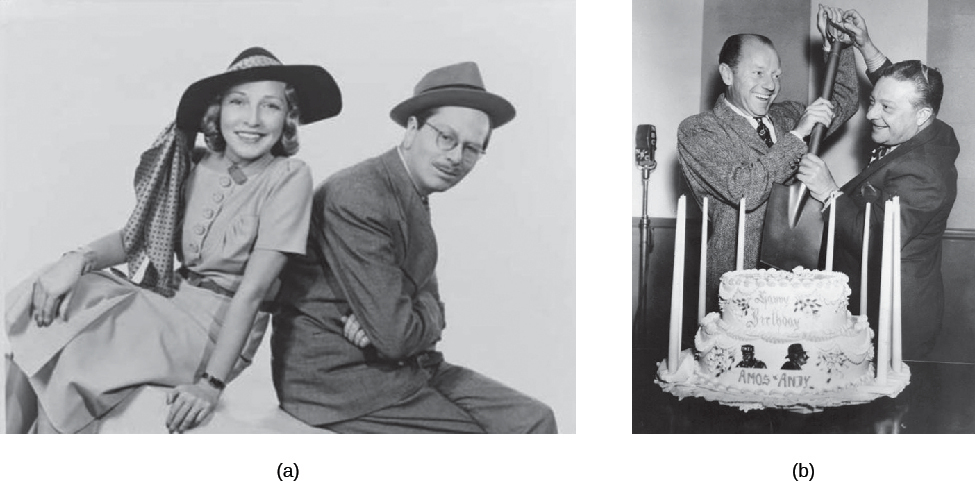
Radio news made its appearance in the 1920s. The National Broadcasting Company (NBC) and the Columbia Broadcasting System (CBS) began running sponsored news programs and radio dramas. Comedy programs, such as Amos ’n’ Andy, The Adventures of Gracie, and Easy Aces, also became popular during the 1930s, as listeners were trying to find humor during the Depression (Figure 5.7). Talk shows, religious shows, and educational programs followed, and by the late 1930s, game shows and quiz shows were added to the airwaves. Almost 83 percent of households had a radio by 1940, and most tuned in regularly.[29]
Not just something to be enjoyed by those in the city, the proliferation of the radio brought communications to rural America as well. News and entertainment programs were also targeted to rural communities. WLS in Chicago provided the National Farm and Home Hour and the WLS Barn Dance. WSM in Nashville began to broadcast the live music show called the Grand Ole Opry, which is still broadcast every week and is the longest live broadcast radio show in U.S. history.[30]
As radio listenership grew, politicians realized that the medium offered a way to reach the public in a personal manner. Warren Harding was the first president to regularly give speeches over the radio. President Herbert Hoover used radio as well, mainly to announce government programs on aid and unemployment relief.[31] Yet it was Franklin D. Roosevelt who became famous for harnessing the political power of radio. On entering office in March 1933, President Roosevelt needed to quiet public fears about the economy and prevent people from removing their money from the banks. He delivered his first radio speech eight days after assuming the presidency:
“My friends: I want to talk for a few minutes with the people of the United States about banking—to talk with the comparatively few who understand the mechanics of banking, but more particularly with the overwhelming majority of you who use banks for the making of deposits and the drawing of checks. I want to tell you what has been done in the last few days, and why it was done, and what the next steps are going to be.”[32]
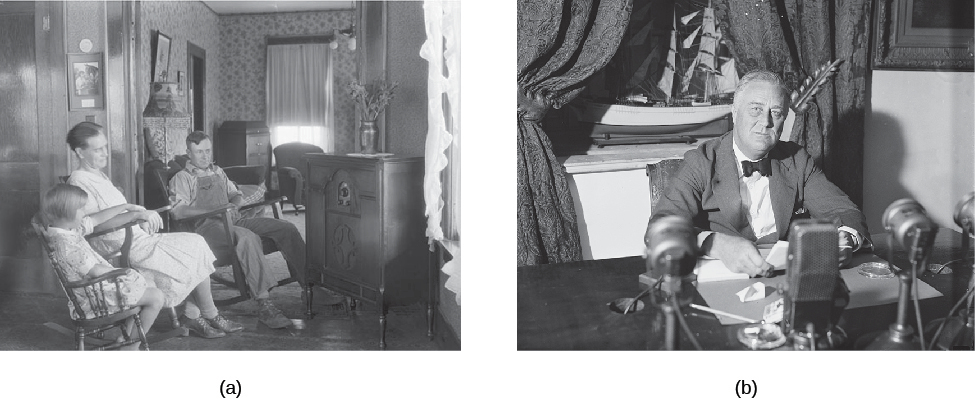
Roosevelt spoke directly to the people and addressed them as equals. One listener described the chats as soothing, with the president acting like a father, sitting in the room with the family, cutting through the political nonsense and describing what help he needed from each family member.[33]Roosevelt would sit down and explain his ideas and actions directly to the people on a regular basis, confident that he could convince voters of their value.[34] His speeches became known as “fireside chats” and formed an important way for him to promote his New Deal agenda (Figure 5.8). Roosevelt’s combination of persuasive rhetoric and the media allowed him to expand both the government and the presidency beyond their traditional roles.[35]
During this time, print news still controlled much of the information flowing to the public. Radio news programs were limited in scope and number. But in the 1940s the German annexation of Austria, conflict in Europe, and World War II changed radio news forever. The need and desire for frequent news updates about the constantly evolving war made newspapers, with their once-a-day printing, too slow. People wanted to know what was happening, and they wanted to know immediately. Although initially reluctant to be on the air, reporter Edward R. Murrow of CBS began reporting live about Germany’s actions from his posts in Europe. His reporting contained news and some commentary, and even live coverage during Germany’s aerial bombing of London. To protect covert military operations during the war, the White House had placed guidelines on the reporting of classified information, making a legal exception to the First Amendment’s protection against government involvement in the press. Newscasters voluntarily agreed to suppress information, such as about the development of the atomic bomb and movements of the military, until after the events had occurred.[36]
The number of professional and amateur radio stations grew quickly. Initially, the government exerted little legislative control over the industry. Stations chose their own broadcasting locations, signal strengths, and frequencies, which sometimes overlapped with one another or with the military, leading to tuning problems for listeners. The Radio Act (1927) created the Federal Radio Commission (FRC), which made the first effort to set standards, frequencies, and license stations. The Commission was under heavy pressure from Congress, however, and had little authority. The Communications Act of 1934 ended the FRC and created the Federal Communications Commission (FCC), which continued to work with radio stations to assign frequencies and set national standards, as well as oversee other forms of broadcasting and telephones. The FCC regulates interstate communications to this day. For example, it prohibits the use of certain profane words during certain hours on public airwaves.
Prior to WWII, radio frequencies were broadcast using amplitude modulation (AM). After WWII, frequency modulation (FM) broadcasting, with its wider signal bandwidth, provided clear sound with less static and became popular with stations wanting to broadcast speeches or music with high-quality sound. While radio’s importance for distributing news waned with the increase in television usage, it remained popular for listening to music, educational talk shows, and sports broadcasting. Talk stations began to gain ground in the 1980s on both AM and FM frequencies, restoring radio’s importance in politics. By the 1990s, talk shows had gone national, showcasing broadcasters like Rush Limbaugh and Don Imus.
In 1990, Sirius Satellite Radio began a campaign for FCC approval of satellite radio. The idea was to broadcast digital programming from satellites in orbit, eliminating the need for local towers. By 2001, two satellite stations had been approved for broadcasting. Satellite radio has greatly increased programming with many specialized offerings, such as channels dedicated to particular artists. It is generally subscription-based and offers a larger area of coverage, even to remote areas such as deserts and oceans. Satellite programming is also exempt from many of the FCC regulations that govern regular radio stations. Howard Stern, for example, was fined more than $2 million while on public airwaves, mainly for his sexually explicit discussions.[37] Stern moved to Sirius Satellite in 2006 and has since been free of oversight and fines.
In a related vein, which speaks to the blurring of radio with the internet, is the explosion in podcasting. These audio shows, which are usually original but can be recorded versions of existing radio programs, explore a variety of topics and are enjoyed by millions of people around the world. They are especially popular for those who commute to and from work, but can be enjoyed anywhere, anytime. Total U.S. podcast listeners are a whopping 106.7 million, with 77.9 million listening to a podcast at least once per week. According to Business Insider: "A proliferation of shows, involvement from celebrity talent, investment from large companies like Spotify, and the spread of technologies that boost awareness, like smart speakers, have all helped podcast growth."[38] Podcasts with celebrity hosts include those offered by Anna Faris, Ricky Gervais and Stephen Merchant, and John Oliver.[39]
Television
Television combined the best attributes of radio and pictures and changed media forever. The first official broadcast in the United States was President Franklin Roosevelt’s speech at the opening of the 1939 World’s Fair in New York. The public did not immediately begin buying televisions, but coverage of World War II changed their minds. CBS reported on war events and included pictures and maps that enhanced the news for viewers. By the 1950s, the price of television sets had dropped, more televisions stations were being created, and advertisers were buying up spots.
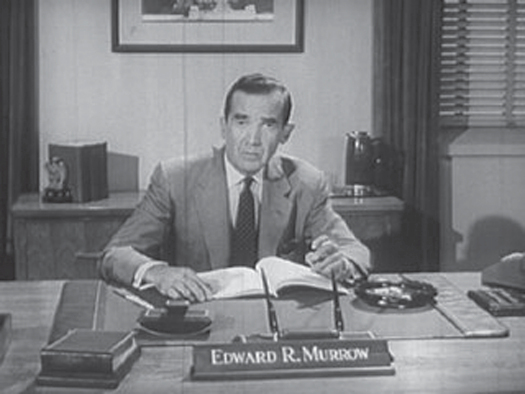
As on the radio, quiz shows and games dominated the television airwaves. But when Edward R. Murrow made the move to television in 1951 with his news show See It Now, television journalism gained its foothold (Figure 5.9). As television programming expanded, more channels were added. Networks such as ABC, CBS, and NBC began nightly newscasts, and local stations and affiliates followed suit.
Even more than radio, television allows politicians to reach out and connect with citizens and voters in deeper ways. Before television, few voters were able to see a president or candidate speak or answer questions in an interview. Now everyone can decode body language and tone to decide whether candidates or politicians are sincere. Presidents can directly convey their anger, sorrow, or optimism during addresses.
The first television advertisements, run by presidential candidates Dwight D. Eisenhower and Adlai Stevenson in the early 1950s, were mainly radio jingles with animation or short question-and-answer sessions. In 1960, John F. Kennedy’s campaign used a Hollywood-style approach to promote his image as young and vibrant. The Kennedy campaign ran interesting and engaging ads, featuring Kennedy, his wife Jacqueline, and everyday citizens who supported him.
Television was also useful to combat scandals and accusations of impropriety. Republican vice presidential candidate Richard Nixon used a televised speech in 1952 to address accusations that he had taken money from a political campaign fund illegally. Nixon laid out his finances, investments, and debts and ended by saying that the only election gift the family had received was a cocker spaniel the children named Checkers.[40] The “Checkers speech” was remembered more for humanizing Nixon than for proving he had not taken money from the campaign account. Yet it was enough to quiet accusations. Democratic vice presidential nominee Geraldine Ferraro similarly used television to answer accusations in 1984, holding a televised press conference to answer questions for over two hours about her husband’s business dealings and tax returns.[41]
In addition to television ads, the 1960 election also featured the first televised presidential debate. By that time most households had a television. Kennedy’s careful grooming and practiced body language allowed viewers to focus on his presidential demeanor. His opponent, Richard Nixon, was still recovering from a severe case of the flu. While Nixon’s substantive answers and debate skills made a favorable impression on radio listeners, viewers’ reaction to his sweaty appearance and obvious discomfort demonstrated that live television had the potential to make or break a candidate.[42] In 1964, Lyndon B. Johnson was ahead in the polls, and he let Barry Goldwater’s campaign know he did not want to debate.[43] Nixon, who ran for president again in 1968 and 1972, declined to debate. Then in 1976, President Gerald Ford, who was behind in the polls, invited Jimmy Carter to debate, and televised debates became a regular part of future presidential campaigns.[44]
LINK TO LEARNING
Between the 1960s and the 1990s, presidents often used television to reach citizens and gain support for policies. When they made speeches, the networks and their local affiliates carried them. With few independent local stations available, a viewer had little alternative but to watch. During this “Golden Age of Presidential Television,” presidents had a strong command of the media.[45]
Some of the best examples of this power occurred when presidents used television to inspire and comfort the population during a national emergency. These speeches aided in the “rally ’round the flag” phenomenon, which occurs when a population feels threatened and unites around the president.[46] During these periods, presidents may receive heightened approval ratings, in part due to the media’s decision about what to cover.[47] In 1995, President Bill Clinton comforted and encouraged the families of the employees and children killed at the bombing of the Oklahoma City Federal Building. Clinton reminded the nation that children learn through action, and so we must speak up against violence and face evil acts with good acts.[48]
Following the terrorist attacks in New York and Washington on September 11, 2001, President George W. Bush’s bullhorn speech from the rubble of Ground Zero in New York similarly became a rally. Bush spoke to the workers and first responders and encouraged them, but his short speech became a viral clip demonstrating the resilience of New Yorkers and the anger of a nation.[49] He told New Yorkers, the country, and the world that Americans could hear the frustration and anguish of New York, and that the terrorists would soon hear the United States (Figure 5.10).
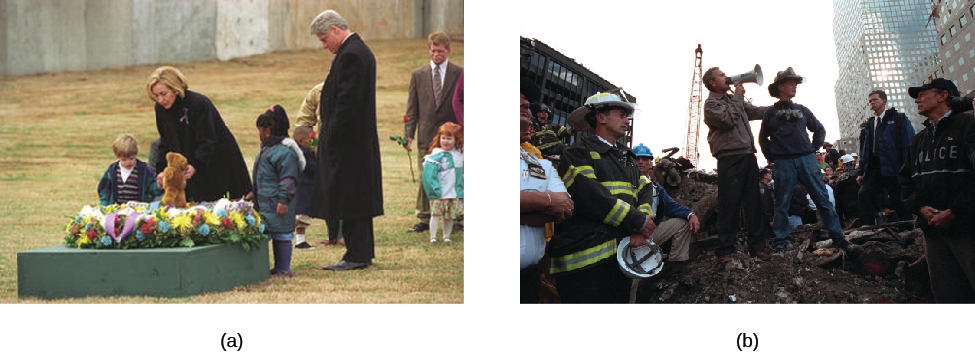
Following their speeches, both presidents also received a bump in popularity. Clinton’s approval rating rose from 46 to 51 percent, and Bush’s from 51 to 90 percent.[50]
New Media Trends
The invention of cable in the 1980s and the expansion of the Internet in the 2000s opened up more options for media consumers than ever before. Viewers can watch nearly anything at the click of a button, bypass commercials, and record programs of interest. The resulting saturation, or inundation of information, may lead viewers to abandon the news entirely or become more suspicious and fatigued about politics.[51] This effect, in turn, also changes the president’s ability to reach out to citizens. For example, viewership of the president’s annual State of the Union address has decreased over the years, from sixty-seven million viewers in 1993 to thirty-two million in 2015.[52] Citizens who want to watch reality television and movies can easily avoid the news, leaving presidents with no sure way to communicate with the public.[53] Other voices, such as those of talk show hosts and political pundits, now fill the gap.
Electoral candidates have also lost some media ground. In horse-race coverage, modern journalists analyze campaigns and blunders or the overall race, rather than interviewing the candidates or discussing their issue positions. Some argue that this shallow coverage is a result of candidates’ trying to control the journalists by limiting interviews and quotes. In an effort to regain control of the story, journalists begin analyzing campaigns without input from the candidates.[54] The use of social media by candidates provides a countervailing trend. President Trump’s hundreds of election tweets in 2016 are the stuff of legend. He continued to tweet with gusto as president and during the 2020 election, at times surprising even those who worked for him with the subject areas being tweeted about. The presidential tweet replaced the presidential press conference. Ultimately, in the wake of the January 6th insurrection at the U.S. Capitol, Twitter closed down Trump's account after he repeatedly raised topics and points that were of questionable veracity. Facebook and Instagram also followed suit with their own bans.[55]
MILESTONE
The First Social Media Candidate
When president-elect Barack Obama admitted an addiction to his Blackberry, the signs were clear: A new generation was assuming the presidency.[56] Obama’s use of technology was a part of life, not a campaign pretense. Perhaps for this reason, he was the first candidate to fully embrace social media.
While John McCain, the 2008 Republican presidential candidate, focused on traditional media to run his campaign, Obama did not. One of Obama’s campaign advisors was Chris Hughes, a cofounder of Facebook. The campaign allowed Hughes to create a powerful online presence for Obama, with sites on YouTube, Facebook, MySpace, and more. Podcasts and videos were available for anyone looking for information about the candidate. These efforts made it possible for information to be forwarded easily between friends and colleagues. It also allowed Obama to connect with a younger generation that was often left out of politics.
By Election Day, Obama’s skill with the web was clear: he had over two million Facebook supporters, while McCain had 600,000. Obama had 112,000 followers on Twitter, and McCain had only 4,600.[57]
Are there any disadvantages to a presidential candidate’s use of social media and the Internet for campaign purposes? Why or why not?
The availability of the Internet and social media has moved some control of the message back into the presidents’ and candidates’ hands. Politicians can now connect to the people directly, bypassing journalists. When Barack Obama’s minister, the Reverend Jeremiah Wright, was accused of making inflammatory racial sermons in 2008, Obama used YouTube to respond to charges that he shared Wright’s beliefs. The video drew more than seven million views.[58] To reach out to supporters and voters, the White House maintains a YouTube channel and a Facebook site, as did the recent Republican Speaker of the House of Representatives, John Boehner.
Social media, like Facebook, also placed journalism in the hands of citizens: citizen journalism occurs when citizens use their personal recording devices and cell phones to capture events and post them on the Internet. In 2012, citizen journalists caught both presidential candidates by surprise. Mitt Romney was taped by a bartender’s personal camera saying that 47 percent of Americans would vote for President Obama because they were dependent on the government.[59] Obama was recorded by a Huffington Post volunteer saying that some Midwesterners “cling to guns or religion or antipathy to people who aren’t like them” due to their frustration with the economy.[60] More recently, as Donald Trump was trying to close out the fall 2016 campaign, his musings about having his way with women were revealed on the infamous Billy Bush Access Hollywood tape. These statements became nightmares for the campaigns. As journalism continues to scale back and hire fewer professional writers in an effort to control costs, citizen journalism may become the new normal.[61]
Another shift in the new media is a change in viewers’ preferred programming. Younger viewers like there to be humor in their news. In terms of TV, the popularity of The Daily Show with Trevor Noah, the Late Show with Stephen Colbert, and Full Frontal with Samantha Bee demonstrate that news, even political news, can win young viewers if delivered well.[62] Such soft news presents news in an entertaining and approachable manner, painlessly introducing a variety of topics. While the depth or quality of reporting may be less than ideal, these shows can sound an alarm as needed to raise citizen awareness (Figure 5.11).[63] Some young viewers also get their fun news from social media networks, such as TikTok, Twitter, and Instagram.
LINK TO LEARNING
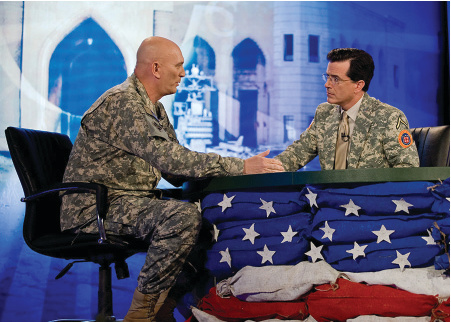
Viewers who watch or listen to programs like John Oliver’s Last Week Tonight are more likely to be aware and observant of political events and foreign policy crises than they would otherwise be.[64] They may view opposing party candidates more favorably because the low-partisan, friendly interview styles allow politicians to relax and be conversational rather than defensive.[65] Because viewers of political comedy shows watch the news frequently, they may, in fact, be more politically knowledgeable than citizens viewing national news. In two studies researchers interviewed respondents and asked knowledge questions about current events and situations. Viewers of The Daily Show scored more correct answers than viewers of news programming and news stations.[66] That being said, it is not clear whether the number of viewers is large enough to make a big impact on politics, nor do we know whether the learning is long term or short term.[67]
GET CONNECTED!
Becoming a Citizen Journalist
Local government and politics need visibility. College students need a voice. Why not become a citizen journalist? City and county governments hold meetings on a regular basis and students rarely attend. Yet issues relevant to students are often discussed at these meetings, like increases in street parking fines, zoning for off-campus housing, and tax incentives for new businesses that employ part-time student labor. Attend some meetings, ask questions, and write about the experience on your Facebook page. Create a blog to organize your reports or use Storify to curate a social media debate. If you prefer videography, create a YouTube channel to document your reports on current events, or Tweet your live video using Periscope or Meerkat.
Not interested in government? Other areas of governance that affect students are the university or college’s Board of Regents meetings. These cover topics like tuition increases, class cuts, and changes to student conduct policies. If your state requires state institutions to open their meetings to the public, consider attending. You might be the one to notify your peers of changes that affect them.
What local meetings could you cover? What issues are important to you and your peers?
5.4 Regulating the Media
LEARNING OUTCOMES
By the end of this section, you will be able to:
- Identify circumstances in which the freedom of the press is not absolute
- Compare the ways in which the government oversees and influences media programming
The Constitution gives Congress responsibility for promoting the general welfare. While it is difficult to define what this broad dictate means, Congress has used it to protect citizens from media content it deems inappropriate. Although the media are independent participants in the U.S. political system, their liberties are not absolute and there are rules they must follow.
Media and the First Amendment
The U.S. Constitution was written in secrecy. Journalists were neither invited to watch the drafting, nor did the framers talk to the press about their disagreements and decisions. Once it was finished, however, the Constitution was released to the public and almost all newspapers printed it. Newspaper editors also published commentary and opinion about the new document and the form of government it proposed. Early support for the Constitution was strong, and Anti-Federalists (who opposed it) argued that their concerns were not properly covered by the press. The eventual printing of The Federalist Papers, and the lesser-known Anti-Federalist Papers, fueled the argument that the press was vital to American democracy. It was also clear the press had the ability to affect public opinion and therefore public policy.[68]
The approval of the First Amendment, as a part of the Bill of Rights, demonstrated the framers’ belief that a free and vital press was important enough to protect. It said:
“Congress shall make no law respecting an establishment of religion, or prohibiting the free exercise thereof; or abridging the freedom of speech, or of the press; or the right of the people peaceably to assemble, and to petition the government for a redress of grievances.”
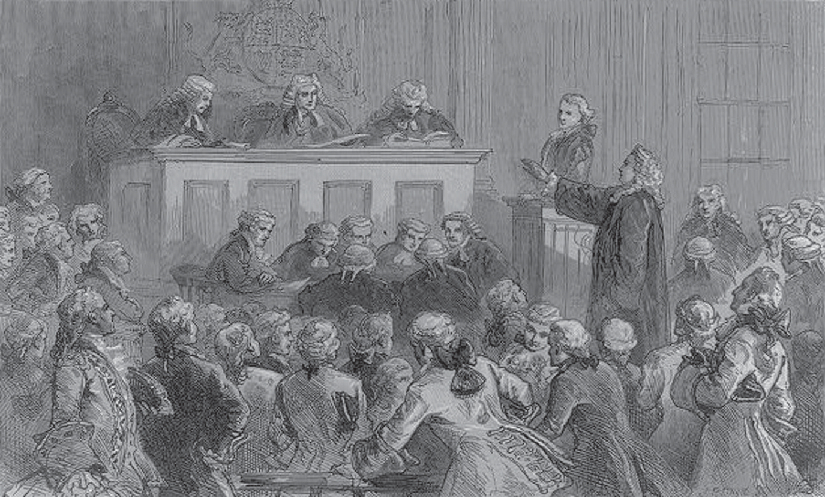
This amendment serves as the basis for the political freedoms of the United States, and freedom of the press plays a strong role in keeping democracy healthy. Without it, the press would not be free to alert citizens to government abuses and corruption. In fact, one of New York’s first newspapers, the New York Weekly Journal, began under John Peter Zenger in 1733 with the goal of routing corruption in the colonial government. After the colonial governor, William Cosby, had Zenger arrested and charged with seditious libel in 1735, his lawyers successfully defended his case and Zenger was found not guilty, affirming the importance of a free press in the colonies (Figure 5.12).
The media act as informants and messengers, providing the means for citizens to become informed and serving as a venue for citizens to announce plans to assemble and protest actions by their government. Yet the government must ensure the media are acting in good faith and not abusing their power. Like the other First Amendment liberties, freedom of the press is not absolute. The media have limitations on their freedom to publish and broadcast.
Slander and Libel
First, the media do not have the right to commit slander, speak false information with an intent to harm a person or entity, or libel, print false information with an intent to harm a person or entity. These acts constitute defamation of character that can cause a loss of reputation and income. The media do not have the right to free speech in cases of libel and slander because the information is known to be false. Yet on a weekly basis, newspapers and magazines print stories that are negative and harmful. How can they do this and not be sued?
First, libel and slander occur only in cases where false information is presented as fact. When editors or columnists write opinions, they are protected from many of the libel and slander provisions because they are not claiming their statements are facts. Second, it is up to the defamed individual or company to bring a lawsuit against the media outlet, and the courts have different standards depending on whether the claimant is a private or public figure. A public figure must show that the publisher or broadcaster acted in “reckless disregard” when submitting information as truth or that the author’s intent was malicious. This test goes back to the New York Times v. Sullivan (1964) case, in which a police commissioner in Alabama sued over inaccurate statements in a newspaper advertisement.[69] Because the commissioner was a public figure, the U.S. Supreme Court applied a stringent test of malice to determine whether the advertisement was libel; the court deemed it was not.
A private individual must make one of the above arguments or argue that the author was negligent in not making sure the information was accurate before publishing it. For this reason, newspapers and magazines are less likely to stray from hard facts when covering private individuals, yet they can be willing to stretch the facts when writing about politicians, celebrities, or public figures. But even stretching the truth can be costly for a publisher. In 2010, Star magazine published a headline, “Addiction Nightmare: Katie Drug Shocker,” leading readers to believe actress Katie Holmes was taking drugs. While the article in the magazine focuses on the addictive quality of Scientology sessions rather than drugs, the implication and the headline were different. Because drugs cause people to act erratically, directors might be less inclined to hire Holmes if she were addicted to drugs. Thus Holmes could argue that she had lost opportunity and income from the headline. While the publisher initially declined to correct the story, Holmes filed a $50 million lawsuit, and Star’s parent company American Media, Inc. eventually settled. Star printed an apology and made a donation to a charity on Holmes’ behalf.[70]
Classified Material
The media have only a limited right to publish material the government says is classified. If a newspaper or media outlet obtains classified material, or if a journalist is witness to information that is classified, the government may request certain material be redacted or removed from the article. In many instances, government officials and former employees give journalists classified paperwork in an effort to bring public awareness to a problem. If the journalist calls the White House or Pentagon for quotations on a classified topic, the president may order the newspaper to stop publication in the interest of national security. The courts are then asked to rule on what is censored and what can be printed.
The line between the people’s right to know and national security is not always clear. In 1971, the Supreme Court heard the Pentagon Papers case, in which the U.S. government sued the New York Times and the Washington Post to stop the release of information from a classified study of the Vietnam War. The Supreme Court ruled that while the government can impose prior restraint on the media, meaning the government can prevent the publication of information, that right is very limited. The court gave the newspapers the right to publish much of the study, but revelation of troop movements and the names of undercover operatives are some of the few approved reasons for which the government can stop publication or reporting.
During the second Persian Gulf War, FOX News reporter Geraldo Rivera convinced the military to embed him with a U.S. Army unit in Iraq to provide live coverage of its day-to-day activities. During one of the reports he filed while traveling with the 101st Airborne Division, Rivera had his camera operator record him drawing a map in the sand, showing where his unit was and using Baghdad as a reference point. Rivera then discussed where the unit would go next. Rivera was immediately removed from the unit and escorted from Iraq.[71] The military exercised its right to maintain secrecy over troop movements, stating that Rivera’s reporting had given away troop locations and compromised the safety of the unit. Rivera’s future transmissions and reporting were censored until he was away from the unit.
Media and FCC Regulations
LINK TO LEARNING
*Watch this video to learn about attempts to regulate media.
The liberties enjoyed by newspapers are overseen by the U.S. court system, while television and radio broadcasters are monitored by both the courts and a government regulatory commission.
The Radio Act of 1927 was the first attempt by Congress to regulate broadcast materials. The act was written to organize the rapidly expanding number of radio stations and the overuse of frequencies. But politicians feared that broadcast material would be obscene or biased. The Radio Act thus contained language that gave the government control over the quality of programming sent over public airwaves, and the power to ensure that stations maintained the public’s best interest.[72]
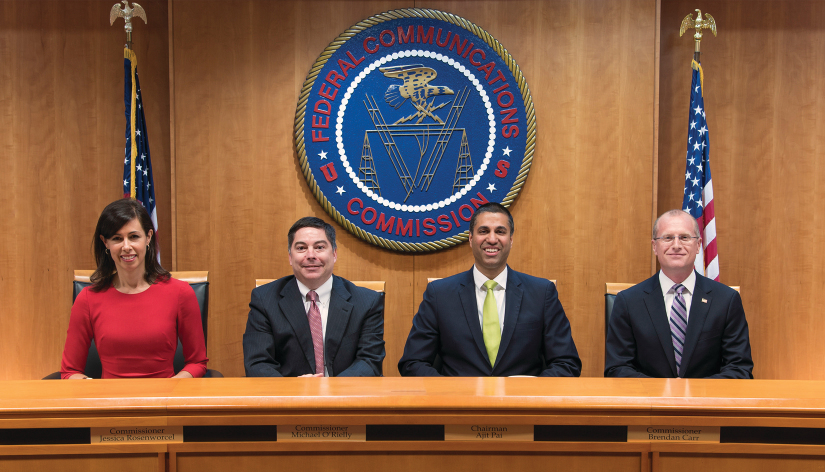
The Communications Act of 1934 replaced the Radio Act and created a more powerful entity to monitor the airwaves—a seven-member Federal Communications Commission (FCC) to oversee both radio and telephone communication. The FCC, which now has only five members (Figure 5.13), requires radio stations to apply for licenses, granted only if stations follow rules about limiting advertising, providing a public forum for discussion, and serving local and minority communities. With the advent of television, the FCC was given the same authority to license and monitor television stations. The FCC now also enforces ownership limits to avoid monopolies and censors materials deemed inappropriate. It has no jurisdiction over print media, mainly because print media are purchased and not broadcast.
LINK TO LEARNING
Concerned about something you heard or viewed? Would you like to file a complaint about an obscene radio program or place your phone number on the Do Not Call list? The FCC oversees each of these.
To maintain a license, stations are required to meet a number of criteria. The equal-time rule, for instance, states that registered candidates running for office must be given equal opportunities for airtime and advertisements at non-cable television and radio stations beginning forty-five days before a primary election and sixty days before a general election. Should WBNS in Columbus, Ohio, agree to sell Senator Marco Rubio thirty seconds of airtime for a presidential campaign commercial, the station must also sell all other candidates in that race thirty seconds of airtime at the same price. This rate cannot be more than the station charges favored commercial advertisers that run ads of the same class and during the same time period.[73] More importantly, should Fox5 in Atlanta give Bernie Sanders five minutes of free airtime for an infomercial, the station must honor requests from all other candidates in the race for five minutes of free equal air time or a complaint may be filed with the FCC.[74] In 2015, Donald Trump, when he was running for the Republican presidential nomination, appeared on Saturday Night Live. Other Republican candidates made equal time requests, and NBC agreed to give each candidate twelve minutes and five seconds of air time on a Friday and Saturday night, as well as during a later episode of Saturday Night Live.[75]
The FCC does waive the equal-time rule if the coverage is purely news. If a newscaster is covering a political rally and is able to secure a short interview with a candidate, equal time does not apply. Likewise, if a news program creates a short documentary on the problem of immigration reform and chooses to include clips from only one or two candidates, the rule does not apply.[76] But the rule may include shows that are not news. For this reason, some stations will not show a movie or television program if a candidate appears in it. In 2003, Arnold Schwarzenegger and Gary Coleman, both actors, became candidates in California’s gubernatorial recall election. Television stations did not run Coleman’s sitcom Diff’rent Strokes or Schwarzenegger’s movies because they would have been subject to the equal time provision. With 135 candidates on the official ballot, stations would have been hard-pressed to offer thirty-minute and two-hour time slots to all.[77] Even the broadcasting of the president’s State of the Union speech can trigger the equal-time provisions. Opposing parties in Congress now use their time immediately following the State of the Union to offer an official rebuttal to the president’s proposals.[78]
While the idea behind the equal-time rule is fairness, it may not apply beyond candidates to supporters of that candidate or of a cause. Hence, there potentially may be a loophole in which broadcasters can give free time to just one candidate’s supporters. In the 2012 Wisconsin gubernatorial recall election, Scott Walker’s supporters were allegedly given free air time to raise funds and ask for volunteers while opponent Tom Barrett’s supporters were not.[79] According to someone involved in the case, the FCC declined to intervene after a complaint was filed on the matter, saying the equal-time rule applied only to the actual candidates, and that the case was an instance of the now-dead fairness doctrine.[80] The fairness doctrine was instituted in 1949 and required licensed stations to cover controversial issues in a balanced manner by providing listeners with information about all perspectives on any controversial issue. If one candidate, cause, or supporter was given an opportunity to reach the viewers or listeners, the other side was to be given a chance to present its side as well. The fairness doctrine ended in the 1980s, after a succession of court cases led to its repeal by the FCC in 1987, with stations and critics arguing the doctrine limited debate of controversial topics and placed the government in the role of editor.[81]
The FCC also maintains indecency regulations over television, radio, and other broadcasters, which limit indecent material and keep the public airwaves free of obscene material.[82] While the Supreme Court has declined to define obscenity, it is identified using a test outlined in Miller v. California (1973).[83] Under the Miller test, obscenity is something that appeals to deviants, breaks local or state laws, and lacks value.[84] The Supreme Court determined that the presence of children in the audience trumped the right of broadcasters to air obscene and profane programming. However, broadcasters can show indecent programming or air profane language between the hours of 10 p.m. and 6 a.m.[85]
The Supreme Court has also affirmed that the FCC has the authority to regulate content. When a George Carlin skit was aired on the radio with a warning that material might be offensive, the FCC still censored it. The station appealed the decision and lost.[86] Fines can range from tens of thousands to millions of dollars, and many are levied for sexual jokes on radio talk shows and nudity on television. In 2004, Janet Jackson’s wardrobe malfunction during the Super Bowl’s half-time show cost the CBS network $550,000.
While some FCC violations are witnessed directly by commission members, like Jackson’s exposure at the Super Bowl, the FCC mainly relies on citizens and consumers to file complaints about violations of equal time and indecency rules. Approximately 2 percent of complaints to the FCC are about radio programming and 10 percent about television programming, compared to 71 percent about telephone complaints and 15 percent about Internet complaints.[87] Yet what constitutes a violation is not always clear for citizens wishing to complain, nor is it clear what will lead to a fine or license revocation. In October 2014, parent advocacy groups and consumers filed complaints and called for the FCC to fine ABC for running a sexually charged opening scene in the drama Scandal immediately after It’s the Great Pumpkin, Charlie Brown—without an ad or the cartoon’s credits to act as a buffer between the very different types of programming.[88] The FCC did not fine ABC.
The Telecommunications Act of 1996 brought significant changes to the radio and television industries. It dropped the limit on the number of radio stations (forty) and television stations (twelve) a single company could own. It also allowed networks to purchase large numbers of cable stations. In essence, it reduced competition and increased the number of conglomerates. Some critics, such as Common Cause, argue that the act also raised cable prices and made it easier for companies to neglect their public interest obligations.[89] The act also changed the role of the FCC from regulator to monitor. The Commission oversees the purchase of stations to avoid media monopolies and adjudicates consumer complaints against radio, television, and telephone companies.
An important change in government regulation of the press in the name of the fairness of coverage relates to net neutrality. Net neutrality rules were promulgated in 2015 by the Obama administration. These regulations required internet service providers to give everyone equal access to their services and disallowed biased charging of internet access fees. Early in the Trump Administration, the Federal Communications Commission (FCC) reversed that course by throwing out the policy of net neutrality.[90] Later, the Trump administration challenged California's state law providing for net neutrality in court. The Biden administration dropped the lawsuit less than two weeks after taking office in 2021.[91] In March 2020, a group of tech companies petitioned the FCC to go a step further and formally reinstate net neutrality.[92]
FINDING A MIDDLE GROUND
Watch Dog or Paparazzi?
We expect the media to keep a close eye on the government. But at what point does the media coverage cross from informational to sensational?
In 2012, former secretary of state Hillary Clinton was questioned about her department’s decisions regarding the U.S. consulate in Benghazi, Libya. The consulate had been bombed by militants, leading to the death of an ambassador and a senior service officer. It was clear the United States had some knowledge that there was a threat to the consulate, and officials wondered whether requests to increase security at the consulate had been ignored. Clinton was asked to appear before a House Select Committee to answer questions, and the media began its coverage. While some journalists limited their reporting to Benghazi, others did not. Clinton was hounded about everything from her illness (dubbed the “Benghazi-flu”) to her clothing to her facial expressions to her choice of eyeglasses.[93] Even her hospital stay was questioned.[94] Some argued the expanded coverage was due to political attacks on Clinton, who at that time was widely perceived to be the top contender for the Democratic presidential nomination in 2016.[95] Republican majority leader Kevin McCarthy later implied that the hearings were an attempt to make Clinton look untrustworthy.[96] Yet Clinton was again brought before the House Select Committee on Benghazi as late as October 2015 (Figure 5.14).
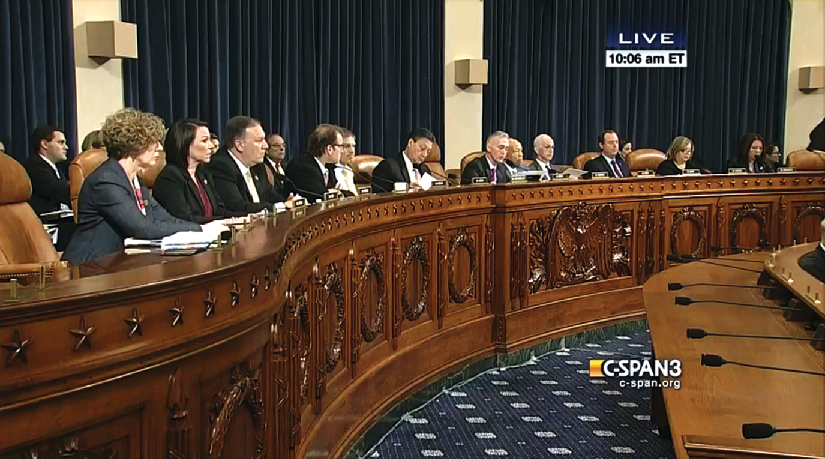
This coverage should lead us to question whether the media gives us the information we need, or the information we want. Were people concerned about an attack on U.S. state officials working abroad, or did they just want to read rumors and attacks on Clinton? Did Republicans use the media’s tendency to pursue a target as a way to hurt Clinton in the polls? If the media gives us what we want, the answer seems to be that we wanted the media to act as both watchdog and paparazzi.
How should the press have acted in this case if it were behaving only as the watchdog of democracy?
Media and transparency
The press has had some assistance in performing its muckraking duty. Laws that mandate federal and many state government proceedings and meeting documents be made available to the public are called sunshine laws. Proponents believe that open disagreements allow democracy to flourish and darkness allows corruption to occur. Opponents argue that some documents and policies are sensitive, and that the sunshine laws can inhibit policymaking.
While some documents may be classified due to national or state security, governments are encouraged to limit the over-classification of documents. The primary legal example for sunshine laws is the Freedom of Information Act (FOIA), passed in 1966 and signed by President Lyndon B. Johnson. The act requires the executive branch of the U.S. government to provide information requested by citizens and was intended to increase openness in the executive branch, which had been criticized for hiding information. Citizens wishing to obtain information may request documents from the appropriate agencies, and agencies may charge fees if the collection and copying of the requested documentation requires time and labor.[97] FOIA also identifies data that does not need to be disclosed, such as human resource and medical records, national defense records, and material provided by confidential sources, to name a few.[98] Not all presidents have embraced this openness, however. President Ronald Reagan, in 1981, exempted the CIA and FBI from FOIA requests.[99] Information requests have increased significantly in recent years, with U.S. agencies receiving over 700,000 requests in 2014, many directed to the Departments of State and Defense, thus creating a backlog.[100] As FOIA requests have become institutionalized across the levels of the U.S. government, one challenge is the work created in responding to those requests.[101] For example, at the University of Oklahoma, two staff in the university counsel's office spend most of their time responding to FOIA requests about the university.
LINK TO LEARNING
Few people file requests for information because most assume the media will find and report on important problems. And many people, including the press, assume the government, including the White House, sufficiently answers questions and provides information about government actions and policies. This expectation is not new. During the Civil War, journalists expected to have access to those representing the government, including the military. But William Tecumseh Sherman, a Union general, maintained distance between the press and his military. Following the publication of material Sherman believed to be protected by government censorship, a journalist was arrested and nearly put to death. The event spurred the creation of accreditation for journalists, which meant a journalist must be approved to cover the White House and the military before entering a controlled area. All accredited journalists also need approval by military field commanders before coming near a military zone.[102]
To cover war up close, more journalists are asking to travel with troops during armed conflict. In 2003, George W. Bush’s administration decided to allow more journalists in the field, hoping the concession would reduce friction between the military and the press. The U.S. Department of Defense placed fifty-eight journalists in a media boot camp to prepare them to be embedded with military regiments in Iraq. Although the increase in embedded journalists resulted in substantial in-depth coverage, many journalists felt their colleagues performed poorly, acting as celebrities rather than reporters.[103]
The line between journalists’ expectation of openness and the government’s willingness to be open has continued to be a point of contention. Some administrations use the media to increase public support during times of war, as Woodrow Wilson did in World War I. Other presidents limit the media in order to limit dissent. In 1990, during the first Persian Gulf War, journalists received all publication material from the military in a prepackaged and staged manner. Access to Dover, the air force base that receives coffins of U.S. soldiers who die overseas, was closed. Journalists accused George H. W. Bush’s administration of limiting access and forcing them to produce bad pieces. The White House believed it controlled the message.[104] The ban was later lifted.
In his 2008 presidential run, Barack Obama promised to run a transparent White House.[105] Yet once in office, he found that transparency makes it difficult to get work done, and so he limited access and questions. In his first year in office, George W. Bush, who was criticized by Obama as having a closed government, gave 147 question-and-answer sessions with journalists, while Obama gave only 46. Even Helen Thomas, a long-time liberal White House press correspondent, said the Obama administration tried to control both information and journalists (Figure 5.15).[106]
The Trump administration had an especially bumpy relationship with the news media. In part, this had to do with Trump's penchant for using Twitter, instead of news briefings, to get his thoughts out to the public. The repeated line from the former president that news media could not be trusted, which he called "fake news," added insult to injury. The prickly relationship also resulted from reduced use of traditional press gaggles and excluding some media outlets, such as CNN, when tempers flared.
While some may have expected the Biden administration to undertake a complete reversal from the Trump White House, the first few months demonstrated that presidents' overall relationships with the press may have evolved. A number of news outlets and media commentators noted the lack of a formal press conference for months after Biden took office. However, he did frequently provide comments and answer questions during other occasions.[107]
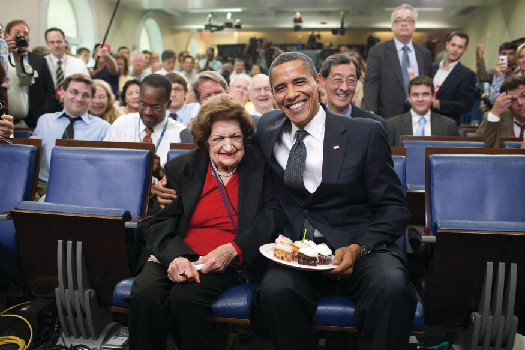
Because White House limitations on the press are not unusual, many journalists rely on confidential sources. In 1972, under the cloak of anonymity, the associate director of the Federal Bureau of Investigation, Mark Felt, became a news source for Bob Woodward and Carl Bernstein, political reporters at the Washington Post. Felt provided information about a number of potential stories and was Woodward’s main source for information about President Richard Nixon’s involvement in a series of illegal activities, including the break-in at Democratic Party headquarters in Washington’s Watergate office complex. The information eventually led to Nixon’s resignation and the indictment of sixty-nine people in his administration. Felt was nicknamed “Deep Throat,” and the journalists kept his identity secret until 2005.[108]
The practice of granting anonymity to sources is sometimes referred to as reporter’s privilege. Fueled by the First Amendment’s protection of the press, journalists have long offered to keep sources confidential to protect them from government prosecution. To illustrate, as part of the investigation into the outing of Valerie Plame as a CIA officer, New York Times reporter Judith Miller was jailed for refusing to reveal “Scooter” Libby, Vice President Dick Cheney’s chief of staff, as her confidential government source.[109] Reporter’s privilege has increased the number of instances in which whistleblowers and government employees have given journalists tips or documents to prompt investigation into questionable government practices. Edward Snowden’s 2013 leak to the press regarding the U.S. government’s massive internal surveillance and tapping program was one such case.
In 1972, however, the Supreme Court determined that journalists are not exempt from subpoenas and that courts could force testimony to name a confidential source. Journalists who conceal a source and thereby protect that source from being properly tried for a crime may spend time in jail for contempt of court. In the case of Branzburg v. Hayes (1972), three journalists were placed in contempt of court for refusing to divulge sources.[110] The journalists appealed to the Supreme Court. In a 5–4 decision, the justices determined that freedom of the press did not extend to the confidentiality of sources. A concurring opinion did state that the case should be seen as a limited ruling, however. If the government needed to know a source due to a criminal trial, it could pursue the name of that source.[111]
More recently, the Supreme Court refused to hear an appeal from New York Times journalist James Risen, who was subpoenaed and ordered to name a confidential source who had provided details about a U.S. government mission designed to harm Iran’s nuclear arms program. Risen was finally released from the subpoena, but the battle took seven years and the government eventually collected enough other evidence to make his testimony less crucial to the case.[112] Overall, the transparency of the government is affected more by the executive currently holding office than by the First Amendment.
5.5 The Impact of the Media
LEARNING OUTCOMES
By the end of this section, you will be able to:
- Identify forms of bias that exist in news coverage and ways the media can present biased coverage
- Explain how the media cover politics and issues
- Evaluate the impact of the media on politics and policymaking
In what ways can the media affect society and government? The media’s primary duty is to present us with information and alert us when important events occur. This information may affect what we think and the actions we take. The media can also place pressure on government to act by signaling a need for intervention or showing that citizens want change. For these reasons, the quality of the media’s coverage matters.
Media Effects and Bias
Concerns about the effects of media on consumers and the existence and extent of media bias go back to the 1920s. Reporter and commentator Walter Lippmann noted that citizens have limited personal experience with government and the world and posited that the media, through their stories, place ideas in citizens’ minds. These ideas become part of the citizens’ frame of reference and affect their decisions. Lippmann’s statements led to the hypodermic theory, which argues that information is “shot” into the receiver’s mind and readily accepted.[113]
Yet studies in the 1930s and 1940s found that information was transmitted in two steps, with one person reading the news and then sharing the information with friends. People listened to their friends, but not to those with whom they disagreed. The newspaper’s effect was thus diminished through conversation. This discovery led to the minimal effects theory, which argues the media have little effect on citizens and voters.[114] By the 1970s, a new idea, the cultivation theory, hypothesized that media develop a person’s view of the world by presenting a perceived reality.[115] What we see on a regular basis is our reality. Media can then set norms for readers and viewers by choosing what is covered or discussed.
In the end, the consensus among observers is that media have some effect, even if the effect is subtle. This raises the question of how the media, even general newscasts, can affect citizens. One of the ways is through framing: the creation of a narrative, or context, for a news story. The news often uses frames to place a story in a context so the reader understands its importance or relevance. Yet, at the same time, framing affects the way the reader or viewer processes the story.
Episodic framing occurs when a story focuses on isolated details or specifics rather than looking broadly at a whole issue. Thematic framing takes a broad look at an issue and skips numbers or details. It looks at how the issue has changed over a long period of time and what has led to it. For example, a large, urban city is dealing with the problem of an increasing homeless population, and the city has suggested ways to improve the situation. If journalists focus on the immediate statistics, report the current percentage of homeless people, interview a few, and look at the city’s current investment in a homeless shelter, the coverage is episodic. If they look at homelessness as a problem increasing everywhere, examine the reasons people become homeless, and discuss the trends in cities’ attempts to solve the problem, the coverage is thematic. Episodic frames may create more sympathy, while a thematic frame may leave the reader or viewer emotionally disconnected and less sympathetic (Figure 5.16).

LINK TO LEARNING
Framing can also affect the way we see race, socioeconomics, or other generalizations. For this reason, it is linked to priming: when media coverage predisposes the viewer or reader to a particular perspective on a subject or issue. If a newspaper article focuses on unemployment, struggling industries, and jobs moving overseas, the reader will have a negative opinion about the economy. If then asked whether they approve of the president’s job performance, the reader is primed to say no. Readers and viewers are able to fight priming effects if they are aware of them or have prior information about the subject.
Coverage Effects on Governance and Campaigns
When it is spotty, the media’s coverage of campaigns and government can sometimes affect the way government operates and the success of candidates. In 1972, for instance, the McGovern-Fraser reforms created a voter-controlled primary system, so party leaders no longer pick the presidential candidates. Now the media are seen as kingmakers and play a strong role in influencing who will become the Democratic and Republican nominees in presidential elections. They can discuss the candidates’ messages, vet their credentials, carry sound bites of their speeches, and conduct interviews. The candidates with the most media coverage build momentum and do well in the first few primaries and caucuses. This, in turn, leads to more media coverage, more momentum, and eventually a winning candidate. Thus, candidates need the media.
In the 1980s, campaigns learned that tight control on candidate information created more favorable media coverage. In the presidential election of 1984, candidates Ronald Reagan and George H. W. Bush began using an issue-of-the-day strategy, providing quotes and material on only one topic each day. This strategy limited what journalists could cover because they had only limited quotes and sound bites to use in their reports. In 1992, both Bush’s and Bill Clinton’s campaigns maintained their carefully drawn candidate images by also limiting photographers and television journalists to photo opportunities at rallies and campaign venues. The constant control of the media became known as the “bubble,” and journalists were less effective when they were in the campaign’s bubble. Reporters complained this coverage was campaign advertising rather than journalism, and a new model emerged with the 1996 election.[116]
Campaign coverage now focuses on the spectacle of the season, rather than providing information about the candidates. Colorful personalities, strange comments, lapse of memories, and embarrassing revelations are more likely to get air time than the candidates’ issue positions. Donald Trump may be the best example of shallower press coverage of a presidential election. Some argue that newspapers and news programs are limiting the space they allot to discussion of the campaigns.[117] Others argue that citizens want to see updates on the race and electoral drama, not boring issue positions or substantive reporting.[118] It may also be that journalists have tired of the information games played by politicians and have taken back control of the news cycles.[119] All these factors have likely led to the shallow press coverage we see today, sometimes dubbed pack journalism because journalists follow one another rather than digging for their own stories. Television news discusses the strategies and blunders of the election, with colorful examples. Newspapers focus on polls. In an analysis of the 2012 election, Pew Research found that 64 percent of stories and coverage focused on campaign strategy. Only 9 percent covered domestic issue positions; 6 percent covered the candidates’ public records; and, 1 percent covered their foreign policy positions.[120]
For better or worse, coverage of the candidates’ statements get less air time on radio and television, and sound bites, or clips, of their speeches have become even shorter. In 1968, the average sound bite from Richard Nixon was 42.3 seconds, while a recent study of television coverage found that sound bites had decreased to only eight seconds in the 2004 election.[121] The clips chosen to air were attacks on opponents 40 percent of the time. Only 30 percent contained information about the candidate’s issues or events. The study also found the news showed images of the candidates, but for an average of only twenty-five seconds while the newscaster discussed the stories.[122]
This study supports the argument that shrinking sound bites are a way for journalists to control the story and add their own analysis rather than just report on it.[123] Candidates are given a few minutes to try to argue their side of an issue, but some say television focuses on the argument rather than on information. In 2004, Jon Stewart of Comedy Central’s The Daily Show began attacking the CNN program Crossfire for being theater, saying the hosts engaged in reactionary and partisan arguing rather than true debating.[124] Some of Stewart’s criticisms resonated, even with host Paul Begala, and Crossfire was later pulled from the air.[125]
The media’s discussion of campaigns has also grown negative. Although biased campaign coverage dates back to the period of the partisan press, the increase in the number of cable news stations has made the problem more visible. Stations like FOX News and MSNBC are overt in their use of bias in framing stories. During the 2012 campaign, seventy-one of seventy-four MSNBC stories about Mitt Romney were highly negative, while FOX News’ coverage of Obama had forty-six out of fifty-two stories with negative information (Figure 5.17). The major networks—ABC, CBS, and NBC—were somewhat more balanced, yet the overall coverage of both candidates tended to be negative.[126] Coverage of the COVID-19 pandemic also featured differences, which had an effect on the public. In the spring of 2020, a study of public opinion on the origins of the virus and likelihood of a vaccine being developed, revealed that respondents who watched FOX News were much more likely to believe the virus was created in a lab and much less likely to have confidence that a vaccine would be developed to stop the disease, whereas respondents who relied on MSNBC believed the virus originated in nature and were quite confident a vaccine would be developed.[127]
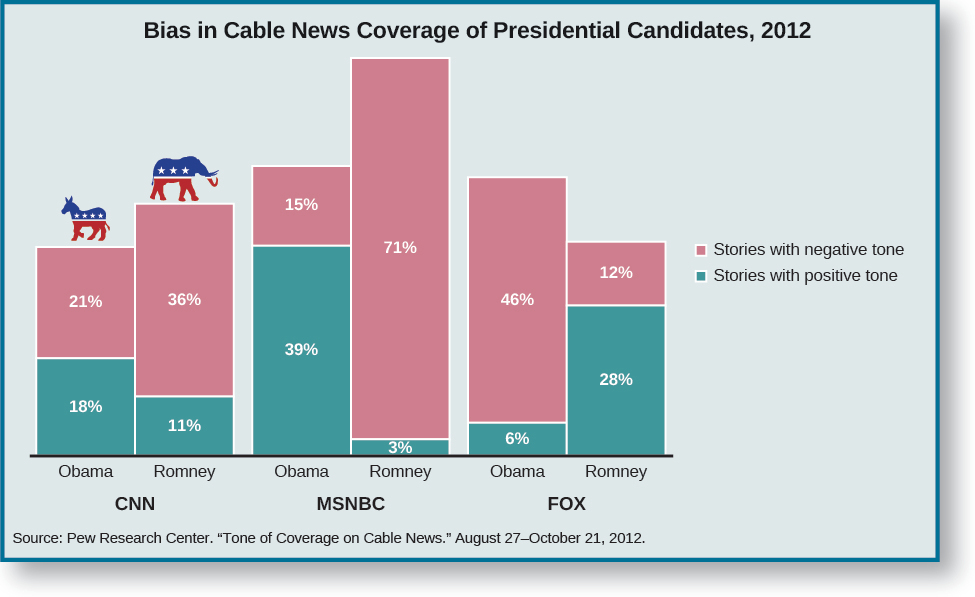
Due in part to the lack of substantive media coverage, campaigns increasingly use social media to relay their message. Candidates can create their own sites and pages and try to spread news through supporters to the undecided. In 2012, both Romney and Obama maintained Facebook, Twitter, and YouTube accounts to provide information to voters. Yet, on social media, candidates still need to combat negativity, from both the opposition and supporters. Stories about Romney that appeared in the mainstream media were negative 38 percent of the time, while his coverage in Facebook news was negative 62 percent of the time and 58 percent of the time on Twitter.[128] In the 2016 election cycle, both party nominees heavily used social media. Donald Trump’s scores of tweets became very prominent as he tweeted during Clinton’s convention acceptance speech and sometimes at all hours of the night. Clinton also used Twitter, but less so than Trump, though arguably staying better on message. Trump tended to rail on about topics and at one point was even drawn into a Twitter battle with Senator Elizabeth Warren (D-MA). Hillary Clinton also used Facebook for longer messages and imaging. Trump took social media posts to a new level, both in terms of the number of posts and the intensity. In January 2021, he was permanently suspended from the Twitter platform due to "the risk of further incitement of violence" in the wake of the January 6th attack on the U.S. capitol building. In contrast, Biden has used social media quite sparingly, both during his campaign and after becoming president.
Once candidates are in office, the chore of governing begins, with the added weight of media attention. Historically, if presidents were unhappy with their press coverage, they used personal and professional means to change its tone. Franklin D. Roosevelt, for example, was able to keep journalists from printing stories through gentleman’s agreements, loyalty, and the provision of additional information, sometimes off the record. The journalists then wrote positive stories, hoping to keep the president as a source. John F. Kennedy hosted press conferences twice a month and opened the floor for questions from journalists, in an effort to keep press coverage positive.[129]
When presidents and other members of the White House are not forthcoming with information, journalists must press for answers. Dan Rather, a journalist for CBS, regularly sparred with presidents in an effort to get information. When Rather interviewed Richard Nixon about Vietnam and Watergate, Nixon was hostile and uncomfortable.[130] In a 1988 interview with then-vice president George H. W. Bush, Bush accused Rather of being argumentative about the possible cover-up of a secret arms sale with Iran:
Rather: I don’t want to be argumentative, Mr. Vice President.Bush: You do, Dan.
Rather: No—no, sir, I don’t.
Bush: This is not a great night, because I want to talk about why I want to be president, why those 41 percent of the people are supporting me. And I don’t think it’s fair to judge my whole career by a rehash of Iran. How would you like it if I judged your career by those seven minutes when you walked off the set in New York?[131]
One of the more profound changes with President Trump compared to prior presidents revolved around his relationship with the press. Trump rarely held press conferences, choosing instead to tweet what he was thinking to the world. Whereas previous presidents spent much effort to cultivate relationships with the media in order to court public opinion, Trump instead criticized the media as untrustworthy and producing "fake news." This approach led to critical coverage of the president across all but a few press outlets. Moreover, President Trump's attack on the media led key outlets, like CNN and the Washington Post, to take action. CNN sued in federal court to get one of their news reporters (Jim Acosta) reinstated on the White House beat after he was thrown out of the West Wing. The Washington Post has run the tagline "Democracy Dies in Darkness" on its website regularly since 2017. Compared to Trump, President Biden's relationship with the press is more conventional, with regular interaction and briefings by Press Secretary Jennifer Psaki.[132]
Cabinet secretaries and other appointees also talk with the press, sometimes making for conflicting messages. The creation of the position of press secretary and the White House Office of Communications both stemmed from the need to send a cohesive message from the executive branch. Currently, the White House controls the information coming from the executive branch through the Office of Communications and decides who will meet with the press and what information will be given.
But stories about the president often examine personality, or the president’s ability to lead the country, deal with Congress, or respond to national and international events. They are less likely to cover the president’s policies or agendas without a lot of effort on the president’s behalf. When Obama first entered office in 2009, journalists focused on his battles with Congress, critiquing his leadership style and inability to work with Representative Nancy Pelosi, then Speaker of the House. To gain attention for his policies, specifically the American Recovery and Reinvestment Act (ARRA), Obama began traveling the United States to draw the media away from Congress and encourage discussion of his economic stimulus package. Once the ARRA had been passed, Obama began travelling again, speaking locally about why the country needed the Affordable Care Act and guiding media coverage to promote support for the act.[133]
Congressional representatives have a harder time attracting media attention for their policies. House and Senate members who use the media well, either to help their party or to show expertise in an area, may increase their power within Congress, which helps them bargain for fellow legislators’ votes. Senators and high-ranking House members may also be invited to appear on cable news programs as guests, where they may gain some media support for their policies. Yet, overall, because there are so many members of Congress, and therefore so many agendas, it is harder for individual representatives to draw media coverage.[134]
It is less clear, however, whether media coverage of an issue leads Congress to make policy, or whether congressional policymaking leads the media to cover policy. In the 1970s, Congress investigated ways to stem the number of drug-induced deaths and crimes. As congressional meetings dramatically increased, the press was slow to cover the topic. The number of hearings was at its highest from 1970 to 1982, yet media coverage did not rise to the same level until 1984.[135] Subsequent hearings and coverage led to national policies like DARE and First Lady Nancy Reagan’s “Just Say No” campaign (Figure 5.18).
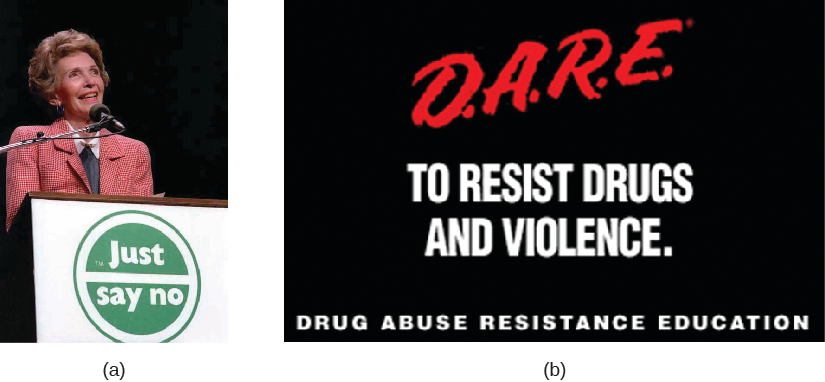
Later studies of the media’s effect on both the president and Congress report that the media has a stronger agenda-setting effect on the president than on Congress. What the media choose to cover affects what the president thinks is important to voters, and these issues were often of national importance. The media’s effect on Congress was limited, however, and mostly extended to local issues like education or child and elder abuse.[136] If the media are discussing a topic, chances are a member of Congress has already submitted a relevant bill, and it is waiting in committee.
Coverage Effects on Society
The media choose what they want to discuss. This agenda setting creates a reality for voters and politicians that affects the way people think, act, and vote. Even if the crime rate is going down, for instance, citizens accustomed to reading stories about assault and other offenses still perceive crime to be an issue.[137] Studies have also found that the media’s portrayal of race is flawed, especially in coverage of crime and poverty. One study revealed that local news shows were more likely to show pictures of criminals when they were African American, so they overrepresented Black people as perpetrators and White people as victims.[138] A second study found a similar pattern in which Latino people were underrepresented as victims of crime and as police officers, while White people were overrepresented as both.[139] Voters were thus more likely to assume that most criminals are African American and most victims and police officers are White, even though the numbers do not support those assumptions.
Network news similarly misrepresents the victims of poverty by using more images of African Americans than White people in its segments. Viewers in a study were left believing African Americans were the majority of the unemployed and poor, rather than seeing the problem as one faced by many races.[140] The misrepresentation of race is not limited to news coverage, however. A study of images printed in national magazines, like Time and Newsweek, found they also misrepresented race and poverty. The magazines were more likely to show images of young African Americans when discussing poverty and excluded the elderly and the young, as well as White and Latino people, which is the true picture of poverty.[141]
Racial framing, even if unintentional, affects perceptions and policies. If viewers are continually presented with images of African Americans as criminals, there is an increased chance they will perceive members of this group as violent or aggressive.[142] The perception that most recipients of welfare are working-age African Americans may have led some citizens to vote for candidates who promised to reduce welfare benefits.[143]
Word choice may also have a priming effect. News organizations like the Los Angeles Times and the Associated Press no longer use the phrase “illegal immigrant” to describe undocumented residents. This may be due to the desire to create a “sympathetic” frame for the immigration situation rather than a “threat” frame.[144]
Media coverage of women has been similarly biased. Most journalists in the early 1900s were men, and women’s issues were not part of the newsroom discussion. As journalist Kay Mills put it, the women’s movement of the 1960s and 1970s was about raising awareness of the problems of equality, but writing about rallies “was like trying to nail Jell-O to the wall.”[145] Most politicians, business leaders, and other authority figures were men, and editors’ reactions to the stories were lukewarm. The lack of women in the newsroom, politics, and corporate leadership encouraged silence.[146]
In 1976, journalist Barbara Walters became the first woman coanchor on a network news show, The ABC Evening News. She was met with great hostility from her coanchor Harry Reasoner and received critical coverage from the press.[147] On newspaper staffs, women reported having to fight for assignments to well-published beats, or to be assigned areas or topics, such as the economy or politics, that were normally reserved for male journalists. Once women journalists held these assignments, they feared writing about women’s issues. Would it make them appear weak? Would they be taken from their coveted beats?[148] This apprehension allowed poor coverage of women and the women’s movement to continue until women were better represented as journalists and as editors. Strength of numbers allowed them to be confident when covering issues like health care, childcare, and education.[149]
LINK TO LEARNING
The media’s historically uneven coverage of women continues in its treatment of women candidates. Early coverage was sparse. The stories that did appear often discussed the candidate’s viability, or ability to win, rather than her stand on the issues.[150] Women were seen as a novelty rather than as serious contenders who needed to be vetted and discussed. Modern media coverage has changed slightly. One study found that women candidates receive more favorable coverage than in prior generations, especially if they are incumbents.[151] Yet a different study found that while there was increased coverage for woman candidates, it was often negative.[152] And it did not include Latina candidates.[153] Without coverage, they are less likely to win.
The historically negative media coverage of woman candidates has had another concrete effect: Women are less likely than men to run for office. One common reason is the effect negative media coverage has on families.[154] Many women do not wish to expose their children or spouses to criticism.[155] In 2008, the nomination of Sarah Palin as Republican candidate John McCain’s running mate validated this concern (Figure 5.19). Some articles focused on her qualifications to be a potential future president or her record on the issues. But others questioned whether she had the right to run for office, given she had young children, one of whom has developmental disabilities.[156] Even when candidates ask that children and families be off-limits, the press rarely honors the requests. So women with young children may wait until their children are grown before running for office, if they choose to run at all.
In 2020, woman candidates, though still facing negative media coverage, nevertheless ran in record numbers at all levels. Several women were competitive for the Democratic presidential nomination, including Senator Elizabeth Warren (D-MA), Senator Kamala Harris (D-CA), and Senator Amy Klobuchar (D-MN). Harris was later selected by Joe Biden as his running mate and now serves as the first woman vice president.
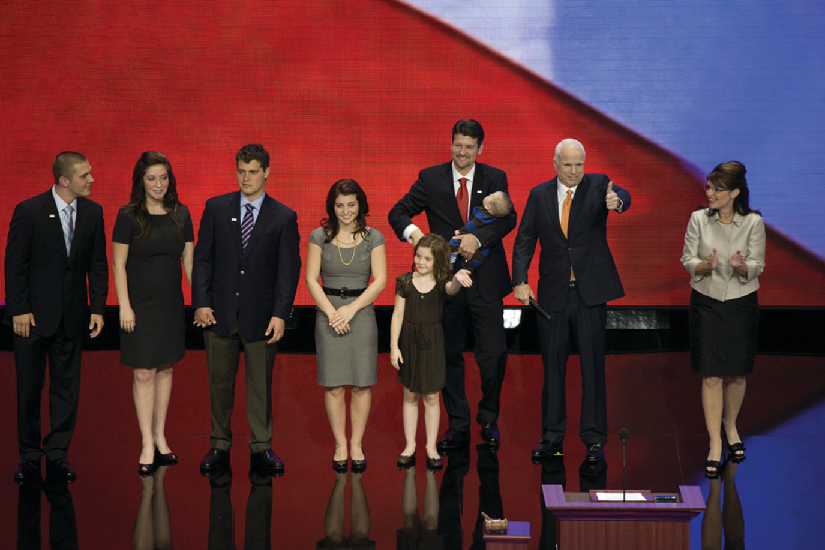
This chapter was remixed from American Government (2e- Second Edition) by Lumen Learning, licensed under a Creative Commons Attribution 4.0 International License, except where otherwise noted.
5.6 Protecting Communication from Government Censorship
The First Amendment provides Congress shall make no law . . . abridging the freedom of speech, or of the press." Understanding this specific formulation is important, for it is very different than "Congress shall pass no law abridging speech or press." That would mean that speech and press had to be totally free from government regulation, and there is no evidence this is what the framers of the amendment intended. The risk of harm from some communication is so high that some limits are necessary.
The drafters of the First Amendment recognized that the British common law that the states adopted in 1776 already recognized certain actions as beyond the power of government to regulate. One of the most important principles was that publication was free from restriction by the government unless it constituted "seditious libel," which meant a threat to the government. The justification was that the government was allowed to protect itself from speech that threatened to harm or destroy it. Even if the threat involved criticism that was true, the truth of the criticism was not a defense since the maintenance of order was more important.
Prior to the Revolution, the colonies enforced laws against seditious libel. In 1733, John Peter Zenger published articles critical of New York Governor-General William Cosby, and he was charged with criminal libel. Zenger's defense was that the charges of corruption were true, but the trial judge told the jury to disregard his argument since truth did not constitute a valid defense. Although the only issue for the jury was whether Zenger had published the libelous articles--which he clearly had--the jury found Zenger not guilty, marking a victory for free speech over government censorship.[157]
Did the First Amendment's prohibition against Congress passing laws that "abridg[ed] the freedom of speech, or of the press" exempt laws punishing seditious libel? The language of the amendment implies a preexisting freedom since it does not say "abridging speech." Therefore, if "freedom of speech" had an exception for seditious libel, then Congress could punish such speech without violating the First Amendment. In 1798, Congress did exactly this when it passed the Sedition Act to bar "false, scandalous, or malicious" statements intended to defame or bring into contempt the President, Congress, or the federal government. The inclusion of the word "or" made it clear that true but scandalous or malicious statements were also criminalized. However, the Sedition Act did not apply to comments about the Vice President, Thomas Jefferson, who was challenging President John Adams for reelection. This meant that during the 1800 presidential election campaign the Federalists could freely criticize Republican candidate Jefferson, but the Republicans were limited in what they could say about Federalist candidate Adams.[158]
At the time, Congress was controlled by the Federalist Party, and it hoped to maintain its control over Congress by limiting what attacks the opposition Democratic Republicans could make against them. After the Federalists won the 1798 elections, their political opponents began violating the Sedition Act, claiming that it was unconstitutional. Fourteen men were prosecuted for violating the Act, and the trials were held in the election year of 1800. Matthew Lyon was the first to be tried for writing a letter to the editor that claimed President Adams demonstrated a "continual grasp for power, ridiculous pomp, foolish adulation, and selfish avarice." Since the only jury issue was whether he had written the article, he was convicted and sentenced to four months in prison and a $1000 fine. David Brown was convicted for inspiring people to put up a "liberty pole" with signs protesting Adams' policies, and he as sentenced to 18 months in prison and a fine of $480.[159]
While the defendants argued that the Act was unconstitutional, Federalist judges either ignored or dismissed their arguments, and thus there are no opinions that addressed this issue. Nevertheless, the voters recognized the hypocrisy of an elected government that tried to censor its opponents, and in the 1800 elections the Democratic Republicans took control of the executive and judicial branches. President Jefferson pardoned all those convicted of violating the Sedition Act, and Congress remitted the full amount of fines paid. The Act had expired by the time the new Congress was sworn in, and the issue of whether seditious libel was an exception to freedom of speech evaded judicial review.
Punishment for seditious libel reappeared during the Civil War after President Abraham Lincoln suspended habeas corpus in April 1861 and Congress subsequently authorized the expanded use of detention without trial. Lincoln viewed public expressions of support for the Confederacy as grounds for indefinite detention. Eventually, he detained people who opposed the draft, discouraged enlistment, and even opposed an income tax that was likely unconstitutional. Numerous publishers, editors and writers were taken into military custody and held without trial. Newspapers that published opposition to Lincoln's policies were shut down and some had their presses destroyed. His suppression of speech was one of the reasons why the Republican Party lost seats in the 1862 Congressional elections.[160]
In 1863, Congress authorized the government to hold military trials for those accused of opposing the war effort, which Lincoln labeled treason. These were held before military judges instead of civilian juries as required by the Constitution. Among those convicted was Congressman Clement Valladigham, who had given a speech criticizing Lincoln's action and calling him a "king." He was sentenced to two years in prison, and the conviction was upheld by a federal circuit judge. He appealed to the Supreme Court, which had been packed with Lincoln's appointees. In Ex Parte Vallandigham, 68 U.S. 243 (1864), it dismissed the appeal on the grounds that it had no jurisdiction to decide appeals from military courts, thereby avoiding having to rule on whether those courts were constitutional.
In 1907, the Supreme Court upheld the exclusion of seditious libel from constitutional protection for free speech. Patterson v. Colorado, 205 U.S. 454, 462 (1907), involved a newspaper publisher held in contempt by the Colorado Supreme Court for publishing articles and a cartoon critical of that Court's decisions in election challenges. He attempted to argue that his criticisms were true, but that Court held that the truth of his statements was irrelevant since they interfered with a jury's ability to reach a fair decision in a pending case. Justice Oliver Wendell Holmes wrote the Supreme Court's decision rejecting the publisher's free speech challenge: "A publication likely to reach the eyes of a jury declaring a witness in a pending cause a perjurer would be nonetheless a contempt that it was true. It would tend to obstruct the administration of justice because even a correct conclusion is not to be reached or helped in that way if our system of trials is to be maintained."
The next time the US government prosecuted political communication occurred after the nation entered World War I in April 1917. Congress passed the Espionage Act that year, which made it a crime to engage in speech that interfered with the operation or success of the military. Two years later, the Court decided two cases that addressed whether the First Amendment right to communicate protected criticism of mandatory conscription.
Schenck v. United States, 249 U.S. 47 (1919)
Charles Schenck and others distributed thousands of pamphlets arguing that the federal law establishing a draft violated the Thirteenth Amendment by forcing citizens to serve in a foreign war. He was convicted and appealed on the grounds that he had the right to speak publicly in opposition to the government's actions. A unanimous Supreme Court upheld the conviction, holding that during wartime, the government was justified in punishing actions that had the tendency to impair its ability to fight. Justice Holmes' opinion suggested that Schenck's arguments had no merit, comparing his pamphlet to "falsely shouting fire in a crowded theater." (emphasis added)
Justice Oliver Wendell Holmes:
This is an indictment in three counts. The first charges a conspiracy to violate the Espionage Act of June 15, 1917, c. 30, § 3, 40 Stat. 217, 219, by causing and attempting to cause insubordination, &c., in the military and naval forces of the United States, and to obstruct the recruiting and enlistment service of the United States, when the United States was at war with the German Empire, to-wit, that the defendants willfully conspired to have printed and circulated to men who had been called and accepted for military service under the Act of May 18, 1917, a document set forth and alleged to be calculated to cause such insubordination and obstruction. The count alleges overt acts in pursuance of the conspiracy, ending in the distribution of the document set forth. The second count alleges a conspiracy to commit an offence against the United States, to-wit, to use the mails for the transmission of matter declared to be nonmailable by Title XII, § 2 of the Act of June 15, 1917, to-wit, the above mentioned document, with an averment of the same overt acts. The third count charges an unlawful use of the mails for the transmission of the same matter and otherwise as above. The defendants were found guilty on all the counts. . . .
The document in question, upon its first printed side, recited the first section of the Thirteenth Amendment, said that the idea embodied in it was violated by the Conscription Act, and that a conscript is little better than a convict. In impassioned language, it intimated that conscription was despotism in its worst form, and a monstrous wrong against humanity in the interest of Wall Street's chosen few. It said "Do not submit to intimidation," but in form, at least, confined itself to peaceful measures such as a petition for the repeal of the act. The other and later printed side of the sheet was headed "Assert Your Rights." It stated reasons for alleging that anyone violated the Constitution when he refused to recognize "your right to assert your opposition to the draft," and went on "If you do not assert and support your rights, you are helping to deny or disparage rights which it is the solemn duty of all citizens and residents of the United States to retain."
It described the arguments on the other side as coming from cunning politicians and a mercenary capitalist press, and even silent consent to the conscription law as helping to support an infamous conspiracy. It denied the power to send our citizens away to foreign shores to shoot up the people of other lands, and added that words could not express the condemnation such cold-blooded ruthlessness deserves, &c., winding up, "You must do your share to maintain, support and uphold the rights of the people of this country." Of course, the document would not have been sent unless it had been intended to have some effect, and we do not see what effect it could be expected to have upon persons subject to the draft except to influence them to obstruct the carrying of it out. The defendants do not deny that the jury might find against them on this point.
But it is said, suppose that that was the tendency of this circular, it is protected by the First Amendment to the Constitution. Two of the strongest expressions are said to be quoted respectively from well known public men. It well may be that the prohibition of laws abridging the freedom of speech is not confined to previous restraints, although to prevent them may have been the main purpose, as intimated in Patterson v. Colorado, 205 U. S. 454, 462. We admit that, in many places and in ordinary times, the defendants, in saying all that was said in the circular, would have been within their constitutional rights. But the character of every act depends upon the circumstances in which it is done. Aikens v. Wisconsin, 195 U. S. 194, 205-206. The most stringent protection of free speech would not protect a man in falsely shouting fire in a theatre and causing a panic. It does not even protect a man from an injunction against uttering words that may have all the effect of force. The question in every case is whether the words used are used in such circumstances and are of such a nature as to create a clear and present danger that they will bring about the substantive evils that Congress has a right to prevent. It is a question of proximity and degree. When a nation is at war, many things that might be said in time of peace are such a hindrance to its effort that their utterance will not be endured so long as men fight, and that no Court could regard them as protected by any constitutional right. It seems to be admitted that, if an actual obstruction of the recruiting service were proved, liability for words that produced that effect might be enforced. The statute of 1917, in § 4, punishes conspiracies to obstruct, as well as actual obstruction. If the act (speaking, or circulating a paper), its tendency, and the intent with which it is done are the same, we perceive no ground for saying that success alone warrants making the act a crime.
Abrams v. United States, 250 U.S. 616 (1919)
In 1918, Congress amended the 1917 Espionage Act to cover communication that criticized the government's war effort or interfered with its efforts to sell bonds. Five Russian immigrants who supported the new Communist government in Russia published leaflets criticizing President Wilson's decision to send troops into the USSR and calling for a general strike in support of Communism. The Court dismissed their challenge to the prosecution by a 7-2 vote, citing its decision in Schenck. But Justice Holmes, who wrote the decision in Schenck, saw an important difference. There was no evidence in this case of any immediate threat to the US war effort; rather, it appeared that the defendants were being singled out for their ardent support of Communism. This led Justice Holmes to dissent on the grounds that when the country is in no immediate danger of harm from criticism of its government it is better to allow the free market of ideas to operate than to stifle views the government deems potentially dangerous.
Justice John Clarke:
Each of the first three counts [of the indictment] charged the defendants with conspiring, when the United States was at war with the Imperial Government of Germany, to unlawfully utter, print, write and publish: in the first count, "disloyal, scurrilous and abusive language about the form of Government of the United States;" in the second count, language "intended to bring the form of Government of the United States into contempt, scorn, contumely and disrepute;" and in the third count, language "intended to incite, provoke and encourage resistance to the United States in said war." The charge in the fourth count was that the defendants conspired, "when the United States was at war with the Imperial German Government, unlawfully and willfully, by utterance, writing, printing and publication, to urge, incite and advocate curtailment of production of things and products, to-wit, ordnance and ammunition, necessary and essential to the prosecution of the war.". . .
It was charged in each count of the indictment that it was a part of the conspiracy that the defendants would attempt to accomplish their unlawful purpose by printing, writing and distributing in the City of New York many copies of a leaflet or circular, printed in the English language, and of another printed in the Yiddish language, copies of which, properly identified, were attached to the indictment. . . .
It was admitted on the trial that the defendants had united to print and distribute the described circulars, and that five thousand of them had been printed and distributed about the 22nd day of August, 1918. The group had a meeting place in New York City, in rooms rented by defendant Abrams under an assumed name, and there the subject of printing the circulars was discussed about two weeks before the defendants were arrested. The defendant Abrams, although not a printer, on July 27, 1918, purchased the printing outfit with which the circulars were printed, and installed it in a basement room where the work was done at night. The circulars were distributed, some by throwing them from a window of a building where one of the defendants was employed and others secretly, in New York City. . . .
On the record thus described, it is argued, somewhat faintly, that the acts charged against the defendants were not unlawful because within the protection of that freedom of speech and of the press which is guaranteed by the First Amendment to the Constitution of the United States, and that the entire Espionage Act is unconstitutional because in conflict with that Amendment. This contention is sufficiently discussed and is definitely negatived in Schenck v. United States . . .
Men must be held to have intended, and to be accountable for, the effects which their acts were likely to produce. Even if their primary purpose and intent was to aid the cause of the Russian Revolution, the plan of action which they adopted necessarily involved, before it could be realized, defeat of the war program of the United States. . . [T]he manifest purpose of such a publication was to create an attempt to defeat the war plans of the Government of the United States by bringing upon the country the paralysis of a general strike, thereby arresting the production of all munitions and other things essential to the conduct of the war.
Justice Oliver Wendell Holmes, joined by Justice Brandeis, dissenting:
[A]s against dangers peculiar to war, as against others, the principle of the right to free speech is always the same. It is only the present danger of immediate evil or an intent to bring it about that warrants Congress in setting a limit to the expression of opinion where private rights are not concerned. Congress certainly cannot forbid all effort to change the mind of the country. Now nobody can suppose that the surreptitious publishing of a silly leaflet by an unknown man, without more, would present any immediate danger that its opinions would hinder the success of the government arms or have any appreciable tendency to do so. Publishing those opinions for the very purpose of obstructing, however, might indicate a greater danger, and, at any rate, would have the quality of an attempt. So I assume that the second leaflet, if published for the purposes alleged in the fourth count, might be punishable. But it seems pretty clear to me that nothing less than that would bring these papers within the scope of this law. . . .
In this case, sentences of twenty years' imprisonment have been imposed for the publishing of two leaflets that I believe the defendants had as much right to publish as the Government has to publish the Constitution of the United States now vainly invoked by them. Even if I am technically wrong, and enough can be squeezed from these poor and puny anonymities to turn the color of legal litmus paper, I will add, even if what I think the necessary intent were shown, the most nominal punishment seems to me all that possibly could be inflicted, unless the defendants are to be made to suffer not for what the indictment alleges, but for the creed that they avow--a creed that I believe to be the creed of ignorance and immaturity when honestly held, as I see no reason to doubt that it was held here, but which, although made the subject of examination at the trial, no one has a right even to consider in dealing with the charges before the Court.
Persecution for the expression of opinions seems to me perfectly logical. If you have no doubt of your premises or your power, and want a certain result with all your heart, you naturally express your wishes in law, and sweep away all opposition. To allow opposition by speech seems to indicate that you think the speech impotent, as when a man says that he has squared the circle, or that you do not care wholeheartedly for the result, or that you doubt either your power or your premises. But when men have realized that time has upset many fighting faiths, they may come to believe even more than they believe the very foundations of their own conduct that the ultimate good desired is better reached by free trade in ideas--that the best test of truth is the power of the thought to get itself accepted in the competition of the market, and that truth is the only ground upon which their wishes safely can be carried out. That, at any rate, is the theory of our Constitution. It is an experiment, as all life is an experiment. Every year, if not every day, we have to wager our salvation upon some prophecy based upon imperfect knowledge. While that experiment is part of our system, I think that we should be eternally vigilant against attempts to check the expression of opinions that we loathe and believe to be fraught with death, unless they so imminently threaten immediate interference with the lawful and pressing purposes of the law that an immediate check is required to save the country. I wholly disagree with the argument of the Government that the First Amendment left the common law as to seditious libel in force. History seems to me against the notion. I had conceived that the United States, through many years, had shown its repentance for the Sedition Act of 1798, by repaying fines that it imposed.
******
The rise of Communism after the first World War led states to pass laws punishing its public advocacy, which they believed they could do because they were not bound to comply with the First Amendment. But in the 1920s, the Supreme Court was expanding the reach of the Fourteenth Amedment Due Process Clause, as further discussed in unit three, chapter 2. Would this trend change the way the Court viewed state restrictions on communication?
Gitlow v. New York, 268 U.S. 652 (1925)
Benjamin Gitlow distributed the Left-Wing Manifesto, a Socialist pamphlet written in the same style as Karl Marx's Communist Manifesto. Convicted of violating New York State's criminal anarchy law, he appealed to the Supreme Court on the grounds that the First Amendment should be applied to the states and protect his communication. The Court incorporated the Free Speech and Free Press Clauses against the states, but this did not help Gitlow, whose conviction was sustained 7-2. Justice Sanford's opinion held that legislatures may prohibit publications that advocate the violent overthrow of government, irrespective of whether the speaker commits any overt acts intended to cause this to happen. This is because governments may protect themselves against the possible harm caused by such communications as long as the restrictions it imposes are not arbitrary and unreasonable. Justice Holmes dissented on the grounds that there was no likelihood that the publication would cause such a revolution and thus the law prohibited the discussion of ideas that should be protected by the First Amendment.
Justice Edward Sanford:
Benjamin Gitlow was indicted in the Supreme Court of New York, with three others, for the statutory crime of criminal anarchy. He was separately tried, convicted, and sentenced to imprisonment. The judgment was affirmed by the Appellate Division and by the Court of Appeals.
The contention here is that the statute, by its terms and as applied in this case, is repugnant to the due process clause of the Fourteenth Amendment. Its material provisions are:
"§ 160. Criminal anarchy defined. Criminal anarchy is the doctrine that organized government should be overthrown by force or violence, or by assassination of the executive head or of any of the executive officials of government, or by any unlawful means. The advocacy of such doctrine either by word of mouth or writing is a felony."
"§ 161. Advocacy of criminal anarchy. Any person who:
"1. By word of mouth or writing advocates, advises or teaches the duty, necessity or propriety of overthrowing or overturning organized government by force or violence, or by assassination of the executive head or of any of the executive officials of government, or by any unlawful means; or, 2. Prints, publishes, edits, issues or knowingly circulates, sells, distributes or publicly displays any book, paper, document, or written or printed matter in any form, containing or advocating, advising or teaching the doctrine that organized government should be overthrown by force, violence or any unlawful means is guilty of a felony and punishable by imprisonment or fine, or both.". . .
The following facts were established on the trial by undisputed evidence and admissions: the defendant is a member of the Left Wing Section of the Socialist Party, a dissenting branch or faction of that party formed in opposition to its dominant policy of "moderate Socialism.". . . The Left Wing Section was organized nationally at a conference in New York City in June, 1919, attended by ninety delegates from twenty different States. The conference elected a National Council, of which the defendant was a member, and left to it the adoption of a "Manifesto." This was published in The Revolutionary Age, the official organ of the Left Wing. The defendant was on the board of managers of the paper, and was its business manager. He arranged for the printing of the paper. . . Sixteen thousand copies were printed, which were delivered at the premises in New York City used as the office of the Revolutionary Age and the headquarters of the Left Wing, and occupied by the defendant and other officials. These copies were paid for by the defendant, as business manager of the paper. Employees at this office wrapped and mailed out copies of the paper under the defendant's direction, and copies were sold from this office. . . .
There was no evidence of any effect resulting from the publication and circulation of the Manifesto. No witnesses were offered in behalf of the defendant. . . .
[The Left Wing Manifesto] condemned the dominant "moderate Socialism" for its recognition of the necessity of the democratic parliamentary state; repudiated its policy of introducing Socialism by legislative measures, and advocated, in plain and unequivocal language, the necessity of accomplishing the "Communist Revolution" by a militant and "revolutionary Socialism," based on "the class struggle" and mobilizing the "power of the proletariat in action," through mass industrial revolts developing into mass political strikes and "revolutionary mass action," for the purpose of conquering and destroying the parliamentary state and establishing in its place, through a "revolutionary dictatorship of the proletariat," the system of Communist Socialism. . . .
The court, among other things, charged the jury, in substance, that they must determine what was the intent, purpose and fair meaning of the Manifesto; that its words must be taken in their ordinary meaning, as they would be understood by people whom it might reach. . . .
The sole contention here is, essentially, that as there was no evidence of any concrete result flowing from the publication of the Manifesto or of circumstances showing the likelihood of such result, the statute as construed and applied by the trial court penalizes the mere utterance, as such, of "doctrine" having no quality of incitement, without regard either to the circumstances of its utterance or to the likelihood of unlawful sequences, and that, as the exercise of the right of free expression with relation to government is only punishable "in circumstances involving likelihood of substantive evil," the statute contravenes the due process clause of the Fourteenth Amendment. . .
The statute does not penalize the utterance or publication of abstract "doctrine" or academic discussion having no quality of incitement to any concrete action. It is not aimed against mere historical or philosophical essays. It does not restrain the advocacy of changes in the form of government by constitutional and lawful means. What it prohibits is language advocating, advising or teaching the overthrow of organized government by unlawful means. These words imply urging to action. Advocacy is defined in the Century Dictionary as: "1. The act of pleading for, supporting, or recommending; active espousal." It is not the abstract "doctrine" of overthrowing organized government by unlawful means which is denounced by the statute, but the advocacy of action for the accomplishment of that purpose. . . .
The Manifesto, plainly, is neither the statement of abstract doctrine nor, as suggested by counsel, mere prediction that industrial disturbances and revolutionary mass strikes will result spontaneously in an inevitable process of evolution in the economic system. It advocates and urges in fervent language mass action which shall progressively foment industrial disturbances and, through political mass strikes and revolutionary mass action, overthrow and destroy organized parliamentary government. . . .
For present purposes, we may and do assume that freedom of speech and of the press which are protected by the First Amendment from abridgment by Congress are among the fundamental personal rights and "liberties" protected by the due process clause of the Fourteenth Amendment from impairment by the States. . . .
It is a fundamental principle, long established, that the freedom of speech and of the press which is secured by the Constitution does not confer an absolute right to speak or publish, without responsibility, whatever one may choose, or an unrestricted and unbridled license that gives immunity for every possible use of language and prevents the punishment of those who abuse this freedom. 2 Story on the Constitution, 5th ed., § 1580, p. 634; Patterson v. Colorado, 205 U. S. 454, 462; Schenck v. United States, 249 U. S. 47, 52. Reasonably limited, it was said by Story in the passage cited, this freedom is an inestimable privilege in a free government; without such limitation, it might become the scourge of the republic.
That a State in the exercise of its police power may punish those who abuse this freedom by utterances inimical to the public welfare, tending to corrupt public morals, incite to crime, or disturb the public peace, is not open to question. . . [A] State may punish utterances endangering the foundations of organized government and threatening its overthrow by unlawful means. These imperil its own existence as a constitutional State. Freedom of speech and press . . . does not protect publications prompting the overthrow of government by force; the punishment of those who publish articles which tend to destroy organized society being essential to the security of freedom and the stability of the State. And a State may penalize utterances which openly advocate the overthrow of the representative and constitutional form of government of the United States and the several States, by violence or other unlawful means. In short, this freedom does not deprive a State of the primary and essential right of self-preservation, which, so long as human governments endure, they cannot be denied. . . .
[B]y enacting the present statute, the State has determined, through its legislative body, that utterances advocating the overthrow of organized government by force, violence and unlawful means are so inimical to the general welfare and involve such danger of substantive evil that they may be penalized in the exercise of its police power. That determination must be given great weight. Every presumption is to be indulged in favor of the validity of the statute. And the case is to be considered "in the light of the principle that the State is primarily the judge of regulations required in the interest of public safety and welfare;" and that its police "statutes may only be declared unconstitutional where they are arbitrary or unreasonable attempts to exercise authority vested in the State in the public interest." Great Northern Ry. v. Clara City, 246 U. S. 434, 439. That utterances inciting to the overthrow of organized government by unlawful means present a sufficient danger of substantive evil to bring their punishment within the range of legislative discretion is clear. Such utterances, by their very nature, involve danger to the public peace and to the security of the State. They threaten breaches of the peace, and ultimate revolution. And the immediate danger is none the less real and substantial because the effect of a given utterance cannot be accurately foreseen. The State cannot reasonably be required to measure the danger from every such utterance in the nice balance of a jeweler's scale. A single revolutionary spark may kindle a fire that, smouldering for a time, may burst into a sweeping and destructive conflagration. It cannot be said that the State is acting arbitrarily or unreasonably when, in the exercise of its judgment as to the measures necessary to protect the public peace and safety, it seeks to extinguish the spark without waiting until it has enkindled the flame or blazed into the conflagration. It cannot reasonably be required to defer the adoption of measures for its own peace and safety until the revolutionary utterances lead to actual disturbances of the public peace or imminent and immediate danger of its own destruction; but it may, in the exercise of its judgment, suppress the threatened danger in its incipiency. . . . We cannot hold that the present statute is an arbitrary or unreasonable exercise of the police power of the State unwarrantably infringing the freedom of speech or press, and we must and do sustain its constitutionality. . . .
[W]hen the legislative body has determined generally, in the constitutional exercise of its discretion, that utterances of a certain kind involve such danger of substantive evil that they may be punished, the question whether any specific utterance coming within the prohibited class is likely, in and of itself, to bring about the substantive evil is not open to consideration. It is sufficient that the statute itself be constitutional and that the use of the language comes within its prohibition. The general statement in the Schenck Case that the "question in every case is whether the words are used in such circumstances and are of such a nature as to create a clear and present danger that they will bring about the substantive evils" . . . has no application to those like the present, where the legislative body itself has previously determined the danger of substantive evil arising from utterances of a specified character. . . .
Justice Oliver Wendell Holmes, joined by Justice Brandeis, dissenting:
Mr. Justice Brandeis and I are of opinion that this judgment should be reversed. The general principle of free speech, it seems to me, must be taken to be included in the Fourteenth Amendment, in view of the scope that has been given to the word "liberty" as there used, although perhaps it may be accepted with a somewhat larger latitude of interpretation than is allowed to Congress by the sweeping language that governs or ought to govern the laws of the United States. If I am right, then I think that the criterion sanctioned by the full Court in Schenck v. United States, 249 U. S. 47, 52, applies: "The question in every case is whether the words used are used in such circumstances and are of such a nature as to create a clear and present danger that they will bring about the substantive evils that [the State] has a right to prevent.". . .If what I think the correct test is applied, it is manifest that there was no present danger of an attempt to overthrow the government by force on the part of the admittedly small minority who shared the defendant's views. It is said that this manifesto was more than a theory, that it was an incitement. Every idea is an incitement. It offers itself for belief, and, if believed, it is acted on unless some other belief outweighs it or some failure of energy stifles the movement at its birth. The only difference between the expression of an opinion and an incitement in the narrower sense is the speaker's enthusiasm for the result. Eloquence may set fire to reason. But whatever may be thought of the redundant discourse before us, it had no chance of starting a present conflagration. If, in the long run, the beliefs expressed in proletarian dictatorship are destined to be accepted by the dominant forces of the community, the only meaning of free speech is that they should be given their chance and have their way.
If the publication of this document had been laid as an attempt to induce an uprising against government at once, and not at some indefinite time in the future, it would have presented a different question. The object would have been one with which the law might deal, subject to the doubt whether there was any danger that the publication could produce any result, or in other words, whether it was not futile and too remote from possible consequences. But the indictment alleges the publication, and nothing more.
******
If a State can protect itself by banning certain types of speech, does it follow that it can protect itself by banning membership in organizations devoted to revolutionary purposes? The Supreme Court addressed this issue in Whitney v. California, 274 U.S. 357, 371-372 (1927). California's Criminal Syndicalism Act made it a crime for "any person who . . . organizes or assists in organizing, or is or knowingly becomes a member of, any organization . . . to advocate, teach or aid and abet criminal syndicalism," which was defined as advocating the use of force to achieve political change. The Court upheld the conviction of Charlotte Whitney for joining the California Communist Labor Party: "The essence of the offense denounced by the Act is the combining with others in an association for the accomplishment of the desired ends through the advocacy and use of criminal and unlawful methods. It partakes of the nature of a criminal conspiracy. That such united and joint action involves even greater danger to the public peace and security than the isolated utterances and acts of individuals is clear. We cannot hold that, as here applied, the Act is an unreasonable or arbitrary exercise of the police power of the State, unwarrantably infringing any right of free speech, assembly or association, or that those persons are protected from punishment by the due process clause who abuse such rights by joining and furthering an organization thus menacing the peace and welfare of the State.
Justice Brandeis concurred, but reiterated the principle of Holmes' dissent in Gitlow: "[T]he necessity which is essential to a valid restriction does not exist unless speech would produce, or is intended to produce, a clear and imminent danger of some substantive evil which the state constitutionally may seek to prevent has been settled."
******
While the Court focused on the issue of speech in these cases, no actual speech was prosecuted. The changes were for printing and disseminating material that was harmful to the government, and they were proven by the admission of the seditious material at trial. What the Court referred to as speech was really publication, but the principles it established applied to both written and oral communication. The Court did not specifically address the freedom of press until 1931, when it reviewed a Minnesota law that allowed a publisher to be banned from publishing scandalous and defamatory material.
Near v. Minnesota, 283 U.S. 697 (1931)
Minnesota law permitted a publisher to be enjoined from further publication if they were shown to have published scandalous and defamatory material, and could not demonstrate that it was both truthful and published without malicious intent. There was no doubt that the Saturday Press had published scurrilous attacks on Jews, but Jay Near, its publisher, claimed a First Amendment right to do so without censorship. The Court voted 5-4 to find that defamatory material cannot be suppressed by pre-publication censorship; the victims retained their right to sue for damages due to defamation after publication. Chief Justice Hughes held that publication could only be suppressed if the material was obscene, threatened national security, or created a clear and present danger to public order. Dissenter Pierce Butler claimed that there had never been common law protection for defamation and that it was thus outside the protection of the First Amendment. He argued that such publication constituted nuisance that could be enjoined under common law tort principles.
Chief Justice Charles Evans Hughes:
Chapter 285 of the Session Laws of Minnesota for the year 1925 provides for the abatement, as a public nuisance, of a "malicious, scandalous and defamatory newspaper, magazine or other periodical." Section one of the Act is as follows:
"Section 1. Any person who, as an individual, or as a member or employee of a firm, or association or organization, or as an officer, director, member or employee of a corporation, shall be engaged in the business of regularly or customarily producing, publishing or circulating, having in possession, selling or giving away (a) an obscene, lewd and lascivious newspaper, magazine, or other periodical, or (b) a malicious, scandalous and defamatory newspaper, magazine or other periodical, is guilty of a nuisance, and all persons guilty of such nuisance may be enjoined, as hereinafter provided. . . .
"In actions brought under (b) above, there shall be available the defense that the truth was published with good motives and for justifiable ends and in such actions the plaintiff shall not have the right to report to issues or editions of periodicals taking place more than three months before the commencement of the action."
Section two provides that, whenever any such nuisance is committed or exists, the County Attorney of any county where any such periodical is published or circulated, or, in case of his failure or refusal to proceed upon written request in good faith of a reputable citizen, the Attorney General, or, upon like failure or refusal of the latter, any citizen of the county may maintain an action in the district court of the county in the name of the State to enjoin perpetually the persons committing or maintaining any such nuisance from further committing or maintaining it. Upon such evidence as the court shall deem sufficient, a temporary injunction may be granted.
Under this statute, clause (b), the County Attorney of Hennepin County brought this action to enjoin the publication of what was described as a "malicious, scandalous and defamatory newspaper, magazine and periodical" known as "The Saturday Press," published by the defendants in the city of Minneapolis. The complaint alleged that the defendants, on September 24, 1927, and on eight subsequent dates in October and November, 1927, published and circulated editions of that periodical which were "largely devoted to malicious, scandalous and defamatory articles" concerning Charles G. Davis, Frank W. Brunskill, the Minneapolis Tribune, the Minneapolis Journal, Melvin C. Passolt, George E. Leach, the Jewish Race, the members of the Grand Jury of Hennepin County impaneled in November, 1927, and then holding office, and other persons, as more fully appeared in exhibits annexed to the complaint, consisting of copies of the articles described and constituting 327 pages of the record. While the complaint did not so allege, it appears from the briefs of both parties that Charles G. Davis was a special law enforcement officer employed by a civic organization, that George E. Leach was Mayor of Minneapolis, that Frank W. Brunskill was its Chief of Police, and that Floyd B. Olson (the relator in this action) was County Attorney.
Without attempting to summarize the contents of the voluminous exhibits attached to the complaint, we deem it sufficient to say that the articles charged in substance that a Jewish gangster was in control of gambling, bootlegging and racketeering in Minneapolis, and that law enforcing officers and agencies were not energetically performing their duties. Most of the charges were directed against the Chief of Police; he was charged with gross neglect of duty, illicit relations with gangsters, and with participation in graft. The County Attorney was charged with knowing the existing conditions and with failure to take adequate measures to remedy them. The Mayor was accused of inefficiency and dereliction. One member of the grand jury was stated to be in sympathy with the gangsters. A special grand jury and a special prosecutor were demanded to deal with the situation in general, and, in particular, to investigate an attempt to assassinate one Guilford, one of the original defendants, who, it appears from the articles, was shot by gangsters after the first issue of the periodical had been published. There is no question but that the articles made serious accusations against the public officers named and others in connection with the prevalence of crimes and the failure to expose and punish them.
At the beginning of the action, on November 22, 1927, and upon the verified complaint, an order was made directing the defendants to show cause why a temporary injunction should not issue and meanwhile forbidding the defendants to publish, circulate or have in their possession any editions of the periodical from September 24, 1927, to November 19, 1927, inclusive, and from publishing, circulating, or having in their possession, "any future editions of said The Saturday Press" and "any publication, known by any other name whatsoever containing malicious, scandalous and defamatory matter of the kind alleged in plaintiff's complaint herein or otherwise.". . .
The District Court made findings of fact which followed the allegations of the complaint and found in general terms that the editions in question were "chiefly devoted to malicious, scandalous and defamatory articles" concerning the individuals named. The court further found that the defendants, through these publications, "did engage in the business of regularly and customarily producing, publishing and circulating a malicious, scandalous and defamatory newspaper," and that "the said publication" "under said name of The Saturday Press, or any other name, constitutes a public nuisance under the laws of the State." Judgment was thereupon entered adjudging that "the newspaper, magazine and periodical known as The Saturday Press," as a public nuisance, "be and is hereby abated." The Judgment perpetually enjoined the defendants "from producing, editing, publishing, circulating, having in their possession, selling or giving away any publication whatsoever which is a malicious, scandalous or defamatory newspaper, as defined by law," and also "from further conducting said nuisance under the name and title of said The Saturday Press or any other name or title.". . .
This statute, for the suppression as a public nuisance of a newspaper or periodical, is unusual, if not unique, and raises questions of grave importance transcending the local interests involved in the particular action. It is no longer open to doubt that the liberty of the press, and of speech, is within the liberty safeguarded by the due process clause of the Fourteenth Amendment from invasion by state action. It was found impossible to conclude that this essential personal liberty of the citizen was left unprotected by the general guaranty of fundamental rights of person and property. Gitlow v. New York, 268 U. S. 6522, 666 In maintaining this guaranty, the authority of the State to enact laws to promote the health, safety, morals and general welfare of its people is necessarily admitted. The limits of this sovereign power must always be determined with appropriate regard to the particular subject of its exercise. . . . [I]n the present instance, the inquiry is as to the historic conception of the liberty of the press and whether the statute under review violates the essential attributes of that liberty. . . .
First. The statute is not aimed at the redress of individual or private wrongs. Remedies for libel remain available and unaffected. The statute, said the state court, "is not directed at threatened libel, but at an existing business which, generally speaking, involves more than libel." It is aimed at the distribution of scandalous matter as "detrimental to public morals and to the general welfare," tending "to disturb the peace of the community" and "to provoke assaults and the commission of crime." In order to obtain an injunction to suppress the future publication of the newspaper or periodical, it is not necessary to prove the falsity of the charges that have been made in the publication condemned. In the present action, there was no allegation that the matter published was not true. It is alleged, and the statute requires the allegation, that the publication was "malicious." But, as in prosecutions for libel, there is no requirement of proof by the State of malice in fact, as distinguished from malice inferred from the mere publication of the defamatory matter. The judgment in this case proceeded upon the mere proof of publication. The statute permits the defense not of the truth alone, but only that the truth was published with good motives and for justifiable ends. . . . It is apparent that, under the statute, the publication is to be regarded as defamatory if it injures reputation, and that it is scandalous if it circulates charges of reprehensible conduct, whether criminal or otherwise, and the publication is thus deemed to invite public reprobation and to constitute a public scandal. . . .
Second. The statute is directed not simply at the circulation of scandalous and defamatory statements with regard to private citizens, but at the continued publication by newspapers and periodicals of charges against public officers of corruption, malfeasance in office, or serious neglect of duty. Such charges, by their very nature, create a public scandal. They are scandalous and defamatory within the meaning of the statute, which has its normal operation in relation to publications dealing prominently and chiefly with the alleged derelictions of public officers.
Third. The object of the statute is not punishment, in the ordinary sense, but suppression of the offending newspaper or periodical. The reason for the enactment, as the state court has said, is that prosecutions to enforce penal statutes for libel do not result in "efficient repression or suppression of the evils of scandal." Describing the business of publication as a public nuisance does not obscure the substance of the proceeding which the statute authorizes. It is the continued publication of scandalous and defamatory matter that constitutes the business and the declared nuisance. In the case of public officers, it is the reiteration of charges of official misconduct, and the fact that the newspaper or periodical is principally devoted to that purpose, that exposes it to suppression. . . . Under this statute, a publisher of a newspaper or periodical, undertaking to conduct a campaign to expose and to censure official derelictions, and devoting his publication principally to that purpose, must face not simply the possibility of a verdict against him in a suit or prosecution for libel, but a determination that his newspaper or periodical is a public nuisance to be abated, and that this abatement and suppression will follow unless he is prepared with legal evidence to prove the truth of the charges and also to satisfy the court that, in addition to being true, the matter was published with good motives and for justifiable ends. . . .
Fourth. The statute not only operates to suppress the offending newspaper or periodical, but to put the publisher under an effective censorship. When a newspaper or periodical is found to be "malicious, scandalous, and defamatory," and is suppressed as such, resumption of publication is punishable as a contempt of court by fine or imprisonment. Thus, where a newspaper or periodical has been suppressed because of the circulation of charges against public officers of official misconduct, it would seem to be clear that the renewal of the publication of such charges would constitute a contempt, and that the judgment would lay a permanent restraint upon the publisher, to escape which he must satisfy the court as to the character of a new publication. Whether he would be permitted again to publish matter deemed to be derogatory to the same or other public officers would depend upon the court's ruling. . . .
If we cut through mere details of procedure, the operation and effect of the statute, in substance, is that public authorities may bring the owner or publisher of a newspaper or periodical before a judge upon a charge of conducting a business of publishing scandalous and defamatory matter--in particular, that the matter consists of charges against public officers of official dereliction--and, unless the owner or publisher is able and disposed to bring competent evidence to satisfy the judge that the charges are true and are published with good motives and for justifiable ends, his newspaper or periodical is suppressed and further publication is made punishable as a contempt. This is of the essence of censorship.
The question is whether a statute authorizing such proceedings in restraint of publication is consistent with the conception of the liberty of the press as historically conceived and guaranteed. In determining the extent of the constitutional protection, it has been generally, if not universally, considered that it is the chief purpose of the guaranty to prevent previous restraints upon publication. The struggle in England, directed against the legislative power of the licenser, resulted in renunciation of the censorship of the press. The liberty deemed to be established was thus described by Blackstone: "The liberty of the press is indeed essential to the nature of a free state; but this consists in laying no previous restraints upon publications, and not in freedom from censure for criminal matter when published. Every freeman has an undoubted right to lay what sentiments he pleases before the public; to forbid this is to destroy the freedom of the press; but if he publishes what is improper, mischievous or illegal, he must take the consequence of his own temerity." 4 Blackstone Com. 151, 152; see Story on the Constitution, §§ 1884, 1889. The distinction was early pointed out between the extent of the freedom with respect to censorship under our constitutional system and that enjoyed in England. Here, as Madison said, "the great and essential rights of the people are secured against legislative as well as against executive ambition. They are secured not by laws paramount to prerogative, but by constitutions paramount to laws. This security of the freedom of the press requires that it should be exempt not only from previous restraint by the Executive, as in Great Britain, but from legislative restraint also." Report on the Virginia Resolutions, Madison's Works, vol. IV, p. 543. . . .
it is recognized that punishment for the abuse of the liberty accorded to the press is essential to the protection of the public, and that the common law rules that subject the libeler to responsibility for the public offense, as well as for the private injury, are not abolished by the protection extended in our constitutions. The law of criminal libel rests upon that secure foundation. There is also the conceded authority of courts to punish for contempt when publications directly tend to prevent the proper discharge of judicial functions. Patterson v. Colorado, supra; Toledo Newspaper Co. v. United States, 247 U. S. 402, 419. In the present case, we have no occasion to inquire as to the permissible scope of subsequent punishment. For whatever wrong the appellant has committed or may commit by his publications the State appropriately affords both public and private redress by its libel laws. As has been noted, the statute in question does not deal with punishments; it provides for no punishment, except in case of contempt for violation of the court's order, but for suppression and injunction, that is, for restraint upon publication. . . .
The objection has also been made that the principle as to immunity from previous restraint is stated too broadly, if every such restraint is deemed to be prohibited. That is undoubtedly true; the protection even as to previous restraint is not absolutely unlimited. But the limitation has been recognized only in exceptional cases: "When a nation is at war, many things that might be said in time of peace are such a hindrance to its effort that their utterance will not be endured so long as men fight, and that no Court could regard them as protected by any constitutional right." Schenck v. United States, 249 U. S. 47, 52. No one would question but that a government might prevent actual obstruction to its recruiting service or the publication of the sailing dates of transports or the number and location of troops. On similar grounds, the primary requirements of decency may be enforced against obscene publications. The security of the community life may be protected against incitements to acts of violence and the overthrow by force of orderly government. The constitutional guaranty of free speech does not "protect a man from an injunction against uttering words that may have all the effect of force. Gompers v. Buck Stove & Range Co., 221 U. S. 418, 439." These limitations are not applicable here. . . .
The fact that, for approximately one hundred and fifty years, there has been almost an entire absence of attempts to impose previous restraints upon publications relating to the malfeasance of public officers is significant of the deep-seated conviction that such restraints would violate constitutional right. Public officers, whose character and conduct remain open to debate and free discussion in the press, find their remedies for false accusations in actions under libel laws providing for redress and punishment, and not in proceedings to restrain the publication of newspapers and periodicals. . . .
The statute in question cannot be justified by reason of the fact that the publisher is permitted to show, before injunction issues, that the matter published is true and is published with good motives and for justifiable ends. If such a statute, authorizing suppression and injunction on such a basis, is constitutionally valid, it would be equally permissible for the legislature to provide that at any time the publisher of any newspaper could be brought before a court, or even an administrative officer (as the constitutional protection may not be regarded as resting on mere procedural details) and required to produce proof of the truth of his publication, or of what he intended to publish, and of his motives, or stand enjoined. If this can be done, the legislature may provide machinery for determining in the complete exercise of its discretion what are justifiable ends, and restrain publication accordingly. And it would be but a step to a complete system of censorship. . . .
Equally unavailing is the insistence that the statute is designed to prevent the circulation of scandal which tends to disturb the public peace and to provoke assaults and the commission of crime. Charges of reprehensible conduct, and in particular of official malfeasance, unquestionably create a public scandal, but the theory of the constitutional guaranty is that even a more serious public evil would be caused by authority to prevent publication.
Justice Pierce Butler, dissenting:
The decision of the Court in this case declares Minnesota and every other State powerless to restrain by injunction the business of publishing and circulating among the people malicious, scandalous and defamatory periodicals that in due course of judicial procedure has been adjudged to be a public nuisance. It gives to freedom of the press a meaning and a scope not heretofore recognized, and construes "liberty" in the due process clause of the Fourteenth Amendment to put upon the States a federal restriction that is without precedent. . . .
The record shows, and it is conceded, that defendants' regular business was the publication of malicious, scandalous and defamatory articles concerning the principal public officers, leading newspapers of the city, many private persons and the Jewish race. It also shows that it was their purpose at all hazards to continue to carry on the business. In every edition, slanderous and defamatory matter predominates to the practical exclusion of all else. Many of the statements are so highly improbable as to compel a finding that they are false. The articles themselves show malice. . . .
The Minnesota statute does not operate as a previous restraint on publication within the proper meaning of that phrase. It does not authorize administrative control in advance such as was formerly exercised by the licensers and censors but prescribes a remedy to be enforced by a suit in equity. In this case, there was previous publication made in the course of the business of regularly producing malicious, scandalous and defamatory periodicals. The business and publications unquestionably constitute an abuse of the right of free press. The statute denounces the things done as a nuisance on the ground, as stated by the state supreme court, that they threaten morals, peace and good order. There is no question of the power of the State to denounce such transgressions. The restraint authorized is only in respect of continuing to do what has been duly adjudged to constitute a nuisance. . . .
It is well known, as found by the state supreme court, that existing libel laws are inadequate effectively to suppress evils resulting from the kind of business and publications that are shown in this case. The doctrine that measures such as the one before us are invalid because they operate as previous restraints to infringe freedom of press exposes the peace and good order of every community and the business and private affairs of every individual to the constant and protracted false and malicious assaults of any insolvent publisher who may have purpose and sufficient capacity to contrive and put into effect a scheme or program for oppression, blackmail or extortion. The judgment should be affirmed.
******
Near is often cited as the case that incorporated the Free Press Clause, but that is incorrect--in Gitlow the Court assumed that both were incorporated. Its statement of exceptions to the principle that the government cannot engage in pre-publication censorship except for three specific reasons remains good law today.
During World War II, the Court was unwilling to challenge the Roosevelt's administration of press censorship, but with the end of the war in sight it struck a blow for uncensored communication in 1945.
Thomas v. Collins, 323 U.S. 516 (1945)
To deter union organization, Texas passed a law requiring the registration of persons who solicited membership in such organizations. Pursuant to this law, a union president was served with an order prior to a speech holding him in contempt if he solicited memberships at a union organizing meeting. At the end of his speech, he invited an audience member to join the union, for which he was held in contempt. By a 5-4 vote, the Court struck down the application of the law to the speech as an unconstitutional prior restraint. More importantly, it signaled that henceforward restrictions on speech would be examined with heightened scrutiny since it was a preferred freedom. In addition, it restored the clear and present danger test of Schenck that the Court had abandoned in subsequent decisions. Justice Roberts dissented on the grounds that the registration requirement was not unreasonable, and registration was not required for the union official to give a speech so it was not an unconstitutional prior restraint.
Justice Wiley Rutledge:
The appeal is from a decision of the Supreme Court of Texas which denied appellant's petition for a writ of habeas corpus . . . for contempt for violating a temporary restraining order issued by the District Court of Travis County. The order was issued ex parte, and in terms restrained appellant, while in Texas, from soliciting members for or memberships in specified labor unions and others affiliated with the Congress of Industrial Organizations, without first obtaining an organizer's card as required by [law]. After the order was served, appellant addressed a mass meeting of workers and, at the end of his speech, asked persons present to join a union. For this he was held in contempt, fined and sentenced to short imprisonment. . . .
The facts are substantially undisputed. The appellant, Thomas, is the president of the International Union UAW (United Automobile, Aircraft and Agricultural Implements Workers) and a vice-president of the CIO [Congress of Industrial Organizations]. His duties . . . include giving aid and direction in organizing campaigns and by his own statement soliciting members, generally or in particular instances, for his organizations and their affiliated unions. . . . During and prior to September, 1943, CIO and OWIU [Oil Workers Industrial Union] were engaged in a campaign to organize the employees at this plant into Local No. 1002, after an order previously made by the National Labor Relations Board for the holding of an election. As part of the campaign, a mass meeting was arranged for the evening of September 23, under the auspices of OWIU, at the city hall in Pelly, Harris County, near the Bay Town plant. . . .
At about 2:30 o'clock on the afternoon of Thursday, September 23, only some six hours before he was scheduled to speak, Thomas was served with the restraining order and a copy of the fiat. These had been issued ex parte by the District Court of Travis County (which sits at Austin, the state capital, located about 170 miles from Houston) on the afternoon of September 22, in a proceeding instituted pursuant to § 12 by the State's attorney general. The petition for the order shows on its face it was filed in anticipation of Thomas' scheduled speech. . . .
Upon receiving service, Thomas consulted his attorneys and determined to go ahead with the meeting as planned. He did so because he regarded the law and the citation as a restraint upon free speech and free assembly insofar as they prevented his making a speech or asking someone to join a union without having a license or organizer's card at the time.
Accordingly, Thomas went to the meeting, arriving about 8:00 p.m., and, with other speakers, including Massengale and Crossland, both union representatives, addressed an audience of some 300 persons. The meeting was orderly and peaceful. . . . Thomas testified that he added, at the conclusion of the written speech, an oral solicitation of one Pat O'Sullivan, a nonunion man in the audience whom he previously had never seen. . . .
Appellant first urges that the application of the statute amounted to the requirement of a license "for the simple act of delivering an address to a group of workers." He says the act penalized "was simply and solely the act of addressing the workers on the . . . benefits of unionism, and concluding the address with a plea to the audience generally and to a named worker in the audience to join a union." He points out that he . . . engaged in no disturbance or breach of the peace, and that his sole purpose in going to Texas and his sole activity there were to make the address, including the invitations which he extended at the end. There is no evidence that he solicited memberships or members for a union at any other time or occasion, or intended to do so. His position necessarily maintains that the right to make the speech includes the right to ask members of the audience, both generally and by name, to join the union. . . .
Texas, on the other hand, asserts no issue of free speech or free assembly is presented. With the state court, it says the statute is directed at business practices, like selling insurance, dealing in securities, acting as commission merchant, pawnbroking, etc., and was adopted "in recognition of the fact that something more is done by a labor organizer than talking." . . .
Appellant relies on the rule which requires a showing of clear and present danger to sustain a restriction upon free speech or free assembly. Texas . . . would apply a "rational basis" test. . . .
The case confronts us again with the duty our system places on this Court to say where the individual's freedom ends and the State's power begins. Choice on that border, now, as always, delicate, is perhaps more so where the usual presumption supporting legislation is balanced by the preferred place given in our scheme to the great, the indispensable, democratic freedoms secured by the First Amendment. That priority gives these liberties a sanctity and a sanction not permitting dubious intrusions. And it is the character of the right, not of the limitation, which determines what standard governs the choice. United States v. Carolene Products Co., 304 U. S. 144, 152-153.
For these reasons, any attempt to restrict those liberties must be justified by clear public interest, threatened not doubtfully or remotely, but by clear and present danger. The rational connection between the remedy provided and the evil to be curbed, which, in other contexts, might support legislation against attack on due process grounds, will not suffice. These rights rest on firmer foundation. Accordingly, whatever occasion would restrain orderly discussion and persuasion, at appropriate time and place, must have clear support in public danger, actual or impending. Only the gravest abuses, endangering paramount interests, give occasion for permissible limitation. It is therefore in our tradition to allow the widest room for discussion, the narrowest range for its restriction, particularly when this right is exercised in conjunction with peaceable assembly. It was not by accident or coincidence that the rights to freedom in speech and press were coupled in a single guaranty with the rights of the people peaceably to assemble and to petition for redress of grievances. . . .
That the State has power to regulate labor unions with a view to protecting the public interest is, as the Texas court said, hardly to be doubted. . . . Such regulation however, whether aimed at fraud or other abuses, must not trespass upon the domains set apart for free speech and free assembly. . . . The right thus to discuss, and inform people concerning, the advantages and disadvantages of unions and joining them is protected not only as part of free speech, but as part of free assembly. The Texas court, in its disposition of the cause, did not give sufficient weight to this consideration, more particularly by its failure to take account of the blanketing effect of the prohibition's present application upon public discussion and also of the bearing of the clear and present danger test in these circumstances. . . .
Thomas went to Texas for one purpose, and one only--to make the speech in question. Its whole object was publicly to proclaim the advantages of workers' organization and to persuade workmen to join Local No. 1002 as part of a campaign for members. These also were the sole objects of the meeting. The campaign, and the meeting, were incidents of an impending election for collective bargaining agent, previously ordered by national authority pursuant to the guaranties of national law. Those guaranties include the workers' right to organize freely for collective bargaining. And this comprehends whatever may be appropriate and lawful to accomplish and maintain such organization. It included, in this case, the right to designate Local No. 1002 or any other union or agency as the employees' representative. It included their right fully and freely to discuss and be informed concerning this choice, privately or in public assembly. Necessarily correlative was the right of the union, its members and officials, whether residents or nonresidents of Texas, and, if the latter, whether there for a single occasion or sojourning longer, to discuss with and inform the employees concerning matters involved in their choice. These rights of assembly and discussion are protected by the First Amendment. Whatever would restrict them, without sufficient occasion, would infringe its safeguards. The occasion was clearly protected. The speech was an essential part of the occasion, unless all meaning and purpose were to be taken from it. And the invitations, both general and particular, were parts of the speech, inseparable incidents of the occasion and of all that was said or done.
That there was restriction upon Thomas' right to speak, and the rights of the workers to hear what he had to say, there can be no doubt. The threat of the restraining order, backed by the power of contempt and of arrest for crime, hung over every word. . . . No speaker, in such circumstances, safely could assume that anything he might say upon the general subject would not be understood by some as an invitation. . . .
We have here nothing comparable to the case where use of the word "fire" in a crowded theater creates a clear and present danger which the State may undertake to avoid or against which it may protect. Schenck v. United States. We cannot say that "solicit" in this setting is such a dangerous word. So far as free speech alone is concerned, there can be no ban or restriction or burden placed on the use of such a word except on showing of exceptional circumstances where the public safety, morality or health is involved or some other substantial interest of the community is at stake.
. . . If the exercise of the rights of free speech and free assembly cannot be made a crime, we do not think this can be accomplished by the device of requiring previous registration as a condition for exercising them and making such a condition the foundation for restraining in advance their exercise and for imposing a penalty for violating such a restraining order. So long as no more is involved than exercise of the rights of free speech and free assembly, it is immune to such a restriction. If one who solicits support for the cause of labor may be required to register as a condition to the exercise of his right to make a public speech, so may he who seeks to rally support for any social, business, religious or political cause. We think a requirement that one must register before he undertakes to make a public speech to enlist support for a lawful movement is quite incompatible with the requirements of the First Amendment.
******
Thomas indicated that the Court had decided to review speech restrictions with greater scrutiny, requiring that the government demonstrate a clear and present danger before imposing punishment. However, the "Red Scare" of the late 1940s spurred the passage of new laws barring the teaching of Communism, and Sen. Joseph McCarthy launched a campaign to oust Communists in reaction to the onset of the Cold War. This led the Court to reconsider whether the Free Speech Clause barred suppression of speech in the absence of a "clear and present danger."
Dennis v. United States, 341 U.S. 494 (1951)
Several members of the Communist Party were indicted for violating the Smith Act, which made it illegal to advocate the use of violence to overthrow the government by force as well as to organize a group devoted to this purpose. They challenged their convictions under law as violating the Free Speech Clause because their actions did not present a clear and present danger to the overthrow of any government. The Court ruled 6-2 that in cases where the destruction of government is a desired objective, courts must consider the gravity of the actions advocated for in, and that if they are sufficiently severe it becomes irrelevant whether they are likely to result in imminent harm. Dissenting Justice Douglas pointed out the irony of validating the Communist doctrine of suppressing dissent speech in preventing the country from becoming Communist. He believed that it was up to the jury to determine whether the speech presented a clear and present danger, and that in this case the Court could take judicial notice that there was no realistic fear of a Communist revolution in the US.
Chief Justice Fred Vinson:
Petitioners were indicted in July, 1948, for violation of the conspiracy provisions of the Smith Act, 54 Stat. 671, 18 U.S.C. (1946 ed.) § 11, during the period of April, 1945, to July, 1948. . . .
Sections 2 and 3 of the Smith Act, 54 Stat. 671, 18 U.S.C. (1946 ed.) §§ 10, 11 (see present 18 U.S.C. § 2385), provide as follows:
"SEC. 2.(a) It shall be unlawful for any person --"
"(1) to knowingly or willfully advocate, abet, advise, or teach the duty, necessity, desirability, or propriety of overthrowing or destroying any government in the United States by force or violence, or by the assassination of any officer of any such government;"
"(2) with intent to cause the overthrow or destruction of any government in the United States, to print, publish, edit, issue, circulate, sell, distribute, or publicly display any written or printed matter advocating, advising, or teaching the duty, necessity, desirability, or propriety of overthrowing or destroying any government in the United States by force or violence;"
"(3) to organize or help to organize any society, group, or assembly of persons who teach, advocate, or encourage the overthrow or destruction of any government in the United States by force or violence; or to be or become a member of, or affiliate with, any such society, group, or assembly of persons, knowing the purposes thereof.". . .
"SEC. 3. It shall be unlawful for any person to attempt to commit, or to conspire to commit, any of the acts prohibited by the provisions of this title."
The indictment charged the petitioners with willfully and knowingly conspiring (1) to organize as the Communist Party of the United States of America a society, group and assembly of persons who teach and advocate the overthrow and destruction of the Government of the United States by force and violence, and (2) knowingly and willfully to advocate and teach the duty and necessity of overthrowing and destroying the Government of the United States by force and violence. The indictment further alleged that § 2 of the Smith Act proscribes these acts and that any conspiracy to take such action is a violation of § 3 of the Act. . . .
The trial of the case extended over nine months, six of which were devoted to the taking of evidence, resulting in a record of 16,000 pages. Our limited grant of the writ of certiorari has removed from our consideration any question as to the sufficiency of the evidence to support the jury's determination that petitioners are guilty of the offense charged. Whether, on this record, petitioners did, in fact, advocate the overthrow of the Government by force and violence is not before us, and we must base any discussion of this point upon the conclusions stated in the opinion of the Court of Appeals, which treated the issue in great detail. That court held that the record in this case amply supports the necessary finding of the jury that petitioners, the leaders of the Communist Party in this country, were unwilling to work within our framework of democracy, but intended to initiate a violent revolution whenever the propitious occasion appeared. Petitioners dispute the meaning to be drawn from the evidence, contending that the Marxist-Leninist doctrine they advocated taught that force and violence to achieve a Communist form of government in an existing democratic state would be necessary only because the ruling classes of that state would never permit the transformation to be accomplished peacefully, but would use force and violence to defeat any peaceful political and economic gain the Communists could achieve. But the Court of Appeals held that the record supports the following broad conclusions: by virtue of their control over the political apparatus of the Communist Political Association, petitioners were able to transform that organization into the Communist Party; that the policies of the Association were changed from peaceful cooperation with the United States and its economic and political structure to a policy which had existed before the United States and the Soviet Union were fighting a common enemy, namely, a policy which worked for the overthrow of the Government by force and violence; that the Communist Party is a highly disciplined organization, adept at infiltration into strategic positions, use of aliases, and double meaning language; that the Party is rigidly controlled; that Communists, unlike other political parties, tolerate no dissension from the policy laid down by the guiding forces, but that the approved program is slavishly followed by the members of the Party; that the literature of the Party and the statements and activities of its leaders, petitioners here, advocate, and the general goal of the Party was, during the period in question, to achieve a successful overthrow of the existing order by force and violence.
. . . The obvious purpose of the statute is to protect existing Government not from change by peaceable, lawful and constitutional means, but from change by violence, revolution and terrorism. That it is within the power of the Congress to protect the Government of the United States from armed rebellion is a proposition which requires little discussion. . . . The question with which we are concerned here is not whether Congress has such power, but whether the means which it has employed conflict with the First and Fifth Amendments to the Constitution. . . .
[T]his Court has recognized the inherent value of free discourse. An analysis of the leading cases in this Court which have involved direct limitations on speech, however, will demonstrate that both the majority of the Court and the dissenters in particular cases have recognized that this is not an unlimited, unqualified right, but that the societal value of speech must, on occasion, be subordinated to other values and considerations.
No important case involving free speech was decided by this Court prior to Schenck v. United States (1919). . . . It was not until the classic dictum of Justice Holmes in the Schenck case that speech per se received that emphasis in a majority opinion. That case involved a conviction under the Criminal Espionage Act. Justice Holmes stated that the "question in every case is whether the words used are used in such circumstances and are of such a nature as to create a clear and present danger that they will bring about the substantive evils that Congress has a right to prevent." But . . . the phrase bore no connotation that the danger was to be any threat to the safety of the Republic. The charge was causing and attempting to cause insubordination in the military forces and obstruct recruiting. The objectionable document denounced conscription and its most inciting sentence was, "You must do your share to maintain, support and uphold the rights of the people of this country." 249 U.S. at 51. Fifteen thousand copies were printed, and some circulated. This insubstantial gesture toward insubordination in 1917 during war was held to be a clear and present danger of bringing about the evil of military insubordination.
In several later cases involving convictions under the Criminal Espionage Act, the nub of the evidence the Court held sufficient to meet the "clear and present danger" test enunciated in Schenck was as follows: Frohwerk v. United States, 249 U. S. 204 (1919)--publication of twelve newspaper articles attacking the war; Debs v. United States, 249 U. S. 211 (1919)--one speech attacking United States' participation in the war; Abrams v. United States, 250 U. S. 616 (1919)--circulation of copies of two different socialist circulars attacking the war; Schaefer v. United States, 251 U. S. 466 (1920)--publication of a German language newspaper with allegedly false articles, critical of capitalism and the war; Pierce v. United States, 252 U. S. 239 (1920)--circulation of copies of a four-page pamphlet written by a clergyman, attacking the purposes of the war and United States' participation therein. Justice Holmes wrote the opinions for a unanimous Court in Schenck, Frohwerk and Debs. He and Justice Brandeis dissented in Abrams, Schaefer and Pierce. The basis of these dissents was that, because of the protection which the First Amendment gives to speech, the evidence in each case was insufficient to show that the defendants had created the requisite danger under Schenck. But these dissents did not mark a change of principle. The dissenters doubted only the probable effectiveness of the puny efforts toward subversion. . . .
The rule we deduce from these cases is that, where an offense is specified by a statute in nonspeech or non-press terms, a conviction relying upon speech or press as evidence of violation may be sustained only when the speech or publication created a "clear and present danger" of attempting or accomplishing the prohibited crime, e.g., interference with enlistment. . . .
The next important case before the Court in which free speech was the crux of the conflict was Gitlow v. New York, 268 U. S. 652 (1925). There, New York had made it a crime to advocate "the necessity or propriety of overthrowing . . . organized government by force. . . ." There a legislature had found that a certain kind of speech was, itself, harmful and unlawful. The constitutionality of such a state statute had to be adjudged by this Court just as it determined the constitutionality of any state statute, namely, whether the statute was "reasonable." Since it was entirely reasonable for a state to attempt to protect itself from violent overthrow, the statute was perforce reasonable. The only question remaining in the case became whether there was evidence to support the conviction, a question which gave the majority no difficulty. Justices Holmes and Brandeis refused to accept this approach, but insisted that, wherever speech was the evidence of the violation, it was necessary to show that the speech created the "clear and present danger" of the substantive evil which the legislature had the right to prevent. . . .
Although no case subsequent to Whitney and Gitlow has expressly overruled the majority opinions in those cases, there is little doubt that subsequent opinions have inclined toward the Holmes-Brandeis rationale. And in American Communications Assn. v. Douds, we were called upon to decide the validity of § 9(h) of the Labor Management Relations Act of 1947. That section required officials of unions which desired to avail themselves of the facilities of the National Labor Relations Board to take oaths that they did not belong to the Communist Party and that they did not believe in the overthrow of the Government by force and violence. We pointed out that Congress did not intend to punish belief, but rather intended to regulate the conduct of union affairs. We therefore held that any indirect sanction on speech which might arise from the oath requirement did not present a proper case for the "clear and present danger" test, for the regulation was aimed at conduct, rather than speech. In discussing the proper measure of evaluation of this kind of legislation, we suggested that the Homes-Brandeis philosophy insisted that, where there was a direct restriction upon speech, a "clear and present danger" that the substantive evil would be caused was necessary before the statute in question could be constitutionally applied. . . . [W]e further suggested that neither Justice Holmes nor Justice Brandeis ever envisioned that a shorthand phrase should be crystallized into a rigid rule to be applied inflexibly without regard to the circumstances of each case. Speech is not an absolute, above and beyond control by the legislature when its judgment, subject to review here, is that certain kinds of speech are so undesirable as to warrant criminal sanction. Nothing is more certain in modern society than the principle that there are no absolutes, that a name, a phrase, a standard has meaning only when associated with the considerations which gave birth to the nomenclature. To those who would paralyze our Government in the face of impending threat by encasing it in a semantic straitjacket we must reply that all concepts are relative.
In this case, we are squarely presented with the application of the "clear and present danger" test, and must decide what that phrase imports. We first note that many of the cases in which this Court has reversed convictions by use of this or similar tests have been based on the fact that the interest which the State was attempting to protect was itself too insubstantial to warrant restriction of speech. . . . Overthrow of the Government by force and violence is certainly a substantial enough interest for the Government to limit speech. Indeed, this is the ultimate value of any society, for if a society cannot protect its very structure from armed internal attack, it must follow that no subordinate value can be protected. If, then, this interest may be protected, the literal problem which is presented is what has been meant by the use of the phrase "clear and present danger" of the utterances bringing about the evil within the power of Congress to punish.
Obviously, the words cannot mean that, before the Government may act, it must wait until the putsch is about to be executed, the plans have been laid and the signal is awaited. If Government is aware that a group aiming at its overthrow is attempting to indoctrinate its members and to commit them to a course whereby they will strike when the leaders feel the circumstances permit, action by the Government is required. The argument that there is no need for Government to concern itself, for Government is strong, it possesses ample powers to put down a rebellion, it may defeat the revolution with ease needs no answer. For that is not the question. Certainly an attempt to overthrow the Government by force, even though doomed from the outset because of inadequate numbers or power of the revolutionists, is a sufficient evil for Congress to prevent. The damage which such attempts create both physically and politically to a nation makes it impossible to measure the validity in terms of the probability of success, or the immediacy of a successful attempt. In the instant case, the trial judge charged the jury that they could not convict unless they found that petitioners intended to overthrow the Government "as speedily as circumstances would permit." This does not mean, and could not properly mean, that they would not strike until there was certainty of success. What was meant was that the revolutionists would strike when they thought the time was ripe. We must therefore reject the contention that success or probability of success is the criterion.
The situation with which Justices Holmes and Brandeis were concerned in Gitlow was a comparatively isolated event, bearing little relation in their minds to any substantial threat to the safety of the community. They were not confronted with any situation comparable to the instant one--the development of an apparatus designed and dedicated to the overthrow of the Government, in the context of world crisis after crisis.
Chief Judge Learned Hand, writing for the majority below, interpreted the phrase as follows: "In each case, [courts] must ask whether the gravity of the 'evil,' discounted by its improbability, justifies such invasion of free speech as is necessary to avoid the danger." 183 F.2d at 212. We adopt this statement of the rule. As articulated by Chief Judge Hand, it is as succinct and inclusive as any other we might devise at this time. It takes into consideration those factors which we deem relevant, and relates their significances. More we cannot expect from words.
Likewise, we are in accord with the court below, which affirmed the trial court's finding that the requisite danger existed. The mere fact that, from the period 1945 to 1948, petitioners' activities did not result in an attempt to overthrow the Government by force and violence is, of course, no answer to the fact that there was a group that was ready to make the attempt. The formation by petitioners of such a highly organized conspiracy, with rigidly disciplined members subject to call when the leaders, these petitioners, felt that the time had come for action, coupled with the inflammable nature of world conditions, similar uprisings in other countries, and the touch-and-go nature of our relations with countries with whom petitioners were in the very least ideologically attuned, convince us that their convictions were justified on this score. And this analysis disposes of the contention that a conspiracy to advocate, as distinguished from the advocacy itself, cannot be constitutionally restrained, because it comprises only the preparation. It is the existence of the conspiracy which creates the danger. If the ingredients of the reaction are present, we cannot bind the Government to wait until the catalyst is added. . . .
Justice William O. Douglas, dissenting:
If this were a case where those who claimed protection under the First Amendment were teaching the techniques of sabotage, the assassination of the President, the filching of documents from public files, the planting of bombs, the art of street warfare, and the like, I would have no doubts. The freedom to speak is not absolute; the teaching of methods of terror and other seditious conduct should be beyond the pale along with obscenity and immorality. This case was argued as if those were the facts. . . . Petitioners, however, were not charged with a "conspiracy to overthrow" the Government. They were charged with a conspiracy to form a party and groups and assemblies of people who teach and advocate the overthrow of our Government by force or violence and with a conspiracy to advocate and teach its overthrow by force and violence. . . .
So far as the present record is concerned, what petitioners did was to organize people to teach and themselves teach the Marxist-Leninist doctrine contained chiefly in four books: Stalin, Foundations of Leninism (1924); Marx and Engels, Manifesto of the Communist Party (1848); Lenin, The State and Revolution (1917); History of the Communist Party of the Soviet Union (B.) (1939). Those books are to Soviet Communism what Mein Kampf was to Nazism. If they are understood, the ugliness of Communism is revealed, its deceit and cunning are exposed, the nature of its activities becomes apparent, and the chances of its success less likely. That is not, of course, the reason why petitioners chose these books for their classrooms. They are fervent Communists to whom these volumes are gospel. They preached the creed with the hope that some day it would be acted upon.
The opinion of the Court does not outlaw these texts nor condemn them to the fire, as the Communists do literature offensive to their creed. But if the books themselves are not outlawed, if they can lawfully remain on library shelves, by what reasoning does their use in a classroom become a crime? It would not be a crime under the Act to introduce these books to a class, though that would be teaching what the creed of violent overthrow of the Government is. The Act, as construed, requires the element of intent--that those who teach the creed believe in it. The crime then depends not on what is taught, but on who the teacher is. That is to make freedom of speech turn not on what is said, but on the intent with which it is said. Once we start down that road, we enter territory dangerous to the liberties of every citizen. . . .
Not a single seditious act is charged in the indictment. To make a lawful speech unlawful because two men conceive it is to raise the law of conspiracy to appalling proportions. That course is to make a radical break with the past and to violate one of the cardinal principles of our constitutional scheme.
Free speech has occupied an exalted position because of the high service it has given our society. Its protection is essential to the very existence of a democracy. The airing of ideas releases pressures which otherwise might become destructive. When ideas compete in the market for acceptance, full and free discussion exposes the false, and they gain few adherents. Full and free discussion even of ideas we hate encourages the testing of our own prejudices and preconceptions. Full and free discussion keeps a society from becoming stagnant and unprepared for the stresses and strains that work to tear all civilizations apart. . . .
There comes a time when even speech loses its constitutional immunity. Speech innocuous one year may at another time fan such destructive flames that it must be halted in the interests of the safety of the Republic. That is the meaning of the clear and present danger test. When conditions are so critical that there will be no time to avoid the evil that the speech threatens, it is time to call a halt. Otherwise, free speech which is the strength of the Nation will be the cause of its destruction.
Yet free speech is the rule, not the exception. The restraint to be constitutional must be based on more than fear, on more than passionate opposition against the speech, on more than a revolted dislike for its contents. There must be some immediate injury to society that is likely if speech is allowed. The classic statement of these conditions was made by Mr. Justice Brandeis in his concurring opinion in Whitney v. California, 274 U. S. 357, 376-377, "Fear of serious injury cannot alone justify suppression of free speech and assembly. Men feared witches and burnt women. It is the function of speech to free men from the bondage of irrational fears. To justify suppression of free speech, there must be reasonable ground to fear that serious evil will result if free speech is practiced. There must be reasonable ground to believe that the danger apprehended is imminent. There must be reasonable ground to believe that the evil to be prevented is a serious one. . . . In order to support a finding of clear and present danger, it must be shown either that immediate serious violence was to be expected or was advocated, or that the past conduct furnished reason to believe that such advocacy was then contemplated.". . .
I had assumed that the question of the clear and present danger, being so critical an issue in the case, would be a matter for submission to the jury. It was squarely held in Pierce v. United States, 252 U. S. 239, 244, to be a jury question.
. . . Yet, whether the question is one for the Court or the jury, there should be evidence of record on the issue. This record, however, contains no evidence whatsoever showing that the acts charged, viz., the teaching of the Soviet theory of revolution with the hope that it will be realized, have created any clear and present danger to the Nation. . . .
If we are to take judicial notice of the threat of Communists within the nation, it should not be difficult to conclude that, as a political party, they are of little consequence. Communists in this country have never made a respectable or serious showing in any election. I would doubt that there is a village, let alone a city or county or state, which the Communists could carry. Communism in the world scene is no bogeyman; but Communism as a political faction or party in this country plainly is. Communism has been so thoroughly exposed in this country that it has been crippled as a political force. Free speech has destroyed it as an effective political party. . . . Free speech--the glory of our system of government--should not be sacrificed on anything less that plain and objective proof of danger that the evil advocated is imminent. On this record, no one can say that petitioners and their converts are in such a strategic position as to have even the slightest chance of achieving their aims. . . .
Vishinsky wrote in 1938 in The Law of the Soviet State, "In our state, naturally, there is and can be no place for freedom of speech, press, and so on for the foes of socialism." Our concern should be that we accept no such standard for the United States. Our faith should be that our people will never give support to these advocates of revolution, so long as we remain loyal to the purposes for which our Nation was founded.
******
The views of two dissenters in Dennis eventually convinced the Court that speech can be restrained only in situations of imminent harm. By the late 1960s, liberal justices gained control of the Supreme Court. However, when Richard Nixon was elected President in November 1968, the liberals knew they had to act quickly since his nominees were not likely to be strong supporters of free speech. On June 9, 1969, with conservative Warren Burger about to be confirmed by the Senate to replace Chief Justice Earl Warren,[161] the Court chose to announce a per curiam decision rather than risk losing Warren as Chief Justice before a signed majority opinion could be finalized.
Brandenburg v. Ohio, 395 U.S. 444 (1969)
The case concerned a speech given at a Klu Klux Klan rally in Ohio that remained peaceful throughout. A Cincinnati television station videotaped the speech and broadcast it locally. After it was rebroadcast nationally, public outrage led to the speaker's arrest. He was charged with criminal syndicalism and convicted, but the Court reversed unanimously. Henceforth, speech may only be punished "where such advocacy is directed to inciting or producing imminent lawless action and is likely to incite or produce such action."
Per Curiam.
The appellant, a leader of a Ku Klux Klan group, was convicted under the Ohio Criminal Syndicalism statute for "advocat[ing] . . . the duty, necessity, or propriety of crime, sabotage, violence, or unlawful methods of terrorism as a means of accomplishing industrial or political reform" and for "voluntarily assembl[ing] with any society, group, or assemblage of persons formed to teach or advocate the doctrines of criminal syndicalism." Ohio Rev. Code Ann. § 2923.13. He was fined $1,000 and sentenced to one to 10 years' imprisonment. The appellant challenged the constitutionality of the criminal syndicalism statute under the First and Fourteenth Amendments to the United States Constitution. . . .
The record shows that a man, identified at trial as the appellant, telephoned an announcer-reporter on the staff of a Cincinnati television station and invited him to come to a Ku Klux Klan "rally" to be held at a farm in Hamilton County. With the cooperation of the organizers, the reporter and a cameraman attended the meeting and filmed the events. Portions of the films were later broadcast on the local station and on a national network.
The prosecution's case rested on the films and on testimony identifying the appellant as the person who communicated with the reporter and who spoke at the rally. . . . One film showed 12 hooded figures, some of whom carried firearms. They were gathered around a large wooden cross, which they burned. No one was present other than the participants and the newsmen who made the film. Most of the words uttered during the scene were incomprehensible when the film was projected, but scattered phrases could be understood that were derogatory of Negroes and, in one instance, of Jews. Another scene on the same film showed the appellant, in Klan regalia, making a speech. The speech, in full, was as follows:
"This is an organizers' meeting. We have had quite a few members here today which are--we have hundreds, hundreds of members throughout the State of Ohio. I can quote from a newspaper clipping from the Columbus, Ohio, Dispatch, five weeks ago Sunday morning. The Klan has more members in the State of Ohio than does any other organization. We're not a revengent organization, but if our President, our Congress, our Supreme Court, continues to suppress the white, Caucasian race, it's possible that there might have to be some revengeance taken.
"We are marching on Congress July the Fourth, four hundred thousand strong. From there, we are dividing into two groups, one group to march on St. Augustine, Florida, the other group to march into Mississippi. Thank you."
. . . The second film showed six hooded figures one of whom, later identified as the appellant, repeated a speech very similar to that recorded on the first film. The reference to the possibility of "revengeance" was omitted, and one sentence was added: "Personally, I believe the nigger should be returned to Africa, the Jew returned to Israel." Though some of the figures in the films carried weapons, the speaker did not.
The Ohio Criminal Syndicalism Statute was enacted in 1919. From 1917 to 1920, identical or quite similar laws were adopted by 20 States and two territories. In 1927, this Court sustained the constitutionality of California's Criminal Syndicalism Act, the text of which is quite similar to that of the laws of Ohio. Whitney v. California, 274 U. S. 357 (1927). The Court upheld the statute on the ground that, without more, "advocating" violent means to effect political and economic change involves such danger to the security of the State that the State may outlaw it. But Whitney has been thoroughly discredited by later decisions [that] fashioned the principle that the constitutional guarantees of free speech and free press do not permit a State to forbid or proscribe advocacy of the use of force or of law violation except where such advocacy is directed to inciting or producing imminent lawless action and is likely to incite or produce such action. As we said in Noto v. United States, 367 U. S. 290, 297-298 (1961), "the mere abstract teaching . . . of the moral propriety or even moral necessity for a resort to force and violence is not the same as preparing a group for violent action and steeling it to such action.". . .
Measured by this test, Ohio's Criminal Syndicalism Act cannot be sustained. The Act punishes persons who "advocate or teach the duty, necessity, or propriety" of violence "as a means of accomplishing industrial or political reform"; or who publish or circulate or display any book or paper containing such advocacy; or who "justify" the commission of violent acts "with intent to exemplify, spread or advocate the propriety of the doctrines of criminal syndicalism"; or who "voluntarily assemble" with a group formed "to teach or advocate the doctrines of criminal syndicalism." Neither the indictment nor the trial judge's instructions to the jury in any way refined the statute's bald definition of the crime in terms of mere advocacy not distinguished from incitement to imminent lawless action.
Accordingly, we are here confronted with a statute which, by its own words and as applied, purports to punish mere advocacy and to forbid, on pain of criminal punishment, assembly with others merely to advocate the described type of action. Such a statute falls within the condemnation of the First and Fourteenth Amendments. The contrary teaching of Whitney v. California, supra, cannot be supported, and that decision is therefore overruled.
******
The standard established in Brandenburg remans good law today for both spoken and written communication. The Supreme Court did not further explain what constituted the basis for a national security exception until 1971, when the Nixon administration attempted to suppress the publication of the Rand Institute's 47 volume study of the Vietnam War prior to 1969. This top secret study had been commissioned by the Defense Department and stolen by Daniel Ellsberg, who distributed photocopies to numerous publications. While the formal caption of the case is United States v. New York Times, it is referred to as the Pentagon Papers case because there are many other cases involving litigation between the Times and the federal government.
Pentagon Papers Case, 403 U.S. 713 (1971)
This case was decided on the Court's shadow docket due to the federal government's request for expedited review to preserve national security. The petitions for certiorari were filed on June 24, and that same day the Court granted them and ordered oral argument two days later. The briefs were filed June 26, the same day the Court heard argument. Four days later, on June 30, the Court voted 6-3 that granting the government's request to enjoin publication of the Rand report would be contrary to the First Amendment. However, it did not take time to craft a majority opinion by the six justices in the majority: Black, Brennan, Douglas, Marshall, Stewart, and White. The three dissenters (Burger, Blackmun and Harlan) also wrote separately, bemoaning the haste in which the Court decided the case and worrying that publication could endanger national security because the justices lacked expertise in that field.
Per Curiam.
We granted certiorari in these cases in which the United States seeks to enjoin the New York Times and the Washington Post from publishing the contents of a classified study entitled "History of U.S. Decision-Making Process on Viet Nam Policy."
"Any system of prior restraints of expression comes to this Court bearing a heavy presumption against its constitutional validity." Bantam Books, Inc. v. Sullivan, 372 U. S. 58, 70 (1963); see also Near v. Minnesota, 283 U. S. 697 (1931). The Government "thus carries a heavy burden of showing justification for the imposition of such a restraint." Organization for a Better Austin v. Keefe, 402 U. S. 415, 419 (1971). The District Court for the Southern District of New York, in the New York Times case, and the District Court for the District of Columbia and the Court of Appeals for the District of Columbia Circuit, in the Washington Post case, held that the Government had not met that burden. We agree.
The judgment of the Court of Appeals for the District of Columbia Circuit is therefore affirmed. The order of the Court of Appeals for the Second Circuit is reversed, and the case is remanded with directions to enter a judgment affirming the judgment of the District Court for the Southern District of New York. The stays entered June 25, 1971, by the Court are vacated.
Justice Hugo Black, concurring:
I adhere to the view that the Government's case against the Washington Post should have been dismissed, and that the injunction against the New York Times should have been vacated without oral argument when the cases were first presented to this Court. I believe that every moment's continuance of the injunctions against these newspapers amounts to a flagrant, indefensible, and continuing violation of the First Amendment. . . . In my view, it is unfortunate that some of my Brethren are apparently willing to hold that the publication of news may sometimes be enjoined. Such a holding would make a shambles of the First Amendment. . . .
In the First Amendment, the Founding Fathers gave the free press the protection it must have to fulfill its essential role in our democracy. The press was to serve the governed, not the governors. The Government's power to censor the press was abolished so that the press would remain forever free to censure the Government. The press was protected so that it could bare the secrets of government and inform the people. Only a free and unrestrained press can effectively expose deception in government. And paramount among the responsibilities of a free press is the duty to prevent any part of the government from deceiving the people and sending them off to distant lands to die of foreign fevers and foreign shot and shell. In my view, far from deserving condemnation for their courageous reporting, the New York Times, the Washington Post, and other newspapers should be commended for serving the purpose that the Founding Fathers saw so clearly. In revealing the workings of government that led to the Vietnam war, the newspapers nobly did precisely that which the Founders hoped and trusted they would do.
The Government's case here is based on premises entirely different from those that guided the Framers of the First Amendment. . . . [W]e are asked to hold that, despite the First Amendment's emphatic command, the Executive Branch, the Congress, and the Judiciary can make laws enjoining publication of current news and abridging freedom of the press in the name of "national security." The Government does not even attempt to rely on any act of Congress. Instead, it makes the bold and dangerously far-reaching contention that the courts should take it upon themselves to "make" a law abridging freedom of the press in the name of equity, presidential power and national security, even when the representatives of the people in Congress have adhered to the command of the First Amendment and refused to make such a law. To find that the President has "inherent power" to halt the publication of news by resort to the courts would wipe out the First Amendment and destroy the fundamental liberty and security of the very people the Government hopes to make "secure." No one can read the history of the adoption of the First Amendment without being convinced beyond any doubt that it was injunctions like those sought here that Madison and his collaborators intended to outlaw in this Nation for all time.
The word "security" is a broad, vague generality whose contours should not be invoked to abrogate the fundamental law embodied in the First Amendment. The guarding of military and diplomatic secrets at the expense of informed representative government provides no real security for our Republic. The Framers of the First Amendment, fully aware of both the need to defend a new nation and the abuses of the English and Colonial governments, sought to give this new society strength and security by providing that freedom of speech, press, religion, and assembly should not be abridged. This thought was eloquently expressed in 1937 by Mr. Chief Justice Hughes--great man and great Chief Justice that he was--when the Court held a man could not be punished for attending a meeting run by Communists: "The greater the importance of safeguarding the community from incitements to the overthrow of our institutions by force and violence, the more imperative is the need to preserve inviolate the constitutional rights of free speech, free press and free assembly in order to maintain the opportunity for free political discussion, to the end that government may be responsive to the will of the people and that changes, if desired, may be obtained by peaceful means. Therein lies the security of the Republic, the very foundation of constitutional government."
Justice Brennan, concurring:
I write separately in these cases only to emphasize what should be apparent: that our judgments in the present cases may not be taken to indicate the propriety, in the future, of issuing temporary stays and restraining orders to block the publication of material sought to be suppressed by the Government. So far as I can determine, never before has the United States sought to enjoin a newspaper from publishing information in its possession. The relative novelty of the questions presented, the necessary haste with which decisions were reached, the magnitude of the interests asserted, and the fact that all the parties have concentrated their arguments upon the question whether permanent restraints were proper may have justified at least some of the restraints heretofore imposed in these cases. Certainly it is difficult to fault the several courts below for seeking to assure that the issues here involved were preserved for ultimate review by this Court. But even if it be assumed that some of the interim restraints were proper in the two cases before us, that assumption has no bearing upon the propriety of similar judicial action in the future. To begin with, there has now been ample time for reflection and judgment; whatever values there may be in the preservation of novel questions for appellate review may not support any restraints in the future. More important, the First Amendment stands as an absolute bar to the imposition of judicial restraints in circumstances of the kind presented by these cases.
The error that has pervaded these cases from the outset was the granting of any injunctive relief whatsoever, interim or otherwise. The entire thrust of the Government's claim throughout these cases has been that publication of the material sought to be enjoined "could," or "might," or "may" prejudice the national interest in various ways. But the First Amendment tolerates absolutely no prior judicial restraints of the press predicated upon surmise or conjecture that untoward consequences may result. Our cases, it is true, have indicated that there is a single, extremely narrow class of cases in which the First Amendment's ban on prior judicial restraint may be overridden. Our cases have thus far indicated that such cases may arise only when the Nation "is at war," Schenck v. United States, 249 U. S. 47, 52 (1919), during which times "[n]o one would question but that a government might prevent actual obstruction to its recruiting service or the publication of the sailing dates of transports or the number and location of troops." Near v. Minnesota, 283 U. S. 697, 716 (1931). Even if the present world situation were assumed to be tantamount to a time of war, or if the power of presently available armaments would justify even in peacetime the suppression of information that would set in motion a nuclear holocaust, in neither of these actions has the Government presented or even alleged that publication of items from or based upon the material at issue would cause the happening of an event of that nature. . . . Thus, only governmental allegation and proof that publication must inevitably, directly, and immediately cause the occurrence of an event kindred to imperiling the safety of a transport already at sea can support even the issuance of an interim restraining order. In no event may mere conclusions be sufficient, for if the Executive Branch seeks judicial aid in preventing publication, it must inevitably submit the basis upon which that aid is sought to scrutiny by the judiciary. . . .
Justice Thurgood Marshall, concurring:
On at least two occasions, Congress has refused to enact legislation that would have made the conduct engaged in here unlawful and given the President the power that he seeks in this case. In 1917, during the debate over the original Espionage Act, still the basic provisions of § 793, Congress rejected a proposal to give the President in time of war or threat of war authority to directly prohibit by proclamation the publication of information relating to national defense that might be useful to the enemy. . . . Congress rejected this proposal after war against Germany had been declared, even though many believed that there was a grave national emergency and that the threat of security leaks and espionage was serious. The Executive Branch has not gone to Congress and requested that the decision to provide such power be reconsidered. Instead, the Executive Branch comes to this Court and asks that it be granted the power Congress refused to give.
In 1957, the United States Commission on Government Security . . . proposed that "Congress enact legislation making it a crime for any person willfully to disclose without proper authorization, for any purpose whatever, information classified 'secret' or 'top secret,' knowing, or having reasonable grounds to believe, such information to have been so classified." Report of Commission on Government Security 619-620 (1957). After substantial floor discussion on the proposal, it was rejected. See 103 Cong. Rec. 10447-10450. If the proposal that Sen. Cotton championed on the floor had been enacted, the publication of the documents involved here would certainly have been a crime. Congress refused, however, to make it a crime. The Government is here asking this Court to remake that decision. This Court has no such power.
Either the Government has the power under statutory grant to use traditional criminal law to protect the country or, if there is no basis for arguing that Congress has made the activity a crime, it is plain that Congress has specifically refused to grant the authority the Government seeks from this Court. In either case, this Court does not have authority to grant the requested relief. It is not for this Court to fling itself into every breach perceived by some Government official, nor is it for this Court to take on itself the burden of enacting law, especially a law that Congress has refused to pass.
Chief Justice Warren Burger, dissenting:
In these cases, the imperative of a free and unfettered press comes into collision with another imperative, the effective functioning of a complex modern government, and, specifically, the effective exercise of certain constitutional powers of the Executive. Only those who view the First Amendment as an absolute in all circumstances--a view I respect, but reject--can find such cases as these to be simple or easy.
These cases are not simple for another and more immediate reason. We do not know the facts of the cases. No District Judge knew all the facts. No Court of Appeals judge knew all the facts. No member of this Court knows all the facts. . . .
I suggest we are in this posture because these cases have been conducted in unseemly haste. . . . [T]he frenetic haste is due in large part to the manner in which the Times proceeded from the date it obtained the purloined documents. . . .
It is not disputed that the Times has had unauthorized possession of the documents for three to four months, during which it has had its expert analysts studying them, presumably digesting them and preparing the material for publication. During all of this time, the Times, presumably in its capacity as trustee of the public's "right to know," has held up publication for purposes it considered proper, and thus public knowledge was delayed. No doubt this was for a good reason; the analysis of 7,000 pages of complex material drawn from a vastly greater volume of material would inevitably take time, and the writing of good news stories takes time. But why should the United States Government, from whom this information was illegally acquired by someone, along with all the counsel, trial judges, and appellate judges be placed under needless pressure? After these months of deferral, the alleged "right to know" has somehow and suddenly become a right that must be vindicated instanter.
Would it have been unreasonable, since the newspaper could anticipate the Government's objections to release of secret material, to give the Government an opportunity to review the entire collection and determine whether agreement could be reached on publication? Stolen or not, if security was not, in fact, jeopardized, much of the material could no doubt have been declassified, since it spans a period ending in 1968. With such an approach--one that great newspapers have in the past practiced and stated editorially to be the duty of an honorable press--the newspapers and Government might well have narrowed the area of disagreement as to what was and was not publishable, leaving the remainder to be resolved in orderly litigation, if necessary. To me, it is hardly believable that a newspaper long regarded as a great institution in American life would fail to perform one of the basic and simple duties of every citizen with respect to the discovery or possession of stolen property or secret government documents. That duty, I had thought--perhaps naively--was to report forthwith, to responsible public officers. . . .
The consequence of all this melancholy series of events is that we literally do not know what we are acting on. As I see it, we have been forced to deal with litigation concerning rights of great magnitude without an adequate record, and surely without time for adequate treatment either in the prior proceedings or in this Court. It is interesting to note that counsel on both sides, in oral argument before this Court, were frequently unable to respond to questions on factual points. Not surprisingly, they pointed out that they had been working literally "around the clock," and simply were unable to review the documents that give rise to these cases and were not familiar with them. This Court is in no better posture.
Justice John Harlan, dissenting:
With all respect, I consider that the Court has been almost irresponsibly feverish in dealing with these cases. Both the Court of Appeals for the Second Circuit and the Court of Appeals for the District of Columbia Circuit rendered judgment on June 23. The New York Times' petition for certiorari, its motion for accelerated consideration thereof, and its application for interim relief were filed in this Court on June 24 at about 11 a.m. The application of the United States for interim relief in the Post case was also filed here on June 24 at about 7:15 p.m. This Court's order setting a hearing before us on June 26 at 11 a.m., a course which I joined only to avoid the possibility of even more peremptory action by the Court, was issued less than 24 hours before. The record in the Post case was filed with the Clerk shortly before 1 p.m. on June 25; the record in the Times case did not arrive until 7 or 8 o'clock that same night. The briefs of the parties were received less than two hours before argument on June 26.
This frenzied train of events took place in the name of the presumption against prior restraints created by the First Amendment. Due regard for the extraordinarily important and difficult questions involved in these litigations should have led the Court to shun such a precipitate timetable. In order to decide the merits of these cases properly, some or all of the following questions should have been faced:
1. Whether the Attorney General is authorized to bring these suits in the name of the United States. This question involves as well the construction and validity of a singularly opaque statute--the Espionage Act, 18 U.S.C. § 793(e).
2. Whether the First Amendment permits the federal courts to enjoin publication of stories which would present a serious threat to national security.
3. Whether the threat to publish highly secret documents is of itself a sufficient implication of national security to justify an injunction on the theory that, regardless of the contents of the documents, harm enough results simply from the demonstration of such a breach of secrecy.
4. Whether the unauthorized disclosure of any of these particular documents would seriously impair the national security.
5. What weight should be given to the opinion of high officers in the Executive Branch of the Government with respect to questions 3 and 4.
6. Whether the newspapers are entitled to retain and use the documents notwithstanding the seemingly uncontested facts that the documents, or the originals of which they are duplicates, were purloined from the Government's possession, and that the newspapers received them with knowledge that they had been feloniously acquired.
7. Whether the threatened harm to the national security or the Government's possessory interest in the documents justifies the issuance of an injunction against publication in light of: a. The strong First Amendment policy against prior restraints on publication; b. The doctrine against enjoining conduct in violation of criminal statutes; and c. The extent to which the materials at issue have apparently already been otherwise disseminated.
These are difficult questions of fact, of law, and of judgment; the potential consequences of erroneous decision are enormous. The time which has been available to us, to the lower courts, and to the parties has been wholly inadequate for giving these cases the kind of consideration they deserve. It is a reflection on the stability of the judicial process that these great issues--as important as any that have arisen during my time on the Court--should have been decided under the pressures engendered by the torrent of publicity that has attended these litigations from their inception.
Forced as I am to reach the merits of these cases, I dissent from the opinion and judgments of the Court. Within the severe limitations imposed by the time constraints under which I have been required to operate, I can only state my reasons in telescoped form, even though, in different circumstances, I would have felt constrained to deal with the cases in the fuller sweep indicated above . . .
I think there is another and more fundamental reason why this judgment cannot stand--a reason which also furnishes an additional ground for not reinstating the judgment of the District Court in the Times litigation, set aside by the Court of Appeals. It is plain to me that the scope of the judicial function in passing upon the activities of the Executive Branch of the Government in the field of foreign affairs is very narrowly restricted. This view is, I think, dictated by the concept of separation of powers upon which our constitutional system rests. . . .
The power to evaluate the "pernicious influence" of premature disclosure is not, however, lodged in the Executive alone. I agree that, in performance of its duty to protect the values of the First Amendment against political pressures, the judiciary must review the initial Executive determination to the point of satisfying itself that the subject matter of the dispute does lie within the proper compass of the President's foreign relations power. Constitutional considerations forbid "a complete abandonment of judicial control." Cf. United States v. Reynolds, 345 U. S. 1, 8 (1953). Moreover, the judiciary may properly insist that the determination that disclosure of the subject matter would irreparably impair the national security be made by the head of the Executive Department concerned--here, the Secretary of State or the Secretary of Defense--after actual personal consideration by that officer. This safeguard is required in the analogous area of executive claims of privilege for secrets of state. But, in my judgment, the judiciary may not properly go beyond these two inquiries and redetermine for itself the probable impact of disclosure on the national security. . . .
Even if there is some room for the judiciary to override the executive determination, it is plain that the scope of review must be exceedingly narrow. I can see no indication in the opinions of either the District Court or the Court of Appeals in the Post litigation that the conclusions of the Executive were given even the deference owing to an administrative agency, much less that owing to a co-equal branch of the Government operating within the field of its constitutional prerogative.
Accordingly, I would vacate the judgment of the Court of Appeals for the District of Columbia Circuit on this ground, and remand the case for further proceedings in the District Court. Before the commencement of such further proceedings, due opportunity should be afforded the Government for procuring from the Secretary of State or the Secretary of Defense or both an expression of their views on the issue of national security. , , , Pending further hearings in each case conducted under the appropriate ground rules, I would continue the restraints on publication. I cannot believe that the doctrine prohibiting prior restraints reaches to the point of preventing courts from maintaining the status quo long enough to act responsibly in matters of such national importance as those involved here.
This chapter was remixed from Constitutional Freedoms in the United States by Tom Rozinski, licensed under a Creative Commons Attribution NonCommercial License, except where otherwise noted.
- Dan Merica, “Black Lives Matter Protesters Shut Down Sanders Event in Seattle,” CNN, 10 August 2015 ↵
- http://blacklivesmatter.com/about/ (August 29, 2015) ↵
- Conor Friedersdorf, “A Conversation about Black Lives Matter and Bernie Sanders,” The Atlantic, 21 August 2015. ↵
- Anthony R. Fellow. 2013. American Media History. Boston: Cengage, page 67 ↵
- Jeremy Lipschultz and Michael Hilt. 2003. “Race and Local Television News Crime Coverage,” Studies in Media & Information Literacy Education 3, No. 4: 1–10 ↵
- Lucas Shaw, “TV Networks Offering More On Demand to Reduce Ad-Skipping,” Bloomberg Technology, 24 September 2014 ↵
- Shannon Bond, "Unwelcome On Facebook And Twitter, QAnon Followers Flock To Fringe Sites," NPR, 31 January, 2021. https://www.npr.org/2021/01/31/962104747/unwelcome-on-facebook-twitter-qanon-followers-flock-to-fringe-sites ↵
- Vanna Le, “Global 2000: The World’s Largest Media Companies of 2014,” Forbes, 7 May 2014[/footonte] With the Disney-Fox merger in March 2019 and the CBS-Viacom merger in December 2019, this number was reduced to four. Moreover, these conglomerates own much of the airways for television news. The Walt Disney Company also owns the ABC Television Network, ESPN, A&E, and Lifetime, in addition to the Disney Channel and Disney+, a popular streaming service. Viacom also owns BET, Comedy Central, MTV, Nickelodeon, and VH1. Warner Bros. Discovery owns Cartoon Network, CNN, HBO, Food Network, and HGTV among others. While each of these networks has its own programming, in the end, the conglomerate can make a policy that affects all stations and programming under its control.
Conglomerates can create a monopoly on information by controlling a sector of a market. When a media conglomerate has policies or restrictions, they will apply to all stations or outlets under its ownership, potentially limiting the information citizens receive. Conglomerate ownership also creates circumstances in which censorship may occur. iHeartMedia (formerly Clear Channel Media) owns music, radio, and billboards throughout the United States, and in 2010, the company refused to run several billboard ads for the St. Pete Pride Festival and Promenade in St. Petersburg, Florida. The festival organizers said the content of two ads, a picture of same-sex couples in close contact with one another, was the reason the ads were not run. Because iHeartMedia owns most of the billboards in the area, this limitation was problematic for the festival and decreased awareness of the event. Those in charge of the festival viewed the refusal as censorship.[footnote]Stephanie Hayes, “Clear Channel Rejects St. Pete Pride Billboards, Organizers Say,” Tampa Bay Times, 11 June 2010 ↵
- Meg James, “DOJ Clears Gannett-Belo Deal but Demands Sale of St. Louis TV Station,” Los Angeles Times, 16 December 2013 ↵
- John Zaller. 2003. “A New Standard of News Quality: Burglar Alarms for the Monitorial Citizen,” Political Communication 20, No. 2: 109–130 ↵
- Suzanne Ranks, “Ethiopian Famine: How Landmark BBC Report Influenced Modern Coverage,” Guardian, 22 October 2014 ↵
- Hisham Aidi, “Haitians in the Dominican Republic in Legal Limbo,” Al Jazeera, 10 April 2015 ↵
- “Pressure the Government of the Dominican Republic to Stop its Planned ‘Cleaning’ of 250,000 Black Dominicans,” https://petitions.whitehouse.gov/petition/pressure-government-dominican-republic-stop-its-planned-cleaning-250000-black-dominicans (November 26, 2015); Led Black, “Prevent Humanitarian Tragedy in Dominican Republic,” CNN, 23 June 2015 ↵
- “Oprah Talks to Christiane Amanpour,” O, Oprah Magazine, September 2005. Unless otherwise noted, all quotations in this feature box are from this article ↵
- “How Christiane Amanpour Stumbled Into a Career in TV News,” TVNewser, 10 February 2016 ↵
- Erik Ortiz, “George Holliday, Who Taped Rodney King Beating, Urges Others to Share Videos,” NBC, 9 June 2015 ↵
- “Walter Cronkite’s ‘We Are Mired in Stalemate’ Broadcast, February 27, 1968” Digital History, http://www.digitalhistory.uh.edu/active_learning/explorations/vietnam/cronkite.cfm (November 29, 2015) ↵
- Joel Achenbach, “Cronkite and Vietnam,” Washington Post, 18 May 2012 ↵
- Larry Sabato, “Our Leaders, Surprise, Have Strong Views,” New York Times, 23 February 2009 ↵
- "Top 100 Political Blogs and Websites to Follow in 2021," Feedspot, 1 June 2021. https://blog.feedspot.com/political_blogs/ ↵
- Fellow. American Media History ↵
- “Population in the Colonial and Continental Periods,” http://www2.census.gov/prod2/decennial/documents/00165897ch01.pdf (November 18, 2015); Fellow. American Media History ↵
- Fellow. American Media History ↵
- Lars Willnat and David H. Weaver. 2014. The American Journalist in the Digital Age: Key Findings. Bloomington, IN: School of Journalism, Indiana University ↵
- Felix Richter, "The Dramatic Decline of Print Advertising," 9 December 2019, https://www.statista.com/chart/20244/estimated-print-advertising-revenue-in-the-united-states/ ↵
- “Facebook and Twitter—New but Limited Parts of the Local News System,” Pew Research Center, 5 March 2015. ↵
- Lara Takenaga, "More Than 1 in 5 U.S. Papers Has Closed. This Is the Result." The New York Times, 21 December 2019, https://www.nytimes.com/2019/12/21/reader-center/local-news-deserts.html ↵
- Edward Smith, "A Declining Statehouse Press Corps Leaves Readers Less Informed about Lawmakers' Efforts," National Conference of State Legislatures, https://www.ncsl.org/press-room/sl-magazine-disappearing-act.aspx ↵
- “1940 Census,” http://www.census.gov/1940census (September 6, 2015) ↵
- Steve Craig. 2009. Out of the Dark: A History of Radio and Rural America. Tuscaloosa, AL: University of Alabama Press ↵
- “Herbert Hoover: Radio Address to the Nation on Unemployment Relief,” The American Presidency Project, 18 October 1931, http://www.presidency.ucsb.edu/ws/?pid=22855 ↵
- “Franklin Delano Roosevelt: First Fireside Chat,” http://www.americanrhetoric.com/speeches/fdrfirstfiresidechat.html (August 20, 2015) ↵
- “The Fireside Chats,” https://www.history.com/topics/fireside-chats (November 20, 2015); Fellow. American Media History, 256 ↵
- “FDR: A Voice of Hope,” http://www.history.com/topics/fireside-chats (September 10, 2015) ↵
- Mary E. Stuckey. 2012. “FDR, the Rhetoric of Vision, and the Creation of a National Synoptic State.” Quarterly Journal of Speech 98, No. 3: 297–319 ↵
- Fellow. American Media History ↵
- Sheila Marikar, “Howard Stern’s Five Most Outrageous Offenses,” ABC News, 14 May 2012 ↵
- Mariel Soto Reyes, "Podcast Industry Report: Market Growth and Advertising Statistics in 2021," Insider, 23 Feb. 2021. https://www.businessinsider.com/the-podcast-industry-report ↵
- Andrew Delmar, "20 Celebrity Podcasts That Are A Must Listen!" We Edit Podcasts, https://www.weeditpodcasts.com/20-celebrity-podcasts/ ↵
- Lee Huebner, “The Checkers Speech after 60 Years,” The Atlantic, 22 September 2012 ↵
- Joel K. Goldstein, “Mondale-Ferraro: Changing History,” Huffington Post, 27 March 2011 ↵
- Shanto Iyengar. 2016. Media Politics: A Citizen’s Guide, 3rd ed. New York: W.W. Norton ↵
- Bob Greene, “When Candidates said ‘No’ to Debates,” CNN, 1 October 2012 ↵
- “The Ford/Carter Debates,” http://www.pbs.org/newshour/spc/debatingourdestiny/doc1976.html (November 21, 2015); Kayla Webley, “How the Nixon-Kennedy Debate Changed the World,” Time, 23 September 2010 ↵
- Matthew A. Baum and Samuel Kernell. 1999. “Has Cable Ended the Golden Age of Presidential Television?” The American Political Science Review 93, No. 1: 99–114 ↵
- Alan J. Lambert1, J. P. Schott1, and Laura Scherer. 2011. “Threat, Politics, and Attitudes toward a Greater Understanding of Rally-’Round-the-Flag Effects,” Current Directions in Psychological Science 20, No. 6: 343–348 ↵
- Tim Groeling and Matthew A. Baum. 2008. “Crossing the Water’s Edge: Elite Rhetoric, Media Coverage, and the Rally-Round-the-Flag Phenomenon,” Journal of Politics 70, No. 4: 1065–1085 ↵
- “William Jefferson Clinton: Oklahoma Bombing Memorial Prayer Service Address,” 23 April 1995, http://www.americanrhetoric.com/speeches/wjcoklahomabombingspeech.htm ↵
- Ian Christopher McCaleb, “Bush tours ground zero in lower Manhattan,” CNN, 14 September 2001 ↵
- “Presidential Job Approval Center,” http://www.gallup.com/poll/124922/presidential-job-approval-center.aspx (August 28, 2015) ↵
- Alison Dagnes. 2010. Politics on Demand: The Effects of 24-hour News on American Politics. Santa Barbara, CA: Praeger ↵
- “Number of Viewers of the State of the Union Addresses from 1993 to 2015 (in millions),” http://www.statista.com/statistics/252425/state-of-the-union-address-viewer-numbers (August 28, 2015) ↵
- Baum and Kernell, “Has Cable Ended the Golden Age of Presidential Television?” ↵
- Shanto Iyengar. 2011. “The Media Game: New Moves, Old Strategies,” The Forum: Press Politics and Political Science 9, No. 1, http://pcl.stanford.edu/research/2011/iyengar-mediagame.pdf ↵
- Billy Perrigo, "Facebook and Twitter Finally Locked Donald Trump's Accounts. Will They Ban Him Permanently?" TIME, 7 January 2021, https://time.com/5927398/facebook-twitter-trump-suspension-capitol/ ↵
- Jeff Zeleny, “Lose the BlackBerry? Yes He Can, Maybe,” New York Times, 15 November 2008 ↵
- Matthew Fraser and Soumitra Dutta, “Obama’s win means future elections must be fought online,” Guardian, 7 November 2008 ↵
- Iyengar, “The Media Game.” ↵
- David Corn. 29 July 2013. “Mitt Romeny’s Incredible 47-Percent Denial,” http://www.motherjones.com/mojo/2013/07/mitt-romney-47-percent-denial ↵
- Ed Pilkington, “Obama Angers Midwest Voters with Guns and Religion Remark,” Guardian, 14 April 2008 ↵
- Amy Mitchell, “State of the News Media 2015,” Pew Research Center, 29 April 2015 ↵
- Tom Huddleston, Jr., “Jon Stewart Just Punched a $250 Million Hole in Viacom’s Value,” Fortune, 11 February 2015 ↵
- John Zaller. 2003. “A New Standard of News Quality: Burglar Alarms for the Monitorial Citizen,” Political Communication 20, No. 2: 109–130 ↵
- Matthew A. Baum. 2002. “Sex, Lies and War: How Soft News Brings Foreign Policy to the Inattentive Public,” American Political Science Review 96, no. 1: 91–109 ↵
- Matthew Baum. 2003. “Soft News and Political Knowledge: Evidence of Absence or Absence of Evidence?” Political Communication 20, No. 2: 173–190 ↵
- “Public Knowledge of Current Affairs Little Changed by News and Information Revolutions,” Pew Research Center, 15 April 2007; “What You Know Depends on What You Watch: Current Events Knowledge across Popular News Sources,” Fairleigh Dickinson University, 3 May 2012, http://publicmind.fdu.edu/2012/confirmed/ ↵
- Markus Prior. 2003. “Any Good News in Soft News? The Impact of Soft News Preference on Political Knowledge,” Political Communication 20, No. 2: 149–171 ↵
- Fellow. American Media History ↵
- New York Times Co. v. Sullivan, 376 U.S. 254 (1964) ↵
- Jill Serjeant, “Katie Holmes Settles Libel Suit on Drugs Claim,” Reuters, 28 April 2011, http://www.reuters.com/article/2011/04/28/us-katieholmes-idUSTRE73Q7K620110428 ↵
- Christ Plante, “Military Kicks Geraldo Out of Iraq,” CNN, 31 March 2003 ↵
- Chapter 4—Radio Act of 1927, http://uscode.house.gov/view.xhtml?path=/prelim@title47/chapter4&edition=prelim (May 19, 2016) ↵
- “Statutes and Rules on Candidate Appearances & Advertising,” https://transition.fcc.gov/mb/policy/political/candrule.htm. Section 73.1942 [47 CFR §73.1942] Candidate rates. (November 21, 2015) ↵
- “Statutes and Rules,” Section 73.1941 [47 CFR §73.1941] Equal Opportunities ↵
- Eric Deggans, “It’s Not Hosting SNL, But NBC Will Give ‘Equal Time’ To 4 GOP Candidates,” National Public Radio, 24 November 2015 ↵
- “47 U.S. Code § 315 - Candidates for public office,” Legal Information Institute, https://www.law.cornell.edu/uscode/text/47/315 ↵
- Joel Roberts, “Arnold’s Movies Face TV Blackout,” CBS News, 13 August 2003; Gary Susman, “Arnold’s Movies Go off the Air until Election,” Entertainment Weekly, 13 August 2003 ↵
- David Schultz and John R. Vile. 2015. The Encyclopedia of Civil Liberties in America ↵
- Sue Wilson, “FCC: No More Equal Time Requirements for Political Campaign Supporters over Our Public Airwaves,” Huffington Post, 15 May 2014 ↵
- William Lake, Letter from the FCC Regarding Capstar Texas LLX, 8 May 2014, http://bradblog.com/Docs/FCC_ZappleDoctrineRuling_050814.pdf ↵
- Syracuse Peace Council vs. FCC, 867 F.2d 654 (1989); Katy Steinmetz, “The Death of the Fairness Doctrine,” Time, 23 August 2011 ↵
- “Obscenity, Indecency, and Profanity,” FCC, https://www.fcc.gov/encyclopedia/obscenity-indecency-and-profanity (September 10, 2015) ↵
- Miller v. California, 413 U.S. 15 (1973) ↵
- “Obscenity,” Legal Information Institute at Cornell University, https://www.law.cornell.edu/wex/obscenity (November 29, 2015) ↵
- “Consumer Help Center: Obscene, Indecent, and Profane Broadcasts,” FCC, https://consumercomplaints.fcc.gov/hc/en-us/articles/202731600-Obscene-Indecent-and-Profane-Broadcasts (September 10, 2015) ↵
- FCC vs. Pacifica Foundation, 438 U.S. 726 (1978) ↵
- “Obscenity, Indecency and Profanity,” Federal Communications Commission, https://consumercomplaints.fcc.gov/hc/en-us/articles/204009760-Consumer-Complaint-Charts-and-Data-Overview ↵
- Jason Molinet, “TV Watchdog Slams ABC for Sex-filled ‘Scandal’ Opening Immediately After ‘Charlie Brown’ Special,” Daily News, 4 November 2104 ↵
- “The Fallout from the Telecommunications Act of 1996: Unintended Consequences and Lessons Learned,” Common Cause, 9 May 2005; Mark Baumgartner, “Average Cable Rates on the Rise,” ABC News, February 15, http://abcnews.go.com/Business/story?id=88614&page=1 ↵
- Keith Collins, “Net Neutrality Has Officially Been Repealed. Here’s How That Could Affect You.”, New York Times, 11 June 2018, https://www.nytimes.com/2018/06/11/technology/net-neutrality-repeal.html ↵
- Kimberly Adams, "To undo Trump’s net neutrality policy, the Biden admin drops a lawsuit," Marketplace, 9 February 2021, https://www.marketplace.org/2021/02/09/biden-administration-drops-trump-net-neutrality-lawsuit/ ↵
- Lauren Feiner, "Mozilla leads push for FCC to reinstate net neutrality," CNBC, 19 March 2021, https://www.cnbc.com/2021/03/19/mozilla-leads-push-for-fcc-to-reinstate-net-neutrality.html ↵
- Dana Hughes and Dan Childs, “Hillary Clinton’s Glasses are for Concussion, Not Fashion,” ABC News, 25 January 2013 ↵
- Mary Bruce, “Hillary Clinton Took 6 Months to ‘Get Over’ Concussion, Bill Says of Timeline,” ABC News, 14 May 2014 ↵
- Dan Merica, “Clinton Campaign, Republicans Clash Over Benghazi Testimony,” CNN, 25 July 2015 ↵
- Alex Seitz-Wald, “Kevin McCarthy Credits Benghazi Committee for Clinton Damage,” MSNBC, 30 September 2015 ↵
- “The Freedom of Information Act, 5 U.S.C.”, The United States Department of Justice, http://www.justice.gov/oip/blog/foia-update-freedom-information-act-5-usc-sect-552-amended-public-law-no-104-231-110-stat (September 7, 2015) ↵
- Ibid ↵
- Fellow. American Media History ↵
- “What is FOIA?” The Department of Justice, http://www.foia.gov/index.html (September 8, 2015) ↵
- Courtney Kueppers, "The Flip Side of FOIA: Mountains of Paper, Small Government Staffs and — for Some — an Attitude Problem," Chicago Tribune, 9 April 2021. https://www.chicagotribune.com/news/ct-foia-illinois-how-it-works-20210409-g3km5bma4rgn7ka4hkbswmvs7i-story.html ↵
- Fellow. American Media History ↵
- Ibid ↵
- Ibid ↵
- Christopher Beam, “The TMI President,” Slate, 12 November 2008. ↵
- Fellow. American Media History, 388 ↵
- Manuel Roig-Franzia and Sarah Ellison, "A History of the Trump War on Media — the Obsession Not Even Coronavirus Could Stop," The Washington Post, 29 March 2020, https://www.washingtonpost.com/lifestyle/media/a-history-of-the-trump-war-on-media--the-obsession-not-even-coronavirus-could-stop/2020/03/28/71bb21d0-f433-11e9-8cf0-4cc99f74d127_story.html ↵
- Bob Woodward, “How Mark Felt Became ‘Deep Throat,’” The Washington Post, 20 June 2005. ↵
- Don Van Natta Jr., Adam Liptak, and Clifford J. Levy, “The Miller Case: A Notebook, a Cause, a Jail Cell and a Deal,” The New York Times, 16 October 2005 ↵
- Branzburg v. Hayes, 408 U.S. 665 (1972) ↵
- Adam Liptak, “A Justice’s Scribbles on Journalists Rights,” New York Times, 7 October 2007 ↵
- Matt Apuzzo, “Times Reporter Will Not Be Called to Testify in Leak,” New York Times, 12 January 2015 ↵
- Walter Lippmann. 1922. Public Opinion. http://xroads.virginia.edu/~hyper/Lippman/contents.html (August 29, 2015) ↵
- Bernard Berelson, Paul Lazarsfeld, and William McPhee. 1954. Voting. Chicago: University of Chicago Press ↵
- George Gerbner, Larry Gross, Michael Morgan, Nancy Signorielli, and Marilyn Jackson-Beeck. 1979. “The Demonstration of Power: Violence Profile,” Journal of Communication 29, No.10: 177–196 ↵
- Elizabeth A. Skewes. 2007. Message Control: How News Is Made on the Presidential Campaign Trail. Maryland: Rowman & Littlefield, 79 ↵
- Stephen Farnsworth and S. Robert Lichter. 2012. “Authors’ Response: Improving News Coverage in the 2012 Presidential Campaign and Beyond,” Politics & Policy 40, No. 4: 547–556 ↵
- “Early Media Coverage Focuses on Horse Race,” PBS News Hour, 12 June 2007 ↵
- Stephen Ansolabehere, Roy Behr, and Shanto Iyengar. 1992. The Media Game: American Politics in the Television Age. New York: Macmillan ↵
- “Frames of Campaign Coverage,” Pew Research Center, 23 April 2012, http://www.journalism.org/2012/04/23/frames-campaign-coverage ↵
- Kiku Adatto. May 28, 1990. “The Incredible Shrinking Sound Bite,” New Republic 202, No. 22: 20–23 ↵
- Erik Bucy and Maria Elizabeth Grabe. 2007. “Taking Television Seriously: A Sound and Image Bite Analysis of Presidential Campaign Coverage, 1992–2004,” Journal of Communication 57, No. 4: 652–675 ↵
- Craig Fehrman, “The Incredible Shrinking Sound Bite,” Boston Globe, 2 January 2011, http://www.boston.com/bostonglobe/ideas/articles/2011/01/02/the_incredible_shrinking_sound_bite/ ↵
- “Crossfire: Jon Stewart’s America,” CNN, 15 October 2004, http://www.cnn.com/TRANSCRIPTS/0410/15/cf.01.html ↵
- Paul Begala, “Begala: The day Jon Stewart blew up my show,” CNN, 12 February 2015 ↵
- Pew Research Center: Journalism & Media Staff, “Coverage of the Candidates by Media Sector and Cable Outlet,” 1 November 2012 ↵
- Mark Jurkowitz and Amy Mitchell, "Cable TV and COVID-19: How Americans Perceive the Outbreak and View Media Coverage Differ by Main News Source," Pew Research Center, 1 April 2020, https://www.journalism.org/2020/04/01/cable-tv-and-covid-19-how-americans-perceive-the-outbreak-and-view-media-coverage-differ-by-main-news-source/ ↵
- “Winning the Media Campaign 2012,” Pew Research Center, 2 November 2012 ↵
- Fred Greenstein. 2009. The Presidential Difference. Princeton, NJ: Princeton University Press ↵
- “Dan Rather versus Richard Nixon, 1974,” YouTube video, :46, from the National Association of Broadcasters annual convention in Houston on March 19, 1974, posted by “thecelebratedmisterk,” https://www.youtube.com/watch?v=ZGBLAKq8xwc (November 30, 2015); “‘A Conversation With the President,’ Interview With Dan Rather of the Columbia Broadcasting System,” The American Presidency Project, 2 January 1972, http://www.presidency.ucsb.edu/ws/?pid=3351 ↵
- Wolf Blitzer, “Dan Rather’s Stand,” CNN, 10 September 2004 ↵
- Michael M. Grynbaum. 13 November 2018. “CNN Sues Trump Administration for Barring Jim Acosta from White House.” New York Times. https://www.nytimes.com/2018/11/13/business/media/cnn-jim-acosta-trump-lawsuit.html. Paul Farhi. 24 February 2017. “The Washington Post’s New Slogan Turns Out to Be an Old Saying.” https://www.washingtonpost.com/lifestyle/style/the-washington-posts-new-slogan-turns-out-to-be-an-old-saying/2017/02/23/cb199cda-fa02-11e6-be05-1a3817ac21a5_story.html?noredirect=on&utm_term=.f8a0e1c5ef97 ↵
- Ibid. ↵
- Gary Lee Malecha and Daniel J. Reagan. 2011. The Public Congress: Congressional Deliberation in a New Media Age. New York: Routledge ↵
- Frank R. Baumgartner, Bryan D. Jones, and Beth L. Leech. 1997. “Media Attention and Congressional Agendas,” In Do The Media Govern? Politicians, Voters, and Reporters in America, eds. Shanto Iyengar and Richard Reeves. Thousand Oaks, CA: Sage ↵
- George Edwards and Dan Wood. 1999. “Who Influences Whom? The President, Congress, and the Media,” American Political Science Review 93, No 2: 327–344; Yue Tan and David Weaver. 2007. “Agenda-Setting Effects Among the Media, the Public, and Congress, 1946–2004,” Journalism & Mass Communication Quarterly 84, No. 4: 729–745 ↵
- Ally Fogg, “Crime Is Falling. Now Let’s Reduce Fear of Crime,” Guardian, 24 April 24 2013 ↵
- Travis L. Dixon. 2008. “Crime News and Racialized Beliefs: Understanding the Relationship between Local News Viewing and Perceptions of African Americans and Crime,” Journal of Communication 58, No. 1: 106–125 ↵
- Travis Dixon. 2015. “Good Guys Are Still Always in White? Positive Change and Continued Misrepresentation of Race and Crime on Local Television News,” Communication Research, doi:10.1177/0093650215579223 ↵
- Travis L. Dixon. 2008. “Network News and Racial Beliefs: Exploring the Connection between National Television News Exposure and Stereotypical Perceptions of African Americans,” Journal of Communication 58, No. 2: 321–337 ↵
- Martin Gilens. 1996. “Race and Poverty in America: Public Misperceptions and the American News Media,” Public Opinion Quarterly 60, No. 4: 515–541 ↵
- Dixon. “Crime News and Racialized Beliefs.” ↵
- Gilens. “Race and Poverty in America.”[/footnote When survey respondents were shown a story of a White unemployed individual, 71 percent listed unemployment as one of the top three problems facing the United States, while only 53 percent did so if the story was about an unemployed African American.[footnote]Shanto Iyengar and Donald R. Kinder. 1987. News That Matters. Chicago: University of Chicago Press. ↵
- Daniel C. Hallin. 2015. “The Dynamics of Immigration Coverage in Comparative Perspective,” American Behavioral Scientist 59, No. 7: 876–885 ↵
- Kay Mills. 1996. “What Difference Do Women Journalists Make?” In Women, the Media and Politics, ed. Pippa Norris. Oxford, UK: Oxford University Press, 43 ↵
- Kim Fridkin Kahn and Edie N. Goldenberg. 1997. “The Media: Obstacle or Ally of Feminists?” In Do the Media Govern? eds. Shanto Iyengar and Richard Reeves. Thousand Oaks, CA: Sage ↵
- Barbara Walters, “Ms. Walters Reflects,” Vanity Fair, 31 May 2008 ↵
- Mills. “What Difference Do Women Journalists Make?” ↵
- Mills. “What Difference Do Women Journalists Make?” ↵
- Kahn and Goldenberg, “The Media: Obstacle or Ally of Feminists?” ↵
- Kim Fridkin Kahn. 1994. “Does Gender Make a Difference? An Experimental Examination of Sex Stereotypes and Press Patterns in Statewide Campaigns,” American Journal of Political Science 38, No. 1: 162–195 ↵
- John David Rausch, Mark Rozell, and Harry L. Wilson. 1999. “When Women Lose: A Study of Media Coverage of Two Gubernatorial Campaigns,” Women & Politics 20, No. 4: 1–22 ↵
- Sarah Allen Gershon. 2013. “Media Coverage of Minority Congresswomen and Voter Evaluations: Evidence from an Online Experimental Study,” Political Research Quarterly 66, No. 3: 702–714 ↵
- Jennifer Lawless and Richard Logan Fox. 2005. It Takes a Candidate: Why Women Don’t Run for Office. Cambridge: Cambridge University Press ↵
- Brittany L. Stalsburg, “Running with Strollers: The Impact of Family Life on Political Ambition,” Eagleton Institute of Politics, Spring 2012, Unpublished Paper, http://www.eagleton.rutgers.edu/research/documents/Stalsburg-FamilyLife-Political-Ambition.pdf (August 28, 2015) ↵
- Christina Walker, “Is Sarah Palin Being Held to an Unfair Standard?” CNN, 8 September 2008 ↵
- Howard Gilman, Mark A. Graber and Keith Whittington, American Constitutionalism 48-50 (2d ed. 2017). ↵
- Akhil Amar, The Words that Made Us 438-439 (2021). ↵
- Anthony Lewis, Make No Law 63-64 (1991). ↵
- Noah Feldman, The Broken Constitution 218-222 (2021). ↵
- He would be confirmed two weeks later. ↵
the collection of all media forms that communicate information to the general public
biased communication intended to improve the image of people, companies, or organizations
the media’s ability to choose which issues or topics get attention
period during the 1780s in which newspaper content was biased by political partisanship
sensationalized coverage of scandals and human interest stories
news coverage focusing on exposing corrupt business and government practices
the need for a paid subscription to access published online material
video and print news posted to the Internet or social media by citizens rather than the news media
news presented in an entertaining style
spoken information about a person or organization that is not true and harms the reputation of the person or organization
printed information about a person or organization that is not true and harms the reputation of the person or organization
a government action that stops someone from doing something before they are able to do it (e.g., forbidding people to publish a book they plan to release)
an FCC policy that all candidates running for office must be given the same radio and television airtime opportunities
a 1949 Federal Communications Commission (FCC) policy, now defunct, that required holders of broadcast licenses to cover controversial issues in a balanced manner
laws that limit indecent and obscene material on public airwaves
laws that require government documents and proceedings to be made public
a federal statute that requires public agencies to provide certain types of information requested by citizens
the right of a journalist to keep a source confidential
the idea that information is placed in a citizen’s brain and accepted
the idea that the media have little effect on citizens
the idea that media affect a citizen’s worldview through the information presented
the process of giving a news story a specific context or background
the process of predisposing readers or viewers to think a particular way
the coverage area assigned to journalists for news or stories